
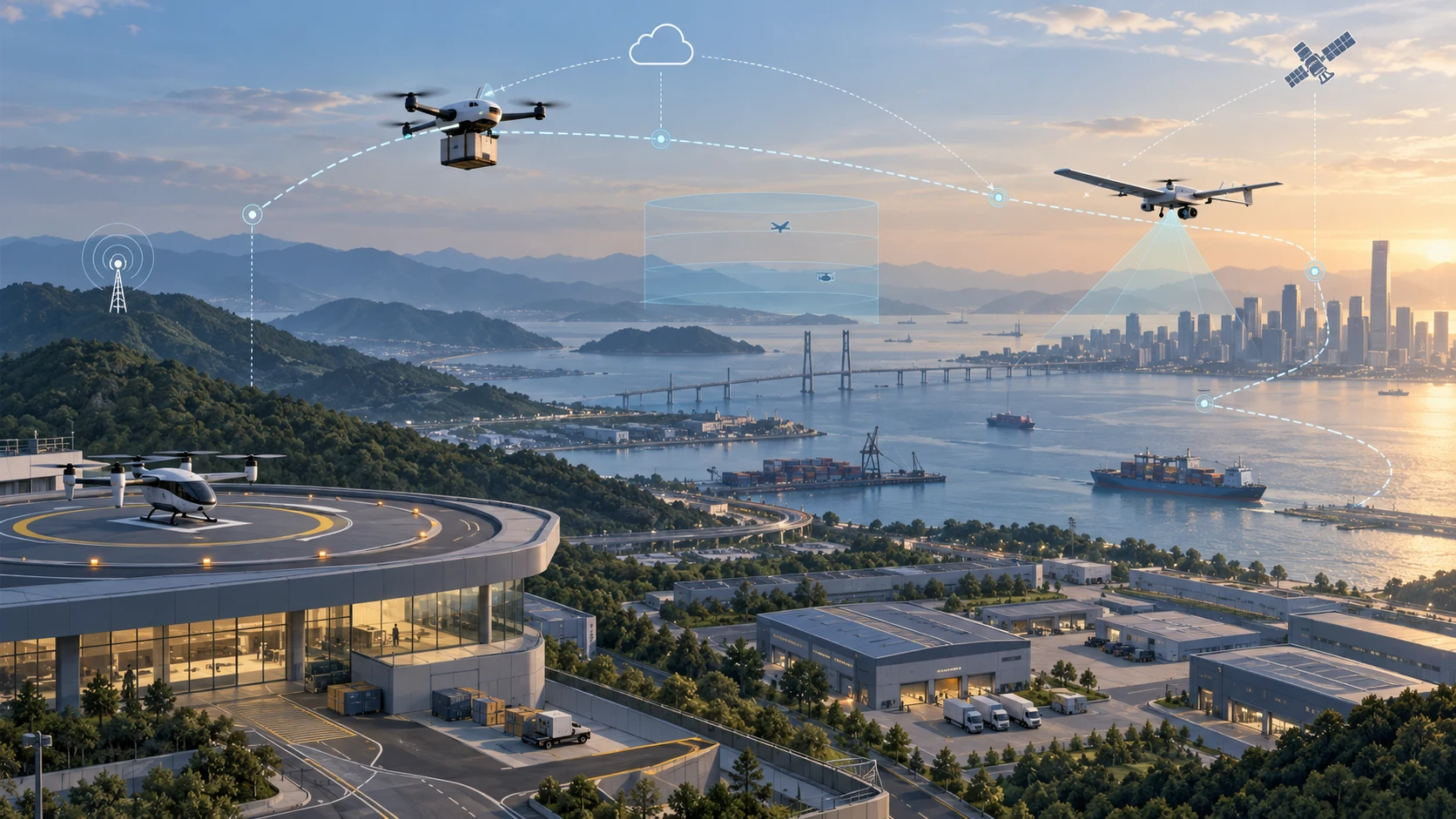
China's low-altitude economy is often pictured as a future of air taxis over city centers. The phrase covers a much wider system. It includes drones used for inspection, agriculture, logistics, emergency response and surveying; general aviation; helicopters; airports and helipads; communication and navigation networks; flight-service platforms; manufacturers; operators; regulators; insurance and maintenance.
The Civil Aviation Administration of China reports that by the end of 2025 China had 3,140 general-aviation aircraft and 513 general-aviation airports. During 2025, registered drones reached 3.287 million and drone flight time reached 45.3029 million hours. There were also 46 low-altitude flight-service stations across 23 provinces and regions.
Those figures show a large and growing base of equipment and activity. They do not prove that passenger eVTOL routes are commercially ready, that all drone operations are profitable or that every city has a functioning low-altitude network. A registered aircraft is not the same as an active aircraft. Flight hours do not reveal revenue, safety performance or the share of operations that are public-service, industrial or recreational.
The broader China Drone Industry: A Four-System Guide (2026) explains the drone and aviation system. This article focuses on the conversion problem: how China can move from many aircraft and operating scenarios to regulated routes, reliable infrastructure and repeatable business models. The related Xiong'an's Commercial-Space Manufacturing Ambition: From One Satellite to a Repeatable Industrial Chain follows a place-based aerospace manufacturing story; the low-altitude economy adds an operations and urban-infrastructure layer.
The central question is: Can China turn low-altitude policy, aircraft manufacturing and digital infrastructure into safe services that customers use repeatedly and operators can finance?
The phrase covers several different industries
Low-altitude economy is not one market. A crop-spraying drone, a power-line inspection drone, a helicopter shuttle and a passenger eVTOL have different aircraft, operators, airspace requirements, customers, insurance and economics.
Unmanned aircraft can be small or large, remotely piloted or increasingly automated, battery-electric or fuel-powered. Their missions may be repetitive and controlled, such as inspecting a pipeline or mapping a construction site. They may also be time-sensitive, such as delivering medical supplies or supporting emergency response.
General aviation includes manned aircraft, helicopters, business aviation, training, tourism, medical rescue and other services. It needs airports, pilots, maintenance organizations and operating approvals. The infrastructure and safety model is closer to aviation than to a consumer electronics platform.
eVTOL aircraft add a future passenger and cargo category. They combine electric propulsion, distributed motors, flight-control software, batteries, vertical takeoff and landing, and a new operating environment near cities. Certification, noise, vertiports, passenger handling, emergency procedures and battery energy limits all matter.
The sectors can share components, digital systems and policy attention, but they cannot share one readiness claim. A thriving drone inspection business is evidence that some low-altitude services work. It is not evidence that an autonomous air taxi can safely carry passengers on a scheduled route.
What has to exist before a route can scale
The first commercial question is not which aircraft looks most advanced. It is whether a route can operate inside a known physical, digital and regulatory environment. The following layers are connected: activity creates demand for service systems, infrastructure makes flights controllable, airspace rules make them predictable, and governance assigns responsibility when something goes wrong.
The first layer is aircraft registration and operating activity
The CAAC's 2025 statistics give the most useful starting point because they separate different indicators. General-aviation aircraft and airports describe one part of the system. Registered drones and flight hours describe another. Low-altitude flight-service stations describe a piece of the infrastructure layer.
The scale of drone registration is important, but it does not by itself establish a manufacturing base or a pool of active operators. It expands the base of registered equipment and the governance workload, creating reasons to improve registration, remote identification, traffic management and safety supervision. It also creates a governance problem: millions of aircraft cannot be managed with only manual approval and local knowledge.
Flight hours are a stronger activity signal than registration. A drone that flies regularly for inspection or logistics is part of an operating system. A drone registered but rarely used may reflect consumer ownership, training, a pilot project or equipment waiting for an approved mission.
The next analytical step is to separate hours by use. Public-service flights, agricultural operations, industrial inspection, mapping, logistics, tourism and emergency response have different revenue and reliability patterns. Aggregated hours show momentum but hide the business composition.
For passenger eVTOL, the equivalent evidence will be stricter. The sector needs certified aircraft, trained pilots or approved autonomy, vertiports, route approvals, maintenance, insurance and passengers paying for repeat service. Registration alone cannot answer those questions.
Infrastructure is more than a landing pad
A low-altitude route needs a physical and digital environment. Physical assets may include airports, helipads, vertiports, charging or refueling, maintenance facilities, weather equipment and emergency access. Digital assets include communications, navigation, surveillance, flight plans, identification, dispatch, weather data and a system for resolving conflicts.
The MIIT's 2026 infrastructure opinion treats communications, sensing and navigation as core low-altitude infrastructure. It sets a 2027 target of at least 90 percent mobile-communication coverage along public low-altitude routes and calls for standards, sensing and navigation support.
That target shows that the network is being planned as a public infrastructure problem. It also shows why a drone route cannot be judged by the aircraft alone. An operator needs a predictable link, a way to know where the aircraft is, a route that other users recognize and a response procedure when the link or navigation signal is degraded.
Mobile coverage can support some operations, but not every mission will use the same communications architecture. A remote inspection route may need satellite or specialized links. Urban operations may use multiple networks and local sensing. The system needs redundancy and clear limits for each operation.
Infrastructure should be evaluated by service quality, not only by the number of bases or towers. Does it provide coverage at the altitude and route needed? Does it support the latency and availability required? Can the operator obtain a flight service? Are incidents recorded and investigated? Can a new operator connect without building a private network from scratch?
Airspace access is the scarce input
Cities have roads, buildings, cranes, cables, airports, emergency helicopters and weather. Low-altitude operations must coexist with these users. Airspace is not an empty layer above the street waiting for vehicles.
An operator needs to know where it can fly, at what height, under what weather conditions and with which approvals. A route may be available for inspection but not for passenger transport. A logistics corridor may have restrictions near an airport or sensitive site. A city may approve a demonstration while leaving permanent route access unresolved.
Airspace management needs a common picture. Operators, regulators and other aircraft users need accurate information about location, identity, status and planned paths. The more autonomous the aircraft, the more important the data and rules become because the system must handle a conflict without relying on a pilot's visual judgment alone.
The CAAC's 2025 policy article describes low-altitude economy as an emerging industry and also warns that management concepts, regulations, service systems and supervision technology need to catch up with development. The policy challenge is that aircraft development can outpace the institutions needed for a safe, repeatable operating environment.
Airspace access becomes a commercial asset when it is predictable. A company can invest in aircraft and training if it knows which routes will remain available and what conditions apply. That predictability is part of the service a customer is paying for.
Governance must coordinate several regulators
Low-altitude operations sit at the intersection of civil aviation, communications, public security, transport, emergency response, industry, local government and sometimes military or sensitive-airspace management. A company can satisfy one authority and still lack the approvals needed for a route.
The CAAC announced a dedicated general-aviation and low-altitude-economy leadership group with work groups covering planning, airworthiness, market regulation, flight operations, service platforms and safety supervision. The structure is evidence that coordination has become an explicit policy task.
A leadership group does not itself create a national commercial market. It can reduce fragmentation, clarify responsibility and identify issues that no single department can solve. The result will depend on standards, data sharing, local execution and the ability to make decisions quickly without lowering safety requirements.
Local governments also have a role. They can provide landing sites, test zones, public-service procurement, industrial parks and demonstration routes. They can coordinate roads, buildings, emergency services and utilities. But city targets can differ, and a route that works under one local system may not transfer easily to another.
The governance test is whether a manufacturer or operator can obtain route approval through a clear process. If every route requires a bespoke negotiation, the market will remain project-based. If standards and platforms become reusable, the market can scale.
Which services can become repeatable routes
Once the operating environment is visible, the next question is where customers will pay for a service often enough to justify it. Public-service work, logistics and tourism differ in urgency, frequency and exposure to passengers and public-safety risk. eVTOL belongs in this comparison because it faces the highest safety and infrastructure burden, not because every drone use case leads directly to air taxis.
Public-service drones are the nearest commercial base
Among the more established low-altitude applications are operational missions rather than glamorous ones. Drones inspect power lines, pipelines, roads, railways, farms, forests, construction sites and coastlines. They can support emergency mapping, firefighting, disaster assessment and medical logistics.
These missions have a clear customer and a measurable task. A utility can compare inspection time, coverage, data quality and labor safety. A road authority can compare response speed and repeatability. An emergency agency can measure whether a drone reaches an area when roads are blocked.
The economics still require discipline. The aircraft may be cheaper than a helicopter but needs operators, batteries, maintenance, data processing and regulatory coordination. A drone can capture images faster than a human, yet an organization still needs software and staff to interpret the data and act on it.
Public procurement can create a stable early market. It can also create dependence on one budget cycle. A service that exists only because a local government funds it may not survive without a contract tied to a recurring operational need.
The Shandong transport authority's regional report describes examples including road inspection, metro inspection, island food delivery and logistics routes, tourism and helipad infrastructure. These are signals of operating activity. They should be evaluated by frequency, whether customers pay repeatedly, safety record and operating continuity rather than by the existence of a pilot announcement.
A recurring contract turns that operating foundation into evidence of a business. It should identify the customer, measurable outcome, operating limits and payment trigger, including what happens when weather or maintenance prevents a flight. That small set of terms lets a public agency compare the service with its existing process and gives an operator a basis for staffing and renewal.
Logistics must solve the last kilometer twice
Drone delivery is often presented as a faster alternative to road transport. The aircraft may move quickly, but the service still needs a warehouse, loading process, route approval, landing point, handoff and customer confirmation. In many cases, the drone solves only the middle part of the trip.
Island, mountain, medical and urgent industrial logistics can have a stronger business case because roads are slow or unreliable and the cargo value is high. Dense urban parcel delivery is harder because landing sites, buildings, privacy, noise and customer availability create friction.
The operator must manage weather and battery limits. A route that works in calm conditions may need a different policy during rain, high wind or heat. A delivery network needs spare aircraft and a recovery plan when a flight is canceled. The cost of a failed delivery can include a second vehicle, a refund, a medical delay or a customer complaint.
Landing infrastructure is another constraint. A rooftop pad may require structural certification, fire controls, access procedures and neighborhood management. A ground site may compete with parking or logistics space. A shared network can improve utilization but requires scheduling and safety rules.
The useful logistics evidence is stable volume, repeated payment and measured service levels. A distinctive bottleneck in many of these routes is the handoff and recovery process after a delay or cancellation, not the aircraft's speed in isolation.
Tourism is visible but hard to scale
Low-altitude tourism can attract attention because passengers understand the experience immediately. Helicopter sightseeing, short scenic flights and future eVTOL tours can create early revenue and public familiarity. They also expose the aircraft and operator to weather, noise, passenger handling and safety expectations.
Tourism demand is seasonal and location-specific. A scenic route may work on weekends or holidays but have low utilization in bad weather. A service may depend on a landmark, resort or event. The operator must price the experience high enough to cover aircraft, pilots, maintenance, insurance and site costs.
Tourism can still be strategically useful. It provides a controlled passenger environment and a way to test booking, check-in, boarding, customer communication and emergency procedures. It can introduce a service before a daily commuter route is possible.
The Shandong report describes low-altitude tourism and recurring aviation services alongside industrial and public-service applications. In my reading, that mix reflects the possibility that early demand will come from several narrower services rather than one universal route.
Tourism's commercial case depends on recurring, insured, staffed and regulated service; a one-time event flight says little about the route's long-term economics.
eVTOL faces a higher proof threshold
eVTOL aircraft combine several difficult systems: electric propulsion, batteries, distributed motors, flight controls, vertical takeoff and landing, navigation, noise management and emergency procedures. A passenger service adds the safety expectations of commercial aviation and the public visibility of urban transport.
The technology may be promising, but the route to operation is long. A manufacturer must define the aircraft's operating envelope, test failure modes, demonstrate battery and motor performance, verify software and obtain certification. An operator must train crews or operate under an approved autonomy system, maintain the aircraft and manage passengers.
Vertiports need more than a marked landing area. They need approach and departure procedures, passenger access, fire response, charging or energy management, weather information, maintenance and integration with the surrounding city. A rooftop site may be convenient but may also create noise, evacuation and structural questions.
An eVTOL route needs a schedule that survives weather and maintenance. If a service is canceled often where road or rail alternatives exist, passengers may return to them. If the aircraft must carry a large reserve for safety, the available payload and range may be lower than the marketing image suggests.
The CAAC's policy framing places eVTOL within a broader low-altitude transformation while identifying governance and safety gaps. The policy direction is active, but substantial operational work remains. Certification and route economics therefore matter more than a prototype flight.
These use cases also create different manufacturing and operating requirements. An inspection fleet values uptime, sensor integration and data processing. Island or medical logistics values payload, weather tolerance, handoff speed and a recovery plan. Tourism values passenger handling, booking and seasonal utilization. eVTOL adds certification, energy reserves, vertiport integration and public acceptance. A supplier that treats all four as the same aircraft market will miss where the real bottleneck sits: sometimes in the vehicle, sometimes in the route, and often in the service organization around it.
How local pilot projects can scale into a market
Paid routes still depend on local institutions and shared systems. The bottleneck may sit in the aircraft, route, operator, platform or allocation of risk, depending on the application. A city decides where flights are useful, a manufacturing cluster supplies and tests aircraft, and contracts and insurance determine who carries responsibility. The scaling task is to make those arrangements portable across corridors and attractive to outside capital.
City plans reveal the required ecosystem
Cities are useful laboratories because low-altitude services are local. The aircraft flies through a city's buildings, roads, population, weather, communications and emergency system. A city plan can reveal whether officials understand the ecosystem beyond an aircraft factory.
Hangzhou's low-altitude economy plan includes drones, unmanned helicopters and eVTOL, along with key components, control systems, sensors, communications, navigation, landing facilities and test fields. On paper, the plan links manufacturing categories with operating facilities; it does not show that an integrated network is already running.
A city can support the sector by providing test zones, public-service demand, data platforms, landing sites, technical standards and financing. It can also identify where flights are useful: hospitals, ports, islands, industrial parks, emergency sites or tourism corridors.
City plans still need a delivery mechanism. Which agency owns the route? Who pays for infrastructure? Which operator is responsible for safety? How are residents informed? What happens when a route crosses district boundaries? What metric decides whether a pilot becomes permanent?
Plans become credible when they assign an owner, funding mechanism and decision rule for turning a proposed facility or pilot into a service. A list of intended facilities shows an intention; delivery arrangements determine whether it becomes an operating capability.
Industrial clusters can accelerate learning
Low-altitude manufacturing benefits from clusters because the product is multidisciplinary. Airframes, motors, batteries, avionics, sensors, communications, software, composite materials and maintenance need to interact. A city or region with suppliers, universities, test facilities and customers can shorten the feedback loop.
The cluster also needs a place to test. Aircraft cannot be validated only in a factory. They need controlled airspace, weather data, emergency response, maintenance staff and a regulator able to observe operations. Test facilities become shared infrastructure when several companies use them.
The risk is duplication. Many cities may announce industrial parks with similar goals while demand and test capacity remain limited in some regions. An industrial park with empty buildings is not an ecosystem. The stronger cluster has operating customers, component qualification, flight records, service companies and a path from test to certification.
The connection with commercial space is instructive. Manufacturing clusters need launch or flight operations, supply chains and regulatory infrastructure. Low-altitude systems operate closer to populated areas and therefore require more local coordination with cities. The industrial logic is similar, but the safety and service problem is different.
Clusters should be judged by transactions and operations: supplier contracts, certified components, repeated test hours, fleet maintenance, route revenue and export orders. Headcount and planned floor area are weaker early indicators.
Communications and autonomy change the safety model
Remote piloting depends on communications, while higher autonomy depends on sensors, software and a reliable understanding of the environment. For a manufacturer, the practical question is whether the aircraft has defined behavior when links, navigation or perception degrade. For an operator, it is whether those behaviors can be tested, supervised and explained to a regulator.
The MIIT infrastructure opinion links communications, sensing and navigation to low-altitude infrastructure, but its 90 percent public-route coverage target remains a target. Coverage alone does not establish the availability, latency, integrity or security required for every aircraft. A test on a defined route therefore says little about general urban autonomy.
The safety case must connect aircraft design, operating rules, infrastructure performance, human supervision and emergency response. A smart aircraft still operates in a physical city.
Insurance and liability determine commercial readiness
When an aircraft flies over people, goods or infrastructure, a failure can create financial and legal consequences. Insurance needs data on aircraft reliability, operator training, route risk, weather and maintenance. Early operations may have limited statistical history, making premiums and coverage difficult to price.
Liability must also be clear. If a drone delivery misses a route, responsibility may involve the operator, manufacturer, software provider, communications network or customer. If a passenger eVTOL service is delayed or makes an emergency landing, the operator needs a process for passengers and regulators.
A mature market needs incident reporting, investigation, maintenance records and claims handling. Operators can use the data to improve routes and procedures. Insurers can price risk more accurately. Regulators can identify recurring hazards.
The absence of visible incidents does not prove safety if reporting is incomplete. The presence of a test accident does not prove that the sector is unsafe if the investigation improves the design and rules. Commercial readiness depends on transparent learning.
Insurance is often ignored in future-market forecasts because it is not as visible as aircraft orders. It can nevertheless become a gating condition for a route and for a customer's contract.
Platform economics matter more than vehicle sales
Selling an aircraft creates a one-time transaction. Operating a low-altitude service requires a continuing platform: flight planning, traffic information, weather, maintenance, data processing, customer scheduling, billing and incident management. The platform may be operated by the aircraft maker, a specialist company, a city-owned entity or a partnership.
The platform can create recurring revenue if customers pay for a useful outcome. A utility may pay for inspected assets rather than flight time. A hospital may pay for guaranteed medical delivery. A tourism operator may pay for seat capacity and booking support. A city may procure emergency readiness rather than ordinary daily flights.
This changes the competitive landscape. A company with an excellent aircraft but weak operations may lose to a company with a simpler aircraft and a better service network. The aircraft maker needs to decide whether it wants to sell equipment, operate routes, license software or combine those roles.
Platform economics also create a data advantage. Repeated flights generate information about weather, battery use, maintenance, route obstacles and customer timing. That data can improve operations, but it also needs governance and secure sharing. A platform that cannot turn flight records into better service will not justify its operating cost.
For manufacturers, this creates a feedback loop beyond the factory. Route data can reveal which components fail in local weather, which payloads justify a larger aircraft and which maintenance tasks delay a customer. Operators can turn those records into service-level commitments, while cities can use them to decide whether a corridor deserves more infrastructure. The value appears when the information changes the next purchase, schedule or operating procedure.
A sign that the low-altitude economy is maturing will be customers buying dependable outcomes. Vehicle deliveries are early signals; recurring contracts and service margins show whether the platform is working.
Cities need to choose high-value corridors
Not every city should begin with passenger air taxis. A practical low-altitude plan starts with corridors where the benefit is visible and the operating environment can be controlled. Islands, rivers, mountains, large industrial sites, ports and emergency routes may be easier to manage than dense downtown airspace.
A corridor should have a defined origin, destination, altitude, schedule, aircraft, operator, customer and contingency plan. It should identify where the vehicle lands, how energy is replenished, who responds to an incident and how the service interacts with existing transport.
The strongest early routes tend to solve a costly problem. An inspection route can replace dangerous climbing or long travel. A medical route can reduce the time to move a sample or medicine. A mountain or island route can connect communities where road travel is slow. A tourism route can monetize a unique view while building passenger procedures.
Urban commuting is a harder first use case because it requires many routes, frequent departures, reliable weather performance and public acceptance. The service must compete with trains, cars and buses on total journey time and price, including travel to the vertiport.
City governments should measure whether a corridor remains busy, safe and financially supported over time, using launch events only as context.
Data governance is part of public acceptance
Low-altitude aircraft collect and transmit data. Cameras, lidar, microphones, navigation systems and inspection sensors can observe buildings, roads, farms, factories and people. A city needs rules about what is collected, why it is collected, how long it is stored and who can access it.
Public trust is a safety input. Residents may accept an emergency drone while objecting to an unidentified aircraft hovering over a home. Businesses may allow inspection while restricting the use of images outside the contracted purpose. Passengers may expect the operator to protect booking and travel data.
Operators should provide clear identification and complaint channels. They need procedures for mistaken observations, data leaks and requests from authorities. A technical ability to collect information is not permission to use it without limits.
Data standards also affect competition. If every city uses a closed platform, operators may need separate integrations and customers cannot move their records. Common interfaces can help aircraft, operators and service providers work across regions while preserving security.
The low-altitude economy sits above homes and workplaces. Its long-term scale will depend on whether residents see a useful service with understandable rules rather than an invisible surveillance network.
Manufacturing and operating companies play different roles
Aircraft manufacturers tend to focus on design, production, certification and product support. Operators focus on routes, schedules, customers, pilots, maintenance and incident response. A city or platform company may focus on infrastructure and airspace coordination. These roles can be combined, but they do not have to be.
A manufacturer that runs its own service gains operating knowledge and customer feedback. It also takes on route risk, staffing, insurance and local coordination. A specialist operator may understand the customer better but depend on several aircraft suppliers. A city-owned platform may provide public infrastructure while private companies compete on service.
Clear responsibility is essential when an operation fails. The aircraft maker should not be able to blame the operator for every technical problem. The operator should not blame the platform for an unsafe procedure. The infrastructure provider needs to define what its coverage and data service guarantee.
Procurement contracts should define service levels, maintenance response, data ownership, training, insurance and termination. A low purchase price can be misleading if the customer must build the entire operating organization afterward.
A mature ecosystem is likely to contain specialists and integrators. The critical evidence is not who uses the word “platform,” but whether the operating roles are clear enough for a customer to buy a dependable service.
National scale requires interoperable rules
China's cities can test different applications, but manufacturers and operators gain more scale when a qualified aircraft, maintenance record and operating procedure have a path from one corridor to another. Interoperability means that core data, identification, emergency procedures and authorization categories are understandable across systems; it does not mean every city has identical geography or routes.
The CAAC's coordinated leadership structure and the MIIT infrastructure opinion point toward this need. One city may be better for island logistics, another for industrial inspection and another for passenger tourism. The useful output is a reusable procedure with clearly marked local parameters. Without that portability, each new route remains a bespoke project and each manufacturer designs for a smaller addressable market.
Capital should follow operating evidence
Low-altitude projects can attract investment because the technology combines aviation, batteries, software and urban infrastructure. Capital can fund prototypes, factories, landing sites and platforms before revenue is proven. That is useful for innovation, but it also makes announced investment a weak substitute for operating evidence.
Investors should separate development capital from fleet capital and route capital. A prototype company needs money for testing and certification. A manufacturer needs money for tooling and production. An operator needs money for aircraft, staff, insurance and working capital. A city needs money for sites, networks and safety systems. The returns and risks differ at each stage.
The strongest projects release capital against milestones: a defined capability, the approval for a limited route, a paid contract and repeat utilization. This sequence protects customers and prevents a large facility from being built around an unproven service.
Public procurement can reduce early risk, but it should include performance requirements and renewal criteria. Private customers can provide stronger evidence when they pay repeatedly for a measurable result. The sector will have stronger foundations when investment follows reliable operation rather than the other way around.
What evidence would show a functioning low-altitude economy?
The useful test is a chain rather than a single headline: a named customer pays for a measurable outcome on a defined route; the aircraft, airspace, infrastructure and operator have the approvals and contingency procedures that make the service repeatable; and the economics include labor, energy, maintenance, insurance, sites, software and compliance. A subsidy can start a service, but a durable market needs a path beyond the pilot budget.
A further test is portability across cities. A route that works in one city should be adaptable to another because its standards, data interfaces, maintenance records and operating procedures are reusable. Passenger services still require a higher certification and safety threshold than industrial drones. These tests separate a real industrial opportunity from a collection of impressive demonstrations.
What the evidence shows now
China already has a substantial base of registered drones, flight activity, general aviation, service stations, industrial applications and local plans. That is evidence of equipment, policy attention and several operating scenarios. It is not evidence of one national market with common economics, universal route coverage or commercially ready passenger eVTOL.
The most plausible near-term opportunities described here are inspection, mapping, agriculture, emergency response, industrial logistics and selected tourism. These uses can create flight hours, data, maintenance experience and customer contracts. Passenger eVTOL may become a major future category, but it must pass a higher threshold for certification, public safety, infrastructure, economics and public acceptance.
The industrial bet is that China can connect aircraft manufacturing with communications, navigation, airspace management, operators, insurance, customer contracts and city infrastructure. The evidence to watch is practical: maintenance records, insurance renewals, repeat contracts, trained operators and a city that expands a route without rebuilding the system. Together, those signals would show that the operating model is becoming repeatable.
The near-term path is to make the strongest existing industrial and public-service routes more frequent, measurable and transferable before treating passenger air taxis as the sector's defining product. When customers buy an outcome, operators manage a fleet and regulators oversee a known risk, manufacturers can improve products through use. Repeated safe operation provides a stronger basis for investment.