

By China Made & Tech Team · Updated 31 August 2026
An aircraft that can fly a mission is not necessarily an aircraft a team can keep flying after its first damaged gimbal, ageing battery, failed controller, or software-support cutoff. That is the practical question behind an Autel Robotics service and spare-parts search. It is not answered by finding a dot on a repair-centre map.
Autel publishes a Global Repair Center page, distinguishes “Official Service” from “Authorised Repair,” and maintains support contacts. That establishes that a service route may exist. It does not publish the facts that determine a fleet’s downtime: whether a named model and serial number are accepted in the buyer’s country, who owns the repair obligation, whether a part is on hand, whether a replacement unit is available, or when the unit will return.Autel’s Global Repair Center
The useful buying judgment is therefore simple: treat an Autel service network as a conditional evidence chain, not as a brand attribute. Before a drone becomes operationally important, the buyer should be able to join nine things in writing: aircraft model, serial number, country of sale, contracting seller, warranty version, authorised repair provider, parts route, target turnaround, and escalation owner.
This is a desk-research service file, not a test of Autel support, a warranty interpretation, or a recommendation to buy from any seller.
Quick answer: a repair-centre page is a lead, not a service-level agreement
The word “network” can conceal several different arrangements. A manufacturer may operate a central repair site, nominate a local authorised provider, ask a dealer to receive the aircraft, or offer a replacement programme whose geographic coverage is tied to the version originally sold. All can appear under the heading of after-sales support. They have very different consequences for a drone that must be back in the air for an inspection, mapping, public-safety, or asset-management schedule.
Autel’s public material gives useful starting points. The Global Repair Center page presents support categories, while its Care and warranty pages describe parts of a repair or replacement process. None of those pages is a quote for a particular aircraft.
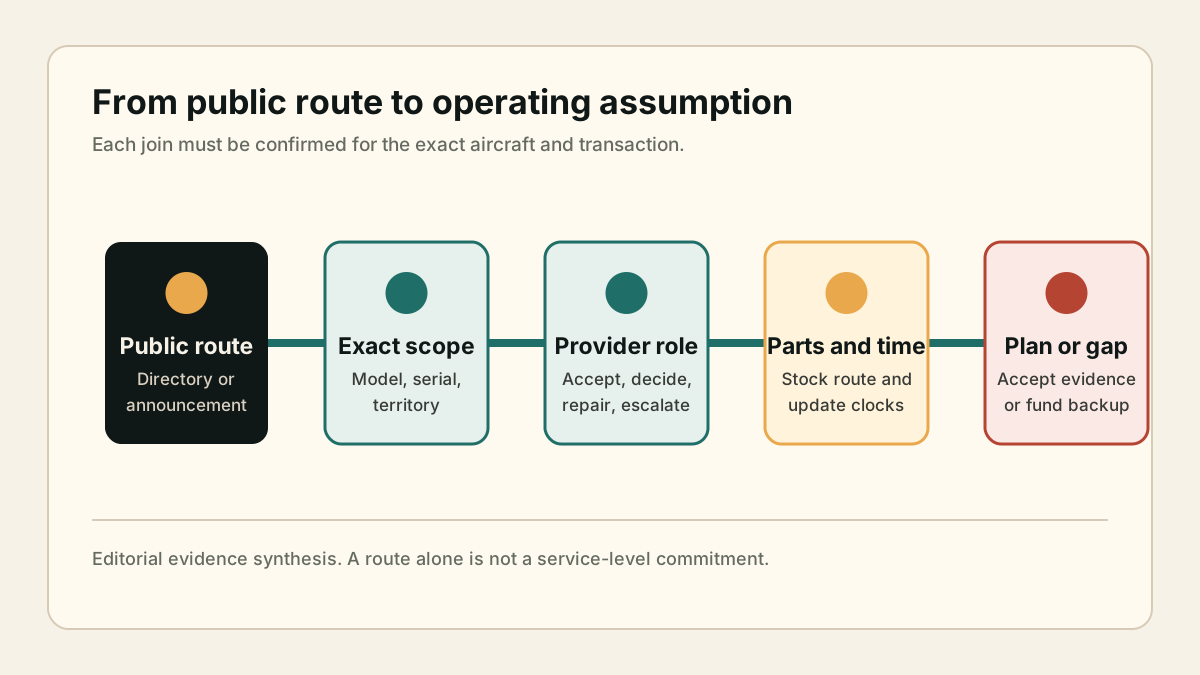
That distinction matters because public support pages are designed to route a case. A fleet manager needs to allocate risk. The first question is not “Is there a repair centre?” It is: who will accept this exact serial-numbered aircraft in this jurisdiction, under which terms, with which parts, and on what timetable?
For a small recreational purchase, an uncertain answer might be inconvenient. For a fleet, it changes the required spare-aircraft pool, the maintenance budget, insurance planning, and the commercial value of a local distributor.
Start with the route, then identify who is making each promise
Autel’s service pages should be read as manufacturer claims. A partner page should be read as a partner claim. A seller’s invoice and contract define a different commercial relationship again. Keeping those layers separate prevents a common error: converting a public announcement into a warranty obligation owed to a buyer who purchased elsewhere.
The Mexico hub is a documented route—not a regional performance result
On March 9, 2026, Autel announced an authorised repair and service centre in Mexico through a partnership with Tecnodron. The announcement identifies enterprise-focused coverage including Autel Alpha, the EVO Max series, EVO Lite Enterprise, EVO II V3, EVO Nest, and Dragonfish. It says the centre is intended to reduce cross-border shipping friction for Mexico and neighbouring customers, and describes technicians and genuine-parts use as part of the company’s offering.Autel’s Mexico service-hub announcement
Tecnodron separately says that it is an official Autel Robotics distributor in Mexico and describes an authorised repair centre offering diagnosis, corrective maintenance, and original spare parts.Tecnodron’s company description
Those two records are valuable because they name a current route and let a buyer start a serious conversation. They do not provide a current queue length, parts inventory, price list, repair-completion rate, service territory, or contractual turnaround target. Nor do they establish that every Autel aircraft, every country of purchase, or every warranty plan is eligible for that route.
The practical request is narrower than “Do you service Autel?” Ask the provider to confirm, in the same reply:
- the exact aircraft, payload, controller, and battery part numbers it will accept;
- the serial-number and country-of-sale eligibility it has checked;
- whether it acts as the warranty decision-maker, a diagnostics/repair provider, a logistics receiver, or only a channel coordinator;
- whether the necessary parts are in stock, orderable, or subject to a supplier lead time;
- who pays outbound and return shipping, duties, insurance, and any diagnostic charge;
- the target turnaround and the escalation contact if that target is missed.
If those answers are unavailable before a purchase decision, the service route is not necessarily bad. It is simply unresolved. The fleet should budget for the unresolved risk rather than call it local support.
A directory is not a substitute for a serial-number check
Autel’s Global Repair Center page visibly separates “Official Service” and “Authorised Repair.” That is a useful taxonomy, but it does not publicly expose an auditable list of capacity, stock, or eligibility for every location in the accessible text. The safe interpretation is that the page can tell a buyer where to begin—not whether the next service event will be local or timely.Autel’s Global Repair Center
This is especially important when the aircraft was sourced through a reseller, transferred between regions, bought as surplus, or bundled with a service plan that was sold for a different market. The support answer can change with the version, account, proof of purchase, coverage package, and product lifecycle, even when the hardware looks identical.
The terms matter more than the word “warranty”
A warranty page is often read as proof that repairs will be free and local. The public terms are more conditional than that.
Autel’s retail warranty-and-repairs page describes a sequence: the customer contacts support, Autel reviews warranty eligibility, an authorisation is issued if eligible, the customer sends the product, and Autel repairs or replaces it. The same page says service time depends on the nature of the issue and the availability of service parts.Autel’s published warranty and repair process
That sentence about parts availability is not a negative finding about Autel. It is a reminder that “repairable” and “repaired by a particular date” are different commercial statements. Any manufacturer’s route can be constrained by a component, shipping lane, diagnostic finding, seasonal demand, or decision about repair versus replacement. A public process page is not where those variables become commitments.
Autel Care terms add a second boundary. They state that replacement service is available only in the country or region corresponding to the purchased version. The terms also say that, outside that service area, the customer may bear the one-way shipping, taxes, and other unagreed charges, and that the company may refuse replacement service if the stated conditions are not met.Autel Care Terms of Service
The precise plan, product, and market still need checking. But the operational lesson is general: country of operation is not enough; country and version of purchase can matter as well. A distributor’s claim that it can assist is useful, yet it should not be assumed to override the plan terms or warranty decision for an aircraft it did not sell.
Keep warranty, accidental cover, paid repair, and parts supply in different columns
Teams frequently collapse four separate questions into one:
| Question | What it asks | Evidence to request |
|---|---|---|
| Warranty | Is this defect eligible under the applicable limited warranty? | Warranty version, proof-of-purchase rule, serial eligibility, written case reference |
| Accidental cover | Does a plan cover this event and this region? | Plan certificate, service-area clause, remaining-use record, incident requirements |
| Paid repair | Can the provider diagnose and repair the unit if coverage is denied? | Diagnostic fee, repair quote process, payment terms, shipment responsibilities |
| Parts continuity | Can a specified component be supplied within the mission window? | Part number, stock/lead-time statement, substitute policy, price and warranty for the part |
Lifecycle status is part of the spare-parts question
The service route must also be read alongside product lifecycle. Autel’s UAV Product Lifecycle Management Policy defines End of Support as termination of services related to a product, including version updates and fixes, technical assistance, and after-sales repair, subject to stated critical-security and legal/regulatory exceptions.Autel’s UAV lifecycle policy
That definition makes lifecycle a live operating variable. It does not mean every older aircraft is immediately unsupported, and it does not supply an end-of-support date for a buyer’s individual serial number. It does mean that a purchase file should ask for the current lifecycle notice for the exact product family before a fleet assumes a parts route will remain open for its planned operating horizon.
For a mission-critical fleet, record at least these dates:
- purchase date and country/version of sale;
- activation or warranty-start date under the applicable terms;
- service-plan expiration date, if any;
- last date a provider confirms it will accept the model;
- last date a supplier confirms availability for critical part numbers;
- the manufacturer’s current end-of-sale, end-of-maintenance, end-of-full-service, and end-of-support dates where published.
The point is not to convert every aircraft into a compliance spreadsheet. It is to prevent a support plan from being built around a product family after the supporting commercial conditions have moved.
What public pages cannot prove
The most important service facts are often not public. A web page normally cannot tell a buyer whether the next repair will be completed in three days or three weeks, whether a specific gimbal is in stock, whether a local provider can handle a particular payload configuration, or whether a transferred unit retains coverage.
One dated forum discussion from Australia illustrates the reason for this discipline. In January 2021, a user reported being told that no authorised repair facility was then available locally. This is not evidence about Autel’s current network, Australia today, or overall service quality. It is an old, unaudited, country-specific account. Its only value is methodological: availability claims age quickly, and a historical search result cannot replace a current, written confirmation.the dated AutelPilots discussion
The same caution applies to positive evidence. A 2026 Mexico-hub announcement should not be stretched into a universal Latin American SLA. A warranty page should not be stretched into a parts-inventory promise. A local retailer’s support offer should not be stretched into manufacturer authorisation. The buyer is not being difficult by asking for the join; the join is what turns support marketing into operational planning.
Build an Autel operating-continuity file before the purchase order
The following file is deliberately practical. It does not score Autel against any other brand. It records the evidence a buyer needs to decide whether the service route is adequate for a specified operating plan.
1. Aircraft identity
Record the exact model, aircraft serial number, controller, payload, batteries, charging equipment, firmware branch if relevant, and purchase version. “EVO” or “enterprise drone” is not specific enough for a parts or lifecycle decision.
2. Commercial counterparty
Keep the seller’s legal name, invoice, order number, country of sale, and warranty document together. If a reseller says that support will be coordinated locally, ask whether it is the contractual warranty counterparty or only a point of contact.
3. Service-plan boundary
Attach the actual plan terms rather than a product-page summary. Mark the coverage territory, start date, event limits, exclusions, return requirements, and charges that move to the customer outside the service area.
4. Repair-provider authority
Ask the named provider to state whether it is authorised to diagnose, repair, replace, process warranty requests, obtain genuine parts, and perform work on the exact configuration. The answer should include a dated contact and a case/escalation path—not merely a logo on a dealer page.
5. Parts route
Identify the few parts that could ground the mission: batteries, propellers, gimbal/camera assembly, landing or airframe components, controller, charging equipment, payload connection, and any device that is serial-bound or software-paired. For each, request an availability status, order route, expected lead-time category, and substitute policy.
6. Turnaround and replacement
Ask for a target turnaround, how it is measured, what begins the clock, and what happens if a part is not available. If an aircraft is business-critical, ask whether a loaner, replacement unit, or buyer-owned spare is part of the plan. A replacement promise is only useful when the buyer knows the model equivalence, configuration work, account transfer, and commercial condition attached to it.
7. Shipping, customs, and damage handoff
Document who arranges the shipment, bears shipping and insurance, owns the aircraft in transit, handles cross-border paperwork, and assesses transport damage. The Care terms make clear that geographic conditions can change costs; the exact route should be agreed before the first incident, not discovered after it.Autel Care’s service-area terms
8. Service-case record and escalation
Set a written incident path before an aircraft is down. Record the contact channel, case-reference format, initial fault description, condition-on-handover record, quotation approval point, target update cadence, and the person who can authorise an alternative route if the first provider cannot accept the job. This is not paperwork for its own sake. It stops a logistics receiver, dealer, repair provider, and warranty administrator from each assuming another party owns the next step.
The record should distinguish three clocks: the time to acknowledge a request, the time to decide eligibility or issue a quotation, and the time from authorisation to return shipment. A provider may be able to answer one of those questions but not the others. Treat an answer such as “we usually repair these quickly” as a useful lead for a conversation, not as a planning assumption.
9. Lifecycle and exit plan
Record the current lifecycle status, expected fleet retirement date, minimum parts buffer, and the trigger for a replacement programme. The right time to design an exit is while the route is still operating—not after an end-of-support notice or a parts constraint turns it into an emergency.
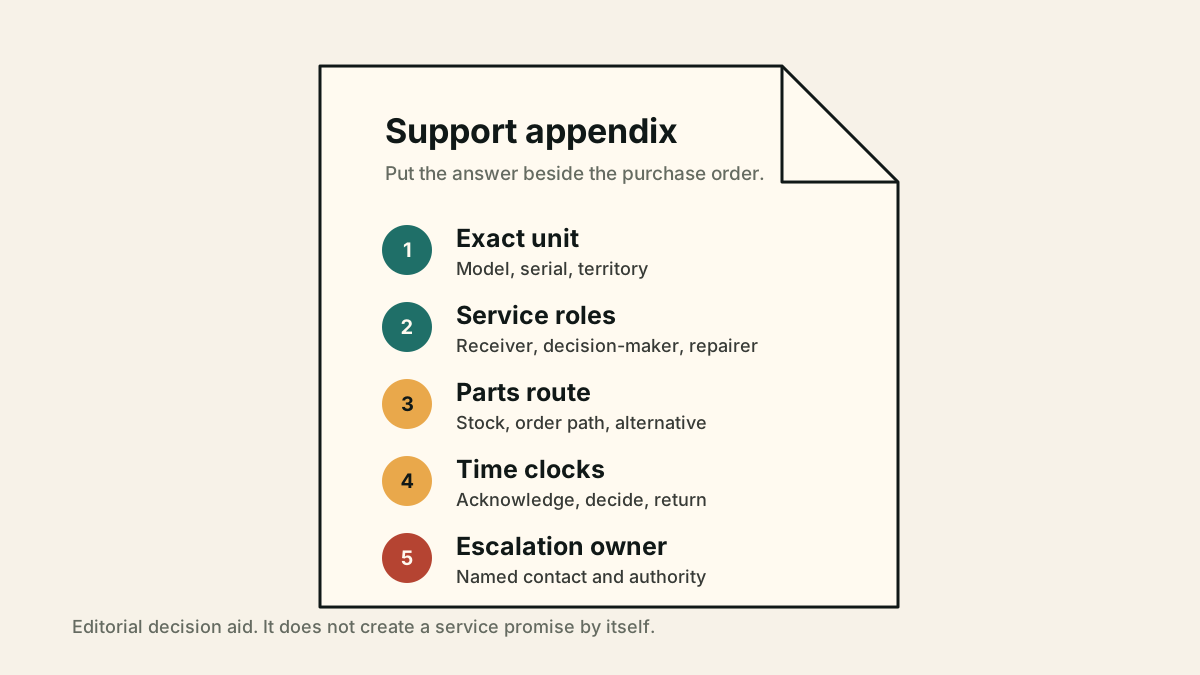
Turn a support reply into a usable contract appendix
A good pre-sale support reply has a clear owner, a bounded scope, and a date. A weak reply may be perfectly honest, but it leaves the buyer unable to decide what downtime it is accepting. The table below is a way to convert a broad “yes, we provide support” statement into operational evidence without requiring a provider to predict every possible repair.
| Question to put in writing | Decision-ready answer | What remains unresolved if the answer is vague |
|---|---|---|
| Which units are covered? | Exact model, controller, payload, battery and serial-number eligibility; country/version of sale. | Whether the route applies to the fleet actually being purchased. |
| Who receives the case? | Named provider, contact route, roles in diagnosis, warranty approval and physical repair. | Whether the buyer is dealing with a repairer, a dealer, or only a forwarding contact. |
| What happens when coverage is disputed? | Initial evidence required, decision maker, quotation path, and escalation contact. | Who can approve work and when a paid repair becomes necessary. |
| What parts may delay the job? | Critical part numbers, stock status or order route, and the condition for an alternative or replacement. | Whether a technically repairable aircraft can return during the mission window. |
| When does each clock start? | Acknowledgement, diagnostic decision, repair/replacement, and return-shipment targets or reporting cadence. | Whether “turnaround” includes shipping, waiting for authorisation, or only bench work. |
| Who carries transport responsibility? | Dispatch point, packaging requirement, insurance, carrier, customs owner, and damage-at-handover process. | Whether an apparently local repair still creates a cross-border delay or cost. |
| When does support cease? | Current model-specific lifecycle notice and a notice/escalation route for changes. | Whether the planned operating horizon runs past the support assumption. |
The buyer should also make sure the reply is tied to the commercial transaction. A helpful email from a regional contact is not necessarily incorporated into the purchase order. Ask which statement becomes part of the seller’s obligation, which is a manufacturer policy reference, and which is merely a point of contact. If the fleet is buying through one company but expecting service from another, the purchase order should name the handoff and the escalation path between them.
Use a small scenario test before relying on a route
Before placing a fleet order, run one hypothetical service event through the proposed path. The exercise takes little time and reveals where nouns such as “support,” “warranty,” and “local service” are doing too much work.
- Name a realistic fault, such as a damaged gimbal, a controller failure, or a battery that will not charge.
- Identify the exact unit and purchase territory involved.
- Ask who receives the request and how the case is acknowledged.
- Ask where the aircraft is sent, who arranges the shipment, and what evidence must travel with it.
- Ask who determines warranty eligibility and when a paid quotation can begin.
- Ask which parts are likely to govern the repair path and when their availability is checked.
- Ask what update the fleet receives if the provider cannot accept the unit or cannot obtain the required component.
- Ask who has authority to offer a replacement, loaner, or alternative repair route.
- Record the owner who can escalate if the stated process stalls.
The output is not a prediction of how long that particular fault will take. It is a map of the commitments that exist before a fault happens. If the provider can answer the scenario with named responsibilities and written boundaries, the buyer has a usable starting point. If the answer repeatedly falls back to “contact us when it happens,” the buyer should not count the route as a quantified resilience measure.
Plan for uncertainty instead of importing it into the mission schedule
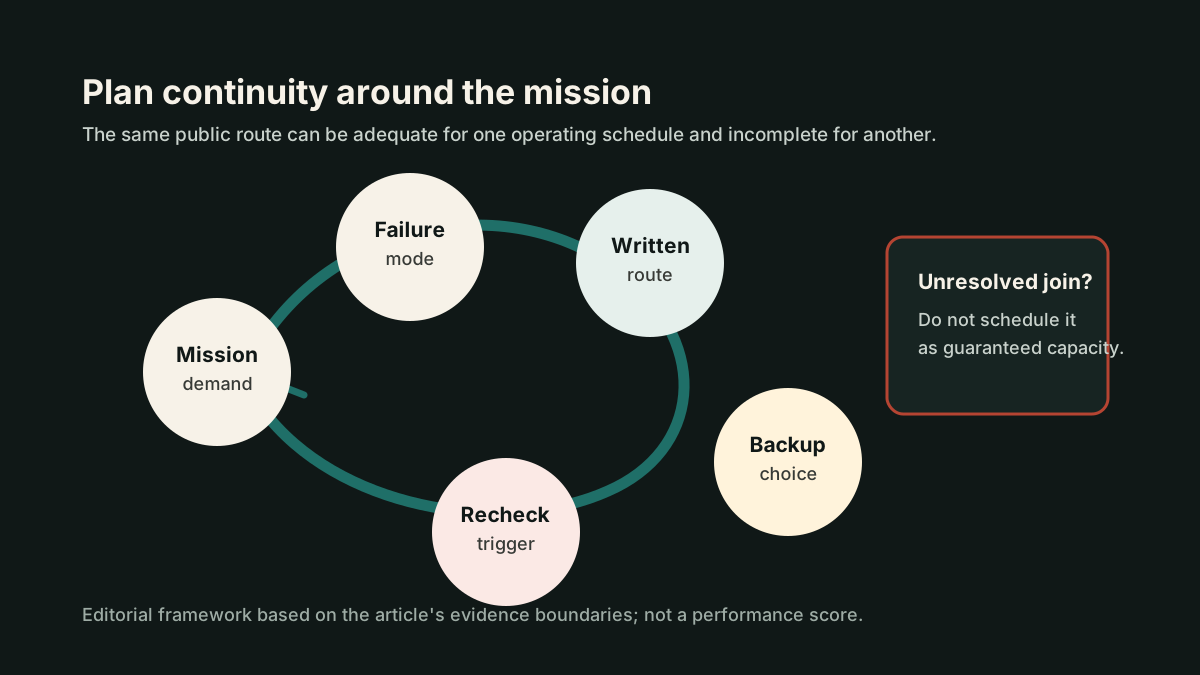
There is no universal number of spare drones or spare parts that suits every Autel deployment. A short mapping project and a year-round inspection programme expose different downtime. The useful planning question is therefore not “Does the brand have support?” but “What interruption can this operation tolerate while the service file is incomplete?”
Start with the mission. Identify the minimum number of aircraft and critical accessories that must be available for the next scheduled work period. Then list the single failures that could remove that capacity: an aircraft, controller, battery set, payload, charging unit, or an approval needed before repair begins. Finally, compare those dependencies with the written support route. A route that contains no replacement option or parts commitment may still work for a low-urgency mission; it may be inadequate for an operation that cannot reschedule.
This framing avoids an unhelpful binary judgment. Public records can show that Autel identifies support channels and publishes particular terms. They cannot produce a fleet-specific resilience score because the missing facts—model eligibility, provider capacity, transport, parts, commercial terms, and mission tolerance—belong to the individual transaction. The buyer’s job is to make those facts explicit, then choose a contingency proportionate to the remaining uncertainty.
Recheck the file when any of its joins change: a different country of purchase, a new reseller, a model revision, a lapsed plan, a newly critical payload, a lifecycle notice, or an updated provider contact. The date on the evidence matters as much as the evidence itself. A support route that was reasonable at procurement can become incomplete later without any of the public pages having been misleading at the time.
Frequently asked questions
Does Autel have a global repair network?
Autel publicly labels a Global Repair Center and separates official-service and authorised-repair categories. That establishes a support starting point, not a published global service level. Confirm an exact model, serial number, country, provider authority, parts route, and turnaround before relying on it operationally.
Can I get Autel spare parts locally?
Public pages and partner descriptions can identify possible local routes, including the announced Mexico hub. They do not publish an auditable, real-time stock list for every component. Request the named part number, availability status, route, and lead-time commitment from the provider that will handle the case.
Does Autel Care work in another country?
Autel’s Care terms state that replacement service is tied to the country or region corresponding to the purchased version, with stated out-of-area charges and conditions. Check the exact plan and version before moving an aircraft or assuming overseas cover.
How long does an Autel repair take?
Autel’s warranty page says timing depends on the issue and the availability of service parts. It does not publish a universal repair-time promise. A fleet should seek a written target, escalation path, and replacement/loaner plan for its own model and location.
Is an older Autel drone still repairable?
Do not infer this from age alone. Check the current lifecycle status and ask the repair provider about the exact model and part numbers. Autel’s lifecycle policy defines End of Support to include after-sales repair, making lifecycle evidence part of the support decision.
Method and limitations
This article reviewed public Autel service, warranty, Care, lifecycle, and Mexico-hub materials, plus Tecnodron’s own description of its role and one dated community report used only as a limitation example. It did not test an aircraft, open a repair ticket, verify a dealer agreement, inspect parts inventory, or measure turnaround. Public service information can change. The final authority for a purchase or deployment is the current written response and agreement for the exact aircraft and territory.