

By China Made & Tech Team
AI-generated editorial illustration. It depicts no real Autel aircraft, customer, deployment, data system or government finding.
“DJI alternative” is a useful search phrase and a poor procurement decision. It turns a company, a named aircraft, a support promise, a data path, a seller, and a policy question into one short label. That shortcut is especially risky with Autel Robotics because public sources do establish important facts—but not all of the facts an enterprise, public-sector, or regulated buyer needs to approve a deployment.
Autel’s own materials identify Autel Robotics Co., Ltd. as a Shenzhen-headquartered company founded in 2014 and focused on civil UAV research, design, manufacturing, and sales. Its Chinese operating name is 深圳市道通智能航空技术股份有限公司. Autel’s public company page is the direct source for that description. That makes Autel a real protagonist in China’s drone ecosystem, not a generic label on a marketplace listing.
It does not make every Autel aircraft interchangeable with DJI, nor does it make the brand a pre-approved substitute for a particular mission. The useful buyer question is narrower: which counterparty, product lifecycle, operating dependencies, and applicable policy records can we prove for this deployment? The answer changes by model, region, customer, use case, reseller, repair route, software stack, and regulatory environment.
This is a desk-research company dossier, not a flight review, cybersecurity test, legal opinion, export determination, or procurement approval. It separates the public record from the decisions that still need current documents, technical validation, and qualified advice.
Start with the company, not the alternative label
Autel Robotics appears in international buying conversations because it is a Chinese drone maker with a global-facing product and service presentation. Its official site says the company is headquartered in Shenzhen and has overseas subsidiaries in the United States, Germany, Italy, the Netherlands, the UAE, Singapore, and Vietnam, plus after-sales service centres in multiple markets. Those are Autel’s own claims, not an independently audited network map. A buyer should treat them as a starting point for asking which legal entity, authorised channel, repair centre, and support terms apply to the actual order.
That distinction sounds administrative, but it is operational. The company name on a product page may not be the contracting entity on a quotation. The entity that invoices may not be the one that processes support, hosts an application service, receives telemetry, supplies spare parts, owns a warranty obligation, or carries local product responsibility. An enterprise procurement process should not fill those blanks with a brand name.
The first page of an Autel file therefore needs two columns: what is publicly identified and what needs a current counterparty document.
| Question | What the public record can support | What the buyer should still obtain or verify |
|---|---|---|
| Company identity | Autel identifies Autel Robotics Co., Ltd. as a 2014-founded, Shenzhen-headquartered civil-UAV company. | Exact contracting entity, registration number, registered address, tax and payment entity, and signatory authority for this order. |
| Operating footprint | Autel describes overseas subsidiaries and service centres. | Which entity will sell, import, repair, update, insure, warrant, and support the named model in the buyer’s market. |
| Product family | The public site currently separates enterprise multi-rotor, eVTOL, hardware, software, and a more limited consumer catalogue. | Exact aircraft, payload, controller, firmware, application, accessories, serial range, and regional availability. |
| Leadership connection | A listed-company disclosure documents Li Hongjing’s role at Autel Intelligent Technology and historical Autel Limited history. | Current ownership, control, beneficial-owner, affiliate, and authority evidence for the Autel Robotics counterparty. |
| Policy record | U.S. Department materials document a named Section 1260H listing and a defined Section 851 contracting context. | The buyer’s own applicable laws, customer requirements, jurisdiction, use case, and contractual restrictions. |
The Shenzhen point matters—but only in the right way
Shenzhen matters because a dense drone and electronics ecosystem can make it easier to find component, engineering, manufacturing, and service capability around an aircraft platform. It does not tell a buyer which entity is responsible for a particular purchase, how a system will behave in a particular environment, or whether a local procurement policy applies. “Made in Shenzhen” is industrial context, not a technical result.
Autel’s public presentation gives a useful high-level product map. It places multi-rotor enterprise products alongside tilt-rotor eVTOL offerings, ecosystem hardware, software such as mapping and command tools, and sector-oriented solution pages. The same site shows a narrow consumer-product menu alongside a broader enterprise menu. That is a current company presentation, not a stock, performance, or service guarantee.
For buyers, the practical implication is that a drone decision should name the whole working system. “Autel” is not a requirement. “A specified aircraft and payload, with a named controller, application version, local repair commitment, data route, operator workflow, and support term” is a requirement. Until the second description exists, a comparison to DJI is a conversation starter rather than an approval-ready option.
The Li Hongjing connection is real—but incomplete
Searches for an Autel Robotics founder or owner often return Li Hongjing. There is a public record behind that connection, but it has a defined boundary.
Autel Intelligent Technology Corp., Ltd.—the Shenzhen listed company commonly called Autel Technology—states in its 2024 annual report that Li Hongjing founded Autel Limited in 2004, which later transitioned into Autel Technology. The report also identifies Li as Autel Intelligent Technology’s actual controller, chairman, and general manager during the reporting period. The company’s annual report gives that history and role on pages 90 and 172 of its English translation.
That disclosure supports two limited statements. First, Li Hongjing has a documented historical connection to the Autel business name. Second, he had a disclosed controller and management role at the listed Autel Intelligent Technology company. It does not by itself prove that Autel Intelligent Technology currently owns Autel Robotics, that Li currently owns or controls Autel Robotics, that a buyer’s seller sits in a particular group structure, or that any particular overseas affiliate is a subsidiary of a named parent.
That distinction is not semantic caution. Group charts change; minority interests, operating arrangements, overseas entities, trading companies, and authorised distributors can all complicate the party a buyer actually relies on. A 2024 annual report is useful evidence about the listed company and its disclosed controller. It is not a substitute for current records from the counterparty.
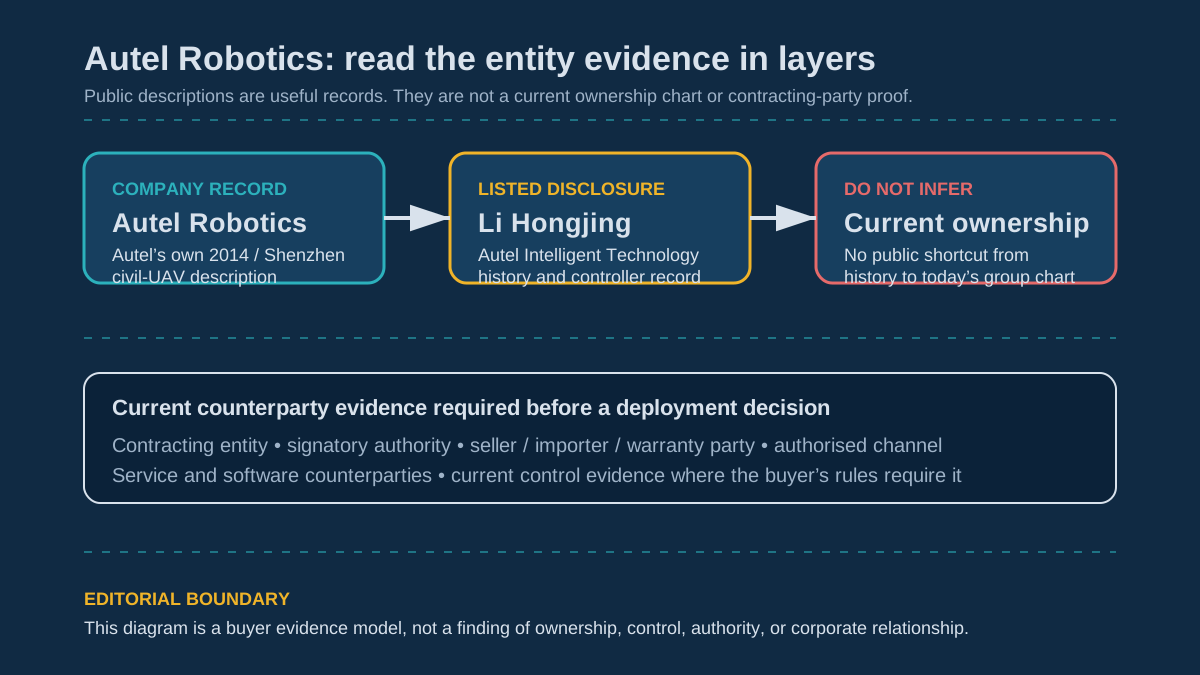
Editorial entity-evidence map. It is not a current ownership chart or legal-entity finding.
What to ask for instead of guessing
If identity or ownership affects a tender, security review, customer representation, import decision, or approved-vendor process, request the documents that answer the live question. The exact list depends on the jurisdiction and relationship, but commonly includes:
- the full legal name and registration details of the seller, manufacturer, importer, warranty provider, repair provider, and software or cloud counterparty;
- a current signatory-authority document for the person signing the quote, contract, support undertaking, or data-processing terms;
- an explanation of the relationship among the quoted entity, manufacturer, brand owner, distributor, and service centre, supported by current documents where needed;
- current beneficial-owner or control evidence where the buyer’s law, customer, lender, insurer, or policy requires it;
- the serial-number and product-configuration path from manufacturer through authorised channel to the buyer; and
- a written statement of which party is responsible when support, firmware, repair, recall, data handling, export, or warranty obligations arise.
None of these requests presumes a problem. They simply put the legal and operating chain on paper before the buyer builds a programme around it. If the response is incomplete, that is a scope finding: the organisation may need to narrow the intended use, obtain a different commercial structure, or seek advice before continuing. It is not evidence that a product or company has failed a test.
The important editorial conclusion is therefore modest: Li Hongjing is a documented figure in Autel Intelligent Technology’s public disclosures; that is enough to explain why his name appears in company research. It is not enough to draw a current Autel Robotics ownership map. A responsible dossier leaves the unresolved line visible.
Read the operating portfolio, not a brand nickname
Autel’s official site currently groups its public-facing offerings into enterprise multi-rotor products, eVTOL products, ecosystem hardware and software, and a limited consumer section. Its product history lists the Alpha and EVO Lite Enterprise series in 2025, the EVO Max series in 2024, and several EVO II and Dragonfish entries in prior years. Those dates and families are presented on Autel’s own timeline. The page also makes broad claims about underlying technologies and industries; this article does not treat those claims as independent performance validation.
For a feature shopper, this may look like a conventional product catalogue. For an enterprise buyer, it is a series of different operating questions.
Multi-rotor aircraft may lead to questions about payload configuration, mission duration, batteries, controller hardware, operator training, spare parts, and field repair. Tilt-rotor or fixed-wing systems change launch, recovery, airspace, logistics, pilot, maintenance, and mission-planning questions. Ecosystem software and dock or command components introduce versioning, account, connectivity, update, data, retention, access-control, and incident-response questions. A brand comparison that only compares airframes has left the system-level work undone.
This does not make Autel uniquely complicated. It is the normal structure of enterprise drone procurement. The buyer should build a configuration sheet before asking whether a given Autel product is an alternative to a DJI product:
| System layer | Decision evidence to capture |
|---|---|
| Aircraft and payload | Exact model, payload, serial eligibility, batteries, radio configuration, operating limits, and maintenance schedule. |
| Ground control | Controller model, account owner, application version, update method, offline capability if relevant, and managed-device policy. |
| Data and connectivity | Data types, storage location, network path, telemetry route, third-party integrations, retention, access, and deletion process. |
| Service and continuity | Local repair path, turnaround commitments, spares, batteries, training, warranty, escalation route, and end-of-life terms. |
| Mission and governance | Airspace and operational rules, client requirements, procurement restrictions, insurance, records, and internal risk owner. |
The Nano and Lite lifecycle notice changes the comparison
The clearest public product-boundary record is Autel’s July 18, 2025 lifecycle notice for the EVO Nano, Nano+, EVO Lite, and Lite+ series. Autel says sales for those named series ended on July 18, 2025. It also says service—including software updates and fixes, technical support, after-sales repair, and related support described in the notice—will end on July 18, 2030, except for stated major safety or regulatory circumstances. Read the company’s lifecycle announcement directly.
This is easy to overread in two directions. It does not say that every Autel consumer product, enterprise product, accessory, or service has ended. It also does not guarantee that a specific Nano or Lite buyer will receive every kind of support in every geography until 2030. It is a named-series, dated notice issued by the company. That is already valuable: it tells a buyer that product lifecycle needs to sit beside feature and price in the decision file.
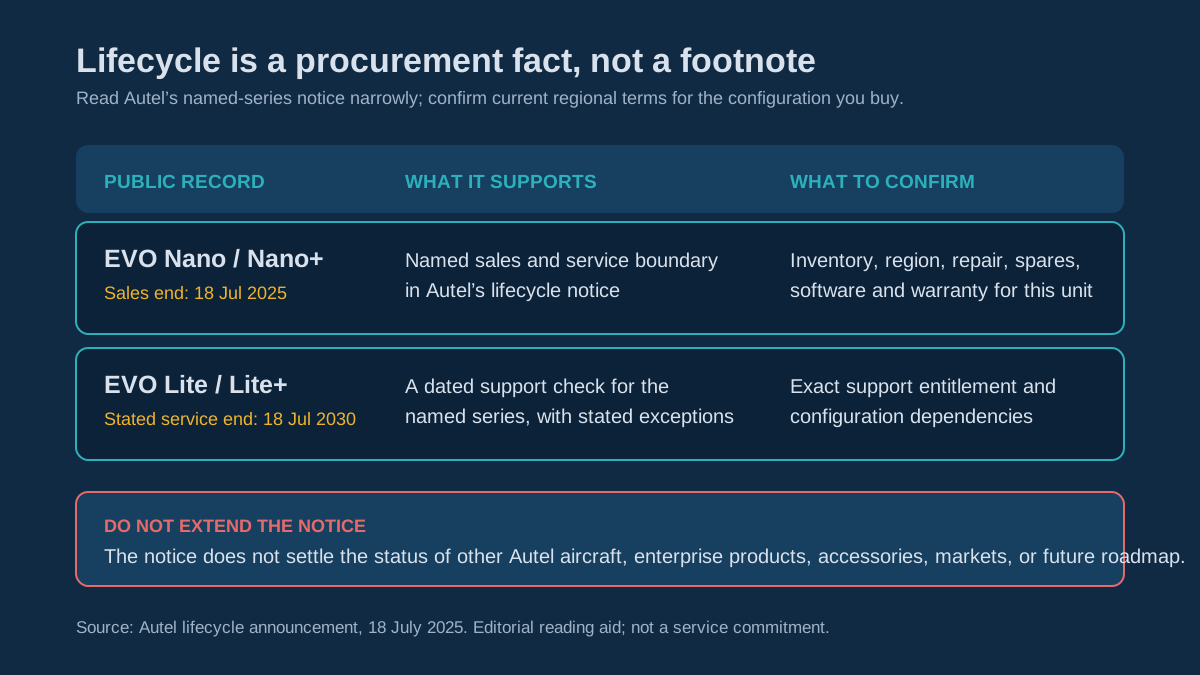
Editorial lifecycle reading aid based on Autel’s named-series notice. Confirm current regional service terms for a specific model.
| Product question | What the July 2025 notice establishes | What it does not establish |
|---|---|---|
| EVO Nano / Nano+ | Sales ended July 18, 2025; the notice states service end on July 18, 2030, with stated exceptions. | Current inventory, regional warranty, repair capacity, parts availability, or suitability for a mission. |
| EVO Lite / Lite+ | The same named-series sales and service boundary applies. | The status of another EVO family, enterprise variant, payload, controller, or accessory. |
| Current enterprise portfolio | Autel’s current site presents enterprise products and ecosystem components separately. | Purchase availability, approved configuration, support term, future roadmap, or performance result for the buyer’s market. |
| “Autel consumer retreat” | A dated notice supports a conclusion about the named Nano and Lite series. | A claim about the entire consumer-drone market, Autel’s strategy, financial outlook, or every current product line. |
Why lifecycle is a procurement control
Lifecycle affects more than replacement parts. A drone programme may be designed around training materials, accessories, chargers, battery policy, application compatibility, repair routes, mapping workflows, operator qualifications, data archives, and safety procedures. When the platform changes, these dependencies may change at different speeds. A fleet can look operational on a spreadsheet while the real constraint is a depleted battery stock, a repair channel that has changed, a device no longer eligible for an update, or a mission application that is no longer part of the agreed support scope.
For an existing Nano or Lite fleet, ask the provider to confirm the exact models and serial ranges; covered service in the buyer’s location; repair and spare-parts process; battery availability; current software and controller compatibility; any update policy; required account or network dependency; and the escalation route when a fault is discovered. Retain the answer with the purchase and support documents. A published notice is a reason to ask these questions; it is not the answer to them.
For a new enterprise purchase, do the same work prospectively. The contract or commercial record should identify the model and configuration, the expected support scope, revision and update mechanism, repair route, spares policy, warranty party, and what happens at end of service. Do not rely on a current website menu as a roadmap commitment. A product page is evidence of how the company is presenting a line today, not a binding promise about future availability.
A U.S. policy record is a diligence trigger, not a verdict
Autel has a public U.S. policy record that buyers should neither ignore nor inflate. The U.S. Department of Defense’s January 2025 document titled Entities Identified as Chinese Military Companies Operating in the United States includes Autel Robotics Co., Ltd. on its Section 1260H list. The name appears on page 1 of the Department’s published list.
The Department’s January 7, 2025 release describes the update as an identification exercise required by Section 1260H of the FY2021 National Defense Authorization Act. It says the Department may take additional actions under authorities other than Section 1260H. The release states the programme and date directly. Those are important facts. They are not, on their own, a product-security test, a sanctions designation, an export-control analysis, a universal ban on purchase, or a conclusion that a particular organisation cannot deploy an Autel system.
The defined scope matters. Project CLEAR, a Department of Defense initiative, explains that Section 851 of the FY2025 NDAA creates certain Department contracting restrictions where a Department contractor, its parent, or subsidiary has a relationship with a covered lobbyist that also represents a company on the 1260H list. Project CLEAR describes the covered-lobbyist and Department-contracting condition here. That is a specific legal and contracting context. It should not be rewritten as “all organisations are barred from buying” or “a listed product has been technically found insecure.”
Autel published its own response on January 7, 2025. The company said it is a civil-drone business, not a defense contractor or military supplier, and that it would communicate with relevant U.S. departments to clarify the matter. That is Autel’s attributed position in its statement. It should be read beside the Department’s record, not as an independent adjudication that replaces it.
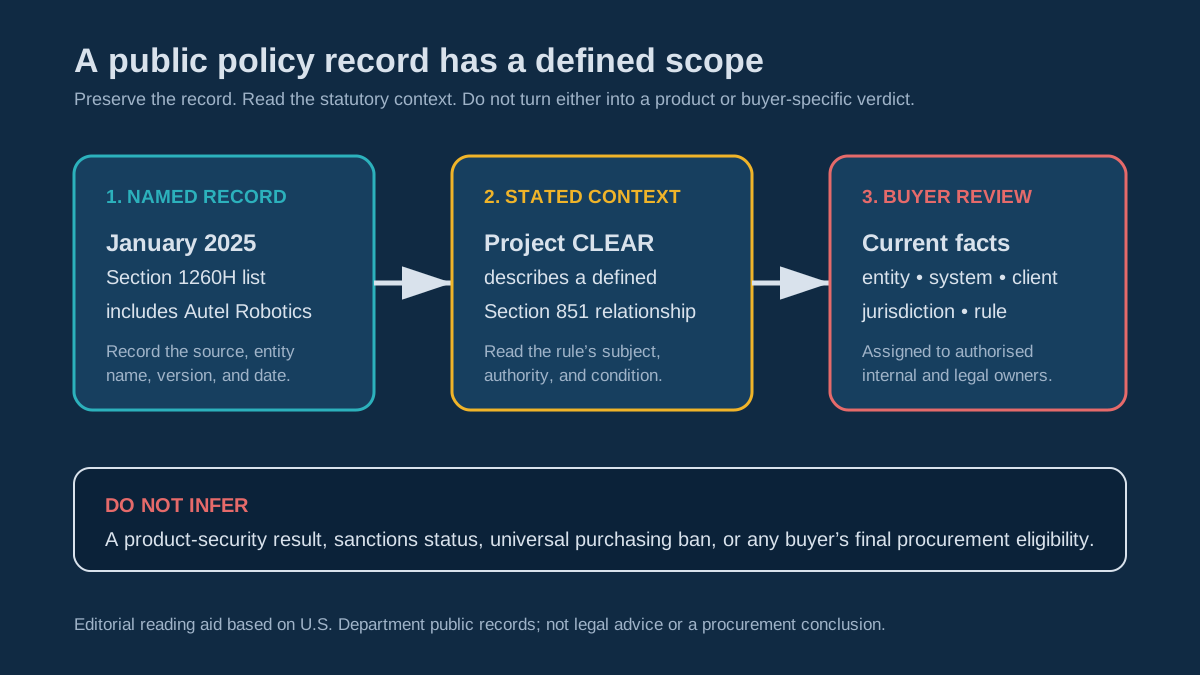
Editorial policy-reading boundary. It reports how to keep a named public record within its stated scope; it is not a legal opinion or procurement finding.
What a responsible policy review looks like
A good review starts with the buyer’s question, not the most dramatic label in a search result. A U.S. Department contractor might need to assess a different set of facts from a commercial US utility, a European infrastructure operator, an Asian survey firm, a university, a humanitarian programme, or a private individual. A public entity may have state, local, agency, grant, customer, or internal rules that go beyond or differ from a federal source. A company shipping across borders may have separate customs, export-control, data, aviation, or end-user obligations. Only qualified advisers and the organisation’s responsible officials can interpret the rules that apply to the actual facts.
The buyer file should preserve the record, version, and date of each policy check; identify the owning internal team; name the precise product and counterparty under review; record which jurisdiction and customer requirement are in scope; and distinguish a legal question from a technical or operational question. “We saw a list” is not an audit trail. Neither is “the vendor says it is fine.”
This is the place to ask direct questions of the seller and, where necessary, counsel: Which legal entity is selling and supporting this configuration? What are the system’s data flows? Which cloud or account services are required? Can the planned use operate under our contracts and policies? Is a particular customer, funder, agency, tender, or local rule imposing a condition? Has the organisation asked the right authority to decide? The answer may be yes, no, conditional, or still under review. The honest article should allow all four states.
Build the decision file before comparing features
The public record is enough to build a better buyer process. It is not enough to choose an aircraft. A practical Autel decision file brings five evidence threads together before a pilot, purchase order, or vendor approval is treated as a conclusion.
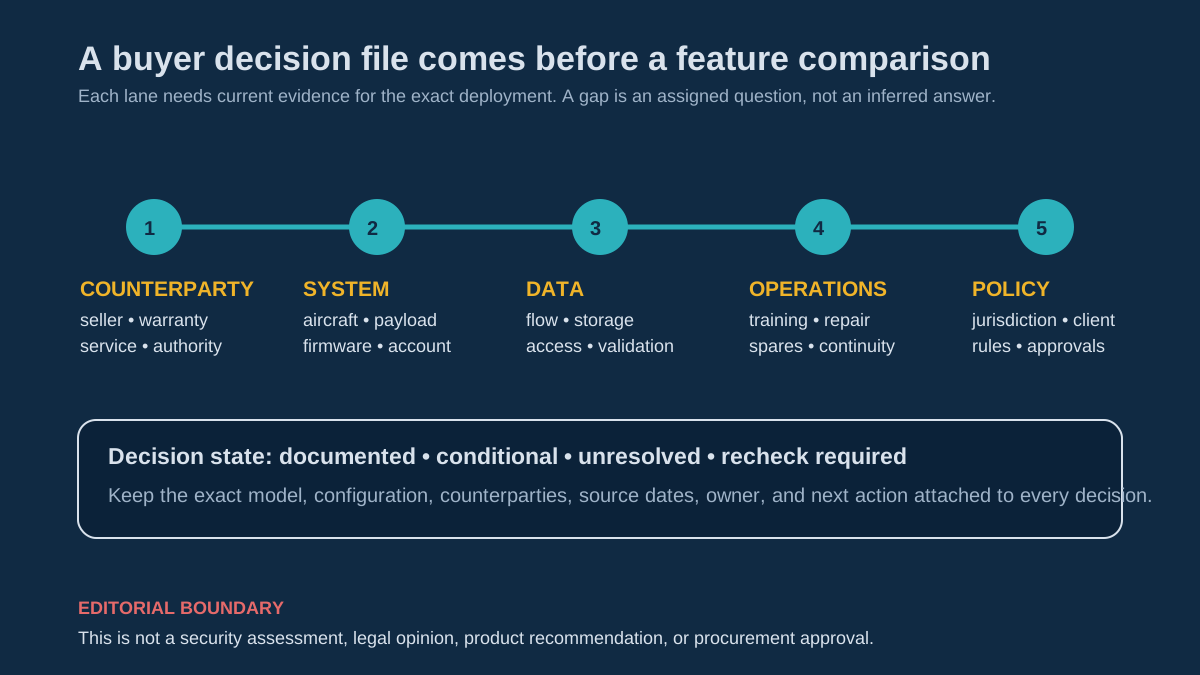
Editorial buyer decision file. It is not a security assessment, legal opinion or procurement approval.
1. Counterparty and commercial chain
Name the legal seller, manufacturer, importer, distributor, warranty party, repair party, and software or service party. Ask who may sign, who will invoice, which entity carries the warranty, and whether a reseller is authorised for the named region and configuration. Capture the documents, not just the answers. If the programme depends on a particular overseas support route, put it in the commercial record with a contact and escalation path.
This is where the public entity map stops and live diligence begins. The buyer should not use a historical leadership disclosure to populate a beneficial-owner field, or an “About Us” page to fill a contracting-party field. Ask the party that will be bound by the contract. If a tender asks a question that cannot be answered from the supplied documents, record the gap and resolve it through the appropriate process rather than completing it from inference.
2. Exact system and lifecycle
Write down the exact aircraft, payload, controller, batteries, charger, accessories, application, firmware, account, and support tier. Treat the hardware and software as one configured system. Link the configuration to the purchase order, acceptance test, asset register, training record, service request, and end-of-life plan.
Then ask the lifecycle questions before the pilot becomes a fleet. What is the current support commitment in this market? Which updates are included, how are they delivered, and which devices or accounts are required? What happens if an application version changes? What is the battery and spare-parts plan? Who repairs the unit, where, under which turnaround target, and with what data handling? What must be retained when an aircraft is transferred, retired, or replaced? Autel’s Nano and Lite notice makes this line of questioning concrete; the same questions should apply to every candidate platform.
3. Data, software, and security validation
Do not turn a public policy record into a security conclusion, and do not turn a vendor response into a security test. A serious evaluation needs a defined technical scope: what data the aircraft, controller, application, account, mapping tool, dock, or command platform creates; where it travels and rests; how it is authenticated; which updates and dependencies are required; who can administer it; what logs exist; and how the organisation responds to loss, compromise, or service change.
The validation method belongs to the buyer’s risk model. It may involve architecture review, contractual data terms, managed-device controls, network segmentation, a controlled pilot, penetration testing where appropriate, an independent security assessment, or a review by the organisation’s security team. This article has performed none of those tests. The useful action is to write the unanswered technical question down, assign an owner, and choose a method that can answer it.
For some deployments, data may be almost entirely local and operational risk may centre on devices, batteries, airspace, or repair. For others, the drone is tightly connected to cloud workflow, mapping, client systems, or sensitive locations. Treating both as the same product-comparison problem creates a false sense of precision. The decision file needs a deployment diagram, not just a specification sheet.
4. Mission, operations, and continuity
An aircraft can meet an advertised capability and still be wrong for a programme because the operator cannot sustain training, maintenance, launch-site workflow, authorisations, spares, safety processes, insurance, or incident management. Conversely, an aircraft with less headline appeal may fit the mission if the support and operations model is demonstrably better. The article does not rank Autel against DJI or another supplier; it gives the criteria that turn an apparent alternative into a testable operational candidate.
Run a controlled pilot against the requirements the programme actually owns. Define the mission, success criteria, failures that matter, weather and site constraints, operator and observer responsibilities, device management, data collection, support handoffs, and the decision maker. Record exact configuration and software versions. If a result is specific to a location or controlled test, label it as such. A one-day demonstration does not prove long-term service continuity, and a clean flight does not prove every data or policy question has been resolved.
5. Applicable policy and customer commitments
Finally, map the intended buyer, operator, customer, project, jurisdiction, funding source, and contract requirements to the rules and policies that apply. The Department’s Section 1260H record and Project CLEAR’s Section 851 explanation may be relevant for some organisations; they are not a one-line answer for all organisations. Current aviation rules, procurement rules, local restrictions, data conditions, contract promises, and end-user controls may also matter. Escalate this layer to the people authorised to interpret it.
The key output is not a generic red or green label. It is a documented decision: what was checked, by whom, against which version of the system and rule; what is confirmed; what is conditional; what needs further review; and what would trigger a recheck. That record remains useful when a buyer changes model, region, service provider, customer, or mission.
The bottom line: Autel is a company file before it is an alternative
Autel Robotics is a Shenzhen civil-drone company with a public global-facing footprint, an enterprise-oriented product presentation, and a documented lifecycle boundary for named Nano and Lite consumer series. Li Hongjing’s role at listed Autel Intelligent Technology is publicly documented, but that does not substitute for a current Autel Robotics ownership or counterparty map. The U.S. Department’s January 2025 Section 1260H list includes Autel Robotics, while the Department’s own materials define a narrower statutory and contracting context than a headline-level verdict. Autel has publicly disputed the military characterisation; that remains the company’s position, not a replacement for the government record.
Those facts are enough to improve the first meeting. They are not enough to approve a purchase. The better next step is to build the counterparty, configuration, lifecycle, data, service, mission, and policy file for the exact deployment. Once that exists, a DJI comparison can be rigorous: not “which drone looks similar?” but “which documented system can meet this requirement under this operating and governance model?”
Method and limitations
This article uses desk research conducted through August 24, 2026. It relies on Autel Robotics’ own public pages for its company description, product presentation, lifecycle notice, and January 2025 response; on Autel Intelligent Technology’s 2024 annual report for the limited Li Hongjing record; and on U.S. Department of Defense materials for the Section 1260H and Project CLEAR context. Company statements are identified as such.
No Autel aircraft, firmware, application, cloud service, customer deployment, reseller contract, corporate registry record, support channel, ownership document, cybersecurity control, flight performance, or procurement rule was tested or independently audited. Nothing here determines a product’s security, a company’s current ownership, sanctions or export status, legal compliance, flight permission, or suitability for a specific purchase or mission. Obtain current documents, perform appropriate technical and operational validation, and seek qualified advice on rules that apply to the actual facts.