
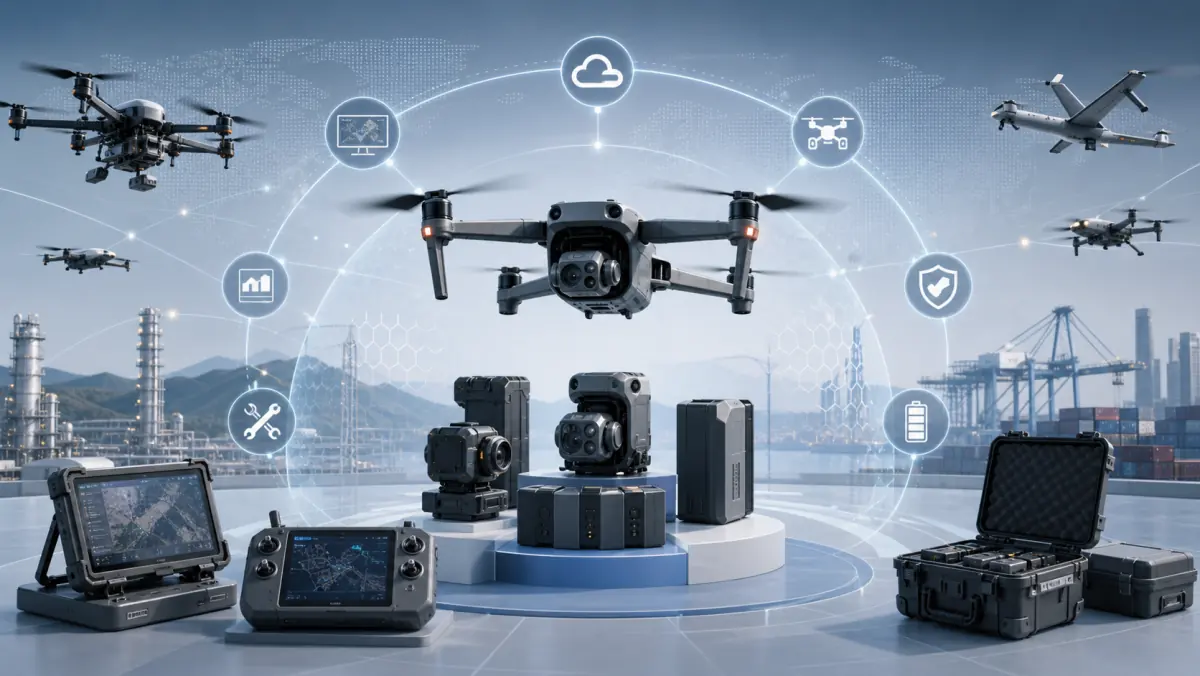
On December 22, 2025, the US Federal Communications Commission updated its Covered List for foreign-made UAS and critical components, blocking new covered device models from receiving FCC equipment authorization while leaving previously authorized models usable. Four months later, on May 1, 2026, Beijing began enforcing a citywide drone sales and flight restriction with limited approval pathways for universities, research institutions, and public-safety uses. DJI was not the only company affected by either policy, but no drone brand sits closer to the center of both stories.
A Chinese company estimated to hold roughly 70% or more of the global consumer drone market is now squeezed by the world's two largest economies. Yet no competitor has broken through at comparable global scale. Not Skydio in the US, not Parrot in France, and not Autel despite close specification comparisons in several models. DJI's de facto dominance persists even under policy pressure.
This is the story of how DJI built that position and why it has proven remarkably durable. "Monopoly" here is used as the searcher's shorthand for market dominance, not as a legal finding.
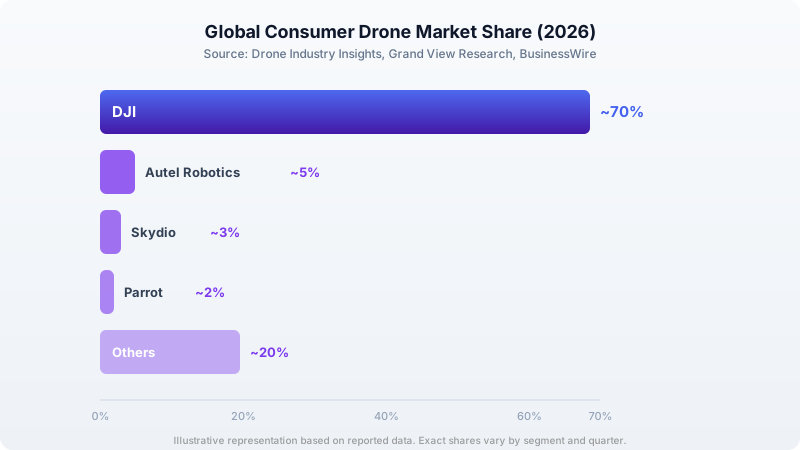 Data sources: Drone Industry Insights, Grand View Research, BusinessWire
Source File
This article was reviewed on 2026-07-06 against the FCC's official Covered List fact sheet, AP coverage of Beijing's May 2026 drone restrictions, market-share references from Drone Industry Insights, Grand View Research, Fortune Business Insights, and ResearchAndMarkets coverage distributed via BusinessWire. Company and regulatory context is cross-checked against 36Kr, Yicai Global, UAV Coach's DJI ban tracker, and DroneXL reporting on DJI's Ninth Circuit filing. DJI is private, so revenue, valuation, shipment, product-pipeline, and segment-share figures are estimates rather than audited company disclosures.
From Dorm Room to Drone King: The Origin
Frank Wang (Wang Tao) built DJI's first product in a Hong Kong University of Science and Technology dorm room in 2006. The initial product was not a drone at all — it was a flight controller board called the XP3.1, sold to hobbyists for building their own remote-controlled helicopters.
The pivot came in 2013 with the Phantom, the first ready-to-fly consumer drone that actually worked out of the box. Before the Phantom, flying a camera-equipped drone required assembling components from multiple vendors, tuning flight parameters, and accepting a high probability of crashing. DJI packaged the entire experience: flight controller, gimbal, camera, and airframe in a white plastic shell that anyone could fly.
The Phantom did to drones what the iPhone did to smartphones. It did not invent the category — it made the category accessible.
But the real turning point came in 2016-2017 with a sequence of moves that established the pattern DJI has followed ever since: rapid product iteration, aggressive pricing, and expanding into adjacent categories faster than competitors could respond to the previous one. The Mavic Pro (2016) made folding drones mainstream. The Spark (2017) brought face-recognition gesture control to a $399 price point. The Mavic Air (early 2018) packed high-end features into a device the size of a water bottle.
By 2015, DJI had raised $500 million and was valued as a unicorn. Revenue grew from CNY 1 billion in 2012 to CNY 18 billion in 2017, with 80% year-over-year growth. By 2025, market reports from 36Kr estimated DJI's revenue approaching CNY 80 billion ($11.6 billion), with some sources suggesting it could cross CNY 100 billion ($14.5 billion). The company employs approximately 14,000 people across five countries and is valued at roughly CNY 160 billion ($22 billion) — all while remaining private.
That private status is deliberate. DJI has never pursued an IPO, and founder Frank Wang has maintained tight control over the company's direction. In an internal letter referenced by 36Kr, Wang reportedly framed DJI's trajectory as moving from "cost advantage" to "technology definition" — setting the industry standard rather than competing on price. Whether this positioning holds under dual geopolitical pressure is the question the industry is watching.
The Numbers Behind the Monopoly
DJI's exact market share is not audited, but the direction is hard to miss. Multiple market references put DJI in roughly the same range: about 70% or more of the global consumer drone market, with the figure varying by segment, geography, and methodology.
China as a whole produces a large majority of the world's commercial drones, according to BusinessWire's 2026 Drones Research Report. Global market-size estimates differ sharply by whether the analyst counts consumer hardware, commercial aircraft, services, payloads, software, or military-adjacent segments, so this article treats market-size numbers as context rather than a precise denominator for DJI.
The consumer drone segment alone is expected to grow at 11.6% CAGR through 2034, per Fortune Business Insights. Yet within this growing market, DJI's share has barely moved. The company has held roughly the same 70%+ position since 2018.
This is not dominance by default. It is dominance by system design.
To understand the scale, consider DJI's product line breadth. The company sells drones across every major segment:
| Segment | Key Products | Price Range | What It Does |
|---|---|---|---|
| Consumer | Mini 4 Pro, Air 3, Mavic 3 | $339–$2,199 | Photography, casual flying |
| Prosumer | Mavic 3 Pro, Inspire 3 | $2,199–$16,499 | Professional filmmaking |
| Enterprise | Matrice 350 RTK, Mavic 3 Thermal | $4,499–$13,999 | Inspection, surveying, public safety |
| Agriculture | Agras T40, T50 | $12,000–$25,000+ | Crop spraying, precision agriculture |
| Racing/FPV | Avata 2, FPV Combo | $329–$1,399 | Immersive first-person flight |
Five Layers of DJI's Competitive Moat
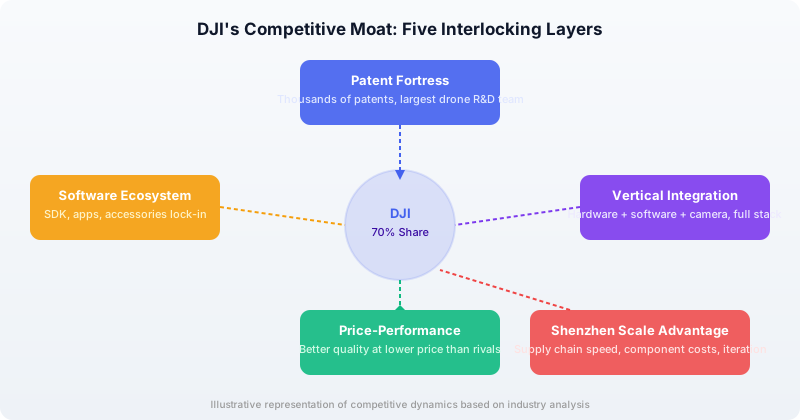
DJI's position rests on five interlocking advantages that reinforce each other. Remove any one, and the other four still make DJI hard to displace. The current competitive landscape shows how difficult it is to assemble all five at once.
1. Patent Fortress
A DJI executive publicly stated that the company has the world's largest drone-focused R&D team and that no drone maker can bypass DJI on patents and research methods, as reported by Yicai Global.
The patent base is large. DJI holds thousands of patents covering flight control algorithms, gimbal stabilization, obstacle avoidance, image transmission, and battery management. These are not decorative filings; they cover the core technologies that make a drone fly stably, hover precisely, and transmit high-quality video in real time.
Any competitor entering the market must either license DJI patents, design around them (which often means inferior solutions), or risk litigation. The patent moat is particularly deep in flight control and gimbal stabilization — the two technologies that most directly determine whether a drone feels "solid" or "cheap" in the air.
Patent coverage is only one part of the market-power question. European distribution and competition scrutiny, where reported, should be treated separately from the technical patent moat: a regulator can examine channel conduct without proving that the product technology itself is weak. For buyers, the practical lesson is narrower. DJI's technical position, product breadth, and channel influence are strong enough that legal, reseller, and procurement disputes can become part of the operating risk.
2. Vertical Integration
DJI controls the entire technology stack. Unlike competitors who assemble components from third-party suppliers, DJI designs its own:
- Flight controllers (N3, A3 series) — the "brain" of the drone
- Gimbal systems — mechanical stabilization for cameras
- Cameras and image processors — including co-engineered Hasselblad cameras for the Mavic line
- Transmission systems — OcuSync, DJI's proprietary wireless video link
- Software — DJI Fly, DJI GO, DJI Pilot apps, plus SDKs for developers
This vertical integration means DJI can optimize the entire system in ways that component-assemblers cannot. When a DJI drone's camera feeds video to the controller with minimal latency, that is not just a good camera plus a good transmission system — it is a camera and transmission system designed to work together from the ground up.
The practical impact is measurable. DJI's OcuSync 4.0, the latest generation of its proprietary transmission system, delivers 1080p/60fps live video at distances up to 20 km (FCC mode) with latency measured in milliseconds. Competitors using off-the-shelf transmission components typically achieve a fraction of that range with noticeably higher latency. The gap is not in any single component — it is in the system-level integration that only happens when one company designs the entire signal chain.
3. Price-Performance Ratio
Competitors face a brutal dilemma: match DJI's quality and charge more, or match DJI's price and deliver less. As multiple drone enthusiasts note on forums like Reddit's r/drones, rival drones that fly as well as DJI's cost more, and drones at DJI's price point do not fly as well.
This is not an accident. DJI's Shenzhen manufacturing base and enormous production volumes drive component costs down through economies of scale. When you ship millions of drones per year, every chip, motor, and sensor gets cheaper per unit. A competitor shipping tens of thousands of units simply cannot match those procurement economics.
4. Software Ecosystem Lock-in
DJI's software creates switching costs that go beyond the hardware. The DJI Fly app is polished and intuitive. The SDK enables third-party developers to build enterprise applications on top of DJI hardware. Accessories — batteries, filters, carrying cases — are designed for DJI form factors.
For enterprise users, the lock-in is even stronger. Industries like agriculture, construction, and filmmaking have built workflows around DJI's software ecosystem. Switching to a competitor means retraining pilots, rebuilding workflows, and repurchasing accessories. Most organizations simply do not bother.
Consider the agriculture sector. DJI's Agras line of spraying drones and its DJI Smart Farm platform create an end-to-end system: the drone flies the field, collects multispectral data, the software generates a prescription map, and the same drone (or a larger one) executes the spraying mission. Competing systems exist, but they require stitching together hardware and software from multiple vendors — with the integration headaches that implies. DJI's all-in-one approach is simply easier, and ease of use wins in practical deployment.
5. Shenzhen's Supply Chain Speed
DJI's headquarters in Shenzhen gives it access to the world's fastest hardware iteration cycle. A new drone component can go from design to prototype to production in weeks, not months. Shenzhen's ecosystem of component suppliers, PCB manufacturers, and assembly houses means DJI can iterate hardware at a pace that competitors based in San Francisco or Paris cannot match.
This is the same advantage described in Shenzhen Manufacturing: Complete Ecosystem Guide (2026): the one-hour supply chain where a hardware startup can source, prototype, and iterate faster than anywhere else on Earth.
Why Competitors Keep Failing
The competitive landscape in 2026 tells the story of DJI's moat in action. Here is how the main challengers stack up:
| Company | Origin | Strength | Why It Cannot Beat DJI |
|---|---|---|---|
| Skydio | US | Best autonomous flight AI | Expensive, limited manual control, small product line |
| Autel Robotics | China | Closest spec match | Also Chinese (same geopolitical risk), smaller scale |
| Parrot | France | European-made, enterprise focus | Less versatile, lower thermal resolution, limited consumer line |
| Anzu Robotics | US | Licensed DJI-adjacent designs | New, unproven at scale |
As one Reddit user put it plainly: "Autel is Chinese. Skydio is overpriced and buggy. Parrot is good for what it was designed to do but not very versatile."
The harsh truth is that no competitor has assembled all five layers of DJI's moat simultaneously. Several have one or two. None have all five.
The Regulatory Landscape Beyond the US
The US FCC action is the most dramatic regulatory challenge, but it is not the only one. The global regulatory environment for drones is tightening in ways that affect DJI and its competitors differently.
The European Union has implemented its own drone regulations under EASA (European Union Aviation Safety Agency), requiring CE marking, remote identification, and geo-awareness features. DJI drones generally comply with these requirements — the company invested early in regulatory compliance across jurisdictions. Parrot, as a European manufacturer, has a home-field advantage in EU regulatory familiarity, but has not translated that into market share gains.
Reported European distribution scrutiny signals another dimension: market power can create reseller and antitrust questions even when customers like the product. The buyer-risk point is not the size of any potential fine. It is that a dominant hardware vendor can create dependency across product, channel, support, and software at the same time.
Japan and South Korea have their own drone registration and airworthiness requirements, generally less politically charged than the US framework but still creating compliance costs. DJI's scale advantage means these costs are proportionally smaller for DJI than for smaller competitors.
The net effect of global regulation is paradoxical: higher regulatory barriers disproportionately hurt smaller competitors who lack the resources to navigate multiple jurisdictions. In a real sense, regulation reinforces DJI's dominance by raising the cost of entry.
The Geopolitical Squeeze
Here is where DJI's story becomes genuinely unprecedented. The company is being squeezed from both sides — by the United States citing national security, and by China citing domestic security.
The US Side: FCC Covered List
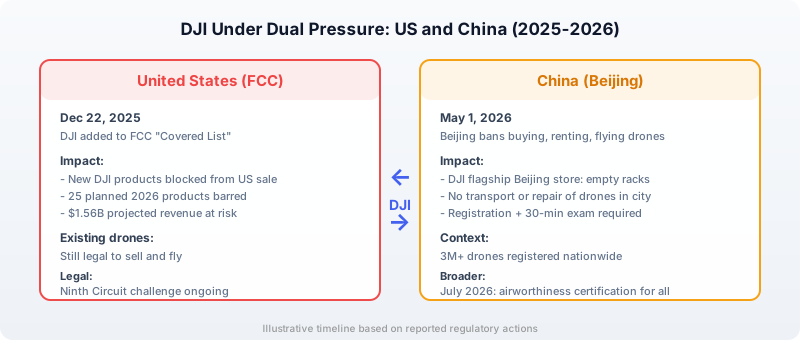
On December 22-23, 2025, the FCC updated its Covered List for foreign-made UAS and critical components, as documented in the FCC's official fact sheet. The action does not ban drones already lawfully purchased, and it does not stop retailers from selling, importing, or marketing device models that were previously authorized. The restriction applies to new covered device models seeking FCC equipment authorization, which is why future DJI product cycles face US-market risk.
In a Ninth Circuit court filing reported by DroneXL, DJI disclosed that 25 planned 2026 products are now barred from the US market, with projected losses of $1.56 billion. DJI is challenging the ban in court, while the FCC accepted public comments through May 11, 2026.
The FCC's rationale is national security: concerns that foreign-made UAS could enable surveillance, data exfiltration, attacks, disruptions, or industrial-base dependency. DJI has repeatedly denied misuse allegations and points to data-privacy features such as Local Data Mode.
Florida's experience is instructive. When a government buyer restricts DJI without a mature replacement path, agencies still need to solve the mission: public safety, mapping, inspection, training, spare parts, and data management. That does not settle the security debate, but it explains why drone policy often becomes an operational problem before it becomes a clean procurement choice.
The China Side: Beijing Ban
China's own pressure on DJI is less globally reported but equally significant. On May 1, 2026, Beijing implemented citywide restrictions on buying, renting, or flying drones without approval, with limited exceptions for certain institutional and public-safety uses. This is not only a no-fly zone around sensitive sites; it is a much broader local-security rule.
According to AP and other reporting, Beijing's new rules restrict drone sales and flights citywide, require approval for limited exempt users, and have pushed retailers and e-commerce platforms to remove or block drone listings for Beijing customers. The point is not that DJI alone was targeted. The point is that DJI's most famous domestic category now operates under a much tighter security lens in the Chinese capital.
China has also been moving toward tighter national drone registration, airworthiness, and operating rules. The precise implementation burden varies by aircraft type and use case, but the direction is clear: the low-altitude economy is being promoted for commercial and industrial use while consumer and recreational operation faces more documentation and local restriction.
The Paradox: China Builds, China Bans
This creates what might be called the China Drone Paradox. China dominates global drone manufacturing through DJI, yet simultaneously imposes some of the world's tightest drone regulations on its own citizens. The tension is between commercial and industrial applications (which the government actively promotes under the banner of the "low-altitude economy") and consumer and recreational use (which is increasingly restricted).
The low-altitude economy, encompassing UAVs, eVTOL aircraft, and drone delivery, is a national priority sector in Chinese policy. Yet the consumer side of the same technology is being restricted more aggressively in sensitive cities and contexts.
For DJI, the paradox is acute: the company's home market is becoming less hospitable even as it dominates globally. The Beijing ban hits differently than the FCC ruling. When the US restricts DJI, it hurts sales. When China restricts drones, it signals a domestic environment that is skeptical of the consumer technology DJI was built on.
What Happens Next
Three scenarios are worth considering for DJI's near-term future.
Scenario 1: Status quo with erosion. DJI keeps its dominant position in most global markets but loses new-model momentum in the US if covered-list restrictions continue. Existing inventory and previously authorized models create a softer landing than a full ban, but the long-term product pipeline becomes harder.
Scenario 2: Legal or compliance breakthrough. DJI wins meaningful relief, or a compliance framework allows some future models to enter the US with additional security certifications. This is possible, but it depends on legal process, agency posture, and the broader US-China technology relationship.
Scenario 3: Competitor emergence. A well-funded competitor, possibly Skydio with US government demand or a new entrant backed by European or Japanese industrial groups, builds a credible alternative across more of the moat. Given the capital, time, certifications, software, and channel work required, this is a multi-year proposition rather than a quick replacement story.
There is a fourth scenario worth watching, though it is less about competition and more about transformation. DJI has been quietly expanding into adjacent markets: handheld camera gimbals (Osmo line), robotic camera systems (Ronin), and even electric mobility. The company's imaging and stabilization technology transfers directly into these markets. If DJI's drone business faces sustained headwinds, its technology platform gives it multiple pivoting options that competitors do not have.
None of these scenarios should be read as a forecast guarantee. The stronger conclusion is narrower: DJI's moat is deep enough that policy pressure does not automatically create a capable alternative.
What DJI's Monopoly Means for the Drone Industry
DJI's dominance shapes the entire drone industry in ways that go beyond simple market share numbers.
For consumers, DJI's dominance has often been beneficial in price-performance terms. Aggressive pricing and rapid iteration made capable camera drones accessible at price points that would have seemed difficult a decade ago. A DJI Mini-class drone delivers capabilities that would once have required a much more expensive prosumer setup. That price compression is a direct result of scale economics: DJI can price aggressively while still spreading R&D, tooling, supply-chain, and software costs across a large installed base.
For competitors, DJI's dominance creates a discouraging landscape. A startup is not only competing against an aircraft. It is competing against batteries, cameras, software, SDKs, resellers, repair habits, and user familiarity. The few remaining competitors survive in niches: Skydio in autonomy-heavy government and enterprise work, Parrot in European defense/public-safety niches, and specialized industrial drone makers in specific verticals.
For regulators, DJI's position creates an uncomfortable reality. Restricting DJI without a viable alternative can create operational problems for agencies and enterprises that depend on drone technology. That does not settle the security question, but it explains why procurement teams often end up comparing policy risk against mission capability rather than making a simple brand decision.
For the broader technology industry, DJI is a case study in how a Chinese company can build global technology leadership through sustained R&D investment, vertical integration, and the manufacturing ecosystem advantages of Shenzhen. That does not mean subsidies, policy, or national-champion dynamics are irrelevant in China. It means DJI's global position is better explained by product-system execution than by the lazy "cheap copy" frame.
The Bigger Picture: What DJI Teaches Us About Chinese Tech
DJI's story is not just about drones. It illustrates a broader pattern in Chinese technology leadership that deserves attention.
Unlike Chinese internet platforms that built dominance mainly inside a protected domestic market, DJI won much of its reputation in open international hardware markets against American, European, and Japanese competitors. Product merit is not the only factor, but it is the central one buyers encounter.
This is the same pattern visible in China Solar Dominance: Supply Chain Power, Profit Crisis, where Chinese solar manufacturers hold 80%+ global share through genuine cost and scale advantages. It is visible in the rise of How China Manufactures: Inside the World's Factory (2026), where Shenzhen's hardware ecosystem enables iteration speeds that no other region can match.
DJI also illustrates the limits of that model. When your dominance is based on product excellence rather than regulatory protection, geopolitical actions can still threaten you — even when those actions are arguably protectionist rather than security-driven. The FCC Covered List designation targets DJI not for product failures but for perceived security risks that remain debated.
And the Beijing ban illustrates a uniquely Chinese constraint: a government that builds national champions and then restricts their domestic market for political security. DJI's experience mirrors broader tensions in Chinese tech policy, where commercial innovation and state security concerns are increasingly in conflict.
Methodology
This analysis separates three evidence layers: market-share estimates from drone market research firms, verifiable regulatory actions from official or legal sources, and company operating estimates from business media. Because DJI is privately held, revenue, valuation, shipment, and product pipeline figures should be treated as directional estimates. Regulatory details reflect the status reviewed on 2026-07-06 and may change if courts, agencies, or Chinese aviation authorities revise their rules.
Claim Confidence File
| Claim | Confidence | Evidence boundary |
|---|---|---|
| DJI holds roughly 70%+ of the global consumer drone market | Medium-high | Directionally consistent across market references, but DJI is private and segment definitions vary. |
| The FCC action blocks previously authorized DJI drones from use | Low | The article does not make this claim; the FCC fact sheet distinguishes previously authorized models from new covered device authorizations. |
| New covered foreign-made UAS models face FCC authorization restrictions | High | Supported by the FCC fact sheet. |
| Beijing's May 2026 rule tightened drone sales and flight permissions citywide | High | Supported by AP and regional reporting; exemptions and approval pathways matter. |
| DJI's moat is unbreakable | Low | The article rejects that framing and treats the moat as durable but exposed to policy, channel, and software risk. |
| Competitors cannot challenge DJI within any timeframe | Low | The article treats competitor emergence as possible but multi-year and evidence-dependent. |
Frequently Asked Questions
Does DJI really have 70% of the drone market?
The best public reading is that DJI holds roughly 70% or more of the global consumer drone market, but the exact figure varies by segment, geography, and research methodology. Because DJI is private, treat the number as a well-supported market estimate rather than an audited company disclosure.
Can I still buy and fly DJI drones in the US?
As of the July 2026 review, previously purchased and previously authorized DJI drones can still be used in the United States. The FCC Covered List update affects new covered device models seeking equipment authorization. Existing inventory and previously authorized models are treated differently from future models, and the regulatory situation remains fluid. Check UAV Coach's DJI ban guide or official FCC materials for the latest operational details.
Why has no competitor been able to challenge DJI?
Competitors face five simultaneous barriers: DJI's patent portfolio covering core drone technologies, full vertical integration from chips to software, a price-performance ratio that undercuts rivals at equal quality, software ecosystem lock-in, and Shenzhen's supply chain speed. Most competitors have one or two of these advantages. None have all five. Building all five from scratch would require billions in investment and years of iteration.
Is DJI a Chinese government company?
No. DJI is a private company founded by Frank Wang and headquartered in Shenzhen. It is not state-owned, though it has received investment from Chinese state-backed investors, as is common for large Chinese tech companies. The US government's security concerns center on data collection risks from DJI drones, not on DJI's ownership structure. DJI maintains that it does not share user data with the Chinese government and offers Local Data Mode for sensitive applications.
What is the Beijing drone ban?
Effective May 1, 2026, Beijing restricted drone sales and flights without government approval within the city jurisdiction, with exemptions for certain institutional and public-safety uses. It is one of China's most restrictive local drone-rule signals, and it is notable because DJI is China's best-known drone champion even though its headquarters are in Shenzhen, not Beijing. The ban reflects China's broader tension between promoting industrial drone applications and restricting consumer drone use for security reasons.
Related Entries
- DJI Matrice 400 enterprise buyer file — China's Drone and Aviation Technology: DJI, eVTOL, and Beyond
- DJI security audit buyer file — Are DJI Drones Safe? A Balanced Technical Analysis
- DJI alternatives for enterprise buyers — DJI Alternatives: Chinese and Western Drone Comparison
- China drone export rule checklist — China's Drone Regulations: How the Government Manages Skies
- How China Manufactures: Inside the World's Factory (2026) — How China Manufactures: Inside the World's Factory
- Shenzhen Manufacturing: Complete Ecosystem Guide (2026) — Shenzhen Manufacturing: Complete Ecosystem Guide
- China Solar Dominance: Supply Chain Power, Profit Crisis — How China Came to Dominate Solar Panel Manufacturing