
For enterprise drone buyers, "What should we buy instead of DJI?" is now the wrong first question.
The better question is: What compliance problem are we trying to solve?
That distinction matters because DJI's 2026 problem is no longer only about product quality. DJI still offers the best price-performance stack in much of the drone market. The pressure now comes from procurement rules, import approvals, data-security concerns, and local flight restrictions.
The squeeze is coming from both sides. In the United States, DJI and Autel face FCC Covered List restrictions on new equipment authorizations and related procurement pressure. In China, AP reported that Beijing banned drone sales and flights inside city limits from May 1, with limited exceptions for approved institutional uses. TechRadar reported that U.S. restrictions still matter even as regulators allowed a limited software-update reprieve for already-authorized devices.
That is the new drone market: existing DJI fleets may still work, but new procurement is becoming a legal and operational risk exercise.
Source File
This article was reviewed on 2026-07-06 against FCC Public Notice DA 26-454, AP reporting on Beijing's 2026 drone sales and flight restrictions, TechRadar's coverage of the limited U.S. software-update reprieve, and Drone U's DJI alternatives guide. The article treats alternative-drone lists as procurement leads, not as endorsement. Enterprise buyers still need to verify airworthiness, data handling, firmware support, warranty, NDAA / agency rules, customer rules, and mission payload fit for their own use case.
Quick Answer
| Buyer type | Best path | Why |
|---|---|---|
| Private commercial operator with existing DJI fleet | Keep using existing approved DJI hardware while monitoring support | Lowest switching cost if no federal funding or covered procurement rule applies |
| Public safety or federally funded US buyer | Evaluate NDAA/FCC-compliant alternatives | Procurement eligibility matters more than specs |
| Mapping and inspection team | Skydio X10 or Freefly Astro | Better fit for autonomy, modular payloads, and enterprise workflows |
| Commercial team needing DJI-like workflow | Anzu Robotics Raptor | Familiar hardware class with US-oriented software and compliance positioning |
| Budget non-DJI user | Potensic Atom 2 | Consumer-priced option, but not an enterprise substitute |
| China-based consumer or travel user in Beijing | Do not buy or fly locally without permission | Local rules can override product availability |
Why "DJI Alternative" Is Now A Compliance Query
Before 2025, most DJI-alternative content compared camera sensors, flight time, obstacle avoidance, and price. That still matters for hobbyists and private operators. But for enterprise buyers, the first filter is now regulatory.
If a buyer uses federal funding, works with sensitive infrastructure, or must comply with internal security rules, the question is not whether a DJI Mavic 3 Enterprise is better value. It usually is. The question is whether that aircraft can be purchased, approved, insured, and supported inside the buyer's compliance environment.
This is why generic "best alternatives" lists miss the point. A $330 consumer drone and a $23,000 enterprise drone are not alternatives to each other. They solve different procurement problems.
The underlying reason is explained in DJI Drone Dominance: How It Built a 70% Share: DJI's moat is not just one drone model. It is a full stack of aircraft, gimbals, batteries, software, service, accessories, and pilot familiarity. Replacing that stack is expensive.
The 2026 Alternative Map
Drone U's May 2026 guide is useful because it names real options and price ranges rather than pretending the market is full of equal substitutes. Its top professional options include Skydio X10, Freefly Astro, Anzu Robotics Raptor, and Parrot Anafi Ai, with Potensic Atom 2 as a budget consumer choice.
Here is the procurement reality behind those names.
| Option | Approx. price signal | Best use case | Main limitation |
|---|---|---|---|
| Skydio X10 | Around $23,000 | Autonomous inspection, public safety, enterprise missions | Expensive and enterprise-focused |
| Freefly Astro | Around $20,000 | Mapping, modular payloads, open workflows | Not a low-cost DJI substitute |
| Anzu Raptor | Around $5,099 | DJI-like commercial workflow with US software positioning | Hardware lineage and legal scrutiny need diligence |
| Parrot Anafi Ai | Around $4,500 | Portable professional work, weather-resistant operations | Smaller ecosystem than DJI |
| Potensic Atom 2 | Around $330 | Budget consumer flight | Not enterprise-grade |
Existing DJI Fleets Are Not The Same As New DJI Purchases
One of the most common misunderstandings is that a DJI ban means every existing DJI drone becomes illegal overnight. That is generally not how the US restrictions work.
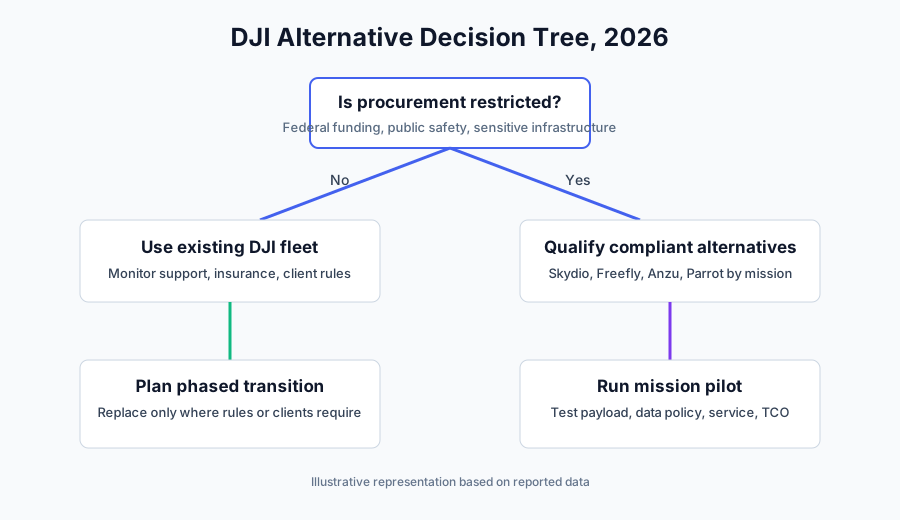
Existing approved DJI hardware can remain legal for many private and commercial users. The pressure is on new equipment approvals, procurement rules, federally funded programs, and customer-specific data policies. That distinction matters because many organizations do not need to replace every drone immediately. They need a transition plan and a paper trail.
A rational enterprise response has three layers:
- Keep safe, legal, supported DJI equipment operating where allowed.
- Freeze new DJI purchases in departments exposed to procurement restrictions.
- Pilot compliant alternatives for the missions that cannot tolerate supply or approval risk.
That is less dramatic than "DJI is banned," but it is how real fleet transitions happen.
The Replacement Budget Is Bigger Than The Aircraft Price
Many DJI replacement plans understate the cost because they compare aircraft prices only. An enterprise drone program is a working system.
The real replacement budget includes:
| Cost layer | What changes when leaving DJI |
|---|---|
| Aircraft and payloads | Thermal, zoom, RTK, LiDAR, speaker, spotlight, and mapping payloads may need new equivalents |
| Batteries and chargers | Existing battery inventory usually cannot move to the new platform |
| Pilot training | Operators must relearn controls, emergency behavior, app workflows, and maintenance habits |
| Software | Mission planning, mapping, fleet logs, and report templates may need migration |
| Repair and support | Dealer network, warranty turnaround, and spare-parts availability can change materially |
| Customer approval | Some customers may need to approve the new platform before missions resume |
Beijing Changes The Story Too
The Beijing ban adds a second layer to the narrative. DJI is not only under pressure abroad. It is also operating in a domestic environment where low-altitude security, real-name registration, and city-level restrictions are tightening.
AP reported that Beijing's rules ban drone sales and flights inside city limits, with exceptions requiring police permission for universities, research institutions, or public-safety uses. That does not destroy DJI's global business. Beijing is one city, not the global drone market.
But it does show that the regulatory pressure is not purely anti-China politics from Washington. China's own regulators are also treating civilian drones as security-sensitive infrastructure. That supports a broader point: drones have moved from consumer electronics into regulated airspace.
For DJI, that makes its monopoly more complicated. The same technical capability that made DJI dominant also makes governments nervous.
How Enterprise Buyers Should Decide
Start with mission and compliance, not brand.
| Decision step | Question |
|---|---|
| 1. Legal status | Can this aircraft be purchased and operated under your funding source and jurisdiction? |
| 2. Mission fit | Is the job inspection, mapping, public safety, media, agriculture, or training? |
| 3. Payload needs | Do you need thermal, RTK, LiDAR, zoom, multispectral, or custom sensors? |
| 4. Data policy | Where is flight data stored, processed, and updated? |
| 5. Fleet support | Who services batteries, controllers, payloads, and software? |
| 6. Transition cost | How many pilots, workflows, and accessories must change? |
| 7. Replacement timing | Is this a fleet-wide replacement or a parallel pilot program? |
A Mission-By-Mission Shortlist Is Better Than One Standard
The old DJI advantage was that one brand could cover many jobs. A non-DJI strategy may need more than one platform.
| Mission | What to prioritize |
|---|---|
| Public safety | procurement eligibility, thermal payload, training, evidence handling, and dispatch reliability |
| Utility inspection | zoom/thermal quality, wind tolerance, data workflow, and approved vendor status |
| Survey and mapping | RTK accuracy, camera calibration, flight planning, and photogrammetry compatibility |
| Construction progress | cost, ease of use, client acceptance, and report generation |
| Training or low-risk visual inspection | affordability and replacement simplicity |
Where DJI Still Wins
Even under pressure, DJI still wins on three things.
First, price-performance. Competitors can match pieces of the stack, but often at higher cost.
Second, ecosystem depth. Batteries, payloads, repair options, pilot familiarity, and third-party workflows all matter.
Third, product breadth. DJI has consumer, prosumer, enterprise, agriculture, cinema, and industrial lines. Most alternatives specialize.
This is why bans and procurement restrictions do not automatically create a healthy replacement market. They create demand for alternatives faster than alternatives can match DJI's economics.
What To Put In The Procurement Memo
A useful procurement memo should name the reason DJI is being avoided. Is the issue federal funding, customer policy, data handling, future import approval, insurance, or reputational risk? Each reason points to a different alternative.
The memo should also document why the selected alternative is "good enough" for the mission. That means flight time, payload fit, data workflow, pilot training, service support, warranty, and total transition cost. A buyer who cannot show mission fit may solve the compliance problem while creating an operational problem.
The final line should be explicit: whether existing DJI hardware remains approved for low-risk legacy work, or whether the organization is committing to a full fleet transition. Ambiguity here creates shadow purchasing, inconsistent field behavior, and messy audit trails.
What To Watch Next
The next important signals are:
- FCC movement on DJI petitions and equipment authorizations.
- Whether software-update waivers continue or narrow.
- Public-safety procurement lists and state-level restrictions.
- Anzu legal and regulatory scrutiny.
- Skydio and Freefly price changes.
- Whether Autel can remain a credible non-DJI option under the same China-related pressure.
- Whether Beijing-style local drone restrictions spread to other Chinese cities.
The market is not waiting for a better camera. It is waiting for a compliant drone that is good enough, available enough, and affordable enough.
Methodology
This analysis uses AP's report on Beijing's May 1 drone restrictions, Drone U's May 2026 alternative price and model guide, TechRadar's reporting on the US software-update reprieve, and the site's prior DJI market-structure analysis in DJI Drone Dominance: How It Built a 70% Share. It distinguishes private commercial operation from government or federally funded procurement because those are different legal risk categories.
Claim Confidence File
| Claim | Confidence | Evidence boundary |
|---|---|---|
| DJI remains exposed to U.S. FCC Covered List and procurement pressure | High | Supported by FCC notice and public regulatory coverage; exact buyer impact depends on funding source and agency rule |
| Existing DJI drones are universally illegal to fly in the United States | Low | Existing authorized devices and private commercial use can differ from new procurement and agency-funded programs |
| The 2026 software-update reprieve solves DJI's U.S. market-access problem | Low | It helps already-authorized devices receive updates; it does not normalize new procurement |
| Skydio, Freefly, Anzu, Parrot, and Potensic are all direct enterprise substitutes for DJI | Medium-low | They are procurement leads across different missions and price classes, not interchangeable replacements |
| Alternative fleets can cost more than the aircraft sticker price suggests | High | Training, batteries, payloads, software migration, repair, and customer approval create transition cost |
FAQ
Are DJI drones banned in the United States in 2026?
Existing DJI drones are not universally illegal to fly. The major pressure is on new equipment authorizations, imports, and procurement by federal or federally funded buyers.
What is the best DJI alternative for enterprise inspection?
Skydio X10 and Freefly Astro are the clearest enterprise-grade options, depending on whether autonomy or modular payloads matter more. They are much more expensive than consumer DJI drones.
Is Autel a safe DJI alternative?
Autel faces similar China-related regulatory pressure in some US contexts. Buyers should not assume Autel solves a compliance problem unless the specific aircraft and procurement program are approved.
Should private operators replace existing DJI drones now?
Not automatically. If the drones are legal, supported, insured, and accepted by clients, a phased transition is more rational than a sudden fleet replacement.