
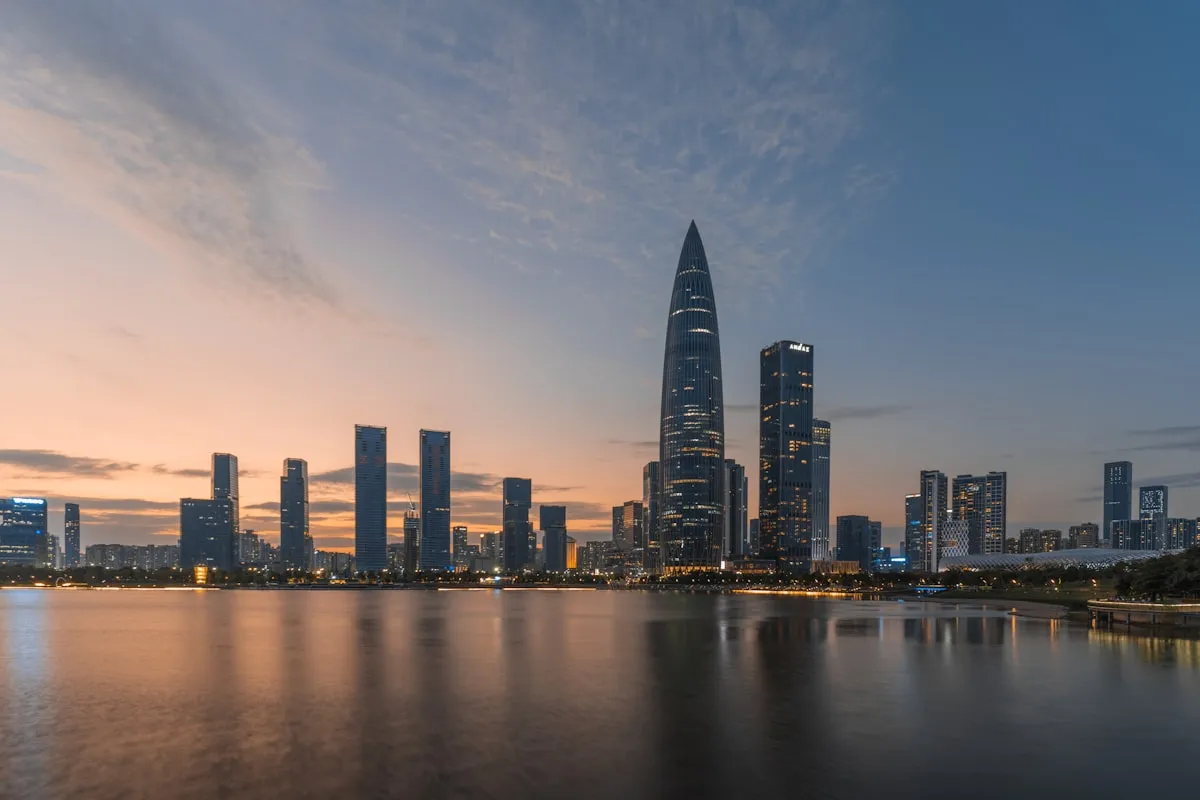
In 1980, Shenzhen's GDP was 270 million yuan — the output of a small fishing county with about 300,000 residents, rice paddies, and not much else. By 2025, that number reached 3.87 trillion yuan, a 14,000-fold increase that makes Shenzhen the third-richest city in China by economic output, trailing only Shanghai and Beijing. The population stands at 17.99 million, roughly two-thirds of whom are migrants who arrived from elsewhere in China seeking opportunity. Only about a third hold a local hukou, the household registration that confers residency rights (33.4% as of the 2020 census).
This is not a miracle story. Miracles imply randomness, divine intervention, luck. Shenzhen's rise was a deliberate, 45-year industrial construction project — one of the most consequential economic experiments in modern history. Understanding how it actually works, district by district, company by company, is essential for anyone engaging with Chinese manufacturing at a professional level.
Source File
This article was reviewed on 2026-06-30 against Shenzhen Municipal Government reporting on district industrial output and Nanshan/Bao'an metrics, Shenzhen government data on Fortune Global 500 headquarters, China Daily's report on 2025 Shenzhen foreign trade, CnEVPost's coverage of Shenzhen vehicle production, Sellers Union China's Huaqiangbei market guide, and background context from the Charter Cities Institute. City-level Chinese statistics can be revised; company-specific figures for private firms such as DJI are industry estimates unless explicitly attributed to audited filings.
Quick Overview
Shenzhen occupies a unique position in global manufacturing that no other city matches. It is simultaneously a hardware prototyping capital, a software and internet powerhouse, an electric vehicle production hub, and a drone industry cluster. The numbers tell the story:
| Metric | Value |
|---|---|
| GDP (2025) | 3.87 trillion yuan (~$540B) |
| Population | 17.99 million |
| R&D spending (% of GDP) | 6.67% (vs 2.8% national) |
| PCT patent applications (2024) | 16,300 (21 consecutive years #1 in China) |
| Fortune Global 500 HQs | 10 (7th globally) |
| High-tech companies | 25,000+ |
| Foreign trade (2025) | 4.55 trillion yuan (record) |
| Above-scale industrial enterprises | 14,000+ |
How Shenzhen Works: District by District
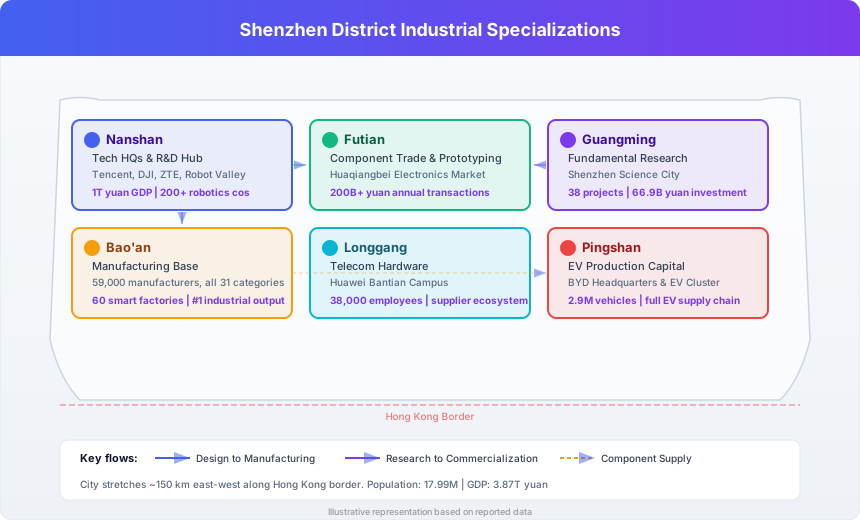
Shenzhen's administrative geography is the key to understanding its industrial logic. The city stretches roughly 150 kilometers from east to west along the Hong Kong border, and each district has evolved a distinct industrial specialization over decades of coordinated (and sometimes chaotic) development.
Nanshan: China's First Trillion-Yuan District
In 2025, Nanshan became the first district-level jurisdiction in China to surpass 1 trillion yuan in GDP — up from 652.7 billion yuan in 2020, as reported by the Shenzhen Municipal Government. That is a GDP density of 5.4 billion yuan per square kilometer, with 4,300 registered technology firms packed into each square kilometer.
Nanshan is where Shenzhen's tech crown jewels sit. Yuehai Subdistrict alone houses the headquarters of Tencent, DJI, and ZTE. The "Robot Valley" corridor has attracted 200+ robotics companies generating over 100 billion yuan in output, as noted by Global Times. Software and internet revenue from the district reached 900 billion yuan.
This is not a manufacturing district in the traditional sense. Nanshan is where products are conceived, designed, and managed — the brain rather than the hands. The headquarters here coordinate supply chains that stretch across Bao'an, Dongguan, and the broader Pearl River Delta.
Bao'an: The Factory Floor
If Nanshan is the brain, Bao'an is the muscle. This single district contains 59,000 manufacturers and 5,600 above-scale industrial enterprises — roughly 40% of Shenzhen's total, according to the Shenzhen Municipal Government. It covers all 31 manufacturing categories recognized in China's national industrial classification, meaning that within Bao'an's boundaries you can source virtually anything: printed circuit boards, precision metal parts, plastic injection molding, LED assemblies, robotics components, battery cells.
Bao'an has ranked first in the city for total industrial output for three consecutive years. The district has also built 60 smart factories — facilities that integrate IoT sensors, automated production lines, and real-time quality monitoring systems. This is where Shenzhen's manufacturing is most visibly upgrading from labor-intensive to technology-intensive.
Futian and Huaqiangbei: The World's Component Marketplace
Futian District contains Huaqiangbei, the 1.45-square-kilometer electronics market that handles over 200 billion yuan in annual transactions. More on Huaqiangbei below, but for now understand that Futian is where Shenzhen's hardware prototyping speed advantage originates — the ability to walk out of a design meeting, source every component within an hour, and have a working prototype by evening.
Longgang: The Huawei Anchor
Longgang's industrial identity is inseparable from Huawei. The company's Bantian campus has housed 38,000 employees since 1998, making it one of the largest single-employer technology complexes in the world, according to Wikipedia's Shenzhen entry. The campus functions as a small city with its own transportation, dining, and recreation infrastructure.
But Longgang is not a one-company district. The Huawei ecosystem has spawned thousands of suppliers, subcontractors, and service companies in the surrounding area. Hardware engineering talent pools around Longgang in a way that creates its own gravitational pull.
Guangming: The Science Bet
Guangming District is Shenzhen's bet on fundamental research and next-generation technology. The Shenzhen Science City project in Guangming has signed 38 major projects totaling 66.9 billion yuan in investment, as tracked by Shenzhen Municipal Government. This is where the city is building research laboratories, advanced materials facilities, and testing centers that aim to move Shenzhen up the value chain from rapid iteration to genuine invention.
Pingshan: The EV Capital
Pingshan is BYD country. The company's headquarters sit here, and BYD's presence has turned Shenzhen into China's top city for automobile production. Shenzhen produced 2.9 million vehicles in 2024, ranking first nationally, according to CnEVPost. The district has attracted a full EV supply chain — battery assembly, powertrain manufacturing, charging infrastructure — that extends well beyond BYD itself.
| District | Industrial Role | Key Metric |
|---|---|---|
| Nanshan | Tech HQs, R&D, software | First district to break 1T yuan GDP |
| Bao'an | Manufacturing base | 59,000 manufacturers, all 31 categories |
| Futian | Component trade, prototyping | Huaqiangbei: 200B+ yuan annual transactions |
| Longgang | Telecom hardware | Huawei campus: 38,000 employees |
| Guangming | Fundamental research | Science City: 38 projects, 66.9B yuan |
| Pingshan | EV production | 2.9M vehicles (city-wide), BYD HQ |
The Company Ecosystem
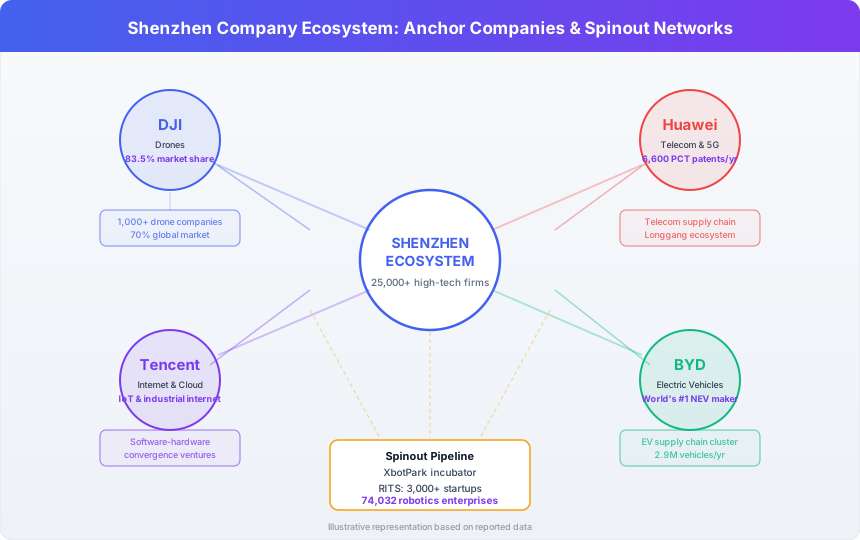
Shenzhen is home to 10 Fortune Global 500 headquarters, placing it seventh globally, per Shenzhen government data. The list includes Ping An Insurance, Huawei, Tencent, BYD, China Merchants Bank, and Vanke. But the Fortune 500 presence understates the ecosystem's depth. The city hosts 25,000+ high-tech companies and 74,032 registered robotics enterprises, per Shenzhen government statistics.
The Anchor Companies
DJI was founded in 2006 after Frank Wang developed early flight-control work while studying at the Hong Kong University of Science and Technology (HKUST), then built the company's commercial base in Shenzhen. From that origin, DJI has grown to command over 80% of the consumer drone market, generating approximately $11.5 billion in revenue with 14,000 employees. Shenzhen now hosts over 1,000 drone companies, collectively controlling roughly 70% of the world's consumer drone market.
Huawei has been in Shenzhen since Ren Zhengfei founded it in 1987 with 21,000 yuan in capital. The Bantian campus in Longgang remains its operational nerve center despite the company's global expansion. Huawei alone filed 6,600 PCT patent applications in 2024, as reported by the Shenzhen Statistics Bureau — a single company filing that would rank many nations in the global top 20.
BYD was founded in Shenzhen in 1995 by Wang Chuanfu and has become the world's largest NEV manufacturer. Its Pingshan headquarters anchor a local EV cluster that produces more cars than any other Chinese city.
Tencent, headquartered in Nanshan, is the world's largest gaming company and one of the most valuable technology firms globally. While not a manufacturer, Tencent's presence in Shenzhen creates a software ecosystem that intersects with hardware companies in areas like IoT, cloud computing, and industrial internet platforms.
The Spinout Dynamic
What makes Shenzhen genuinely different from other technology hubs is not the presence of large companies — every major Chinese city has those. It is the spinout velocity. The city functions as a startup machine for hardware.
DJI emerged from an HKUST lab. XbotPark, the hardware incubator founded by Li Zexiang (the same HKUST professor who mentored DJI's Wang), has spun out dozens of successful hardware companies. The Research Institute of Tsinghua University in Shenzhen (RITS) has incubated over 3,000 startups. This is not random entrepreneurship — it is a structured pipeline that takes academic research, attaches it to Shenzhen's prototyping speed, and pushes it toward commercialization within months rather than years.
The pattern is remarkably consistent. A founder develops a hardware concept, often drawing on experience from an anchor company. They set up in Nanshan or Bao'an, prototype using Huaqiangbei-sourced components, iterate through a local factory's production line, and scale using Shenzhen's logistics infrastructure. Anker, the global charging accessories brand now worth over $10 billion, followed this trajectory — founded by a former Google engineer in Changsha but built in Shenzhen to access the hardware ecosystem. SHEIN leverages Shenzhen's garment manufacturing periphery for its real-time fashion supply chain, even though its formal HQ has moved to Singapore.
The 74,032 robotics enterprises registered in Shenzhen represent the latest wave of this spinout dynamic. Many are founded by engineers who trained at DJI, Huawei, or Tencent and are now applying their expertise to industrial automation, service robots, and logistics drones. The density of these companies in specific corridors — particularly the Robot Valley in Nanshan — creates knowledge spillovers that accelerate the entire sector.
Huaqiangbei: Component Sourcing at Warp Speed
Huaqiangbei deserves its own section because it is the single most concentrated electronics marketplace on Earth, and it operates by rules that foreign hardware professionals often find disorienting.
The market covers 1.45 square kilometers in Futian District and contains over 200,000 square meters of commercial space spread across more than 30 shopping malls, as documented by Sellers Union China's comprehensive guide. Annual transactions exceed 200 billion yuan. The phrase repeated by every hardware entrepreneur who has worked there captures the operational reality: "Design in the morning, process by noon, sample by afternoon."
How It Actually Works
Huaqiangbei is not a single market. It is a district of interconnected buildings, each specializing in different product categories — SEG Electronics Market for components, Huaqiang Electronics World for finished products, Mingtong Digital City for mobile devices, and dozens more. Each building contains hundreds of small booths, typically 3-10 square meters, operated by independent traders.
The booth model is the key innovation. Each booth operator holds inventory of specific components — a particular IC chip, a display module, a battery cell, a connector type. They offer flexible minimum order quantities (MOQs) that would be impossible in traditional manufacturing supply chains. Need 50 units of a specific sensor for a prototype? Walk to the booth, buy them over the counter. Need 50,000 units next week? The same booth operator can arrange that through their factory connections.
This is why hardware entrepreneurs fly to Shenzhen rather than iterating through email exchanges with distant suppliers. The latency in the feedback loop collapses from weeks to hours. A designer can walk through Huaqiangbei in the morning with a bill of materials, source every component by early afternoon, hand them to a nearby assembly shop, and have a working prototype the same evening. This cycle — conceive, source, build, test, iterate — can repeat daily. In Silicon Valley or Berlin, the same cycle takes weeks per iteration.
Who Trades at Huaqiangbei
The market serves three distinct customer tiers. First: the booth operators themselves, who trade components among each other in a high-speed secondary market that prices chips, capacitors, and connectors by the minute. Second: domestic hardware startups and established OEMs who send procurement teams to walk the market with specific sourcing lists. Third: international buyers — from solo entrepreneurs to Fortune 500 procurement teams — who come to Shenzhen specifically because Huaqiangbei enables physical inspection, face-to-face negotiation, and immediate pickup that no online marketplace can replicate.
The market also functions as an informal quality control system. Experienced buyers can spot counterfeit components by sight and touch, compare offerings from a dozen vendors within an hour, and build supplier relationships that carry forward into volume production. The trust network that develops through repeated face-to-face transactions is a form of social infrastructure that no digital platform has managed to replace.
Guangdong province's electronics and telecom sector generated 4.67 trillion yuan in revenue in 2022, and Shenzhen accounts for 88% of Guangdong's IC and semiconductor revenue, according to China Briefing and Chipoda data. Huaqiangbei is the physical interface where that industrial scale becomes accessible at the individual entrepreneur level.
The Innovation Machine
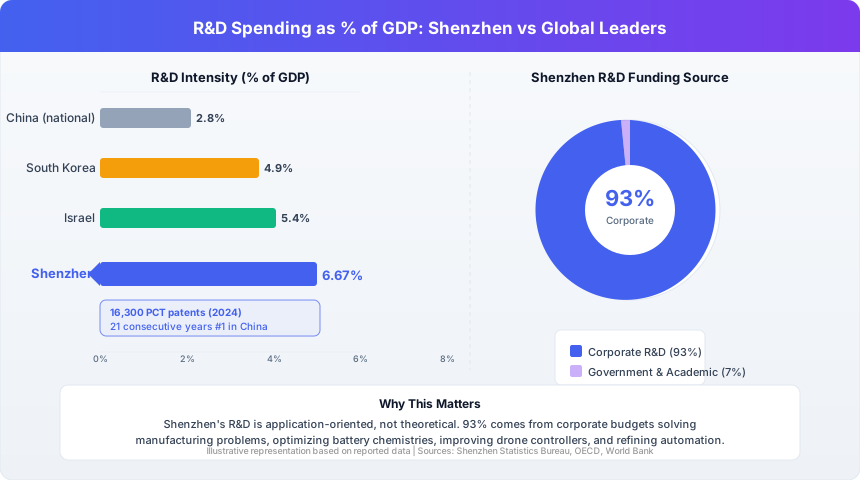
Shenzhen spends 6.67% of its GDP on research and development — more than double the national average of 2.8% and higher than most developed economies. South Korea, often cited as a global R&D leader, spends around 4.9%. Israel, the top spender globally, is near 5.4%. Shenzhen's figure is exceptional, and its composition is distinctive: 93% of R&D spending comes from corporate budgets rather than government or academic institutions, according to the Shenzhen Statistics Bureau.
This matters because corporate R&D is application-oriented. Shenzhen is not producing Nobel Prize-winning theoretical physics. It is solving manufacturing problems, optimizing battery chemistries, improving drone flight controllers, and refining factory automation systems. The innovation is incremental, cumulative, and commercially directed — which is precisely why it compounds so effectively.
The patent numbers confirm this. Shenzhen filed 16,300 PCT international patent applications in 2024, ranking first among Chinese cities for the 21st consecutive year. Huawei alone contributed 6,600 of those. The city also holds the 4th-busiest container port globally and operates the 5th-busiest airport in China — the logistics infrastructure to move innovations from prototype to global market at speed.
The education pipeline is catching up to the industrial base. Shenzhen now hosts 14 universities, including the Southern University of Science and Technology (SUSTech), which is positioned as a top-100 contender. For decades, Shenzhen's weakness was its lack of top-tier universities — it imported talent rather than growing it. That is changing, though the full impact of the university buildout will take another decade to materialize.
Why It Cannot Be Replicated
Every few years, a government somewhere announces plans to build "the next Shenzhen." India has tried with hardware manufacturing zones. Vietnam has attracted electronics assembly. Indonesia, Thailand, and various African nations have all expressed the aspiration. None will replicate what Shenzhen has built, and understanding why is more useful than pretending otherwise.
Supply Chain Density
Shenzhen's advantage is not cheap labor — wages here are among the highest in China. It is density. Within a one-hour drive from Nanshan, you can reach component suppliers, PCB fabricators, injection molders, assembly shops, testing laboratories, packaging companies, and logistics forwarders. Each of these businesses exists in multiples, creating competition that drives quality up and lead times down. This density accumulated over 45 years and cannot be legislated into existence.
Accumulated Knowledge
The migrant workers who arrived in Shenzhen in the 1990s are now factory owners, supply chain managers, and technical specialists with decades of domain expertise. This tacit knowledge — knowing which supplier can hit tight tolerances on aluminum parts, which booth in Huaqiangbei has genuine versus counterfeit ICs, how to navigate customs for electronics exports — lives in people, not databases. It cannot be transferred by building industrial parks.
Government Coordination
Shenzhen's government has played an unusually effective coordinating role over four decades, from the original Special Economic Zone designation in 1980 (one of four original SEZs) through successive waves of infrastructure investment, industrial policy, and talent attraction programs. GDP growth averaged 27% annually in the early years, and the population grew roughly 30-fold, according to the Charter Cities Institute. This consistency of policy direction across decades is rare globally and nearly impossible to replicate in democratic systems with regular government turnover.
What Other Cities Get Wrong
The common mistake is focusing on physical infrastructure — building industrial parks, offering tax incentives, constructing ports — without understanding that Shenzhen's advantage is relational. It is the network of 59,000 manufacturers in Bao'an who know each other, the 200+ robotics companies in Nanshan who share talent and suppliers, the 1,000+ drone companies who collectively push the technology forward. Buildings do not create networks. Time and shared experience do.
Vietnam has attracted significant electronics assembly investment from Samsung, Foxconn, and others. But Hanoi and Ho Chi Minh City remain assembly points — components are largely imported, designed elsewhere, and shipped out as finished goods. The knowledge of how to design a product, optimize its manufacturing process, and iterate on the design based on production feedback remains concentrated in places like Shenzhen. India's hardware ambitions face a similar gap: the country has engineering talent and market demand but lacks the supplier density that makes rapid hardware iteration possible.
The Migrant Talent Pipeline
Shenzhen's population growth from roughly 300,000 to 18 million over 45 years represents one of the largest voluntary migrations in human history. The city's culture was built by people who chose to leave their hometowns for opportunity — a self-selecting population that valued ambition over stability. This migrant mentality permeates the business culture. Factory owners who started as line workers, engineers who learned their trade on the factory floor before founding their own companies, and salespeople who built networks spanning the entire Pearl River Delta — this human capital accumulation is Shenzhen's deepest moat, and the one most difficult to measure or replicate.
Challenges
No ecosystem is without friction, and Shenzhen faces several structural challenges that could constrain its growth trajectory.
Housing Affordability
Shenzhen is the least affordable city in China by price-to-income ratio, a fact that directly threatens the migrant talent pipeline that built the city. When two-thirds of your population are migrants who came seeking opportunity, and housing costs consume an ever-larger share of their income, the incentive structure shifts. Workers and mid-career professionals alike are leaving for lower-cost cities like Chengdu, Wuhan, and Changsha, where salaries are lower but disposable income after housing can be higher.
Investment Slowdown
Fixed-asset investment in Shenzhen has decelerated significantly, reflecting both national real estate headwinds and local saturation in certain infrastructure categories. The city's heavy bet on technology infrastructure (Guangming Science City, smart factory subsidies) partly offsets this, but the headline number is concerning for a city that has historically invested aggressively in its physical capital stock.
Tariff Exposure
Shenzhen's export orientation makes it vulnerable to trade barriers. However, the city's exposure is structurally mitigated by its technology mix: approximately 70% of Shenzhen's exports are classified as high-tech products. While tariffs on low-end manufactured goods can redirect production to Vietnam or Bangladesh, the kind of advanced electronics, telecom equipment, and drone technology that Shenzhen specializes in cannot be easily sourced elsewhere. The tariffs may hurt at the margin, but they do not threaten the core ecosystem.
Practical Guide: Engaging with Shenzhen Manufacturing
For professionals looking to source from, partner with, or simply understand Shenzhen's manufacturing ecosystem, here is a practical framework.
Sourcing from Shenzhen
Start with the product category. If you need electronics — PCBs, consumer electronics components, IoT devices, drone parts — Shenzhen is the optimal starting point and likely the endpoint as well. For other categories, assess whether Shenzhen's advantages (speed, ecosystem density, prototyping capability) outweigh the cost premium compared to inland Chinese cities.
Huaqiangbei is essential for prototyping and small-batch production. For larger volumes, engage with factories directly in Bao'an or through Shenzhen-based sourcing agents who maintain relationships across the district's 59,000 manufacturers.
Visiting Huaqiangbei
Plan at least two full days. SEG Plaza and Huaqiang Electronics World are the essential starting points. Bring your bill of materials, component specifications, and target pricing. Walk the booths, compare offerings, and negotiate face-to-face. Booth operators respond to physical presence differently than email inquiries — it signals seriousness and enables the kind of rapid back-and-forth that the market is designed to facilitate.
Key Trade Shows and Timing
The Canton Fair in Guangzhou is one hour away by high-speed rail and runs biannually (April/May and October/November). Shenzhen also hosts specialized electronics and technology trade shows throughout the year. Align visits to coincide with these events for maximum supplier contact density.
Cross-Border Logistics
Shenzhen's logistics infrastructure is world-class. The city operates the 4th-busiest container port globally and the 5th-busiest airport in China. Integrated cross-border e-commerce zones simplify export procedures. The city was the first in the world to convert its entire public bus and taxi fleet to electric vehicles — a practical detail that speaks to the operational modernity of the infrastructure.
Professional Networks
Shenzhen's manufacturing ecosystem runs on relationships more than contracts. Engaging local sourcing agents, attending industry events, and investing time in face-to-face meetings with factory owners yields returns that purely transactional approaches cannot match. The city's culture rewards long-term relationships and penalizes one-off extractive engagement.
Legal and IP Considerations
China's intellectual property framework has strengthened considerably over the past decade, and Shenzhen's courts are among the most experienced in China for handling technology-related IP disputes. However, the practical reality of manufacturing in a dense ecosystem where information flows quickly means that confidentiality requires active management. Non-disclosure agreements, registered designs, and patents filed before production begins are baseline requirements. For detailed guidance on protecting intellectual property when manufacturing in China, the practical framework in the broader China manufacturing guide covers filing strategies and enforcement mechanisms.
Cost Expectations
Shenzhen is no longer a low-cost manufacturing destination. Land prices, wages, and regulatory compliance costs are among the highest in China. What you are paying for is speed, ecosystem density, and the ability to iterate rapidly. For pure cost optimization on mature, stable products with long production runs, inland Chinese cities or Southeast Asian alternatives may be more economical. The value proposition is strongest for new products, short production runs, frequent design changes, and anything requiring rapid prototyping.
 Photo by Product School on Unsplash
Frequently Asked Questions
Why is Shenzhen called the Silicon Valley of Hardware?
The comparison comes from Shenzhen's concentration of hardware companies, rapid prototyping culture, and ecosystem density — similar to how Silicon Valley concentrates software companies and venture capital. The hardware focus is what distinguishes it: while Silicon Valley builds software, Shenzhen builds physical products. The phrase "Silicon Valley of Hardware" was popularized by Western hardware entrepreneurs like Bunnie Huang and organizations like HAX (formerly HAXLR8R), which was based in Shenzhen specifically to access the prototyping speed.
Can foreign companies manufacture in Shenzhen without a local partner?
Yes. Foreign companies can contract directly with Shenzhen factories, visit Huaqiangbei independently, and engage sourcing agents without a Chinese joint venture partner. However, companies establishing their own manufacturing operations (as opposed to contracting existing factories) need to navigate China's corporate registration requirements, which vary by industry and investment scale. Most foreign companies start with contract manufacturing through an existing Shenzhen factory before considering any local establishment.
How long does it take to get a prototype made in Shenzhen?
For electronics products, the standard claim — and it is largely accurate for simple to moderate complexity — is one to three days from design files to working prototype. This assumes you have complete design files, can physically visit Huaqiangbei to source components, and use a local assembly shop with whom you have a relationship. Complex products with custom tooling (injection molds, CNC-machined enclosures) add days to weeks depending on the precision required.
Is Shenzhen affected by US-China tariffs?
Shenzhen is affected but structurally resilient. The city's exports are approximately 70% high-tech products — telecommunications equipment, drones, advanced electronics, electric vehicles — that are difficult to source from alternative locations. Tariffs increase costs for US buyers but do not eliminate Shenzhen's competitive advantages in these categories. The city's foreign trade reached a record 4.55 trillion yuan in 2025 despite the tariff environment, indicating that demand for Shenzhen's specialized manufacturing capabilities remains strong.
What is the best time of year to visit Shenzhen for manufacturing?
The Canton Fair in Guangzhou (April-May and October-November) is the most productive window, as many Shenzhen suppliers are actively seeking new clients and the broader Pearl River Delta manufacturing ecosystem is at peak engagement. Avoid Chinese New Year (typically late January to mid-February), when factories shut down for two to four weeks and the subsequent ramp-up period can delay orders by weeks. Summer (June-August) is hot, humid, and less convenient but perfectly functional for business purposes.
Claim Confidence File
| Claim | Confidence | Evidence boundary |
|---|---|---|
| Shenzhen's 2025 GDP, foreign-trade, district-output, high-tech-firm, patent, and Fortune Global 500 headquarters figures | High | These figures are drawn from Shenzhen government releases and named state / business-media reports. They are suitable for city-level context but can be revised in later statistical yearbooks. |
| Bao'an, Nanshan, Futian / Huaqiangbei, Longgang, Guangming, and Pingshan each play different industrial roles | High | The district-role map is supported by official district data, named anchor-company locations, and observable market infrastructure. It is a functional map, not a complete administrative inventory. |
| Huaqiangbei gives hardware teams a speed advantage in components, prototypes, and small-batch sourcing | Medium-high | The market structure and transaction-scale claims come from market guides and long-running industry observation. Buyers should still verify specific booth, component authenticity, and volume-production path. |
| Shenzhen cannot be "replicated" by simply building industrial parks elsewhere | Medium | This is the article's analytical judgment based on supplier density, talent accumulation, logistics, and policy continuity. It should be read as a comparative framework, not as a law of economic development. |
| DJI revenue, drone-market share, robotics-enterprise counts, and private-company employment figures | Medium | These are useful ecosystem signals, but some rely on industry reporting or non-audited sources rather than public company filings. They should not be used as investment-grade figures. |
| Sourcing from Shenzhen reduces risk by itself | Low | The article does not make this claim. Shenzhen improves access, speed, and supplier density; buyer risk still depends on factory identity, quality controls, contracts, IP handling, and logistics execution. |
Methodology
This analysis draws on Shenzhen Statistics Bureau economic data, district-level government reports from sz.gov.cn, corporate filings from DJI, Huawei, and BYD, and field reporting from Huaqiangbei market surveys. GDP and trade figures use official 2025 releases; patent data is from 2024 annual reports. Fixed-asset investment figures are from macaonews reporting on municipal statistics. Note that Chinese economic statistics at the city level are subject to revision, and some company-specific figures (particularly for private companies like DJI) are estimates based on industry reporting rather than audited financials.
Related Entries
- How China Manufactures: Inside the World's Factory (2026) — How China Manufactures: Inside the World's Factory
- Yongkang hardware cluster — China's Industrial Clusters: Why Everything Is Made in One Place
- China manufacturing guide — China's Global Supply Chain: How the World Depends on Chinese Manufacturing
- China Solar Dominance: Supply Chain Power, Profit Crisis — How China Came to Dominate Solar Panel Manufacturing
- DJI Drone Dominance: How It Built a 70% Share — How DJI Built a 70% Global Drone Monopoly
- Huawei Comeback Story: How Sanctions Remade It — Huawei's Comeback: From US Sanctions to Global Return