
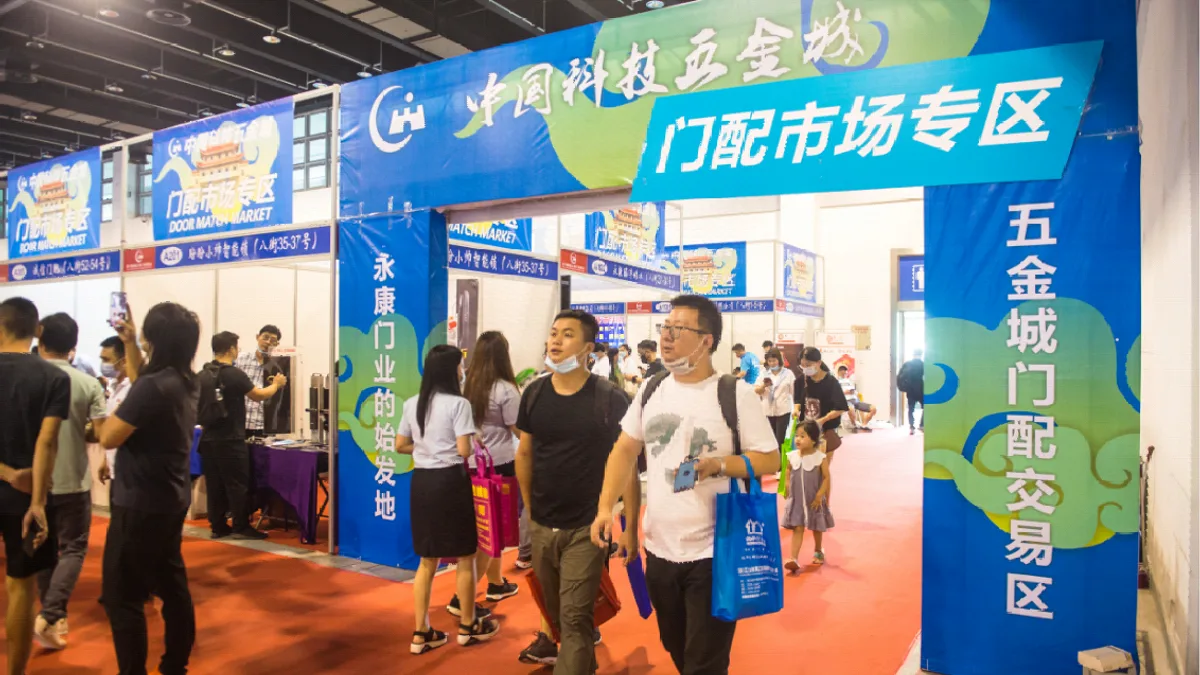
Search Yongkang in English and it first looks like a supplier list: angle grinders, chainsaws, security doors, vacuum cups, cookware, ladders, locks, OEM, ODM, fast delivery, certificates. The pages are useful if you need leads. They are weak if you want to understand why the same county keeps appearing behind so many ordinary things.
The numbers behind the place are not supplier-list numbers. Yongkang exported RMB 49.5 billion in goods in 2024, according to the city's 2024 statistical communique. More than 2,100 local enterprises recorded self-operated exports. Above-scale industrial sales output reached RMB 104.125 billion, and export delivery value reached RMB 33.675 billion.
Those numbers change the question. Yongkang is not interesting because one factory became famous. It is interesting because an inland county built a system that turns metalworking, private workshops, wholesale markets, fairs, e-commerce, logistics and export services into thousands of sellable hardware SKUs.
For global buyers, Yongkang appears as a wall of supplier names. For Yongkang itself, the deeper story is harder: how to turn a hardware bazaar into a world-facing industrial brand before margins, imitation, tariffs and weak channel control catch up with the old model.
Source File
This article was reviewed on 2026-06-30 against Yongkang's 2024 statistical communique, the Commerce Bureau's 2025 first-half trade summary, the China Hardware Fair English page, Hardware City's market profile, People's Daily coverage of the 30th China Hardware Fair, Haers' 2024 annual report, and Zhongjian Technology's 2024 annual report. Official city figures are used as administrative reporting, not as buyer-level proof that any specific supplier is export-ready.
Quick Answer
| Question | Short answer |
|---|---|
| What is the Yongkang hardware cluster? | A county-level manufacturing and trading ecosystem in Zhejiang built around hardware factories, China Technology Hardware City, trade fairs, e-commerce and export services. |
| Is Yongkang a market or a factory town? | Both, plus more. The market helps factories sell, the factories give the market depth, and exhibitions and online channels extend both. |
| What products is Yongkang known for? | Hardware, doors and locks, stainless-steel cups, power tools, garden tools, cookware, cleaning appliances, leisure vehicles and related metal goods. |
| Why does Yongkang show up in English sourcing searches? | Supplier directories and trade platforms use Yongkang as a location and cluster signal. That signal is useful, but it is not proof that a listing is the real factory. |
| What should buyers verify? | Legal entity, factory address, business type, product specialization, tooling, certifications, QC process, export records, after-sales parts and whether the seller is a manufacturer, trading company or mixed industry-and-trade firm. |
The Story English Search Misses
Search "Yongkang hardware market" or "Yongkang tools manufacturer" in English and the first layer is predictable. You find sourcing-agent guides, Alibaba pages, Made-in-China profiles, exhibition pages and supplier storefronts. They can be useful as leads. They are weak as explanation.
The reason is structural. A marketplace page is built to answer "who can sell me this product?" It is not built to answer "why did this county become good at this product family?" A supplier profile is built to promote one company. It will not usually explain how that company sits inside local tooling shops, surface-treatment vendors, market stalls, fair organizers, logistics providers and export agents.
That gap is why Yongkang is easy to find and hard to understand in English. The demand signal is visible in search results, but the better evidence sits in Chinese official documents, trade-fair materials, company filings and local industry pages. Connecting those layers turns a wall of vendor names into a working map.
The most useful mental model is simple:
> Yongkang is what happens when a hardware production base, a wholesale market, a fair economy and an export-service system occupy the same county.
That model is more useful than calling it "China's hardware capital" and stopping there.
The county's story is not a straight line from cheap labor to exports. It is a loop: products created the market, the market attracted buyers, buyers sharpened product feedback, fairs made the cluster visible, and export channels pulled more firms into the system. The same loop also created the weakness Yongkang now has to solve. When too many firms learn to make similar goods, density can become sameness.
The County Is The Protagonist, Not A Single Factory
Yongkang is administratively a county-level city under Jinhua in Zhejiang province. It is not a coastal megacity like Shenzhen or Shanghai. Its power comes from specialization, density and repetition across decades.
Local official pages describe Yongkang through a "five-metal" identity and a long hardware culture. That history is partly civic narrative. The city's five-metal culture page reaches back into local legend and craft memory, which should not be read as literal proof of modern industrial continuity. But the page is still useful because it shows how Yongkang understands itself: a small county that asks why it, rather than many nearby places with similar geography, became such a hardware center.
The modern answer is less mythic. Reform-era private enterprise, specialized workshops, product-market feedback, local wholesale infrastructure, and repeated trade events created a reinforcing loop. The factories made products. The market attracted buyers. Buyers generated product feedback. Fairs made the cluster visible. E-commerce and export channels widened the geography. More suppliers entered because the county already had suppliers, materials, buyers and know-how.
This is the same broad cluster logic described in How China Manufactures: Inside the World's Factory (2026), but on a county scale rather than a mega-region scale. Shenzhen compresses electronics. Yiwu compresses small commodities. Yongkang compresses hardware and related metal goods.
The Hard Scale: 2024 And 2025
Yongkang is easy to underestimate because the products are ordinary: doors, cups, tools, locks, cookware, mower parts, cleaning appliances. Ordinary products can produce extraordinary industrial density.
The city's 2024 statistical communique gives the hard frame:
| 2024 indicator | Yongkang figure | Why it matters |
|---|---|---|
| GDP | RMB 83.553B | County-level scale, not workshop-town scale |
| Secondary industry added value | RMB 42.524B | Manufacturing remains central |
| Above-scale industrial firms | 1,009 | Large enough for meaningful industrial breadth |
| Above-scale industrial sales output | RMB 104.125B | The manufacturing layer is bigger than the county GDP number suggests because sales output is a different measure |
| Above-scale industrial export delivery value | RMB 33.675B | Export is embedded in the production system |
| Total import/export | RMB 51.3B | Yongkang is a trade machine, not only a local market |
| Exports | RMB 49.5B | Exports dominate its external trade profile |
| Enterprises with self-operated export records | 2,120 | Export capability is distributed across many firms |
| Postal parcel volume | 8.97B pieces | E-commerce and logistics matter to the industrial story |
| Patent authorizations | 9,944 | Innovation exists, but must be read beside the city's own R&D concerns |
That is the key: Yongkang is not only a factory base. It is a production-and-channel system.
Seven Capitals, One Industrial Logic
Yongkang's e-commerce 14th Five-Year plan lays out how the city brands its product families. It names several "capitals": China Hardware Capital, China Door Capital, China Cup Capital, China Power Tool Capital, China Leisure Sports Vehicle Capital, China Home Cleaning Products Capital and China Cookware Capital.
Those labels are promotional, but they are not random. They point to product families that repeatedly appear across official materials, trade fairs, supplier listings and company cases.
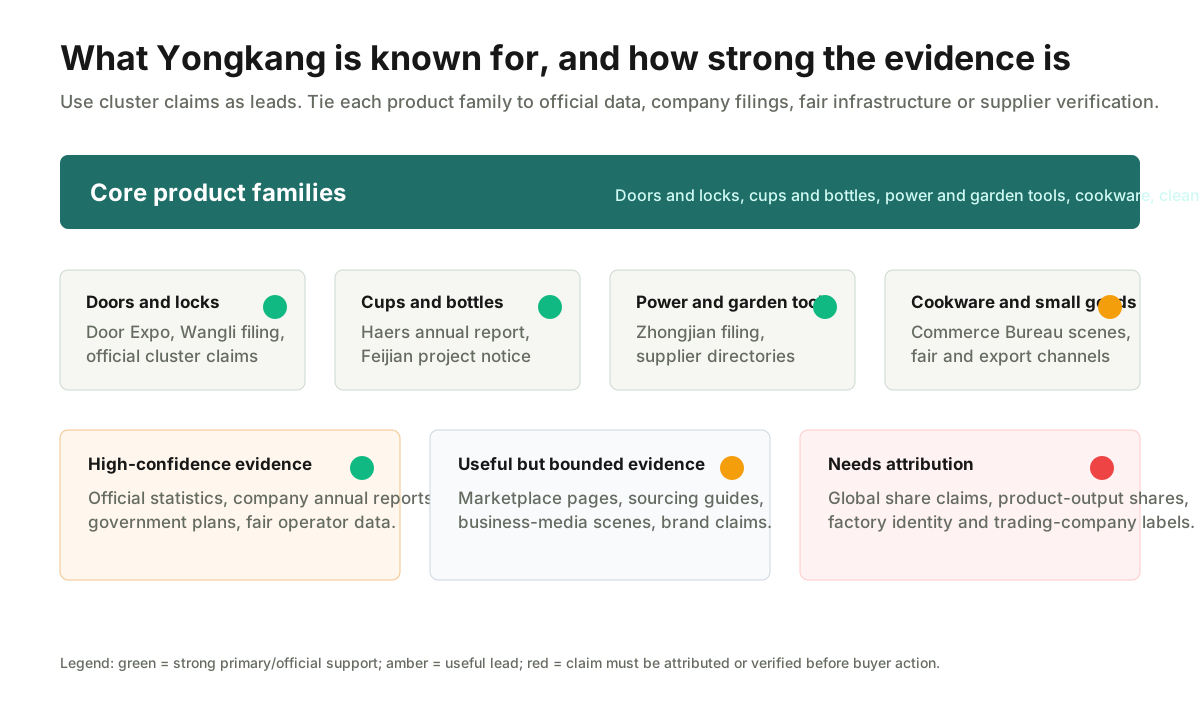
The category labels are most useful when they are tied to evidence rather than repeated as slogans:
| Product family | Evidence that supports the cluster link | How to treat the claim |
|---|---|---|
| Doors and locks | Door Expo history, Wangli Security annual report, official cluster claims | Strong cluster signal, but market-share claims need attribution |
| Stainless-steel cups and bottles | Haers annual report, Feijian project notice, official category labels | Strong named-company evidence |
| Power and garden tools | Zhongjian Technology annual report, Made-in-China and Alibaba supplier profiles | Strong category signal, but verify individual factory capability |
| Cookware and small hardware | Commerce Bureau stories, market/fair materials, supplier directories | Useful cluster signal, but company-level verification needed |
| Cleaning goods and leisure vehicles | Official category labels and e-commerce plan | Good strategic map; needs product-level sourcing for specific claims |
The Market That Made The Cluster Visible
China Technology Hardware City is the physical center of Yongkang's commercial story.
The official China Hardware Fair site describes Zhejiang China Technology Hardware City Group as a market group that combines hardware product and production-material trading, information, exhibitions, hardware indexes and online markets. Its about page says the market has about 800,000 square meters of business area, two physical market groups, the international exhibition center, a hardware life hall, online platforms, five major operating sections and more than 4,500 shops. It says products reach more than 170 countries and regions and cites annual physical-market transaction value above RMB 50 billion.
A separate official market profile says China Technology Hardware City was founded in 1992, covers 1,260 mu, has 1 million square meters of business facilities, and historically reached RMB 38.6 billion in transaction value in 2014. The exact current annual market transaction figure should be handled with care because pages differ by date and definition. The direction is clear: this is a large specialized market, not a tourist market with hardware stalls.
The market's function is more important than any single number. Hardware City's own profile frames the relationship as a two-way mechanism: industry supports the market, and the market pushes industry. That is the cluster in one sentence. Yongkang did not only produce goods and then find buyers. It built a place where the act of selling goods fed information back into production.
It does three things for the county:
- It aggregates sellers so buyers can compare products quickly.
- It gives factories and traders a public channel outside one-to-one export relationships.
- It turns local manufacturing capacity into a visible marketplace identity.
That mechanism explains why supplier pages often lean on "Yongkang" as a signal. The place name does some sales work. But that also creates the buyer risk. A trading company can borrow the cluster aura. A factory in a nearby county can use Yongkang market access as a selling point. A mixed industry-and-trade company may be partly real factory, partly reseller. The address alone does not answer the verification question.
By 2024, the market system was no longer only physical counters and storefronts. A Yongkang state-owned-assets office summary of Hardware City Group said the group held 33 exhibitions and events in 2024, with 582,000 square meters of exhibition area, about 533,000 exhibitors and professional visitors, and RMB 14.397 billion in intended transaction value. Those are event figures, not audited final sales, but they show how the market became a recurring machine for matching products, buyers and local policy priorities.
Fairs Are Not Decoration. They Are Infrastructure.
Yongkang's fairs are not side events. They are part of the cluster's operating mechanism.
The China Hardware Fair English page says the fair has been held since 1996, relying on Yongkang as a major hardware production and export base and on China Technology Hardware City as a major distribution center. It presents seven major categories and more than 60 subcategories. The 1996 origin matters because it gives Yongkang a long-running annual ritual for converting local capacity into national and international visibility.
People's Daily used the 2025 30th China Hardware Fair to frame that evolution. Its 2025 article traces the fair from the first event in October 1996 to the 30th event in September 2025, emphasizing how it expanded from a simple trading venue into a broader exhibition, conference, online-offline, industry, market and technology platform.
That is the second turning point in the story. A market lets buyers find sellers. A fair gives the whole county a calendar, a stage and a reason to upgrade what it can show. In 1996, Yongkang needed a way to gather and display local hardware. By 2025, the fair was being described as a platform that connected exhibition, conference, online commerce, industrial upgrading, market activity and technology. The fair did not replace the factories. It made the factory town readable from the outside.
The door industry has its own institutional layer. The China (Yongkang) International Door Industry Expo's history page records recurring door-expo transaction values, including the 2024 14th expo with 980 firms and RMB 3.839 billion transaction value, and the 2025 15th expo with 817 firms, 88,000 square meters, 150,500 visits and RMB 3.891 billion transaction value.
The point is not that every fair number should be treated as audited commercial revenue. Many are transaction or intended-transaction figures. The point is that Yongkang has a recurring public mechanism for matching local suppliers, domestic distributors, overseas buyers, product categories and local government priorities.
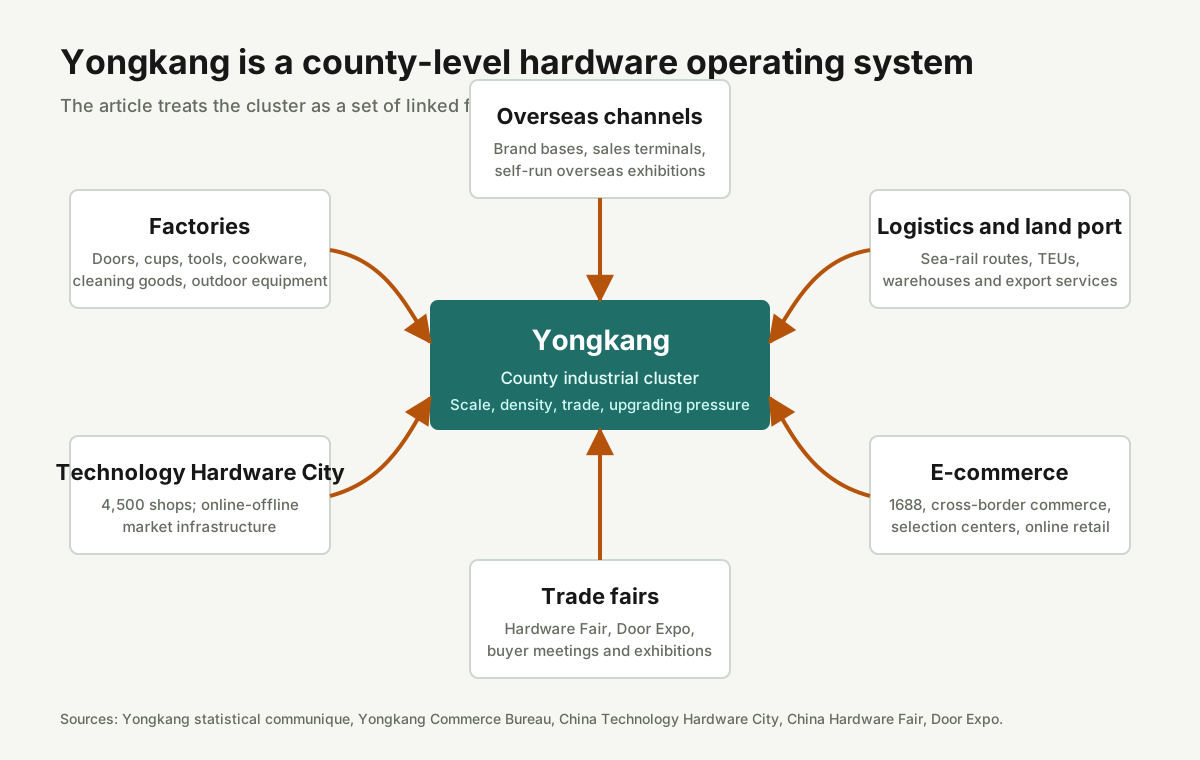
In a thin cluster, a trade fair is a marketing event. In a dense cluster, it is a coordination layer.
E-Commerce And The Export Channel Push
The next layer is digital and overseas channel-building.
Yongkang's e-commerce plan set aggressive 2025 targets: RMB 140 billion in online retail, more than 200 influencer brands, more than 1,300 traditional enterprises using cross-border e-commerce, more than five e-commerce parks and 200 e-commerce professional villages. These are policy targets, not automatic proof of achievement. They show the direction the county wants: a move from factory and market density toward platform-enabled demand generation.
The channel story was already visible in 2024. Yongkang's Commerce Bureau described a "Pulse Yongkang, Link the World" outbound campaign in which the first 30 companies signed on, more than 200 overseas service providers from Russia, Kazakhstan and other Central Asian markets visited Yongkang, and the city supported 72 domestic and overseas exhibitions, more than 20 overseas exhibition groups, and 500-plus enterprise participations. The same Commerce Bureau summary said intended transactions exceeded RMB 3 billion and that the city planned overseas brand display centers in more than 80 emerging markets.
The 2025 Commerce Bureau materials make that direction more concrete. The H1 summary says Yongkang planned to build a global hardware marketing network, hold seven overseas self-run "Yongkang Hardware Brand Overseas" exhibitions, organize 40 groups and 800 enterprise participations, build seven overseas brand bases, add 100 overseas sales terminals and add 10 overseas warehouses.
Another Commerce Bureau article from September 2025 describes the emerging-market push in more operational terms: overseas self-run exhibitions, outbound groups, hundreds of enterprise participations, support for brands such as CROWN, DWT, TOSAN and COOFIX in overseas niche markets, overseas brand bases, sales terminals and public overseas warehouses. It also says the 1688 Yongkang Hardware Selection Center had 57 enterprises, 4,675 products, 50 brands, 42 special zones and sales above RMB 10 million.
Hardware City Group's 2024 work also points in the same direction. The state-owned-assets office summary said the group landed a Yongkang hardware Mailian overseas service center in Turkey and, with Amazon and other platforms, achieved RMB 12.75 million in sales. That is small beside Yongkang's total export value. Its importance is symbolic: the county is trying to extend the market outward, not merely wait for foreign buyers to arrive at the market.
Those figures are not the same as saying Yongkang has solved global branding. They show the county trying to solve a real channel problem collectively. A factory can make a product. A market can display it. But global buyers increasingly demand documentation, service, warranty terms, local warehousing, customs reliability, platform visibility and brand trust.
That is the move from supplier cluster to export operating system.
The Logistics Layer
Hardware is physical. It moves by truck, port, rail, container and warehouse. That sounds obvious until you realize how often English sourcing pages ignore it.
Yongkang's transport bureau described logistics work in 2024 around the China Hardware Logistics Port and a "one station, two ports, three lines" sea-rail model. The transport bureau article says more than 800 trains and 180,000 TEUs had been operated, and it describes a planned Yongkang land-port project of about 170 mu with RMB 500 million in total investment.
For a buyer, this matters because hardware categories often have low tolerance for logistics surprises. Doors are bulky. Tools involve batteries, motors, chargers and cartons. Stainless cups need packaging quality. Cookware can suffer from coating, denting and carton failures. Garden machinery involves engines or battery systems, blade safety and spare parts. Export capability is not only "can the factory make it?" It is "can the local system move it, document it and support it?"
This is where Yongkang's market-fair-logistics package starts to make sense. The county is trying to make itself easier to buy from as a system.
Named Company Vignettes: What The Cluster Looks Like In Firms
The temptation is to turn every manufacturing story into a founder story. Yongkang does not work that way. The protagonist is the system, and individual companies show different ways that system creates opportunity and pressure.
These examples do not represent every Yongkang supplier. They show how different product families sit inside the same county machine: cups moving from OEM toward brands, doors leaning on dense component chains, garden machinery built for export, and smaller firms using fairs and outbound programs to find new market geography.
Haers: Cups, OEM And Own Brands
Zhejiang Haers Vacuum Containers is the cleanest public-company example for Yongkang's cup-and-bottle family. Its 2024 annual report lists its registered and office address at Haers Road 1 in Yongkang Economic Development Zone. It reported 2024 revenue of RMB 3.3315 billion, up 38.40%, and net profit attributable to shareholders of RMB 286.5 million.
Haers describes itself as a cup and bottle manufacturer and brand operator. The important part is the business model: it works with global brands through OEM and also operates own brands including Haers and SIGG. That places the company on the Yongkang upgrade path. The county is not only trying to ship metal goods. It is trying to move from making for others toward owning product design, brand equity and customer channels.
Haers should not be read as a stand-in for all Yongkang. It is a larger, listed company. Many Yongkang firms are much smaller. But Haers shows what the upgrade path looks like when it succeeds enough to become visible in filings: the county's old advantage was making metal goods efficiently, while the next advantage has to include brand, design, channel and repeat consumer trust.
Wangli: Doors And The Security-Door Chain
Wangli Security & Surveillance is a listed company case for the door and security-door side. Its 2024 annual report, displayed by Sina Finance, lists the company address in Yongkang Economic Development Zone. It describes Yongkang as having a mature security-door industrial chain and says Yongkang security-door output accounts for about 70% of national total.
That 70% figure is a company-disclosure claim, not an independently verified market-share audit. It is still useful because it shows how a listed company frames the local industrial advantage: component availability, related firms, labor familiarity, and category identity.
The company's product revenue breakdown also matters. It includes steel security doors, other doors and smart locks. That is exactly the kind of category broadening Yongkang wants: from metal door manufacturing toward smarter, branded, higher-value building hardware.
Zhongjian Technology: Garden Machines And Export Weight
Zhongjian Technology gives another angle: garden and outdoor power equipment. Its 2024 annual report reported revenue of RMB 970.89 million, up from RMB 666.62 million. Product revenue includes chainsaws, brush cutters and lawn mowers. More important for the Yongkang story, overseas revenue was RMB 896.42 million versus domestic revenue of RMB 74.47 million.
That is an export-weighted hardware business. It connects Yongkang not only to old metal goods, but to outdoor power equipment, garden tools and related machinery. The report also describes vertical, intelligent and information-based manufacturing, including the ability to respond to multi-SKU and small-batch orders.
That last phrase is the cluster promise in company form: flexibility, product variety and export execution. A hardware cluster does not win only by making one standardized item cheaply. It wins when the local system can turn many related SKUs, components, processes and buyer requests into shippable products without rebuilding the supply base from zero each time.
Feijian: Factory Expansion In Vacuum Cups
Zhejiang Feijian Industry & Trade appears in Yongkang official project material. A 2025 official project notice describes a high-end stainless-steel vacuum-cup production-line project in Yongkang Economic Development Zone, with RMB 8.8 million investment, 4 million additional annual units, expected sales of RMB 120 million, profits and taxes of RMB 15 million and foreign exchange of USD 8 million.
The notice is narrow, but it gives a concrete factory-process vignette. It shows the kind of incremental capacity expansion that rarely appears in English search results but helps explain how a cluster renews itself: one line, one project, one product family, one export-oriented capacity addition at a time.
Smaller Firms At The Canton Fair
Yongkang's Commerce Bureau coverage of the 135th Spring Canton Fair adds smaller-firm scenes. It says Yongkang exhibitors reached more than USD 200 million in intended orders. It describes firms such as Tuda Hardware showing products including smart treadmills and massage guns, and Huandi Cookware discussing an Algeria customer visit and plans linked to Horgos and Central Asian markets.
These are official local-news scenes rather than audited company data. They still matter because they show how the cluster is looking outward: not only Europe and the United States, but Belt and Road markets, Central Asia, overseas exhibitions and new channel geography.
The vignettes matter because they resist a simple story. Yongkang is not one type of company. It contains listed brands, export-heavy manufacturers, project-by-project capacity expansion, market sellers, industry-and-trade firms and smaller exporters testing new geographies. That mix is the reason the county is powerful, and also the reason buyers cannot outsource judgment to the place name.
Scale Is Not The Same As Power
Yongkang's conflict is not whether the cluster is real. The cluster is real. The harder question is whether the same density that made the county powerful can keep from trapping firms in imitation, thin margins and weak brands.
Yongkang's own science and technology bureau provides the best anti-boosterism source. In a 2024/2025 work plan, the bureau describes weaknesses in the traditional model: many private enterprises still show too much imitation and too little innovation, too much manufacturing and too little R&D, strong trade but weak brand. That admission is more useful than any slogan.
That helps explain why the county is pushing design, R&D, high-tech industrial value added, industrial design upgrading, overseas channels and brand bases. It also explains why buyers should not treat "Yongkang" as a quality guarantee.
The numbers also contain tension. The 2024 statistical communique says above-scale industrial added value rose 9.5% and sales output rose 7.4%, but above-scale industrial profit fell 4.6%. In plain English: output and scale improved, but profit pressure existed.
The 2025 Commerce Bureau summary adds external pressure. It explicitly discusses US-related tariff pressure and says some major hardware categories faced added tariffs in a 30%-95% range, naming cookware, auto parts, stoves, ovens and household-appliance derivative products among affected areas.
That makes the upgrade push less abstract. The county wants brands and channels because margin pressure, tariff pressure and supplier sameness make the old model vulnerable.
What English Sourcing Pages Get Right
English sourcing pages are not useless. They capture real demand signals.
Alibaba and Made-in-China pages show that international buyers do search Yongkang for hand tools, power tools, garden tools, electric planers, chainsaws, brush cutters, angle grinders, ladders, tool sets, hardware accessories, doors and locks. A Made-in-China supplier profile may list a company as a manufacturer/factory. Another may use "Industry & Trade" or "Import & Export." Those labels are clues.
Sourcing-agent guides also capture buyer behavior. People want to know where to go, which market matters, what products cluster there and how to avoid being misled by a middleman.
What those pages usually miss is the evidence hierarchy:
| Source type | What it is good for | What it cannot prove alone |
|---|---|---|
| Alibaba / Made-in-China listings | Product signals, addresses, category density, seller language | Actual factory ownership, quality, export history, audited capability |
| Sourcing-agent guides | Buyer pain points and navigation clues | Official scale, verified market share, company-level facts |
| Official city statistics | Macro scale, export values, local development direction | Individual supplier reliability |
| Trade-fair pages | Event infrastructure, category maps, exhibitor visibility | Whether any one exhibitor is qualified for your product |
| Annual reports | Named company data, product mix, revenue, strategy | Representativeness of smaller firms |
| Project notices | Specific factory expansion evidence | Full company quality or financial health |
The "Yongkang Manufacturer" Verification File
A buyer should treat Yongkang as a useful cluster signal and then verify the supplier at factory level.
Here is the practical file:
| Verification field | What to ask | Why it matters |
|---|---|---|
| Legal entity | What is the Chinese legal name, business license, tax ID and registered address? | English brand names can hide the actual operating entity. |
| Factory address | Where is the production site, and is it the same as the sales office or market stall? | Yongkang market access does not prove factory ownership. |
| Business type | Manufacturer, trading company, industry-and-trade firm, distributor or platform seller? | Each has a different risk profile. |
| Product family fit | Is the factory specialized in this category or borrowing broad "hardware" language? | Cluster strength is category-specific. |
| Process capability | Which processes are in-house: stamping, die-casting, motor assembly, coating, welding, polishing, injection molding, testing, packing? | Outsourcing is normal, but hidden outsourcing changes control. |
| Tooling ownership | Who owns molds, dies, fixtures and test equipment? | Tool control determines switching and IP risk. |
| Certifications | Which certificates apply to the exact model and production site? | Generic certificates can be misused across SKUs. |
| QC plan | What inspection, testing and defect classification apply before shipment? | Final inspection alone is weak for high-variance goods. |
| Export record | Can the supplier show export documents, customer references or platform records for similar products? | Export experience reduces documentation risk. |
| After-sales parts | What spare parts, manuals, repair path and warranty documents exist? | Hardware failure cost often appears after delivery. |
| Tariff and origin file | What is the declared HS code, origin, routing and component boundary? | Tariff pressure can change landed cost or compliance exposure. |
In a soft-demand or margin-pressure environment, supplier-level triage becomes even more important. The same logic applies in China May 2026 PMI: Supplier Risk Checklist: a strong manufacturing system can contain weak individual factories. For buyers exposed to European diversification rules or supplier concentration policies, EU Three-Supplier Rule: China Dependency Math explains why vendor count is not enough. What matters is qualified, substitutable capacity.
Which Buyers Should Care Most
Yongkang is especially relevant for five buyer types.
1. Hardware importers sourcing broad product lines. If you buy many SKUs across tools, hardware accessories, locks, door parts, cookware or small metal goods, Yongkang's market density can reduce discovery cost. But it can also increase confusion because many suppliers look similar online.
2. Brands looking for OEM or ODM partners. Yongkang can be useful when the product family matches the local base. The key is to verify whether the supplier has engineering depth or only production capacity.
3. Distributors evaluating "factory direct" claims. Many sellers use factory language. Ask whether the seller owns production equipment, controls process quality and can host an audit at the production site.
4. Investors or analysts mapping hidden champions. Yongkang is a good place to look for niche firms that English media ignores. Haers, Wangli and Zhongjian show how listed-company evidence can reveal local product families.
5. Compliance teams dealing with tariffs and origin. Hardware categories can be exposed to tariff shifts. A supplier's location, component source, HS code, routing and overseas warehouse strategy all matter.
The common thread is information asymmetry. Yongkang's cluster density gives buyers options. It also gives weak sellers cover. The job is to separate local advantage from borrowed local branding.
What Remains Uncertain
Several claims should stay bounded.
First, product-output share claims need attribution. Yongkang government and company sources make strong claims about security doors, vacuum cups and power tools. Those claims are useful because they show how local actors understand the cluster's position. They are not the same as independent global market-share audits.
Second, China Technology Hardware City's current total transaction value needs careful sourcing. Official pages and fair pages provide market size, shop count, category range and historical transaction figures; the strongest recent data is often for exhibitions and intended transaction values rather than the whole physical market.
Third, many company stories need more primary material before they can become founder-driven narratives. Haers, Wangli and Zhongjian have filings. Feijian has a project notice. Smaller Canton Fair examples have local official news. Those are enough for vignettes, not for full founder biographies.
Fourth, buyer verification cannot be outsourced to the place name. "Yongkang" is a cluster signal. It is not a certification mark.
The Real Story
Yongkang's story is not that one Chinese county "makes so many tools" because labor is cheap. That explanation is outdated and too small. It misses the market that made thousands of sellers visible, the fair calendar that forced local companies to show themselves, the product families that deepened category knowledge, and the export services now trying to stretch the county beyond China.
The larger story is that Yongkang built a hardware operating system before most English buyers had a name for it. The system has product families, private firms, specialized markets, fairs, e-commerce, logistics, overseas services and a local government that understands the county's brand problem. It also has the weaknesses that come with density: imitation, sameness, thin margins, trading-company ambiguity, tariff exposure and the hard transition from OEM capacity to brand power.
That is what makes Yongkang worth studying.
To an English buyer, Yongkang first appears as a list of suppliers. To the county itself, it is trying to turn a hardware bazaar into a world-facing industrial brand. The truth sits between those two views. The cluster is real. The upgrading battle is also real. A serious reader should hold both facts at once: Yongkang is not a shortcut around supplier diligence, but it is one of the clearest windows into how China's county-level manufacturing power actually works.
Claim Confidence File
| Claim | Confidence | Evidence boundary |
|---|---|---|
| Yongkang is a major hardware cluster with large export and above-scale industrial output | High | The 2024 statistical communique and 2025 commerce materials support the cluster-scale claim. City statistics are administrative reporting and can be revised. |
| China Technology Hardware City and hardware fairs function as coordination infrastructure | High | Official market / fair pages and People's Daily coverage support the market-and-fair infrastructure story. Transaction figures may include intended or fair-related transactions, not audited final sales. |
| Yongkang's listed-company examples show the cluster's product-family range | Medium-high | Annual reports for Haers, Zhongjian, Wangli, and official project notices support vignettes. They do not prove every smaller supplier has similar capability. |
| "Made in Yongkang" certifies a supplier's quality | Low | The article explicitly rejects this. Yongkang is a cluster signal, not a certification mark or factory audit. |
| Official share claims prove independent global market share | Medium-low | Product-output and category-position claims from government or company sources are useful local signals, but they should be attributed unless independently audited. |
| A buyer can skip entity, factory, process, certification, and QC checks because the cluster is strong | Low | The article's buyer file exists to prevent that mistake. Cluster density gives options and ambiguity at the same time. |
Methodology
This dossier draws on Yongkang's 2024 statistical communique, Yongkang Commerce Bureau 2024 and 2025 materials, the city's e-commerce plan, Yongkang science and technology bureau planning documents, Yongkang state-owned-assets office material on Hardware City Group, China Technology Hardware City and China Hardware Fair official pages, China (Yongkang) International Door Industry Expo materials, company annual reports for Haers and Zhongjian Technology, Wangli Security annual-report material, official Yongkang project notices, and English-facing marketplace and sourcing pages as search-demand signals.
Strong share claims from official or company sources are treated as attributed claims unless an independent public source is available. Marketplace and supplier-directory pages are used as evidence of English search behavior and product-category visibility, not as proof of factory capability.
Frequently Asked Questions
What is Yongkang famous for?
Yongkang is famous for hardware and related product families: doors, locks, stainless-steel cups, power tools, garden tools, cookware, cleaning products, leisure vehicles and metal goods. The best evidence is not a single slogan, but the overlap between official city plans, market infrastructure, fair categories, company filings and supplier listings.
Is Yongkang the same as Yiwu?
No. Yiwu is best known for small commodities and its global wholesale market model. Yongkang is more specialized in hardware and related manufacturing categories. Both are Zhejiang cluster stories, but the product base and market logic differ.
Is every Yongkang supplier a real factory?
No. Yongkang contains factories, trading companies, industry-and-trade firms, distributors, market stalls and platform sellers. A supplier using "Yongkang" in its profile should still be verified through legal entity checks, factory address, auditability, product specialization and process capability.
What products are strongest in Yongkang?
Public evidence is strongest for doors and locks, stainless-steel cups and bottles, power and garden tools, and broad hardware categories. Cookware, cleaning goods, leisure vehicles and other metal goods are also part of the city's official category map, but specific sourcing decisions should be verified at company and product level.
Why does Yongkang matter outside China?
Because it shows how modern Chinese manufacturing often works below the level of famous national brands. A county can combine factories, markets, fairs, e-commerce and export services into a system that global buyers encounter through thousands of supplier pages. Understanding that system helps buyers, analysts and operators interpret what "Made in Yongkang" really signals.
What should buyers verify first?
Start with business type and factory reality. Ask for the Chinese legal entity, production address, business license, in-house processes, exact product specialization, certifications tied to the exact SKU, QC plan, export documents, tooling ownership and after-sales parts support.
Related Entries
- How China Manufactures: Inside the World's Factory (2026) - How China's manufacturing ecosystem works at national and regional scale.
- China May 2026 PMI: Supplier Risk Checklist - How to triage supplier health when macro manufacturing signals look mixed.
- EU Three-Supplier Rule: China Dependency Math - Why supplier count is not the same as qualified diversified capacity.