

Source File
This article was reviewed on 2026-06-30 against Financial Times / Reuters-derived reporting via The Irish Times on the reported EU supplier-diversification plan, Reuters reporting carried by Hydrocarbon Processing on the May 2026 Commission debate, the European Commission's EU-China trade page, the EU Critical Raw Materials Act page, and IEA rare-earth elements analysis. The article treats the three-supplier idea as reported policy discussion, not final law. It is buyer-preparation analysis, not legal compliance advice.
The reported EU three-supplier rule is not law yet. The procurement work starts before the law.
On 2026-05-18, Financial Times / Reuters-derived reporting via The Irish Times said the European Union was drawing up plans that would require companies in key sectors to buy critical components from at least three different suppliers. The report said no single supplier would be allowed to provide more than roughly 30%-40%, and it named chemicals and industrial machinery as affected sectors.
On 2026-05-29, commissioners discussed a broader policy shift to protect European industry from China. A Reuters report carried by Hydrocarbon Processing said possible measures could include forcing EU companies to diversify supply chains and creating new trade tools for chemicals, metals, and clean technology.
As of 2026-05-30, there is no final legal text, no sector list, no calculation method, and no effective date for a three-supplier rule. That caveat matters. But if you buy critical components with China-linked inputs, waiting for final wording is risky. Supplier qualification takes longer than policy drafting.
Quick Answer
| Question | Practical answer |
|---|---|
| Is the EU three-supplier rule already in force? | No. It is reported and under discussion, not final law. |
| Is it a China import ban? | No. It is better understood as a possible concentration and diversification rule triggered by China dependency. |
| What should buyers calculate now? | Qualified capacity, not vendor count. Spend share, unit share, approved-SKU coverage, and bottleneck exposure all matter. |
| Does country concentration matter? | Probably yes. The reported version may combine supplier count, supplier caps, and whether suppliers come from the same country. |
| Why is it hard? | Tooling, customer approvals, PPAP/PPA, certifications, sub-tier materials, and ramp capacity do not move just because procurement adds a vendor. |
The Status Box: As Of 2026-05-30
| Item | Status |
|---|---|
| Formal rule | Not yet published |
| Reported trigger | EU concern over China dependency, critical inputs, trade imbalance, and industrial exposure |
| Sectors named in May 18 reporting | Chemicals and industrial machinery |
| Sectors in the May 29 broader debate | Chemicals, metals, and clean technology |
| Buyer watchlist inferred from the same dependency logic | EVs, semiconductors, robotics, defense, aerospace, grid equipment, and energy hardware |
| Reported supplier cap | About 30%-40% from one supplier, according to Reuters/FT reporting |
| Open questions | Which components count, how supplier share is calculated, whether country concentration or company concentration matters more, and when compliance would begin |
This is the backdrop for the supplier rule. The policy target is dependency, not just trade volume.
The Critical Raw Materials Act shows the same logic in a more formal area. The EU's 2030 framework aims for at least 10% domestic extraction, 40% domestic processing, 25% recycling, and no more than 65% dependence on a single third country for any strategic raw material at a relevant processing stage. That 65% threshold is not the same as the reported component-sourcing rule. It is useful because it shows how Brussels already thinks: concentration can be measured, capped, monitored, and turned into corporate obligations.
If the three-supplier idea moves forward, it would apply that same dependency logic closer to finished industrial components.
What The Reported Rule Would Do
The reported rule would turn a vague China-dependency concern into a measurable procurement constraint.
If the final version resembles the reporting, affected companies would need to show that critical components are not concentrated in one supplier or one country. That could mean at least three suppliers, with no supplier above roughly 30%-40% of the relevant supply and with the remaining supply not simply routed through the same country exposure.
That sounds straightforward until the buyer asks: 30%-40% of what?
Possible denominators include:
- spend
- unit volume
- part numbers
- approved SKUs
- qualified capacity
- capacity available during a disruption
- beneficial ownership or control
- country of final assembly
- country of critical processing
Those produce different answers. A buyer may spend only 35% with a Chinese supplier and still be dependent if that supplier makes the only certified version of a critical component. Another buyer may have three invoice suppliers, but all three may rely on the same Chinese magnet processor, graphite processor, plating supplier, tooling shop, or specialty chemical input.
That is why the useful metric is not supplier count. It is qualified substitutable capacity.
Why Supplier Count Is A Weak Metric
Procurement dashboards like clean numbers. Supply chains do not.
In industrial manufacturing, a supplier is not just a legal entity. It is a package of tooling, process knowledge, material approvals, quality history, customer sign-offs, and ramp capacity. This is the same manufacturing-system advantage described in How China Manufactures: Inside the World's Factory (2026): Chinese suppliers often sit inside dense ecosystems of materials vendors, tooling shops, test labs, logistics agents, and process engineers.
A second source is real only when it can make the same part, to the same spec, at approved quality, in the required volume, inside the disruption window.
That means buyers should separate:
| Metric | Why it can mislead |
|---|---|
| Vendor count | Three vendors can share the same sub-tier bottleneck |
| Invoice country | A non-Chinese distributor may still rely on China-made components |
| Spend share | Low spend can hide a high-criticality part |
| Approved supplier list | Approved in theory may not mean approved for every SKU |
| Annual capacity | Normal-year capacity may not be available during a disruption |
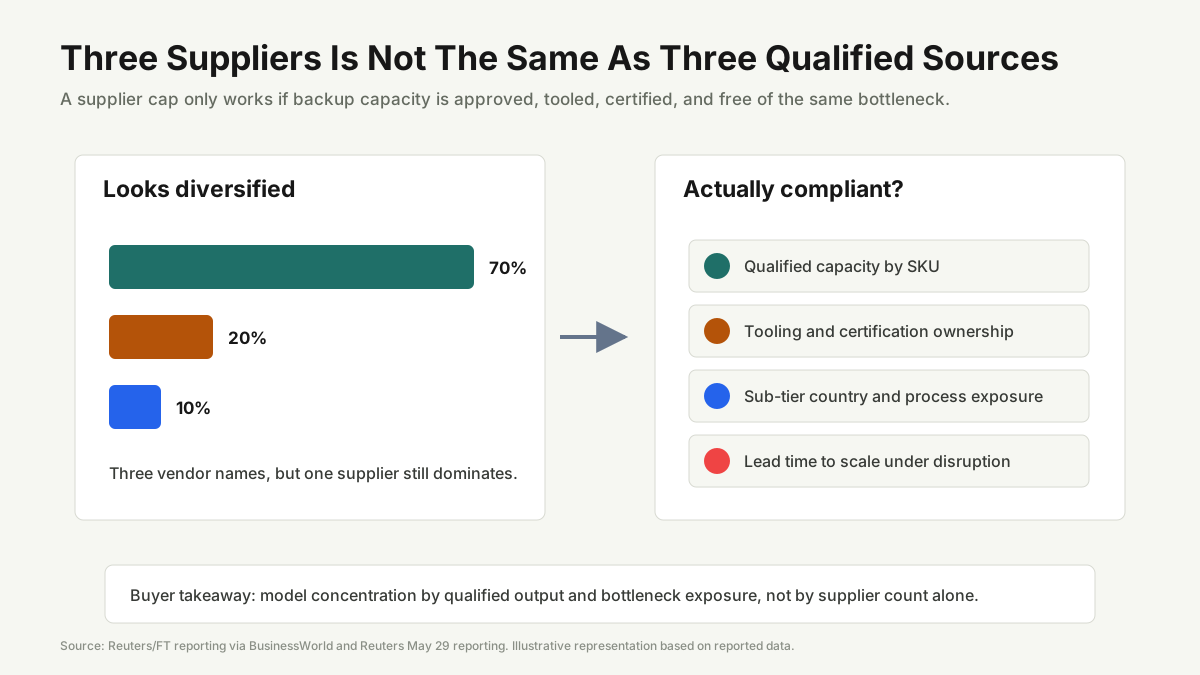 Source: Reuters/FT reporting via BusinessWorld and Reuters reporting on the May 29 Commission debate.
The Exposure Worksheet
Before final EU language appears, buyers can build a simple worksheet.
For every critical component, calculate the concentration measures and evidence fields together:
| Field | Question |
|---|---|
| SKU and part family | Which exact part is being tested? |
| Largest supplier share | How much spend, unit volume, and qualified capacity sits with the largest supplier? |
| Qualified capacity by supplier | How much approved output can each supplier deliver for that exact SKU? |
| Country and process exposure | Where are final assembly, critical processing, tooling, and key sub-tier inputs located? |
| Beneficial ownership | Who ultimately controls each supplier and key sub-tier supplier? |
| Evidence owner | Who owns the proof: procurement, quality, engineering, legal, or supplier management? |
| Approval status | Is the source quoted, sampled, validated, customer-approved, or already in production? |
| Switch lead time | How long would it take to shift 30%, 50%, or 70% of volume away from the largest supplier? |
| Bottleneck exposure | Which material, process, tool, firmware, or certification could stop every listed supplier at once? |
Example: a European buyer may have one supplier in China, one in Eastern Europe, and one in Southeast Asia. On paper, that looks diversified. But if all three depend on Chinese rare-earth magnet processing, Chinese graphite, Chinese industrial controllers, Chinese specialty chemicals, or China-owned tooling, the buyer still has a structural exposure.
That does not mean the non-Chinese suppliers are useless. It means the buyer must describe the exposure accurately.
Three Layers Of China Dependency
China dependency usually hides in three layers.
| Layer | Example | Buyer risk |
|---|---|---|
| Component dependency | Finished part comes from one Chinese supplier | Visible and easiest to map |
| Process dependency | Non-Chinese supplier relies on Chinese tooling, plating, casting, test capacity, firmware, or engineering support | Harder to see in supplier portals |
| Material dependency | Critical minerals, magnets, graphite, chemicals, or battery inputs pass through Chinese processing | Often invisible until disruption |
That matters for industrial machinery, EVs, wind turbines, defense systems, robotics, medical equipment, and factory automation. A buyer can diversify final assembly and still remain dependent on Chinese processing.
China Made & Tech covered the buyer side of this issue in China Rare Earth Squeeze on Japan: Buyer Checklist (2026).
Why Qualification Is The Real Clock
The easiest part of diversification is finding a supplier that says yes.
The hard part is proving the supplier can ship approved product.
Industrial customers often require formal approval for site transfers, sub-tier changes, tooling changes, process changes, raw material changes, and supplier changes. Supplier quality manuals from companies such as Volvo, Bosch, and Infineon show why this is not a paperwork formality. Production Process Approval, PPAP/PPA documentation, process capability, material release, tool release, contingency plans, and sub-supplier process review can all matter.
A realistic diversification timeline looks like this:
| Stage | Work | Hidden delay |
|---|---|---|
| Mapping | BOM, country exposure, supplier share, sub-tier origin | Internal systems often track supplier name, not process origin |
| Supplier discovery | Identify second and third sources | Quoting ability is not production capability |
| Sampling | Drawings, tolerances, materials, initial articles | Small deviations can fail downstream |
| Tooling and process | Tool ownership, fixtures, jigs, process route, test equipment | Tooling may belong to the incumbent supplier |
| Validation | Life-cycle tests, safety tests, process capability | Failure can restart the clock |
| Approval | Customer, regulatory, or OEM sign-off | Approval may be required before shipment |
| Ramp | Inventory, line balancing, yield improvement, logistics | Backup capacity may be small or unreserved |
What The Compliance File Should Contain
If a customer asks for three-source evidence tomorrow, most companies will be tempted to send a vendor list. That will not be enough for serious buyers.
A useful compliance file should contain:
- the critical-part list and rationale for why each part is critical
- the approved supplier list by exact SKU
- annual and surge qualified capacity by supplier
- country of final assembly and critical processing
- tooling ownership and tooling location
- validation status, PPAP/PPA status, and customer approval status
- sub-tier material exposure for magnets, graphite, chemicals, electronics, and castings
- estimated time to shift 30%, 50%, or 70% of volume away from the largest supplier
- inventory buffer and redesign plan where sourcing alone cannot solve the bottleneck
This file is more useful than a compliance certificate. It tells management which parts are diversified, which are pretending to be diversified, and which require engineering redesign rather than procurement pressure.
Which Sectors Should Move First
The Reuters report named chemicals and industrial machinery. That makes sense because both sectors combine long qualification cycles with upstream concentration.
Industrial machinery buyers should review:
- bearings, drives, motors, controllers, and sensors
- precision castings and machined components
- rare-earth magnet assemblies
- industrial electronics and power modules
- tooling, fixtures, test systems, and spare parts
Chemical and advanced-material buyers should review:
- precursor chemicals
- specialty additives
- purification or refining steps
- battery and electronics materials
- process inputs that determine product certification
The rule may begin in a few sectors, but the supplier math applies more broadly. EVs, semiconductors, robotics, clean energy, grid equipment, aerospace, and defense all share upstream inputs.
That last sentence is an inference, not a leaked sector list. Buyers in those sectors should prepare because the same concentration logic applies, not because they have already been named in the reported rule.
What A Supplier Questionnaire Should Ask
Most supplier questionnaires are not ready for this.
They ask for country of origin and factory address. That is not enough.
A useful questionnaire should ask:
| Question | Acceptable evidence | Red flag |
|---|---|---|
| Where is final assembly? | Factory address, quality certificate, customer-approved site record | Sales-office country only |
| Where are critical processing steps? | Process route, approved sub-tier list, change-control record | "Confidential" with no substitute evidence |
| Who owns tooling and test fixtures? | Tooling register, ownership clause, transfer rights | Tooling trapped at incumbent supplier |
| Can the part move sites without customer approval? | Customer approval matrix and PPAP/PPA requirement | Supplier assumes transfer is automatic |
| What is approved capacity by SKU? | Capacity statement tied to the exact part number | Aggregate factory capacity only |
| What surge capacity exists during disruption? | Reserved capacity, inventory buffer, ramp plan | Normal-year capacity presented as backup |
| What sub-tier changes require notice? | Supplier quality agreement and change-notification clause | No sub-tier visibility |
| What is the failure history by plant? | Warranty, PPM, audit, and corrective-action records | One global quality number |
What Not To Diversify First
There is also a trap in trying to diversify everything.
Buyers should rank by consequence, not political visibility. A low-cost housing with five qualified sources is not the same as a magnet assembly, specialty chemical, power electronics module, industrial controller, or safety-certified component.
The first wave should focus on parts that meet three tests:
- The part can stop production or trigger customer non-compliance.
- The qualified supply base is narrow or China-linked underneath.
- Qualification lead time is long enough that waiting is dangerous.
That framing prevents performative diversification. It sends engineering, quality, and procurement attention to the parts that actually matter.
There is an uncomfortable implication here: some parts should not be diversified immediately because the second source is worse than the concentration risk. If the backup supplier has weak process control, uncertain certification, or no real surge capacity, forcing volume there may create quality failures before it creates resilience.
That is why the rule, if it comes, will not be solved by purchasing alone. Quality, engineering, finance, legal, and operations all have to be in the same room. The buyer is not only changing who gets the purchase order. It is changing the production system.
Counter-Signals And Limits
Buyers should not treat the reported rule as inevitable or fully defined.
China has pushed back. Xinhua reported on 2026-05-28 that China's foreign ministry framed EU de-risking, reliance-reduction, and trade-imbalance language as protectionism that could raise costs for European companies and weaken competitiveness. China also signaled it would protect its legitimate interests.
European implementation is also hard. The Critical Raw Materials Act sets a 2030 objective that the EU should not depend on a single third country for more than 65% of any strategic raw material at any relevant processing stage. But EU auditors and policy analysts have warned that critical raw-material diversification remains difficult, and rare-earth processing remains a major gap.
So the realistic conclusion is not "Europe can quickly replace China." It is "Europe is likely to keep turning dependency into measurable procurement rules."
That is enough reason for buyers to start mapping.
What Good Looks Like
A mature buyer will not claim to be China-free. In many categories that is unrealistic.
It will be able to say:
- which critical parts have one qualified source
- which parts have two or three approved sources
- which backup suppliers can scale within 30, 90, or 180 days
- which inputs remain China-linked after final assembly changes
- which tooling and certification steps block a fast switch
- which customers must approve supplier changes before shipment
- which parts need redesign, not just resourcing
That is the kind of evidence a regulator, customer, or board can use. It is also the kind of evidence many companies do not yet have.
What To Watch Next
The next signals are concrete:
- whether the EU publishes draft text defining critical components and supplier-share calculation
- whether chemicals, industrial machinery, metals, clean technology, EVs, defense, or grid equipment appear in sector lists
- whether supplier share is calculated by spend, volume, qualified capacity, or country concentration
- whether large customers start asking for three-source evidence before regulation is final
- whether China responds with specific countermeasures affecting minerals, components, tools, or equipment
The last point matters. Supplier diversification is not a one-way policy choice. If China responds through export controls or administrative friction, the qualification clock could start even earlier.
Methodology
This article relies on Financial Times / Reuters-derived reporting via The Irish Times on 2026-05-18, Reuters reporting carried by Hydrocarbon Processing on 2026-05-29, European Commission trade and Critical Raw Materials Act materials, IEA rare-earth data, supplier quality requirements from industrial OEMs, and China Made & Tech's manufacturing-system framework in How China Manufactures: Inside the World's Factory (2026). Because no final EU text exists as of 2026-05-30, this is a buyer-preparation article, not legal compliance advice.
Claim Confidence File
| Claim | Confidence | Evidence boundary |
|---|---|---|
| EU component-sourcing rules increase the need to map China-linked dependencies | Medium-high | Based on cited regulatory context; exact obligations depend on final rule text, product category, and project facts. |
| China-linked components are automatically disqualifying in every EU procurement | Low | The article avoids that legal overreach and frames the issue as dependency and documentation risk. |
| Buyers should preserve bills of materials, supplier declarations, origin evidence, and substitution options | High | This is the article's compliance-file recommendation. |
| The article provides legal advice for a specific tender | Low | It is a buyer-risk guide and flags the need for counsel/broker review. |
FAQ
Is the EU three-supplier rule final?
No. As of 2026-05-30, it is reported as a possible policy direction under discussion. Buyers should treat it as an early warning signal, not as final legal text.
Does three suppliers eliminate China dependency?
No. Three final suppliers can still rely on the same China-linked material, process, tooling, firmware, or sub-tier manufacturer. Buyers need to map bottlenecks, not just vendor names.
What is the best first step?
Start with a critical-parts list and calculate spend share, unit share, qualified capacity share, and bottleneck share. Then identify which parts would take longest to qualify with a second or third source.
Why not wait for the final rule?
Because second-source qualification can take months or longer. Tooling, testing, certifications, PPAP/PPA, customer approval, and ramp capacity cannot be created after a deadline appears.