
China did not need a dramatic embargo announcement to make the market nervous. It only needed the trade data.
Reuters reported on 2026-05-22 that Chinese customs data showed exports to Japan of dysprosium, terbium oxide, and gallium had largely stopped since December 2025, with only limited yttrium shipments still getting through. Five days earlier, China's government said export control applications for compliant civilian uses would continue to be reviewed under law. Put those two signals together and the buyer lesson is clear: the issue is not whether material is theoretically legal. The issue is whether it arrives on time, in the right form, with the right license path, for the right factory schedule.
Source File
This article was reviewed on 2026-07-06 against Reuters reporting republished by OE Digital / Energy News, China's official 2026-05-20 statement on rare earth export-control reviews, CSIS analysis of rare earth export restrictions one year later, and the site's structural explainer China's Rare Earth Monopoly: Strategic Materials Explained. The article treats the Japan flow data as a timing and licensing-risk signal, not as proof of a universal rare-earth embargo. Buyer guidance separates mining exposure, separation / processing exposure, magnet supply, and delivery timing because those risks behave differently. This is procurement-risk analysis, not legal advice.
Quick Answer
If you buy motors, magnets, actuators, sensors, or precision industrial assemblies, this is not a Japan-only problem. It is a warning that the part of the supply chain you thought had diversified may still depend on Chinese heavy rare earth processing.
| Buyer profile | Immediate risk | Best response now |
|---|---|---|
| EV, robotics, or servo motor buyer | Magnet lead-time disruption | Ask suppliers for dysprosium/terbium exposure and buffer inventory assumptions |
| Aerospace or defense-adjacent manufacturer | Highest compliance and continuity risk | Require non-China processing path disclosure, not just mine-of-origin claims |
| Industrial OEM buying finished assemblies | Hidden cost pass-through | Re-price contracts for magnet-rich subcomponents before the next quarter |
| Investor or procurement team building "China plus one" plans | False sense of diversification | Separate mining diversification from processing diversification in every sourcing review |
Why Japan Matters to Everyone Else
Japan is the second-largest rare-earth magnet producer outside China. That matters because Japan is not a marginal customer improvising in spot markets. It is one of the few places outside China with real downstream magnet capability, deep engineering know-how, and a long institutional memory of the 2010 rare earth shock.
If a buyer like Japan still cannot fully insulate itself from heavy rare earth licensing pressure, smaller industrial buyers should be careful about assuming their own supply chains are safer than they really are.
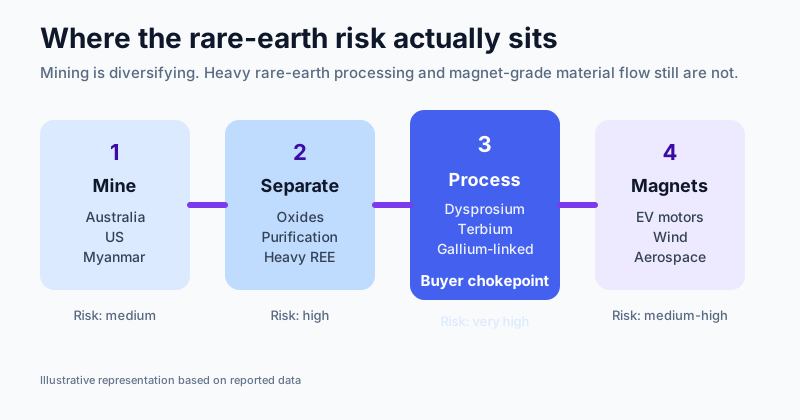
This is the difference between upstream diversification and midstream dependence:
- Mining can diversify.
- Separation and refining diversify much more slowly.
- Magnet-grade heavy rare earth processing is still highly concentrated.
That concentration is why How China Manufactures: Inside the World's Factory (2026) matters to this story. China's advantage is rarely one mine or one policy. It is the full industrial chain sitting close together, with policy, engineering, and capacity moving in the same direction.
Japan Is A Stress Test, Not A Special Case
Japan matters because it is one of the better-prepared non-China rare-earth users. It has experience from the 2010 shock, stronger industrial policy memory than many buyers, sophisticated magnet companies, and deeper relationships with alternative suppliers. If that system still shows vulnerability in heavy rare earth flows, the lesson for smaller buyers is uncomfortable.
The takeaway is not that every country has the same exposure as Japan. The takeaway is that a prepared buyer can still be exposed at the processing and licensing layer.
| Capability Japan has | Why it still may not be enough |
|---|---|
| Long experience with rare-earth supply shocks | Experience improves response, but it does not create instant heavy rare-earth processing capacity |
| Strong magnet and materials companies | Downstream capability still needs feedstock and processed inputs |
| Government-backed diversification efforts | New projects take years to scale and qualify |
| Stockpiling discipline | Inventory buys time but does not replace a sustainable processing path |
The Real Buyer Risk Is Timing, Not Headlines
The most common mistake in critical-minerals coverage is to ask whether there is a "ban." Buyers usually need a more operational question: will my supplier get licensed material in time to meet the production window?
China's official line on 2026-05-20 was deliberately calibrated. Beijing said compliant civilian-use applications would still be reviewed. That does not contradict the Reuters trade data. It explains the buyer problem. Export control systems do not need to ban all flows to create disruption. Delays, selective approvals, documentation gaps, and licensing friction can be enough.
That is especially true in heavy rare earth markets because volumes are small, concentration is high, and many downstream parts are specialized. A procurement team can survive a shortfall in generic aluminum or standard steel more easily than a shortfall in a magnet input that sits inside motors, radar systems, factory robots, or precision motion platforms.
How To Find Hidden Exposure In Finished Assemblies
Many buyers do not purchase rare earths directly. They purchase motors, actuators, pumps, robotics modules, generator components, sensors, or finished machines. That makes exposure harder to see.
Start with component families rather than supplier names:
| Component family | Hidden question |
|---|---|
| Permanent-magnet motors | Does the magnet use dysprosium or terbium for heat resistance or coercivity? |
| Servo drives and actuators | Are high-performance magnets sourced through a Japan, China, or third-country processor? |
| Wind and industrial generators | Which magnet grade is used, and can it tolerate substitution? |
| Aerospace or defense-adjacent assemblies | Does end-use documentation create a higher license-review burden? |
| Factory automation equipment | Is the OEM passing through magnet lead-time risk without naming it? |
What Has Actually Changed Since 2010
The world is better prepared than it was in 2010, but not prepared enough.
Japan spent years building stockpiles, backing overseas mine development, and supporting alternative supply partnerships. Those steps reduced immediate panic risk. They did not create a large, fully independent heavy rare earth processing ecosystem outside China. That is the distinction many buyers still miss.
The supply chain has four different vulnerability layers:
- Ore availability
- Separation and purification
- Alloy and magnet production
- Finished component integration
Public discussion often celebrates progress at layer one. Industrial continuity usually fails at layers two and three.
That is why buyers should treat "we have non-Chinese mining exposure" as incomplete information. Unless your supplier can show where dysprosium and terbium are separated, refined, and converted into usable magnetic material, you do not yet know the real resilience of the chain.
What A Good Supplier Answer Sounds Like
Weak supplier answers are vague: "we have alternative sources," "we are monitoring the situation," or "no major impact expected." Strong answers are specific.
A strong answer should include:
- which controlled elements are present in the product
- whether exposure sits in ore, oxide, alloy, magnet, or finished component form
- the processing country, not only the mining country
- current license status or whether a license is needed
- inventory measured in weeks of finished output, not raw-material weight
- substitution limits and requalification time
- which customer programs get priority if supply tightens
That last line is important. When material is constrained, suppliers allocate. A buyer who does not know its allocation priority does not really know its supply position.
The Procurement Questions Buyers Should Be Asking This Week
This is where the story stops being macro commentary and becomes practical procurement work.
| Question | Why it matters |
|---|---|
| Do our suppliers use dysprosium, terbium, yttrium, or gallium at any stage? | Many buyers do not know their hidden heavy rare earth exposure |
| Is the supplier disclosing mine origin or processing origin? | Processing origin is usually the real chokepoint |
| What is the current lead-time assumption for magnet-rich parts? | Old assumptions may now be wrong by weeks or months |
| Is there a stockpile, and where in the chain does it sit? | Supplier stock is not the same as your own production buffer |
| What share of the BOM can be redesigned if heavy rare earth inputs tighten further? | Design flexibility matters when pricing and approvals move suddenly |
The right conclusion is not panic. It is segmentation. Some firms have stock, some have long contracts, and some are exposed only indirectly through tier-two suppliers. The mistake would be assuming that because one large magnet producer is calm, every downstream buyer is safe.
Why This Matters for Robotics, EVs, and Factory Automation
Heavy rare earths are not an abstract geopolitical category. They sit inside the products that define China's industrial rise and the rest of the world's decarbonization push.
- EV traction motors use high-performance magnets.
- Wind turbines depend on magnet-heavy generator systems.
- Industrial robots and servo systems need precise motion components.
- Aerospace and defense platforms rely on specialized magnet and material performance.
That makes this story especially relevant to readers following China's robotics and manufacturing buildout. The faster the world electrifies and automates, the less optional these materials become.
In other words, the risk is not that rare earths suddenly disappear. The risk is that a small amount of constrained heavy material creates bottlenecks in high-value downstream systems.
What Smart Buyers Should Do Next
The best response is boring and specific.
First, map exposure by subcomponent, not by finished product category. "Motor" is too broad. "Magnet-containing servo module sourced from supplier X with processing path Y" is the level of detail that matters.
Second, rewrite supplier questionnaires. Ask for processing geography, magnet chemistry, inventory assumptions, and substitution limits. Many questionnaires still stop at country of origin.
Third, treat alternative supply announcements carefully. New mines help. New separation and refining capacity matters more. New magnet capacity matters most if your actual problem is a finished industrial component.
Fourth, build scenario pricing. If dysprosium-rich inputs move from ordinary lead times to constrained lead times, what happens to your margin, delivery promise, or warranty exposure?
Scenario Planning Beats Headline Watching
Buyers should model three cases.
| Scenario | Planning assumption | Buyer action |
|---|---|---|
| Managed approval | Licenses continue but take longer | Add lead-time buffers and require license-status reporting |
| Selective squeeze | Some buyers, products, or countries face tighter timing | Prioritize high-margin programs and qualify alternative grades |
| Hard disruption | Heavy rare-earth flows remain constrained for months | Activate redesign, customer allocation, and executive-level sourcing plans |
Claim Confidence File
| Claim | Confidence | Evidence boundary |
|---|---|---|
| Reuters reported sharply constrained Japan-bound flows of dysprosium, terbium oxide, gallium, and limited yttrium since late 2025 | High | Based on Reuters/customs-data reporting as republished by OE Digital; not independently recalculated here from raw customs data. |
| China announced that compliant civilian-use rare-earth export applications can still be reviewed | High | Based on China's official statement. |
| The situation proves a universal rare-earth embargo | Low | The article explicitly rejects this; the evidence points to timing, licensing, and flow-risk pressure. |
| Japan's exposure is a useful stress test for global buyers | Medium-high | Inference from Japan's magnet capability and 2010 experience; exposure varies by buyer, product, and contract path. |
| Mining diversification alone solves the risk | Low | Processing, separation, alloy, and magnet capacity remain the stronger chokepoints. |
| Buyers should panic-buy inventory | Low | The article recommends segmentation, license-status checks, supplier mapping, and scenario thresholds instead. |
Methodology
This analysis draws on Reuters reporting on Japan-bound heavy rare earth flows, China's 2026-05-20 official statement on rare earth export control reviews, CSIS rare-earth export-control analysis, and the site's structural explainer China's Rare Earth Monopoly: Strategic Materials Explained. The framework here distinguishes mining exposure from processing exposure because those are different risks. Buyers should validate shipment-specific classification, license status, and end-use documentation with trade counsel or qualified customs specialists.
What To Watch Next
- Whether China continues approving civilian-use applications while keeping Japan-bound heavy rare earth volumes constrained
- Whether Japanese magnet makers start extending lead-time warnings beyond internal contingency planning
- Whether non-Chinese processors can add meaningful heavy rare earth capacity before 2027 rather than only announcing future projects
FAQ
Did China ban all rare earth exports to Japan?
No. The cleaner description is that Reuters reported major heavy rare earth flows to Japan had largely stopped since December 2025, while China says compliant civilian-use licenses can still be reviewed.
Why are dysprosium and terbium more important than generic rare earth headlines suggest?
They are critical to high-performance magnets used in EVs, robotics, wind systems, and aerospace applications. Small supply disruptions can create outsized downstream delays.
Does mining diversification solve this problem?
Not by itself. The harder bottleneck is still separation, refining, and magnet-grade processing, where dependence on China remains much deeper.