

By China Made & Tech Team. This is desk-researched supply-chain analysis, not legal, customs, export-control, engineering, investment, or supplier advice.
“China rare earth monopoly” is a useful search phrase and a poor procurement conclusion. China’s position is consequential, but a buyer does not purchase a national mining share. The buyer purchases a named material inside a magnet, a magnet inside a component, and a component inside an order with a route, end use, contract, and delivery promise.
That distinction became harder to ignore after China’s Ministry of Commerce and General Administration of Customs announced export controls on specified medium and heavy rare-earth-related items on 4 April 2025. The notice establishes a control framework for listed items. It does not say every rare-earth order is prohibited, that a licence will be granted, or that an individual buyer has no alternative. Those answers depend on the actual item, technical state, destination, end use, parties, documents, and then-current rules.
The right question is therefore not “Does China control rare earths?” It is: which stage in this product’s material chain is concentrated, controlled, qualified, committed, and evidenced well enough to release the order?
Quick Answer: One Statistic Cannot Release a Shipment
USGS records mine output and reserves. The IEA maps a more specific magnet-rare-earth chain: mining, refining, magnet manufacturing, and downstream demand. Its 2025 analysis highlights concentrated supply, the 2025 controls, and the gap between diversified capacity and projected requirements. Those facts make concentration a real commercial issue. They still do not establish the condition of a particular purchase order.
| Public fact | What it can reasonably support | What it cannot decide |
|---|---|---|
| USGS production and reserve data | a broad baseline for mining and national production | the source, processing route, availability, or price of one ordered item |
| IEA concentration analysis | that magnet rare-earth refining and magnet capacity merit supply-chain attention | that every Chinese magnet or component will be unavailable |
| MOFCOM’s 2025 control notice | that listed items can be subject to export-control requirements | whether a particular SKU, shipment, counterparty, or end use can proceed |
| a supplier allocation statement | the supplier’s stated plan at a point in time | a binding delivery, approved substitution, or licence result without supporting records |
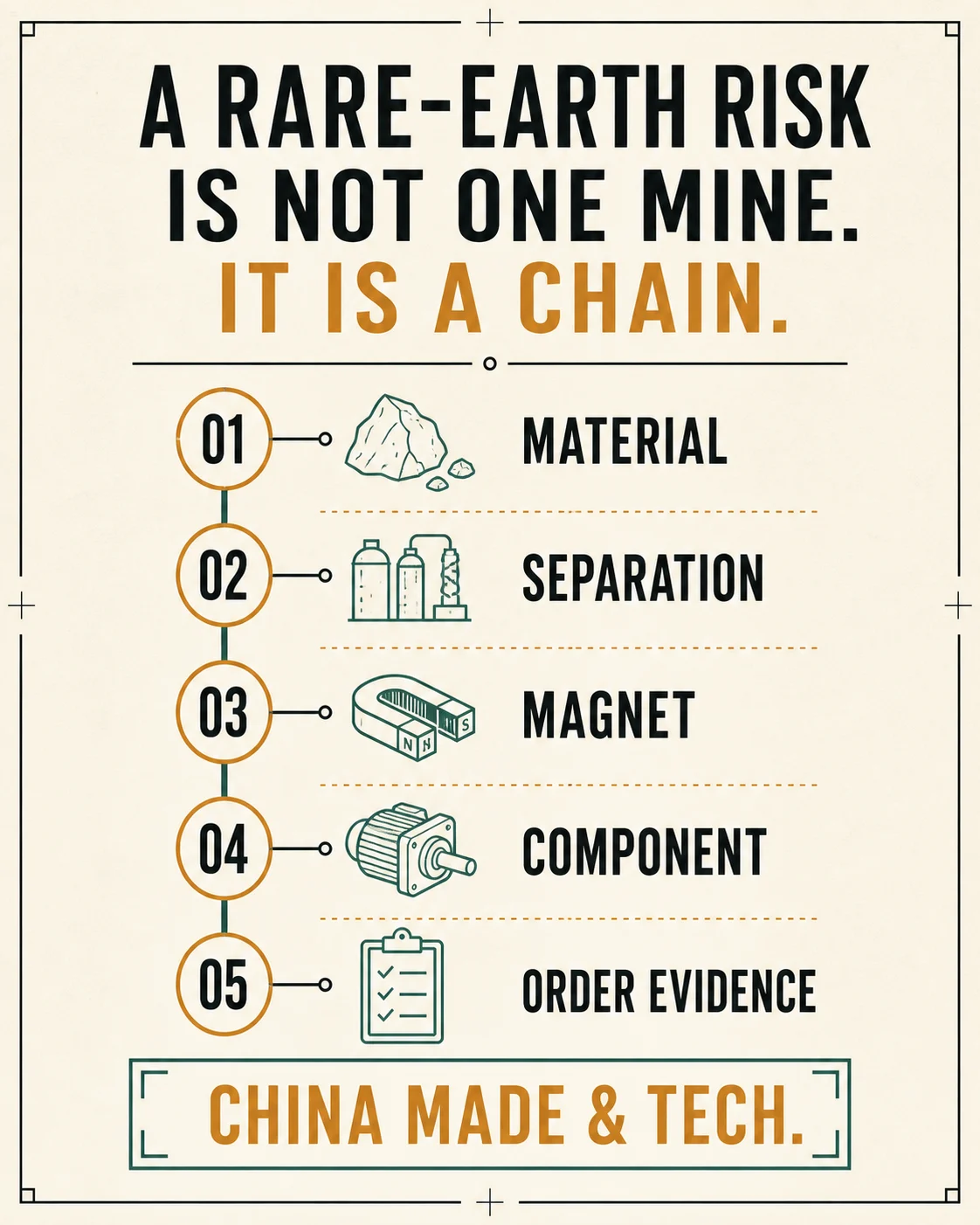 Field Note: market concentration becomes a buyer risk only through a specific material and order chain.
The Exposure Has Six Different Layers
Rare-earth discussion often collapses several industrial steps into “supply.” That hides the controls a buyer can actually use. A permanent-magnet component can be exposed at any of the following layers:
| Layer | The buyer’s real question | Useful evidence | Common false shortcut |
|---|---|---|---|
| material | Which rare-earth-bearing material is actually used? | current BOM, grade/composition declaration, approved product configuration | assuming every motor or electronic part contains the same magnet material |
| separation and refining | Where was the relevant material separated or refined, and does that matter to the order? | supplier material route statement, declared scope and date | treating a mine country as the full supply-chain origin |
| alloy and magnet | Who makes and qualifies the magnet or alloy? | approved source list, part/spec revision, qualification and change record | using a national share as proof of an individual magnet source |
| component | Which tier supplies the finished subassembly and can it change? | tier mapping, part number, serial/lot or batch traceability where proportionate | stopping diligence at the OEM’s country of incorporation |
| control and trade | Is a listed item, derivative, document, party, end use, or route involved? | current item review and records held by qualified legal/compliance teams | interpreting a headline as a customs or licence decision |
| delivery and recovery | What happens if supply, approval, or configuration changes? | contractual notification, allocation, alternate qualification, remedy and escalation terms | accepting “we have stock” without a time-bound commitment |
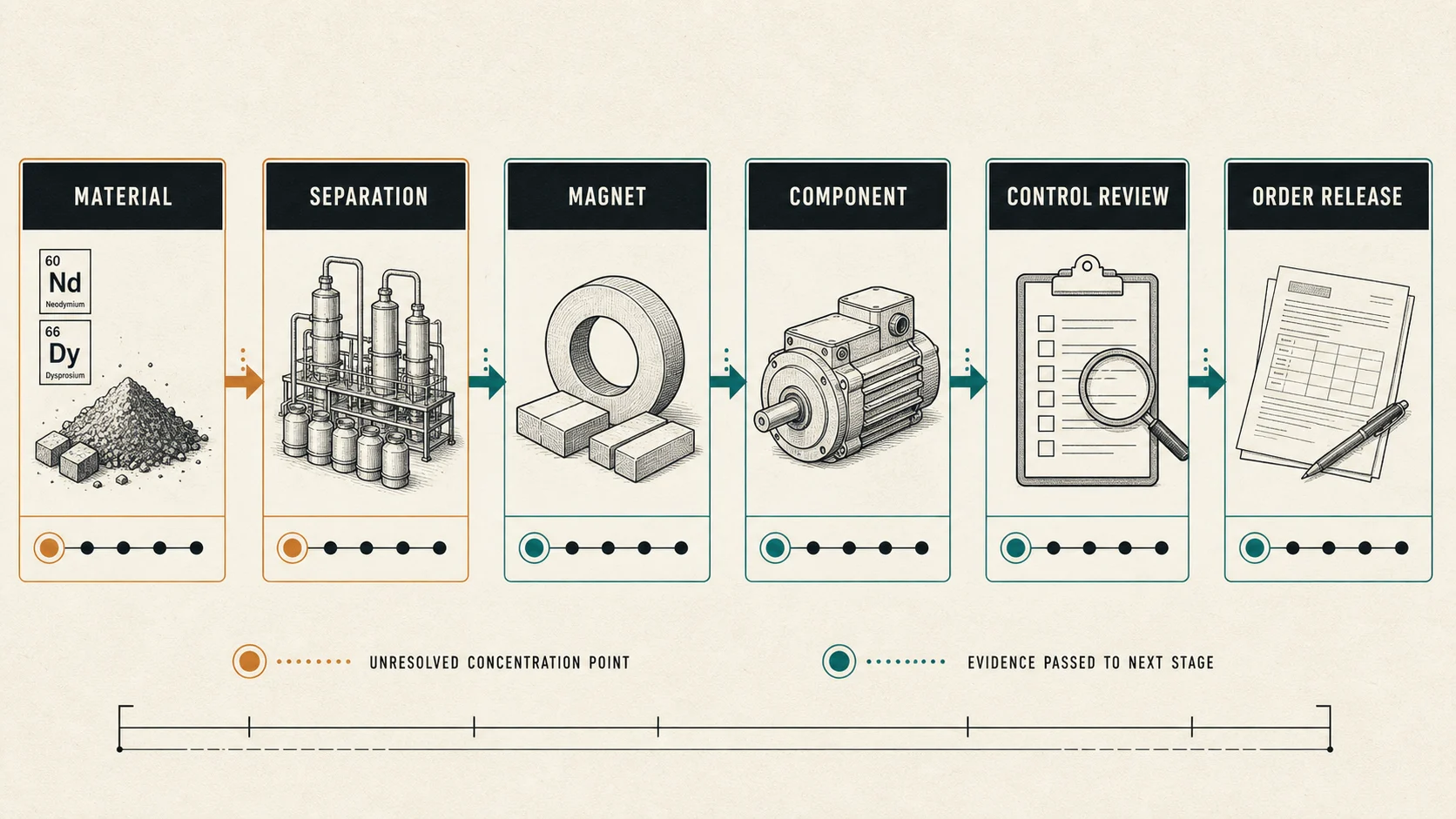 A procurement risk is created by a missing link in the product chain, not by a headline alone.
The order of these layers matters. A buyer may discover that a direct-drive generator contains magnet material but not know which exact grade, magnet producer, or component revision is planned. Another buyer may have a well-mapped magnet but no contract mechanism requiring notice before a source or composition change. Both have exposure, but the corrective action is different. The first needs mapping and technical ownership; the second needs commercial change control.
What the Current Sources Actually Establish
The USGS Mineral Commodity Summaries 2026 is a useful baseline because it reports 2025 production, reserve and import data using rare-earth-oxide equivalents. It is not an order-traceability database. The report also notes that a significant quantity of rare earths reaches users embedded in finished goods, which is precisely why a buyer should not end the analysis at raw-material import figures.
The IEA’s Rare Earth Elements 2025 narrows the issue to magnet rare earths including neodymium, praseodymium, dysprosium and terbium. It describes concentrated supply and states that existing and announced ex-China capacity is insufficient to meet projected 2035 needs across refining and magnets under current policy settings. That is a strategic capacity observation, not a forecast of a named supplier’s failure or a claim that diversification is impossible.
China’s Announcement No. 18 of 2025 lists specified medium and heavy rare-earth-related items and invokes export-control requirements. A purchasing team should preserve the notice as an escalation trigger, then send the concrete part, material state, technical parameters, destination, end use, contract route, and supplier documents through the relevant qualified review. A blog post cannot classify the item or provide a licence opinion.
Build a Material-to-Order Evidence File
The discipline is modest: start with the purchased product rather than a country narrative. Ask the design or product owner which parts are magnet-dependent and whether the performance requirement makes substitution difficult. Ask the supplier to identify the information it can provide, the level at which it is current, and the constraints on disclosure. Then create an evidence file that links the technical item to a commercial hold point.
| Record | Why it matters | Owner before release |
|---|---|---|
| approved BOM and part revision | identifies the actual material-bearing component and controlled configuration | engineering/product owner |
| tier and magnet-source map | shows how far the buyer can trace the critical sub-tier | supplier plus procurement |
| material/source statement with date and scope | makes clear what is declared and what is not | supplier; buyer records limits |
| current control/compliance escalation | prevents a public notice from being silently ignored or over-interpreted | qualified legal/compliance owner |
| allocation and delivery commitment | turns availability language into an order-specific promise | procurement and supplier account owner |
| change-notice and alternate-qualification process | keeps a supply response from becoming an uncontrolled performance change | engineering, quality, procurement |
| receiving and exception record | preserves the evidence actually used to release, hold, or escalate | quality/operations owner |
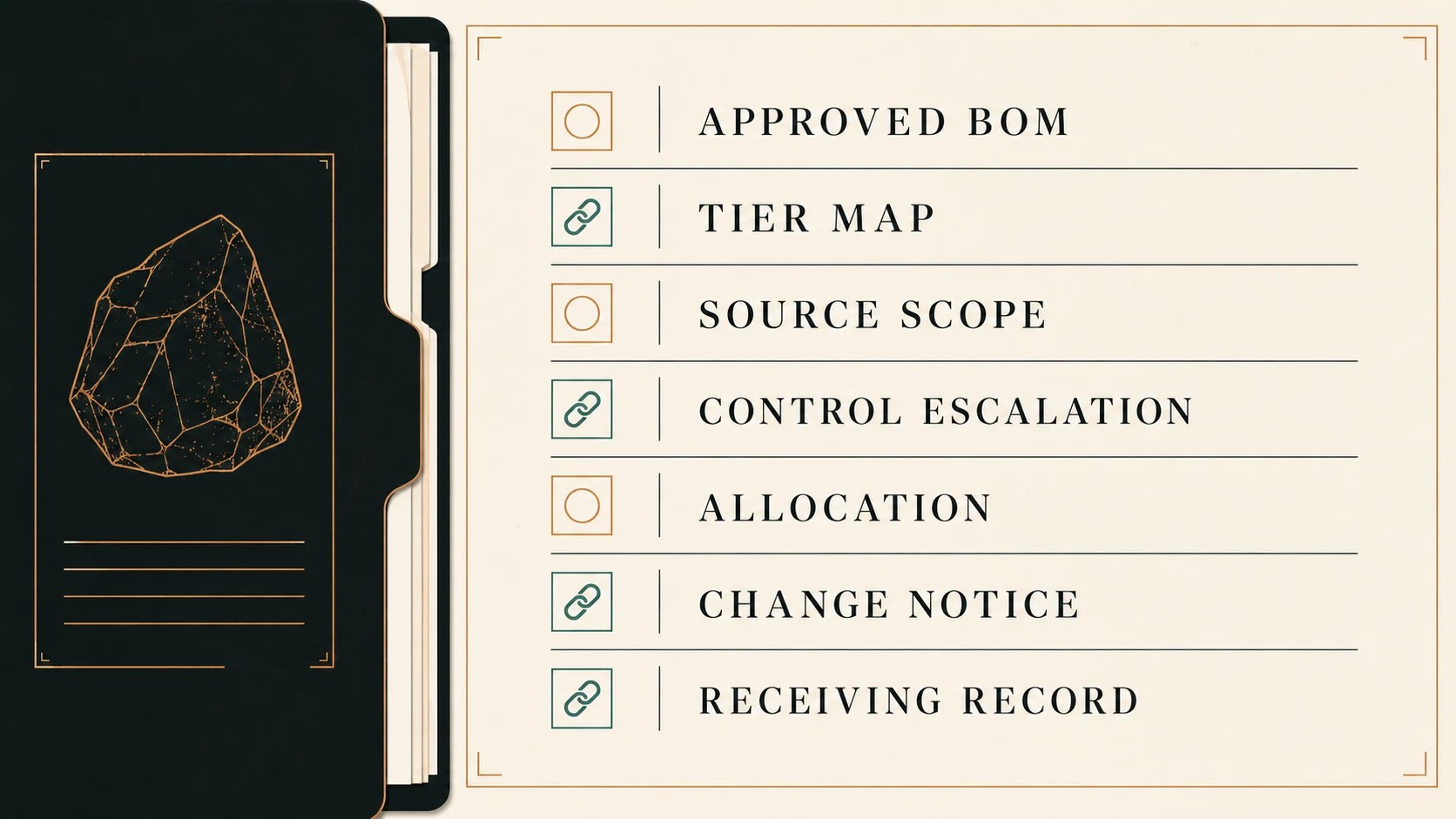 The release file does not guarantee availability or compliance; it makes the decision and its dependencies visible.
An evidence file is not a demand for every supplier to disclose proprietary commercial relationships. It can use bounded documents: a statement of configuration and scope, a controlled review, a designated contact for a legal review, a source-change commitment, or a dated allocation record. The buyer should record what was supplied, what was withheld, who interpreted it, and the decision that followed. Otherwise, later teams cannot tell the difference between verified information and a sales assurance.
Use Two Clocks: Structural Diversification and Order Risk
Diversification programmes operate on a multi-year clock. They involve deposits, separation chemistry, environmental permitting, capital, skilled operators, alloy and magnet lines, customer qualification, and sometimes government support. The IEA’s capacity outlook explains why new mining alone is not a full substitute for refining and magnet manufacturing. For strategic sourcing, that is a reason to develop alternatives early.
An open purchase order runs on a different clock. It needs a known part configuration, current supplier status, applicable control review, allocation or lead-time basis, transport and customs records where relevant, and a response if the proposed source changes. A distant investment announcement may strengthen a long-term sourcing case while doing almost nothing for a shipment scheduled next month. Conversely, a supplier with no public strategic narrative may still offer a well-documented, order-linked solution.
Keep these clocks separate in reporting:
| Decision horizon | Good question | Bad proxy |
|---|---|---|
| strategy | Where should we invest in qualified alternative capability, inventory design, reuse, or product redesign? | “A new mine has been announced, so dependence is solved.” |
| supplier qualification | Can this supplier identify the relevant material chain and control source changes? | “The supplier is in a low-risk country.” |
| contract | What notice, evidence, alternate-qualification, allocation and remedy obligations are enforceable? | “The supplier said it has enough stock.” |
| release | Has the ordered configuration and current evidence met the project’s release conditions? | “The market share has not changed.” |
Design the Contract for a Change, Not a Prediction
No contract can make a concentrated material market unconcentrated. It can reduce the chance that a problem first appears as an unexplained late delivery or technical substitution. For material-sensitive components, define an approved configuration; require notice before a material, magnet, component, processing route, or source change where it is material to the product or transaction; establish who reviews the change; and state whether the buyer may hold, test, accept, replace, or terminate under defined conditions.
The required level of detail should match exposure. A consumer accessory and a grid-critical generator should not necessarily have the same traceability or engineering-review burden. The important principle is that a supplier cannot respond to a supply issue by silently changing a product attribute that the buyer relied upon. Engineering, quality, procurement, legal/compliance, and operations each own a different part of the response.
A practical change-control sequence
Start by distinguishing a commercial substitution from a technical substitution. A change in a sub-tier location, a processing route, a magnet grade, an alloy, a component revision, or a finished assembly may have very different consequences. The supplier should not be asked to promise that its chain will never change; industrial supply chains do change. It should be required to say which changes are material to the agreed configuration, who is notified, what information accompanies the notice, and whether the buyer has a review or qualification right before the affected item is shipped.
The notice should reach the right people early enough to matter. Procurement can assess allocation and commercial remedy; engineering can evaluate specification, performance, validation and interoperability; quality can assess inspection or documentation needs; operations can consider spares and installed-base consistency; and legal/compliance can assess transaction-specific control questions. A late alert sent only to a purchasing inbox is not useful control of a material change.
| If the supplier reports | The first buyer question | Possible controlled response |
|---|---|---|
| allocation pressure | Which order, part, quantity, date and evidence are affected? | confirm the allocation record, re-sequence demand, or escalate the release condition |
| source or route change | Does the change alter the approved product, evidence boundary, trade review, or traceability requirement? | route to engineering/quality/compliance before acceptance |
| proposed alternate magnet or component | What evidence compares it with the approved configuration and what qualification is required? | hold, test, qualify, or reject under the agreed process |
| licence or document uncertainty | What exact item and transaction facts require qualified review? | preserve the facts, avoid assumptions, and escalate to the designated owner |
| delivery variance | Is the impact recoverable under the contract and does it affect downstream commitments? | activate the agreed escalation, remedy, and stakeholder communication path |
Measure Resilience by Evidence Quality, Not by a Country Label
Country-of-origin information can be important for a particular transaction, but it is not a complete resilience score. A component assembled outside China can still use a magnet made from material processed in China; a Chinese supplier can have a transparent, controlled allocation and change process. The operational question is whether the buyer has enough current, scoped, order-linked evidence to understand the dependency and act on it.
Use a simple status for each material-sensitive part: mapped when the relevant configuration and tier are known; evidenced when current records support the declared route or condition; conditional when a material decision still depends on review, allocation or qualification; and unresolved when the decision owner cannot identify the next record or release condition. This status is more actionable than an undifferentiated red/green assessment of China exposure. It also makes management reporting more candid: a highly concentrated market may be strategically concerning while a specific order remains well evidenced, or a low-profile component may be operationally unresolved.
Treat Inventory and Alternatives as Separate Controls
Inventory can buy time; it does not reveal the configured material chain. Before increasing stock, identify the exact part revision, its shelf-life or storage constraints, where it will be held, who owns it, and how it will be allocated across products or customers. A statement that a supplier has inventory is meaningful only when it is tied to a quantity, configuration, location, availability date, and contractual entitlement. Otherwise, the same stock can be counted by several buyers or become unavailable after a configuration change.
Alternative sources and rare-earth-light designs are also distinct projects. An alternative magnet, motor, component, or supplier may reduce exposure, but it can introduce performance, safety, regulatory, warranty, tooling, service, software, certification, or customer-approval work. Do not report an alternative as resilience until the responsible technical and commercial owners define the qualification boundary and the decision date. A live order may need a short-term allocation control while an alternative is evaluated on a much longer clock.
| Control | What it can do | What it must not be reported as |
|---|---|---|
| targeted inventory | creates time for a defined part and demand profile | proof that the material route, control review, or future supply is resolved |
| a second supplier | creates a possible commercial source | an approved substitute before configuration and qualification are complete |
| a redesigned product | may reduce material dependence over time | an immediate solution for installed or contracted products |
| recycling or recovery | may contribute to longer-term supply resilience | a traceable source for a current order without specification and quality evidence |
Escalate What You Cannot Close
Some unknowns will remain. A sub-tier may not disclose a full material route. A control question may require specialist review. An alternative may not yet be qualified. Record the unresolved issue, the decision it affects, the interim control, a named owner, a review date, and the consequence if it remains open. That approach is more honest than declaring either safety or crisis from a national statistic.
The article does not conclude that China’s position makes a product unavailable, that a licence will be denied, or that a non-Chinese option is acceptable. It provides a repeatable way to translate concentration into an order file that can be reviewed and challenged before the decision becomes irreversible.
Method and Limits
This desk-researched article uses USGS for a production baseline, the IEA for magnet-rare-earth concentration and diversification context, and MOFCOM’s April 2025 notice for the existence and scope boundary of specified export controls. It does not classify goods, determine a licence requirement, verify a supplier’s material chain, assess a substitute, predict price or delivery, or provide legal, customs, trade, engineering, investment, or supplier advice. The actual item, technical state, destination, end use, parties, contract, live rules, and qualified reviewers control the decision.