
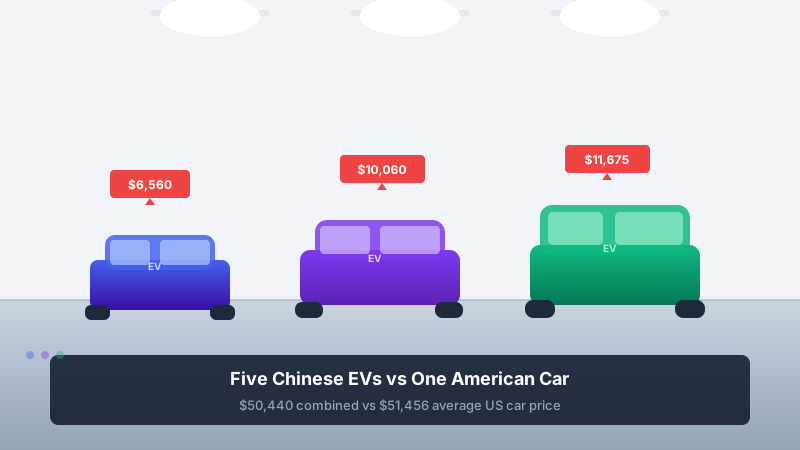
Add up the sticker prices of the five cheapest Chinese electric vehicles: Wuling MiniEV at $6,560, Geely EX2 at $10,060, BYD Seagull at $10,200, BYD Yuan UP at $10,945, and BYD Qin Plus DM-i at $11,675. The total comes to $50,440. The average new car in the United States costs $51,456, according to Kelley Blue Book data cited in Dealership Guy's summary of the Reuters comparison. Five for the price of one.
The comparison is real. It is also misleading. And understanding why it is misleading reveals far more about the global auto industry than the headline suggests.
> Key takeaway: Many Chinese EVs are genuinely cheaper because of vertical integration, domestic scale, intense competition, and local cost structure, not only subsidies. But the five-for-one headline overstates the gap by comparing small city cars and a plug-in hybrid with the average US new vehicle, then ignoring export markups and tariff barriers.
Source File
This article was reviewed on 2026-07-06 against the Reuters comparison mirrored by MSN, Dealership Guy's summary of the five-for-one Chinese EV price gap, InsideEVs' EV range-cycle conversion guide, Rhodium Group's Chinese EV cost analysis, CNBC's coverage of BYD's cost advantage, CAAM data reported by Gasgoo, and the IEA's Global EV Outlook 2025. Domestic sticker prices, export prices, tariff rates, and range figures are treated as market snapshots, not durable global pricing.
What $50,440 Actually Buys
The five-car figure went viral after a Reuters report laid out the comparison. But the range numbers quoted for these vehicles use China's CLTC testing cycle, which consistently produces figures 30-35% higher than the US EPA standard, as InsideEVs has documented. Converting to EPA equivalents changes the picture considerably.
| Model | Price (China) | CLTC Range | EPA-Equiv. Range | Key Details |
|---|---|---|---|---|
| Wuling MiniEV | $6,560 | 205 km (127 mi) | ~85 mi | 30 kW motor, 100 km/h top speed, no rear airbag on base |
| Geely EX2 | $10,060 | 310 km (193 mi) | ~130 mi | 14.6-inch touchscreen, #1 seller in China 2025 |
| BYD Seagull | $10,200 | 305 km (190 mi) | ~125 mi | LFP Blade Battery, rotating 10.1-inch screen |
| BYD Yuan UP | $10,945 | 301 km (187 mi) | ~125 mi | Compact SUV, 70-130 kW motor options |
| BYD Qin Plus DM-i | $11,675 | 55-120 km pure EV | ~35-80 mi pure EV | PHEV, not BEV. Gas engine provides 1,200+ km total |
First, the $6,560 Wuling MiniEV is closer to a neighborhood electric vehicle or quadricycle than a full automobile by US standards. Its earliest base models shipped without airbags, without ABS, and without air conditioning. The 2026 fifth-generation base model finally added a driver airbag and A/C, but the 30 kW motor and ~100 km/h top speed put it in a category that barely exists in the American market. This is not a car you drive on the interstate. It is a city commuter, a school run vehicle, a second car for short trips.
Second, the $10,000-$11,000 models are surprisingly well-equipped for the price. The Geely EX2 ships with a large touchscreen, digital instrument cluster, safety equipment, and vehicle-to-load charging in some trims. The BYD Seagull uses BYD's LFP Blade Battery family, which is part of the broader BYD battery technology story, but it should not be confused with BYD's newer ultra-fast charging systems for higher-end models. These are genuinely competitive products in their segment. But that segment is compact and subcompact vehicles with EPA-equivalent ranges often far below the 300+ mile expectation common among US buyers, as Ars Technica's analysis notes.
Third, the BYD Qin Plus DM-i, the most expensive of the five at $11,675, is not a pure electric vehicle. It is a plug-in hybrid with a pure EV range of just 35-80 miles EPA equivalent. The 1.5L gasoline engine provides a combined range of over 1,200 km, which makes it genuinely comparable to a Toyota Corolla or Honda Civic in practical terms. But it achieves its price point through a small battery supplemented by a combustion engine, not through breakthrough EV cost reduction.
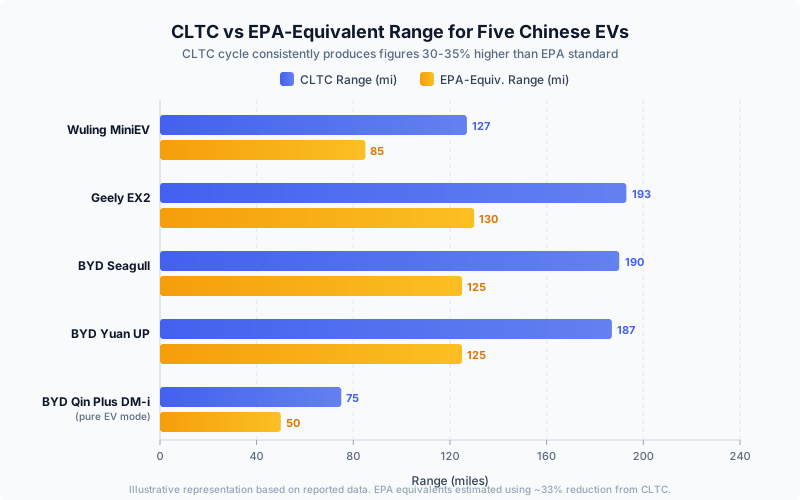 Data derived from InsideEVs CLTC-to-EPA conversion methodology; EPA equivalents estimated using ~33% reduction
Why Chinese EVs Are Actually That Cheap
The price gap between Chinese and Western EVs is not primarily explained by cheap labor alone or by a simple subsidy story. A February 2026 Rhodium Group report, covered by CNBC, quantified BYD's per-vehicle cost advantage against Tesla at approximately $4,700 in a BYD Seal vs. Tesla Model 3 comparison. That single-model comparison is not the whole industry, but the breakdown is instructive.
Vertical integration accounts for roughly $2,369 of that advantage. BYD produces approximately 80% of core components in-house, compared to Tesla's 35-40%. This means BYD builds its own batteries, semiconductor modules, electric motors, and even some raw material processing. Each layer of vertical integration eliminates a supplier margin that Western OEMs have been paying for decades.
Government subsidies contribute just 5% of the cost advantage, roughly $235 per vehicle. This finding undercuts the most common Western explanation for Chinese EV pricing. Yes, China has provided over $29 billion in EV subsidies since 2009, according to MIT Technology Review estimates cited by CNBC. But those subsidies built the industry's foundation during its early years. They are a minor factor in today's cost structure.
The remaining advantage comes from lower construction and manufacturing costs, cheaper R&D conducted domestically, longer supplier payment terms that improve working capital, and sheer production scale. Rhodium found that the Western assumption that outsourced supply chains deliver greater efficiency at scale "does not hold in practice" when manufacturing costs in China are substantially lower than in the West.
But there is a critical caveat that most coverage misses. As Leon Cheng of YCP Solidiance told CNBC: "Among Chinese EV players, only a few, like BYD, do this [vertical integration]. Legacy auto players don't really have this." The cost advantage is not a Chinese industry trait. It is a BYD and Leapmotor trait. Most Chinese automakers buy components from suppliers at prices not dramatically different from what Western OEMs pay. The Auto China 2026 EV takeaways maps which companies have achieved meaningful vertical integration and which remain dependent on external suppliers.
In that Rhodium comparison, BYD's cost advantage is structural more than subsidy-driven. But the advantage belongs most clearly to specific companies with deep integration, not to every Chinese automaker by default.
What Happens When They Leave China
If the domestic prices look shocking, the export prices tell a different story entirely. BYD's own international pricing data, compiled from BYD's regional pricing pages across eight markets, shows that Chinese EV prices roughly double when they cross borders.
| Region | BYD Average Price (USD) | Premium vs China |
|---|---|---|
| China | $23,929 | Baseline |
| Southeast Asia | $35,667 | +49% |
| Japan | $40,000 | +67% |
| UK | $42,850 | +79% |
| Europe | $45,083 | +88% |
| Middle East | $47,000 | +96% |
| South America | $48,667 | +103% |
| Australia | $52,125 | +118% |
| United States | N/A | prohibitive tariff environment |
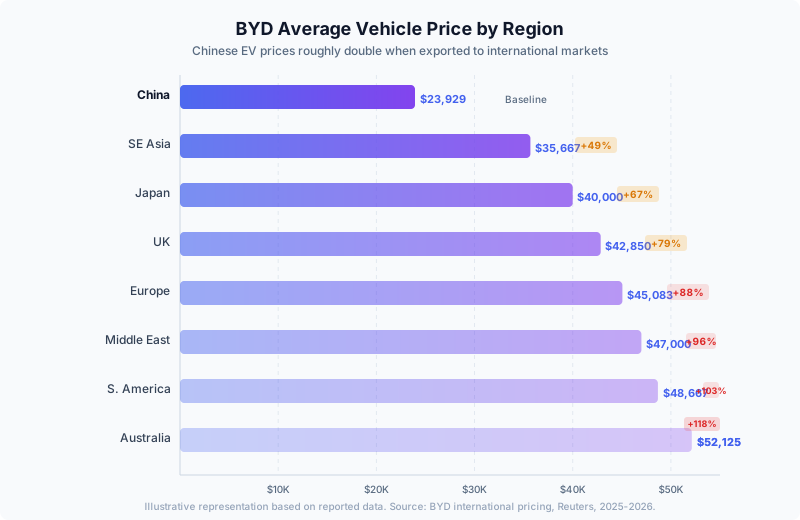 Data source: BYD regional pricing pages across eight markets
The BYD Dolphin, which starts around $13,700 in China, becomes the Dolphin Surf at approximately $23,700 in the UK, $26,000 in the EU, and lands somewhere in between in Australia at roughly $19,500. The BYD Atto 3, known as the Yuan Plus in China at $16,100, reaches $48,000 in the UK, a 198% markup. These figures come from BYD's own regional pricing pages and are confirmed by Reuters reporting.
Where does the money go? The markup stack looks roughly like this:
- Shipping: ~$1,500 per vehicle via roll-on/roll-off or container transport
- EU tariffs: 27% total for BYD (10% standard + 17% countervailing), up to 47% for SAIC
- UK: Similar tariff structure plus 20% VAT
- Brazil: Import tariffs rising from 18% (2025) to 25% (2026)
- Australia: Zero tariffs but 10% GST plus dealer margins and homologation costs
- United States: Section 301 tariffs make direct Chinese-made EV imports commercially prohibitive
- Canada: Policy treatment remains a live trade issue and should be checked before using any North American landed-cost model
On top of tariffs and taxes, there is homologation, which means safety and emissions compliance testing specific to each market. Then dealer and distribution margins of 10-20%. Then localization costs: different trim specifications, warranty provisions, and the expense of building out service networks from scratch.
BYD's export pricing often lands far above China domestic pricing. Reuters and regional price comparisons show that the gap can approach a doubling in some markets, but it is better read as a market-by-market premium than a fixed global rule. Some of that premium is cost recovery: shipping, tariffs, VAT, homologation, warranty, dealer margin, and service buildout. Some is margin capture. The domestic price war has compressed Chinese margins, as our BYD Q1 2026 Profit Fell 55%: The Paradox Explained documented in detail.
The net effect: the $10,200 BYD Seagull that makes headlines in China becomes a $20,000-$25,000 vehicle by the time it reaches a European or Australian showroom. Still competitive, but no longer at the five-for-one pricing that drives the narrative.
The Overcapacity Math Nobody Wants to Hear
The deeper structural story behind Chinese EV prices is one of massive overcapacity. China's auto factories have a nameplate capacity of 55.5 million vehicles annually, according to Bloomberg data from June 2025. Actual production in 2025 reached 34.5 million units, per CAAM data reported by Gasgoo. That yields a capacity utilization rate of approximately 49.5%, though effective utilization is likely higher at 55-65% after accounting for idled ICE lines and model changeovers.
The surplus, roughly 21 million vehicles per year of unused capacity, is the engine driving the price war. It is also the reason Chinese EV prices may not be sustainable at current levels.
Approximately 30 Chinese EV makers have gone bankrupt over the past several years, as UPI reported. Industry-wide debt has climbed to roughly CN¥3 trillion ($415 billion). Of the approximately 120 EV companies still operating in China, only a small number remain financially stable. The BYD vs Tesla comparison tracks the full competitive landscape, but the short version is that the price war is killing the weak faster than it is building the strong.
Can exports absorb the surplus? Not cleanly. China exported millions of vehicles in 2025, but even a very large export increase would not absorb all unused nameplate capacity. The IEA Global EV Outlook 2025 projects continued global EV growth, but much of that demand will be met by local production. The EU, US, India, Brazil, Turkey, Thailand, and other markets all want some domestic manufacturing. The surplus has to go somewhere, but there is no single foreign market large enough to absorb it without political backlash.
Ford CEO Jim Farley put it starkly: China's excess capacity could swallow the entire 12 million vehicle per year US car market. Toyota CEO Koji Sato warned that Japanese automakers are "doomed" unless they match Chinese innovation speed. Both quotes, cited in Ars Technica's reality-check piece, capture the genuine anxiety. But anxiety is not the same as analysis, and the overcapacity problem is as much a threat to Chinese automakers as it is to Western ones.
BYD is addressing this through local manufacturing. Its Brazil plant in Camacari became operational in July 2025, sold approximately 112,900 vehicles in its first year, and is targeting 250,000 units in 2026 with 100,000 export orders already secured from Argentina and Mexico. Factories in Thailand, Hungary, Turkey, and France are in various stages of development. Building where you sell bypasses tariffs but does not eliminate the fundamental overcapacity problem. It simply relocates it.
Why This Matters Right Now
BYD's Q1 2026 earnings crystallized the unsustainability question. Net profit crashed 55% to CN¥4.09 billion despite the company maintaining its position as the world's largest NEV maker. Price cuts reached 34% on some models. Gross margins held at 18.8%, but only because overseas sales at higher prices offset domestic margin compression. As we detailed in our BYD Q1 2026 Profit Fell 55%: The Paradox Explained, BYD is spending nearly three times its net profit on R&D, funding a technology moat that smaller competitors cannot match but that is consuming cash at an extraordinary rate.
Two policy shifts are compounding the pressure. First, China's EV purchase tax exemption expired on January 1, 2026, replaced by a 5% tax that pulled demand forward into late 2025 and hollowed out Q1 2026 sales across the industry. China's auto wholesale sales fell 22% year-over-year in Q1, as Caixin reported. BYD's domestic sales decline tracked the broader market, not company-specific weakness.
Second, trade barriers continue to rise. The EU's countervailing tariffs took full effect. Brazil's import duties are escalating annually. The US 100% tariff remains in place under both the Biden and Trump administrations. Each new barrier makes the export-led growth strategy more expensive to execute.
The combination of domestic demand softening, rising trade barriers, and industry-wide overcapacity creates a squeeze: Chinese automakers need to export to escape the domestic price war, but exporting means higher costs and lower price competitiveness. The BYD vs Tesla comparison covers this dynamic in full, but the key insight is that Chinese EV prices are low because they have to be low, not because they can afford to be low.
Someone is paying for the price war. Right now, that someone is BYD's shareholders.
The Real Competitive Threat
The $6,560 Wuling MiniEV makes for great headlines. It is not the competitive threat that should concern Western automakers. Very few buyers are cross-shopping a Wuling city car against a Ford F-150.
The real threat sits in the $20,000-$30,000 band that Chinese EVs can occupy in export markets when tariffs and dealer structures allow it. The BYD Dolphin, Dolphin Surf, Atto 3, and Geely's low-cost EVs are not five-for-one cheap once exported, but they can still pressure Western entry-level EVs and compact cars. They offer real screens, real safety equipment, LFP battery economics, and increasingly mature software at prices that expose how expensive Western EV cost structures remain.
Western automakers cannot compete at these prices because they never built the vertical integration that makes them possible. Decades of supply chain outsourcing, the same practice that Rhodium Group found does not deliver its promised efficiency advantage in a Chinese manufacturing context, left Western OEMs paying supplier markups at every layer. Rebuilding that integration would take years and tens of billions of dollars.
The Chinese EV price gap is real. The structural cost advantage is real. But the five-for-one comparison obscures more than it reveals. The cheapest Chinese EVs are not competing in the same segment as the average American car. The export prices roughly double the domestic figures. And the prices themselves may not be sustainable, as BYD's collapsing margins demonstrate.
What is sustainable is the cost structure that produces those prices. Vertical integration, domestic R&D, manufacturing scale, and a brutally competitive domestic market that eliminates weak players faster than any Western market could. These are durable advantages that will outlast the current price war. The question is not whether Chinese EVs are as cheap as the headlines suggest. The question is what Western automakers do about the cost structures that make even half those prices possible.
Methodology Note
This analysis draws on pricing data from BYD's international website, CLTC-to-EPA range conversion methodology from InsideEVs and AutoEvolution, cost advantage analysis from the Rhodium Group as reported by CNBC, capacity data from Bloomberg, production statistics from CAAM via Gasgoo and Global Times, and global EV demand projections from the IEA Global EV Outlook 2025. All USD figures use approximate exchange rates as of the data collection date. China domestic prices, tariff rates, tax treatments, and export prices can move quickly, so the numbers should be read as a 2026 market snapshot rather than durable global pricing.
Claim Confidence File
| Claim | Confidence | Evidence boundary |
|---|---|---|
| The five low-cost China-market vehicles can total roughly one average US new-car price | Medium-high | Based on Reuters/Dealership Guy comparison; exact prices and exchange rates move. |
| The five vehicles are equivalent to the average US new car | Low | The article explicitly rejects this: segments, range, size, safety expectations, and PHEV/BEV categories differ. |
| BYD's cost advantage is mainly vertical integration in the Rhodium comparison | High | Supported by Rhodium/CNBC for the BYD Seal vs. Tesla Model 3 comparison. |
| All Chinese automakers have BYD-like structural cost advantage | Low | The article rejects this; integration depth varies sharply by company. |
| Export prices always double China prices | Medium-low | Often much higher than domestic prices, but market-specific; the article avoids a fixed global rule. |
| Chinese EV prices are sustainable at current levels | Low | Price-war, margin, and capacity data all point to sustainability risk. |
FAQ
Are Chinese EVs really 5 times cheaper than American cars?
Combined, the five cheapest Chinese EVs total $50,440 versus $51,456 for the average US new car. But the comparison is misleading. Three of the five have EPA-equivalent ranges of only 125-130 miles. The cheapest, the $6,560 Wuling MiniEV, is closer to a neighborhood EV than a full car by US standards. And one of the five, the BYD Qin Plus DM-i, is a plug-in hybrid, not a pure electric vehicle.
Why are Chinese EVs so much cheaper than Western EVs?
The Rhodium Group found that BYD's $4,700 per-vehicle cost advantage in its Seal vs. Model 3 comparison comes primarily from vertical integration, with subsidies a small part of that specific gap. Lower manufacturing costs, cheaper domestic R&D, longer supplier payment terms, and massive production scale account for the rest. Only a subset of Chinese automakers have achieved this level of integration.
Do Chinese EV prices stay low when exported?
No. BYD and other Chinese brands often charge much more outside China, but the premium varies by model and market. The markup can come from shipping, tariffs, VAT, dealer margins, homologation, warranty, trim differences, and service-network costs.
What is China's EV overcapacity problem?
China's auto factories have 55.5 million units of annual nameplate capacity but produced only 34.5 million vehicles in 2025, a utilization rate of about 49.5%. The 21 million unit surplus drives the domestic price war. Even doubling exports to 12 million vehicles would absorb only 35% of the overcapacity. Approximately 30 Chinese EV makers have gone bankrupt, and industry debt has reached CN¥3 trillion ($415 billion).
Will Chinese EVs come to the US market?
Not at meaningful scale under current trade policy. The US tariff environment makes Chinese-made EV imports commercially prohibitive, and BYD has repeatedly signaled that the US is not an immediate entry market. North American policy should be checked market by market because tariffs, quota discussions, and origin rules can change faster than model plans.