

On April 28, 2026, BYD reported the steepest quarterly profit decline in six years. Net income attributable to shareholders fell 55.38% year-over-year to CN¥4.09 billion ($598 million), the lowest level in more than three years, according to the company's HKEX filing. Revenue dropped 11.82% to CN¥150.2 billion. NEV sales plunged 30% to 700,463 units, marking the eighth consecutive month of domestic sales declines. Operating cash flow collapsed 67%.

By every conventional metric, this was a disastrous quarter. Yet BYD's Hong Kong-listed stock rose as much as 3.6% to HK$107.40 in early trading after the earnings release. Morgan Stanley maintained its Overweight rating with a HK$126 price target. Citi kept its Buy rating. Analysts from JPMorgan to Macquarie wrote that Q1 likely marked the earnings bottom.
Three facts are simultaneously true: BYD's profit crashed, its gross margins improved, and the market rallied. Understanding why all three coexist requires looking past the headline numbers and into the structural shifts happening inside China's most important automaker.
Source File
This article was reviewed on 2026-06-30 against BYD's official Q1 2026 HKEX filing, CnEVPost's earnings report on BYD's Q1 net profit decline, ChinaEVHome's analysis of BYD's overseas and R&D offset, Benchmark Minerals' note on Chinese EV purchase tax changes, Gasgoo Institute export data on BYD's Q1 overseas destinations, and Reuters Breakingviews commentary on BYD's premium push. The interpretation separates reported accounting profit from cash-flow and borrowing signals.
The Bear Case in Full View
Start with the numbers that would alarm any investor.
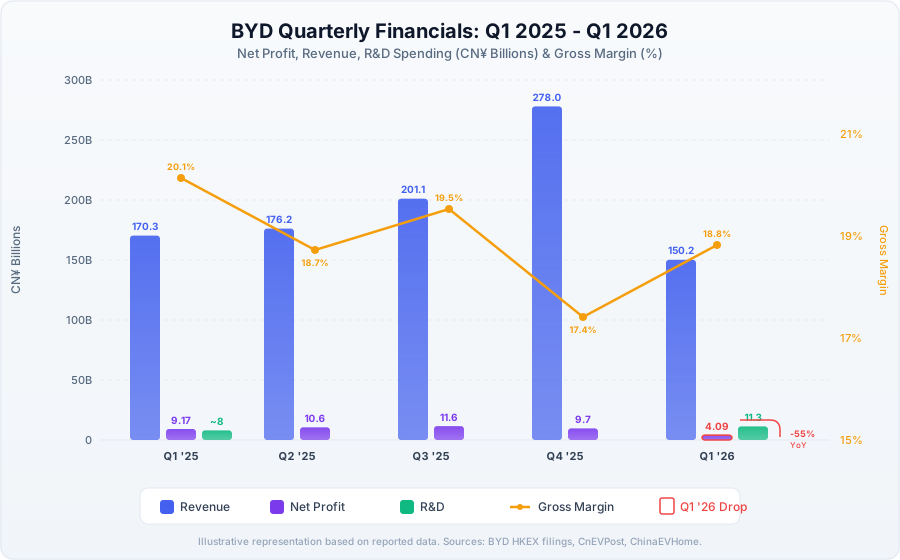 Data source: BYD HKEX filings, CnEVPost, ChinaEVHome
| Metric | Q1 2026 | YoY Change |
|---|---|---|
| Net profit | CN¥4.09B | -55.38% |
| Revenue | CN¥150.2B | -11.82% |
| NEV sales | 700,463 units | -30.01% |
| Operating cash flow | CN¥2.79B | -67.48% |
| Short-term borrowings | CN¥66.3B | +72% (QoQ) |
| Inventory | CN¥160.4B | +16% (QoQ) |
| Gross margin | 18.8% | +1.4pp (QoQ) |
The debt picture compounds the concern. Short-term borrowings surged 72% in three months to a record CN¥66.3 billion, as Bloomberg reported. Bills payable doubled to CN¥48.6 billion. BYD attributed the borrowing spike to "the increase in group financing needs," language that raises more questions than it answers. Inventory piled up 16% to CN¥160.4 billion despite aggressive discounting that pushed BYD's March price cuts to their highest level in two years.
Foreign exchange losses added a third headwind. The stronger Chinese yuan in Q1 2026 produced currency translation losses on BYD's growing overseas operations, compounding the profit decline beyond what domestic demand weakness and R&D spending alone would explain.
On a trailing twelve-month basis, BYD burned through CN¥88 billion in free cash flow despite reporting a net profit of CN¥27.3 billion, as Aktiencheck noted. That gap between accounting profit and cash reality deserves attention.
Why the Market Shrugged
The stock rally was not irrational. Several underappreciated dynamics explain it.
Margin improvement. Gross margin expanded to 18.8%, up 1.4 percentage points from Q4 2025 and near a one-year high. Citi calculated that gross profit per car actually rose 18% year-over-year. The improvement came from two sources: a higher share of premium models (the Denza, Fangchengbao, and Yangwang brands sold a combined 84,131 units, up 60% YoY), and improved geographic mix with overseas sales commanding better prices. Premium models now account for roughly 12% of BYD's total vehicle sales, double their contribution from a year ago, per Sunwah Kingsway analysts.
Policy-driven demand shock. The sales decline was heavily concentrated in China's domestic market, which was hit by the expiration of a decade-long full EV purchase tax exemption. Starting January 1, 2026, new energy vehicles became subject to a 5% purchase tax (half the standard 10% for ICE vehicles), as Benchmark Minerals documented. The change triggered a massive demand pull-forward into late 2025, hollowing out Q1 2026 demand. China wholesale passenger vehicle sales fell 22% YoY across the industry, according to Caixin. BYD's domestic decline tracked the broader market, not company-specific failure.
Export surge. Overseas sales served as a counterweight. BYD exported approximately 320,000 units in Q1, up 50-71% year-over-year depending on the source, as AInvest reported. Cumulative BYD exports have now exceeded 2.08 million units across more than 120 countries. The company raised its 2026 overseas sales target to 1.5 million units from 1.3 million, a 15% increase communicated directly to analysts, per Automotive World.
The market's verdict: the domestic slump is cyclical and policy-driven, while the margin improvement and export growth are structural. That calculus has merit, though it is not without risk.
The R&D Bet: Spending Beyond Profit
The single most telling number in BYD's Q1 report is not the profit decline. It is the R&D line.
BYD spent CN¥11.3 billion ($1.65 billion) on research and development in Q1 2026, according to ChinaEVHome. That figure exceeds the company's entire net profit by CN¥7.2 billion. In other words, BYD is investing nearly three times what it earns back into technology development. It is worth noting that R&D spending itself declined roughly 20% year-over-year — the ratio widened primarily because profit collapsed faster than R&D was trimmed. The commitment to outspending earnings remains, but the headline number reflects a shrinking denominator more than an expanding numerator.
This is not a new pattern. BYD has consistently run an "R&D above profit" structure, and the spending funds three critical initiatives: the Gen 2 BYD five-minute charging file, the flash charging infrastructure that now spans 5,500 stations across 311 cities, and the God's Eye advanced driver assistance system (covered in our analysis of China Autonomous Driving 2026: Reality Check).
The flash charging network alone deserves attention. BYD is targeting 20,000 stations by end of 2026 (18,000 urban plus 2,000 highway), as covered in our analysis of BYD 5-Minute Charging: What Buyers Can Actually Verify. This is infrastructure spending on a scale that no other automaker is attempting. Tesla's Supercharger network took a decade to reach comparable density in its home market. BYD is building its Chinese network in roughly two years.
The R&D spending pattern signals a company that is deliberately sacrificing short-term profitability to widen its technology moat. The bet: if BYD can maintain a 12-18 month technology lead in batteries, charging, and software, it will emerge from the current industry shakeout in an unassailable position. The risk: if the shakeout drags on, or if competitors close the gap faster than expected, BYD will have burned through cash and margin for a lead that proves temporary.
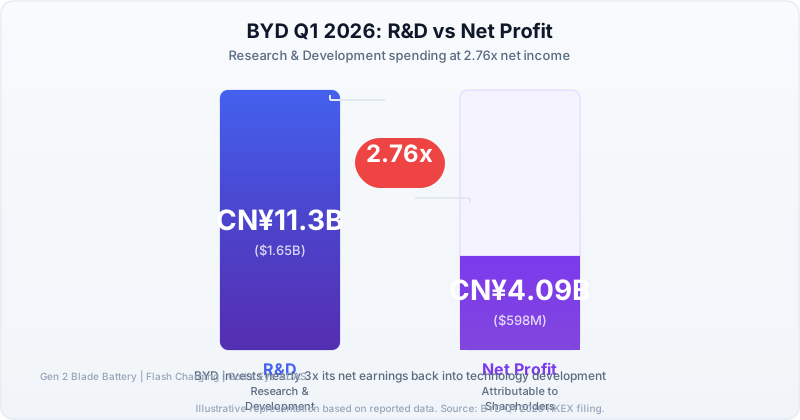 Data source: BYD Q1 2026 HKEX filing
The Debt Question Nobody Can Fully Answer
The surge in short-term borrowings to CN¥66.3 billion deserves scrutiny, because the official explanation is incomplete.
Part of the increase reflects a structural change in how BYD manages supplier payments. The Chinese government's crackdown on extended payment practices forced BYD to shift from IOU-based systems that delayed supplier payments to faster settlement cycles, as Reuters reported. This transition pushed more supplier obligations onto interest-bearing debt.
But the scale of the increase, 72% in a single quarter, suggests more than a payment-timing shift. BYD is simultaneously funding a massive factory buildout program (Thailand, Hungary, Turkey, Brazil, France, Uzbekistan), the flash charging infrastructure rollout, and the development of premium sub-brands that require different marketing, dealer networks, and customer service than the mass-market business.
The Hungary plant illustrates the execution risk. BYD invested EUR 4 billion in the Szeged facility with a planned capacity of 300,000 vehicles per year, but mass production has been delayed, with initial output limited to tens of thousands of units. The Turkey plant is planned to start production in 2026, but timelines remain uncertain.
Meanwhile, industry-wide overcapacity casts a shadow over all this investment. China's auto factories can produce 55.5 million vehicles annually against domestic sales of roughly 23 million, yielding an average capacity utilization of about 50%, per Bloomberg's earlier reporting. BYD is expanding production capacity into a global market where supply already exceeds demand by a wide margin.
The bull case says BYD's factories in Brazil and Southeast Asia serve underserved markets with genuine demand, not the oversupplied Chinese domestic market. The bear case says building factories in countries with smaller addressable markets, higher labor costs, and unfamiliar regulatory environments is exactly how overextended companies stumble. The truth probably sits somewhere in between, and Q2-Q3 data will begin to reveal which direction the balance tips.
Industry Consolidation as BYD's Weapon
The broader Chinese EV industry is in the early stages of a brutal consolidation, and BYD's Q1 pain is an accelerant, not a symptom.
Approximately 30 Chinese EV makers have gone bankrupt over the past several years, as UPI reported. Industry-wide debt has climbed to roughly CN¥3 trillion ($415 billion), a figure comparable to the GDP of some Southeast Asian economies. Of the roughly 120 EV companies still operating in China, only a small number remain financially stable. Most face significant liquidity risks.
BYD EVP Stella Li stated at the Beijing Auto Show in April 2026 that "history suggests not all will survive." The statement was matter-of-fact, not threatening, but the subtext was clear: BYD has the balance sheet to endure losses that kill smaller competitors.
Consider the contrast. NIO reported a net loss of CN¥14.9 billion in 2025, pushing cumulative losses over eight years past CN¥110 billion, and cut more than 10,000 jobs in restructuring, per Sherwood News. Geely's net profit dropped 27% in Q1 2026. Multiple major automakers posted double-digit declines, as IndexBox documented. WM Motor, once considered a promising EV startup, filed for bankruptcy reorganization after failing to scale.
The price war that BYD helped initiate in 2023 has become the industry's defining feature. Every round of price cuts hurts BYD's margins, but it hurts smaller, less capitalized competitors more. The strategy is rational if you have the deepest pockets and the strongest technology, which BYD arguably does. The Auto China 2026 EV takeaways provides a fuller picture of which brands are positioned to survive this shakeout.
BYD's technology advantage compounds the pressure. The Gen 2 Blade Battery, the 5-minute flash charging system, and the God's Eye ADAS represent capabilities that smaller competitors cannot replicate without similar R&D investment, which they cannot afford without profits, which they cannot generate because BYD keeps cutting prices. This is a self-reinforcing cycle.
The Escape Route: Export-Led Growth
If there is a credible path for BYD to maintain growth while domestic demand softens, it runs through overseas markets.
Brazil has emerged as BYD's largest export destination by far, with 89,637 units sold in Q1 2026 (53,355 BEV plus 36,282 PHEV), according to Gasgoo Institute data. The UK followed at 17,403 units, the UAE at 14,885, Belgium at 14,533, and Australia at 13,977. European markets showed broad-based growth with a balanced BEV/PHEV mix, while Middle Eastern demand was dominated by plug-in hybrids.
| Market | Q1 2026 Units | Notable Pattern |
|---|---|---|
| Brazil | 89,637 | 60% BEV, dominant #1 position |
| UK | 17,403 | Strong BEV share |
| UAE | 14,885 | PHEV-heavy |
| Belgium | 14,533 | Balanced mix |
| Australia | 13,977 | Growing market share |
| Germany | 10,649 | Despite EU tariff headwinds |
The 1.5 million unit overseas sales target for 2026 is ambitious but not implausible given the current trajectory. If achieved, it would represent a fundamental rebalancing of BYD's revenue base, reducing exposure to Chinese domestic policy swings while capturing higher-margin markets.
Fuel-price volatility is a secondary sensitivity in BYD's export thesis. Higher gasoline costs can make EVs more attractive in price-sensitive markets like Brazil and Southeast Asia, exactly where BYD is building its factory footprint. But this is not the core reason the export story matters. The harder evidence is BYD's Q1 export mix, overseas factory buildout, car-carrier capacity, and higher-margin geographic exposure.
Tesla's Momentary Reclaim
One data point stings: Tesla retook the global #1 BEV sales spot in Q1 2026, the first time it led BEV deliveries since Q4 2024, as InsideEVs reported. BYD had surpassed Tesla in full-year 2025 BEV sales with approximately 2.26 million units versus Tesla's 1.8 million, but the Q1 reversal underscored BYD's domestic demand collapse.
This is a temporary statistical artifact rather than a competitive shift. Tesla's deliveries held roughly steady while BYD's fell, and BYD's total NEV sales (including plug-in hybrids) still exceeded Tesla's BEV-only figure. But it provides ammunition for the narrative that BYD's growth story is losing momentum.
The deeper competitive dynamic is covered in the upcoming BYD vs Tesla: EV Strategy and Technology (2026) analysis, but the relevant point here is that BYD's technology lead appears to be widening even as its sales lead narrows. The flash charging system, the Gen 2 Blade Battery, and the God's Eye ADAS represent capabilities that Tesla has not matched. The question is whether technology leadership translates into sustained market share when price is the dominant purchase criterion for most buyers.
The Great Tang Signal
The most optimistic data point for BYD's near-term outlook came after the earnings release. At the Beijing Auto Show on April 24, BYD's Great Tang flagship SUV secured over 30,000 pre-orders within 24 hours, and later passed 100,000 orders within two weeks, as Electrek reported.
Priced at CN¥250,000-320,000 ($36,460-$46,670), the Great Tang is a seven-seater with up to 950 km range and flash charging that adds 200 km in 5 minutes. It is equipped with the Gen 2 Blade Battery. The pre-order volume suggests that BYD's premium push has genuine demand behind it, not just marketing spend.
If BYD can consistently move metal at the CN¥250,000+ price point, the margin structure of the business changes meaningfully. The Reuters Breakingviews analysis noted that Wang Chuanfu's strategy includes a sporty Denza Z9 GT at roughly CN¥300,000 (four times the price of the budget Seagull) and a new supercar targeting Porsche and Maserati. The challenge is that building a luxury brand requires a different set of muscles than dominating the mass market, and the tools that worked at scale may not serve BYD well in the premium segment.
BYD has also explored Formula One racing participation as a brand-building tool, discussions that span team ownership, power unit supply, and sponsorship, per Reuters Breakingviews. The mere fact that BYD is considering F1 reveals the ambition. Whether it can execute the brand transition remains the open question.
What Happens Next
The second and third quarters will reveal whether Q1 was a cyclical trough or the beginning of a structural profitability decline.
Several signals to watch:
Domestic demand recovery. The 5% purchase tax shock is a one-time adjustment. If demand normalizes by Q3, as several analysts expect, BYD's domestic volumes should recover. China extended trade-in subsidies into 2026 at up to CN¥20,000 for eligible NEV purchases, though the program was scaled back earlier than expected in parts of the country, contributing to an 8% drop in auto sales, as Yahoo Finance noted.
Hungary and Turkey plant ramp. The pace at which BYD's European factories reach meaningful production volumes will determine whether the 1.5 million overseas sales target is achievable and whether BYD can sidestep EU tariff costs.
Premium brand traction. The Great Tang pre-orders are encouraging, but sustained sales at CN¥250,000+ will prove whether BYD can compete on brand rather than price.
Competitor attrition. If more EV makers fail in 2026, the survivors gain market share without spending on price cuts. The China EV price gap tracks the broader competitive dynamics across the sector.
Cash flow trajectory. The CN¥88 billion trailing free cash flow burn cannot continue indefinitely. If overseas sales ramp and domestic demand recovers, cash generation should improve. If not, the borrowing spree will face harder questions from creditors.
The balance of evidence suggests Q1 was primarily a cyclical trough driven by a one-time tax policy adjustment, with structural tailwinds — improving margins, widening technology lead, accelerating exports — outweighing structural risks like debt accumulation and industry overcapacity. But the thesis rests on demand recovering in the second half of 2026. If it does not, the CN¥66.3 billion in short-term borrowings and the CN¥88 billion free cash flow burn will shift from concerns to constraints.
Methodology Note
This analysis draws on BYD's official Q1 2026 HKEX filing, financial data reported by CnEVPost, ChinaEVHome, and Bloomberg, and export data from Gasgoo Institute. Macro context on China's EV policy changes draws from Benchmark Minerals. All currency figures are in Chinese yuan unless otherwise noted, with USD conversions at approximate exchange rates. Analyst quotes and ratings are as reported by Yahoo Finance and other financial media on the earnings date.
Claim Confidence File
| Claim | Confidence | Evidence boundary |
|---|---|---|
| BYD profit pressure is relevant to buyers because price-war economics can affect warranties, service, and dealer behavior | Medium-high | Based on financial-reporting interpretation; exact future service outcomes are not proven by one quarter. |
| A profit decline means BYD is structurally weak or near failure | Low | The article avoids that claim and frames the issue as margin pressure, not solvency. |
| The China EV price war can shift risk from sticker price to lifecycle support | High | Consistent with the article's buyer framing and linked EV procurement context. |
| Quarterly results alone prove a permanent trend | Low | The article treats Q1 data as a signal that needs later-quarter confirmation. |
FAQ
Why did BYD's profit fall 55% in Q1 2026?
BYD's net profit dropped to CN¥4.09 billion primarily due to a 30% year-over-year decline in NEV sales caused by China's new 5% EV purchase tax, which took effect January 2026 and pulled demand forward into late 2025. R&D spending of CN¥11.3 billion (though down ~20% YoY) still exceeded net profit by CN¥7.2 billion, and foreign exchange losses on overseas operations added further pressure.
Did BYD's gross margin improve despite the profit drop?
Yes. BYD's comprehensive gross margin rose to 18.8% in Q1 2026, up 1.4 percentage points from Q4 2025. Citi calculated that gross profit per car increased 18% year-over-year, driven by a higher share of premium models and improved overseas market mix with better pricing.
Why did BYD's stock rise after the bad earnings?
BYD's Hong Kong-listed stock rose 3.6% because analysts viewed Q1 as the earnings bottom. Gross margin improvement, overseas sales surging 50-71%, and the raised export target to 1.5 million units signaled that the domestic slump was cyclical and policy-driven rather than a structural competitive decline.
How much debt does BYD have?
BYD's short-term borrowings surged 72% in Q1 2026 to a record CN¥66.3 billion, partly due to a government-mandated shift away from delayed supplier payments toward faster settlement. Bills payable doubled to CN¥48.6 billion. Total liabilities reached CN¥640 billion, though overall liabilities rose only 2.4% as declining trade payables offset the borrowing increase.
Is BYD's Q1 profit decline a sign of deeper trouble?
The evidence is mixed. The domestic sales decline aligns with the industry-wide 22% drop caused by expiring tax incentives. Margin improvement and surging exports suggest structural strength. The real risk is the cash burn rate: CN¥88 billion in trailing free cash flow, combined with massive factory and infrastructure investment. The next two quarters will determine whether the investment thesis holds.
Related Entries
- BYD vs Tesla: EV Strategy and Technology (2026) — BYD vs Tesla competitive landscape
- BYD 5-Minute Charging: What Buyers Can Actually Verify — BYD's flash charging technology
- BYD five-minute charging file — BYD's Blade Battery technology
- China EV price gap — China's EV and battery industry overview
- Auto China 2026 EV takeaways — Chinese EV brand landscape