
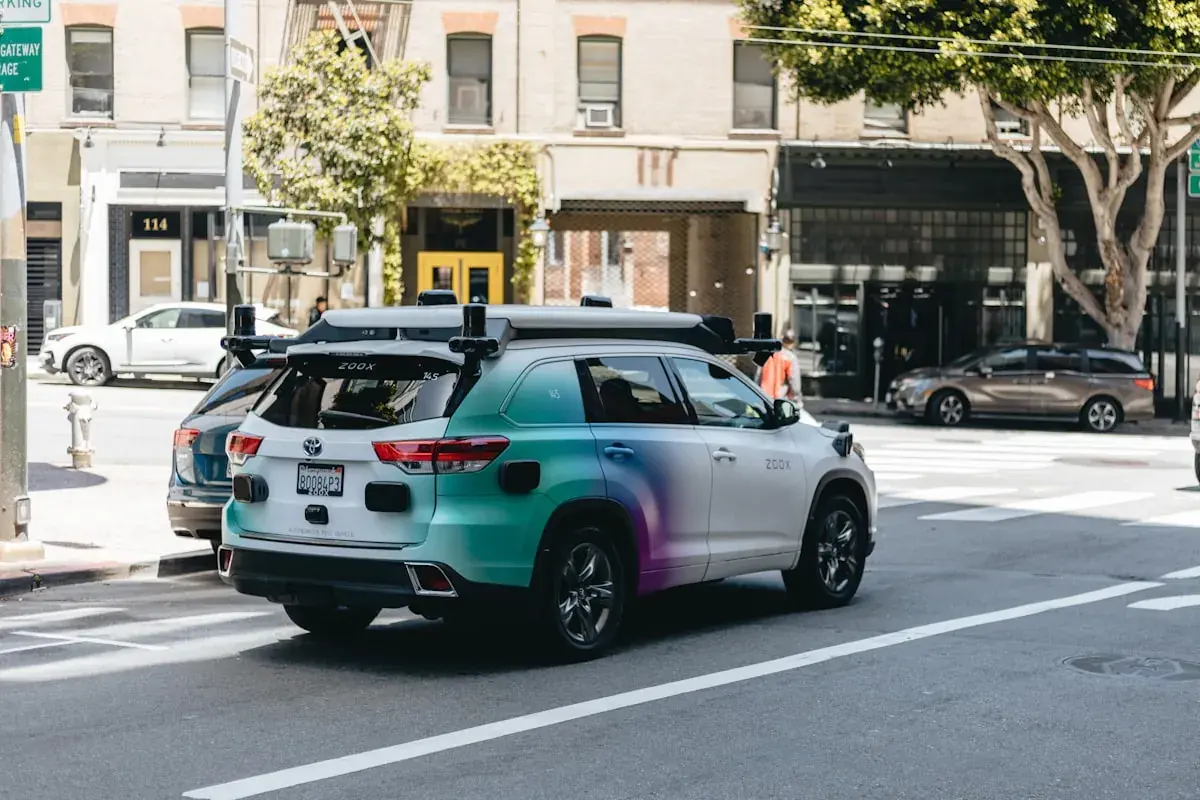
Two things happened in China during April 2026 that capture the state of autonomous driving. At Auto China 2026 in Beijing, BYD, Huawei, Xiaomi, and Geely all pushed L2+, L3 testing, or robotaxi narratives, with BYD's "God's Eye" system now deployed on over 2.5 million vehicles and Huawei's ADS logging 8.76 billion kilometers of driving data across 1.4 million equipped cars. Chinese tech media outlet 36Kr declared 2026 "the first year of autonomous driving commercialization."
That same month, reports said more than 100 Baidu Apollo Go robotaxis stalled across Wuhan during a system malfunction. Some passengers described being trapped in vehicles or unable to get useful help quickly. Public reporting did not establish a fully confirmed root cause, so the safer reading is operational: a fleet-scale robotaxi service can fail in ways that look less like a perception breakthrough problem and more like a deployment, monitoring, and recovery problem.
Source File
This article was reviewed on 2026-07-06 against Yahoo / SCMP coverage of Daiwa's 270,000-unit L3 forecast, China Daily's report on MIIT-approved L3 road and speed limits, BYD's official God's Eye / Urban NOA damage-coverage announcement, CarNewsChina's report on BYD God's Eye installed-base data, Global China EV's report on Huawei Qiankun ADS installed base and assisted-driving mileage, Guardian coverage of the Baidu Apollo Go Wuhan malfunction, ECNS coverage of the Supreme People's Court driver-liability ruling, Counterpoint's Auto China 2026 autonomous-driving trend review, and Pony.ai's investor update on robotaxi fleet scale. The article treats "commercialization" as a staged deployment claim, not proof of full autonomy. Robotaxi incident-cause language is deliberately conservative because public sources reviewed did not provide a complete confirmed root-cause report.
Claim Confidence File
| Claim | Confidence | Evidence boundary |
|---|---|---|
| China is commercializing supervised ADAS and geofenced robotaxi services quickly | High | Supported by company, industry, and media reporting cited in the Source File; commercialization does not mean unrestricted full autonomy. |
| BYD and Huawei installed-base/mileage claims prove unsupervised autonomy | Low | The article treats those numbers as deployment-scale signals, not proof that liability has moved from driver to vehicle. |
| Robotaxi incidents make fleet operations, passenger recovery, and remote assistance a buyer-risk category | Medium-high | Grounded in reported Wuhan incident coverage; public sources do not provide a full confirmed root-cause report. |
| China autonomous driving is unsafe in every operating domain | Low | The article avoids that conclusion and focuses on evidence limits, ODD boundaries, and operational readiness. |
Quick Answer
| Reader question | Practical answer |
|---|---|
| Is China leading autonomous driving in 2026? | China leads in deployment scale and data accumulation, but not in unrestricted full autonomy. |
| What is actually commercial today? | L2+ ADAS is deployed in millions of cars; L3 is limited to designated roads; L4 robotaxis remain geofenced pilot services. |
| What is the biggest risk signal? | The Baidu Wuhan robotaxi outage showed that fleet operations, passenger recovery, and remote assistance matter as much as perception algorithms. |
| What should buyers or analysts watch? | L3 permit expansion, driver-liability rules, incident transparency, fleet uptime, and whether export markets accept Chinese ADAS stacks. |
| Related field guide | Read this with Auto China 2026: 5 Chinese EV Technology Shifts, China's 140T AI Tokens: Infrastructure Signal, Not Hype, and BYD 5-Minute Charging: What Buyers Can Actually Verify. |
Both of these realities are true at the same time. China is deploying assisted-driving and geofenced autonomous systems at very large scale. The hardware is real, the data accumulation is compounding, and the regulatory environment is permissive enough to allow testing and pilots across many cities. But "commercialization" is doing a lot of work in that headline. This article breaks down what is actually happening on three fronts -- consumer cars, robotaxi fleets, and regulation -- and what "commercialization" means when you look past the press releases.
Front 1: Consumer Cars and the L3 Transition
The consumer vehicle side is where the numbers look most impressive and the reality is most nuanced.
BYD has equipped over 2.5 million vehicles with its DiPilot "God's Eye" advanced driver assistance system. At Auto China 2026, BYD showcased the updated system on vehicles like the Denza Z9 GT, which ships with roof-mounted lidar as standard equipment alongside a 122.5 kWh Blade battery pack and 1,036 km CLTC range. The hardware is formidable. But God's Eye, despite the branding, operates at L2+ level -- the driver must remain engaged and legally responsible at all times. The system can handle highway lane keeping, adaptive cruise control, and automated lane changes, but it is not an autonomous driving system by SAE definition.
Huawei's Intelligent Automotive Solution (IAS) division presents a more complete picture. Huawei ADS is now equipped on 1.4 million vehicles across 25+ brand partnerships, including Seres Aito, Chery Luxeed, BAIC Stelato, and JAC Maextro. The accumulated driving data stands at 8.76 billion kilometers. Huawei has invested tens of billions of RMB in automotive R&D, with recent disclosures indicating over 50 billion yuan (~$7 billion) cumulative spending on intelligent automotive solutions. The Aito M9 alone has exceeded 270,000 cumulative deliveries and has been China's best-selling SUV above 500,000 yuan ($72,900) for 21 consecutive months. Huawei's latest Qiankun ADS system uses 500-line lidar (upgradeable to 1,000 lines), multiple solid-state lidars, 4D millimeter-wave radar, and ultrasonic sensors. This is production hardware at volume, not prototype demonstration.
Xiaomi received an L3 autonomous driving test license in April 2026 for its SU7 model -- a meaningful milestone for a company that only entered the automotive market in 2024. Geely also received L3 highway test approval. These are test licenses, not commercial deployment permits. They allow the companies to operate vehicles in autonomous mode on designated roads under specific conditions, with a safety driver present.
Daiwa Research projects that approximately 270,000 L3-capable vehicles will be on Chinese roads by end of 2026. That sounds significant until you put it in context: China produces roughly 27 million passenger vehicles annually. 270,000 L3 vehicles represents roughly 1% of the market. The transition from L2+ ADAS (millions of cars, driver responsible) to L3 (car responsible under specific conditions, limited permits) is just beginning.
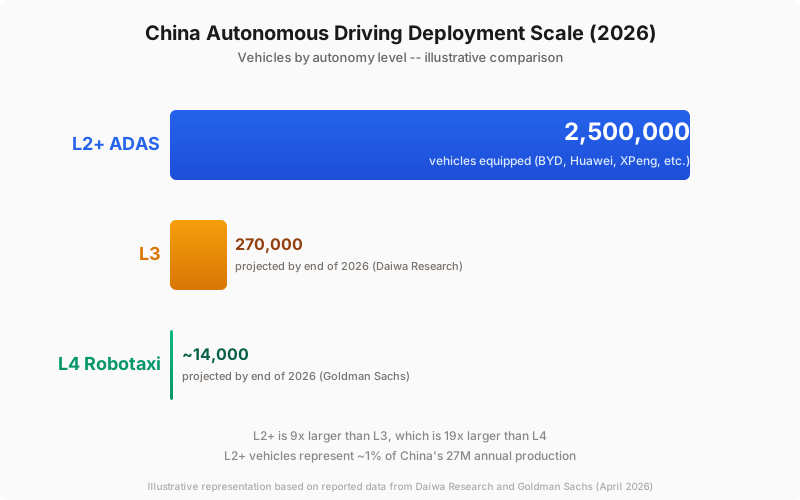 Data source: Daiwa Research projections as reported by Yahoo / SCMP, plus market-reported robotaxi fleet estimates.
Front 2: Robotaxi Fleets -- Scale With Growing Pains
The robotaxi sector is where China's "deploy first, iterate fast" philosophy is most visible -- and where the cracks are showing.
Baidu's Apollo Go operates the largest commercial robotaxi fleet in China, with services in Wuhan, Beijing, Chongqing, Shenzhen, and several other cities. In Wuhan alone, Apollo Go has been running hundreds of driverless rides daily. But the April 2026 mass failure was a watershed moment. Reports described more than 100 vehicles stalling during a system malfunction. Passengers reported being unable to exit or get effective in-car help quickly. The incident was resolved after several hours, but the footage of stranded robotaxis blocking traffic went viral on Chinese social media, feeding into public skepticism about autonomous vehicle readiness.
The Baidu Wuhan failure is covered in detail in Baidu Robotaxi Wuhan Failure Analysis. The short version: a fleet-scale robotaxi outage can be an operational failure even when the underlying driving stack is not the immediate issue. Monitoring, fail-safe behavior, passenger release procedures, remote assistance, and rollback planning are now part of autonomous-vehicle readiness.
Pony.ai, backed by Toyota and operating in Beijing, Guangzhou, and Shanghai, is now a NASDAQ-listed robotaxi company and has reported a fleet of more than 1,400 robotaxis. It has discussed larger fleet targets, but buyers should separate current deployed fleet, regulatory permits, and future expansion goals.
WeRide, headquartered in Guangzhou, operates approximately 2,600 autonomous vehicles across robotaxi, robobus, and freight applications. The company has expanded to international markets including the UAE and Singapore, making it one of the first Chinese autonomous driving companies to operate commercially outside mainland China.
Geely-backed Caocao Mobility debuted a purpose-built robotaxi vehicle at Auto China 2026, targeting 100,000 units by 2030. The vehicle is designed from the ground up for autonomous operation -- no steering wheel in the fully autonomous version, modular sensor architecture, and a cost target that could make fleet economics viable at scale.
Analyst projections point to rapid Chinese robotaxi fleet growth in 2026, but even optimistic fleet estimates remain modest relative to urban transportation scale. Thousands or low tens of thousands of robotaxis spread across multiple cities are still a rounding error against the millions of human-driven taxis, ride-hailing vehicles, and buses operating in China's tier-one cities.
Major Autonomous Driving Players in China
| Company | Fleet/Equipped Vehicles | Autonomy Level | Cities | Notable Status |
|---|---|---|---|---|
| Huawei ADS | 1.4M vehicles | L2+ (L3 testing) | Nationwide | ~50B yuan R&D, 8.76B km data, 25+ brands |
| BYD DiPilot | 2.5M vehicles | L2+ | Nationwide | God's Eye system, volume leader |
| Baidu Apollo Go | ~1,000+ robotaxis | L4 (geofenced) | Wuhan, Beijing, Chongqing, Shenzhen | Wuhan mass failure April 2026 |
| Pony.ai | 1,400+ reported fleet, larger target | L4 (geofenced) | Beijing, Guangzhou, Shanghai | NASDAQ-listed; expanding commercial fleet |
| WeRide | ~2,600 vehicles | L4 (geofenced) | Guangzhou, UAE, Singapore | International operations |
| XPeng | Growing consumer fleet | L2+ (L3 testing) | Nationwide | XNGP city driving system |
| Caocao (Geely) | Purpose-built robotaxi | L4 (planned) | not yet broad commercial scale | Targeting 100K by 2030 |
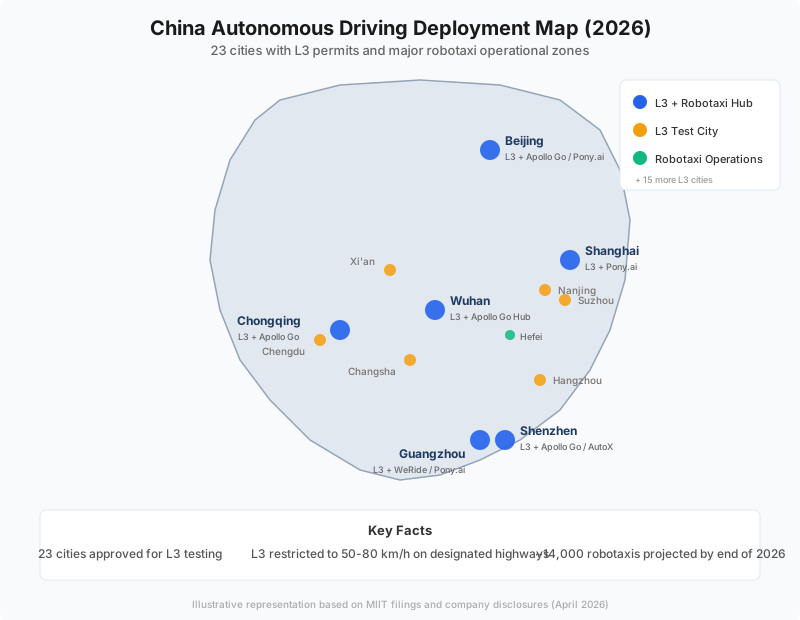 Data source: MIIT regulatory filings and company disclosures (April 2026)
Front 3: Regulation -- Permissive but Cautious
China's regulatory approach to autonomous driving is best described as "regionally permissive, nationally ambiguous."
Multiple Chinese cities now allow L3 testing or pilot operation on designated roads. This sounds like a broad regulatory green light, but the specifics matter. Reported L3 operation is restricted by road segment, speed range, operating condition, and safety-driver or takeover requirements. The geographical and speed restrictions mean that L3 in China today applies to a narrow set of driving scenarios -- essentially, highway cruising in controlled conditions.
In February 2026, China's Supreme Court issued a ruling that drivers remain legally responsible even when autonomous driving systems are engaged. This is the single most important regulatory fact for understanding the current state of play. An L3 system may theoretically be capable of handling driving tasks, but if the car crashes, the human behind the wheel is liable. This creates an odd incentive structure: automakers market autonomous capability, consumers pay for it, but nobody wants to actually rely on it because the legal consequences fall on the driver.
There is no unified national autonomous driving law in China. What exists instead is a patchwork of local regulations, test permits, and pilot zones. Cities like Wuhan, Beijing, and Shenzhen have been aggressive in designating autonomous driving test zones and issuing commercial operation permits. Other cities are more cautious. The regulatory framework is evolving faster than the technology in some places, and slower in others.
The Xiaomi SU7 crash in March 2025, which resulted in three deaths, was a pivotal moment for Chinese autonomous driving regulation. The vehicle was operating on a highway using its ADAS system when it collided with a construction zone barrier. The investigation found that the driver-assistance system failed to detect the barrier, and the driver did not intervene in time. The incident triggered a regulatory overhaul and delayed L3 mass production plans across multiple automakers. It also intensified public scrutiny of how autonomous driving capabilities are marketed versus what they can actually do.
As Bill Russo, a Shanghai-based automotive consultant, has observed: "Marketing is running ahead of governance." The observation applies broadly. Automakers advertise "full-scenario autonomous driving" and "city-level NOA" (Navigate on Autopilot), but the legal and regulatory infrastructure to support actual autonomous operation remains incomplete.
What "Commercialization" Actually Means
Understanding China's autonomous driving landscape requires separating three distinct categories that tend to get conflated in headlines.
L2+ ADAS in millions of cars (real, now). BYD's 2.5 million God's Eye vehicles, Huawei's 1.4 million ADS-equipped cars, XPeng's XNGP, Li Auto's AD Max, NIO's NOP+ -- these are advanced driver assistance systems that handle an increasing range of driving tasks but require continuous human supervision. They are commercially deployed, generating enormous amounts of real-world driving data, and improving rapidly. This is the foundation on which everything else is built. It is also not autonomous driving. It is very good cruise control with lane keeping and decision-making capability.
L3 highway permits (just starting, limited scope). The 270,000 projected L3 vehicles by year-end represent the first stage of true conditional automation, where the car can handle driving tasks in specific scenarios and the driver is permitted to look away briefly (but must be ready to take over). L3 permits are restricted to designated highway zones at limited speeds. This is meaningful progress, but it covers a fraction of driving scenarios. City streets, intersections, construction zones, and adverse weather remain L2+ territory.
L4 robotaxis (pilot operations, not commercial scale). Even optimistic 2026 robotaxi fleet estimates are impressive as technology demonstrations and data-gathering exercises, but they are not yet a transportation system. Baidu's Apollo Go in Wuhan charges fares and carries real passengers, but the service area is geographically limited, the vehicles operate under permits that can be revoked, and as the April 2026 failure demonstrated, the operational reliability is not yet at the level that public transportation infrastructure demands.
"Commercialization" in 2026 means that autonomous driving technology is being sold in consumer vehicles (L2+), permitted in limited autonomous scenarios (L3), and operating pilot services in select cities (L4). It does not mean that autonomous driving is replacing human drivers at scale.
The Speed Versus Safety Calculation
China's approach to autonomous driving differs from the United States and Europe in a fundamental way: China prioritizes deployment speed, accepting more incidents as the cost of faster data accumulation. The US and Europe prioritize safety verification before deployment.
The tradeoff has concrete consequences, but cross-market safety comparisons are easy to overstate. US, Chinese, and European autonomous-vehicle programs operate under different reporting rules, road domains, weather exposure, safety-driver requirements, and disclosure incentives. The safer conclusion is narrower: Chinese autonomous driving systems accumulate real-world driving data at rates that American and European competitors often cannot match in their home markets, precisely because the deployment scale is so much larger.
Bloomberg has reported that there is no statistically rigorous data to prove that robotaxis are safer than human drivers in any market, including China. The sample sizes are too small, the operating conditions are too controlled (geofenced areas, good weather, daylight hours), and the comparison baselines are difficult to establish. Claims about safety advantages in either direction should be treated with skepticism.
Baidu's Wuhan failure illustrates the risk of the deployment-first approach. Public reports described a system malfunction; the complete root cause was not confirmed in the sources reviewed for this update. That uncertainty is itself part of the lesson. Robotaxi operators need transparent incident reporting, resilient rollback procedures, passenger-release safeguards, and fleet recovery playbooks, not only better driving algorithms.
The BYD 5-Minute Charging: What Buyers Can Actually Verify article covers a different dimension of this speed-first approach in the EV charging space, where BYD is deploying megawatt-class charging infrastructure faster than any global competitor. The pattern repeats across Chinese technology sectors: deploy at scale, iterate based on real-world data, and accept that early deployments will have problems.
What This Means Globally
China's autonomous driving push in 2026 matters beyond its borders for three reasons.
First, the data advantage is compounding. Every kilometer driven by Huawei ADS, BYD DiPilot, or Baidu Apollo Go can generate data for improving the next generation of driving algorithms. With 1.4 million Huawei-equipped vehicles alone generating billions of kilometers of data, Chinese companies are building unusually large domestic datasets. That scale is a real advantage, even though dataset quality, labeling, edge-case coverage, and regulatory access matter as much as raw volume.
Second, the regulatory model is being watched. China's city-by-city approach to autonomous driving regulation, where local governments compete to attract autonomous driving companies with permissive test zones and commercial permits, is producing real-world regulatory data that other countries are studying. The Supreme Court ruling on driver liability, the speed restrictions on L3 permits, and the aftermath of the Xiaomi SU7 crash are all case studies in what happens when technology outpaces governance.
Third, the export question is coming. WeRide already operates in the UAE and Singapore. Baidu has explored partnerships in Southeast Asia. Chinese automakers exporting vehicles equipped with L2+ autonomous driving features are effectively exporting Chinese-trained autonomous driving algorithms. The China's 140T AI Tokens: Infrastructure Signal, Not Hype analysis covers how Chinese AI capabilities are scaling in ways that have geopolitical implications. Autonomous driving is part of that pattern.
Methodology
This analysis draws on regulatory filings and reporting around China's Ministry of Industry and Information Technology (MIIT), company disclosures from BYD, Huawei, Baidu, Pony.ai, and WeRide, Daiwa Research projections, market-reported robotaxi fleet estimates, and incident reports from the Baidu Apollo Go Wuhan failure in April 2026. Fleet size and deployment data reflect company-reported or analyst-reported figures as of April 2026 unless otherwise noted. Safety comparisons are treated cautiously because reporting standards, operating domains, and disclosure practices differ by jurisdiction.
What to Watch Next
The trajectory of China's autonomous driving commercialization will be shaped by three developments over the next 12 months. First, whether the 270,000 L3 vehicle projection from Daiwa materializes, and what consumer uptake looks like when drivers understand they remain legally liable. Second, how Baidu and other robotaxi operators respond to the Wuhan failure -- whether operational safeguards improve or whether regulatory patience wears thin. Third, whether the Chinese government introduces a unified national autonomous driving law that resolves the current patchwork of local regulations.
Frequently Asked Questions
Is autonomous driving legal in China?
Yes, with significant conditions. Multiple Chinese cities allow L3 testing or pilot operation on designated roads, while L4 robotaxis operate under commercial permits in select cities including Wuhan, Beijing, and Shenzhen. However, there is no unified national law. Public reporting on court guidance indicates drivers can remain legally responsible even when autonomous systems are engaged, which limits the practical value of L3 permits.
What is the difference between L2+ and L3 autonomous driving?
L2+ (the system in BYD's God's Eye, Huawei ADS, XPeng XNGP) requires the driver to remain alert and in control at all times. The car handles steering, acceleration, and braking in certain scenarios, but the human is legally driving. L3 means the car can handle all driving tasks in specific conditions (currently limited to 50-80 km/h on designated highways in China), and the driver may look away briefly but must be ready to take over when prompted. The legal liability shift from driver to manufacturer that L3 implies in theory has not happened in practice in China.
How many robotaxis are operating in China?
Analyst estimates point to rapid robotaxi fleet growth in China through 2026, but the deployed base remains small relative to urban transportation. Major operators include Baidu Apollo Go, Pony.ai, and WeRide. These operate in geofenced areas within specific cities, not nationwide.
What happened with Baidu's robotaxi failure in Wuhan?
In April 2026, reports said more than 100 Baidu Apollo Go robotaxis stalled around Wuhan during a system malfunction. Some passengers described being unable to exit promptly or get useful in-car assistance. Public sources reviewed for this update did not establish a complete confirmed root cause. The incident still raised a concrete question about the operational maturity of large-scale robotaxi fleet management.
Are Chinese autonomous vehicles safe?
There is no definitive answer. Public safety data is not yet strong enough to prove that robotaxis are safer than human drivers across all markets and conditions. Differences in reporting standards make direct US-China comparisons especially fragile. The March 2025 Xiaomi SU7 crash that killed three people and the April 2026 Baidu Wuhan fleet failure both highlight that the technology is not yet mature enough for broad unsupervised deployment without careful limits.
By China Made & Tech Team. Independent English field guide to China's niche hardware brands, hidden champions, founders, factory towns, and supplier clusters.
Related Entries
- Auto China 2026 EV takeaways -- broader vehicle and autonomy context
- China's AI infrastructure scale -- why cheap inference and data scale matter
- BYD 5-minute charging -- another example of China scaling EV infrastructure quickly