
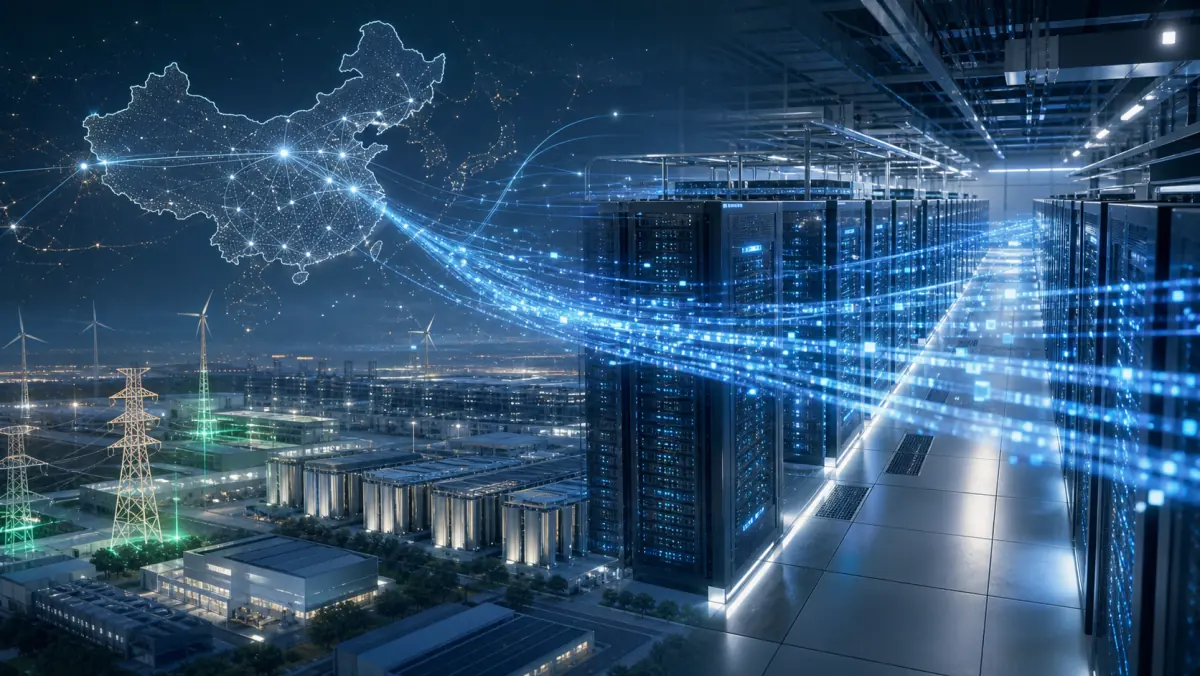
In March 2026, China's National Data Administration said the country was processing more than 140 trillion AI tokens per day. The number is useful, but not because it proves China is "winning AI." For a buyer, developer, factory operator, or analyst, it is a signal that China is trying to turn inference into industrial capacity: cheap, abundant, policy-supported, and available to ordinary workflows rather than only frontier labs.
That is why this belongs in a manufacturing field guide, not only an AI-market note. Token volume now behaves like electricity, freight capacity, or machine-tool utilization: it tells you something about the cost floor and deployment rhythm of the system underneath. The useful questions are practical. Which workloads are likely consuming the tokens? What infrastructure makes the volume possible? Which claims are official disclosures rather than audited measures? And when should a global team treat Chinese AI capacity as a real cost advantage rather than a headline?
The answer is more nuanced than either the "China is winning AI" or "token obsession is misguided" narratives suggest. The 140 trillion figure is not a scoreboard. It is a source-file clue about how China is building the low and middle layers of AI deployment.
Source File
This article was reviewed on 2026-07-03 against TechNode's report on China's 140 trillion daily token disclosure, China Daily's report that ByteDance-backed Volcano Engine said Doubao usage passed 120 trillion tokens per day, Reuters Breakingviews' critique of China's AI token obsession, SCMP's reporting on Qwen and DeepSeek open-source usage, and Xinhua's coverage of green power and new industries. Token counts are treated as disclosed usage indicators, not independently audited measures of economic value. The article's working question is not "who leads AI?" but "what does this usage signal change for people evaluating Chinese inference capacity, industrial AI tools, and low-cost automation stacks?"
Quick Judgment For Buyers And Operators
| Question | Practical answer |
|---|---|
| Does 140 trillion daily tokens prove China has better AI models? | No. It mainly signals broad deployment and low-cost inference capacity. |
| Is the figure independently audited? | No. Treat it as an official usage disclosure, cross-checked against public platform-volume signals where possible. |
| Why does it matter for manufacturing readers? | Cheap inference can make quality inspection, document processing, translation, support chat, coding assistance, and light agents economical at factory scale. |
| What is the main risk? | Token volume hides value per token, model quality, data governance, and hardware constraints. |
| What should a team verify before switching workloads? | Actual model quality, latency, data location, API reliability, audit logs, export-control exposure, and total cost beyond token price. |
The Numbers, In Context
Let's start with the data points that are verifiable.
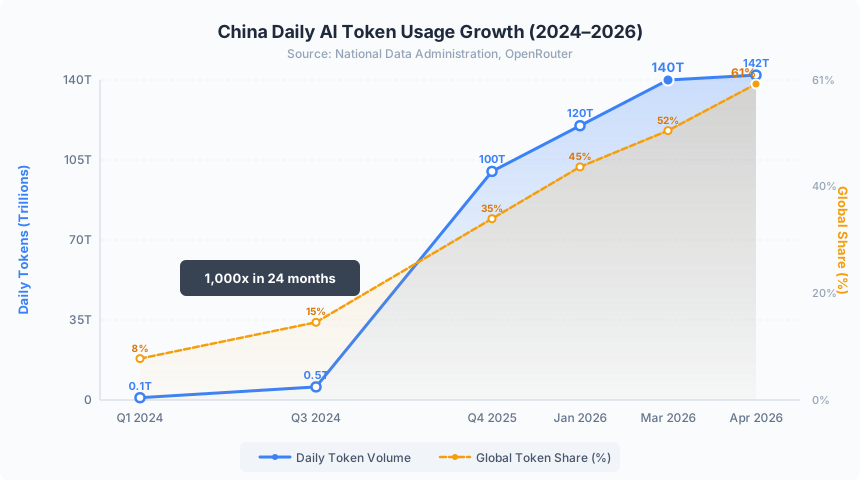
China's daily average token usage hit 140 trillion in March 2026, up from roughly 100 trillion at the end of 2025 — a 40% increase in about three months, according to the official disclosure reported by TechNode. The same period also produced company-level signals: China Daily reported that Volcano Engine said Doubao usage had passed 120 trillion tokens per day and doubled over the previous three months. These figures are not audited national accounts, but they are consistent with a rapid shift from experimentation to mass inference use.
According to OpenRouter data cited by Chinese media, Chinese models contributed 12.96 trillion tokens in the first week of April 2026 alone, accounting for roughly 61% of tracked global token volume. This marked the first time Chinese models surpassed American models in aggregate token consumption within that tracked platform sample.
That caveat matters. Platform snapshots are not the same as national usage audits. They are useful because they show direction: Qwen, DeepSeek, Doubao, and other Chinese models are no longer fringe alternatives in high-volume API use. They are becoming default options for workloads where price and speed matter more than frontier reasoning.
Three developments drove this acceleration:
First, model quality became good enough for more ordinary work. Models such as Qwen, DeepSeek, Doubao, and MiMo are not interchangeable with every Western frontier model, but they are good enough for many lower-risk, high-volume workflows: translation, support drafting, document processing, coding assistance, internal search, and lightweight agents.
Second, official API prices show a real cost gap. DeepSeek's official pricing page lists V4 Flash at $0.14 per million cache-miss input tokens and $0.28 per million output tokens, while Xiaomi's MiMo-V2.5 page lists the same $0.14 / $0.28 overseas schedule. OpenAI's GPT-5.5 release note lists gpt-5.5 at $5 input and $30 output per million tokens. That gap does not prove model equivalence, but it does explain why high-volume, reviewable workflows move quickly when Chinese models become usable.
Third, adoption broadened beyond tech companies. Liu Liehong's announcement emphasized that token growth reflects "rapid commercialization," meaning the consumers are no longer just AI startups and cloud companies. The most plausible use cases include manufacturers running quality inspection support, local governments using AI for administrative processing, exporters translating catalogs and service tickets, and small businesses deploying chatbots. Those workloads are less glamorous than frontier science, but they are exactly where low inference cost changes behavior.
The Infrastructure Behind 140 Trillion Tokens
Processing 140 trillion tokens per day requires compute infrastructure at a scale that most analysis overlooks. The "who uses the tokens" question matters, but so does "where does the compute come from."
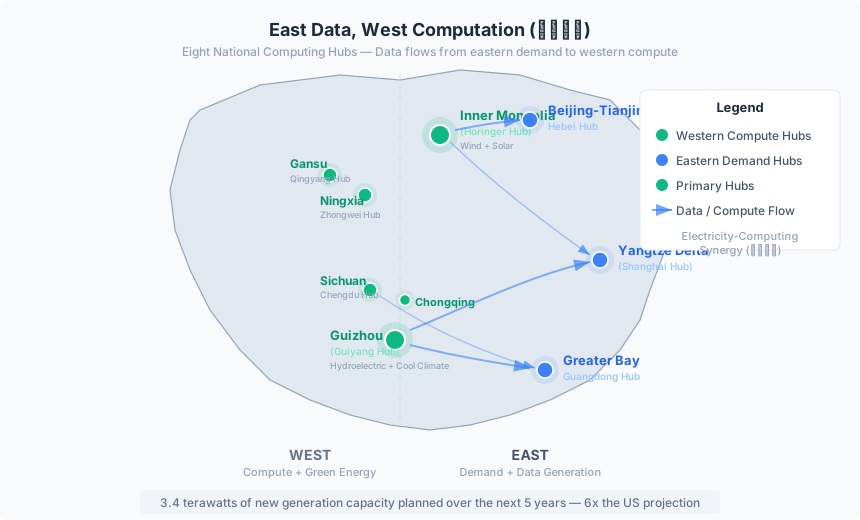
China's answer is the "East Data, West Computation" (东数西算) national strategy — a plan to build massive data center clusters in western provinces where renewable energy is abundant and land is cheap, then pipe compute to the economically dense eastern seaboard.
Two regions have emerged as the anchors:
Inner Mongolia, particularly the Horinger cluster near Hohhot, leverages wind and solar resources to power AI training and inference at scale. The region has become a national hub for green computing, with major cloud providers building facilities that draw directly from renewable generation.
Guizhou, in southwest China, uses its hydroelectric resources and naturally cool climate (which reduces cooling energy costs) to host data centers for companies including Apple, Tencent, and Huawei.
The policy framework supporting this is called "electricity-computing synergy" (算电协同) — a coordinated approach where AI workloads are scheduled to match renewable energy availability. When the wind blows in Inner Mongolia, inference jobs are routed there. When solar peaks in the afternoon, batch processing tasks spin up.
This is not only a software story. It depends on data-center siting, power supply, grid access, chip availability, cooling, and regional cloud capacity. Xinhua and official policy coverage frame "green power" and new industries as part of the same infrastructure push, but the exact economics vary by province and operator.
The constraint is not only total energy supply. It is grid connectivity, power quality, and the intermittency of renewable sources. Data centers require constant power, and even aggressive renewable buildout does not guarantee 24/7 supply without storage, dispatchable generation, or careful workload scheduling. This is where the "electricity-computing synergy" concept faces its hardest engineering test.
For industrial users, this creates a useful distinction. Batch workloads such as translation, document extraction, supplier-email summarization, catalog tagging, and visual-inspection model retraining can tolerate scheduled compute. Real-time workloads such as robot control, safety-critical inspection, grid operations, or customer-facing support during peak demand need predictable latency and uptime. A cheap token is only useful when the service-level requirement matches the infrastructure.
| Workload type | Fit for low-cost Chinese inference | Main verification point |
|---|---|---|
| Translation, catalog cleanup, internal search | High | glossary accuracy and data retention terms |
| Customer support chat | Medium to high | escalation path, hallucination handling, audit logs |
| Factory quality-inspection assistance | Medium | image/model benchmark on the buyer's own defect set |
| Coding assistant for internal tools | Medium | security review and repository access controls |
| Safety-critical robotics or grid control | Low without heavy validation | latency, failover, certification, and human override |
The Cost Moat: Why Token Volume Matters
Token volume is not just a vanity metric. It reflects and reinforces a structural cost advantage that compounds over time.
Chinese AI inference costs are lower for three structural reasons:
Energy and data-center siting. Inference is power-sensitive. Regions with cheaper electricity, renewable buildout, cooler climates, or local data-center incentives can lower the cost floor. The exact tariff matters less than the structural point: AI deployment is becoming part of China's industrial-infrastructure planning.
Architecture choices. Sparse and mixture-of-experts designs activate only part of a model for a given request, reducing active compute per token. This is an engineering choice that prioritizes inference efficiency, which matters when the market is defined by volume.
Competitive dynamics. China's AI market is intensely competitive, with Alibaba, Baidu, ByteDance, Tencent, DeepSeek, MiniMax, Moonshot, Xiaomi, and others offering model access or AI platforms. Price compression is the natural outcome, especially when model access also helps sell cloud services, agents, storage, deployment, and enterprise tools.
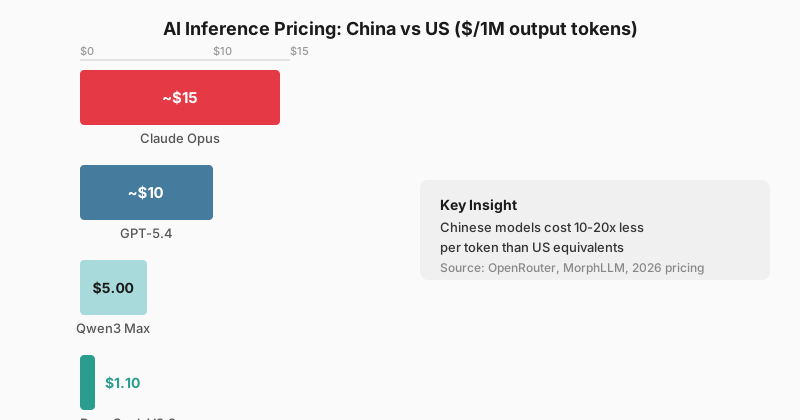
The result is a possible flywheel: lower prices drive more usage, more usage justifies more infrastructure investment, and better infrastructure can lower per-token costs further. It is similar to a manufacturing scale curve, but it is not automatic; value depends on what the tokens are actually doing.
What 140 Trillion Tokens Does Not Tell You
There are legitimate reasons to be cautious about reading too much into token volume as a competitive metric.
Token volume does not equal value creation. A chatbot answering customer service queries and a model assisting scientific research both consume tokens, but their economic value can differ by orders of magnitude. China's token consumption appears heavily weighted toward high-volume, lower-complexity applications such as chatbots, content generation, translation, and basic coding assistance. That does not settle the frontier-model question, where model quality, enterprise trust, research adoption, and compliance requirements still matter more than raw token count.
The "who" matters as much as the "how many." Reuters' Breakingviews column argued that China's "AI token obsession may be misguided" because raw volume does not necessarily translate into productivity gains or economic value. This is a fair point. If much of the 140 trillion daily tokens are consumed by bots generating content for content farms or automated systems talking to other automated systems, the number inflates without corresponding economic benefit.
Chinese policy language around data-value release points to the same tension: volume is useful only if it turns into measurable productivity, services, automation, or industrial capability.
Export controls still bite. Despite the impressive scale, China's AI companies operate under hardware constraints. US restrictions on advanced chip exports limit access to the latest NVIDIA GPUs, forcing Chinese companies to rely more on domestic alternatives, efficiency work, and infrastructure optimization. The token volume numbers reflect engineering around constraints, not the absence of constraints.
There is also a measurement problem. Token counts vary by tokenizer, model family, language mix, and whether a platform counts input tokens, output tokens, cached context, tool calls, or internal reasoning tokens. Chinese-language workloads can also tokenize differently from English-language workloads, so cross-country comparisons are not always apples to apples. A trillion tokens on one platform is not automatically equivalent to a trillion tokens on another platform.
The more useful reading is directional: China has moved from low-volume experimentation to mass-market inference deployment. That shift matters even if the exact 140 trillion figure is imprecise. It means cloud providers, app developers, manufacturers, schools, government offices, and consumer platforms are all normalizing AI usage at a scale where infrastructure cost becomes strategic. The metric should be treated like electricity consumption in the early industrial era: not proof that every kilowatt created value, but strong evidence that production systems were being reorganized around the new input.
For global buyers and developers, the practical implication is simple. Chinese AI models are becoming default options in price-sensitive, high-volume workflows: translation, support chat, internal document processing, coding assistance, search summarization, and lightweight agent tasks. That does not mean they replace frontier US models in every use case. It means the bottom and middle of the AI market are being repriced around Chinese inference economics.
How To Verify The Signal Before Acting On It
A team evaluating Chinese AI capacity should not stop at the token price or the national token-volume claim. The minimum source file should include:
| Verification item | Why it matters |
|---|---|
| Provider pricing page and effective price after caching | List prices often hide cache-hit assumptions or volume tiers |
| Benchmark on the team's own documents, images, or code | Public benchmarks rarely match industrial workload conditions |
| Data residency and retention policy | A low-cost model is unusable if data controls fail procurement review |
| API uptime, rate limits, and latency by region | Cheap tokens can become expensive if workflows stall |
| Model versioning and deprecation policy | Factory and support workflows need repeatability |
| Export-control or customer-policy restrictions | Some customers may prohibit certain model providers or data locations |
| Human review loop for high-impact outputs | Token volume does not remove accountability for decisions |
The Open Source Dimension
One aspect of the token story that deserves more attention is the role of open-source models.
China's open-source AI models — primarily Qwen and DeepSeek — now account for roughly 30% of global AI usage, according to the South China Morning Post. Combined, they hold about 15% of the global AI market, up from roughly 1% just a year ago.
This matters because open-source models are not limited by geography. Developers in Brazil, India, Indonesia, and Nigeria can download and deploy Qwen and DeepSeek models without waiting for a domestic frontier lab. The 140 trillion daily token figure is mostly a China disclosure, but the broader usage pattern includes growing international consumption of Chinese models through APIs and self-hosted deployments.
This is a different kind of AI influence than the one the US has built. American AI leadership has been defined by frontier model performance and enterprise adoption. Chinese AI influence is increasingly defined by accessibility and affordability — making capable AI available to markets and users that cannot afford $15 per million tokens.
It is the same pattern visible in smartphones (Xiaomi, Transsion), telecom equipment (Huawei, ZTE), and EVs (BYD). Not the most premium product, but the product that defines the market at scale.
What This Means for the AI Industry
The 140 trillion token number is a signal, not a conclusion. Here is what it signals:
Inference economics will define the next phase of applied AI competition. The training race still matters at the frontier, but most industrial users do not buy "the biggest model." They buy adequate capability at predictable cost. China has built a structural advantage in that layer through energy costs, competitive dynamics, and infrastructure planning.
Token volume is becoming a proxy for AI adoption depth. Countries and companies that consume more tokens per capita may be integrating AI more deeply into ordinary activity. China's 140 trillion daily tokens, relative to its population and economic size, suggest unusually broad inference deployment, but they do not measure productivity by themselves.
The cost advantage is real but not permanent. China's low-cost inference tiers reflect structural factors such as energy, competition, architecture, and policy. But American and European companies are also reducing inference costs through model distillation, specialized hardware, caching, batch processing, and smaller models. The gap can narrow.
The real question is value per token, not tokens per day. The company that extracts the most economic value per token consumed wins the applied-AI layer, not the company that simply consumes the most tokens. China has the volume signal. Whether that volume is producing durable value remains the open question.
The broader AI landscape in China — from robotics to autonomous driving to manufacturing — is explored in our China autonomous driving reality check. The token consumption story is one chapter in a larger question: how China turns cheap computation into industrial routines.
Claim Confidence File
| Claim | Confidence | Evidence boundary |
|---|---|---|
| China AI usage scale is relevant because cheap inference can expand experimentation and deployment volume | Medium-high | Supported as a strategic interpretation from usage and pricing signals; exact platform-level token shares are snapshots. |
| Token consumption proves model quality or enterprise readiness | Low | The article separates usage scale from reliability, governance, and production suitability. |
| Buyer due diligence should include workload tests, data controls, and exit planning | High | This is a procurement recommendation derived from the article's source-boundary and buyer framing. |
| Public usage estimates are permanent market-share facts | Low | The article treats usage figures as time-sensitive and source-dependent, not stable rankings. |
FAQ
Is China's 140 trillion daily token figure independently verified?
No. The 140 trillion figure comes from China's National Data Administration and related media reporting. This article treats it as an official usage disclosure and cross-checks it against reported OpenRouter and model-usage data, but there is no third-party audit showing exactly which applications generated every token.
Does more token usage mean China is ahead in AI?
Not by itself. Token volume is a useful signal for adoption depth and inference cost, but it does not measure model quality, revenue, productivity gains, or scientific value. A country can consume many low-value tokens and still lag in frontier research or enterprise monetization.
Why are Chinese AI tokens cheaper?
The main factors are intense domestic model competition, lower industrial electricity costs, efficient model architectures such as mixture-of-experts designs, and a policy environment that encourages large-scale infrastructure deployment. The gap can narrow if US and European model providers cut inference costs.
Methodology Disclosure
This analysis draws on official Chinese usage disclosures as reported by TechNode, company-level token usage reporting from China Daily, SCMP reporting on Qwen and DeepSeek usage, and official pricing pages from DeepSeek, Xiaomi MiMo, and OpenAI for cost context. Token pricing comparisons reflect list prices for API access and may not account for cache hits, volume discounts, batch pricing, regional processing, or negotiated enterprise rates. The 140 trillion daily token figure is an official Chinese disclosure and has not been independently audited.
Reader judgment: use the token number as a capacity and adoption signal, not as proof of model superiority. If a workload is high-volume, price-sensitive, and tolerant of review loops, Chinese inference economics may change the cost base. If the workload is safety-critical, regulated, or high-stakes, the verification file matters more than the headline price.
By China Made & Tech Team. Independent English field guide to China's niche hardware brands, hidden champions, founders, factory towns, and supplier clusters.
Sources:
- TechNode: China daily AI token usage exceeds 140 trillion
- Reuters Breakingviews: China's AI token obsession may be misguided
- SCMP: China's open-source models make 30% of global AI usage
- China Daily: ByteDance-backed Volcano Engine says Doubao model hits 120t daily tokens
- TrendingTopics.eu: Chinese AI models overtake US rivals in global token consumption
- Fortune: China's token economy AI boom
- Xinhua: How China's green power forges new industries
- Reuters: China's power edge brings mixed AI blessings
- DeepSeek API pricing
- Xiaomi MiMo API pricing
- OpenAI model pricing
- OpenAI: Introducing GPT-5.5