
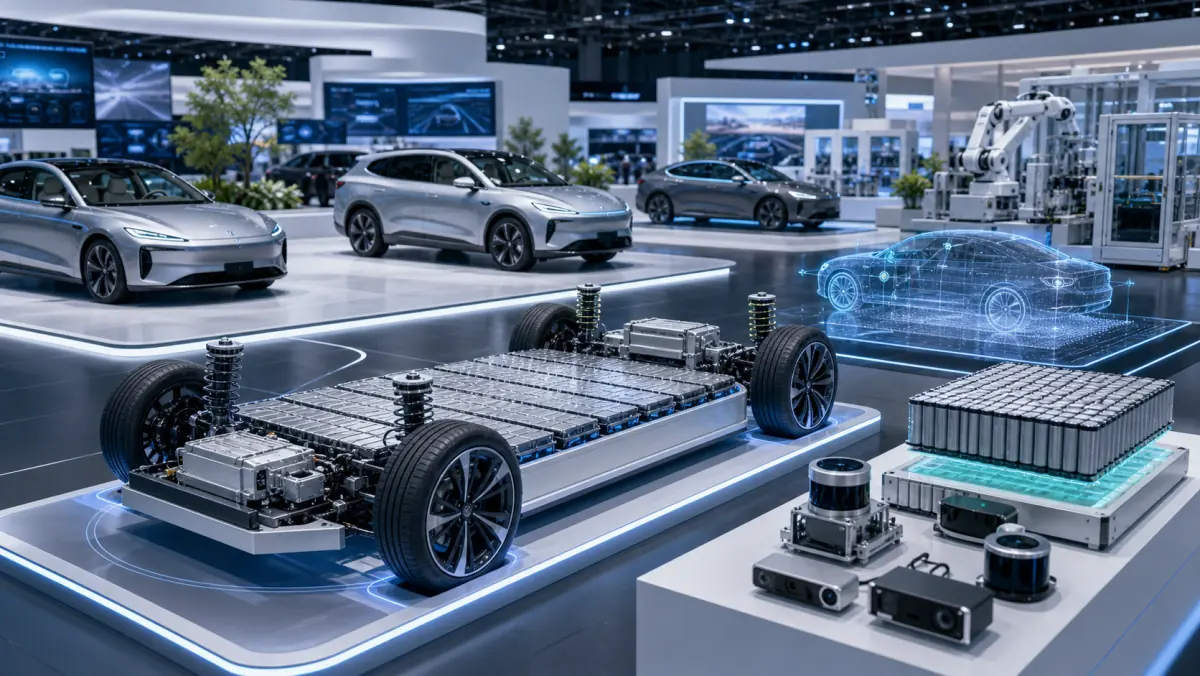
Auto China 2026 opened in Beijing on April 24 against a backdrop that would have been unthinkable a few years ago. Chinese automakers now compete globally on volume, launch cadence, batteries, software, and manufacturing speed. BYD reached its 16 millionth NEV production milestone in early 2026, and newer technology-led brands such as Xiaomi and Huawei-linked vehicle alliances have forced the market to treat software and cockpit experience as core product attributes rather than add-ons.
None of this happened because Chinese EVs are cheap. Average export prices rose 23% year-over-year in 2025. The competitive moat has shifted, and Auto China 2026 made that visible in five specific technology domains. This is not another auto show recap of which celebrity appeared on which stand. These are the five technology shifts that signal where Chinese EVs are actually heading.
Source File
This article was reviewed on 2026-07-07 against the official Auto China 2026 event record for the Beijing show dates and theme at BeijingAutoShow.com, Gotion solid-state battery reporting from Automotive World and CarNewsChina, BYD flash-charging reporting from CarNewsChina, Huawei lidar reporting from CarNewsChina, and broader Auto China context from The Guardian. The article treats show claims as technology-direction signals, not as buyer specifications for any single vehicle. Internal links connect the analysis to BYD vs Tesla comparison and China EV price-gap analysis.
1. Solid-State Batteries Move From Lab to Production Line
Gotion High-Tech, 25% owned by Volkswagen, reported that design work for its first 2 GWh all-solid-state battery mass-production line was substantially complete during the 2026 show cycle. This is not yet proof of broad commercial solid-state EV availability. It is a signal that Chinese battery makers are moving from pilot validation toward production engineering, with investment and line-design work now visible.
The numbers matter. Gotion's "Jinshi" cell uses a sulfide-based solid electrolyte and achieves 350 Wh/kg at the cell level -- a 40% improvement over mainstream ternary lithium-ion cells. The chemistry promises a 1,000 km driving range per charge and stable operation across a temperature range of -40 degrees Celsius to 80 degrees Celsius. The 0.2 GWh pilot line has reached a 90% yield rate, with 100% domestically sourced core equipment and 100% in-house developed line architecture. In safety testing, the cells passed 200-degree thermal chamber exposure and 3 mm steel needle penetration without ignition or explosion.
Gotion ranked fifth globally in power battery installations in 2025, with 53.5 GWh installed -- an 82.5% year-on-year increase. The company's existing "G-Yuan" semi-solid-state battery, launched in 2025, offers 300 Wh/kg and has a planned 12 GWh production capacity to bridge the gap toward full solid-state. Gotion targets small-batch vehicle integration by end of 2026, with full-scale mass production scheduled for 2030. Volkswagen and Audi have already signed letters of intent for supply.
CATL, for context, has disclosed plans to begin small-scale solid-state production in 2027. Gotion's timeline is marginally ahead, but the real story is that multiple Chinese battery makers are running parallel solid-state development programs at industrial scale, not laboratory scale. Total overseas planned capacity across Chinese battery makers exceeds 100 GWh for Europe, North America, and Southeast Asia combined.
The significance is not that solid-state batteries are here today. It is that the industrial infrastructure to produce them is being built now, in China, at scale. The BYD vs Tesla comparison covers the full battery supply chain context, but the signal from Auto China 2026 is clear: Chinese battery makers are compressing the timeline from laboratory validation to factory floor.
2. Megawatt Charging Redefines the Fast-Charging Benchmark
BYD's reported 1,500 kW Flash Charge system was one of the strongest infrastructure signals around the show cycle. Reporting described internal testing at a demonstration site near BYD's Shenzhen headquarters, with stations configured to resemble fuel forecourts - liquid-cooled charging guns, T-shaped gantry structures, and plug-and-charge behavior. Buyers should treat this as an early high-power charging signal, not as proof that every BYD export model or public market can use megawatt charging.
The claimed peak output of 1,500 kW on a 1,000 V architecture would put the system far above mainstream public DC fast-charging power levels. But usable charging speed depends on the vehicle pack, cooling system, charging curve, grid connection, and station availability. Testing access and vehicle compatibility are therefore more important than the headline kilowatt number.
BYD has described large flash-charging network ambitions in China, with partner networks potentially expanding coverage. Those targets matter because high-power charging is only useful when vehicles and infrastructure arrive together. Displayed demonstration-site pricing and promotional electricity offers should be treated as local rollout details, not global buyer assumptions.
The competitive implication is straightforward. When charging speed approaches refueling speed, the last major convenience argument against EV adoption erodes. The BYD vs Tesla: EV Strategy and Technology (2026) details how BYD and Tesla are diverging on charging strategy -- Tesla building a global but lower-power network, BYD building a higher-power network concentrated in China with expansion plans. Chinese companies are not waiting for a global standard to emerge. They are building one.
3. Autonomous Driving Sensors Enter Mass Production at Unprecedented Scale
Huawei's updated Maextro S800 luxury sedan and Aito M9 flagship SUV will be the first vehicles equipped with the world's highest line-count mass-produced lidar -- a 500-line unit designated D5 Max, with reported upgrade capability to 1,000 lines. The detail specifications were confirmed through Chinese MIIT regulatory filings. For comparison, the current Maextro S800 uses a 192-line lidar as part of its Qiankun ADS 4.0 sensor suite (which also includes three solid-state lidars, five 4D millimeter-wave radars, and twelve ultrasonic radars). Both updated models are expected to run Huawei's Qiankun ADS 5.0.
The Aito M9 has been reported as a high-volume premium model in China, and Huawei-linked vehicle programs have become important channels for advanced cockpit and driver-assistance hardware. These are not merely lab prototypes. But model-ranking and delivery claims move quickly, so buyers should verify the latest sales and regulatory filings before using any single ranking in a market-entry memo.
BYD, meanwhile, is standardizing its DiPilot 300 "God's Eye" B 5.0 system across the updated Denza Z9 GT -- a vehicle that now claims the title of world's longest-range pure electric vehicle at 1,036 km CLTC (with MIIT filings showing up to 1,068 km for a variant). The AWD version produces 1,140 hp from a triple-motor layout (230 kW front, two 310 kW rear). The updated Denza Z9 GT also ships with a 122.496 kWh Blade battery pack and roof-mounted lidar as standard. When autonomous driving hardware ships as standard on a 1,000+ km range station wagon, the technology has moved beyond early-adopter territory.
The key trend is not any single sensor specification. It is the rate at which high-end perception hardware is moving from flagship-only to volume production. Chinese automakers are absorbing the cost of advanced sensor suites across broader model lines, which generates the real-world driving data needed to train the next generation of autonomous driving algorithms. XPeng's XNGP city driving system, Li Auto's AD Max, and NIO's NOP+ are all accumulating kilometers on Chinese roads at rates that European and American competitors cannot match in their home markets. This is a compounding advantage that does not show up in any single spec sheet.
4. In-Car AI Becomes the Primary Interface
The smart cockpit was not a subplot at Auto China 2026. It was the plot. Multiple exhibitors demonstrated AI systems that function less like voice assistants and more like operating systems for the vehicle.
BYD's updated Denza Z9 GT features a 4 nm DiLink smart cockpit chip driving a 17.3-inch central display and dual 13.2-inch 2.5K screens, supporting ten-screen linkage and natural-language voice recognition. The symmetrical cockpit layout allows the interface to adapt based on driving mode and passenger configuration. Xiaomi's Vision GT concept, which debuted at MWC Barcelona ahead of the Beijing show, showcased a panoramic display with a "cocoon-shaped sofa" interior and butterfly steering wheel -- a cockpit designed around the assumption that the software experience is the product, not the drivetrain.
The Vision GT deserves a specific note as a branding signal. It is a Gran Turismo concept developed in collaboration with Polyphony Digital, not a normal production-vehicle specification sheet. The scissor doors, T-shaped headlights, center fin, and exaggerated diffuser communicate Xiaomi's intent to treat EVs like consumer-electronics products. Overseas-store and market-entry plans should be treated as roadmap claims until Xiaomi executes them market by market.
The underlying technology stack has shifted significantly. Chinese automakers are now integrating large language models from Baidu (ERNIE Bot), Huawei (Pangu Model), Alibaba (Tongyi Qianwen), and SenseTime (SenseNova) directly into vehicle infotainment systems. The result is multi-turn conversational control of navigation, climate, media, and vehicle settings -- not the rigid command-and-response systems that characterized earlier generations. The models support contextual understanding: a driver can say "I'm cold and tired" and the system will raise the temperature, adjust the seat, and suggest nearby rest stops.
Huawei's HarmonyOS smart cockpit, deployed across its HIMA (Harmony Intelligent Mobility Alliance) vehicles, has been particularly aggressive in treating the car as an extension of the consumer electronics ecosystem. Phone, tablet, watch, and car share a unified interface with seamless handoff. For Huawei, the vehicle is a peripheral. For BYD and Xiaomi, the vehicle is the platform. Both approaches converge on the same outcome: the buyer's primary evaluation criterion shifts from horsepower and range to software capability and AI responsiveness.
This is a domain where Chinese companies have structural advantages -- not in automotive engineering per se, but in the consumer software and hardware ecosystems (Xiaomi, Huawei, Baidu) that now extend into the car. Western automakers partnering with Google or Apple face platform dependency. Chinese automakers building on domestic LLMs face a home-market software ecosystem optimized for Chinese-language interaction, Chinese mapping data, and Chinese digital services. The BYD vs Tesla comparison provides context on how these tech-first companies are reshaping brand expectations.
5. Manufacturing Innovation Reaches the Body Structure
Gigacasting -- Tesla's term for large-scale integrated die-casting of vehicle body structures -- has been adopted aggressively by Chinese automakers, but Auto China 2026 showed the technology entering its second generation.
Xiaomi's SU7 already uses 9,100-ton giga-casting machines for its rear body structure. BYD has deployed integrated die-casting across multiple model lines, including the Seal and Dolphin platforms. The next iteration visible at the show: larger single-piece castings encompassing both front and rear body sections, reducing parts counts by hundreds per vehicle and cutting assembly time accordingly. Chinese equipment maker LK Technology, which supplies die-casting machines to multiple automakers, has been scaling its production capacity to meet demand from both domestic and international customers.
The manufacturing innovation extends beyond casting. Chery's Exeed EX7, also shown at Auto China 2026, claims to be the world's first mass-production vehicle with Electronic Mechanical Braking (EMB) -- replacing traditional hydraulic brake systems with fully electronic actuation. This is a fundamental shift in braking architecture that reduces weight, enables tighter integration with autonomous driving systems, and eliminates brake fluid entirely. EMB has been discussed in the automotive industry for over a decade. Chery putting it into mass production is a concrete example of the kind of manufacturing-first innovation that Chinese automakers are now pursuing.
These are not incremental improvements. They are changes to how cars are physically constructed. Integrated die-casting reduces the number of robots needed on an assembly line. Electronic braking removes an entire fluid system from the vehicle architecture. The compounding effect is lower manufacturing cost, faster production cycles, and vehicles that are fundamentally simpler to assemble -- which means faster model iteration and more competitive pricing without sacrificing margin.
Zeekr's launch of the 8X hybrid SUV at $48,370 at the show illustrates the downstream effect. Geely's premium EV brand is expanding into hybrids with pricing that undercuts comparable European luxury SUVs while offering comparable or superior technology. That pricing is sustainable because the manufacturing cost base is lower -- and the manufacturing cost base is lower because of integrated body construction, modular platforms, and supply chain vertical integration that Chinese automakers have spent a decade building.
For a deeper look at how Chinese manufacturing systems produce these kinds of innovations, the BYD vs Tesla comparison examines the manufacturing philosophy that underpins the product launches.
What the Signals Mean
Auto China 2026 is not a turning point. The turn happened years ago. What the show demonstrates is the rate at which Chinese EV technology is compounding.
Solid-state battery production lines are being designed now, for factories that will ship cells in 2027-2030. Megawatt charging networks are in internal testing with 1,500 kW peak output. Lidar with 500 lines (upgradable to 1,000) ships on vehicles that sell 270,000+ cumulative units. AI-powered cockpits run on 4 nm chips with multi-turn natural-language interaction. Gigacasting is entering its second generation. Electronic braking reaches mass production for the first time globally.
These are not isolated product launches. They form a system: advanced batteries enable longer range, which makes fast charging more important, which makes the charging infrastructure investment more urgent, which reduces range anxiety, which expands the buyer base, which generates more driving data, which improves autonomous driving, which makes sensor-heavy vehicles more valuable, which justifies the manufacturing investment in integrated architectures.
The flywheel is spinning. The five technology shifts at Auto China 2026 are not about catching up to Western or Japanese automakers. They are about building a different kind of car industry -- one where the vehicle is a software platform with a battery, manufactured by companies that iterate at consumer-electronics speed.
Canada's trade minister met with BYD, XPeng, and GAC during a China visit in April 2026 to discuss EV market-entry pathways. Audi and SAIC announced a second offensive with four all-new AUDI-brand models. BMW, Mercedes-Benz, and Seres formed a premium charging joint venture called Ionchi. These are not stories about Chinese companies going abroad. They are stories about global companies coming to China -- because that is where the technology is.
Chinese automakers' global rise, BYD's fast NEV production milestones, Xiaomi's software-led entry, and Huawei-linked cockpit and ADAS ecosystems are outcomes, not just predictions. The technology on display in Beijing helps explain why the competitive pressure is likely to keep rising.
Methodology And Source Notes
This article was reviewed on 2026-07-07 using Auto China 2026 event materials, Chinese EV supplier and model reporting, and public coverage of solid-state battery, megawatt charging, lidar, smart-cockpit, and manufacturing announcements. Show-floor claims are treated as technology signals, not as confirmed specifications for every production vehicle. Where companies described roadmaps, the article separates near-term production signals from 2027-2030 commercialization targets.
Claim Confidence File
| Claim | Confidence | Evidence boundary |
|---|---|---|
| Auto China 2026 showed Chinese EV competition moving beyond price alone | Medium-high | Supported by repeated battery, charging, lidar, cockpit, and manufacturing announcements, but show-floor signals are not the same as full deployment |
| Gotion's 2 GWh solid-state line means solid-state EVs are already mass-market | Low | Line design and pilot progress are real signals; broad mass-market adoption remains a later-stage target |
| BYD's 1,500 kW charging claims apply to all BYD vehicles and export markets | Low | Charging speed depends on compatible vehicles, chargers, cooling, grid connection, and rollout geography |
| Huawei-linked lidar and cockpit systems are moving into production vehicles, not only demos | Medium-high | Supported by MIIT/model reporting and commercial vehicle programs; exact rankings and sales should be refreshed frequently |
| Concept-car and roadmap announcements prove overseas commercial execution | Low | Concepts and store plans are intent signals until market launches, homologation, service networks, and sales follow |
| Manufacturing innovations such as integrated die-casting and brake-by-wire can reduce complexity | Medium | Plausible and supported by industry direction, but cost impact varies by model, volume, and supplier base |
Frequently Asked Questions
Was Auto China 2026 mainly about lower EV prices?
No. Price competition is still part of the Chinese EV market, but the strongest signals at Auto China 2026 were technology-led: solid-state battery production planning, megawatt charging, lidar at volume, AI cockpits, and manufacturing automation. Those signals matter because they explain how Chinese EV makers are trying to move away from pure price competition.
Are the solid-state battery claims already mass-market reality?
Not yet. Gotion and other battery makers are moving from pilot lines and engineering validation toward industrial production, but full mass-market solid-state EV adoption remains a late-2020s or 2030 scenario. The important point is that production infrastructure is being built now.
Why does megawatt charging matter for buyers?
Megawatt charging narrows the convenience gap between EV charging and refueling. It only matters when vehicles, batteries, chargers, cooling systems, and grid connections are all designed for high power, so the first impact will be in China and in premium models rather than in every export market immediately.
How should global automakers read the Beijing show?
They should treat it as evidence that Chinese EV competition is becoming system-level. The advantage is not one model or one feature; it is the combination of batteries, charging, sensors, software, and manufacturing speed.
Related Entries
- BYD vs Tesla comparison -- Full analysis of China's EV battery supply chain and competitive positioning
- Chinese EV Price Gap: 5 Cars for 1 American Car (2026 Reality) -- Chinese EV price gap and domestic-market competition context
- BYD five-minute charging file -- Battery and charging claims in buyer context