
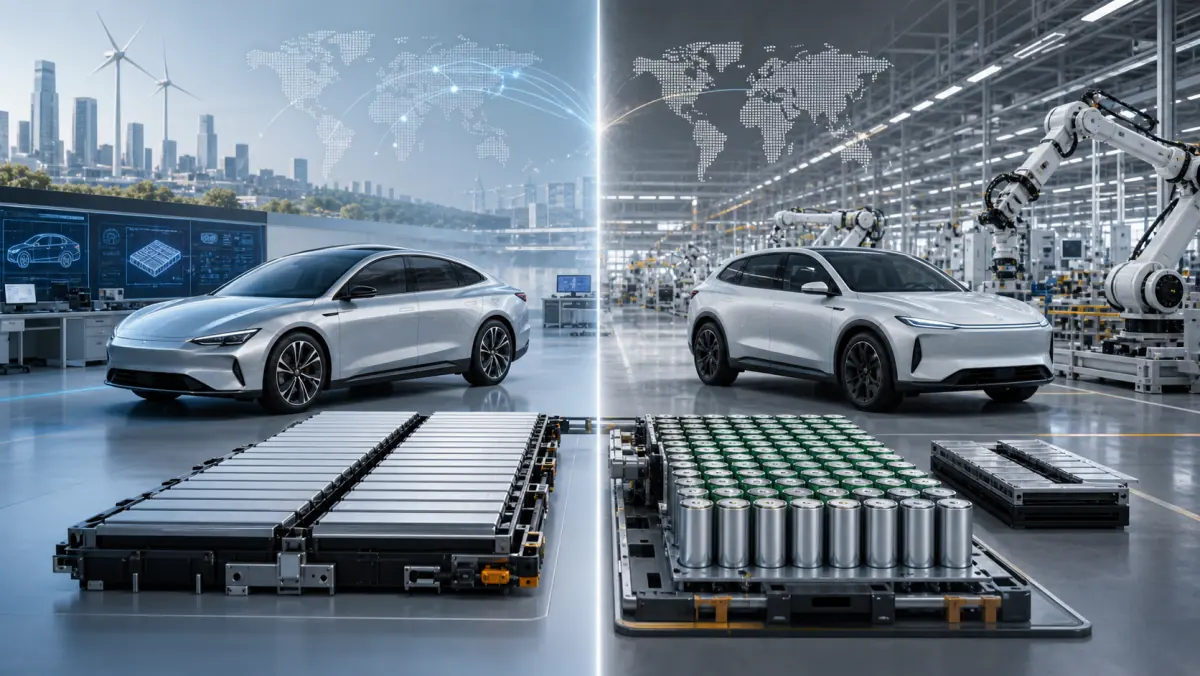
In March 2026, BYD announced flash-charging claims built around its next Blade battery platform. Around the same period, European reporting pointed to low utilization at Tesla's Berlin Gigafactory. These two signals capture the essential tension in the world's most consequential EV rivalry: BYD is pushing battery speed and manufacturing localization, while Tesla is trying to turn its software, brand, and AI premium into renewed production momentum.
The numbers tell a story of two companies that have never been further apart - or more directly competitive. BYD sold 4.6 million new energy vehicles in 2025, nearly three times Tesla's 1.64 million pure-BEV deliveries. Tesla still usually trades at a large valuation premium because investors price in software, autonomy, robotics, and energy optionality. One company leads on volume, vertical integration, and cost. The other leads on software narrative, brand, charging ecosystem, and financial markets' belief in an AI-powered future.
This is not another quarterly sales comparison. This is a technology-first dissection of how these two companies actually build electric vehicles — their battery chemistry choices, manufacturing architectures, autonomous driving strategies, and the fundamentally different paths they have chosen to compete globally.
> Key takeaway: BYD wins on battery technology, manufacturing cost, and production scale. Tesla wins on energy density, software ecosystem, and market valuation. The winner depends entirely on which metric you choose — and neither company is winning on all fronts.
Source File
This article was reviewed on 2026-07-06 against BYD's official Blade 2.0 and flash-charging release, the RWTH Aachen teardown published in Cell Reports Physical Science, Tesla's official manufacturing footprint, InsideEVs' Q1 2026 report on Tesla retaking the BEV sales lead, Rhodium Group analysis of Chinese EV cost advantages, and related site work in BYD Q1 2026 Profit Fell 55%: The Paradox Explained and Chinese EV Price Gap: 5 Cars for 1 American Car (2026 Reality). Price, margin, valuation, tariff, and delivery comparisons are date-specific and should be rechecked after each quarterly delivery cycle.
Battery Technology: Different Chemistry, Different Philosophy
BYD Blade Battery 2.0: Safety and Speed
BYD's battery strategy is built on one core conviction: lithium iron phosphate (LFP) chemistry is the correct answer for mass-market electric vehicles. The BYD five-minute charging file that debuted in 2020 proved that LFP could be both safe and practical, passing the nail penetration test that other chemistries failed. The second-generation Blade Battery, unveiled in March 2026, takes this philosophy further.
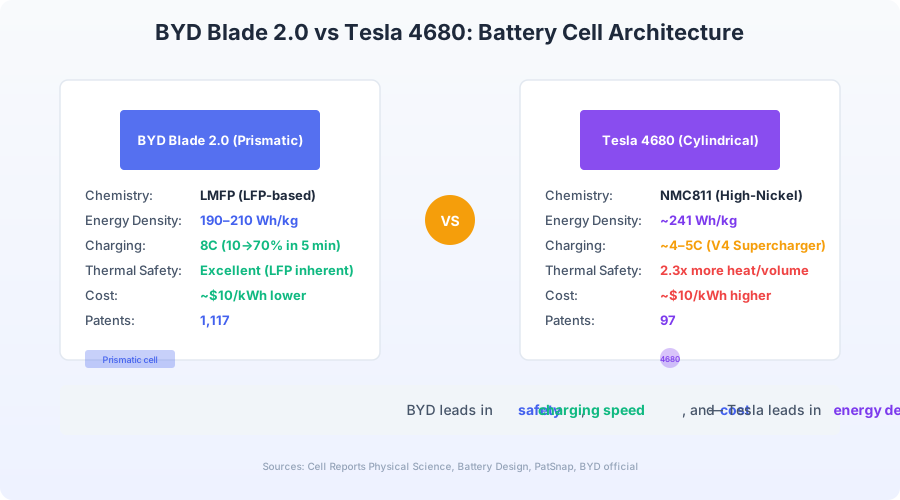
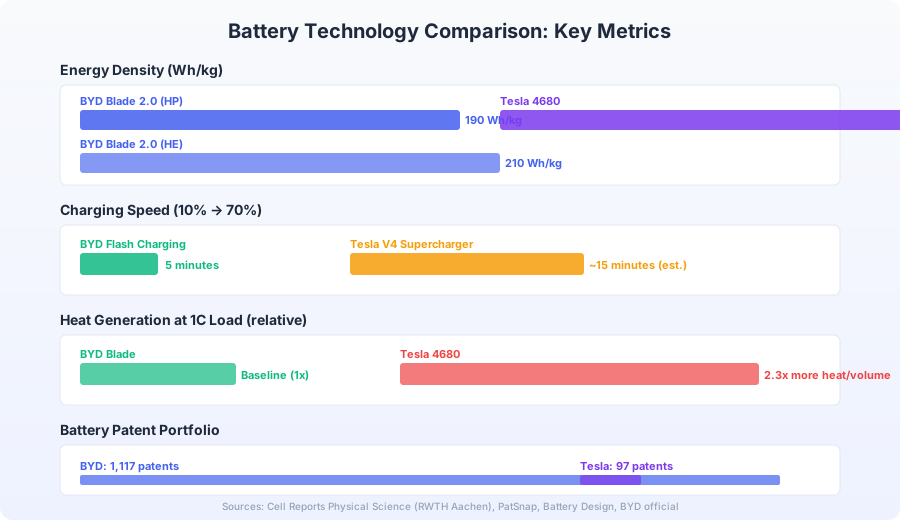
The Gen 2 Blade uses LMFP (Lithium Manganese Iron Phosphate) chemistry with a silicon-carbon anode, raising cell voltage from 3.2V to 3.8V. Cell-level energy density reaches 190 to 210 Wh/kg depending on variant, according to BYD's official specifications and confirmed by Battery Design's technical analysis. The charging rate hits 8C sustained with 16C peak discharge — enough to charge from 10% to 70% in five minutes and from 10% to 97% in nine minutes, even at minus 30 degrees Celsius.
The thermal advantage is significant. A teardown study published in Cell Reports Physical Science by researchers at RWTH Aachen found that the BYD Blade cell generates roughly half the heat per volume compared to cylindrical alternatives under identical 1C loads. This is not a minor engineering detail — it means simpler cooling systems, fewer failure modes, and fundamentally safer battery packs.
Tesla 4680: Energy Density and Performance
Tesla's battery strategy prioritizes energy density above all else. The 4680 cylindrical cell uses high-nickel NMC811 chemistry, achieving approximately 241 Wh/kg and 643 Wh/L, according to the same RWTH Aachen teardown study. That is roughly 50% higher gravimetric energy density than BYD's Blade cell and 80% higher volumetric density.
The trade-off is cost and thermal complexity. The same study found that the 4680 cell generates about 2.3 times more heat per volume than BYD's prismatic cell, requiring more sophisticated cooling systems. Teardown-derived cost estimates put Tesla's cell at a disadvantage of roughly $10 per kWh compared with the BYD Blade.
Tesla has been working to close the gap with its own LFP battery production at Giga Shanghai, and the company sources LFP cells from CATL for standard-range models. But the 4680 remains the flagship technology, and its production ramp has been slower than initially projected.
The Patent Gap
The contrast in battery R&D investment is stark. According to PatSnap's patent analysis, BYD holds 1,117 battery-related patents versus Tesla's 97 — a ratio of more than 11 to 1. BYD's peak filing period was 2024-2025 with 426 new patents. Tesla's battery innovation appears increasingly concentrated on cell format and pack integration rather than fundamental chemistry.
| Specification | BYD Blade 2.0 | Tesla 4680 |
|---|---|---|
| Cell format | Prismatic | Cylindrical |
| Chemistry | LMFP (LFP-based) | NMC811 (High-Nickel) |
| Cell energy density | 190-210 Wh/kg | ~241 Wh/kg |
| Volumetric density | ~355 Wh/L | ~643 Wh/L |
| Heat at 1C load | Baseline | 2.3x more per volume |
| Cost per kWh | Lower (~$10 advantage) | Higher |
| Max charging rate | 8C (10-70% in 5 min) | ~4-5C |
| Battery patents | 1,117 | 97 |
| Thermal runaway risk | Very low (LFP inherent) | Moderate (requires active management) |
Manufacturing: Vertical Integration vs Platform Strategy
BYD: Build Everything Yourself
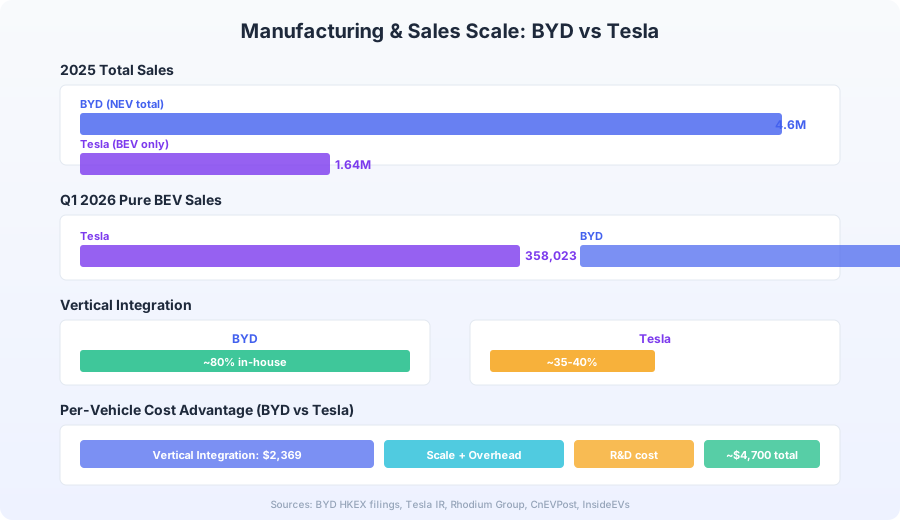
BYD's manufacturing advantage is structural, not incremental. The company produces approximately 80% of its core components in-house, according to the Rhodium Group's analysis of Chinese EV cost advantages — batteries, motors, electronic control systems, semiconductors, and even the tooling on its factory floors. This vertical integration saves roughly $2,369 per vehicle compared to Tesla's more outsourced approach.
The result is a per-vehicle cost advantage of approximately $4,700 over Tesla, of which only about 5% ($235) comes from government subsidies, according to the Rhodium Group. The rest is genuine manufacturing efficiency: lower overheads, faster R&D cycles, longer supplier payment terms, and production at scale that no other automaker matches.
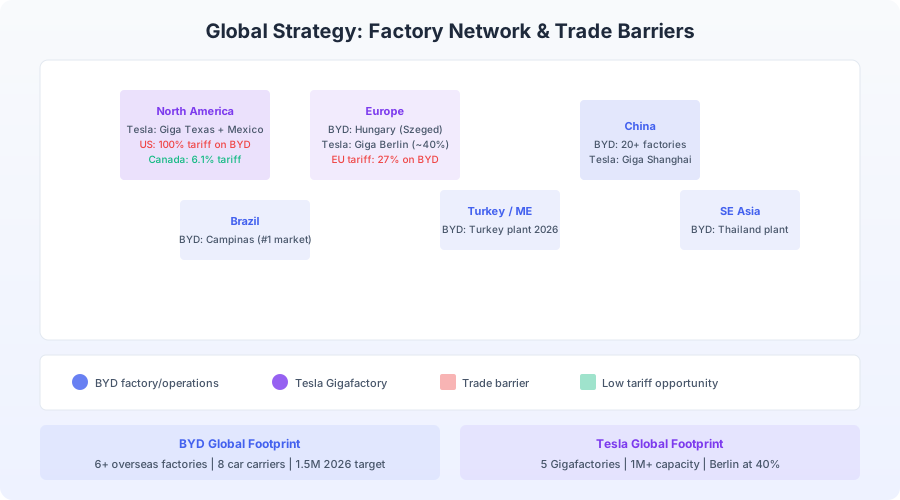
BYD's factory network now extends well beyond China. Thailand hosts its first full-scale overseas plant, now operational. Brazil has a facility in Campinas. Hungary has a EUR 4 billion factory in Szeged with a planned capacity of 300,000 units per year — though trial production started slowly, with mass production initially only in the tens of thousands. Turkey has production planned for 2026, and France has a facility in Beauvais. BYD operates eight car carriers with over one million units of annual transport capacity, as detailed in our BYD Q1 2026 Profit Fell 55%: The Paradox Explained.
The 2026 overseas sales target has been raised to 1.5 million units from 1.3 million, according to Automotive World's Bloomberg-sourced report. Q1 2026 overseas sales approached 320,000 units, up approximately 50% year-over-year, with Brazil as the number-one export destination at 89,637 units.
Tesla: Platform and Software Layer
Tesla's manufacturing model is fundamentally different. Rather than vertical integration, Tesla builds mega-factories — Gigafactories — designed around standardized vehicle platforms that can be produced at massive scale. The approach leverages software-defined architecture, over-the-air updates, and a relatively narrow product lineup to achieve efficiency through simplicity.
But the numbers reveal strain. Tesla's total installed manufacturing capacity exceeds one million vehicles per year across its five Gigafactories, according to Tesla's official manufacturing page. Yet global deliveries in 2025 were only 1.636 million, down 8.56% from 2024 — the second consecutive annual decline. Giga Berlin produced approximately 149,000 vehicles in 2025, operating at roughly 40% of its installed capacity, according to Handelsblatt data cited by CleanTechnica.
A planned Gigafactory in Mexico remains strategically important, but factory construction timelines are long, and Tesla's expansion pace has slowed compared to its 2020-2022 buildout.
The Manufacturing Scorecard
| Dimension | BYD | Tesla |
|---|---|---|
| 2025 total sales | 4.6M NEVs | 1.64M BEVs |
| 2025 BEV sales only | 2.26M | 1.64M |
| Q1 2026 BEV sales | 310,389 | 358,023 |
| Vertical integration | ~80% in-house | ~35-40% in-house |
| Per-vehicle cost advantage | ~$4,700 vs Tesla | Baseline |
| Active factories | 6+ overseas + China network | 5 Gigafactories |
| Factory utilization | High (China), ramping (overseas) | Berlin at ~40% |
| 2026 overseas target | 1.5M units | Not disclosed |
| Gross margin (Q1 2026) | 18.8% | ~16-18% (est.) |
Autonomous Driving: Vision-Only vs Sensor Fusion
Tesla FSD: Betting Everything on Cameras
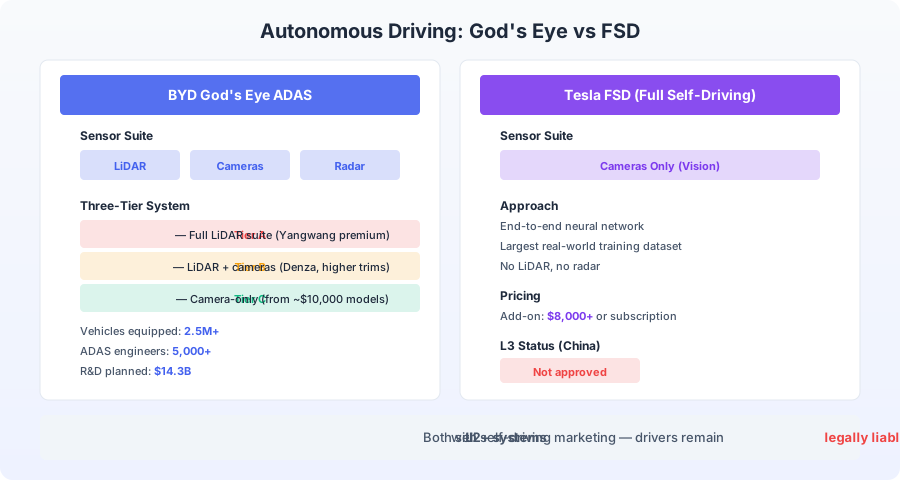
Tesla's Full Self-Driving system is the most controversial autonomous driving program in the industry. The approach is uncompromising: vision-only, meaning no LiDAR, no radar, just cameras feeding an end-to-end neural network trained on billions of miles of real-world driving data. Tesla charges $8,000 or more for FSD as an add-on, or offers it as a monthly subscription.
The vision-only approach has advantages — fewer sensors means lower hardware cost and fewer points of failure. Tesla also has the largest real-world driving dataset of any automaker, collected from its fleet of vehicles on roads worldwide. The company has been rolling out FSD Supervised (requiring driver attention) in the US and China, and is working toward unsupervised autonomous driving with a planned robotaxi launch.
But Tesla missed the first round of China's L3 autonomous driving approvals. When China's MIIT approved the first two L3 models in December 2025 — the Changan Deepal SL03 and BAIC Arcfox Alpha S — neither Tesla nor XPeng made the cut, according to reported Chinese regulatory coverage. The approved models are restricted to low speeds on designated highways in specific cities, but the regulatory signal is clear: China's government is not yet convinced by vision-only approaches.
BYD God's Eye: Sensors Everywhere, for Everyone
BYD's autonomous driving strategy is the mirror image of Tesla's. The God's Eye system comes in three tiers, the top two of which use LiDAR alongside cameras and radar:
- God's Eye A (flagship): Full LiDAR sensor suite for premium Yangwang models
- God's Eye B (mid-tier): LiDAR-based for Denza and higher-trim mainstream models
- God's Eye C (entry): Camera-only for budget models starting around $10,000
The key strategic decision was making advanced ADAS standard equipment across nearly the entire lineup. BYD says millions of vehicles now carry some form of God's Eye, and the company is pushing the system down into mass-market trims. This is ADAS democratization at a scale that has no parallel in the Western auto industry.
BYD has invested $14.3 billion in autonomous driving R&D with a team of over 5,000 ADAS engineers. The company completed more than 150,000 kilometers of real-world L3 validation on Shenzhen highways and was approved for L3 trials alongside Nio, though it missed the first round of commercial L3 permits.
In May 2026, BYD raised the price of God's Eye B by 21% from 9,900 to 12,000 CNY (~$1,660), citing DRAM cost surges of 93-98% in Q1 2026. The move signals that the global AI chip boom is now reaching automotive ADAS cost structures.
The Autonomous Driving Comparison
| Feature | BYD God's Eye | Tesla FSD |
|---|---|---|
| Sensor approach | LiDAR + cameras + radar (A/B) | Camera-only (vision) |
| Pricing model | Standard on most models | $8,000+ add-on or subscription |
| Vehicles equipped | 2.5M+ | ~2M (estimated) |
| L3 regulatory status (China) | Approved for trials | Not approved |
| ADAS engineers | 5,000+ | Not disclosed |
| R&D investment | $14.3B planned | Part of broader AI spend |
| Weakness | Software maturity gap | Regulatory resistance in China |
Global Strategy: Build Where You Sell vs Mega-Export
BYD: The Export Machine
BYD's global strategy is defined by a dual pivot: moving upmarket while simultaneously expanding overseas. In Q1 2026, overseas sales accounted for approximately 45% of total deliveries, up from roughly 25% a year earlier. The company raised its 2026 overseas target to 1.5 million units and has the shipping fleet to support it — eight dedicated car carriers with over one million units of annual transport capacity.
The factory strategy follows a "build where you sell" logic designed to bypass trade barriers. The Hungary plant targets EU tariff avoidance. The Thailand and Indonesia plants serve Southeast Asia. Brazil is BYD's single largest overseas market at 89,637 units in Q1 2026. The factory in Turkey, planned for 2026 production, provides another European production base.
But BYD's export pricing tells a more nuanced story. The company charges substantially more outside China after shipping, tariffs, VAT, and dealer margins. A BYD Dolphin that costs approximately $13,700 in China sells for much more in the UK and EU, while the BYD Atto 3 can carry a steep export premium. The result is that BYD's headline price advantage narrows dramatically outside China.
The U.S. market remains effectively closed to China-made passenger EVs because the Section 301 tariff stack makes imported BYD cars commercially unrealistic. Canada is more policy-dependent and should be checked against the current surtax, quota, and origin rules before any North American plan is built around it. BYD has not publicly announced a clear Canada-specific passenger-EV factory or import plan.
BYD's flash charging infrastructure is also going global. The company had over 5,500 flash charging stations across 311 Chinese cities as of April 2026, with a target of 20,000 by year-end. International deployment plans include 3,000 stations in Europe and 6,000 globally by end 2026, according to CnEVPost. If executed, this would create a charging network that rivals Tesla's Supercharger footprint in key European markets — a challenge Tesla has not faced from any competitor before.
Tesla: The Global Brand Under Pressure
Tesla's global strategy relies on brand power and a concentrated factory model. Gigafactory Shanghai remains its largest production hub, serving both the Chinese market and as an export base for Asia-Pacific. Giga Berlin and Giga Texas serve their respective regions. The Mexico factory, when operational, will provide a low-cost production base for North America.
But Tesla faces headwinds that BYD does not. CEO Elon Musk's political involvement has damaged the brand in key European markets, contributing to Giga Berlin's low utilization rate. European registrations for BYD surged 162% year-over-year in early 2026 while Tesla managed only 11.8% growth, according to Electrek. In China, Tesla's market share has been steadily eroded by domestic competitors offering comparable or better technology at lower prices.
Tesla's strength remains its software ecosystem. Over-the-air updates, the Supercharger network, and the FSD program create a differentiated ownership experience that no Chinese competitor has fully replicated. The Supercharger network, now opening to other brands, is both a revenue opportunity and a potential strategic concession — it reduces the exclusivity advantage that Tesla once held.
The Strategy Scorecard
| Dimension | BYD | Tesla |
|---|---|---|
| Primary market | China (55% domestic) | US + Europe + China |
| Overseas sales share (Q1 2026) | ~45% | ~60% (est.) |
| 2026 overseas target | 1.5M units | Not disclosed |
| Export pricing | ~2x China prices | Premium globally |
| Factory model | Build where you sell | Mega-factories |
| EU tariff exposure | ~27% (mitigated by Hungary plant) | Low (Berlin factory) |
| US market | Blocked (100% tariff) | Dominant |
| Brand risk | Low (institutional) | High (CEO politics) |
| Supercharger network | Building own (5,500+ flash chargers) | Established (global) |
Pricing: The $4,700 Question
The price gap between BYD and Tesla is not primarily about subsidies. The Rhodium Group's analysis found that BYD's per-vehicle cost advantage breaks down as follows:
- Vertical integration: ~$2,369 (BYD produces roughly 80% of core components in-house versus Tesla's 35-40%)
- Lower overheads and cheaper R&D: significant but hard to quantify precisely
- Longer supplier payment cycles: ~90-day terms that reduce working capital costs
- Greater production scale: BYD's 4.6M vehicles versus Tesla's 1.64M
- Government subsidies: approximately $235 per vehicle, just 5% of the total advantage
BYD achieved a 20% gross margin in 2025 versus Tesla's 18%, according to the Rhodium Group data — remarkable given that BYD's average selling price is a fraction of Tesla's. The Chinese EV Price Gap: 5 Cars for 1 American Car (2026 Reality) is real at Chinese domestic prices, though it narrows dramatically when export markups and tariffs are factored in.
In Q1 2026, BYD's gross margin actually improved to 18.8%, up 1.4 percentage points quarter-over-quarter, despite a 55% profit crash. The improvement came from a higher share of premium models and a better overseas mix, as detailed in our BYD Q1 2026 Profit Fell 55%: The Paradox Explained. This is the paradox of BYD's current position: volumes and profits are falling even as per-vehicle economics improve.
Tesla, meanwhile, has engaged in aggressive price cuts since late 2023 to defend market share, compressing its own margins. The 2026 Tesla Model Y Standard RWD starts at $39,990 in the US, according to CarBuzz. A comparably sized BYD would cost roughly half that in China — but BYD cannot sell in the US, and the comparison only becomes relevant in markets where both brands compete, such as Europe, Australia, and Southeast Asia.
In those overlapping markets, the price gap is real but smaller than it appears from China-only figures. In Australia, a BYD Atto 3 starts around $25,900 versus a Tesla Model Y at approximately $39,990. In the UK, the BYD Dolphin Surf starts at approximately $23,700 versus the Tesla Model 3 at $39,990. BYD wins on price in every head-to-head comparison, but the premium for a Tesla includes the Supercharger network, brand recognition, and FSD capability — intangibles that many buyers are willing to pay for.
So Who Is Winning?
The answer depends entirely on the metric.
BYD wins on: battery technology (safety, charging speed, patent portfolio), manufacturing cost, production volume, vertical integration, and factory expansion speed. BYD's Blade Battery 2.0 with 5-minute charging represents the most commercially advanced fast-charging system in the industry. Its factory network is expanding faster than any automaker in history. Its LMFP chemistry delivers 80% of NMC's energy density at a fraction of the cost and with superior thermal safety.
Tesla wins on: energy density per cell, software ecosystem, brand recognition, global distribution network, and market valuation. Tesla's 4680 remains one of the highest-energy-density cells in mass production. The Supercharger network is the most reliable fast-charging infrastructure globally. FSD, despite its controversies, has the largest real-world training dataset. And the market continues to value Tesla at a large premium because investors believe in its optionality beyond cars - in AI, robotics, and energy.
Neither wins on: autonomous driving regulation, L3 commercialization, or consistent profit growth. Both companies are selling L2+ systems with self-driving marketing while drivers remain legally liable. Both face margin pressure from competition and commodity costs. The robotaxi future that both promise remains years away from commercial reality.
The structural reality: BYD and Tesla are not really competing for the same customers. BYD dominates in markets where cost matters most — China, Southeast Asia, Latin America, the Middle East. Tesla leads in markets where brand, software, and charging infrastructure matter most — the US, parts of Europe. The overlap is growing, particularly in Europe, where BYD's Hungary plant and Tesla's Berlin factory are located a few hundred kilometers apart. But the core competitive dynamics are different in every region.
What makes this rivalry consequential is not which company sells more cars in any given quarter. It is that they represent two fundamentally different answers to the same question: how do you build a global electric vehicle company? BYD's answer is vertical integration, battery chemistry mastery, and aggressive expansion. Tesla's answer is software-defined vehicles, AI-driven autonomy, and brand power. Both answers are partially correct. Neither is complete.
Methodology
This comparison weighs five categories: battery chemistry and pack behavior, manufacturing cost structure, autonomous-driving architecture, global market access, and pricing after tariffs and distribution costs. BYD and Tesla report different vehicle categories, so this article separates BYD's total NEV volume from pure BEV comparisons. Technology specifications and prices are reviewed as of 2026-07-06 and should be treated as moving targets.
Claim Confidence File
| Claim | Confidence | Evidence boundary |
|---|---|---|
| BYD sold far more total NEVs than Tesla sold BEVs in 2025 | High | BYD includes plug-in hybrids and BEVs; Tesla reports BEVs only |
| Tesla retook the pure-BEV lead in Q1 2026 | Medium-high | Based on quarterly delivery snapshots; the lead can change quickly |
| BYD's Blade/LMFP path prioritizes cost, safety, and fast charging | Medium-high | Supported by BYD disclosures and teardown studies, but 2026 charging claims need real-world validation across models and charger availability |
| Tesla's 4680 path prioritizes energy density and pack integration | Medium-high | Supported by teardown data, but chemistry and production mix vary by model and plant |
| BYD can freely enter North America because Canada lowered tariffs | Low | North American access remains policy-dependent and should be checked under current tariff, quota, and origin rules |
| Tesla is worth more purely because it sells better cars | Low | Valuation reflects expectations for software, autonomy, robotics, energy, and brand, not only current vehicle sales |
Frequently Asked Questions
Is BYD bigger than Tesla?
By volume, yes. BYD sold 4.6 million new energy vehicles (including plug-in hybrids) in 2025, compared to Tesla's 1.64 million pure electric vehicles. However, Tesla briefly retook the pure BEV sales lead in Q1 2026 with 358,023 deliveries versus BYD's 310,389, according to InsideEVs.
Which has better battery technology, BYD or Tesla?
They excel in different areas. BYD's Blade Battery 2.0 leads in charging speed (5 minutes for 10-70%), thermal safety, and cost efficiency. Tesla's 4680 leads in energy density (241 Wh/kg versus BYD's 190-210 Wh/kg) and volumetric efficiency. For most consumers, BYD's fast-charging advantage is more practically useful than Tesla's density advantage, but the trade-off depends on use case.
Can BYD sell cars in the United States?
Not effectively. The U.S. tariff stack on China-made passenger EVs makes imported BYD cars commercially unrealistic. BYD has not announced plans to build a U.S. passenger-car factory. Canada may be more accessible depending on current surtax, quota, and origin rules, but buyers should not treat it as a confirmed BYD beachhead without fresh policy and company-plan checks.
Is Tesla FSD better than BYD God's Eye?
There is no definitive answer because the systems use fundamentally different approaches. Tesla's FSD uses cameras only with an end-to-end neural network, trained on the largest real-world driving dataset. BYD's God's Eye uses LiDAR, cameras, and radar in its higher tiers. In China's regulatory environment, sensor-fusion systems have received L3 trial approvals while Tesla's vision-only approach has not. Globally, Tesla's FSD has more real-world testing miles but also faces more scrutiny over safety incidents.
Why is Tesla worth so much more than BYD?
Tesla's market capitalization changes daily, but the persistent premium reflects investor expectations beyond automotive manufacturing - specifically AI, autonomous driving, robotics, charging, and energy storage. BYD's valuation is tied more closely to current vehicle sales, revenue, and manufacturing fundamentals. Tesla trades at a significant premium to automotive peers because the market prices in the potential of these non-automotive businesses, even though they currently contribute a smaller share of revenue than the car business.
Will BYD overtake Tesla globally?
In pure BEV sales, the seesaw battle continues — BYD led in 2025, Tesla retook the lead in Q1 2026. In total new energy vehicles including PHEVs, BYD already sells far more. The more important question is whether BYD can maintain its technology lead in batteries and manufacturing while successfully scaling its overseas presence against rising trade barriers. The data suggests BYD's structural advantages in cost and vertical integration are durable, but Tesla's software and brand advantages are also resilient. Neither company is likely to "win" outright in the near term.
Related Articles
- China EV price gap — The Complete Guide to China's Electric Vehicle and Battery Industry
- CATL storage validation file — CATL: The Company That Powers Half the World's Electric Cars
- BYD five-minute charging file — BYD Blade Battery: How It Changed EV Safety Standards
- BYD Q1 2026 Profit Fell 55%: The Paradox Explained — BYD's 55% Profit Drop Hides a Bigger Story
- Chinese EV Price Gap: 5 Cars for 1 American Car (2026 Reality) — Five Chinese EVs for the Price of One American Car