
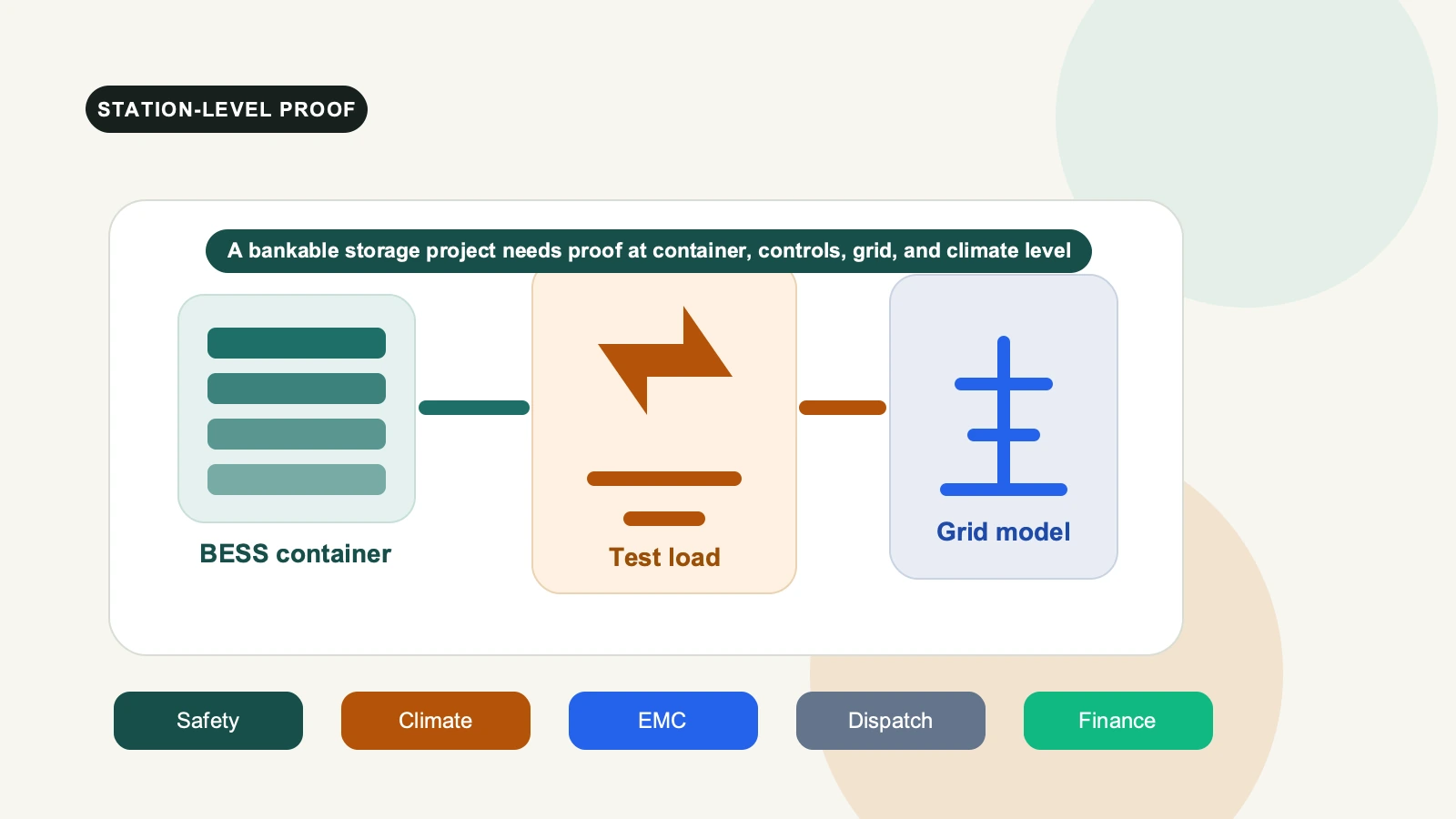
CATL did not just announce another battery lab.
It announced a way to make grid-scale storage look more financeable.
On 2026-06-01, CATL said its Xiamen Energy Storage Validation Research Institute had begun operations on May 28. The company describes it as a 10-hectare, RMB 3 billion testbed for real-world energy-storage validation. The headline claim is scale. The more important signal is what CATL says the industry needs to validate: not just cells, but station-level behavior under grid stress.
That distinction matters for buyers because battery energy storage systems are becoming infrastructure assets. A project owner, lender, EPC, or insurer does not only care whether the cell chemistry looks good in a datasheet. They care whether the complete system connects on time, dispatches reliably, avoids thermal incidents, survives harsh climates, and produces the revenue profile used in the financial model.
This is where CATL is trying to move the basis of competition.
Source File
| Source | What it supports | Why it matters |
|---|---|---|
| CATL Xiamen validation institute announcement | Facility scale, May 28 operations start, validation scope, and CATL's storage market claims | Primary source for the article's main thesis |
| IEA Batteries and Secure Energy Transitions | Global storage-capacity growth requirement and battery share of storage expansion | Independent demand context beyond CATL's framing |
| IEA Global EV Outlook 2025 battery chapter | China's battery manufacturing, cathode/anode, and graphite supply position | Supply-chain context for why CATL can turn scale into validation leverage |
| State Council/Xinhua new-type storage action-plan summary | China's 2027 new-type storage target and project-investment signal | Policy context for why large-scale validation infrastructure matters |
Quick Answer
| CATL claim | Buyer interpretation |
|---|---|
| 10-hectare, RMB 3B validation facility | CATL wants validation infrastructure to become part of its moat |
| One in five large storage stations underperforming | The industry has a station-level reliability problem, not only a battery-price problem |
| 46.5% of systems face grid-connection delays over two months | Interconnection risk belongs in the procurement file |
| 121 GWh of 2025 storage battery sales, 30.4% global share | CATL has enough project exposure to define buyer expectations |
| Full-container EMC, climate, and safety testing | Grid buyers should ask for system evidence, not cell-only certificates |
The Storage Market Has Outgrown Cell-Level Trust
For a small pilot project, cell specs can carry the conversation. For a grid-scale portfolio, they cannot.
The International Energy Agency says global energy storage capacity must rise sixfold to 1,500 GW by 2030 if the world is to support the renewable buildout needed in its Net Zero scenario. Batteries account for 90% of that increase, rising to 1,200 GW by 2030.
That scale creates a different buyer problem.
When storage was experimental, the main question was whether lithium-ion batteries were cheap enough. Now the question is whether BESS projects are predictable enough. Predictability means commissioning, grid connection, controls, fire behavior, degradation, dispatch performance, and warranty execution.
CATL's announcement leans into that gap. The company says nearly one in five large-scale storage power stations worldwide are underperforming and that 46.5% of energy storage systems experience grid-connection delays of more than two months. Those figures come from CATL, so buyers should treat them as supplier framing. But the problem they describe is real: storage procurement has moved faster than the evidence base many projects need.
What CATL Is Really Selling
The visible product is batteries.
The deeper product is confidence.
CATL says its Xiamen facility can validate storage systems at station level, including safety, grid-support capability, extreme-climate reliability, and electromagnetic compatibility. The company highlights full-system container testing, environmental chambers from -50 C to 100 C, simulated high-altitude pressure up to 7,200 meters, and a full 40-foot-container EMC facility with a 65-ton turntable and 5 MW power supply.
That is not normal marketing detail. It is aimed at the people who write procurement risk memos.
For a utility-scale project, a supplier that can show station-level validation can make four claims:
- The equipment has been tested under conditions closer to operating reality.
- The PCS, EMS, batteries, container, and thermal system have been evaluated as a system.
- The supplier can document risk in a way lenders and insurers may understand.
- The vendor's service promise is backed by repeatable testing, not only by brand reputation.
That fourth point is where the moat sits.
Bankability Is The New Differentiator
In solar, bankability became a way to separate durable suppliers from cheap suppliers. Module buyers learned to ask whether a manufacturer had scale, audited quality, warranty reserves, global service, and projects that lenders recognized.
Grid batteries are going through a similar transition, but with higher operational complexity.
A BESS project has more moving parts than a module order. It includes cells, racks, battery management, power conversion, energy management software, fire protection, site design, grid-code compliance, interconnection work, cybersecurity, and long-term degradation modeling. If any of those assumptions fail, the project economics can move quickly.
That is why CATL's Xiamen testbed matters. It suggests the next competitive frontier is not only lower $/kWh. It is lower perceived project risk.
For Chinese suppliers, this is a natural evolution. China already has the battery manufacturing base. The IEA's Global EV Outlook 2025 says about 85% of global battery manufacturing capacity is in China, with over 75% owned by Chinese producers. China also supplies about 85% of cathode active materials and over 90% of anode active materials.
Manufacturing scale is the foundation. Validation is the attempt to turn that scale into institutional trust.
How Buyers Should Use This Signal
The wrong response is to treat CATL's announcement as proof that every CATL project is automatically low risk.
The right response is to raise the diligence standard for every supplier.
Buyers should ask:
| Diligence question | Why it matters |
|---|---|
| Has the complete container been tested, or only cells/modules? | Most project failures happen at system level |
| What grid-code scenarios were tested? | Interconnection delays can destroy project timelines |
| What thermal event evidence exists for the actual configuration? | Fire risk is configuration-specific |
| Are warranty assumptions tied to the buyer's dispatch profile? | Cycle-life claims can mislead if usage differs |
| Who controls EMS data and software updates? | Operational control and cybersecurity are now procurement issues |
| Which project references were financed, refinanced, or insured successfully? | Lender acceptance is a practical trust signal |
What Not To Over-Read
CATL's testbed is important, but buyers should keep three limits in view.
First, a validation facility is not the same as independent field performance. Testing can reduce uncertainty, but it does not replace multi-year operating data across different grid codes, climates, contractors, and revenue models.
Second, company-provided underperformance statistics are useful clues, not neutral market data. CATL has a reason to frame the industry as needing station-level validation because CATL can offer station-level validation. The buyer should still ask for third-party reports, project references, commissioning history, and lender feedback.
Third, testing the system does not automatically solve responsibility boundaries. If a project underperforms, the dispute may involve the cell supplier, integrator, PCS vendor, EPC, grid operator, software provider, or owner dispatch strategy. A good testbed can clarify risk. It cannot make poor contracts good.
This is why the announcement should change diligence behavior, not suspend it.
What Would Make The Testbed Signal Stronger
The most useful next evidence would not be another statement about the size of the institute. It would be report-level transparency. A buyer would want to see which configurations were tested, which PCS / EMS combinations were used, which grid-code scenarios were simulated, how thermal events were bounded, what failure modes were observed, and whether third parties witnessed or certified the results.
The second useful evidence layer is field correlation. A testbed becomes more valuable when the supplier can show how test results mapped to real commissioned projects: fewer interconnection delays, fewer thermal incidents, better availability, lower augmentation surprises, cleaner insurance review, or easier lender approval. That does not require every result to be public, but serious buyers should ask for project references that connect lab validation to operating assets.
The third layer is responsibility mapping. If CATL validates a complete station, the buyer still needs to know which party owns each promise once the asset is built. Cell, rack, BMS, PCS, EMS, HVAC, fire suppression, EPC integration, grid-code compliance, software updates, and dispatch assumptions can all sit with different counterparties. A stronger validation file should reduce finger-pointing, not merely produce a better brochure.
The fourth layer is local acceptance. A Chinese validation platform can be technically impressive and still need translation into the buyer's jurisdiction. Grid codes, fire authorities, insurers, lenders, and O&M contractors may ask for different documents. The more CATL can map its testbed outputs into those local decision files, the more the Xiamen institute becomes bankability infrastructure rather than internal R&D infrastructure.
That is the standard this article applies to all suppliers. The question is not "who has the biggest lab?" It is "whose evidence can survive the buyer's finance, safety, grid, and service review without becoming vague at the exact moment risk is allocated?"
The Supplier Comparison That Matters Now
The most useful comparison is no longer "CATL versus another battery brand" at the cell level. It is "which supplier can make the project easier to underwrite?"
| Supplier claim | Weak evidence | Strong evidence |
|---|---|---|
| Long cycle life | generic cell-cycle chart | dispatch-specific degradation model for the exact system |
| High safety | cell certificate only | container-level thermal and fire evidence |
| Grid compatibility | broad grid-code promise | passed tests for the buyer's target grid code and PCS/EMS stack |
| Low LCOS | capex-only estimate | modeled availability, augmentation, degradation, O&M, and downtime |
| Fast delivery | factory lead time | delivered, commissioned, and grid-connected project history |
| Strong warranty | long warranty term | clear exclusion list, local enforcement path, and service capacity |
What It Means For Non-CATL Suppliers
This is also a warning to other Chinese storage exporters.
Price competition will continue, but price alone is becoming a weaker story for utility-scale buyers. The suppliers that want to win institutional projects will need to show more than cell sourcing and container assembly. They will need credible validation, grid-code familiarity, field data, cybersecurity policies, and after-sales coverage.
That does not mean only CATL can win. In fact, CATL's move may help serious competitors by teaching buyers what to ask for. A smaller supplier with strong project execution can use the same framework to prove itself. A weaker supplier that survives on low capex and vague warranty promises will be easier to screen out.
For overseas buyers, that is useful. The Chinese BESS market is deep, but it is uneven. The job is not to find the cheapest Chinese battery. The job is to find the supplier whose evidence matches the project's risk.
Why This Fits China's Storage Strategy
China's policy direction makes this more urgent.
The State Council/Xinhua summary of China's 2025-2027 new-type energy storage action plan says the country targets more than 180 million kW of installed new-type storage capacity by 2027. That scale will create more projects, more edge cases, more grid-integration pressure, and more demand for credible testing.
CATL is positioning itself where those pressures meet.
It is not only selling batteries into a policy-supported market. It is trying to define the validation language for that market. If that language travels overseas, CATL's advantage becomes more than manufacturing cost. It becomes a buyer checklist.
This is the same broader pattern described in China Battery Storage Boom: Grid-Scale BESS Explained: China's battery storage edge is shifting from cell capacity to repeatable infrastructure delivery.
The Real Story
The real story is not that CATL opened a big testing facility in Xiamen.
The real story is that grid storage has reached a stage where cheap batteries are not enough. The market now needs evidence that a complete system will behave like a reliable power asset.
CATL's testbed is a bet that bankability can be industrialized. If that bet works, the winners in storage will be the companies that make project risk legible to buyers, lenders, and grid operators.
That is a more durable advantage than another price cut.
Claim Confidence File
| Claim | Confidence | Evidence boundary |
|---|---|---|
| CATL announced the Xiamen Energy Storage Validation Research Institute and described it as a large station-level validation platform | High | This is based on CATL's own announcement. The institute exists as a company-disclosed validation asset; detailed test protocols and independent reports still need project-level review. |
| Station-level validation matters more for BESS than cell-only evidence | High | This is a systems-engineering judgment supported by BESS architecture: cells, racks, PCS, EMS, fire design, grid code, software, O&M, and dispatch all affect project risk. |
| CATL's underperformance and grid-delay figures prove neutral market-wide failure rates | Low | The article does not treat them as neutral statistics. They are supplier framing used to understand how CATL wants buyers to define the problem. |
| A CATL testbed makes every CATL project bankable | Low | This is explicitly rejected. Buyers still need grid-code mapping, warranty terms, local service, commissioning record, cyber terms, and lender / insurer acceptance for the exact project. |
| Smaller Chinese BESS suppliers are automatically unbankable | Low | The article argues that CATL raises the evidence bar. A smaller supplier can still compete if it produces stronger project-specific proof. |
| China's storage policy targets guarantee profitable BESS projects | Low | Policy scale supports demand, but project economics still depend on market rules, dispatch, interconnection, curtailment, degradation, and contract terms. |
Methodology
This article is based on CATL's 2026-06-01 Xiamen Energy Storage Validation Research Institute announcement, the IEA's Batteries and Secure Energy Transitions, the IEA's Global EV Outlook 2025 battery chapter, and the State Council/Xinhua summary of China's 2025-2027 new-type energy storage action plan. CATL performance figures are treated as company claims and interpreted through buyer-risk logic.
Frequently Asked Questions
Does CATL's Xiamen testbed prove every CATL BESS project is bankable?
No. The testbed is a strong validation signal, but buyers still need project-specific evidence: grid-code mapping, dispatch assumptions, thermal configuration, warranty terms, local service, and operating references.
Why does station-level validation matter more than cell testing?
Grid storage risk lives at system level. Cells can pass tests while the container, PCS, EMS, thermal system, fire design, grid interface, or commissioning process still creates project risk.
What should buyers ask CATL or any BESS supplier after this announcement?
Ask for complete-container validation evidence, grid-support test results, safety evidence for the exact configuration, dispatch-specific degradation modeling, EMS data-control terms, and references from financed or insured projects.
Is CATL's underperformance data independent?
No. The underperformance and grid-delay figures cited in the article come from CATL's own announcement, so they are treated as supplier framing. The broader point is still useful: BESS buyers need stronger system-level proof.