
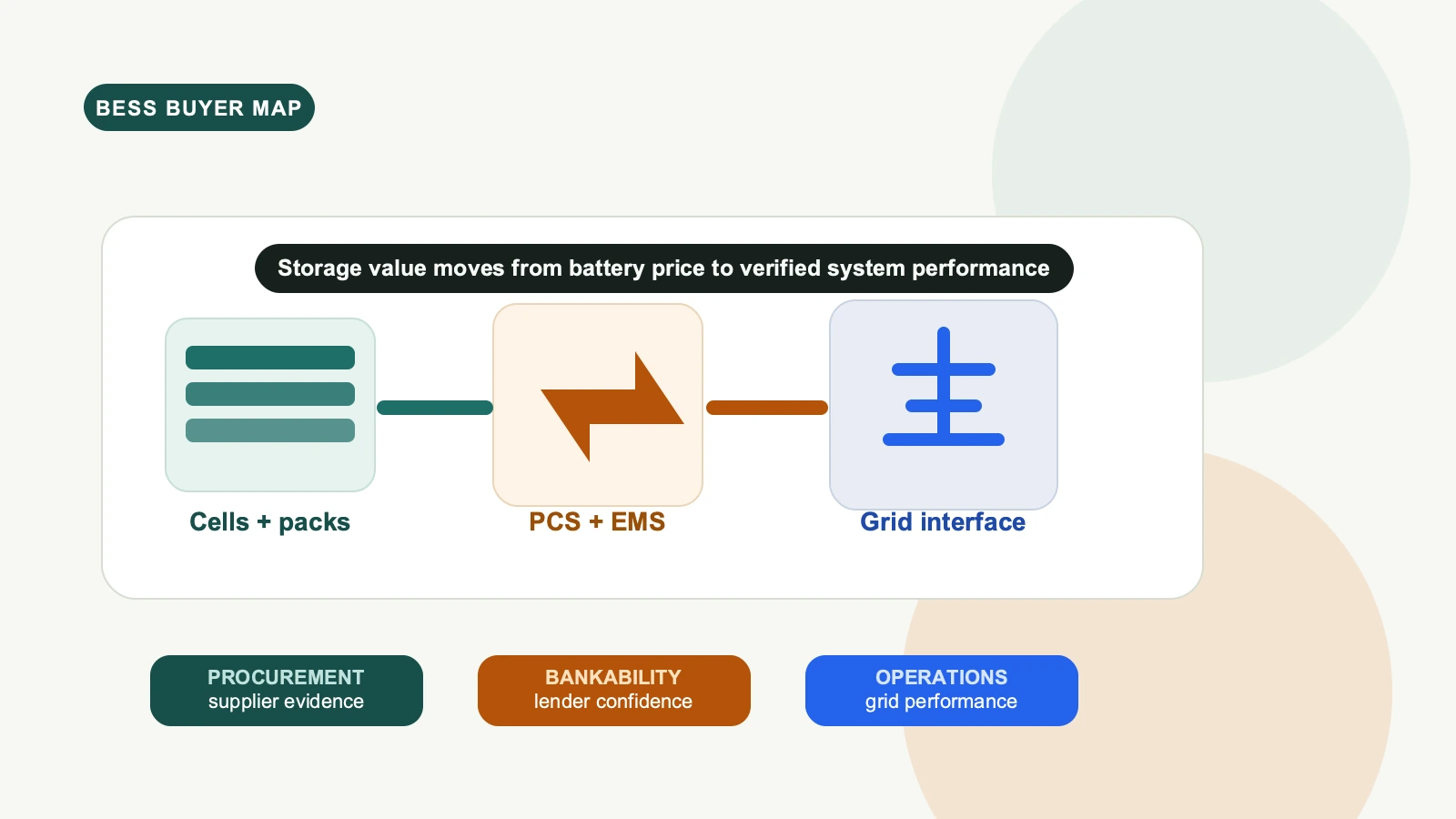
China's battery storage story is easy to misread if you only look at cell prices.
The more important shift is that China is turning batteries into grid infrastructure. That means the buyer question changes from "Who sells the cheapest cells?" to "Whose system can survive grid dispatch, heat, warranty claims, curtailment events, and bank due diligence?"
The scale is no longer small. The International Energy Agency says global energy storage capacity must increase sixfold to 1,500 GW by 2030 if the world is to triple renewable capacity, and batteries account for 90% of that increase in its Net Zero Emissions scenario. China is trying to make itself the factory, test market, and operating benchmark for that buildout.
In September 2025, China's State Council and Xinhua summarized a three-year action plan targeting more than 180 million kW of installed new-type energy storage capacity by 2027, with about RMB 250 billion in direct project investment. That target matters because "new-type energy storage" mostly means electrochemical storage: lithium-ion, sodium-ion, flow batteries, compressed-air variants, and other technologies that can support renewables-heavy grids.
The practical implication is simple: China's storage market is moving from demonstration projects to industrial procurement.
Source File
| Source | What it supports | Why it matters |
|---|---|---|
| IEA Batteries and Secure Energy Transitions | Storage-capacity growth need, battery share of storage growth, and global demand context | External baseline for why storage is becoming grid infrastructure |
| State Council/Xinhua 2025-2027 action-plan summary | China's target of more than 180 million kW of new-type energy storage by 2027 and RMB 250 billion project investment | Primary China policy signal for domestic deployment scale |
| IEA Global EV Outlook 2025 battery chapter | China's battery manufacturing, cathode/anode, graphite, and LFP cost-position data | Supply-chain evidence behind China's BESS cost base |
| CATL Xiamen validation institute announcement | CATL's storage sales, market-share, and validation-positioning claims | Supplier-side evidence for bankability and validation strategy |
| CATL Naxtra sodium-ion announcement | Sodium-ion technical claims and chemistry roadmap | Shows why Chinese storage suppliers are preparing beyond LFP |
| CATL GB 38031-2025 certification note | Naxtra safety-certification claim | Safety-context source for sodium-ion discussion |
Quick Answer
| Question | Short answer |
|---|---|
| Why is China important in grid battery storage? | It has the battery manufacturing base, domestic grid demand, policy targets, and leading BESS suppliers. |
| Is this just an EV battery spillover? | No. EV battery scale helps, but grid storage needs different warranty, safety, dispatch, and revenue assumptions. |
| What should buyers watch? | System-level validation, power-conversion integration, thermal management, degradation assumptions, and project references. |
| Where does CATL fit? | CATL is moving from cell supplier to trust infrastructure provider for storage projects. |
| What is the biggest risk? | Treating BESS like a commodity battery purchase when the real risk sits at project operation level. |
Why Storage Is Becoming The Next Chinese Battery Export
Solar made China central to global renewables manufacturing. Batteries are doing the same thing for renewable integration.
The logic is straightforward. Solar and wind output fluctuate. Grids need fast-response assets that can shift power from high-generation hours to peak-demand hours, provide frequency support, and reduce curtailment. Pumped hydro still matters, but lithium-ion storage can be deployed faster, closer to load, and in smaller increments.
That creates a market that looks familiar to Chinese manufacturers: fast-growing demand, fierce price competition, fragmented global buyers, and a strong advantage for companies that control manufacturing, software, components, and after-sales service together.
The difference from solar is that storage is less forgiving. A solar module can underperform and still generate some power. A battery energy storage system can lose money quickly if it cannot meet dispatch requirements, interconnection timelines, safety tests, or warranty assumptions.
This is why the storage race will not be won by the lowest cell quote alone.
The Supply Chain Starts Before The Container
A grid battery project looks like rows of containers, but the supply chain starts much earlier.
The key layers are:
| Layer | What it includes | China relevance |
|---|---|---|
| Materials | lithium, iron phosphate, graphite, copper, electrolyte, separator | China is strongest in processing and component manufacturing, not just mining |
| Cells | LFP, sodium-ion, NMC variants | Chinese firms dominate LFP manufacturing and are pushing sodium-ion commercialization |
| Pack and container | modules, racks, thermal management, fire suppression | Integration quality determines much of the operating risk |
| PCS and EMS | inverter, power conversion, controls, dispatch software | Grid compatibility and software matter more as projects scale |
| EPC and O&M | site design, installation, warranty service, degradation monitoring | Local partners can make or break project performance |
That does not mean every BESS project must use a Chinese brand. It does mean even non-Chinese projects often touch Chinese processing, components, or equipment somewhere upstream.
For buyers, the right question is not "China or not China?" The better question is: "Which parts of the project depend on Chinese battery supply, and which parts can be validated independently?"
CATL's Move From Cell Scale To Trust Scale
CATL is the clearest example of where the market is heading.
In EVs, CATL became powerful because it could supply high-volume cells to automakers. In storage, cell scale still matters, but customers also care about project bankability. Utilities, independent power producers, insurers, and lenders need evidence that a system can perform over years, not just pass a cell-level test.
CATL's own numbers show the ambition. In a June 2026 announcement for its Xiamen Energy Storage Validation Research Institute, CATL said its 2025 energy storage battery sales reached 121 GWh, with a 30.4% global market share and the top global position for five consecutive years. Company numbers should be read carefully, but the direction is clear: CATL wants to define what credible storage validation looks like.
This is a different kind of moat from price. A cheap cell can be copied or undercut. A validated project history is harder to reproduce.
Why LFP Is The Default Chemistry For Storage
Most near-term grid storage is LFP, not high-nickel NMC.
The reason is not mystery technology. LFP is cheaper, safer, and good enough for stationary applications where weight matters less than in passenger cars. The IEA says LFP batteries are almost 30% cheaper per kWh than NMC, while NMC still has an energy-density advantage. For EVs, that tradeoff depends on range and packaging. For grid storage, LFP's cost and safety profile are usually more attractive.
That is why Chinese LFP scale matters. It gives Chinese BESS suppliers a cost base that Western suppliers struggle to match. It also lets them iterate faster because cell suppliers, pack designers, thermal-management vendors, inverter makers, and test labs sit inside the same industrial ecosystem.
Sodium-ion is the next chemistry to watch. CATL's Naxtra announcement claims 175 Wh/kg energy density and strong low-temperature performance for its sodium-ion passenger EV battery. CATL later said Naxtra passed China's GB 38031-2025 EV traction battery safety certification. Those are EV-oriented claims, but they matter for storage because sodium-ion could reduce lithium dependence and fit cold-climate or lower-cost stationary use cases if the economics work.
The buyer takeaway is not "sodium will replace LFP." It is that Chinese battery firms are already preparing a multi-chemistry storage market.
The Project Risk Is Not Just Battery Degradation
Storage buyers often ask about cycle life. They should, but cycle life is only one line in the risk model.
The more complete diligence checklist includes:
| Risk bucket | What to ask |
|---|---|
| Grid connection | Has the same PCS/EMS stack passed interconnection in comparable markets? |
| Thermal safety | Is fire testing system-level, not just cell-level? |
| Degradation | Are the warranty assumptions tied to real dispatch profiles? |
| Software | Who controls EMS updates, cybersecurity, and data access? |
| Spare parts | Where are replacement modules, PCS parts, and service teams located? |
| Finance | Can the supplier provide project references that lenders recognize? |
That is the same pattern visible in China Solar Dominance: Supply Chain Power, Profit Crisis. China first wins manufacturing scale, then fights brutal price competition, then tries to turn scale into ecosystem control.
The Business Model Is Still The Hard Part
Storage is not valuable just because it exists. It is valuable when a project can earn money from one or more grid services.
In mature markets, a BESS project may stack revenue from energy arbitrage, capacity payments, frequency response, ancillary services, congestion relief, and renewable smoothing. In emerging markets, the first use case may be simpler: avoiding diesel generation, supporting weak distribution networks, or making solar-plus-storage dispatchable enough for an industrial park.
This is where many buyers make a category mistake. They treat BESS procurement like a hardware RFQ. The better way to read the project is as a linked chain:
| Commercial layer | Main risk | Buyer diligence question |
|---|---|---|
| Hardware price | low-cost equipment hides missing service cost | What is included in the delivered system price? |
| Grid revenue | dispatch assumptions are too optimistic | Which revenue streams are contracted and which are merchant? |
| Degradation model | warranty does not match actual cycling | What dispatch profile was used in the warranty model? |
| Interconnection | project connects late or at reduced output | Who owns grid-study and compliance risk? |
| O&M | system availability falls below model | What response time and spare-parts stock are guaranteed locally? |
The danger is that low prices can hide weak project design. A developer that buys the cheapest container but underestimates PCS sizing, cooling loads, grid-code requirements, or replacement logistics may lose more in lost availability than it saved in capex.
Where Chinese Storage Is Still Vulnerable
China's storage advantage is real, but it is not the same as an automatic win in every market.
The first vulnerability is policy risk. Some markets already scrutinize Chinese solar equipment, inverters, drones, and critical minerals. Storage brings the same concerns into a higher-stakes grid asset. A battery container is not just hardware; it includes controls, software access, telemetry, and sometimes remote service. For regulated utilities, that can make cybersecurity and vendor-origin questions more sensitive than they are for commodity components.
The second vulnerability is localization. Storage projects need local grid-code knowledge, fire-code compliance, construction partners, spare parts, and O&M coverage. A supplier with excellent Chinese references may still be weak in a European island grid, a Middle Eastern desert project, or a U.S. utility territory with strict interconnection rules.
The third vulnerability is warranty enforceability. Global buyers have learned from solar that a warranty is only as useful as the balance sheet, local legal route, and service network behind it. Storage increases that risk because failures can involve cells, racks, HVAC, fire suppression, PCS, EMS, or site design. Suppliers will try to draw boundaries around responsibility. Buyers need to map those boundaries before signing.
The fourth vulnerability is price compression. China can manufacture cheaply, but a brutal domestic price war can weaken smaller vendors. If a supplier wins projects at unsustainably low margins, the buyer may inherit warranty and service risk later. That is why bankability matters: the lowest bid is not always the cheapest delivered energy.
A Practical Buyer Checklist
For a buyer comparing Chinese BESS offers, the checklist should be specific enough to expose weak claims.
| Evidence to request | What a strong answer looks like |
|---|---|
| Project reference list | operating projects with similar climate, grid code, and dispatch profile |
| System validation report | complete container/system tests, not only cell certificates |
| PCS/EMS integration record | named inverter/control stack and grid-code test history |
| Degradation model | warranty tied to cycles, depth of discharge, C-rate, and temperature |
| Safety evidence | thermal runaway and fire-suppression evidence for the actual configuration |
| O&M plan | local spare parts, remote monitoring, escalation contacts, response SLA |
| Cyber/data terms | clarity on data ownership, remote access, software updates, and audit rights |
| Finance support | lender references, insurance familiarity, and performance guarantee structure |
Why This Matters For Solar Buyers
Storage changes the solar procurement equation.
A solar buyer used to ask about module price, inverter origin, warranty terms, and installation cost. Once storage enters the project, the procurement file becomes more complex. The buyer needs to assess dispatch revenue, degradation, grid interconnection, cybersecurity, thermal risk, and who is responsible when the system misses its modeled performance.
For developers, this can make Chinese storage attractive and uncomfortable at the same time. Attractive because Chinese suppliers have cost, volume, and engineering depth. Uncomfortable because procurement teams must decide whether cheaper hardware also creates exposure to software, service, geopolitical, or warranty risks.
That is why storage belongs beside solar in this cluster. The next wave of clean-energy procurement will not be "solar panels plus optional batteries." It will be integrated solar, storage, inverter, controls, and financing architecture.
The more renewables China exports, the more storage becomes part of the offer.
The Real Competitive Edge
China's battery storage edge is not one thing.
It is cell capacity, LFP chemistry leadership, component supply, domestic deployment, grid-policy pressure, low-cost manufacturing, and companies like CATL trying to convert project validation into trust. The country is not simply making batteries cheaper. It is building the industrial routines that turn battery storage into a repeatable infrastructure product.
That is powerful, but it is not risk-free. Buyers should not treat Chinese BESS as a commodity purchase. The best suppliers will be those that can show verified operating data, transparent warranty assumptions, local service capability, and a credible answer to interconnection risk.
The market is moving fast enough that the old diligence model is already obsolete.
Methodology
This article was reviewed on 2026-07-07 and uses the IEA's Batteries and Secure Energy Transitions, the IEA's Global EV Outlook 2025 battery chapter, the State Council/Xinhua summary of China's 2025-2027 new-type energy storage action plan, and CATL's public disclosures on energy-storage validation and Naxtra sodium-ion technology. Company claims are treated as supplier claims unless independently corroborated.
Claim Confidence File
| Claim | Confidence | Evidence boundary |
|---|---|---|
| Global storage capacity needs to grow sharply by 2030 in IEA transition scenarios | High | Supported by IEA scenario analysis; scenario need is not a guaranteed market forecast |
| China's 2025-2027 policy target points to more than 180 million kW of new-type energy storage by 2027 | High | Supported by State Council/Xinhua policy summary; implementation depends on provincial projects and grid economics |
| China dominates battery manufacturing, cathode/anode processing, and LFP cost position | High | Supported by IEA supply-chain data; exact shares should be refreshed annually |
| CATL's 121 GWh / 30.4% storage-share figures are audited neutral market data | Medium | They are CATL disclosures; useful but should be cross-checked before bankability decisions |
| Sodium-ion will replace LFP in near-term grid storage | Low | CATL disclosures show roadmap progress, not wholesale chemistry replacement |
| Chinese BESS can be bought like commodity battery containers | Low | Grid storage requires validation, PCS/EMS integration, thermal safety, warranty, O&M, and finance evidence |
Frequently Asked Questions
Why is China so important in battery energy storage?
China combines battery manufacturing scale, LFP supply depth, domestic grid demand, policy targets, and major BESS suppliers. That gives Chinese vendors both cost leverage and a large home market for system iteration.
Is grid storage just an EV battery export story?
No. EV scale helps cell cost, but grid storage is a system business. Buyers need to validate PCS/EMS integration, thermal management, degradation assumptions, warranty terms, local service, and project finance evidence.
What should a buyer check before choosing a Chinese BESS supplier?
Ask for operating project references, system-level safety tests, grid-code records, degradation models tied to the expected dispatch profile, local O&M coverage, spare-parts terms, cybersecurity language, and lender-recognized performance guarantees.
Does sodium-ion replace LFP for storage?
Not yet. LFP remains the default near-term chemistry for many stationary storage projects. Sodium-ion is worth watching because it may reduce lithium dependence and improve cold-climate or lower-cost use cases if the economics mature.