
The most important solar chokepoint in 2026 is not the panel leaving China. It is the machine that builds the panel.
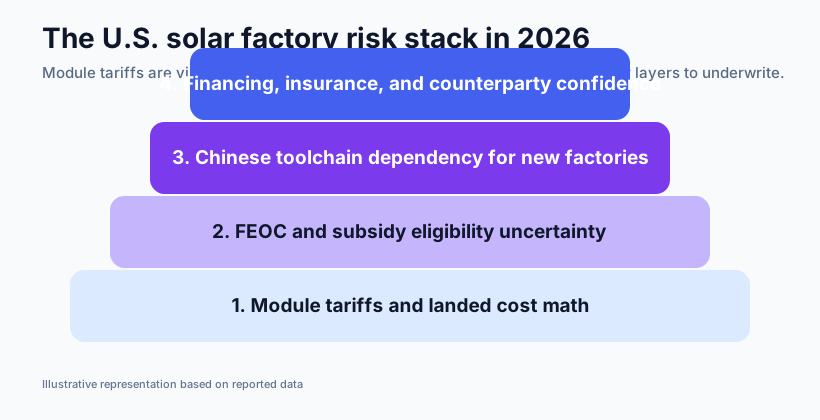
Reuters reported on 2026-04-15 that China was weighing curbs on exports of solar manufacturing equipment to the United States. That is a reported policy-risk signal, not proof that a blanket export ban is already in force. A few weeks later, Reuters reported on 2026-05-08 that banks, insurers, and counterparties had already stepped back from several China-linked U.S. solar factories because subsidy eligibility under U.S. rules remains uncertain. Put together, those stories point to the real risk stack for factory builders: even if the United States wants domestic solar manufacturing, much of the know-how and tooling still comes from the same Chinese ecosystem Washington is trying to fence out.
Source File
This article was reviewed on 2026-07-06 against Reuters reporting republished by MarketScreener on China weighing solar manufacturing-equipment curbs, Reuters reporting republished by Investing.com on financing pressure at China-linked U.S. solar factories, and prior site work in China Solar Dominance: Supply Chain Power, Profit Crisis, Chinese Solar Brands: LONGi vs Jinko vs Trina (2026), and US & EU Tariffs on Chinese Solar Panels 2026. The article treats equipment curbs as a reported policy risk, not a finalized blanket export ban. Buyer guidance separates equipment access, ownership / subsidy eligibility, IP-service dependence, and factory ramp execution.
Quick Answer
If you are building, financing, insuring, or supplying a U.S. solar factory, the question is no longer only "Can we avoid Chinese modules?" It is now "Can we build bankable capacity without Chinese equipment, Chinese IP entanglement, or Chinese-origin subsidy risk?"
| Buyer or operator | Main risk | What matters most now |
|---|---|---|
| New U.S. cell or module factory sponsor | Tool delivery and commissioning delays | Equipment sourcing map and backup vendors |
| Investor or lender | Subsidy disqualification risk | FEOC exposure, ownership, and IP agreements |
| EPC or offtake counterparty | Project delivery confidence | Whether the factory can actually ramp on schedule |
| Chinese solar equipment seller | Policy and export approval risk | U.S. exposure concentration and customer diversification |
Why the Tooling Story Matters More Than Another Tariff Headline
Tariffs are easy to see. Equipment dependence is easier to miss.
Most policy debates still focus on panel origin, landed cost, and subsidy qualification. That is the front-end story already covered in US & EU Tariffs on Chinese Solar Panels 2026. But a factory does not appear because a tariff exists. It appears because someone can secure deposition equipment, automation lines, metallization tools, testing systems, and process engineers who know how to make cells and modules yield at scale.
Reuters reported that Tesla was seeking around $2.9 billion of solar manufacturing equipment from Chinese suppliers such as Suzhou Maxwell. That matters because Tesla is not a hobbyist buyer. It is one of the few companies with enough capital and ambition to force a real industrial shift. If even a buyer at that scale still depends on Chinese tooling, smaller U.S. factory builders should assume the same dependency is broader than public narratives suggest.
The U.S. Factory Boom Already Has a Financing Problem
The May 8 Reuters report is the second part of the story, and possibly the more immediate one.
Reuters said top solar companies, banks, and insurers had stopped doing business with at least half a dozen recently built U.S. panel factories because of uncertainty over whether ties to China could disqualify those facilities from clean-energy subsidies. It also noted that roughly 25 GW of the United States' approximately 66 GW of operating solar module capacity was tied to factories originally built and operated by China-linked producers.
This means some factories face two independent pressures at once:
- Their current financing and insurance stack may weaken if China links remain too visible.
- Their future ramp plans may weaken if Chinese equipment access tightens further.
That combination is much more serious than a normal trade spat. It turns solar manufacturing into a capital-structure problem, not just a sourcing problem.
What China Would Actually Be Protecting
China's motive here is not mysterious. The domestic solar industry is under severe margin pressure even while it dominates globally.
The completed evergreen work on Chinese Solar Brands: LONGi vs Jinko vs Trina (2026) shows what that looks like on the company level: the Big Four continue shipping at huge scale while margins collapse and losses persist. In that environment, exporting high-value tools, engineers, and process know-how to potential future U.S. competitors looks less like normal commerce and more like self-created competition.
Reuters quoted Huasun chairman Xu Xiaohua warning that outside buyers could use China's solar downturn to acquire equipment and talent cheaply. Trivium China called Tesla's self-sufficiency push a nightmare scenario for Chinese solar manufacturers. That is the industrial logic behind a potential export curb.
The Buyer Mistake to Avoid
The biggest mistake is treating a solar factory like a commodity assembly line.
Tool access and process learning matter because modern solar manufacturing is not one machine and one step. It is a chain:
- wafer or cell process equipment
- automation and quality-control systems
- throughput tuning
- yield optimization
- integration with the downstream module line
When buyers say "we will localize," they often mean they will localize the building and payroll. The harder part is localizing the process intelligence.
That is why the real exposure map should look like this:
| Layer | Typical buyer assumption | What to verify instead |
|---|---|---|
| Factory shell | Site is in the U.S., so the risk is domestic | Factory location does not prove process independence |
| Equipment | Tools can be replaced later | Replacement after line design is expensive and slow |
| IP | Minority ownership solves compliance | Licensing, software, and service contracts may still matter |
| Ramp plan | Nameplate capacity equals output | Bankability depends on stable output, not press-release GW |
What This Means for Different Kinds of U.S. Solar Players
For manufacturers, the immediate task is a toolchain audit. Which parts of the line are truly replaceable, and which parts still run through Chinese vendors or Chinese process knowledge?
For financiers, the task is underwriting realism. A project can clear one policy hurdle and still fail because its equipment path becomes politically constrained or because insurers decide the subsidy risk is too hard to price.
For policy makers, the awkward reality is that industrial policy works more slowly than political timelines. The United States can encourage domestic capacity, but it cannot instantly create a deep solar equipment ecosystem with Chinese-scale learning curves.
For installers and offtakers, this matters because promised domestic capacity may not translate into cheap, reliable module supply as fast as the rhetoric suggests.
The Contradictory Signal Buyers Should Keep in Mind
There is still an important counterpoint: Reuters described these equipment curbs as something China was weighing, not a finalized rule. Buyers should not act as if a formal prohibition is already in force.
That matters because some U.S. projects may still get tools through approvals, existing relationships, or alternative transaction structures. Overstating certainty would be lazy analysis.
But underreacting would be lazy too. The useful conclusion is that factory plans relying on smooth, apolitical access to Chinese equipment now deserve a risk premium. The probability of friction is high enough that serious buyers should model it, even before a formal rule lands.
What Smart Buyers Should Do Next
Start with a red-team review of every expansion plan.
- Identify which tools are Chinese, which are substitutable, and which are not.
- Separate ownership risk from equipment risk from IP-service risk.
- Re-test financing cases under delayed ramp assumptions.
- Ask whether the business case still works if commissioning slips by two quarters.
- Treat domestic-capacity headlines as early-stage signals, not proof of bankable output.
The broader lesson is the same one running through China Solar Dominance: Supply Chain Power, Profit Crisis: China's lead is not just product share. It is the industrial stack behind the product. Buyers who only price the module miss the harder strategic dependency.
The Toolchain Audit U.S. Factory Sponsors Need
A serious U.S. solar factory plan should now include a toolchain audit before financing closes. The audit should not stop at the brand name on the invoice. It should identify which part of the production process depends on Chinese equipment, Chinese software, Chinese commissioning teams, Chinese spare parts, or Chinese process recipes.
| Factory layer | Audit question | Why it matters |
|---|---|---|
| Cell process tools | Which deposition, diffusion, metallization, and inspection tools are Chinese-origin or China-serviced? | These tools can define yield and throughput, not only capex |
| Module automation | Which stringing, lamination, framing, and test systems are tied to Chinese vendors? | A module line can be delayed by one missing or unsupported machine |
| Software and recipes | Who owns process parameters, optimization software, and remote diagnostics? | IP-service dependence can remain even if equipment is physically in the U.S. |
| Spare parts | Which consumables, sensors, motors, and controllers require China-linked replacement channels? | Factory uptime depends on boring parts, not only headline tools |
| Commissioning labor | Which engineers must travel or connect remotely to bring the line up? | Export curbs or visa friction can hit the ramp schedule |
Financing Should Price Ramp Risk, Not Only Capex
The financing problem is also more subtle than "Chinese equipment yes or no." A lender cares about whether the factory can turn nameplate capacity into saleable output quickly enough to service debt and qualify for subsidies.
If a project depends on Chinese tools, the lender should model at least three cases:
| Case | Assumption | Financing implication |
|---|---|---|
| Smooth access | Equipment ships, engineers commission, and spare parts flow normally | Base case can use the sponsor's normal ramp curve |
| Delayed access | Tool approvals, installation, or service support slip by one or two quarters | Debt-service reserve, working capital, and offtake penalties need adjustment |
| Restricted access | Key tools or service support cannot be delivered as planned | The project needs a redesign, alternate tool vendor, or lower capacity assumption |
Contract Terms That Matter More Than The Press Release
Factory sponsors should also move this risk into the purchase agreement. Useful terms include equipment-delivery milestones, service-response obligations, source-code or process-recipe escrow where feasible, spare-parts inventory commitments, export-approval responsibility, and a remedy if commissioning support becomes unavailable.
Those clauses will not solve a national policy conflict. They will make the risk visible before the factory is half-built. A domestic solar factory that cannot prove tool access, ramp support, and subsidy eligibility at the same time is not yet bankable capacity. It is an industrial-policy aspiration with a missing execution file.
Methodology
This analysis draws on Reuters reporting that China is weighing solar equipment curbs for the U.S., Reuters reporting on financing and subsidy pressure facing China-linked U.S. factories, and the site's completed evergreen work in China Solar Dominance: Supply Chain Power, Profit Crisis, Chinese Solar Brands: LONGi vs Jinko vs Trina (2026), and US & EU Tariffs on Chinese Solar Panels 2026.
Claim Confidence File
| Claim | Confidence | Evidence boundary |
|---|---|---|
| China was reported to be weighing solar manufacturing-equipment curbs for the U.S. | Medium-high | Based on Reuters reporting; not the same as a finalized blanket export ban |
| Chinese process equipment and commissioning know-how matter for U.S. factory ramp risk | High | Supported by the tooling-dependence logic and Reuters examples; exact exposure varies by factory |
| U.S. China-linked solar factories face financing or subsidy-eligibility pressure | Medium-high | Based on Reuters reporting; facility-by-facility outcomes depend on ownership, contracts, and Treasury interpretation |
| A domestic factory shell proves process independence from China | Low | Equipment, software, recipes, service teams, and spare parts can keep China-linked dependence in place |
| Factory sponsors should audit tools, IP service, spare parts, and commissioning support before financing close | High | Directly follows from equipment and ramp-risk exposure |
What To Watch Next
- Whether Beijing turns the reported equipment-curb discussion into a formal export-control measure
- Whether U.S. Treasury guidance narrows or widens the acceptable China linkage for subsidy eligibility
- Whether major U.S. factory builders disclose non-Chinese equipment alternatives that are credible at scale
FAQ
Is China already banning all solar equipment exports to the United States?
No. Reuters reported on 2026-04-15 that China was weighing curbs. Buyers should read that as elevated risk, not yet as a fully implemented blanket ban.
Why is solar equipment a bigger story than another module tariff?
Because tariffs affect what you import today. Equipment access affects whether you can build competitive manufacturing capacity at all.
Does U.S. domestic module capacity solve this problem?
Not fully. Reported nameplate capacity is only part of the picture. Financing, subsidy qualification, and equipment dependence still shape whether that capacity becomes reliable output.