
JinkoSolar shipped 13.7 GW of modules in Q1 2026 and still lost CNY 1.35 billion. LONGi posted a negative gross margin of -1.19%. Trina Solar was the only one of the Big Four to grow revenue, up 17.4% year-over-year. JA Solar narrowed its losses by 34.9% while sending 77% of its output overseas.
These four companies, JinkoSolar, LONGi, Trina Solar, and JA Solar, account for a large share of global solar module shipments. Depending on the data provider and shipment definition, their combined 2025 shipments likely sat in the high hundreds of gigawatts. If you are buying bankable Chinese modules, they are usually on the shortlist, but they are not the only credible manufacturers.
Yet they are not interchangeable. Each has made distinct technology bets (TOPCon versus back-contact), serves different market segments, and faces a different financial trajectory as the industry navigates its worst pricing crisis in decades. This comparison breaks down what actually differentiates the Big Four — and which one makes sense for your situation.
Source File
This comparison uses public Q1 2026 financial reporting and product-family materials rather than distributor claims. The Big Four Q1 financial table is checked against PV Magazine's May 2026 Chinese PV Industry Brief on JinkoSolar, LONGi, Trina Solar and JA Solar Q1 losses. Jinko's reporting perimeter is cross-checked against its investor-relations release for Q1 2026 financial results. Product specifications are checked against manufacturer materials for Jinko Tiger Neo, LONGi Hi-MO X10, Trina Vertex S+, and JA Solar DeepBlue 4.0. Tariff context is separated into the companion guide on US & EU Tariffs on Chinese Solar Panels 2026 because landed-cost rules change faster than module specs.
Quick Answer: Which Brand Should You Shortlist?
Before the deep dive, here is the short version based on use case:
| Use Case | Recommended Brand | Why |
|---|---|---|
| Residential rooftop | LONGi (Hi-MO X10) | Aesthetics and BC architecture are strong when shade and appearance matter |
| Utility-scale, maximum yield | JinkoSolar (Tiger Neo 3.0) | Large shipped base, mature TOPCon route, high-power modules, long power warranty |
| Budget-conscious commercial | JA Solar (DeepBlue 4.0) | Often competitive on cost-per-watt among Tier 1 options; verify local warranty channel |
| Energy storage + solar | Trina Solar (Vertex S+) | Storage exposure and positive Q1 operating cash flow make it a stronger integrated-project candidate |
| Shaded or complex roof | LONGi (Hi-MO X10) | BC technology can help in certain shaded conditions, but site design still matters |
| Markets with tariff risk | Depends on origin file | JA Solar's Oman plan is relevant, but tariff treatment depends on cell origin, bill of materials, and current customs rules |
The Big Four at a Glance
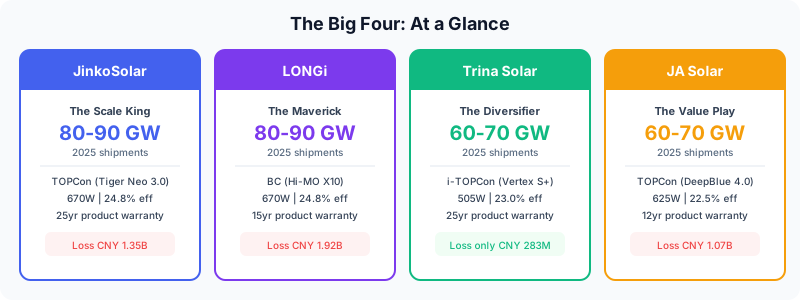
| Metric | JinkoSolar | LONGi | Trina Solar | JA Solar |
|---|---|---|---|---|
| 2025 Module Shipments | 80-90 GW (Tier 1) | 80-90 GW (Tier 1) | 60-70 GW (Tier 2) | 60-70 GW (Tier 2) |
| Q1 2026 Revenue | CNY 12.25B (-11.5%) | CNY 11.19B (-18%) | CNY 16.83B (+17.4%) | CNY 9.22B (-13.7%) |
| Q1 2026 Net Result | Loss CNY 1.35B | Loss CNY 1.92B | Loss CNY 283M | Loss CNY 1.07B |
| Gross Margin | 6.16% | -1.19% | Positive | Positive |
| Flagship Technology | TOPCon (Tiger Neo) | HPBC 2.0 (Hi-MO X10) | i-TOPCon (Vertex S+) | TOPCon (DeepBlue 4.0) |
| 2026 Shipment Target | 75-85 GW | ~80 GW (BC conversion) | ~70 GW | ~65 GW |
| Key Differentiator | Largest global scale | BC technology leader | Storage + cash flow | Overseas manufacturing |
Technology Showdown: TOPCon vs BC vs HJT
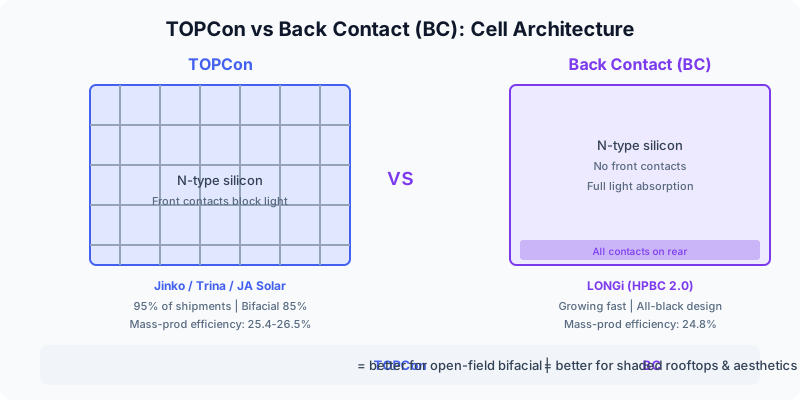
The single biggest differentiator among the Big Four in 2026 is the technology choice between TOPCon (Tunnel Oxide Passivated Contact) and BC (Back Contact). This is not an academic debate — it directly affects how much power your installation generates.
TOPCon: The Mainstream Choice
TOPCon captured roughly 95% of ranked module shipments in 2025 and remains the dominant technology. It evolved from PERC with moderate production line modifications, which is why adoption was so fast — growing from 8% to 70% market share in just three years.
Who uses it: JinkoSolar, Trina Solar, JA Solar (all three as primary technology)
Strengths:
- Bifacial performance (85% rear-side generation), ideal for utility-scale
- Proven track record at scale — hundreds of GW deployed globally
- Lower manufacturing cost due to mature supply chain
- Mass-production cell efficiency around 25.4-26.5%
Weaknesses:
- Front-side metal contacts create shading losses
- Lower aesthetic appeal (visible grid lines)
- Technology plateau approaching — most gains already captured
Back Contact (BC): The Challenger
LONGi has placed the industry's biggest bet on back-contact technology, with a stated push to convert more domestic cell capacity toward BC. In BC cells, electrical contacts are moved to the rear of the cell, reducing front-side shading.
Who uses it: LONGi (primary), Aiko Solar (ABC)
Strengths:
- Strong shaded-condition claims in certain morning/evening and partial-shade scenarios; buyers should check the test condition behind any "up to" figure
- Higher aesthetic appeal — uniform black surface, no visible grid lines
- LONGi's HPBC 2.0 achieves 24.8% module efficiency, matching top TOPCon modules
- LONGi's HIBC (heterojunction BC) lab cells reached 27.3% efficiency — the world record for commercial silicon
Weaknesses:
- Unipolar — bifaciality limited compared to TOPCon
- Higher manufacturing cost and lower current yields
- LONGi's BC ramp contributed to its negative gross margin (-1.19%)
- Smaller installed base means less long-term degradation data
What This Means for Buyers
For utility-scale projects in open terrain with no shade, TOPCon from JinkoSolar, Trina, or JA Solar remains the pragmatic choice. The bifacial gain on a ground-mount installation with reflective surfaces can add 5-15% to total yield.
For residential rooftops with complex geometry, trees, chimneys, or neighboring buildings causing shade, LONGi's BC technology has a genuine performance advantage. The all-black aesthetic is also a selling point for homeowners who care about curb appeal.
For a full exploration of why Chinese solar technology leads globally, see China Solar Dominance: Supply Chain Power, Profit Crisis.
Brand-by-Brand Deep Dive
JinkoSolar: The Scale King
JinkoSolar is the world's largest solar module manufacturer by shipment volume, a title it has held or shared since 2022. The company shipped 80-90 GW in 2025 and targets 75-85 GW in 2026.
Financials (Q1 2026): Revenue of CNY 12.25 billion was down 11.5% year-over-year, with a net loss of CNY 1.35 billion ($186 million). Gross margin held at 6.16% — positive, but razor-thin for a company of this scale. Module shipments hit 13.7 GW in the quarter alone.
Technology: JinkoSolar is a TOPCon pure-play. Its Tiger Neo 3.0 series represents the flagship:
- Up to 670W power output
- 24.8% module efficiency
- 25-year product warranty, 30-year linear power warranty (87.4% at year 30)
- Temperature coefficient of -0.26%/C — among the best in class
- Bifaciality of 85%
Global presence: JinkoSolar has the broadest geographic footprint of the Big Four, with manufacturing facilities in China, Southeast Asia, and a US-based assembly operation (Jinko Solar US Industries in Jacksonville, Florida). Its service infrastructure in North America has expanded significantly since 2023.
Verdict: JinkoSolar is a safe default shortlist candidate when shipped base, TOPCon maturity, and global service footprint matter. It still needs project-specific checks on local distributor support, warranty jurisdiction, and origin documentation.
LONGi: The Technology Maverick
LONGi Green Energy Technology is making the industry's most aggressive technology pivot. The company is converting all domestic cell production capacity to back-contact (BC) technology by the end of 2026, a bet that has already cost it dearly in the short term.
Financials (Q1 2026): Revenue of CNY 11.19 billion was down 18% year-over-year — the steepest decline among the Big Four. Net loss widened to CNY 1.92 billion ($264 million), partly due to a 34.2% foreign exchange impact. Gross margin went negative at -1.19%, meaning LONGi sold modules for less than the cost of production. BC module shipments reached 8.34 GW in Q1 alone.
Technology: LONGi is the only Big Four member going all-in on back-contact:
Hi-MO X10 (current flagship):
- HPBC 2.0 cell technology with TaiRay silicon wafers
- Up to 670W power output
- 24.8% module efficiency
- 15-year product warranty (extended from 12), 30-year performance warranty
- All-black aesthetic, no visible grid lines
HIBC (next generation):
- Lab cell efficiency of 27.3% — world record for commercial silicon
- Module efficiency up to 25%
- Currently in pilot production
LONGi also holds the world record for perovskite/silicon tandem cells at 34.85% efficiency, though this technology is years from commercial production.
The BC gamble: LONGi's negative gross margin is partly the cost of converting PERC and early TOPCon lines to BC. The company believes BC will become the dominant technology within 3-5 years. If correct, LONGi will have a multi-year head start. If TOPCon remains dominant, the conversion costs will weigh on LONGi's margins for years.
Verdict: LONGi is the best choice for residential installations where aesthetics and shaded-condition performance matter. The Hi-MO X10's all-black design and 24.8% efficiency make it a premium option. But buyers should be aware that LONGi's financial position is the weakest among the Big Four right now — a consideration for warranty fulfillment over 25-30 years.
Trina Solar: The Diversifier
Trina Solar stands out as the only Big Four member growing revenue and narrowing losses simultaneously — a remarkable achievement in an industry where everyone else is bleeding.
Financials (Q1 2026): Revenue of CNY 16.83 billion was up 17.4% year-over-year, making Trina the only grower. Net loss narrowed by 78.6% to just CNY 283 million ($38.9 million). Operating cash flow turned positive — a critical signal that the business is generating real money, not just shipping modules at a loss.
Technology: Trina uses its proprietary i-TOPCon (advanced TOPCon) across its product line:
Vertex S+ (residential/commercial):
- 425-505W power output
- Up to 23.0% module efficiency
- Up to 25-year product warranty, 30-year power warranty
- First-year degradation of just 1% (99% retained power)
- 210mm cell platform
Vertex (utility-scale):
- Higher power output options
- Bifacial dual-glass design
- Proven in large-scale solar farms globally
Trina holds over 2,000 patents spanning TOPCon, PERC, and other technologies — one of the largest patent portfolios in the solar industry.
The storage play: Trina's key differentiator is its rapidly expanding energy storage division. The company is positioning itself as a solar-plus-storage provider, not just a module maker. This matters because integrated solar-plus-storage solutions command higher margins and create stickier customer relationships than standalone modules.
Verdict: Trina Solar looked financially stronger than peers in the Q1 2026 snapshot and has a more visible storage angle. If you are planning a solar-plus-storage project, or if vendor financial trajectory is a top concern, Trina deserves a close look. This is not a permanent ranking; quarterly solar financials can move quickly.
JA Solar: The Value Play
JA Solar has carved out a position as the cost-competitive Tier 1 option. The company is not the largest, not the most innovative, and not the most diversified — but it consistently delivers competitive products at prices that make project economics work.
Financials (Q1 2026): Revenue of CNY 9.22 billion was down 13.7% year-over-year, but net loss narrowed by 34.9% to CNY 1.07 billion ($147 million). The most notable metric: 77% of JA Solar's shipments went overseas — the highest export ratio among the Big Four.
Technology: JA Solar uses standard TOPCon in its DeepBlue series:
DeepBlue 4.0 (current generation):
- Up to 625W power output
- Module efficiency around 22-23%
- 12-year product warranty (extendable to 25 years for N-type), 30-year power warranty
- Annual degradation rate of 0.3% — better than the 0.4% industry standard for TOPCon
The Oman factory: JA Solar's most strategically important move is its planned Oman manufacturing facility, with 6 GW of cell capacity and 3 GW of module capacity referenced in public reporting. This is significant because a non-China cell and module path can help in some tariff environments. For the US, however, origin treatment depends on the full bill of materials, cell origin, substantial-transformation analysis, FEOC rules, and current customs enforcement.
Verdict: JA Solar is a practical shortlist candidate for cost-sensitive projects, especially where origin diversification matters. The Oman plan is strategically relevant, but buyers should not treat it as an automatic tariff solution without a project-specific origin file.
Module Specifications Comparison
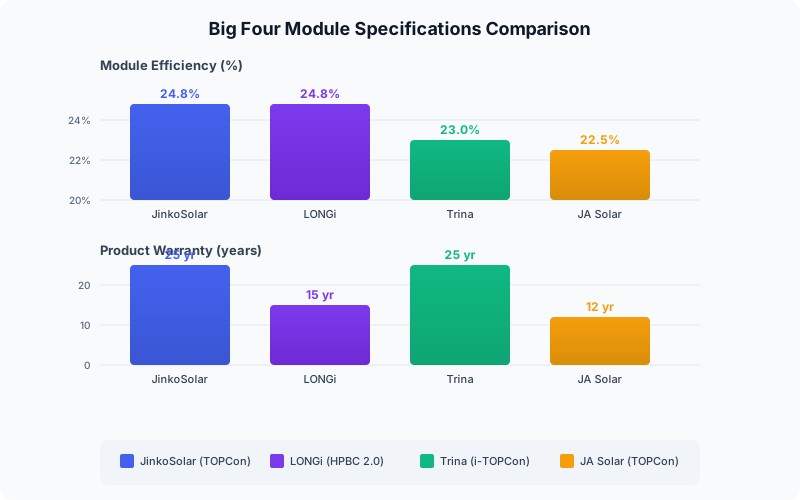
| Specification | JinkoSolar Tiger Neo 3.0 | LONGi Hi-MO X10 | Trina Vertex S+ | JA Solar DeepBlue 4.0 |
|---|---|---|---|---|
| Cell Technology | N-type TOPCon | HPBC 2.0 (BC) | N-type i-TOPCon | N-type TOPCon |
| Max Power (W) | 670 | 670 | 505 | 625 |
| Module Efficiency | Up to 24.8% | Up to 24.8% | Up to 23.0% | Up to 22.5% |
| Product Warranty | 25 years | 15 years | Up to 25 years | 12 years (extendable) |
| Power Warranty | 30 years | 30 years | 30 years | 30 years |
| End-of-Life Output | 87.4% | 87.4% | 87.4% | 87.0% |
| Annual Degradation | ~0.4% | ~0.35% | ~0.4% | ~0.3% |
| Bifaciality | 85% | Limited | 80% | 80% |
| Temp Coefficient | -0.26%/C | -0.26%/C | -0.29%/C | -0.28%/C |
| Cell Size | 182mm | 182mm | 210mm | 182mm |
Financial Health: Who Can Survive the Downturn?
The solar industry is in the midst of a brutal overcapacity crisis. China's manufacturing capacity reached 1,200 GW in 2025 — roughly double global demand. Module prices have been below production cost for over ten consecutive quarters. More than 40 smaller firms have already exited through bankruptcy or acquisition.
The Big Four are much more likely to survive than smaller manufacturers, but buyer due diligence should not treat survival as automatic. The question is how much financial damage they absorb before the cycle turns, and how that affects warranty service, local inventory, and support.
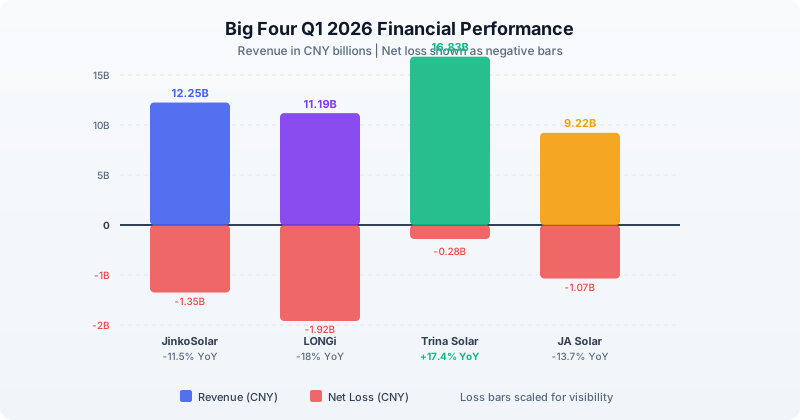
| Financial Metric | JinkoSolar | LONGi | Trina Solar | JA Solar |
|---|---|---|---|---|
| Revenue (CNY B) | 12.25 | 11.19 | 16.83 | 9.22 |
| YoY Revenue Change | -11.5% | -18.0% | +17.4% | -13.7% |
| Net Loss (CNY B) | 1.35 | 1.92 | 0.28 | 1.07 |
| Loss Trend | Widening | Widening | Narrowing (-78.6%) | Narrowing (-34.9%) |
| Gross Margin | 6.16% | -1.19% | Positive | Positive |
| Operating Cash Flow | Negative | Negative | Positive | Negative |
| Overseas Revenue % | ~65% | ~55% | ~60% | 77% |
For buyers making 25-30 year commitments, vendor financial health matters. A manufacturer that goes bankrupt may not honor its warranty. All four have strong balance sheets relative to the rest of the industry, but Trina's trajectory is clearly the most reassuring.
Which Brand for Which Market?
United States
The US market is highly restricted for directly imported Chinese modules due to Section 301 tariffs, AD/CVD exposure, circumvention rules, FEOC-related tax-credit risk, and origin scrutiny. Combined duties can be punitive, but exact landed cost depends on exporter, cell origin, assembly country, scope rulings, and date of entry.
However, all four Big Four members have US-based assembly operations:
- JinkoSolar: Jacksonville, Florida facility
- LONGi: Illuminate USA partnership
- Trina Solar: T1 Energy
- JA Solar: American Panel Solutions / Corning partnership
These US-assembled modules often use imported cells and may qualify for different duty and incentive treatment, subject to FEOC and domestic-content rules. Median US module prices have remained far above FOB China prices, but the exact gap changes with tariffs, inventories, and project timing.
JA Solar's Oman factory adds another option: modules assembled outside China from cells produced outside China could face significantly lower tariffs in the US market.
European Union
The EU does not currently have the same broad AD/CVD tariff wall on Chinese solar modules that the US does, but non-tariff barriers are emerging around resilience, cybersecurity, public funding, and local manufacturing policy. Module buyers should separate module duties from inverter, grid, data, and public-procurement rules.
All four brands are widely available in Europe at competitive prices. LONGi's BC technology has gained particular traction in the European residential market where aesthetics matter. JinkoSolar and Trina have strong commercial and utility-scale positions.
Australia
Australia remains one of the most open major markets for Chinese solar panels, with high China import dependence and very competitive installed residential costs. Buyers still need to check local distributor bankability, warranty service, installer quality, and Clean Energy Council listing.
JinkoSolar has the largest market share in Australian residential solar. LONGi's Hi-MO series is gaining ground in the premium segment. See importing solar panels from China for detailed purchasing guidance.
India
India's module rules change quickly through Basic Customs Duty, ALMM, domestic manufacturing policy, and project-specific procurement requirements. Chinese modules can remain cheaper in some comparisons, but legal eligibility and project finance rules may matter more than FOB price.
For detailed duty calculations across all four markets, see US & EU Tariffs on Chinese Solar Panels 2026.
The Overcapacity Factor: Pricing and Availability
All four brands are pricing modules below sustainable levels. FOB China prices for TOPCon modules rebounded to approximately $0.115-0.120/W in early 2026, up 30%+ from mid-December 2025 lows — but the rebound was driven largely by silver price pass-through, not fundamental demand recovery.
China's cancellation of the 9% VAT export rebate (effective April 1, 2026) adds 10-18% to FOB prices for export markets. This affects all four brands equally and is already reflected in current pricing.
What this means for buyers: module prices may have limited downside from crisis levels, but "floor" claims are risky in a market with severe overcapacity. The industry cannot sustain prices below production cost indefinitely, yet inventory, policy intervention, and demand cycles can still move near-term pricing. Buyers should model price bands, not a single bottom.
Buying Decision Framework
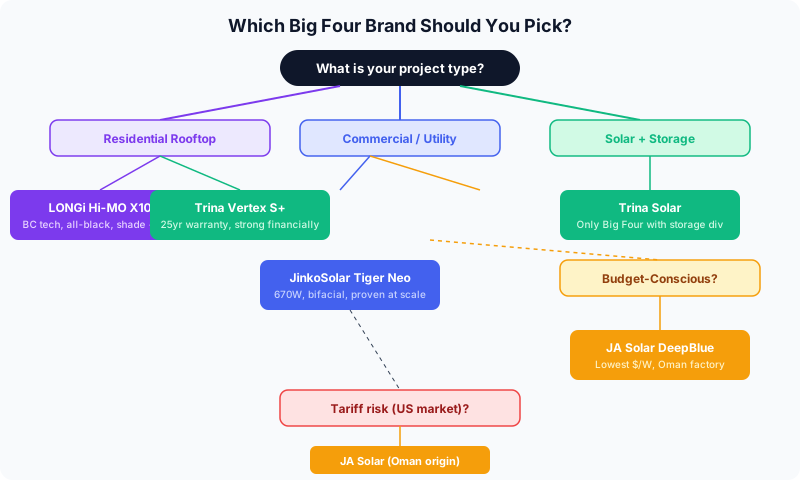
Step 1: Determine Your Installation Type
Residential rooftop (3-15 kW): LONGi Hi-MO X10 or Trina Vertex S+. LONGi wins on aesthetics and shade performance. Trina wins on warranty length and financial stability.
Commercial rooftop (50-500 kW): JinkoSolar Tiger Neo or JA Solar DeepBlue. Both offer excellent value and proven TOPCon performance. JA Solar may have a slight cost advantage.
Utility-scale ground mount (1 MW+): JinkoSolar Tiger Neo 3.0. The 670W high-power modules reduce balance-of-system costs through fewer modules per watt. Proven bifacial performance at scale.
Solar-plus-storage: Trina Solar. The only Big Four member with a meaningful storage division.
Step 2: Check Availability and Local Support
All four brands have extensive global distribution networks, but local availability varies. In most markets, JinkoSolar has the deepest inventory. LONGi can have longer lead times for BC modules in markets where TOPCon dominates distribution.
Step 3: Evaluate Warranty Terms
All four offer 30-year power warranties. The meaningful difference is in product warranty (covering manufacturing defects):
- JinkoSolar: 25 years
- Trina Solar: up to 25 years
- LONGi: 15 years
- JA Solar: 12 years (extendable)
For a 25-year investment, the product warranty duration matters. JinkoSolar and Trina offer the most comprehensive coverage.
Step 4: Consider Tariff Exposure
If you are in the US, your choice may be constrained by which brand has local assembly capacity and FEOC compliance. If you are in a market without tariff barriers (EU, Australia), this is not a factor. See US & EU Tariffs on Chinese Solar Panels 2026 for a full tariff analysis.
Methodology And Source Notes
This comparison was reviewed on July 6, 2026 using Q1 2026 public financial reporting, PV Magazine's Chinese PV Industry Brief, JinkoSolar investor materials, and manufacturer product pages for Jinko Tiger Neo, LONGi Hi-MO X10, Trina Vertex S+, and JA Solar DeepBlue 4.0. Financial health, product warranty, technology route, and tariff exposure are evaluated separately because the best module on a datasheet may not be the best procurement choice in a specific market. Tariff discussion is kept directional here and routed to the dedicated import-duty guide because landed-cost rules change faster than product specifications.
Claim Confidence File
| Claim | Confidence | Evidence boundary |
|---|---|---|
| JinkoSolar, LONGi, Trina Solar, and JA Solar are among the most important Chinese module suppliers | High | Supported by shipment scale, Q1 2026 financial reporting, and product portfolios. |
| The "recommended brand" table is a universal buying rule | Low | It is a shortlist by use case; project design, distributor, warranty, origin, and financing can override it. |
| Q1 2026 financials show Trina with the strongest peer trajectory in this snapshot | High | Supported by PV Magazine's Q1 2026 brief; not a permanent ranking. |
| Tier 1 status removes the need for due diligence | Low | The article explicitly rejects this; Tier 1 is a bankability signal, not a quality guarantee. |
| JA Solar's Oman plan automatically solves US tariff exposure | Low | Origin and duty treatment require project-specific customs analysis. |
| Product specs and warranty terms are enough to choose a module | Low | Local support, installer quality, bankability, origin file, and service process also matter. |
FAQ
Are all four brands truly Tier 1?
Yes, all four are commonly treated as BloombergNEF Tier 1 manufacturers in 2026. That means they have strong bankability signals, not that every project will be financed without additional due diligence. Lenders, insurers, and EPCs can still ask for warranty, origin, financial, and product-specific evidence.
Is LONGi's BC technology proven enough for a 25-year investment?
This is the central risk with LONGi. BC cells have been deployed at scale only since 2024, meaning there is limited long-term degradation data. LONGi's HPBC 2.0 technology is second-generation, and lab testing shows excellent durability, but 25 years of real-world data does not exist yet. JinkoSolar's TOPCon, by contrast, has a much larger installed base with more operational history. If you prioritize proven track records, JinkoSolar or Trina is safer. If you prioritize cutting-edge performance and aesthetics, LONGi's BC is compelling.
Why is Trina Solar performing better financially than the others?
Three factors. First, Trina's revenue diversification into energy storage provides a higher-margin revenue stream. Second, its operating cash flow turned positive in Q1 2026, suggesting better working capital management. Third, Trina has been more disciplined on pricing, avoiding the below-cost sales that have drained LONGi's and JinkoSolar's margins. Trina's loss of only CNY 283 million — compared to LONGi's CNY 1.92 billion — reflects better cost control and a more conservative capacity expansion strategy.
Should I worry about a Big Four manufacturer going bankrupt?
In the near term, the Big Four are much safer than smaller producers, but "no risk" is too strong. Their scale, bank relationships, and strategic value make collapse unlikely, yet a prolonged downturn can still affect warranty reserves, local service, production mix, and delivery reliability. LONGi's negative gross margin in this snapshot is a yellow flag worth tracking.
Does JA Solar's Oman factory actually help with US tariffs?
It potentially does. The Oman factory produces both cells (6 GW) and modules (3 GW), meaning the finished product has a non-China origin. Under current US trade law, the country of origin is determined by where the "substantial transformation" occurs. If cells are produced in Oman from polysilicon sourced outside China, the modules may qualify for lower tariff rates than those produced entirely in China or Southeast Asia. However, the legal landscape is complex and evolving — consult a trade attorney for specific projects.
Which brand has the best warranty?
On paper, JinkoSolar and Trina Solar offer the strongest warranties: 25-year product warranty plus 30-year linear power warranty guaranteeing 87.4% output at year 30. LONGi matches the 30-year power warranty but offers only 15 years of product warranty. JA Solar's base product warranty is 12 years, extendable to 25 years for N-type modules in some regions. In practice, warranty claims across all four brands are processed through local distributors, so the quality of your installer and local distributor matters as much as the manufacturer's terms.
Related Entries
- China Solar Dominance: Supply Chain Power, Profit Crisis — How China came to control 80%+ of every stage of the solar supply chain
- US & EU Tariffs on Chinese Solar Panels 2026 — What you will actually pay for Chinese solar panels after tariffs, with worked cost calculations
- China solar dominance — China's full green energy dominance, from silicon to solar farms
- importing solar panels from China — Practical guide for installers and businesses purchasing Chinese solar panels