
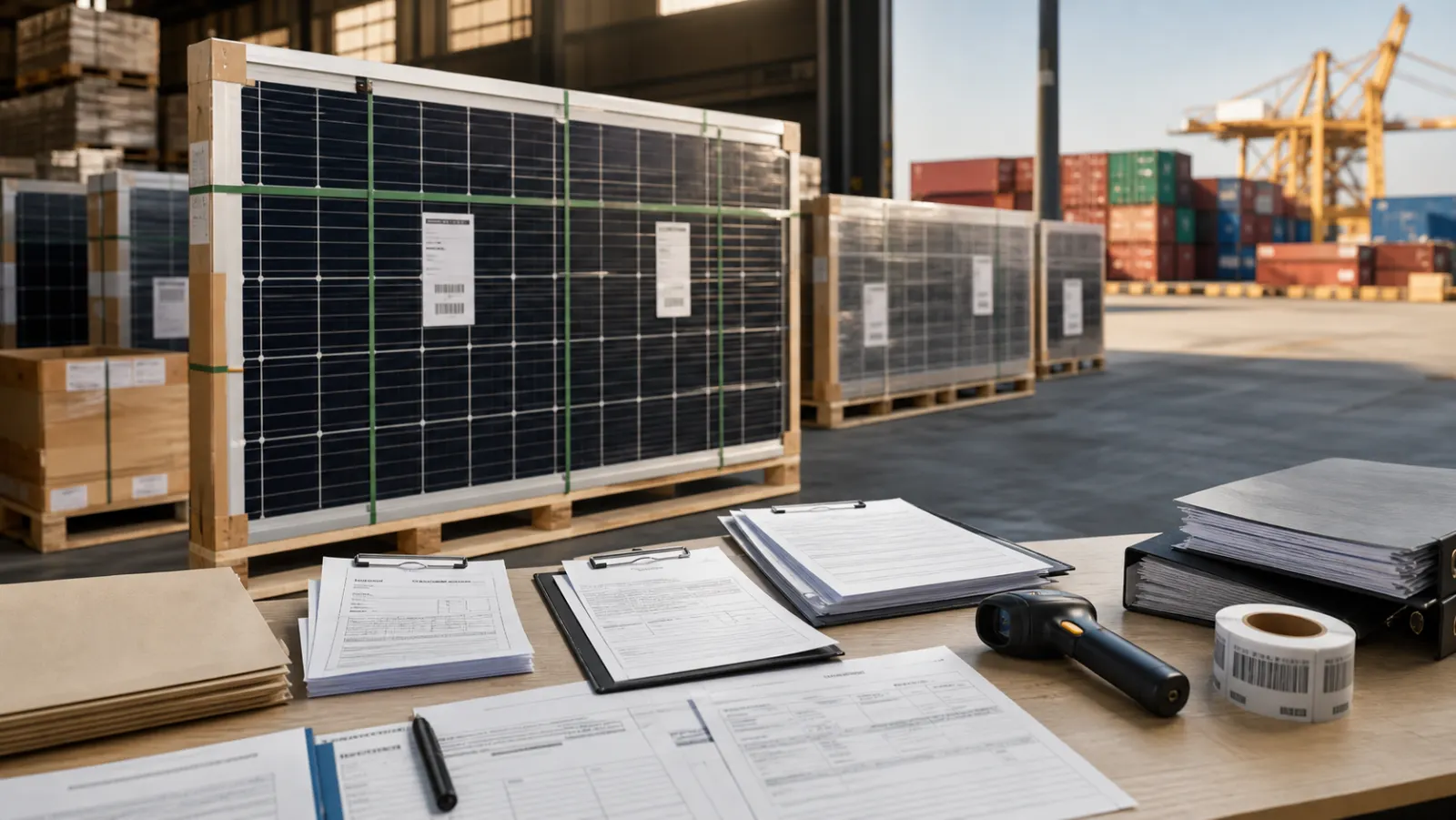
A US buyer looking at a Chinese solar module quote in 2026 is not only buying panels. They are buying an entry file. The price on the pro forma invoice may say $0.13/W, but the shipment can still fail if the importer cannot prove the product classification, manufacturer identity, cell origin, AD/CVD rate, forced-labor traceability, and tax-credit eligibility path.
That is the real importer problem. The United States has not made Chinese solar panels impossible to quote; it has made them impossible to quote casually. The buyer who treats the shipment as "cheap modules plus freight" is exposed. The buyer who treats it as a customs, origin, and project-finance file has a chance to know whether the quote is usable before money moves.
This checklist is for importing solar panels from China to the US in 2026. It does not replace a customs broker, trade lawyer, or tax adviser. It gives the procurement team the file structure they need before asking those specialists for a ruling, quote, or go/no-go decision.
For the full country-by-country landed-cost comparison, see US & EU Tariffs on Chinese Solar Panels 2026. This article stays narrower: what the US importer must verify before accepting a China-origin solar panel quote.
Source File
This article was reviewed on 2026-06-30 against the USITC HTS references for 8541.42.00.10 and 8541.43.00.10, the Federal Register Section 301 solar-cell modification notice, the USITC 2026-05-27 China/Taiwan CSPV sunset-review decision, Commerce's Southeast Asia solar AD/CVD determinations, CBP's UFLPA resources, and IRS/Treasury 2026 prohibited foreign entity guidance. The article turns those sources into an importer checklist; it is not a customs ruling, tax opinion, or substitute for broker / counsel review.
Quick Answer: What US Importers Must Check
If you are importing solar panels from China to the US in 2026, do not start with the supplier's watt price. Start with the file.
| Requirement | What to collect before purchase | Why it matters |
|---|---|---|
| Product identity | Datasheet, bill of materials, cell type, module assembly location, product photos, model number | Classification and duty exposure depend on the actual product form |
| HTS classification | Broker review of the likely HTS code, commonly including 8541.42 or 8541.43 for cells and modules | The HTS code drives Section 301, normal duty, and AD/CVD analysis |
| Manufacturer file | Legal manufacturer, exporter, cell producer, module producer, factory address, related parties | AD/CVD cash deposits are producer-specific, not only country-specific |
| Origin file | Country of polysilicon, wafer, cell, module assembly, frame, glass, junction box where relevant | Origin drives AD/CVD, circumvention, UFLPA, and customer diligence |
| Tariff model | Section 301, temporary Section 122 if still active for the entry date, AD/CVD, MPF, harbor fees if applicable | A 50% headline tariff is not the full US cost |
| UFLPA file | Supply-chain tracing, polysilicon source, affidavits, purchase records, production records | Customs can detain goods if traceability is weak |
| Tax-credit file | FEOC/prohibited foreign entity material-assistance review if the project relies on 45Y, 48E, or 45X value | A shipment can clear customs and still damage project economics |
| Commercial fallback | Alternative supplier, domestic module comparison, cancellation terms, detention cost allocation | Solar imports can fail after the purchase order is signed |
The First Decision: Are You Importing A Module, A Cell, Or A System?
The first turning point in a US solar import file is product identity. A solar module, an individual cell, and a packaged solar generator kit can look related to a buyer, but they can sit in different customs conversations.
The most common US solar classifications in buyer files are not marketing categories. They are HTS classifications. Solar cells not assembled into modules are commonly reviewed under 8541.42.00.10 in the USITC HTS system. Solar cells assembled into modules or panels are commonly reviewed under 8541.43.00.10. The exact classification can change if the product is imported as part of a kit, DC generator, battery-integrated product, controller package, or other complete system.
That is why the first document is not the invoice. It is the product identity packet:
- commercial invoice and packing list
- model number and datasheet
- exploded bill of materials
- product photos
- whether cells are separate, assembled into modules, or built into a larger kit
- rated wattage and electrical architecture
- manufacturer and exporter names
- factory address
- country where cell conversion occurred
- country where module assembly occurred
Do not let the supplier answer this only with a sales brochure. The importer needs documents that a broker can use and that can survive a customs question later.
The Tariff Stack: Why The 50% Number Is Not Enough
Many search results stop at "US tariffs on Chinese solar panels are 50%." That is incomplete.
The Federal Register notice implementing USTR's Section 301 modifications raised the tariff on Chinese solar cells, whether or not assembled into modules, to 50%. That is the floor for China-origin cells and modules in this 2026 file. But it is only one layer.
For a China-origin module, the importer may also need to model:
| Layer | What it means for the importer |
|---|---|
| Normal customs duty | Usually not the main cost for standard PV modules, but classification still matters |
| Section 301 | The 50% China-origin solar cell/module layer |
| Section 122 | A temporary 10% surcharge through 2026-07-24 unless changed, based on the current White House action |
| AD/CVD | Anti-dumping and countervailing duty cash deposits tied to product scope, producer, exporter, review period, and Commerce records |
| MPF and fees | Smaller customs processing costs that still belong in the landed-cost model |
| Detention and demurrage | Commercial costs if the shipment is held for traceability or documentation problems |
The USITC's 2026-05-27 sunset-review decision kept the existing China/Taiwan crystalline silicon photovoltaic product orders alive. That means US importers should not assume old solar AD/CVD exposure disappeared in 2026. It did not.
For the broader landed-cost math, the companion article US & EU Tariffs on Chinese Solar Panels 2026 models the tariff stack in dollars per watt. This page focuses on what the importer needs in the file before the model is trustworthy.
The Producer File: The Name On The Quote Is Not Enough
A Chinese supplier quote often shows one sales entity. That may not be the manufacturer that matters for AD/CVD. It may be a trading company, export affiliate, distributor, or brand entity.
For US imports, the importer should ask for a producer map:
| Entity | Required information | Buyer question |
|---|---|---|
| Seller/exporter | Legal name, address, business license, export role | Is this the entity issuing the invoice or only a sales agent? |
| Module manufacturer | Legal name, factory address, production line | Who assembled the module? |
| Cell producer | Legal name, factory address, country of cell conversion | Who made the cells inside the module? |
| Upstream suppliers | Polysilicon, wafer, frame, glass, junction box where relevant | Can the chain support UFLPA and customer diligence? |
| US importer of record | Legal importer, bond, broker, responsible party | Who is legally responsible at entry? |
If the supplier refuses to identify the cell producer and module producer before deposit, treat the quote as non-actionable. You cannot price the duty file without the parties.
The Origin File: China Direct Is Simple, Mixed Origin Is Not
A direct China-origin shipment is expensive, but at least the question is clear. Mixed-origin supply chains can be cheaper on paper and more difficult in the file.
US solar trade rules have repeatedly focused on whether Chinese-origin inputs or Chinese-controlled production have been routed through third countries. The Department of Commerce's final affirmative determinations on crystalline photovoltaic cells from Cambodia, Malaysia, Thailand, and Vietnam show why route alone is not enough. The importer must understand the production that created the cell and module, not just the port of export.
For a China-related solar module quote, the origin file should answer:
- where polysilicon was produced
- where ingots and wafers were produced
- where cells were manufactured
- where modules were assembled
- whether any Southeast Asian route is involved
- whether the producer has an individual AD/CVD treatment
- whether the documentation supports substantial transformation
- whether the bill of materials matches the claimed origin
- whether the supplier can provide production records if challenged
The practical point is not to avoid all globalized solar supply chains. Most solar supply chains are globalized. The point is to avoid buying a story that cannot be documented.
UFLPA: The Traceability File Is A Delivery-Risk File
The Uyghur Forced Labor Prevention Act is not a tariff. It is a detention and admissibility risk. For solar, it matters because polysilicon and upstream inputs have been central to forced-labor enforcement.
CBP's UFLPA guidance and forced-labor resources make the importer's burden clear: if goods are suspected of being connected to forced labor in covered supply chains, the importer needs evidence. The importer should not wait until detention to ask for it.
For solar modules, the UFLPA file should include:
| Evidence type | What to request |
|---|---|
| Supplier declarations | Signed supplier statements covering polysilicon, wafer, cell, module, and assembly path |
| Transaction records | Purchase orders, invoices, packing lists, transport documents across the relevant tiers |
| Production records | Batch records, factory production logs, inventory movement, input-output matching |
| Entity screening | Screening against UFLPA Entity List, sanctions, and restricted-party databases |
| Traceability logic | A clear chain from raw material to module, not a loose set of unrelated PDFs |
FEOC Is Not Customs, But It Can Break The Project
The next trap is treating customs clearance as the only success condition. A module can clear customs and still be wrong for a US project.
If the project depends on clean-energy tax credits, the buyer needs a prohibited foreign entity and material-assistance review. Treasury and IRS have published 2026 guidance on prohibited foreign entity rules, and the practical effect for procurement is straightforward: the equipment file must support the tax-credit position, not only the import entry.
This is especially important for developers, EPCs, and buyers whose commercial model assumes 45Y, 48E, or 45X value. The customs broker can help classify the product. The tax adviser must evaluate whether the equipment package creates credit risk.
The procurement file should separate the two questions:
| Question | Who reviews it | Output |
|---|---|---|
| Can this shipment enter the United States? | Customs broker, trade counsel | HTS classification, duty model, entry plan |
| Can this equipment support project tax-credit value? | Tax adviser, sponsor, lender, offtaker | FEOC/material-assistance position and lender acceptance |
The Quote Packet A Serious Supplier Should Provide
A usable quote for importing solar panels from China to the US in 2026 should include more than wattage and price.
Ask for this packet before deposit:
| File | Minimum content |
|---|---|
| Commercial file | Quote, Incoterms, payment terms, cancellation terms, delivery schedule |
| Product file | Datasheet, model number, warranty, bill of materials, product photos |
| Classification file | Supplier-proposed HS/HTS code, prior entry examples if available, broker review path |
| Manufacturer file | Legal producer, exporter, cell producer, module producer, factory locations |
| Origin file | Polysilicon, wafer, cell, module, and assembly chain with supporting documents |
| Duty file | Section 301 treatment, AD/CVD producer rate evidence, entry date, surcharge assumption |
| Traceability file | UFLPA supplier declarations and production/transaction evidence |
| Tax-credit file | FEOC/prohibited foreign entity representations if US tax credits matter |
| Warranty file | US warranty counterparty, claims process, parts availability, service channel |
| Contract file | Detention, rate-change, reclassification, delay, and substitution clauses |
What To Send The Customs Broker
The customs broker should not receive a forwarded sales email and be asked for "the tariff." That is too thin. A broker can only give a useful answer when the buyer sends a complete enough packet to classify the product and flag the obvious duty questions.
For the first broker review, send:
| Broker input | Why it belongs in the first review |
|---|---|
| Product datasheet and photos | The broker needs to see whether the item is a cell, module, kit, or system |
| Bill of materials | Integrated controllers, batteries, frames, junction boxes, or bundled components can change the analysis |
| Country-by-process table | The broker needs to separate cell conversion, module assembly, and upstream inputs |
| Manufacturer and exporter names | Producer identity affects AD/CVD review and rate research |
| Intended entry date | Temporary measures and rate periods can depend on timing |
| Incoterms and invoice value | Duty calculation starts from the customs value and transaction structure |
| Prior rulings or prior entries | Useful if the same SKU has already entered the US under a reviewed classification |
| Intended project use | Tax-credit, lender, customer, or public-funding rules may create a second review track |
Contract Clauses That Belong In The Purchase Order
Solar import risk should not live only in the buyer's spreadsheet. It should appear in the purchase order, master supply agreement, or side letter.
At minimum, the buyer should discuss:
- classification cooperation: the supplier must provide documents needed for HTS review and respond to broker questions
- producer identity warranty: the seller confirms the legal manufacturer, cell producer, and module producer named in the quote
- origin documentation: the seller must provide records supporting cell and module origin, plus upstream traceability where required
- UFLPA cooperation: the seller must provide documents needed for CBP review and not substitute upstream suppliers without notice
- rate-change allocation: the contract states who pays if the assumed AD/CVD or surcharge rate changes before entry
- detention cost allocation: storage, demurrage, legal review, and replacement supply costs are assigned before shipment
- substitution control: the seller cannot replace cells, modules, factories, or shipment route without buyer approval
- tax-credit representation: if project credits matter, the seller provides the information needed for FEOC/material-assistance review
Small buyers may not be able to force every clause on a large supplier. But even a weaker written record is better than discovering after arrival that the seller views traceability, rate changes, and detention as entirely the buyer's problem.
Incoterms: Do Not Let DDP Hide The Importer Risk
Many buyers are offered DDP pricing because it feels simple. Delivered Duty Paid can be useful in low-risk categories. In US solar, it can also hide the file.
If the supplier offers DDP, ask:
- who is the importer of record?
- which HTS code will be used?
- which AD/CVD rate is included?
- is Section 301 included?
- is any temporary surcharge included?
- who owns detention risk?
- who provides UFLPA traceability?
- who pays if CBP questions the entry?
- who bears liability if the classification is wrong?
- does the buyer receive entry documentation?
The risk is that DDP converts a hard compliance problem into a cheap landed-price promise. If the supplier or forwarder uses a weak classification, undisclosed route, or poor origin file, the buyer may still face commercial and reputational damage even if it is not technically the importer of record.
For serious commercial or utility-scale projects, the buyer should know the entry file even when the seller manages logistics.
A Practical Import Workflow
Use this sequence before accepting a China-origin solar module quote:
Step 1: Screen The Product
Confirm whether the product is a cell, module, panel, kit, inverter-linked package, battery-linked package, or complete system. Collect datasheets and photos. Ask a broker to identify the likely HTS classification.
Step 2: Name Every Producer
Get the legal manufacturer, exporter, cell producer, module producer, and factory addresses. Do not proceed with "Tier 1 partner" language.
Step 3: Build The Duty Model
Model Section 301, AD/CVD, temporary surcharges if active for the entry date, MPF, fees, detention allowance, and freight. Compare the result with domestic and non-China alternatives.
Step 4: Build The Origin And Traceability File
Collect UFLPA-related supply-chain records before the purchase order. If the supplier says this is only available after deposit, treat that as a risk signal.
Step 5: Run The Project Eligibility Review
If the project relies on tax credits, lender approval, public funding, or customer origin rules, run FEOC and project-finance review before shipment.
Step 6: Put Risk Allocation In The Contract
The purchase order should address classification changes, AD/CVD rate changes, detention, document failure, substitution, delayed delivery, and cancellation. If the seller's documents fail, the buyer should not be the only party absorbing the loss.
When Importing From China Can Still Make Sense
Direct China-origin modules for US projects are usually not viable when full AD/CVD exposure applies. But "usually not viable" is not the same as "never possible."
Importing may still make sense when:
- the producer has a verified lower AD/CVD rate
- the buyer is importing a niche product not easily sourced elsewhere
- the system does not depend on US tax-credit value
- the shipment is small enough for a specialized use case and the buyer accepts the duty cost
- the route and origin file are unusually strong
- the alternative is not domestic production but a different imported product with its own risk
Even then, the comparison should be against project-eligible alternatives, not the Chinese FOB quote. A $0.13/W module can become more expensive than a $0.28/W domestic or lower-risk imported module once duties, delay risk, and tax-credit value are included.
Red Flags In A Chinese Solar Import Quote
Walk away or pause for counsel if you see these signs:
- the seller will not identify the cell producer
- the seller gives one "US tariff included" number with no rate support
- the quote says "no anti-dumping" without explaining the producer record
- the route avoids China but the bill of materials remains China-heavy and undocumented
- the supplier cannot provide polysilicon traceability
- the supplier offers DDP but refuses to share entry documentation
- the warranty counterparty is outside the US with no service channel
- the product is sold under a brand name that does not match the legal producer
- the supplier says UFLPA does not apply because "we have shipped before"
- the project assumes tax credits but no FEOC review has been done
The strongest red flag is speed pressure. If the seller says the price is available only if you deposit before the file is complete, the seller is asking you to buy the risk blind.
Buyer Checklist Before Deposit
Before deposit, the buyer should be able to answer these questions in writing:
| Question | Acceptable answer |
|---|---|
| What exactly are we importing? | A defined product with datasheet, photos, and model number |
| What is the likely HTS code? | Broker-reviewed classification path |
| Who made the cells? | Named legal entity and factory location |
| Who assembled the modules? | Named legal entity and factory location |
| What AD/CVD rate are we using? | Producer-specific source or counsel-reviewed assumption |
| Does Section 301 apply? | Written treatment in the duty model |
| Is Section 122 active for the entry date? | Entry-date assumption documented |
| Can the supplier support UFLPA traceability? | Records available before shipment |
| Does the project need FEOC review? | Tax adviser or sponsor review path |
| Who bears detention and document-failure cost? | Contract clause, not informal email |
How This Article Fits With The Main Tariff Guide
The main guide, US & EU Tariffs on Chinese Solar Panels 2026, answers a broader search question: what are the current US and EU tariffs on Chinese solar panels in 2026, and what do they do to landed cost?
This article answers a narrower importer question: what must be in the file before a US buyer can trust a China-origin solar panel quote?
The two should not be merged. A landed-cost guide is for market comparison. An importer checklist is for execution. The buyer needs both, but at different moments.
Bottom Line
Importing solar panels from China to the US in 2026 is not a simple freight-and-duty exercise. It is a file discipline problem.
The buyer's job is to turn a cheap quote into a documented entry file: product identity, HTS code, named producers, AD/CVD rate, Section 301 treatment, entry date, UFLPA traceability, FEOC review, and contract risk allocation. If the file is strong, the buyer can make a rational decision. If the file is weak, the low price is not a bargain. It is a liability with a wattage number attached.
Claim Confidence File
| Claim | Confidence | Evidence boundary |
|---|---|---|
| Solar import duties, origin rules, and enforcement can materially change landed cost and delivery risk | High | Supported as a buyer-risk principle across CBP, Commerce, ITC, EU, UFLPA, Section 301, and AD/CVD contexts cited by the articles. |
| A tariff or duty number is universal for every shipment under the headline category | Low | The articles repeatedly limit the claim: classification, country of origin, producer/exporter, scope, exemptions, and timing can change the result. |
| Buyers should preserve HTS classification, origin evidence, supplier declarations, traceability files, broker notes, and contract pass-through terms | High | This is the compliance-file recommendation shared by the solar trade-risk articles. |
| The articles provide legal advice for a specific import entry or tender | Low | They are procurement-risk guides and explicitly require broker/counsel confirmation for shipment-specific decisions. |
FAQ
Can I import solar panels from China to the US in 2026?
Yes, but the shipment needs a defensible customs and compliance file. Direct China-origin modules can face Section 301, AD/CVD, UFLPA review, and tax-credit eligibility issues, so the buyer should not rely on the FOB quote alone.
What documents are needed to import solar panels from China to the US?
At minimum, collect the commercial invoice, packing list, bill of lading, datasheet, product photos, likely HTS classification, manufacturer and cell-producer identities, origin records, AD/CVD rate support, and UFLPA traceability documents. Projects using tax credits also need FEOC/prohibited foreign entity review.
What HTS code applies to solar panels imported into the US?
Classification depends on product form. Solar cells not assembled into modules are commonly reviewed under 8541.42.00.10, while solar cells assembled into modules or panels are commonly reviewed under 8541.43.00.10. Kits or battery/controller-integrated systems may require a different classification, so a customs broker should review the final product.
Are US solar tariffs only 50%?
No. The 50% Section 301 rate is only one layer for China-origin solar cells and modules. AD/CVD, temporary surcharges, customs fees, detention risk, and tax-credit issues can matter more than the headline number.
Is DDP safe for Chinese solar panel imports?
Not by itself. DDP can hide who is acting as importer of record, which HTS code is used, which AD/CVD rate is assumed, and who bears detention or classification risk. Buyers should require entry documentation and risk-allocation language even when the seller manages delivery.
Methodology
This article translates current US solar import rules into a buyer file rather than a legal opinion. It uses the USITC HTS system for product-classification reference, the Federal Register record for Section 301 solar-cell changes, the USITC 2026 sunset-review decision for AD/CVD continuity, Commerce trade-defense materials for circumvention/origin context, CBP UFLPA resources for traceability risk, and IRS guidance for prohibited foreign entity and clean-energy tax-credit implications. The article is date-stamped 2026-06-12 because tariff windows, USTR actions, AD/CVD rates, and tax-credit guidance can change.
Related Articles
- US & EU Tariffs on Chinese Solar Panels 2026 - Full 2026 US/EU landed-cost guide for Chinese solar panels
- US AD/CVD on Chinese Solar Panels in 2026: The Producer-Rate File Buyers Need - US AD/CVD producer-rate and cash-deposit file for Chinese solar panels
- Southeast Asia Solar Duties 2026: Check Producer File First - Cambodia, Malaysia, Thailand, and Vietnam AD/CVD route file
- USITC Solar Duty Review: China Module Cost Risk - Why the 2026 USITC solar review kept the duty wall alive
- Jinko Global Manufacturing 3.0: Solar Buyer Origin Risk Guide - Why origin documentation now sits inside solar module quotes
- China Solar Dominance: Supply Chain Power, Profit Crisis - How China came to dominate solar manufacturing
- China Solar Equipment Curbs: What U.S. Buyers Risk (2026) - Why solar equipment controls can affect US factory builders