
The USITC's May 27 solar decision is easy to misread.
It did not create a new China solar tariff. It did not ban Chinese modules. It did not settle every U.S. solar procurement question.
What it did was more practical: it kept an existing duty baseline alive.
In its 2026-05-27 sunset-review release, the U.S. International Trade Commission determined that revoking existing anti-dumping and countervailing duty orders on crystalline silicon photovoltaic products from China, and the antidumping duty order on Taiwan, would likely lead to continued or recurring material injury. The public report, USITC Publication 5748, is expected by July 6, 2026.
For U.S. solar buyers, the lesson is not political. It is operational: do not treat a China-linked or Taiwan-linked CSPV quote as duty-neutral unless the quote file can prove it.
Source File
This article was reviewed on 2026-06-30 against the U.S. International Trade Commission's 2026-05-27 sunset-review release for crystalline silicon photovoltaic products from China and Taiwan, plus the Federal Register continuation notice. The article does not treat the USITC decision as a new tariff; it treats it as a continuity signal for existing AD/CVD exposure that buyers should keep in landed-cost files. The broader landed-cost framework is linked through US & EU Tariffs on Chinese Solar Panels 2026, with internal context from China Solar Dominance: Supply Chain Power, Profit Crisis, China Solar Equipment Curbs: What U.S. Buyers Risk (2026), Chinese Solar Brands: LONGi vs Jinko vs Trina (2026), and importing solar panels from China.
Quick Answer
| Buyer question | Practical answer |
|---|---|
| Did USITC impose a new solar tariff on May 27? | No. It kept existing China/Taiwan CSPV duty risk alive through the sunset-review determination. |
| What changed for buyers? | The "maybe the old orders go away" assumption should be removed from quote models. |
| Why does Taiwan matter? | Taiwan-linked cell, module, exporter, or assembly claims can still affect antidumping analysis. |
| What is the next date? | USITC Publication 5748 is expected by July 6, 2026 and should be reviewed before major awards. |
| What is the procurement rule? | A cheap module is not cheap until origin, producer rate, HTS, entry date, traceability, and project eligibility are documented. |
What A Sunset Review Means For Buyers
A sunset review asks whether existing trade orders should remain. It does not begin with a blank slate.
For procurement teams, the difference matters. If the Commission had found revocation unlikely to cause recurring injury, buyers could have started modeling a possible future where some China/Taiwan CSPV duty exposure disappears. That did not happen. The existing duty framework remains part of the baseline.
The affected area is crystalline silicon photovoltaic products from China and Taiwan. That does not mean every solar-adjacent product from China is covered. It does mean a U.S. buyer cannot treat China/Taiwan CSPV exposure as a historical issue.
This is why the evergreen guide US & EU Tariffs on Chinese Solar Panels 2026 is the necessary bridge. U.S. solar landed cost is a stack, not a headline rate.
The Buyer Timeline
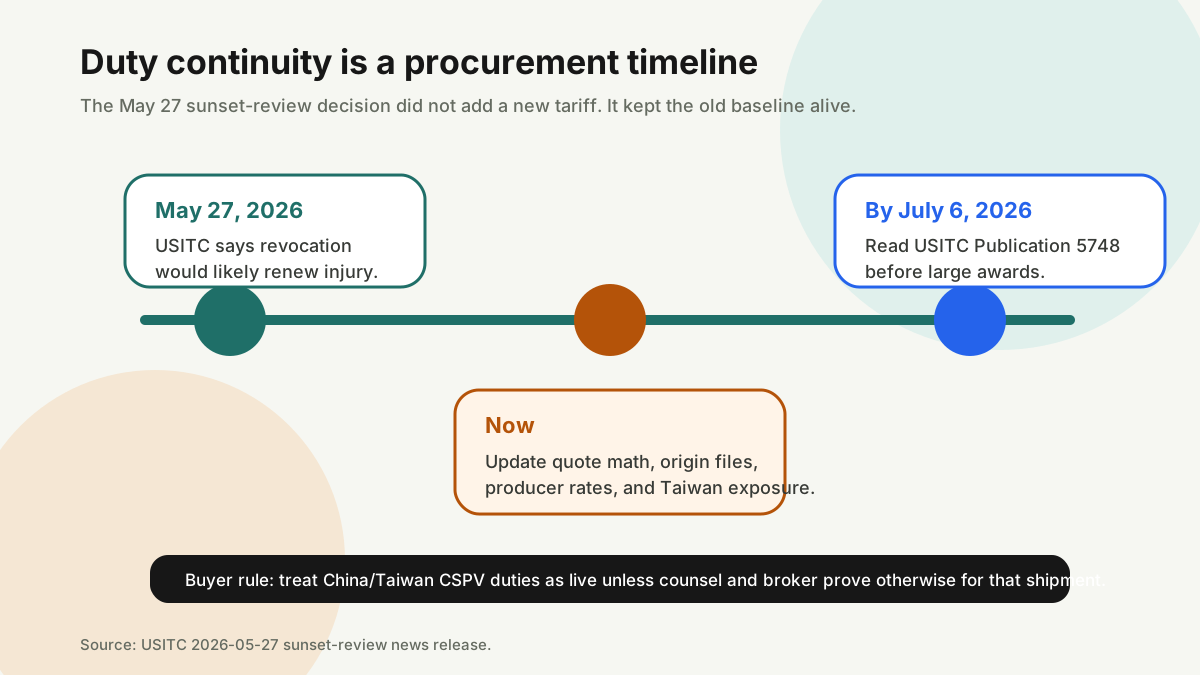
The practical timeline is simple:
| Date | Buyer action |
|---|---|
| May 27, 2026 | Keep China/Taiwan CSPV duty exposure in the landed-cost baseline. |
| Now | Recheck quote assumptions, producer rates, HTS classification, entry date, component origin, Taiwan role, and traceability. |
| By July 6, 2026 | Review USITC Publication 5748 before major project awards or long supply agreements. |
If a project award depends on China/Taiwan CSPV assumptions, assign a named owner to the July 6 review. If nobody owns the date, the project will treat it as trivia.
The Landed-Cost Trap
The most common mistake is comparing module quotes at FOB level.
A Chinese TOPCon module can look extremely attractive before duties. The standing tariff guide on this site uses a screening model that starts around $0.13/W FOB for a standard Chinese TOPCon module. In a direct China-origin U.S. scenario with Section 301, current temporary surcharge assumptions, and China-wide AD/CVD exposure, that screening model can exceed $0.63/W before installation.
That is not a customs ruling. It is a warning about stacked cost.
The May 27 USITC decision reinforces the point: the China/Taiwan AD/CVD layer should not be removed from the buyer's baseline.
| Quote shortcut | Why it is dangerous |
|---|---|
| "FOB China is only $0.13/W" | FOB excludes freight, duty, cash deposits, traceability cost, and financing impact. |
| "This is Taiwan route, so it is fine" | Taiwan AD treatment can still matter, and the exact role of Taiwan must be documented. |
| "Cells are not China-origin" | Cell origin must match producer records, invoices, bill of materials, and traceability evidence. |
| "AD/CVD does not apply" | Scope, producer rate, HTS classification, and broker/legal support must prove it. |
| "The project keeps tax credits" | Customs clearance and tax-credit eligibility are different screens. |
Three Quote Scenarios Buyers Will See
Most buyers will not receive a proposal labeled "high duty risk." They will receive a clean module spec, a warranty, a familiar brand, and a price that looks better than domestic alternatives.
The risk is in the route.
| Quote scenario | Why it looks attractive | What can break the model |
|---|---|---|
| Direct China-origin module | Lowest factory price, strong technology, deep supply, familiar Tier 1 names. | Section 301, AD/CVD, producer-rate exposure, traceability, and project-finance review can overwhelm FOB savings. |
| Taiwan-linked cell or module route | May be presented as non-mainland exposure with better documentation. | Taiwan AD treatment still matters; buyers need to know whether Taiwan means cell origin, module assembly, exporter, or paperwork shorthand. |
| Third-country assembly with Chinese inputs | May look lower-risk than direct China and more available than domestic supply. | Circumvention, cell origin, wafer/polysilicon traceability, FEOC, and lender requirements can still affect landed cost and eligibility. |
The dangerous file is the one that treats route as a label rather than a chain. "Made in Taiwan," "assembled in Southeast Asia," or "not China-origin" is not enough. The file has to show the chain that supports the claim.
What A Defensible Quote File Contains
A serious quote file should separate five sections.
| File section | Required contents |
|---|---|
| Product identity | Module model, wattage, cell technology, HTS classification, bill of materials, producer and exporter names. |
| Origin evidence | Cell origin, module assembly location, wafer and polysilicon traceability, and records matching invoices and packing lists. |
| Duty model | Section 301 assumption, AD/CVD producer-rate support, Taiwan exposure analysis, cash-deposit assumption, and entry-date sensitivity. |
| Project eligibility | FEOC, domestic-content, lender, tax-adviser, customer, and offtaker review notes where relevant. |
| Commercial fallback | Alternative module, schedule impact, price delta, substitution rights, and cancellation clause if the file fails review. |
For a small installer, fallback may mean a distributor-approved alternative module. For a utility-scale buyer, it may mean a second producer-rate file and a schedule clause. For a distributor, it may mean inventory segmentation so unresolved-origin lots do not contaminate lower-risk stock.
The point is not paperwork for its own sake. The point is avoiding a cheap quote that becomes the most expensive risk in the project.
Taiwan Exposure Needs Its Own Line
Taiwan is often treated as a footnote in China solar discussions. It should not be.
The USITC decision covers existing orders on China and an antidumping duty order on Taiwan. A Taiwan-linked claim can mean several things:
- cell production in Taiwan
- module assembly in Taiwan
- Taiwan exporter documentation
- China-origin inputs routed through a Taiwan-linked chain
- a sales shorthand that does not match the production record
The buyer question is not whether Taiwan is "safe." The question is whether the exact product, producer, and shipment have a duty treatment that changes landed cost.
Ask the supplier to state Taiwan's role in one sentence. Then ask for documents that prove it.
If the supplier cannot explain whether Taiwan is cell origin, module assembly location, exporter, or certificate path, the quote is not ready.
How This Interacts With Section 301, FEOC, And Bankability
The sunset review is only one layer.
U.S. solar buyers still need to consider Section 301, AD/CVD, possible temporary surcharge timing, UFLPA traceability, FEOC-style tax-credit eligibility, domestic-content rules, lender acceptance, and offtaker requirements.
These screens are not interchangeable.
| Screen | What it answers |
|---|---|
| Customs/duty | What must be paid or deposited at import? |
| Traceability | Can the buyer prove origin and supply-chain records? |
| Tax credit | Does the equipment package preserve project economics? |
| Lender review | Will financing accept the module, warranty, and supplier file? |
| Customer/offtaker review | Does the project meet contractual equipment-origin rules? |
The USITC decision matters because it keeps one older layer active. It does not solve the rest of the stack.
The Buyer Checklist After May 27
Before accepting a China-linked or Taiwan-linked CSPV quote for a U.S. project, require written answers to these questions:
| Check | Why it matters |
|---|---|
| Exact product scope | A module, cell, integrated product, or component may receive different treatment. |
| HTS classification | Duty modeling starts with classification, not marketing description. |
| Producer rate | AD/CVD exposure can be producer-specific; non-reviewed exposure can destroy quote economics. |
| Cell and module origin | Origin determines orders, route risk, and traceability file requirements. |
| Taiwan role | Taiwan-linked production can still have antidumping implications. |
| Entry date | Temporary measures and review windows can make timing material. |
| Traceability | Polysilicon, wafer, cell, and module records need to survive customs and finance review. |
| Tax-credit file | FEOC and domestic-content assumptions need tax-adviser review, not supplier reassurance. |
| Fallback module | Project schedule needs an alternative if the preferred quote fails review. |
A Simple Cost-Screening Example
Use a simple screening model before sending the quote to counsel or a broker.
Assume a module quote starts at $0.13/W FOB. Add $0.01/W for freight and insurance and the pre-duty baseline becomes $0.14/W. If the product is direct China-origin and exposed to a heavy AD/CVD stack, the landed cost can move several multiples higher before installation. The standing guide US & EU Tariffs on Chinese Solar Panels 2026 uses a screening example that can exceed $0.63/W in a direct China-origin scenario with high duty exposure.
The exact number will vary by producer, entry date, classification, and review status. The point is not that every China-linked quote becomes $0.63/W. The point is that the buyer must know which assumption it is using.
| Model input | Low-risk file | High-risk file |
|---|---|---|
| Producer | Named producer with reviewed or supported rate. | Unknown or non-reviewed producer. |
| Origin | Cell and module origin documented and consistent. | Origin labels do not match bill of materials or invoices. |
| HTS | Broker-reviewed classification. | Marketing description used instead of classification. |
| Duty | Written rate support and entry-date assumption. | Supplier says "no tariff" without evidence. |
| Project eligibility | Tax and lender review complete. | Customs clearance assumed to equal project eligibility. |
What Installers Should Tell Customers
Customers see global module prices and wonder why the U.S. quote is higher.
The honest explanation is simple:
"This price assumes a specific producer, origin path, duty treatment, entry date, and project-eligibility file. If any of those change, the landed cost and financing assumptions can change."
That line is not legal advice. It is expectation management.
It also protects the installer. If a customer later sees a cheaper China-linked quote, the installer can explain what is missing: producer-rate evidence, traceability, tax-credit review, lender acceptance, or fallback planning.
The cheapest bid is not necessarily the lowest-risk bid.
What To Do Before July 6
Buyers do not need to freeze procurement until USITC Publication 5748 appears. They do need to put the date into the workflow.
| Before July 6 | After July 6 |
|---|---|
| Keep quote assumptions conservative. | Recheck report language against pending awards. |
| Ask suppliers for complete origin and producer-rate files. | Update broker and legal notes if the report changes risk language. |
| Avoid contracts that assume duty disappearance. | Confirm whether price-adjustment or substitution clauses are triggered. |
| Keep fallback modules in the file. | Decide whether fallback remains necessary. |
| Tell customers the quote is duty-sensitive. | Replace caveats with reviewed assumptions where possible. |
That question is boring. It can prevent a very expensive surprise.
What Not To Overstate
This is not a ban on Chinese solar.
China remains central to global solar manufacturing, as explained in China Solar Dominance: Supply Chain Power, Profit Crisis. Chinese firms still lead in scale, TOPCon deployment, upstream capacity, and global supply depth. Many non-U.S. markets have very different tariff economics. Even in the U.S., some China-linked firms operate through reviewed, localized, or third-country structures that require case-specific analysis.
The correct conclusion is narrower: for U.S. crystalline silicon PV products connected to China or Taiwan, duty exposure remains live and must be modeled.
That is enough to change procurement.
Buyer Takeaway
The May 27 USITC decision did not add a new tariff. It kept the old cost trap alive.
If you are buying solar modules for a U.S. project, update the quote file now. Ask for product identity, origin evidence, producer-rate support, HTS classification, Taiwan role, entry-date assumptions, traceability, tax-credit review, and fallback options. Then review Publication 5748 when it appears by July 6.
A cheap China-linked module can still be a good buy in the right market and file structure. But in the U.S., a cheap module without a defensible landed-cost file is not cheap yet. It is an unpriced risk.
Claim Confidence File
| Claim | Confidence | Evidence boundary |
|---|---|---|
| Solar import duties, origin rules, and enforcement can materially change landed cost and delivery risk | High | Supported as a buyer-risk principle across CBP, Commerce, ITC, EU, UFLPA, Section 301, and AD/CVD contexts cited by the articles. |
| A tariff or duty number is universal for every shipment under the headline category | Low | The articles repeatedly limit the claim: classification, country of origin, producer/exporter, scope, exemptions, and timing can change the result. |
| Buyers should preserve HTS classification, origin evidence, supplier declarations, traceability files, broker notes, and contract pass-through terms | High | This is the compliance-file recommendation shared by the solar trade-risk articles. |
| The articles provide legal advice for a specific import entry or tender | Low | They are procurement-risk guides and explicitly require broker/counsel confirmation for shipment-specific decisions. |
Methodology
This article is based on the USITC's 2026-05-27 sunset-review news release, the Federal Register continuation notice, and the standing tariff framework in US & EU Tariffs on Chinese Solar Panels 2026. It also uses internal site context from China Solar Dominance: Supply Chain Power, Profit Crisis, China Solar Equipment Curbs: What U.S. Buyers Risk (2026), Chinese Solar Brands: LONGi vs Jinko vs Trina (2026), and importing solar panels from China.
Frequently Asked Questions
Did the USITC create a new solar tariff on May 27, 2026?
No. The decision kept existing China and Taiwan CSPV duty exposure alive through the sunset-review process. Buyers should treat it as a continuity signal, not as a new standalone tariff.
Why does Taiwan still matter in a China solar duty file?
Taiwan can matter because the duty order and antidumping analysis can depend on the exact role of Taiwan in the product chain: cell origin, module assembly, exporter, documentation path, or shorthand in the quote. Buyers need the chain, not just the label.
Should buyers wait for the full public report before awarding projects?
For major awards, yes, or at least assign a named owner to review the report and document the decision. Smaller purchases may proceed with counsel or broker support, but the quote file should not assume the duty issue disappears.
What makes a quote file defensible?
A defensible quote file connects module identity, producer, exporter, HTS classification, cell origin, assembly location, traceability, duty rate, entry date, and project-eligibility assumptions. If those pieces do not match, the landed cost is not stable.