
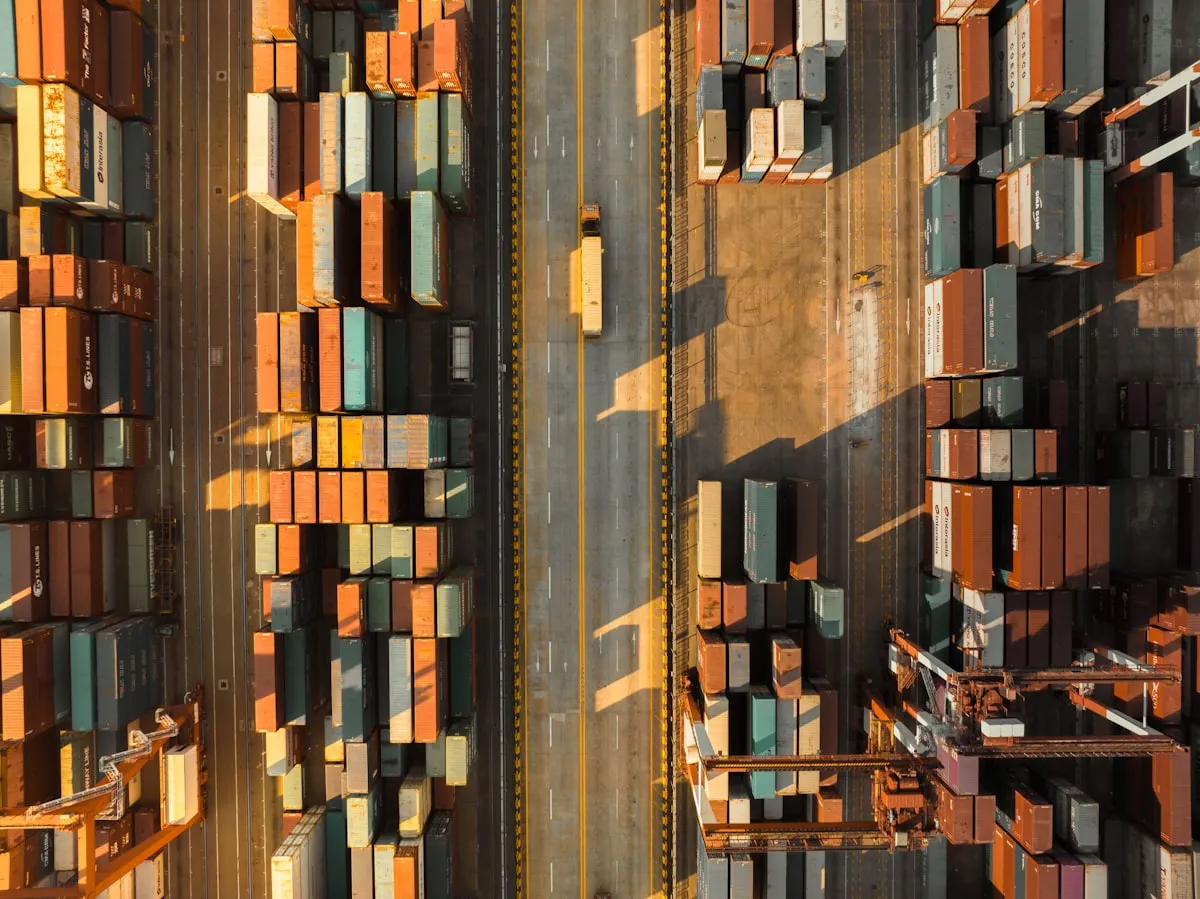
China produces 31.6% of everything manufactured on the planet — roughly double the United States at 15.9%, according to UN data compiled by TheGlobalEconomy.com. It has held the number-one position for 15 consecutive years. In 2024, China's industrial output reached 40.5 trillion yuan, and manufactured product exports hit 25.17 trillion yuan (~$3.53 trillion). The 2025 figures climbed further: manufacturing GDP reached 34.67 trillion yuan (~$4.85 trillion), up 6.1% year-over-year. Manufacturing accounts for 24.87% of China's GDP — a higher share than any other major economy.
Yet most English-language coverage of Chinese manufacturing falls into two camps: sourcing guides telling you how to buy from Alibaba, or geopolitical analysis treating the entire sector as a national security question. Neither explains how the system actually works. This guide does.
Source File
This article was reviewed on 2026-07-07 against official Chinese government reporting on 15 consecutive years as the world's top manufacturing nation, TheGlobalEconomy.com's UN-based manufacturing share data, China Briefing's 2024-25 manufacturing tracker, International Federation of Robotics data on China's 2024 robot installations, World Economic Forum Global Lighthouse Network references, and NBS 2024 employment and demographic data. Country-level manufacturing statistics use value-added methodology and can differ from gross-output, export-only, or unit-volume comparisons.
Quick Overview
This article breaks down the Chinese manufacturing ecosystem into its component parts: the geographic cluster system that concentrates entire supply chains into four mega-regions, the iteration speed that makes "China Speed" a genuine competitive advantage, the OEM-to-brand evolution producing global competitors from Anker to DJI, the smart manufacturing transformation now underway, and the infrastructure backbone that moves 165 million shipping containers a year.
It also addresses the structural weaknesses — a shrinking workforce, persistent intellectual property risks, and the growing tension between state direction and market dynamics.
570 Chinese industrial enterprises now rank among the global top 2,500 R&D investors, representing roughly 25% of the total. This is not a manufacturing base that competes on price alone. It competes on scale, speed, and increasingly on innovation.
 Data: UN Statistics Division via TheGlobalEconomy.com
The Cluster System: Why Factories Concentrate
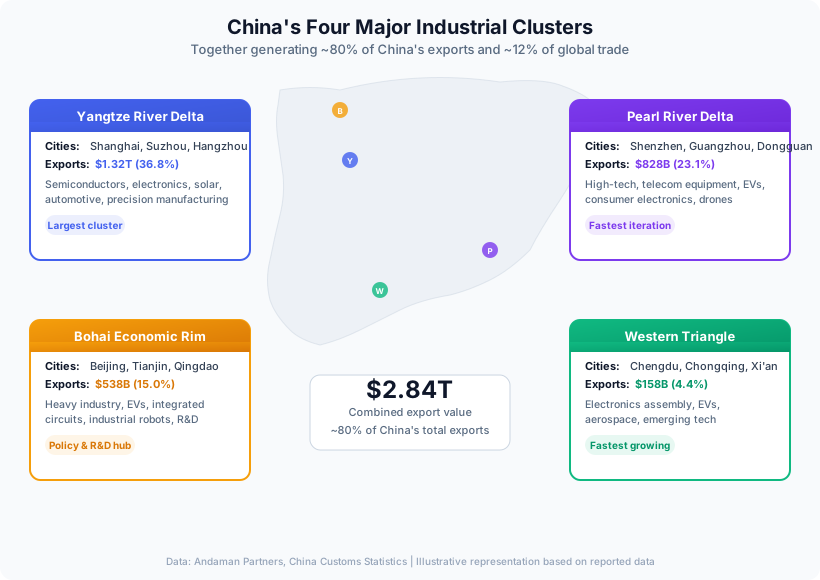
Chinese manufacturing is not evenly distributed across the country. It concentrates in four mega-regions that together generate roughly 80% of China's exports and account for about 12% of global trade. This is not accidental. Industrial clustering is the defining feature of Chinese manufacturing, and understanding it is essential to understanding how the system works.
| Cluster | Key Cities | Export Value | Share | Specializations |
|---|---|---|---|---|
| Yangtze River Delta | Shanghai, Suzhou, Hangzhou | $1.32T | 36.8% | Semiconductors, electronics, solar, automotive |
| Pearl River Delta | Shenzhen, Guangzhou, Dongguan | $828B | 23.1% | High-tech, telecom equipment, EVs, consumer electronics |
| Bohai Economic Rim | Beijing, Tianjin, Qingdao | $538B | 15.0% | EVs, integrated circuits, industrial robots |
| Western Triangle | Chengdu, Chongqing, Xi'an | $158B | 4.4% | Electronics assembly, EVs, aerospace |
For a deeper look at how these clusters formed and what each specializes in, see Yongkang hardware cluster.
The Yangtze River Delta
The YRD dominates in raw scale — its $1.32 trillion in exports exceeds the total merchandise exports of most individual countries. Shanghai's semiconductor fabrication plants, Suzhou's precision manufacturing base, and Hangzhou's e-commerce infrastructure create a corridor where chips, components, and logistics converge. The region produces roughly 36.8% of China's total exports and houses the country's most advanced semiconductor supply chain, from silicon wafer production to chip packaging and testing. Ningbo, Wuxi, and Nanjing round out the cluster with chemical processing, textile manufacturing, and automotive components respectively. The YRD's advantage is breadth: it covers more sectors at higher sophistication levels than any other Chinese cluster.
The Pearl River Delta
The PRD, particularly the Shenzhen manufacturing guide region around Shenzhen, operates at a different speed entirely. Guangdong province alone exported $828 billion in goods in 2024, with Shenzhen accounting for the largest share. The region's specialization is high-tech: telecom equipment, consumer electronics, and increasingly electric vehicles. Dongguan, once known for shoe factories, now hosts sophisticated electronics manufacturing and automated assembly lines.
The Bohai Economic Rim
The Bohai region, anchored by Beijing and Tianjin, contributes $538 billion in exports and specializes in heavy industry, EVs, integrated circuits, and industrial robots. Tianjin's port handles the bulk of northern China's container traffic and provides the logistics backbone for the region's heavy manufacturing. Beijing's strength is in R&D and headquarters — the policy decisions and venture capital that fund the factories tend to originate here. Qingdao, further south along the coast, has emerged as a center for white goods manufacturing, with Haier and Hisense both headquartered in the broader Shandong province that feeds into the Bohai cluster.
The Western Triangle
The newest of the four clusters, centered on Chengdu and Chongqing, represents China's effort to develop interior manufacturing. Its $158 billion in exports is modest compared to the coastal clusters, but it is growing fastest. Electronics assembly for companies like Foxconn and BYD's expanding EV production have driven much of this growth. Improved high-speed rail and Yangtze River logistics made the region viable for manufacturing that previously required coastal proximity.
The One-Hour Supply Chain
Shenzhen's Huaqiangbei district compresses more electronics supply chain into 1.45 square kilometers than most countries manage across their entire industrial base. Over 30 electronics malls stock everything from raw semiconductor wafers to finished circuit boards to custom-machined enclosures. The SEG Electronics Market alone spans multiple floors and thousands of stalls, each specializing in a particular component category.
The operational principle is captured in a phrase repeated across factory floors: "same-day sampling, next-day mass production." A hardware engineer can walk into Huaqiangbei in the morning with a component need, find a supplier before lunch, get a sample produced by afternoon, and begin mass production the next day. No other manufacturing region on earth operates at this density.
This is what industry insiders call "China Speed." At a European automaker, a factory-floor fix might cycle through engineering review, procurement approval, supplier qualification, and quality assurance over several weeks. In China, the same fix happens in days. The difference is not that Chinese engineers work faster individually — it is that the entire supply chain sits within driving distance, and the organizational layers between problem and solution are fewer. A Shenzhen-based hardware company can physically visit its mold maker, PCB fabricator, and assembly line in a single afternoon. That kind of face-to-face problem solving, repeated daily across thousands of factories, compounds into a structural speed advantage that shows up in product development timelines.
The implications extend beyond speed. When a factory in Dongguan needs a custom mold, three tooling shops compete for the job within a 30-minute drive. When a Shenzhen electronics company discovers a component failure in testing, the supplier's engineer can be on the factory floor the same afternoon. This is the competitive advantage that no tariff regime or trade agreement can replicate — it is structural.
For the full picture of how Shenzhen's ecosystem works, from the Huaqiangbei component markets to the Foxconn assembly lines, see Shenzhen Manufacturing: Complete Ecosystem Guide (2026).
The clustering effect also extends to smaller goods. Yiwu, in Zhejiang province, operates the world's largest small commodities market, where buyers can source everything from Christmas ornaments to hardware tools across 75,000 booths. The Temu business model is a different flavor of the same clustering principle — density creates efficiency, and efficiency creates scale.
 Data: Andaman Partners, China Customs Statistics
From OEM to Own Brand: The Evolution Path
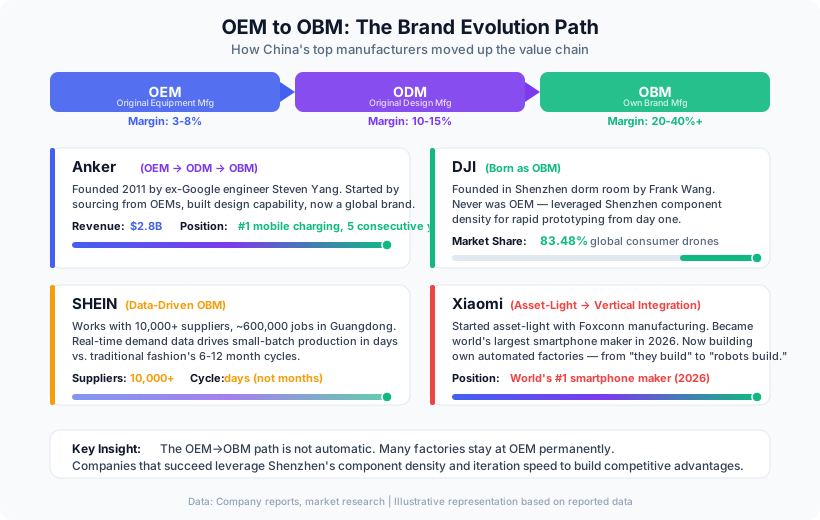
The canonical upgrading trajectory in Chinese manufacturing runs OEM to ODM to OBM:
- OEM (Original Equipment Manufacturing): You make products to someone else's design. The customer owns the brand, the IP, the customer relationship. Margins are thin — typically 3-8% of the final retail price.
- ODM (Original Design Manufacturing): You design and manufacture. The customer still owns the brand, but you have moved up the value chain into engineering and product development. Margins improve to 10-15%.
- OBM (Own Brand Manufacturing): You design, manufacture, and sell under your own brand. You own the customer relationship and capture the full margin. This is where the real value accrues.
This progression is not automatic. Many factories stay at OEM permanently — contract manufacturing is a stable, if low-margin, business. But a growing number have made the leap, and a few skipped OEM entirely. For the detailed mechanics of this transition, see Shenzhen manufacturing guide.
Anker: The Textbook Case
Steven Yang, a former Google engineer, founded Anker in 2011 with a straightforward thesis: Chinese manufacturing could produce charging accessories at higher quality than the cheap generics flooding Amazon, and a brand could be built on that quality advantage. Anker's revenue exceeded RMB 30.5 billion (~$4.2 billion) in 2025, and it has held the number-one position in mobile charging for five consecutive years. The company started by sourcing from Chinese OEMs, moved to ODM as it built internal design capability, and now operates as a full OBM with proprietary charging technology and a global brand recognized by millions of consumers. Anker's path is the textbook OEM-to-OBM trajectory.
DJI: Born as OBM
DJI took a different path — it was never an OEM. Frank Wang began the early flight-control work while studying at the Hong Kong University of Science and Technology, then built DJI's commercial base in Shenzhen. DJI now controls 83.48% of the global consumer drone market, a dominance that no Chinese electronics company has achieved in any other category. This is not a story of manufacturing upgrading; it is a story of innovation born directly inside the Shenzhen ecosystem, leveraging the component density and rapid prototyping that the cluster provides. DJI could prototype, iterate, and scale faster than any competitor precisely because its supply chain was literally down the street.
SHEIN: Real-Time Manufacturing
SHEIN represents a different model entirely — not OEM-to-brand, but data-driven manufacturing at scale. The company works with over 10,000 suppliers and supports roughly 600,000 jobs in Guangdong province alone. Its competitive advantage is speed married to data: rather than forecasting demand months in advance, SHEIN's system captures real-time search and purchase data, feeds it into production planning, and turns small-batch manufacturing into a continuous feedback loop. A factory receives an order based on actual consumer demand, produces a small batch, and the market response determines whether production scales up. Traditional fashion retail operates on 6-12 month planning cycles. SHEIN operates on days. The result is less inventory risk, faster trend response, and margins that defy the fast-fashion norm.
Xiaomi: Asset-Light to Vertical Integration
Xiaomi started as an asset-light company — designing phones manufactured by Foxconn and other contract partners. It sold exclusively online, bypassing the distribution costs that burdened incumbents. By 2026, Xiaomi ranked as the world's third-largest smartphone manufacturer by unit volume, and the largest Chinese smartphone brand globally — briefly surpassing Samsung in selected quarters. Along the way, it built its own automated factories — a transition from "we design, they build" to "we design and build with robots." The progression is a case study in how the most ambitious Chinese companies use the OEM ecosystem as a launchpad to build market share, then vertically integrate when scale justifies the capital investment.
 Data: Company reports and market research
Smart Manufacturing: The Robot Transition
China's manufacturing evolution is not only about brands moving up the value chain. It is also about what happens on the factory floor — and the changes there are accelerating.
In 2024, China installed 295,000 new industrial robots — 54% of all robots installed globally that year. To put that in perspective: China installs more robots annually than the rest of the world combined. Robot density reached 470 units per 10,000 workers, compared to a global average of 162. A decade ago, China's robot density was below the global average. The pace of adoption has been extraordinary.
The country also accounts for the largest single share of the World Economic Forum's Global Lighthouse Network, which recognizes factories at the frontier of Industry 4.0 adoption. Of the approximately 23 new factories added to the Global Lighthouse Network in January 2025, 16 were Chinese. These are not showcase facilities built for publicity — they are operational factories producing at scale, using AI-driven quality inspection, digital twin simulation, and predictive maintenance to reduce defects and downtime.
For the full analysis of how automation is reshaping Chinese factories, see China factory robot deployment.
Made in China 2025: The Scorecard
Launched in 2015, the "Made in China 2025" industrial policy set targets for domestic market share in ten key sectors — from robotics and semiconductors to electric vehicles and aerospace. A decade later, the results are mixed but substantial:
- EVs and batteries: Target exceeded. Chinese automakers dominate the global EV market, with BYD alone producing more EVs than any other manufacturer. CATL and BYD together control over 50% of global EV battery production.
- Industrial robots: Domestic robots reached roughly 48% domestic market share against a 70% target — meaningful progress but still short. Foreign robot makers like Fanuc and ABB remain strong in the high-end segment.
- Semiconductors: Significant investment but the gap to the frontier remains large, particularly in advanced lithography. SMIC's progress on mature nodes has been real but constrained by export controls.
- Overall assessment: Rhodium Group concluded that MIC2025 "drove substantial progress" across most target sectors. A Stanford analysis noted that subsidies played a role but may not have been the primary driver — the existing industrial base and cluster effects were equally important.
The policy's significance lies less in hitting specific numerical targets and more in signaling direction. It concentrated investment, talent, and political attention on upgrading from volume to value. Whether or not every target was met, the trajectory shift was real.
Infrastructure Backbone: Moving 165 Million Containers
Manufacturing capacity means nothing without the logistics to move output to global markets. China's port and rail infrastructure operates at a scale that is difficult to overstate.
Shanghai Port handled over 50 million TEUs (twenty-foot equivalent units) in 2024, maintaining its position as the world's busiest container port for the 14th consecutive year. Ningbo-Zhoushan, also in the Yangtze River Delta, processed 1.37 billion tons of cargo — the world's largest port by tonnage for 16 straight years. Together, China's top five ports moved over 165 million TEUs in 2024. For comparison, the entire United States handles roughly 50 million TEUs across all its ports annually. The top five Chinese ports together process more than three times the container volume of all US ports combined.
The high-speed rail network serves a different function: connecting the interior to the coast. China operates the world's longest HSR network, carrying two-thirds of global high-speed rail traffic and serving 182 cities. For manufacturing, this means the Western Triangle cluster in Chengdu-Chongqing can move people and high-value, time-sensitive components to coastal ports faster than any alternative surface transport.
The relationship between manufacturing and infrastructure is circular: factories need logistics to export, and logistics investment makes new regions viable for manufacturing. The Western Triangle's growth from 4.4% of exports reflects this dynamic — improved rail and river transport made Chengdu and Chongqing competitive with coastal cities for electronics assembly. Foxconn's decision to build major production facilities in Chengdu was not despite the location's distance from the coast; it was enabled by the infrastructure that made that distance manageable.
For anyone evaluating manufacturing costs across regions, the China small-factory supplier risk breaks down China versus Vietnam, India, and Mexico on labor, logistics, lead times, and quality metrics.
The Demographic Challenge
China's manufacturing system faces a structural headwind that no amount of automation policy can fully offset: the working-age population is shrinking.
Total employment stood at 734 million persons in 2024, with the working-age population (ages 16-59) at approximately 962 million. Both figures are declining, and the trend is irreversible in the near term. Manufacturing employment has been falling in absolute terms as automation displaces workers — the 470 robots per 10,000 workers density reflects this transition. China's National Bureau of Statistics has reported declining manufacturing employment for several consecutive years.
The automation push is not merely a competitiveness strategy; it is a demographic necessity. China cannot sustain its manufacturing output with a shrinking workforce unless each worker (or each robot) produces substantially more. This is why the 295,000 robots installed in 2024 matter beyond the headline number — they represent the leading edge of a forced transition from labor-intensive to capital-intensive manufacturing.
The origins of the current system trace back to Shenzhen's designation as a Special Economic Zone in 1980, when the city was a fishing village of roughly 300,000 people. Its population grew 30-fold by 2005, and the city sustained annual GDP growth of 27% during its first two decades. That experiment — low-cost labor plus open investment plus infrastructure buildout — created the template for China's manufacturing rise. Other SEZs followed, but none matched Shenzhen's combination of proximity to Hong Kong's capital markets, Guangdong's entrepreneurial culture, and the Pearl River Delta's existing light manufacturing base.
The next chapter is writing itself differently: fewer workers, more robots, higher value-added output. The SEZ model succeeded because it matched abundant labor supply with capital and infrastructure. The current challenge is to match a shrinking labor supply with enough automation and innovation to maintain the trajectory. Whether China can sustain 31%+ global manufacturing share while its workforce contracts is the central question for the next decade.
What This Means for Everyone
The Chinese manufacturing ecosystem is not just a story about China. It is the operating system for global supply chains — and understanding how it works has implications for anyone who makes, buys, or competes with physical products.
When a European automaker sources battery cells, they are plugging into a system that includes CATL's materials processing, the Yangtze River Delta's logistics network, and a workforce trained in battery chemistry at Chinese universities. When an American brand sources phone chargers from Anker, they are buying from a company that evolved through the OEM-to-OBM path using supply chain density that exists nowhere else. When a Vietnamese factory assembles sneakers, the machinery, the synthetic fabrics, and the shipping containers likely passed through Chinese industrial infrastructure.
The practical implications break down by audience:
For companies sourcing from China, understanding the cluster system reduces lead times and costs. The right supplier is found in the right cluster — electronics in Shenzhen, textiles in Zhejiang, hardware in Yiwu. Attempting to source electronics from a factory in Chengdu when an equivalent factory exists in Dongguan adds days to every iteration. The Shenzhen manufacturing guide guide covers this process in detail, including how to identify the right cluster and evaluate suppliers within it.
For companies competing with Chinese manufacturers, the competition is not a single factory or brand — it is the ecosystem. The iteration speed, the component density, the talent pipeline, the logistics scale. Competing requires either matching that ecosystem density (which no country has done at equivalent scale) or finding niches where speed and density matter less — custom engineering, short-run specialty products, or segments where brand loyalty overrides supply chain advantage.
For policymakers, the lesson is that China's manufacturing dominance is not primarily about cheap labor or government subsidies. Cheap labor was the entry point three decades ago. Today, the advantage is industrial clustering at a scale that creates self-reinforcing competitive advantages — the more factories cluster, the more suppliers concentrate, the faster iteration becomes, the more attractive the cluster is to additional factories. Tariffs can redirect trade flows at the margins, but they do not replicate the ecosystem.
Quality control remains a concern, particularly for buyers unfamiliar with Chinese manufacturing culture and expectations. The Shenzhen manufacturing guide guide covers the inspection systems, testing protocols, and common failure modes. For companies worried about intellectual property exposure, the Shenzhen manufacturing guide guide details the legal frameworks, contractual protections, and practical steps available.
Methodology Note
This analysis was reviewed on 2026-07-07 and draws on official Chinese government statistics from the National Bureau of Statistics and state media portals, United Nations manufacturing share data compiled by TheGlobalEconomy.com, industry reports from the International Federation of Robotics, World Economic Forum Global Lighthouse Network data, and export cluster analysis from Andaman Partners and China Briefing. Where Chinese government figures are cited, they are cross-referenced against independent sources where available. Manufacturing output comparisons use value-added methodology. Robot density figures use the IFR standard of units per 10,000 manufacturing workers. Demographic data comes from the NBS Statistical Communiqué on the 2024 National Economic and Social Development.
Claim Confidence File
| Claim | Confidence | Evidence boundary |
|---|---|---|
| China is the world's largest manufacturing country by value added | High | Supported by UN-based manufacturing share data and official Chinese reporting; not the same as every product category or unit-volume measure |
| The 31.6% / 15.9% China-U.S. comparison is a value-added comparison | High | Uses value-added methodology; readers should not treat it as export share or physical output tonnage |
| China's cluster system creates speed and iteration advantages | Medium-high | Strongly supported by sourcing and logistics evidence, but cluster export-share numbers vary by source and year |
| Shenzhen can routinely turn every hardware idea into next-day mass production | Medium-low | Huaqiangbei density supports rapid prototyping, but mass production depends on tooling, QA, certification, and supplier readiness |
| China installed more industrial robots than any other country in 2024 | High | Supported by IFR data; robot density and installation figures should be refreshed annually |
| Chinese manufacturing dominance is only cheap labor or only subsidies | Low | Labor and policy matter, but the article's evidence points to clusters, logistics, supplier density, automation, and brand evolution as additional drivers |
Frequently Asked Questions
What percentage of global manufacturing does China produce?
China accounts for 31.6% of global manufacturing output as of 2024, roughly double the United States at 15.9%. China has been the world's top manufacturing nation for 15 consecutive years. Manufacturing contributes 24.87% of China's GDP, a higher share than any other major economy.
Why are Chinese factories clustered in specific regions?
China's four major industrial clusters — the Yangtze River Delta, Pearl River Delta, Bohai Economic Rim, and Western Triangle — concentrate supply chains, talent, and infrastructure to reduce costs and accelerate iteration. Together they generate 80% of China's exports and roughly 12% of global trade. Proximity compresses the feedback loop between design and production from weeks to days, creating a compounding speed advantage.
How fast can Chinese factories go from prototype to mass production?
In Shenzhen's Huaqiangbei district, the cycle from same-day sampling to next-day mass production is routine. Over 30 electronics malls stock components within 1.45 square kilometers, enabling iteration speeds that would take weeks in other manufacturing regions. This is the operational reality behind "China Speed."
What is the OEM to OBM evolution in China?
OEM to ODM to OBM is the canonical upgrading trajectory in Chinese manufacturing. Companies like Anker followed this path from contract manufacturing to global brand ownership. Others like DJI skipped OEM entirely, starting as innovation-driven companies from the beginning. The trajectory is not automatic — many factories remain at OEM permanently.
Is Chinese manufacturing moving toward automation?
Yes, and at a pace that outstrips every other country. China installed 295,000 new industrial robots in 2024, representing 54% of global installations. Robot density reached 470 per 10,000 workers, nearly 3x the global average of 162. China also accounts for 70% of new WEF Lighthouse Factory designations, the global benchmark for Industry 4.0 adoption.
What challenges does China's manufacturing sector face?
China's working-age population is declining — total employment was 734 million in 2024 with the 16-59 age group at roughly 962 million, both trending downward. Trade tensions and tariffs are pushing some production to Southeast Asia and Mexico. Intellectual property concerns persist despite improvements. The shift to higher-value manufacturing is both a strategic choice and a demographic necessity driven by the shrinking labor force.
Related Entries
- Shenzhen Manufacturing: Complete Ecosystem Guide (2026) — Shenzhen ecosystem deep dive
- Yongkang hardware cluster — Cluster formation and specialization detail
- China small-factory supplier risk — China vs Vietnam vs India vs Mexico cost analysis
- China factory robot deployment — Industry 4.0 and digital factory detail
- Temu business model — Yiwu small commodities market model