
The most important Chinese humanoid robot story in 2026 is not the backflip, the stage performance, or the martial-arts demo. It is the assembly-line task cycle.
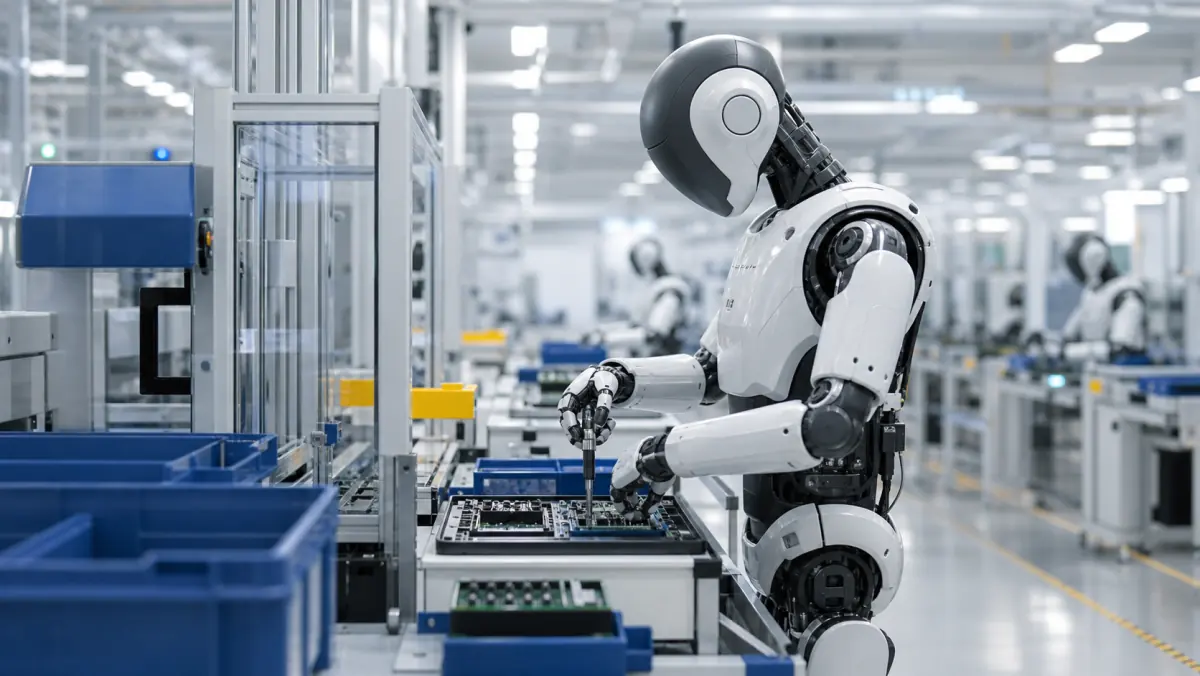
In April, CGTN reported that humanoid robots were operating on a smart-device assembly line in Nanchang, Jiangxi province. AGIBOT and Longcheer's stable deployment release described the same line in factory language: up to 310 units per hour, a 19-20 second cycle time, 99%+ task success, line integration in 36 hours, and roughly 3,000 units per shift. The robots were from AgiBot, a Shanghai-based embodied-AI robotics company.
Those claims need to be treated carefully because they are public deployment claims, not independently audited long-run factory data. But the numbers are useful because they shift the conversation from "Can a humanoid robot move?" to "Can it repeat a factory task with acceptable yield?"
That is the only question that matters for manufacturing.
Source File
This article was reviewed on 2026-07-06 against CGTN's Nanchang factory-deployment report, AGIBOT and Longcheer's PRNewswire deployment release, AGIBOT's official June 2026 update on its 15,000th robot production milestone, and TrendForce's April 2026 note on China humanoid robot output and shipment share. Factory metrics in this article are treated as reported operating claims for constrained electronics-manufacturing tasks, not as proof of general-purpose humanoid readiness. Internal links connect the story to How China Manufactures: Inside the World's Factory (2026) and Shenzhen Manufacturing: Complete Ecosystem Guide (2026).
Quick Read
| Signal | What it says | What it does not prove |
|---|---|---|
| AgiBot factory deployment | Humanoid robots can run constrained assembly-line tasks | Broad general-purpose factory replacement |
| 19-20 second / 310 UPH operating claim | Task timing is now being measured like manufacturing equipment | Full-shift reliability or maintenance cost |
| 99%+ success claim | Early yield numbers are entering the conversation | Long-run defect rate across months |
| TrendForce 94% output growth forecast | Chinese supply is scaling fast | Buyer ROI is already proven |
| Unitree + AgiBot shipment share | Two leaders are emerging | The market has consolidated permanently |
Why Factory Deployment Matters More Than The Demo
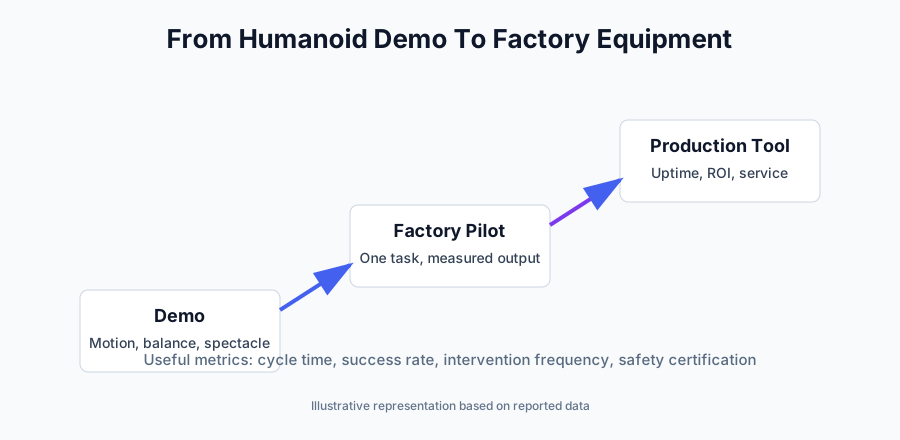
Humanoid robots have spent years in the wrong media format. A viral video rewards motion. A factory rewards repeatability.
The difference is brutal. A robot that walks across a stage once can tolerate hidden operators, pre-programmed paths, soft floors, and a forgiving audience. A robot on an assembly line has to repeat the same physical task thousands of times, next to humans, under takt-time pressure, without damaging parts or stopping the line.
That is why the Nanchang report matters. The task itself appears constrained, but constrained tasks are how automation enters factories. Industrial robots did not begin by replacing the entire worker. They began by welding, painting, picking, placing, palletizing, and inspecting. The humanoid path will be the same if it works at all.
For a deeper explanation of why China's manufacturing system is unusually good at compressing hardware learning cycles, see How China Manufactures: Inside the World's Factory (2026). The same cluster logic that helped Chinese factories iterate electronics, drones, and EVs now helps robotics companies test physical products against real production problems.
The Commercialization Signal From TrendForce
TrendForce's April report expects China's humanoid robot output to grow up to 94% in 2026. More important, it projects Unitree Robotics and AgiBot together could account for nearly 80% of total shipments.
That does not make humanoids a mature market. It does show that the supply side is moving from scattered prototypes toward identifiable leaders.
TrendForce also reported two details that are easy to miss.
First, Unitree's prospectus showed humanoid robot revenue surpassing quadruped robot revenue in 2025, accounting for more than 51% of total revenue. That is a monetization signal, not just an engineering signal.
Second, AgiBot reportedly reached its 10,000th general-purpose embodied robot by late March, with production scale moving from 1,000 units in 2025 to 5,000 units and then 10,000 units within three months. Whether those units are all comparable in complexity is a separate question, but the production-ramp direction is clear.
AGIBOT later said its 15,000th robot rolled off the line in June 2026 and pointed to roughly 100 cumulative hours of factory livestream operations by its G2 robot. That is a stronger production signal than a stage demo, but it is still company-reported evidence. It does not replace customer-by-customer uptime, defect, safety, and service records.
The market is no longer just "Tesla Optimus versus everyone else." China has multiple companies trying to industrialize embodied robotics through the same mechanism that made its other hardware sectors dangerous: fast iteration, supplier density, and aggressive price-performance competition.
What A Factory Buyer Should Actually Ask
A factory manager should not start with "Can it walk?" That is a marketing question.
The buyer checklist should look like this:
| Buyer question | Why it matters |
|---|---|
| What exact task is the robot doing? | "Assembly-line use" is meaningless without task scope |
| What is the cycle time? | It must fit the line's takt time |
| What is the verified success rate? | A 1% error rate can be unacceptable in precision assembly |
| How many hours between interventions? | A robot that needs frequent resets is not labor-saving |
| What happens when part position varies? | Factory reality is messier than demo fixtures |
| Who maintains it? | Service capacity determines uptime |
| What is the payback period? | Labor substitution is only one part of ROI |
But the same environment also creates hype risk. A factory pilot can be real and still not generalize. A robot can succeed on one stable, repetitive task and fail on variable work that a human handles easily.
The Acceptance Test Should Look Like Factory QA
A buyer should not accept a humanoid pilot because the demo looks smooth. The acceptance test should look like normal factory quality assurance.
| Acceptance item | What to measure |
|---|---|
| Cycle time | Median and worst-case task time across a full shift, not one best run |
| Intervention rate | How often a human must reset, reposition, rescue, or re-teach the robot |
| Defect impact | Whether the robot scratches, drops, misplaces, or mis-sorts parts |
| Downtime cause | Separate robot hardware faults, perception faults, fixture issues, and line-system issues |
| Changeover effort | Time and engineering work needed to move to a new SKU, fixture, or station |
| Operator workload | Whether the robot reduces labor or simply moves labor into supervision |
The Use Cases That Make Sense First
The first valuable humanoid factory jobs will not be the most glamorous. They will be repetitive, human-shaped, and awkward for conventional automation.
The near-term shortlist:
- Material transfer between workstations where floor layouts change frequently.
- Simple pick-and-place tasks using tools or fixtures designed for human hands.
- Inspection tasks that require moving through human-scale aisles.
- Packaging and sorting where product variety is high but physical loads are low.
- Training and demonstration roles in "lights-on" smart factories.
The weak use cases are just as important:
- Heavy lifting where a forklift or AMR is cheaper.
- Ultra-fast assembly where a fixed industrial robot is already optimized.
- Dirty or hazardous environments where humanoid hardware is too fragile.
- Highly variable manual work requiring judgment, dexterity, and context.
The point is not that humanoids beat traditional automation. Most of the time, they do not. The point is that they may fill the awkward gap between fixed automation and human labor in factories that change products often.
The Cost Model Must Include Supervision
The naive ROI model compares robot price with worker wages. That is the wrong comparison.
A real cost model includes:
- robot body and replacement parts
- gripper or tool customization
- fixtures and line-layout changes
- safety fencing, sensors, or marked operating zones
- integration with MES, conveyors, test equipment, or quality systems
- operator training and supervision labor
- service contract, software subscription, and update governance
- downtime cost during failures or changeovers
This is why early factory humanoid use will favor constrained, high-frequency tasks where the integration cost can be amortized across enough repetitions. If the robot is only used for a few irregular tasks per shift, the economics may lose to a simple fixture, AMR, cobot arm, or human operator.
The buyer should therefore ask the vendor for a cost-per-successful-task model, not only a hardware price. That model should include intervention labor and downtime, because those are where many pilots quietly fail.
The China Advantage Is Supply Chain, Not Magic AI
The public narrative often frames humanoid robots as an AI story. That is only half right.
LLMs and vision-language-action models matter, but the bottlenecks are physical: actuators, reducers, batteries, sensors, dexterous hands, heat, repairability, and cost. These are manufacturing problems. China is strong precisely because it can attack those problems through its existing hardware ecosystem.
Unitree's growth in both quadrupeds and humanoids suggests component reuse and manufacturing learning across product lines. AgiBot's push into factory deployment suggests a different model: train the robot inside the environment where it will be sold.
That is why this topic belongs in manufacturing, not just AI. The industrial question is whether Chinese companies can build humanoids cheaply enough and reliably enough for factory managers to treat them as equipment rather than experiments.
What Could Go Wrong
There are four obvious failure modes.
First, the robots may remain too expensive relative to human labor and conventional automation. A robot that looks advanced can still lose to a $25,000 cobot arm or a custom fixture.
Second, uptime may disappoint. Factories buy availability, not demos. A 98.5% task success claim does not answer mean time between failures.
Third, safety certification may slow deployment. A humanoid robot operating near people has a different risk profile than a caged industrial arm.
Fourth, buyers may discover that "general purpose" is a slogan. The profitable use cases may be narrow, and narrow use cases invite specialized machines.
What A Good Vendor Answer Sounds Like
Strong vendors will not promise that one robot can do everything. They will name the first task family, the required fixtures, the expected intervention rate, the service plan, and the next two adjacent tasks that can reuse the same setup.
Weak vendors will speak in broad claims: general-purpose labor, flexible automation, or human replacement. Those claims may be directionally true over years, but they do not help a plant manager decide whether to buy in 2026.
The better vendor answer is modest and specific: "This robot can handle this station, under these conditions, with this cycle time, this support model, and this payback assumption." That is the kind of language that moves humanoids from hype to factory equipment.
What To Watch Next
Watch for deployment metrics that sound boring:
- Full-shift operation hours
- Maintenance interval
- Number of customer sites
- Repeat orders from the same factory
- Warranty terms
- Robot-as-a-service pricing
- Safety certifications
- Payload and cycle-time benchmarks in real plants
Those details will tell us more than the next viral demo.
Claim Confidence File
| Claim | Confidence | Evidence boundary |
|---|---|---|
| AGIBOT and Longcheer reported humanoid robots on a Nanchang electronics line | High | Supported by CGTN and AGIBOT/Longcheer release; metrics remain public deployment claims. |
| The reported 19-20 second cycle time, 99%+ success, and 36-hour integration prove long-run ROI | Low | The article does not make this claim; full-shift uptime, defect impact, maintenance, and payback still need buyer verification. |
| TrendForce expects China's humanoid robot output to grow up to 94% in 2026 | High | Supported by TrendForce; it is a forecast, not audited year-end output. |
| Unitree and AgiBot are permanent market leaders | Low | Current shipment forecasts show leadership signals, not permanent consolidation. |
| AGIBOT's 15,000th robot milestone proves real deployment scale | Medium | Company-reported production milestone; stronger than a demo but not the same as third-party audited installed-base performance. |
| Humanoids are ready to replace broad factory labor | Low | The article explicitly limits readiness to constrained, measurable tasks. |
Methodology
This analysis uses TrendForce's April 2026 commercialization forecast, CGTN's Nanchang factory-deployment report, AGIBOT and Longcheer's PRNewswire deployment release, AGIBOT's June 2026 production-milestone update, and the site's existing framework for China's manufacturing ecosystem. The factory and production numbers are treated as reported operating or company claims, not independently verified long-run performance data.
FAQ
Are Chinese humanoid robots already replacing factory workers?
Not broadly. They are entering constrained pilot and early commercial tasks. Replacement at scale depends on uptime, safety, cost, maintenance, and repeatability.
Which Chinese companies matter most in humanoid robots?
Unitree and AgiBot are the clearest current leaders by commercialization signal, according to TrendForce. UBTech, Fourier, and other firms remain relevant, but Unitree and AgiBot have the strongest 2026 shipment narrative.
Why are factories important for humanoid robots?
Factories provide structured environments, repeatable tasks, and measurable ROI. That makes them a more realistic early market than homes.
What should buyers verify before running a pilot?
Verify exact task scope, cycle time, intervention frequency, safety certification, maintenance support, warranty terms, and total cost of ownership.