
In September 2022, an app called Temu launched in the United States. In February 2023, its Super Bowl campaign pushed the slogan "Shop like a billionaire" into mainstream awareness. Three years later, Temu is reported to operate across dozens of markets, with third-party estimates placing it among the world's largest shopping apps by monthly active users. Estimates of Temu's gross merchandise value vary widely, which matters because PDD Holdings does not break out Temu as a standalone segment. The hard company number is parent-level: PDD Holdings reported full-year 2025 revenue of RMB 431.8 billion.
But 2025 was also the year the ground shifted beneath Temu's feet. In May, the United States ended de minimis duty-free treatment for China- and Hong Kong-origin goods, forcing platforms such as Temu and SHEIN to face formal entry, postal-fee, tariff, and fulfillment changes. The exact tariff burden moved through 2025 and 2026 as executive orders, customs implementation, and trade negotiations changed the numbers. The stable buyer lesson is simpler: the regulatory arbitrage that made direct low-value China parcels unusually cheap was no longer reliable. Temu reportedly shifted away from some direct China-to-US shipping, raised prices, reduced US ad intensity, and leaned harder into local or semi-managed fulfillment.
The question is no longer just whether Temu's prices are sustainable. It's whether Temu can survive without the regulatory arbitrage that made those prices possible — and what its transformation tells us about the future of global e-commerce.
This article disassembles Temu's business model piece by piece: the factory-direct supply chain, the logistics architecture, the gamification engine, and the financials that determine whether "shop like a billionaire" is a permanent disruption or a temporary arbitrage.
Source File
This article treats Temu as a cross-border marketplace and regulatory-arbitrage case, not as a shopping review. Parent-company financials are checked against PDD Holdings' SEC company filings, including the 2025 Form 20-F filing and PDD's full-year 2025 results release. The U.S. de minimis shift is checked against the Federal Register notice stating that China and Hong Kong products are not eligible for the Section 321 exemption and the later Federal Register rule on indefinite suspension of de minimis treatment for non-postal modes. User, GMV, and advertising figures are treated as third-party estimates rather than PDD disclosures. The gamification discussion uses behavioral coverage from the BBC and the app-mechanics study summarized by Shaped.ai. Internal context links Temu's price model to China's manufacturing system, Shenzhen-style supply-chain compression, and small-factory supplier pressure.
Correction Note (June 30, 2026)
An earlier version compressed the launch sequence by saying Temu launched with a Super Bowl ad. The product launched in the U.S. in September 2022; the Super Bowl campaign followed in February 2023.
Quick Answer
| Question | Short answer |
|---|---|
| What is Temu's business model? | Temu is a cross-border marketplace that connects consumers to China-based manufacturers and merchants while controlling pricing, traffic, logistics rules, and customer experience. |
| Why were prices so low? | Factory-direct sourcing, PDD's merchant network, intense supplier price competition, gamified demand, and the former U.S. de minimis treatment all reduced apparent consumer prices. |
| What changed in 2025? | The U.S. ended de minimis treatment for China-origin goods, forcing Temu to absorb or pass through higher compliance, tariff, postal, and fulfillment costs while accelerating local or semi-managed fulfillment. |
| Is Temu like Amazon? | Not exactly. Amazon is a hybrid retailer and marketplace; Temu is closer to an asset-light marketplace with much stronger platform control over pricing and seller behavior. |
| What should readers watch next? | U.S. user retention, seller fees, advertising revenue, local-warehouse costs, product-safety enforcement, and whether higher prices weaken Temu's core promise. Treat MAU, GMV, and ad-spend figures as estimates unless PDD discloses them. |
The Core: Consumer-to-Manufacturer (C2M)
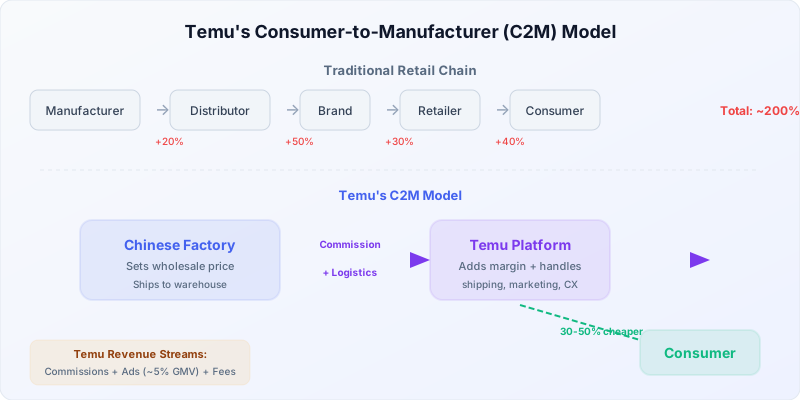
Temu's fundamental innovation isn't a new product category or a clever app feature. It's the elimination of every intermediary between a Chinese factory floor and a consumer's doorstep.
In a traditional retail chain — even Amazon's — products pass through multiple hands. A manufacturer sells to a distributor, who sells to a brand, who sells to a retailer, who sells to a consumer. Each layer adds markup. Even "direct-to-consumer" brands typically work with trading companies that source from factories.
Temu tries to collapse this chain into fewer points: manufacturer or merchant, platform, logistics path, and consumer. That is shorter than a traditional retail chain, but not literally frictionless.
Here is the simplified version. A manufacturer or merchant in a place such as Yiwu, Zhejiang province, one of China's largest small-goods manufacturing hubs, lists a product into Temu's managed marketplace system. The supplier quotes into the platform's pricing logic. Temu controls traffic, consumer-facing price presentation, customer experience, and logistics rules, while monetization can include commissions, advertising, logistics charges, penalties, and other marketplace services.
The manufacturer never deals with marketing, customer service, or international shipping. Temu handles all of it. In return, the manufacturer accepts Temu's pricing discipline — the platform pushes aggressively for the lowest possible prices, and competition among suppliers drives prices down further. The arrangement works because Chinese manufacturers, particularly those in industrial clusters across Guangdong and Zhejiang, have spent decades optimizing for volume over margin. A factory producing 100,000 units of a kitchen gadget at $0.30 each would rather sell through Temu at $0.35 than sit on inventory — and Temu's algorithmic demand prediction helps ensure that production aligns with actual consumer interest.
This is the same consumer-to-manufacturer (C2M) model that PDD Holdings pioneered with Pinduoduo in China. Pinduoduo proved the concept domestically: by aggregating consumer demand and connecting it directly to manufacturers, the platform could offer prices 30-50% below traditional e-commerce. Temu simply exports this model to global markets.
The key difference from Amazon: Amazon is a hybrid first-party retailer and third-party marketplace. Temu is much closer to a managed marketplace. The platform generally avoids the classic retailer inventory bet, but it still shapes seller behavior, logistics rules, return handling, advertising, and price visibility. The risk does not disappear; much of it shifts to suppliers, logistics partners, and the platform's subsidy budget.
| Metric | Temu | Amazon | SHEIN |
|---|---|---|---|
| Business Model | Marketplace (3P) | Hybrid 1P + 3P | First-party (1P) |
| Inventory Risk | Mostly seller / merchant side | High in 1P, lower in 3P | High |
| Category Focus | General merchandise | General merchandise | Fashion/apparel |
| Supplier Relationship | Factory-direct | Mix of brands, distributors, sellers | Direct factory partnerships |
| Pricing Control | Platform-dominated | Seller-determined | Platform-determined |
The Logistics Engine: Fully Managed vs. Semi-Managed
Getting a $2 phone case from Shenzhen to a consumer in Chicago within two weeks requires a logistics operation that most observers underestimate. Temu operates two distinct fulfillment models, each designed for different stages of market development.
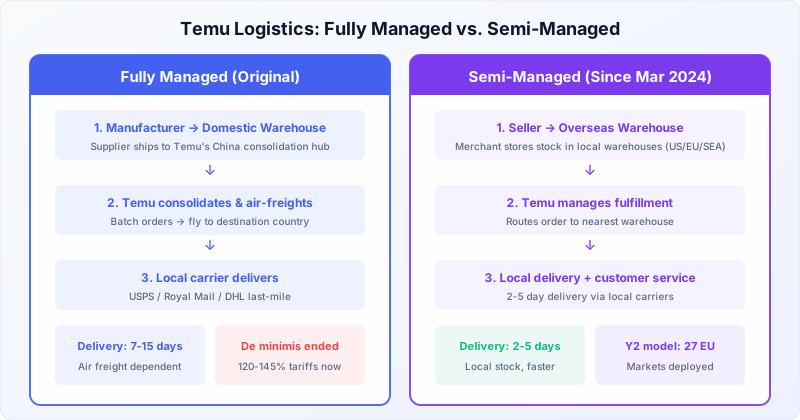
Fully Managed Model (The Original)
When Temu launched, it used a single logistics model that gave it maximum control:
- Manufacturer ships to Temu's domestic warehouse — Suppliers send products to consolidation warehouses in China (primarily in Guangdong and Zhejiang provinces).
- Temu consolidates and ships internationally — Orders from multiple consumers are batched together, flown to destination countries via air freight, and handled by local delivery partners.
- Last-mile delivery — Temu contracts with local carriers (USPS in the US, Royal Mail in the UK, DHL in Germany) for final delivery.
In this model, the manufacturer only needs to get products to a Chinese warehouse. Everything beyond that — international shipping, customs clearance, local delivery, customer service — is Temu's responsibility. The manufacturer has no control over pricing, shipping speed, or customer experience.
This model works well for ultra-low-value items where air freight costs can be absorbed. But it has limitations: shipping takes 7-15 days, and the cost structure breaks down for heavier or higher-value products.
Semi-Managed Model (Launched March 2024)
In March 2024, Temu introduced a second model designed for more mature markets and larger sellers:
- Seller manages inventory in overseas warehouses — Merchants store products in warehouses located in or near the destination market (US, Europe, Southeast Asia).
- Temu handles fulfillment and customer service — Once a consumer places an order, Temu's platform routes it to the nearest warehouse, manages delivery, and handles returns.
- Faster delivery — With inventory already positioned locally, shipping times drop to 2-5 days.
The semi-managed model is critical for Temu's evolution. It enables faster delivery, reduces per-unit shipping costs for heavier items, and positions inventory closer to consumers — a necessity as the de minimis loophole narrows (more on that below). By early 2025, Temu had deployed its "Y2" semi-managed fulfillment model across 27 European Union markets and launched its first semi-managed site in the Philippines.
Partnerships with third-party logistics providers like Armlogi (US warehousing) and ShipBob (fulfillment services) indicate that Temu is building out local infrastructure rather than relying entirely on cross-border shipping.
The Price Machine: How Temu Keeps Prices So Low
Temu's prices aren't just low — they're disorientingly low. A set of kitchen utensils that costs $25 on Amazon might cost $3 on Temu. A Bluetooth speaker that retails for $40 elsewhere is $6 on Temu.
Three structural factors drive this pricing:
1. Factory-direct sourcing with no middlemen. By connecting consumers directly to manufacturers, Temu eliminates distributor margins, brand markups, and retail overhead. The manufacturer gets volume; the consumer gets a lower price; Temu gets a commission.
2. PDD's existing supplier network. Temu didn't build a supplier base from scratch. It leveraged Pinduoduo's network of over 10 million merchants — many of whom are manufacturers already accustomed to operating on razor-thin margins. These suppliers understand the C2M model and have optimized their operations for high-volume, low-margin sales.
3. Aggressive pricing discipline. Temu actively pushes suppliers to lower prices. Multiple suppliers have reported that the platform uses algorithmic pricing that compares products across sellers and favors the cheapest option. This creates intense competition among manufacturers, driving prices to the floor.
But there's a fourth factor that makes the economics possible in the first place — and it's the one that's most at risk.
The De Minimis Loophole — and Its Closure
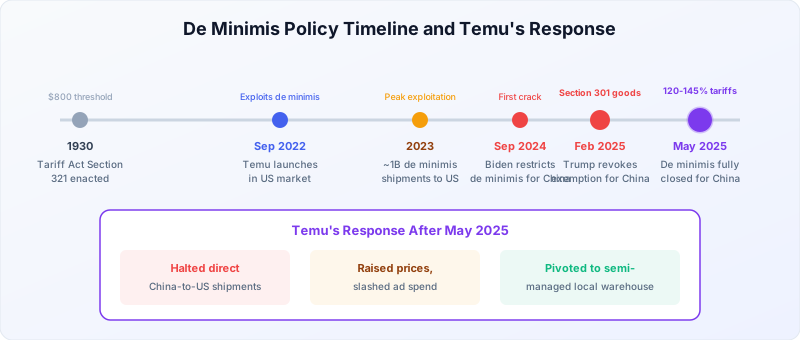
Under Section 321 of the US Tariff Act of 1930, goods valued at under $800 could enter the United States duty-free with minimal customs scrutiny. This "de minimis" exemption was originally designed to simplify trade in low-value items — samples, personal purchases, and the like.
Temu and SHEIN turned this exemption into a structural advantage. By shipping individual orders directly to consumers, each one typically well under $800, they could avoid duty treatment that would otherwise apply to many Chinese-origin imports, including Section 301-related costs and other customs burdens.
The scale was staggering. By 2023, approximately 1 billion de minimis shipments entered the United States annually — more than double the volume from just four years earlier. Temu and SHEIN together accounted for a significant share of this surge.
Then, in May 2025, the loophole closed for China-origin goods. The US government ended duty-free de minimis treatment for products of China and Hong Kong. Parcel-specific duties, postal fees, and China tariff levels changed through the following months, but the strategic impact was immediate: direct low-value China-to-US fulfillment became more expensive and less predictable.
This is why the semi-managed model matters so much. With inventory positioned in local or regional warehouses, products can move through more standard import and fulfillment channels. That does not eliminate tariffs or compliance cost, but it can reduce delivery time, improve returns handling, and make the cost structure more controllable than one-off parcel shipping from China.
For European markets, a similar reckoning may be coming. Several EU member states are pushing for lower de minimis thresholds, and the European Commission has signaled intent to tighten rules on low-value imports.
The Growth Engine: Gamification, Referrals, and $3.4 Billion in Ads
Temu's user acquisition strategy was as aggressive as its pricing. The platform combined massive paid advertising with viral mechanics that turned every user into a distribution channel.
Paid Acquisition
At its peak, third-party ad trackers estimated that Temu spent billions of dollars on online advertising, with Meta and TikTok among the major channels. Super Bowl ads in 2023 and 2024 put the brand in front of a mass US audience. The marketing message was consistent and effective: "prices so low you'll feel rich."
The bet paid off, then began to face retention pressure. Third-party Similarweb-based estimates cited by Backlinko put Temu's US monthly active users at 133.6 million in October 2025, down 28% year over year. Treat that as a traffic-estimate signal, not a company-disclosed user metric. The decline coincided with de minimis changes, higher prices, and reports of lower US ad intensity.
Globally, third-party estimates still put Temu in the hundreds of millions of monthly active users by 2025, but the range is wide and growth appears more challenged in mature markets.
Gamification as Retention
Download an app, buy something cheap, and never open it again — this is the default behavior for most deal-hunting shoppers. Temu's gamification system is designed to prevent exactly that.
The platform is filled with mini-games, spin-the-wheel mechanics, countdown timers, and reward systems that encourage daily engagement. Users earn credits by checking in daily, playing games, completing "missions" (like browsing specific product categories), and sharing products with friends.
Critically, Temu wired gamification directly into its referral program. Users who invite friends get credits, discounts, or free products. The referral mechanism isn't a separate feature — it's embedded in the games themselves. Play a game, earn a reward, unlock it by inviting a friend.
This creates a viral loop: gamification drives retention, retention drives engagement, engagement drives referrals, referrals drive new user acquisition, and new users enter the same cycle. A 2025 study cited by Shaped.ai found that over half of surveyed users had made unplanned purchases due to gamified interactions — a metric that would make any traditional retailer envious. The BBC quoted behavioral scientists describing Temu as "as addictive as sugar," noting that the platform has "mixed shopping and gamification really well."
WhatsApp and Multi-Channel Retention
Beyond the app, Temu has built retention channels on WhatsApp, sending targeted messages about flash deals, abandoned carts, and limited-time offers. This is particularly effective in markets like India, Southeast Asia, and Latin America, where WhatsApp is the dominant messaging platform.
The Financials: Growth vs. Profitability
Temu's financial story is ultimately told through PDD Holdings' earnings — and the narrative is shifting from "explosive growth" to "can it make money?"
The Growth Trajectory
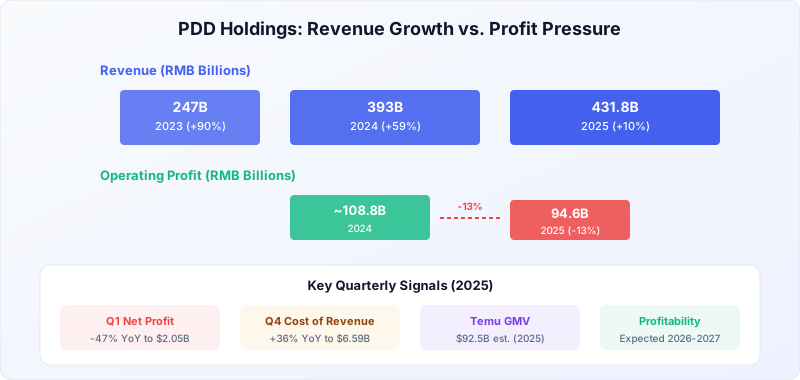
PDD Holdings' revenue growth tells the story of Temu's ascent — and its deceleration:
| Period | Revenue | YoY Growth |
|---|---|---|
| 2023 | ~RMB 247B | +90% |
| 2024 | ~RMB 393B | +59% |
| 2025 | RMB 431.8B | +10% |
Profitability Under Pressure
The profit trends are even more revealing at the PDD parent level:
- Full-year 2025 operating profit: RMB 94.6B (~$13.7B), down 13% year-over-year
- Q1 2025 net profit: RMB 14.74B ($2.05B), down 47% from the prior year — the sharpest single-quarter decline
- Q4 2025 net income: RMB 24.54B, down 11% from the prior year
- Q4 cost of revenue: RMB 47.8B ($6.59B), up 36% — driven by fulfillment and payment processing costs
PDD Holdings does not break out Temu's financials separately, which makes precise analysis difficult. Analysts estimate that Temu contributes a growing but still investment-heavy portion of PDD's overall business, with domestic Pinduoduo generating much of the profit base. That is an analyst model, not a PDD segment disclosure.
The cost pressure is structural. Fulfillment costs are rising as Temu expands into markets with less efficient logistics infrastructure. Customer acquisition costs increase as the easy growth markets (US, Western Europe) saturate. And the potential loss of de minimis benefits would add a direct cost increase to every shipment entering the US.
The Path to Profitability
Some investment-bank and analyst models have projected that Temu could reach a profitability inflection point in 2026-2027. The pathway relies on several levers:
- Advertising revenue: Temu has been opening more seller-facing monetization surfaces, and mature marketplaces can generate meaningful advertising take rates. The exact Temu ad take rate is estimated, not disclosed.
- Seller fees and penalties: Temu charges sellers through marketplace rules and can impose penalties for policy violations. Estimates of fee contribution vary.
- Category mix shift: As Temu moves beyond $2 trinkets into higher-value categories (electronics, home goods, appliances), the average order value and per-transaction margin improve.
- Logistics optimization: The semi-managed model and local warehousing reduce per-unit shipping costs over time.
- Reduced customer acquisition spending: After the de minimis closure, Temu slashed its US ad spend dramatically — a forced efficiency that, if sustained, could improve margins even as growth slows.
The question is whether these monetization levers can offset the structural cost pressures before investor patience runs out.
Temu vs. SHEIN: Two Models, One Origin
Temu and SHEIN are often grouped together as "Chinese ultra-fast e-commerce," but their business models are fundamentally different. Understanding the distinction reveals why Temu's model is both more scalable and more vulnerable than SHEIN's.
| Dimension | Temu | SHEIN |
|---|---|---|
| Inventory model | Managed marketplace; inventory risk often sits with sellers | First-party (1P) — owns inventory |
| Category scope | General merchandise (electronics, home, toys, fashion) | Primarily fashion and apparel |
| Supplier relationships | Any manufacturer can list; platform controls pricing | Curated factory partnerships with deep integration |
| Pricing strategy | Ultra-low, flash deals, gamified discounts | Competitive but more consistent |
| Supply chain depth | Leverages PDD's existing merchant network | Built proprietary supply chain from scratch |
| Risk profile | No inventory risk; platform risk (regulation, quality) | Inventory risk; supply chain risk |
| Global reach | 90+ markets | ~150+ markets (broader but more focused on fashion) |
The competition between them is reshaping cross-border e-commerce. SHEIN is moving toward marketplace features (allowing third-party sellers), while Temu is investing in supply chain depth (semi-managed model, local warehousing). Over time, the two models are converging.
For a deeper comparison of their supply chains, see Chinese Cross Border Ecommerce.
Global Expansion: 90 Countries and Counting
Temu's geographic expansion has been breathtaking in speed, if not always in strategic precision.
Americas: The US remains Temu's most important international market. Third-party estimates put US monthly active users at 133.6 million in October 2025, down 28% year over year. Canada, Mexico, and Brazil are active markets, but landed-cost rules and local compliance can change the economics.
Europe: Temu attracted 115.7 million users in Europe during the first half of 2025, according to its Digital Services Act transparency report. The Y2 semi-managed model is now deployed across 27 EU markets.
Asia-Pacific: Temu launched semi-managed operations in the Philippines in early 2025, marking its entry into Southeast Asia. Australia, Japan, and South Korea are active markets.
The expansion playbook is consistent: aggressive marketing (Super Bowl-level spending adapted to local markets), ultra-low introductory prices, and viral referral programs. The semi-managed model is rolled out once a market reaches sufficient scale to justify local warehousing.
For a broader manufacturing-side view of why Chinese platforms can compress price and delivery cycles, see How China Manufactures: Inside the World's Factory (2026) and Shenzhen Manufacturing: Complete Ecosystem Guide (2026).
Risks: Regulation, Quality, and the Sustainability Question
Regulatory Risk
The de minimis closure for China-origin goods in May 2025 was the regulatory event Temu had always feared, and it happened. The tariff and postal-fee burden moved after the first shock, but the old duty-free parcel model was no longer a dependable foundation. Temu raised prices in some categories and leaned harder into semi-managed or local fulfillment. The European Union is also tightening scrutiny of low-value imports, product safety, and platform responsibility.
Beyond tariffs, Temu faces scrutiny on several fronts:
- Product safety: Regulators in the US, EU, and Australia have raised concerns about product quality and safety standards on the platform.
- Data privacy: Temu's data practices have been questioned in multiple jurisdictions, though the company has stated that it stores user data locally in each market.
- Labor practices: The ultra-low prices depend on manufacturing economics in China that draw periodic scrutiny from labor rights organizations.
Quality Perception
Temu's brand is built on price, not quality. While the platform has made efforts to improve quality control — including seller ratings, return policies, and product testing — the perception persists that Temu is where you buy things you don't expect to last.
This is both a vulnerability and a moat. It limits Temu's ability to move upmarket into higher-value categories where consumers expect quality guarantees. But it also means that traditional retailers can't easily compete on Temu's core turf — the market for cheap, disposable goods has always existed, and Temu has simply digitized and globalized it.
The Sustainability Question
The core question hanging over Temu is whether the current model is a bridge to a sustainable business or a race to the bottom.
The bullish case: Temu is following a marketplace scale playbook. Spend heavily to build scale, logistics infrastructure, and customer habits, then monetize through advertising, higher-margin categories, and seller services. Some analysts see a path to profitability by 2026-2027. The de minimis closure, while painful, forced Temu to build a more resilient logistics infrastructure through the semi-managed model.
The bearish case: Temu's cost advantages depended on regulatory arbitrage, Chinese supplier economics, and funding from PDD's broader profit base. The first pillar has weakened sharply in the US. Parent-level profitability came under pressure in 2025, and third-party US user estimates show decline. There is a limit to how long any parent company can fund international expansion if growth slows and logistics costs rise.
The truth likely lies between these extremes. Temu's marketplace model has genuine structural advantages — zero inventory risk, factory-direct pricing, and a proven C2M framework. But the transition from growth-at-all-costs to sustainable profitability will require logistics investment, category mix shifts, and pricing discipline that may dilute the brand's core promise.
For the manufacturing base that makes factory-direct pricing possible, see How China Manufactures and Shenzhen Manufacturing Ecosystem. Temu's app layer is new; the supplier-density logic underneath is older.
The Competitive Landscape: Where Temu Goes from Here
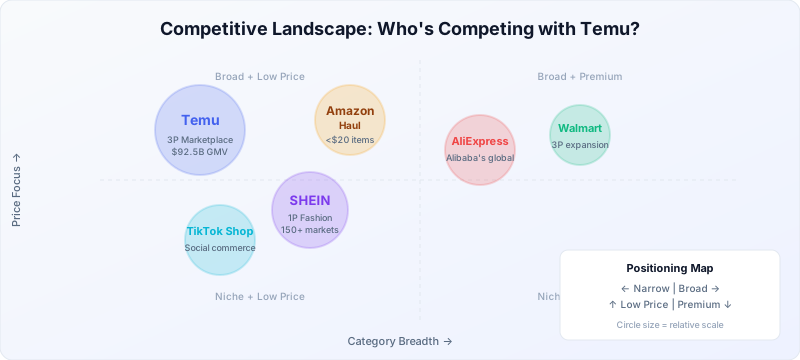
Temu's expansion is forcing responses from every major e-commerce player:
- Amazon launched "Amazon Haul" in late 2024 — a dedicated storefront for items under $20, directly targeting Temu's price-conscious shoppers.
- Walmart has expanded its third-party marketplace to include more Chinese sellers, attempting to offer similar prices with the trust advantage of a known brand.
- TikTok Shop (owned by ByteDance) is competing for the same social-commerce audience, leveraging its content advantage. See Tiktok Shop Ecommerce.
- AliExpress (Alibaba's international platform) has been in this market longer but lacks Temu's marketing aggression and gamification engine.
The competitive dynamic is intensifying just as the regulatory environment tightens. Temu's window to establish market position before cost structures shift may be narrowing.
What Temu's Business Model Means for Global E-Commerce
Regardless of whether Temu itself achieves sustainable profitability, its model has already changed global e-commerce in three permanent ways:
1. Factory-direct is now a proven global pressure point. PDD Holdings demonstrated that the C2M model that worked in China can pressure global retail prices. Every major e-commerce platform is now working to shorten supply chains and connect consumers more directly to manufacturers.
2. Price transparency has increased dramatically. Temu's prices reveal how low some China-sourced goods can be when branding, distribution, retail overhead, and duty-free parcel advantages are stripped down. They do not reveal a universal "true cost" for every product, but they shift the consumer's price anchor.
3. Cross-border e-commerce infrastructure has matured. Temu, SHEIN, and others have built logistics networks, customs processes, and local delivery partnerships that make it feasible to ship individual low-value items from China to anywhere in the world within two weeks. This infrastructure doesn't disappear even if individual platforms struggle.
For consumers, Temu represents a genuine shift in access and affordability. For the e-commerce industry, it represents a challenge to every assumption about how goods move from factory to doorstep. For PDD Holdings, it represents the biggest bet in Chinese internet history — one whose outcome is still being decided.
Methodology And Source Notes
This article was reviewed on July 6, 2026 using PDD Holdings filings and earnings commentary, public reporting and Federal Register materials on the 2025-2026 US de minimis changes, Temu's operating-model changes, and third-party traffic / marketplace analysis. The article separates Temu's original fully managed cross-border model from the post-de minimis semi-managed and local-warehouse model because the economics changed materially after May 2025. Profitability statements are framed as directional analysis rather than as a forecast of PDD Holdings' future earnings.
Claim Confidence File
| Claim | Confidence | Evidence boundary |
|---|---|---|
| PDD Holdings reported RMB 431.8 billion revenue for 2025 | High | Parent-company reported financial data; not Temu standalone revenue. |
| Temu's GMV, MAU, and ad-spend estimates are exact company disclosures | Low | PDD does not disclose Temu as a standalone segment; figures are third-party estimates. |
| The U.S. ended de minimis duty-free treatment for China/Hong Kong-origin goods in May 2025 | High | Supported by Federal Register and trade-policy materials. |
| Temu's old direct-parcel cost advantage was weakened by de minimis changes | High | Strong policy-to-business inference; exact cost impact varies by product, mode, and tariff treatment. |
| Temu is already sustainably profitable as a standalone business | Low | Not disclosed; analyst models differ. |
| Temu's model is only a temporary loophole business | Medium-low | Regulatory arbitrage mattered, but supplier density, marketplace control, and C2M pricing remain real structural factors. |
Frequently Asked Questions
How does Temu make money if prices are so low?
Temu monetizes through seller commissions or marketplace service fees, in-app advertising, logistics-related charges, and policy penalties. The platform generally avoids classic retailer inventory risk, but it still carries subsidy, traffic, returns, compliance, and logistics risk. Standalone profitability is not disclosed by PDD; 2026-2027 profitability is an analyst scenario, not a confirmed company result.
Is Temu owned by a Chinese company?
Yes. Temu is owned by PDD Holdings (NASDAQ: PDD), the same company that operates Pinduoduo, one of China's three largest e-commerce platforms alongside Alibaba and JD.com. PDD Holdings is listed on the NASDAQ stock exchange and is headquartered in Shanghai.
How does Temu ship so cheaply?
Temu's low shipping costs originally relied on consolidated air freight from China (packing thousands of small orders into single shipments), the de minimis customs exemption (which waived tariffs on shipments under $800 in the US), and partnerships with local carriers for last-mile delivery. After the de minimis loophole closed in May 2025, Temu shifted to its semi-managed model with local warehousing, which reduces per-unit shipping costs for higher-volume markets but is more expensive than the previous direct-from-China approach.
What happened to Temu after the de minimis loophole closed?
In May 2025, the US ended de minimis duty-free treatment for China- and Hong Kong-origin goods. Parcel duties, postal fees, and tariff treatment changed after the initial shock, but the old duty-free direct-shipping model was no longer dependable. Temu responded by raising some prices, reducing US marketing intensity, and accelerating semi-managed or local inventory models. Third-party estimates show US monthly active users declined year over year after the changes.
How is Temu different from SHEIN?
SHEIN operates a first-party model — it buys inventory, manages production, and sells directly to consumers. Temu is a marketplace that connects consumers to manufacturers without holding inventory. SHEIN focuses on fashion; Temu sells across all categories. Both face similar regulatory pressures around tariffs and product safety. Their models are converging as SHEIN adds marketplace features and Temu invests in supply chain depth. For more details, see Shein Global Fashion Platform.
Is Temu's business model sustainable long-term?
The answer is being tested right now. With de minimis duty-free treatment closed for China-origin goods, U.S. traffic estimates declining, and local fulfillment becoming more important, Temu is in the middle of its most challenging period. The bullish case points to advertising revenue, category mix shifts, and logistics optimization as pathways to profitability. The bearish case notes that parent-level profit came under pressure in 2025 and that continued international investment could test investor patience. The safest conclusion is that Temu has a plausible but narrowing path to profitability with significant execution risk.
Related Entries
- How China Manufactures: Inside the World's Factory (2026) -- The manufacturing system behind factory-direct pricing
- Shenzhen Manufacturing: Complete Ecosystem Guide (2026) -- How supplier density compresses hardware iteration and sourcing time
- China April-June 2026 PMI: Supplier Risk Signal -- Why small-factory pressure matters for platform pricing
- Chinese EV Price Gap: 5 Cars for 1 American Car (2026 Reality) -- A parallel case of China price compression in another export category