
Three numbers from April 2026 started the story: the official manufacturing PMI was 50.3, the non-manufacturing PMI fell to 49.4, and the RatingDog / S&P Global private manufacturing PMI rose to 52.2. The June update did not erase that split. China's official manufacturing PMI returned to 50.3, the non-manufacturing PMI recovered to 50.2, and RatingDog still showed manufacturing expansion at 51.7.
Read together, the April-June sequence does not simply describe "China's economy." It describes two different supplier environments. Export-oriented and technology-linked factories remain more resilient. Domestically exposed sectors, services, real estate-linked demand, and many small suppliers remain weaker. For a buyer, that split changes how to read quotes, lead times, warranty risk, and supplier cash pressure. A factory can be busy and fragile at the same time.
That is the useful reading of the April-June PMI file: China still has manufacturing momentum, but the domestic demand cushion behind many suppliers is thin. The buyer task is not to forecast GDP. It is to identify whether a supplier is expanding because real demand is strong, or discounting because it needs orders to cover fixed costs.
Source File
This article was reviewed on 2026-07-03 against China's National Bureau of Statistics April 2026 PMI release, the State Council summary of the 49.4 non-manufacturing PMI, the NBS June 2026 PMI release, S&P Global's RatingDog China General Manufacturing PMI April 2026 release, S&P Global's RatingDog June 2026 release, Caixin's notice that its China PMI title sponsorship ended in July 2025, AP reporting on March 2026 China exports and energy/geopolitical pressure, and the site's structural manufacturing guide How China Manufactures: Inside the World's Factory (2026). The article uses "former Caixin PMI" only as search context for readers who still use the old name. It treats the export-versus-domestic split as a survey signal, not a complete measure of realized output.
Claim Confidence File
| Claim | Confidence | Evidence boundary |
|---|---|---|
| April 2026 PMI signals a two-speed Chinese economy relevant to supplier screening | Medium-high | Based on cited PMI and macro/sector context; PMI is a macro signal, not a factory-level audit. |
| A weak or split PMI proves every supplier in a category is distressed | Low | The article rejects blanket conclusions and recommends supplier-specific checks. |
| Buyers should watch payment terms, lead times, subcontracting, QC timing, and order concentration during weak cycles | High | This is a procurement-risk conclusion drawn from the article's buyer framing. |
| PMI alone predicts shipment failure for a specific vendor | Low | The evidence boundary requires additional vendor-level and order-level diligence. |
Quick Buyer Read
| Signal | What April-June 2026 showed | Buyer implication |
|---|---|---|
| Official manufacturing PMI | 50.3 in April, 50.0 in May, 50.3 in June | Large/domestic-heavy producers are stable but not uniformly strong |
| Non-manufacturing PMI | 49.4 in April, 50.2 in June | Domestic services improved, but new orders and real estate-linked activity remain soft |
| RatingDog / S&P manufacturing PMI | 52.2 in April, 51.8 in May, 51.7 in June | Private manufacturers kept expanding, but momentum eased from April's surge |
| Small-factory signal | NBS small-enterprise PMI was 48.2 in June | smaller suppliers still need tighter cash-flow and delivery checks |
| Export-order risk | positive in April, softer in later private PMI commentary | separate durable demand from pull-forward ordering |
June Update: The Split Narrowed, But It Did Not Disappear
The June data is the reason this article needed an update. NBS reported that manufacturing PMI returned to 50.3 in June, up 0.3 points from May and back above the expansion line. Production rose to 51.4 and new orders rose to 51.2, which means the headline factory picture improved.
But the buyer signal is still mixed. Small enterprises remained below the expansion line at 48.2. Non-manufacturing improved to 50.2, but non-manufacturing new orders were still only 48.0, and construction activity stayed below 50. RatingDog / S&P Global's June manufacturing PMI eased to 51.7 from 51.8 in May, still expansionary but no longer the April surge.
So the April thesis should be updated, not discarded. The two-speed economy became less dramatic in the headline PMIs, but the supplier-risk split remains: stronger production and private manufacturing on one side, weak small-factory and domestic-demand signals on the other. Buyers should treat June as a reason to keep ordering selectively, not as a reason to relax supplier diligence.
The Official Manufacturing PMI: Holding the Line at 50.3
The National Bureau of Statistics manufacturing PMI came in at 50.3 for April, slipping from March's 50.4. On the surface, this looks like stability. Beneath it, the component breakdown tells a more complicated story.
Production activity ticked slightly higher, which is the main reason the headline number stayed above 50. But new orders fell to 50.6 from 51.6 in March -- a meaningful deceleration. Employment remained below the 50 threshold, consistent with the persistent labor shedding that has characterized Chinese manufacturing for over a year.
The input cost picture is particularly worth watching. In the NBS component table, input prices registered 63.7 while output prices were 55.1. That gap points to margin pressure: factories were reporting higher input costs faster than they were passing those costs into selling prices. For buyers, this is more useful than a macro headline because it shows where quote instability can enter the order file.
 Data sources: NBS, RatingDog / S&P Global, and company / market reporting.
This dynamic -- rising costs, weak pricing power, and slower order momentum -- is the daily reality for many larger, domestically oriented manufacturers that dominate the NBS survey. These are the companies plugged into China's internal demand channels, and those channels are under pressure.
Non-Manufacturing Weakness: Services Hit 49.4
The non-manufacturing PMI falling to 49.4 was the clearest weak-demand signal in the April release. The State Council summary, citing NBS data, put the service-sector business activity sub-index at 49.6, down 0.6 percentage points from March.
For supplier analysis, the important point is not a full property-market forecast. It is that domestic demand was not giving many suppliers a strong second engine. A factory or component maker that depends on local construction, retail, services, or discretionary consumption may face weaker local order flow even if export-facing peers are busy.
That matters when reading payment terms, production schedules, and quote behavior. Domestic weakness can push suppliers to chase export orders more aggressively, accept thinner margins, or ask for stronger deposits.
RatingDog PMI at 52.2: The Private Sector Surge
If the domestic picture is weak, the export-oriented private sector tells the opposite story. While the official survey showed only modest expansion, the RatingDog / S&P Global manufacturing PMI told a dramatically different story. It surged to 52.2 from 50.8 in March and posted its strongest reading since late 2020.
New export orders reached 50.3, the highest level since April 2024, according to the RatingDog / S&P Global release. This is the number driving the divergence. Export-oriented private manufacturers -- the companies that supply everything from consumer electronics to industrial components to markets worldwide -- are running hot.
Zhiwei Zhang of Pinpoint Asset Management framed it plainly: "the outlook of the export sector is very important... as domestic demand has been weak." The implication is clear: China's growth engine has shifted from internal consumption to external demand, at least for now.
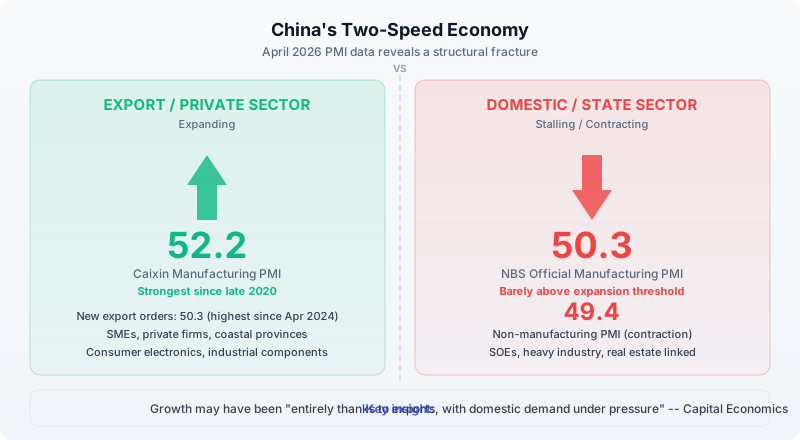
But there is a complication that the headline RatingDog number does not immediately reveal. Part of this export surge appears driven by stockpiling rather than organic end-user demand.
The Stockpiling Factor: Energy Shock And Front-Loaded Demand
The geopolitical and energy backdrop matters for reading April's PMI correctly. AP's March trade reporting pointed to energy and supply-chain pressure around the conflict environment, and PMI surveys can capture precautionary behavior before hard data fully separates real demand from inventory building.
A warehouse manager in Dongguan described the dynamic in telling detail: "there is an overall shortage in the chemical sector, and factories are nervous about future demand. This caused widespread stockpiling on a large scale -- every factory wants to stock up."
This matters because it means the strength in new export orders -- and by extension the RatingDog PMI surge -- may partially reflect precautionary inventory building rather than genuine demand growth. Companies ordering ahead of potential supply disruptions look identical to companies experiencing a genuine order boom in PMI survey data.
The trade flow pattern supports this interpretation. China's exports surged 21.8% in the January-February period, driving a trade surplus of $213.6 billion, per official figures. But by March, export growth slowed to 2.5%, with US-bound exports specifically falling 26.5%, according to AP's report on the customs data. The April PMI export order reading of 50.3, while the highest in a year, comes against this decelerating backdrop.
If the stockpiling impulse fades, the private-manufacturing PMI could soften even if April looked strong. That is why buyers should ask whether a supplier's lead time reflects durable end demand or short-term inventory building.
Why Two PMIs Tell Different Stories: Methodology Matters
Understanding the official-private PMI divergence requires understanding how the two surveys are constructed. They use the same basic methodology -- five component indices (new orders, production, employment, supplier deliveries, inventories) weighted into a composite diffusion index where 50 is the expansion/contraction threshold. But the sample frames are fundamentally different, as S&P Global documentation details.
| Dimension | NBS (Official) PMI | RatingDog / S&P PMI |
|---|---|---|
| Sample size | ~3,000 enterprises | ~500 enterprises |
| Firm profile | Larger companies, SOEs, domestic focus | SMEs, private firms, export-oriented, coastal |
| Sector weight | Heavy industry overrepresented | Light manufacturing, consumer goods |
| Geographic bias | Nationwide, interior included | Coastal provinces dominant |
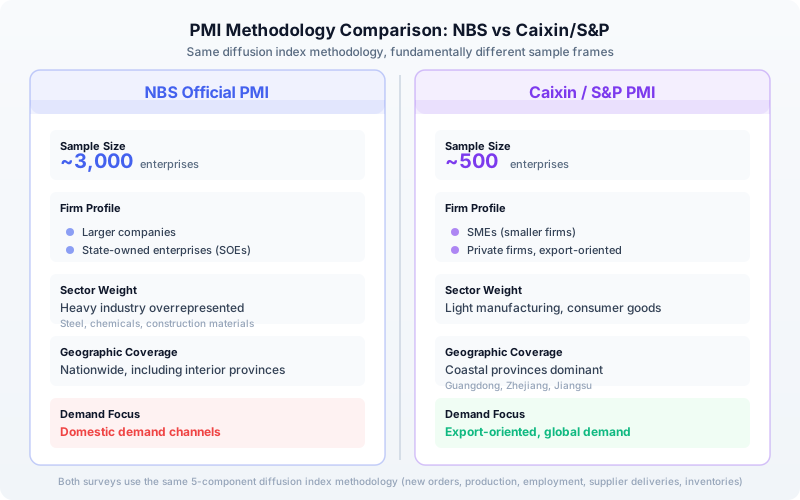
The NBS survey, with its 3,000-enterprise sample, captures the state-dominated heavy industrial base -- steel mills, chemical plants, construction materials producers. These are the companies most exposed to China's property downturn and domestic demand weakness. The RatingDog / S&P survey, sampling about 500 firms, skews toward smaller, private, export-oriented manufacturers clustered in coastal provinces like Guangdong, Zhejiang, and Jiangsu.
Historically, before the pandemic, the NBS PMI typically ran higher than the private Caixin-branded PMI. That relationship has reversed. In 2024, the private PMI tracked actual industrial production growth at 6.0%, closer to the reported 5.9% official figure, while the NBS PMI implied growth of only 5.3%, according to S&P Global analysis. The post-pandemic reversal reflects a genuine structural shift: private exporters have outperformed state-backed domestic producers for years now.
This is not a methodological quirk to dismiss. It is a real-time measure of the two-speed economy. As our How China Manufactures: Inside the World's Factory (2026) explains in detail, the gap between China's export manufacturing sector and its domestic industrial base has been widening since 2022. April 2026 marked the sharpest split in this article's source file; June showed that the split can narrow without disappearing.
How Buyers Should Translate The Split
The two PMI series point to different supplier behaviors. The official PMI tells you about large, domestic-heavy producers. The RatingDog / S&P series tells you more about smaller, coastal, private, export-oriented manufacturers. A buyer sourcing from Guangdong, Zhejiang, Jiangsu, Fujian, or Shandong should not treat the official headline as the whole factory picture.
| Supplier type | What the PMI split suggests | What to verify |
|---|---|---|
| Coastal export OEM/ODM | demand may be stronger than the official PMI implies | current order book, capacity utilization, lead-time realism |
| Domestic-demand supplier | local demand weakness may pressure cash flow | receivables, discounting, late-payment exposure |
| Heavy industrial input supplier | cost pressure may be rising faster than output prices | raw-material pass-through clauses and inventory position |
| Small private factory | busy export orders can coexist with thin margins | deposit terms, subcontracting, QC staffing, shipment schedule |
| Trading company | may use market noise to justify price changes | factory identity, quote validity, origin documents |
The Bigger Picture: Q1 GDP Masks the Split
China's Q1 GDP came in at 5.0% year-over-year, reaching 33.42 trillion yuan, NBS data shows. On paper, that looks like Beijing is hitting its growth target. The aggregate masks a severe imbalance.
Industrial output rose 6.1% in Q1, with March alone registering 5.7% growth, per NBS. Services grew 5.2%. But retail sales -- the most direct measure of consumer spending -- increased just 2.4% for the quarter, with March decelerating to 1.7%. The gap between industrial production and consumer spending is now wider than at any point since the post-COVID reopening.
This is the two-speed economy in macro terms. Factories producing for global markets are running. The domestic consumer economy is stalled. And the property sector -- traditionally the transmission mechanism that converted factory profits into consumer wealth -- is still working through a multi-year decline.
China's leadership has acknowledged the external risk. Officials have framed 2026 policy around responding to external shocks. Producer price index deflation is technically ending, but as the data shows, it is driven by oil price pass-through rather than genuine domestic demand recovery.
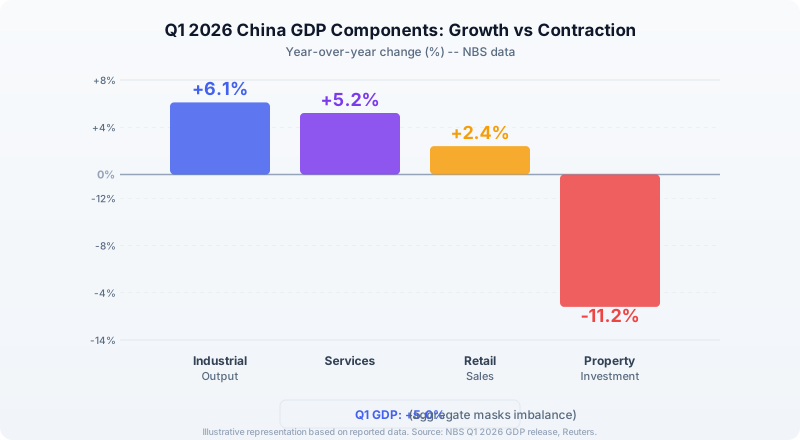 Data source: NBS Q1 2026 GDP release, Reuters
What This Means Globally
For global supply chains, the April-June PMI data carries three practical implications.
First, Chinese export pricing will remain competitive even as input costs rise. The margin squeeze (input prices 63.7 vs output prices 55.1) means factories are absorbing cost increases rather than passing them to buyers. Companies sourcing from China should expect stable or slightly declining unit prices in the near term, even with elevated energy costs.
Second, the stockpiling-driven export surge creates inventory risk downstream. If energy or shipping pressure eases, precautionary orders can leave a demand gap later. Procurement teams should distinguish between genuine consumption demand and panic buying in their order books.
Third, the weakness in China's domestic market affects companies selling into China more than those buying from it. As explored in China small-factory supplier risk, Chinese manufacturers have proven remarkably adaptable to external trade barriers, but the domestic demand slump is a constraint they cannot export their way out of.
The sectors where China leads -- EVs, batteries, solar panels, drones, and power electronics -- can still benefit from global demand tailwinds. The PMI split does not say exports are weak. It says buyers should check whether export strength is supported by sustainable orders, not only by a temporary shock.
Quote And Supplier Checks After The April-June PMI Split
If a supplier cites "China PMI" or "cost pressure" in a negotiation, ask for specifics. The useful checklist is:
| Check | Why it matters |
|---|---|
| Is the quote based on current input costs or pre-April inventory? | A factory may be pricing from old stock or using rising costs as negotiation cover |
| Is the supplier export-heavy or domestic-heavy? | The two groups are operating in different demand environments |
| Are lead times capacity-driven or cash-flow-driven? | Busy lines and weak cash flow create different risks |
| Has the supplier changed payment terms? | Requests for higher deposits can signal working-capital stress |
| Is subcontracting increasing? | Rapid export demand can push work to weaker second-tier shops |
| Are quality-control staff and documentation stable? | Margin pressure often shows up first in inspection discipline |
| Does the order depend on freight or energy volatility? | PMI input-price pressure can flow into landed cost late in the process |
Methodology Note
This analysis draws on official NBS PMI data for April through June 2026, RatingDog / S&P Global manufacturing PMI releases for April through June 2026, and public China trade reporting. PMI survey data is based on purchasing managers' self-reported assessments and may not perfectly match hard economic data when revised figures are released. The stockpiling interpretation is informed by supply-chain reporting but cannot be precisely quantified from survey data alone.
Frequently Asked Questions
What is the difference between the official PMI and the former Caixin PMI?
The official NBS PMI surveys approximately 3,000 predominantly large, state-owned enterprises with a domestic focus. The RatingDog / S&P PMI, formerly known to many readers as the Caixin PMI, surveys about 500 smaller, private, export-oriented firms concentrated in coastal provinces. They use the same diffusion index methodology but capture different segments of China's economy, which is why they increasingly diverge.
Why did China's non-manufacturing PMI fall below 50 in April 2026?
The non-manufacturing PMI dropped to 49.4 primarily because of sustained weakness in real estate-linked services consumption. Property investment fell 11.2% in Q1, suppressing household wealth and spending. Retail sales growth slowed to 1.7% in March, reflecting the knock-on effect across the services sector.
Are China's exports actually growing or just stockpiling?
The data suggests both. January-February exports surged, but March growth slowed according to AP's trade reporting. The April RatingDog PMI export-orders reading of 50.3 was positive, but supply-chain reporting also points to precautionary stockpiling. Disentangling genuine demand from inventory building is difficult in real time.
What does the two-speed economy mean for companies sourcing from China?
Export-oriented Chinese manufacturers are expanding and maintaining competitive pricing despite rising input costs, which benefits foreign buyers. However, the stockpiling component of current demand creates potential inventory risk if geopolitical tensions ease. The domestic demand weakness matters more for companies selling into China than those buying from it.
Should buyers delay orders because China's PMI is mixed?
Not automatically. A mixed PMI does not mean factories are unavailable or demand is collapsing. It means buyers should segment suppliers by export exposure, cash flow, input-cost pressure, and lead-time reliability. For strategic categories, the better response is a tighter quote file and more frequent supplier checks, not a blanket delay.
How reliable are PMI surveys for measuring China's economy?
PMI surveys are timely leading indicators but have known limitations. They capture direction and velocity of change rather than absolute levels, and respondents' expectations can color their assessments. In China specifically, the NBS survey has historically tracked below actual industrial output since the pandemic, while the private RatingDog / S&P series has tracked closer to reported figures. Using both surveys together provides a more complete picture than either alone.
By China Made & Tech Team. Independent English field guide to China's niche hardware brands, hidden champions, founders, factory towns, and supplier clusters.