

China's official May manufacturing PMI landed at 50.0. That number is tidy, memorable, and almost useless for procurement.
The useful signal is underneath it.
The National Bureau of Statistics reported that May 2026 manufacturing PMI fell 0.3 percentage points from April. Production remained in expansion at 51.2. New orders slipped to 49.9. New export orders fell to 48.6 from 50.3 in April. Raw-material inventory and employment were both 48.6. Supplier delivery time was 49.2. The main raw-material purchase price index was 60.5.
That is not a collapse story. It is a triage story.
For buyers, the question is no longer "Is Chinese manufacturing strong?" The better question is: which suppliers are still genuinely healthy, which are producing into weak orders, and which are hiding margin stress behind confident delivery promises?
Source File
This article was reviewed on 2026-06-30 against the National Bureau of Statistics of China's official May 2026 manufacturing PMI release and the S&P Global / RatingDog China General Manufacturing PMI release. The article uses the official sub-indexes as procurement risk prompts, not as proof that any specific supplier is healthy or distressed. Internal context comes from How China Manufactures: Inside the World's Factory (2026), China April-June 2026 PMI: Supplier Risk Signal, China manufacturing guide, China April PMI two-speed economy, and EU component sourcing rule file.
Quick Answer
| May 2026 PMI signal | Procurement interpretation |
|---|---|
| Headline PMI: 50.0 | The system is flat, not broken. Use the sub-indexes, not the headline. |
| Production: 51.2 | Factories are still running, which can hide weak order books. |
| New orders: 49.9 | Demand is soft enough to require backlog verification. |
| New export orders: 48.6 | Export-facing suppliers need tighter checks than domestic-facing suppliers. |
| Raw-material inventory: 48.6 | Some suppliers may be conserving cash or delaying input purchases. |
| Employment: 48.6 | Labor pressure can show up as slower rework, weaker inspection, or lower flexibility. |
| Supplier delivery time: 49.2 | Delivery promises need component-level verification. |
| Raw-material purchase price: 60.5 | Cost pressure can become quality drift if the buyer only demands lower prices. |
The Headline Is The Wrong Unit Of Analysis
PMI uses 50 as the expansion threshold. At 50.0, the official headline says "flat." That is fine for macro commentary. It is not enough for sourcing.
Procurement teams buy from specific suppliers, not from an index.
The May sub-indexes show a tension that matters:
- production is still above threshold
- orders are below or barely below threshold
- export orders are clearly below threshold
- raw-material inventory is below threshold
- employment is below threshold
- delivery time is below threshold
- raw-material prices are elevated
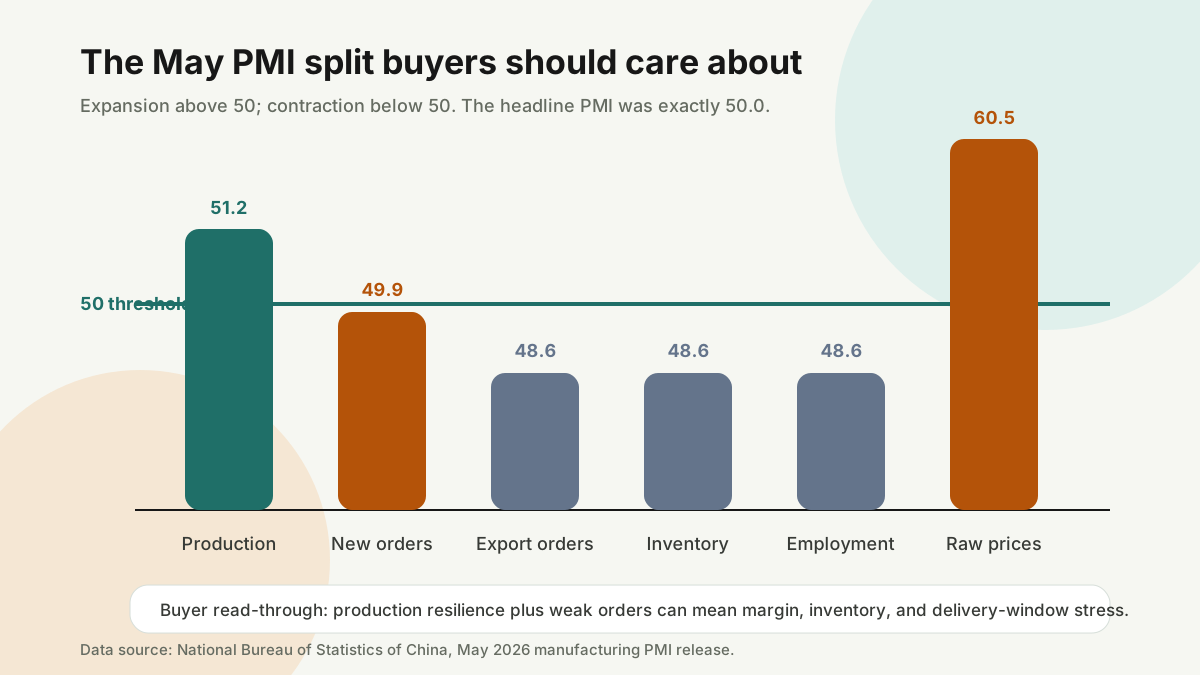
This combination is exactly where buyer mistakes happen. A factory may still be producing because it has backlog, because it wants to keep workers busy, because it is finishing old orders, or because it is trying to preserve cash flow. From the outside, all four can look like activity.
That is why this article links back to How China Manufactures: Inside the World's Factory (2026). China's manufacturing system is strong because of scale, clusters, supplier density, logistics, and speed. But system strength does not remove supplier-specific risk. A strong ecosystem can contain weak factories.
The Core Signal: Production Above Orders
The most important pair is production at 51.2 and new orders at 49.9.
If production is above threshold while orders are below threshold, buyers should ask why output is still moving. There are healthy explanations. A supplier may have long-cycle orders, seasonal demand, export shipments booked earlier, or domestic demand that offsets weak overseas orders.
There are also riskier explanations:
| Possible explanation | Buyer risk |
|---|---|
| Factory is using old backlog | June shipment may be fine, but July/August capacity may weaken. |
| Factory is producing ahead of demand | Finished-goods inventory can mask soft orders and cash stress. |
| Factory is accepting lower-margin work | Quality drift and late price renegotiation become more likely. |
| Factory is delaying input purchases | Delivery can slip when a critical material is not actually on site. |
| Factory is keeping labor busy | Output continues, but inspection, rework, and supervision may be stretched. |
The correct response is not panic. It is evidence.
Export Orders Are The Cleanest Buyer Signal
New export orders fell to 48.6 in May. For importers, that is the most directly relevant number.
Export weakness does not mean every Chinese exporter is fragile. Many large manufacturers have diversified customers, better financing, and stronger bargaining power with upstream suppliers. Some may even become more attentive to serious buyers if weaker demand frees capacity.
The risk is concentrated in smaller export-facing factories with thin margins, limited working capital, and high dependence on a few overseas customers.
Those suppliers can still be good suppliers. But they need tighter checks.
| Supplier type | May PMI read | First diligence question |
|---|---|---|
| Large diversified exporter | Usually resilient, but may prioritize high-margin or high-certainty customers. | Is my order in the preferred production queue? |
| Small export-focused factory | More exposed to weak export orders and raw-material cost pressure. | How much confirmed June-July backlog do you have? |
| Commodity supplier | Most vulnerable to price squeezing and hidden spec changes. | Are material grade, packaging, subcontracting, and inspection unchanged? |
| High-spec component supplier | Less about price, more about process discipline. | Are test coverage, process control, and rework rates stable? |
| Domestic-facing supplier | Less exposed to export orders, still affected by raw-material prices. | Are raw-material costs being passed through openly? |
Raw-Material Prices Are Where Quality Drift Starts
The purchase price index at 60.5 deserves more attention than the headline PMI.
When input costs stay high while orders soften, suppliers have four choices:
- pass cost through to the buyer
- absorb margin pressure
- delay purchases
- recover margin through quieter changes
The fourth choice is the dangerous one. Quality drift often starts as small, defensible compromises: thinner cartons, cheaper surface treatment, lower-grade fasteners, shorter burn-in, looser sorting, more manual rework, or unapproved subcontracting.
The buyer may not see it until the shipment arrives.
This is why China manufacturing guide becomes more important in a month like this. Quality control should not be a final inspection ritual. It should be a prevention system before production starts.
Buyers should lock three documents:
| Document | What it prevents |
|---|---|
| Bill of materials or component list | Quiet material or supplier substitution. |
| Inspection plan | Reduced sampling, shortened testing, or changed defect classification. |
| Approved-substitution list | Last-minute changes justified as "equivalent" without buyer review. |
Delivery Time Below 50 Is A Scheduling Warning
Supplier delivery time came in at 49.2.
PMI delivery-time indexes require care. A lower delivery-time reading can reflect delay pressure, but weak demand can also change supplier behavior in ways that confuse the signal. The buyer-safe reading is this: do not treat delivery promises as self-verifying.
Ask for component-level evidence.
| Delivery claim | Evidence to request |
|---|---|
| "We can ship by June 28" | Production calendar with milestones and responsible line owner. |
| "Materials are ready" | Stock-on-hand for critical inputs, not just supplier assurance. |
| "No problem with lead time" | Purchase orders or delivery confirmations for constrained components. |
| "Same quality as last order" | QC plan, inspection frequency, and defect/rework trend for the last 30 days. |
| "We can expedite" | Which step is being compressed: production, testing, packing, trucking, or customs paperwork? |
How To Ask Without Making The Supplier Hide Risk
Bad questions make suppliers defensive. Defensive suppliers hide risk.
"Are you in financial trouble?" will usually produce a denial. "Are your orders down?" may be too sensitive. "Can you cut the price?" may push the supplier toward hidden compromises.
Operational questions work better.
| Weak question | Better question |
|---|---|
| Are orders weak? | How does your confirmed June-July production schedule compare with April? |
| Are you short of cash? | Have upstream payment terms changed for any critical materials? |
| Can you still deliver? | Which critical inputs are already on site, and which still need supplier delivery? |
| Will quality be the same? | Are material grade, inspection steps, subcontractors, packaging, and test time unchanged from the approved sample? |
| Can you reduce price? | Which cost line changed, and does the reduction affect material, labor, testing, or shipment priority? |
For smaller Chinese factories, relationship quality still matters. A supplier that trusts the buyer may disclose a bottleneck early enough to solve it. A supplier that feels squeezed may say yes until delay is unavoidable.
The June Supplier-Risk Matrix
Use the May PMI split to rank suppliers into three groups.
| Supplier risk tier | Signals | Buyer action |
|---|---|---|
| Green | Confirmed backlog, inputs on site, stable QC, no substitution, clear delivery calendar. | Keep normal cadence, but document milestones. |
| Yellow | Export orders weaker, some inputs pending, raw-material price changes, delivery window tight. | Add weekly milestone checks, BOM lock, and payment tied to verified progress. |
| Red | Thin backlog, delayed input purchases, changed payment terms, vague QC, unapproved substitutions, aggressive price cutting. | Pause new exposure or require pre-shipment audit, third-party inspection, and fallback supplier. |
For a strategic supplier, a yellow signal may justify collaboration: earlier deposits for specific inputs, shared forecast visibility, or revised delivery planning. For a non-strategic commodity supplier, the same yellow signal may justify moving volume elsewhere.
Procurement is context.
Category Examples: Same PMI, Different Buyer Actions
The PMI signal should also be translated by product category. A buyer sourcing molded plastic parts does not face the same risk as a buyer sourcing precision electronics, solar hardware, packaging, or industrial components.
| Category | Most likely May PMI risk | Buyer action |
|---|---|---|
| Consumer electronics accessories | Export-order softness plus component substitution risk. | Lock approved components, labels, packaging, charger/cable specs, and final inspection sampling. |
| Industrial metal parts | Raw-material price swings and delivery-window pressure. | Verify material certificates, machining capacity, surface treatment schedule, and subcontractor use. |
| Packaging and low-margin commodities | Price pressure can turn into thinner material or weaker cartons. | Lock material weight, carton strength, print spec, and pre-shipment packaging test. |
| Solar or energy hardware | Component origin and documentation can matter as much as delivery. | Verify BOM, traceability, certification, and shipment paperwork before production closes. |
| Factory automation parts | A delay in one subcomponent can hold up an integration project. | Ask for component-level lead times and a recovery plan for constrained sensors, controllers, or actuators. |
The May PMI split should therefore trigger a sub-tier question: what sits underneath this supplier?
Ask whether critical materials, components, tooling, coating, testing, or packaging come from the same upstream vendor used by other suppliers. If they do, a buyer may need to qualify a second sub-tier route, not only a second factory.
Payment Terms Can Become A Risk Signal
Working capital is often the first supplier stress point buyers can detect without seeing financial statements.
A supplier under pressure may not tell the buyer "cash is tight." But operational clues appear:
- upstream vendors ask for shorter payment terms
- supplier asks the buyer for a larger deposit
- material purchase is delayed until the buyer pays
- delivery date depends on one critical input that is not yet ordered
- supplier pushes hard for full payment before inspection
None of these clues proves the supplier is failing. Some are normal in volatile raw-material markets. But they belong in the risk file.
The best way to handle this is to tie payment to verifiable progress rather than promises.
| Payment milestone | Better evidence |
|---|---|
| Deposit | Supplier confirms critical material purchase order or stock allocation. |
| Mid-production payment | Photos or video tied to batch, line, and production milestone. |
| Pre-shipment balance | Passed inspection report, packaging confirmation, and shipment booking. |
| Expedited payment request | Written explanation of which bottleneck the payment resolves. |
What Not To Over-Read
The May PMI release does not say China's factory system is breaking.
Production was still 51.2. The headline was 50.0, not a deep contraction. China's manufacturing base remains structurally strong because of clusters, logistics, automation, supplier density, and fast engineering response. China April PMI two-speed economy explains why China can remain competitive even when wages are no longer cheap by emerging-market standards.
The mistake is not optimism. The mistake is blanket optimism.
A buyer who says "China is still strong, so my supplier is fine" may miss supplier-level stress. A buyer who says "PMI is weak, so China sourcing is broken" misunderstands the system. The useful position is in the middle: respect the ecosystem, verify the supplier.
June Sourcing Checklist
If you are placing orders in June, ask for written answers to these questions:
| Check | Buyer question |
|---|---|
| Order book | How much June-July production is covered by confirmed customer orders? |
| Export exposure | Which export regions or customers slowed compared with April? |
| Inventory | Which critical inputs are on site, and how many production days do they cover? |
| Working capital | Have payment terms with any critical upstream vendor changed? |
| Cost pressure | Which raw materials changed price, and how does that affect quote validity? |
| Quality control | Are test time, sample size, defect limits, and inspection staff unchanged? |
| Substitution | Are any materials, components, packaging, or subcontractors changing? |
| Delivery | What are the three most likely delay causes, and what buffer is already built in? |
Buyer Takeaway
China's May PMI headline says flat. The sub-indexes say triage.
Production is still expanding, but orders are soft, export orders are weaker, inventory and employment are below threshold, delivery time is not clean, and raw-material prices remain high. That mix is exactly where supplier confidence can hide operational stress.
The buyer response is straightforward: segment suppliers, verify backlog, lock BOM and QC controls, ask operational questions, and tie payment to production evidence.
China's manufacturing system remains powerful. Your supplier still has to prove it can deliver this order.
Claim Confidence File
| Claim | Confidence | Evidence boundary |
|---|---|---|
| PMI weakness can expose smaller Chinese suppliers to cash-flow, delivery, and quality pressure | Medium-high | Supported as a procurement inference from PMI and supplier-risk context; supplier-level outcomes vary. |
| A weak PMI means every small factory is unsafe to buy from | Low | The article rejects broad supplier stereotyping and recommends targeted diligence. |
| Buyers should check deposit exposure, subcontracting, payment terms, QC timing, and alternative suppliers | High | This is the article's operational checklist. |
| PMI is a precise factory-level health score | Low | The article treats PMI as macro signal, not proof about an individual vendor. |
Methodology
This article is based on the National Bureau of Statistics of China's May 2026 manufacturing PMI release, the S&P Global / RatingDog China General Manufacturing PMI release, and internal site context in How China Manufactures: Inside the World's Factory (2026), China April-June 2026 PMI: Supplier Risk Signal, China manufacturing guide, China April PMI two-speed economy, and EU component sourcing rule file.
Frequently Asked Questions
Should buyers panic because May PMI was flat?
No. A 50.0 headline PMI is a triage signal, not a collapse signal. Buyers should use the sub-indexes to decide which suppliers need deeper backlog, material, labor, and quality checks.
Why compare official PMI with private PMI?
The official PMI and private PMI surveys can emphasize different firm samples and export exposure. Comparing them helps buyers avoid over-reading one headline number and focus instead on supplier-level evidence.
Which suppliers need the most immediate review?
Small export-facing factories, commodity suppliers under cost pressure, and suppliers with weak documentation deserve the first review. Large diversified exporters may still be healthy, but buyers should verify queue priority and material availability.
What is the fastest practical diligence step?
Ask for confirmed backlog, raw-material availability, production schedule, inspection plan, and approved-substitution list for the next shipment. These documents reveal more than a generic assurance that the factory is busy.