
Source File
This article was reviewed on 2026-06-30 against MOFCOM / GAC Announcement No.18 of 2025 on medium and heavy rare earth export controls, the Chinese Embassy in the U.S. repost of the MOFCOM / Global Times statement on approved compliant rare-earth export applications, MP Materials' Q1 2026 filing, and related site work in China's Rare Earth Monopoly: Strategic Materials Explained and China Rare Earth Squeeze on Japan: Buyer Checklist (2026). The article treats license timing as an operational planning risk, not as proof of a universal embargo or a prediction that every civilian-use application will be delayed.
The most dangerous rare-earth question in mid-2026 is no longer "Did China ban exports?"
The more practical question is whether licensed material can move through the paperwork, processing, and shipping chain in time for production windows.
That distinction matters because the official message from Beijing has become more precise. MOFCOM / GAC Announcement No.18 of 2025 put several medium and heavy rare earth related items under export controls and required exporters to apply for licenses. A later MOFCOM statement reposted by the Chinese Embassy in the United States said China had approved a number of compliant rare-earth export applications and would continue communication on compliant trade.
That sounds reassuring. For buyers, it should sound conditional.
The official stance now implies that supply disruption can happen through timing, classification, and documentation friction even when no public blanket embargo is announced.
Quick Answer
| Signal | What it means | What buyers should not assume |
|---|---|---|
| China says compliant applications are being approved | Export channels remain open for some civilian demand | That approvals will arrive fast enough for every production schedule |
| Reviews continue "according to law" | Documentation and end-use review matter more than before | That historic lead times still apply |
| Heavy rare earth flows already tightened earlier this month | Dysprosium and terbium exposure is now a live continuity issue | That alternative mining alone solves the problem |
| Public company filings now mention uncertainty | Downstream users are treating timing risk as material | That this is only a diplomatic headline |
Why Timing Is The Real Control Lever
An export-control regime does not need a total ban to disrupt manufacturing.
If applications take longer, if end-use documentation is questioned, if product classification changes, or if downstream processors cannot predict release timing, buyers still face the same business problem: motors, magnets, and assemblies miss production slots.
That is especially true for heavy rare earths used in high-performance magnets. Buyers with just-in-time assumptions can absorb a price spike more easily than an uncertain delivery window.
This is the same logic behind China Rare Earth Squeeze on Japan: Buyer Checklist (2026), but the official May 29 language sharpens the point. China is not saying the channel is closed. It is saying the channel is conditional and managed.
Conditional supply is exactly what makes planning harder.
The License-Timing Map Buyers Should Build
The useful buyer document is not a one-page supplier statement. It is a timing map from controlled material to finished product.
| Step | Timing risk | Evidence to collect |
|---|---|---|
| Controlled item classification | The supplier may not know whether a material, compound, alloy, or magnet input falls under the controlled scope | product description, HS code, chemical composition, and supplier classification memo |
| Export license preparation | Missing end-use or end-user information can slow the file before submission | named documentation owner, end-use statement, customer identity, and civilian-use evidence |
| Government review | Approval may be lawful but slower than the production schedule | application date, review status, expected decision window, and prior approval history |
| Processing and conversion | Approved material still has to move through separation, alloying, or magnet production | processor identity, capacity slot, and backlog status |
| Logistics and customs | Shipment timing can slip even after approval | broker file, transport route, insurance, and customs documentation |
Public Filings Are Starting To Say The Quiet Part Out Loud
One useful signal came from outside government.
In its Q1 2026 filing, MP Materials said Chinese export controls had created uncertainty around NdPr, SEG, dysprosium, terbium, and related magnet-material flows. That matters because public-company disclosures usually understate rather than exaggerate operational uncertainty.
When a listed materials company uses that language, buyers should read it as a planning signal:
- processing continuity is not guaranteed
- pricing is not the only problem
- magnet-grade availability and timing now matter simultaneously
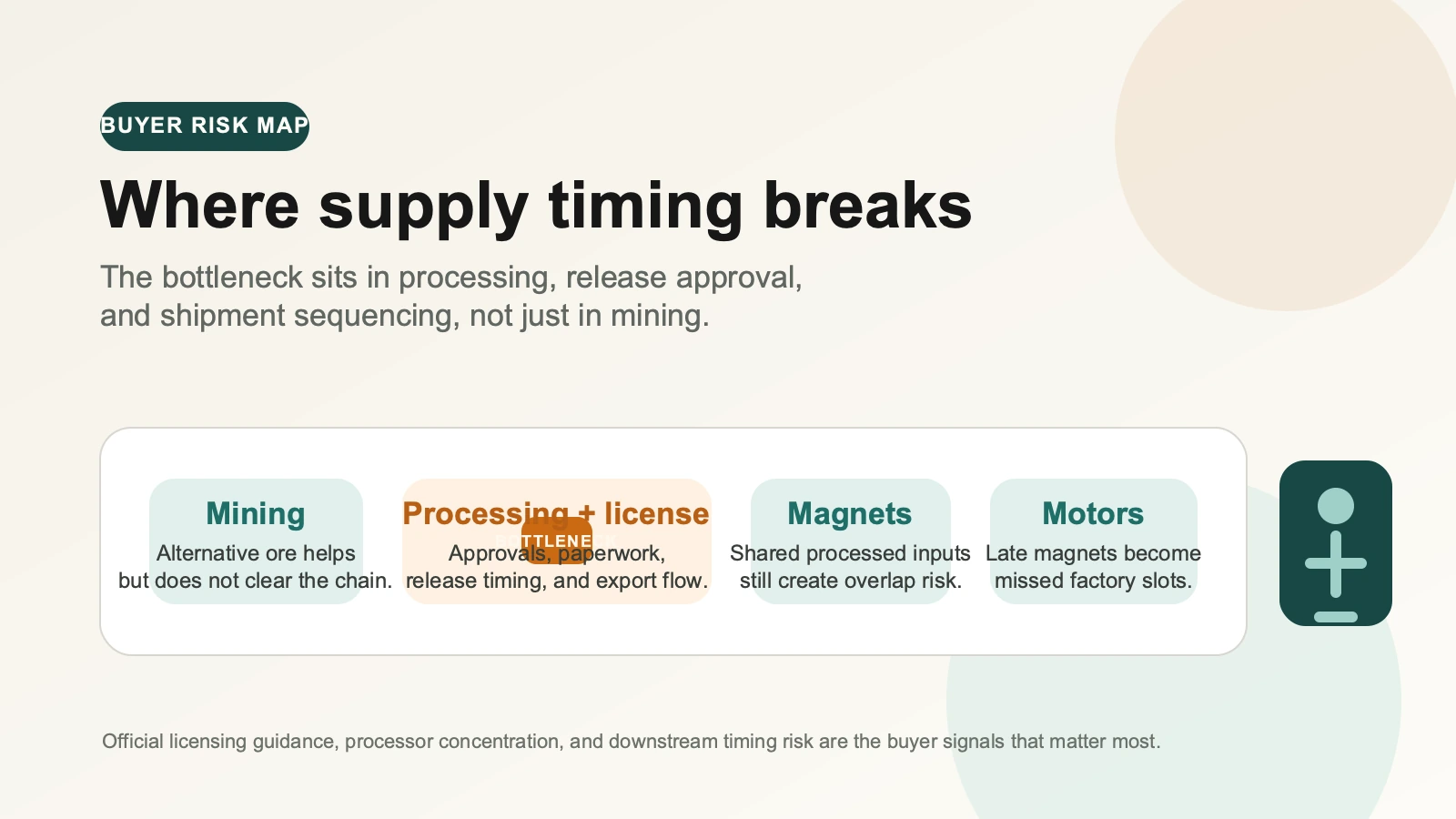
That is also why diversification headlines can mislead. New mines help the upstream story. They do not automatically solve the midstream processing and magnet-material bottleneck.
Why Civilian-Use Language Does Not End The Risk
China's statement that compliant civilian applications can be approved is important. It keeps the story from becoming a simple embargo narrative. But civilian-use language does not remove the buyer workload.
For many industrial buyers, the same magnet-rich component can sit near sensitive and non-sensitive markets. A servo motor may go into a factory automation line, a medical device, a drone subsystem, a machine tool, or a defense-adjacent assembly. The material may be civilian in one use case and sensitive in another customer's program. That means the supplier's documentation must be more specific than "industrial use."
Buyers should therefore ask suppliers to identify:
- the exact end product using the controlled material
- the final customer or customer category where disclosure is permitted
- whether the part can enter defense, aerospace, surveillance, or dual-use channels
- whether any distributor or trading company sits between the processor and exporter
- whether prior licenses were approved for the same item and use case
This is tedious, but it is exactly the paperwork discipline that a timing-sensitive license regime creates.
The Buyer Problem Is Processing-of-Origin, Not Just Mine-of-Origin
Too many sourcing discussions still ask where the ore was mined.
The better question is where the material was separated, refined, alloyed, and converted into magnet-ready input. Those processing layers are where China still holds the harder choke points.
That means a buyer can proudly diversify miner count and still fail to diversify real supply risk.
| Layer | Typical buyer mistake | Better buyer question |
|---|---|---|
| Mining | "We have non-China mine exposure" | Where is the material separated and refined? |
| Processing | "Our supplier says it has alternative feedstock" | How much heavy rare-earth processing still passes through China-linked stages? |
| Magnet production | "We have multiple vendors" | Are those vendors dependent on the same processed inputs and license windows? |
| Final assembly | "We have buffer stock" | How many weeks of actual dysprosium/terbium exposure do we carry at the magnet level? |
What The Official Language Tells Buyers
The wording from MOFCOM is useful because it frames the policy as lawful review of compliant applications rather than as an all-or-nothing stop.
That creates four practical implications.
- Documentation quality becomes a supply variable.
- End-use clarity becomes a supply variable.
- Lead-time assumptions need to be rewritten.
- Inventory policy becomes a board-level issue for exposed manufacturers.
That is a different risk profile from the simpler "tariff" or "ban" frameworks many buyers are used to. A tariff can be priced. A selective and timing-sensitive license regime forces planners to model uncertainty bands.
A Better Magnet Buyer Checklist
Companies exposed to motors, traction systems, industrial servos, wind components, aerospace parts, and defense-adjacent electronics should now ask for evidence in six buckets.
| Bucket | Evidence to request |
|---|---|
| Processing path | country and processor for separation, refining, alloying, and magnet conversion |
| License readiness | current export-license status, documentation owner, and expected review timeline |
| Spec flexibility | whether the application can tolerate alternative magnet grades or redesign |
| Inventory depth | weeks of heavy rare-earth coverage at the component level, not just ore equivalent |
| Supplier overlap | whether multiple suppliers depend on the same Chinese processing nodes |
| Escalation plan | what production gets prioritized first if license timing slips |
Contract Clauses That Matter More Now
Rare-earth timing risk should move into contracts, not stay inside email updates.
Useful clauses include:
| Clause | Why it matters |
|---|---|
| License-status reporting | Forces the supplier to report application submission, review, approval, rejection, and expiry dates |
| Allocation priority | Defines which customer gets limited approved material first if volumes are constrained |
| Origin and processing disclosure | Prevents a supplier from substituting an unclear processing path without notice |
| Delay trigger | Defines when a license delay becomes a force majeure, price adjustment, or cancellation event |
| Alternative-grade approval | Allows engineering teams to pre-approve magnet redesign or grade substitution before the shortage arrives |
| Audit right | Gives the buyer a path to verify the supplier's documents rather than relying on verbal assurance |
How To Turn License Timing Into A Planning File
The practical fix is to stop treating rare-earth exposure as a commodity price line and start treating it as a calendar file. A buyer should know the normal approval path, the named exporter, the document owner, the end-use description, the controlled item boundary, and the decision date by which a late license becomes a production problem. If those dates sit only in a supplier's email thread, the buyer does not have a supply-chain control. They have a hope.
The file should begin at component level, not at raw-material level. A magnet used inside a servo motor, traction motor, compressor, actuator, wind component, or sensor assembly may carry rare-earth exposure even when the buyer never purchases dysprosium, terbium, samarium, or neodymium directly. That means the first operational task is a bill-of-materials trace: identify which assemblies contain high-performance magnets, which magnet grades are used, which suppliers make them, and which processing steps are China-linked.
After that, the buyer needs a timing model. The question is not simply whether the exporter expects approval. The question is whether approval can arrive before the component build, shipment booking, customs cutoff, customer delivery date, or line-change deadline. A one-week slip may be harmless for a warehouse replenishment order and critical for a just-in-time motor line. Rare-earth licensing turns a materials question into a schedule-risk question.
The third layer is substitution. Some buyers will be able to qualify an alternative magnet grade, redesign a motor, change a supplier, or build extra inventory. Others will not. That difference should be documented before a license delay appears. If the engineering team has not approved an alternative grade, the purchasing team should not pretend that a second supplier is a true backup.
The fourth layer is escalation. A serious file names who decides allocation if licensed material becomes scarce. Supplier sales teams often promise "priority" to multiple customers. A contract should define priority more concretely: which purchase orders, which plants, which end customers, which penalty terms, and which evidence the supplier must provide when it says the delay is administrative rather than commercial.
This is where the article's buyer judgment sits. The rare-earth problem in 2026 is not that every shipment stops. It is that a buyer can no longer model the supply chain with a single normal lead time. The more exposed the component is to Chinese heavy rare-earth processing, the more the buyer needs a visible timing file.
Why This Matters Beyond Japan
Earlier coverage focused on Japan because it provided one clean signal path. The broader issue is not country-specific.
Any buyer whose critical component stack relies on Chinese heavy rare-earth processing now faces the same operational question: can the supply chain tolerate administrative delay?
That includes:
- EV motor suppliers
- industrial automation vendors
- wind-turbine component makers
- aerospace and defense-adjacent contractors
- electronics firms that indirectly depend on high-performance magnets
The common failure mode is assuming that if some licenses are being approved, normalcy has returned. That is too generous.
Approval is not the same as predictability.
What To Watch Next
The next decisive signals will not be speeches. They will be operational disclosures:
- public company comments on lead-time changes
- customs or trade-flow evidence in heavy rare-earth categories
- supplier notices on documentation or delivery sequencing
- evidence that buyers are redesigning components to reduce heavy rare-earth intensity
If those signals worsen, this becomes a hard continuity story. If they stabilize, the issue turns into a more familiar inventory-and-paperwork discipline problem.
Either way, the buyer workload has already increased.
Claim Confidence File
| Claim | Confidence | Evidence boundary |
|---|---|---|
| China added export-control licensing requirements for selected medium and heavy rare-earth items in 2025 | High | This is anchored in MOFCOM Announcement No.18 of 2025. It proves a licensing regime exists; it does not prove every application will be delayed or denied. |
| Chinese officials said some compliant rare-earth export applications had been approved | High | The embassy statement is official language. It supports selective approval, not a return to frictionless supply. |
| License timing is now a buyer risk, not only a policy headline | Medium-high | This follows from the structure of the licensing system and public-company disclosure signals. Actual timing depends on product, end use, documents, exporter, and receiving market. |
| Public filings prove broad magnet shortage across all sectors | Low | The article does not claim this. Filings are treated as early disclosure signals, not a statistically complete shortage map. |
| Non-China mining exposure removes China rare-earth risk | Low | This is explicitly rejected. The buyer-relevant question is processing, separation, alloying, magnet conversion, and license exposure, not only mine location. |
| Contract clauses can eliminate supply disruption | Low | Clauses can improve visibility, allocation priority, and dispute handling. They do not make licensed material appear if an approval slips. |
The Real Story
The real story is not whether China can say yes or no to exports.
The real story is that rare-earth leverage works even when the answer is "yes, but later" or "yes, if your paperwork clears." That is enough to shift bargaining power and enough to force downstream manufacturers to hold more inventory, redesign faster, or accept more production risk.
That is why the market should stop reading rare earths as a headline cycle and start reading them as a planning discipline.
Methodology
This article relies on MOFCOM / GAC Announcement No.18 of 2025, the Chinese Embassy repost of the MOFCOM / Global Times statement on approved compliant rare-earth export applications, MP Materials' Q1 2026 filing, and prior site analysis in China's Rare Earth Monopoly: Strategic Materials Explained and China Rare Earth Squeeze on Japan: Buyer Checklist (2026).
FAQ
Are China's rare-earth export controls the same as a total export ban?
No. The official source stack describes licensing and review of controlled rare-earth related items, with compliant applications able to be approved. The buyer risk is timing, documentation, end-use review, and selective friction rather than a simple universal ban.
Why does license timing matter more than the headline policy?
Manufacturers need magnet inputs on production schedules. If a license, classification question, or end-use document delays material by weeks, the buyer can miss production windows even when the shipment is eventually approved.
What should magnet buyers ask suppliers now?
Ask for the processing path, license status, documentation owner, expected review timeline, heavy rare-earth inventory at component level, and a production priority plan if dysprosium or terbium timing slips.