
By China Made & Tech Team · Updated September 1, 2026.
Yes, Huawei is back where the evidence is strongest: China’s phone market. It has also rebuilt enough of a domestic chip-and-software route to plan real product cycles, and it has returned a flagship phone to named overseas markets. But none of that yet proves that Huawei has rebuilt the broadly usable, globally distributed phone business it once had.
The distinction is not semantic. It changes how retailers, app partners, analysts and customers should read a comeback claim. In Omdia’s 2Q 2026 mainland-China shipment record, Huawei led with 23% share as the overall market shipped 66.1 million phones, down 2% year on year. That is a meaningful domestic result in a difficult market. It does not describe Huawei’s worldwide share, a particular phone’s compatibility, or the durability of a regional launch.
The overseas evidence is real but narrower. Huawei put the Mate 80 Pro on the agenda of its Madrid global launch, maintains a UAE product page, and said in an April 2026 Brazil announcement that it was bringing conventional Mate phones back to that market. SCMP’s report from the Madrid event framed the launch as a renewed global push. Those records establish overseas re-entry. They do not establish repeatable ex-China demand, carrier acceptance, essential-service continuity, or a durable regional warranty path.
So the useful answer is a scorecard, not a slogan:
| Question | Best 2026 answer | What that answer does not prove |
|---|---|---|
| Is Huawei competitive in China phones? | Yes. It led Omdia’s 2Q 2026 mainland-China shipment measure. | Worldwide share, phone profitability, or demand in another country. |
| Can it ship a domestic premium-phone chip route? | Yes, with important limits. A Mate 60 Pro teardown found a shipped SMIC-linked 7nm-class signal. | Yield, cost, power efficiency, volume, or parity with the old supply model. |
| Is HarmonyOS a real platform? | Yes, as a company-reported, China-centred platform effort. | A reader’s international app, payment, bank, carrier, or enterprise outcome. |
| Is Huawei globally back? | It is re-entering named markets. | A restored, durable global smartphone business. |
What Huawei has actually rebuilt in China
The domestic result is not simply a good quarter or a patriotic purchase decision. Huawei’s advantage in China is that several pieces now reinforce one another: a current phone audience, a product schedule, a domestic chip route, an operating-system effort, developers and service providers that can see an installed base, and the corporate capacity to keep those loops moving.
That does not mean the components are interchangeable with the global system Huawei previously used. It means they have become coordinated enough to support a viable China-centred product business. That is a substantial change from a period in which a hardware launch, a chip story, or an operating-system announcement could each be treated as an isolated act of survival.
A leading share in a contracting market is stronger than a headline rank
Omdia’s figure matters because it is bounded. The researcher said Huawei took 23% of mainland China smartphone shipments in the second quarter of 2026, while the total market was 66.1 million units and declined 2% year on year. The report attributes Huawei’s position to its stable pricing, product coverage and premium demand in a market facing rising memory costs. Those are market observations for one geography and quarter—not evidence that the company has returned to its former worldwide scale.
But a strong position in a shrinking market has a practical value that a one-off launch lacks. It gives Huawei a place to plan around. Product teams can decide which price bands deserve a successor. Software teams can set priorities against a real audience rather than an imagined future base. Component, device, and channel teams can coordinate for another selling window instead of concentrating all effort on one symbolic flagship.
This is the difference between a technical demonstration and a product organization. A demonstration has to work once. A product organization has to make decisions in sequence: set the hardware target, line up components, build software around that hardware, place the device in a portfolio, supply a channel, support it after sale, and learn enough to make the next version less improvised.
The domestic market does not erase those constraints. It makes them manageable because there is a continuing arena in which they can be solved. Huawei can learn from a current release, distribute that learning into a successor family, and give developers or suppliers a reason to treat the next cycle as plausible. That feedback loop is what the 23% share makes commercially important.
Why a home-market loop is more valuable than a one-off device win
Smartphone competition is usually described through a visible outcome: who led the quarter, whose flagship gained attention, or which technical feature became a talking point. Those are useful snapshots, but a durable phone business is built in the intervals between them. Teams have to turn one release into the next without losing the relationships that make a release possible.
A current home market gives Huawei room to do that work. Product managers can learn where the lineup is too narrow or too crowded. Hardware teams can decide whether a component choice should be carried into another tier. Software teams can prioritise the friction that affects a current group of users. Suppliers and distribution partners can place orders against a sequence instead of a one-time rescue schedule. Each decision is still difficult; the difference is that it has a commercial destination.
That destination also makes failure more informative. A weak device position, an update problem, or a service gap can be observed in an existing market and addressed in a successor. Without a stable audience, the same problem is just another reason a recovery launch failed. With a stable audience, it becomes product feedback. This is one reason a leading share in a declining Chinese market is strategically more useful than a general narrative of national self-reliance: it suggests the company has enough current demand to operate a learning cycle.
The loop should not be romanticised. It may be stronger at the premium end than in price-sensitive segments, and the available public data do not break out every commercial constraint. It also does not mean a domestic solution is automatically the most efficient alternative in every component or market. The narrow conclusion is simply that Huawei now has an operating environment where chip work, device launches, software decisions and customer feedback can reinforce one another. That is the foundation from which a new model can be attempted; it is not proof that the old international model has returned.
 Editorial synthesis; each status keeps the evidence boundary described in the adjacent sections.
The chip signal is a shipped capability, not a completed independence story
The clearest independent hardware evidence remains the Mate 60 Pro. TechInsights’ analysis identified the Kirin 9000S in that device, linked it to SMIC manufacturing, measured a 107 mm² die, and found dimensions consistent with 7nm (N+2) features. The firm described the result as a milestone achieved without EUV equipment.
That is a meaningful fact because it concerns a shipped phone, not merely a roadmap. It says that a domestic manufacturing route had crossed the threshold from aspiration into a real premium product. It gives Huawei’s chip, handset, and software teams a shared object around which to plan.
It does not answer the questions that decide whether a chip path is economically equivalent to the best available global route. The public teardown does not establish production yield, cost per usable chip, available volume, long-run efficiency, product margin, or how freely Huawei can segment later products. Those are not small footnotes. They determine how much flexibility a phone maker has when it needs to offer several models, keep prices competitive, absorb component shocks, or sell beyond its strongest domestic market.
The next evidence should therefore be read with the same discipline. TechNode reported that Huawei launched the Mate 80 series in November 2025 with Kirin 9020, Kirin 9030, and Kirin 9030 Pro variants alongside HarmonyOS 6. That report is useful evidence of product cadence and tiering. It is not an independent verification of the later chips’ process, yield, efficiency, economics, or supply scale.
Why does this distinction matter to a normal reader? Because a phone business lives on repeatability. One device can absorb extraordinary engineering attention. A portfolio needs a reliable sequence of chip targets, device designs, software releases, components, and sales windows. The more often Huawei can repeat that sequence, the more the domestic route becomes a business capability rather than a dramatic exception. The less often it can repeat it, the more the headline outruns the commercial system underneath.
 Editorial synthesis based on TechInsights’ Mate 60 Pro analysis; yield, cost, power, and scale remain unverified here.
SMIC Explained: Real 7nm, Unproven TSMC Parity is the useful companion for readers who want the foundry context. The key point here is simpler: a shipped 7nm-class signal demonstrates capability under constraint, not automatic parity in every manufacturing or commercial dimension.
HarmonyOS gives the home-market business a different centre of gravity
Hardware alone does not make a phone business durable. A customer has to find the device useful after the launch; developers and service providers need a reason to maintain their work; and the operating system has to be part of an ongoing release cycle rather than an orphaned layer.
Huawei’s 2025 annual report says that, by the end of 2025, more than 36 million devices were running HarmonyOS 5 and 6, more than 10 million developers had registered, and AppGallery offered more than 350,000 apps and services. These are Huawei’s own figures, so they should be read as company-reported ecosystem scale. They do not establish the utility of an app in a reader’s country, a smartphone-only installed base, or international developer adoption.
Even with that boundary, the numbers matter. They describe the ingredients of a platform effort: devices that create an audience, developers who can build or maintain software, and a catalogue of services that can make subsequent devices more useful. In China, that changes the phone story from “can Huawei launch hardware without its former dependencies?” to “can Huawei make hardware, software, and a domestic audience reinforce one another?”
This is why HarmonyOS is more than a software sidebar in the comeback narrative. It gives Huawei a way to organise priorities around the users and devices it already has. A new phone can arrive in a current operating-system cycle; an existing device base gives a service provider a clearer reason to participate; and a later release can carry the platform relationship forward. None of this guarantees that the same loop works outside China, where local services and user expectations are different. It does explain why the domestic business can be more coherent than an isolated hardware comeback.
The distinction also protects the reader from a common error: treating a large ecosystem count as a substitute for personal compatibility research. Platform scale and individual usability are related, but they are not the same proof. A reported catalogue of apps and services does not settle whether your bank, workplace app, payment route, carrier feature, or accessibility tool supports a particular regional build now.
Why the China system does not automatically travel
The same combination that strengthens Huawei at home can make overseas expansion more demanding. In China, a phone maker can align its software priorities with a local device base, local service providers, a domestic retail landscape and the product habits it already understands. Outside China, the device enters systems that were not designed around that combination. The additional work is not merely translating a launch page or shipping inventory across a border.
It is the work of fitting a product into a different mesh of institutions. Banks and payment providers set their own device rules. Carriers decide how a model is treated on their networks. Employers decide what is acceptable inside their security and identity systems. Retailers and distributors decide which warranties they can honour. Repair networks decide which parts and training they can support. Each decision can be reasonable on its own; together they determine whether a phone is ordinary to own or perpetually exceptional.
This is why international presence should be measured through continuity rather than spectacle. A bold launch can tell a market that Huawei is willing to return. It cannot, by itself, create the incentives for providers and partners to maintain the small, ongoing pieces of work that normal ownership requires. Those incentives grow when a regional device base persists, when the next model is credible, and when each participant can see an accountable path through support and updates.
The distinction matters for the company as much as for its channel partners. A China-centred platform may reduce Huawei’s dependence on pieces of its earlier stack and give it more control over domestic priorities. Yet international rebuilding requires the company to earn trust in a different way: by proving that the new product system is legible and dependable to organisations beyond its strongest home environment. That takes time, local evidence and more than a single flagship cycle.
A regional return is more than a launch—and less than a global restoration
The most important update since earlier versions of this article is that Huawei’s overseas story can no longer be described simply as absence. The Mate 80 Pro has a documented 2026 international record. Huawei showed it at its Madrid event, maintains region-specific material in the UAE, and explicitly said it was returning conventional Mate phones to Brazil. These are concrete, named-market signals rather than speculation about intent.
They matter because a phone company cannot rebuild international reach only through domestic volume. It has to re-establish a regional product offer: a device identity, retail or distribution arrangements, local software and service expectations, and an ownership path after sale. A launch begins that work. A regional product page and country announcement show that the work has moved beyond an abstract global ambition.
But it is still the first rung of the evidence ladder. A launch proves that a product appeared at a moment in time. A regional page proves that a company has published a market-specific offer. A news report can document the event and the company’s stated direction. None, alone or together, provides a comparable series of ex-China shipments, sell-through, channel replenishment, update continuity, carrier acceptance, repair performance, or customer retention.
This is not a demand that Huawei publish every commercial detail before anyone can acknowledge progress. It is a rule for proportionate language. The public record supports “overseas re-entry is under way.” It does not yet support “Huawei has restored its global phone business.” Those statements are separated by evidence, not by sentiment.
The same applies to service. Huawei’s annual report says its global service network had more than 3,100 Huawei Authorized Service Centers in 70 countries and regions and handled more than 100 million consumer interactions in 2025. That is a meaningful company-reported footprint. It is also a reminder that “outside China” is not a blank space.
Yet a group-level service count does not establish whether a regional Mate 80 offer has an accountable warranty counterparty, stocked parts, or a timely repair route. Those are market-specific channel and service facts. A company can have an international footprint and still offer very different ownership experiences across markets and models.
“Available” is not the same as “normal to own”
This is the practical line between a regional return and a restored phone business. Availability means a device can be found, perhaps through an official local release and perhaps through an importer. Normal ownership means the product fits the routines the market takes for granted: updates have a clear route, a payment or authentication change has an accountable response, faults have a named counterparty, and the next model preserves rather than disrupts the arrangement.
The difference can look mundane, but it changes commercial behaviour. Consumers keep a device longer and recommend it more readily when the ownership path is legible. Retailers can carry inventory with more confidence when returns and service responsibility are clear. Providers are more likely to maintain integrations when the installed base and device roadmap look persistent. Those decisions are the quiet infrastructure of a global phone business.
Huawei’s documented re-entry has begun to create the opportunity for that infrastructure to form again. It does not show that the infrastructure has formed in a broad, durable way. The fair conclusion is neither to dismiss the launch as irrelevant nor to treat it as the endpoint. It is to observe whether the relationships around the phone become easier to verify across ordinary market channels over successive cycles.
The durable-return test is therefore not a single global percentage. It is a pattern that becomes visible one named market at a time: a defined regional product; a channel that replenishes it; essential services that remain workable through updates; an accountable post-sale route; and a successor that arrives without resetting the system. When that pattern repeats across markets, calling Huawei globally back becomes a stronger conclusion. Before then, the company is re-entering—not restored.
What would change the verdict from “re-entry” to “restoration”
The useful thing about a bounded conclusion is that it can be falsified. Huawei does not need to look like its old global business in every detail for the verdict to become more positive. It needs public, repeatable evidence that the new model works outside China as a continuing phone business.
First, watch for repeatable regional continuity. A single flagship launch is a product event. A successor released through the same accountable channels, with continued local service and a visible replenishment cycle, is evidence of a business. The question is whether local partners and customers can plan for the next generation rather than treat the first one as a special case.
Second, watch for service depth, not just catalogue breadth. The decisive external record would connect regional models to the applications, payments, authentication tools, carriers, workplace policies, accessories, repairs, and warranty routes that make ownership normal rather than experimental. The relevant evidence will often be local and mundane: provider support pages, carrier device records, named retailers, clear warranty documents, and support that remains available after a software update.
Third, watch for the economics of breadth. A domestic chip route changes the global story most when it supports repeated product choices rather than a small number of exceptional devices. Public evidence about model availability, product tiering, pricing resilience, and the ability to sustain a family through successive cycles would tell readers more than another isolated chip label. It would show how much freedom Huawei has to translate technical capability into a durable commercial range.
Fourth, keep China and the world separate even if both improve. A stronger China result remains powerful evidence that Huawei has a base from which to fund, develop, and learn. It does not mechanically convert into overseas demand. A stronger overseas result should be judged in its own geography and service environment, not treated as a footnote to a China share chart.
A global return is a sequence of commercial proofs
The most useful way to read the overseas record is as a ladder rather than a switch. A global launch is the first rung: it tells us a company can put a device in front of an international audience and attach its name to the attempt. A regional product page is a second rung: it shows a market-specific offer exists. A country launch announcement adds a third: the company has said that it intends to sell there. Huawei has reached those rungs in 2026.
They are meaningful because each is harder to dismiss than an aspiration. They create a concrete object—a defined device in a named geography—that a distributor, retailer, operator, service organisation or customer can react to. A domestic recovery without such objects would remain a China-only story. The Mate 80 Pro records show that Huawei is again testing whether parts of its current product system can travel.
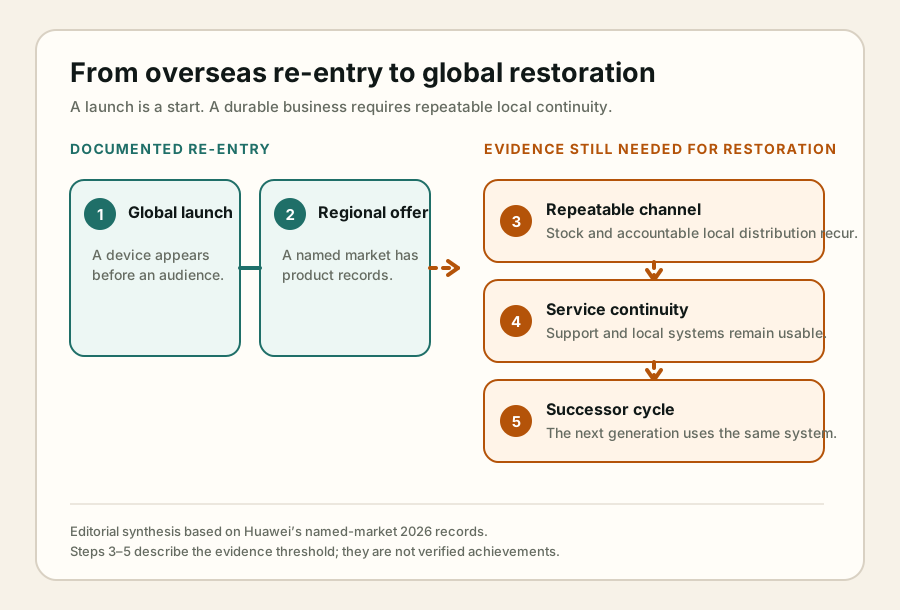 Editorial synthesis based on Huawei’s named-market 2026 records; the final three steps are the standard for restoration, not verified achievements.
But the next rungs are commercial rather than ceremonial. A durable regional business leaves signs that the offer can be repeated: a clear local configuration, a seller that can replenish it, a warranty counterparty that remains responsible after a return window, a repair route with parts, and a successor product that arrives through the same relationships. None of these facts requires an all-purpose “global compatibility” claim. Together, though, they make it easier for a normal market to treat the phone as a continuing product line instead of an exception.
Software and services matter here for the same reason. The test is not whether a company can advertise an operating system or count a catalogue of applications. It is whether the relevant services can remain usable as devices update, local partners make policy changes, and the next handset generation appears. In China, Huawei’s platform effort can draw on an installed base and local developer incentives. Outside China, that loop must be rebuilt through local relationships. A company-reported global service network is evidence of reach; it is not a substitute for continuity in each regional phone business.
This distinction also clarifies what market-share data would and would not do. A comparable ex-China shipment or sell-through series would be valuable evidence that a product return is becoming a business. It would still need to be read beside local channel and service records, because a volume statistic cannot tell us whether the surrounding system remains workable. Conversely, a temporary absence of a public share figure does not prove failure. It means the conclusion should stay with the evidence that is available: documented re-entry, not demonstrated restoration.
The practical consequence for analysts and channel observers is to watch the connective tissue, not just another headline device. Does a named market receive a successor? Does the same channel still carry the line? Are local terms and service responsibilities easier to identify than they were on the prior cycle? Do operators, retailers and service partners treat the device family as ordinary inventory rather than a special-case import? Repetition across several markets would make Huawei’s global comeback claim progressively stronger. A single launch, however prominent, cannot do that work alone.
The evidence that matters will be local and unglamorous
Readers often look for a single global statistic that settles the question. It would certainly be useful to see a comparable, public series for Huawei’s ex-China shipments and share. But a global figure would still not answer the ownership test in any one country. The evidence that makes a return durable is usually less dramatic: an operator lists the exact device; a retailer stocks and replenishes it; a provider documents support; a warranty policy names the responsible party; a repair route remains reachable; and a successor arrives without forcing customers back into an improvised arrangement.
That evidence can be frustratingly fragmented, but fragmentation is part of the reality it describes. Global phone businesses are assembled from local relationships. A company cannot claim the benefits of a worldwide brand while asking each country to treat every device, service and support issue as an exception. The public record becomes more persuasive when those relationships show up repeatedly in the markets where devices are actually sold and supported.
This is also a better way to evaluate future Huawei announcements. Instead of asking whether a new global launch “proves” the comeback, ask what durable regional relationship the announcement adds. Does it identify a continuing sales channel? Does it clarify who supports the phone after purchase? Does it make the next product cycle more likely? Does it let a service provider or carrier treat the device as a normal, maintainable part of the market? If the answer increasingly becomes yes, the global conclusion should change with it.
This approach avoids the two weak narratives that dominate the subject. One assumes that restrictions permanently settled Huawei’s fate. The other treats every new device as proof that the old business has returned. The facts available in 2026 point to something more interesting: Huawei has assembled a different, China-centred system that is strong enough to compete at home and attempt selected overseas returns. Whether that system travels well is still a market-by-market question.
 Evidence timeline, not a product-history or sanctions-law timeline; report types and claim boundaries remain separate.
What the incomplete global return means outside China
This article is not a verdict on any particular handset. Its subject is the evidence for Huawei’s business comeback, and the answer above remains the same whether a reader is a potential customer, retailer or analyst: a China result and an overseas launch do not automatically create a normal local product business.
That has a modest but important implication for anyone looking at a Huawei phone outside China. The relevant facts are local: the exact regional model and software, the services that matter in that market, the seller and warranty counterparty, and the available support path. Those questions are not evidence that Huawei is—or is not—globally back. They are the everyday conditions whose repeated resolution would eventually make the broader business conclusion more credible.
For that reason, it is better to avoid both extremes. Do not turn a named-market launch into a guarantee about every service, carrier or ownership route. But do not turn a missing universal guarantee into proof that the re-entry is meaningless. The evidence supports a narrower conclusion: Huawei has begun rebuilding overseas phone presence, while the country-by-country continuity that would make it a restored global business remains to be demonstrated.
The bottom line
Huawei’s comeback is real, but it is not one thing. The company leads a current China-market measure, has a visible domestic premium-chip capability, reports substantial HarmonyOS ecosystem activity, and has put the Mate phone back into named overseas markets. Those are achievements that deserve to be described plainly.
The global conclusion remains narrower. A reader should not infer a restored worldwide Android business from China share, a teardown, ecosystem totals, or a launch. The public record has not yet demonstrated the continued ex-China distribution, local-service depth, channel accountability, and everyday compatibility that make a phone business durable.
The narrower overseas implication is therefore institutional rather than symbolic: a launch becomes evidence of a restored business only as local distribution, service and successor-cycle records accumulate. Until then, the accurate description is a China-centred recovery with documented overseas re-entry—not the return of Huawei’s former global phone system.
FAQ
Is Huawei back in China’s smartphone market?
Yes. Omdia reported Huawei leading mainland China’s 2Q 2026 smartphone market with 23% share. That supports a real home-market comeback, although it is a quarterly, China-only shipment measure and not a statement about global share or phone profitability.
Does the Mate 80 Pro’s overseas launch mean Huawei is globally back?
No. The Madrid event, UAE product material, and Brazil launch record show overseas re-entry in named markets. A restored global business would require repeated evidence of distribution, service, customer use, and successor products across markets—not only an initial launch.
Does a Huawei launch prove international service continuity?
No. A launch establishes that a device has appeared in a market; it does not establish that regional software, services, channels and support will remain continuous through later product cycles. Those local facts are part of the evidence still needed for a durable global-business verdict. This article is desk research, not a compatibility or hands-on test.
Method and limitations
This update uses public market research, a semiconductor analysis, Huawei’s own regional and annual-report disclosures, and contemporary reporting. Company figures are attributed as company-reported; market metrics retain their time, geography, and measurement basis. No handset, application, carrier, payment service, repair route, or enterprise policy was tested by this editorial team.
The evidence supports a China-centred recovery, a bounded domestic chip capability, company-reported HarmonyOS and service scale, and documented overseas re-entry. It does not establish universal device compatibility, Google-service access, worldwide share, chip yield or cost, security, legal outcomes, or a restored 2019-style global smartphone business.