

In April 2026, Huawei unveiled its first AI smart glasses at the Pura series launch event in Guangzhou. Launch coverage described a 12MP camera, real-time multilingual translation, voice-activated AI assistance, HarmonyOS, a reported self-developed low-power chip, and a 35.5 gram frame. The important point is not the spec sheet alone. It is that Huawei is testing a hardware category where the phone-era constraints do not bite in exactly the same way.
That last detail matters more than any specification on the spec sheet.
Huawei's phone business remains constrained by US export controls that limit access to advanced semiconductor manufacturing and Google Mobile Services. Smart glasses sit in a less directly constrained category. They do not need a flagship phone SoC, they can run inside Huawei's own HarmonyOS ecosystem, and the market is still early enough that no single hardware-and-AI stack has set the global standard.
The result is a product that gives Huawei a cleaner test of whether it can turn China-first hardware, in-house software, and retail distribution into a global wearable product. That is a strategic question, not a confirmed export success.
The Product: What Huawei Actually Shipped
The Huawei AI Glasses combine audio eyewear with camera-based AI capabilities. The hardware specifications tell a clear story:
| Feature | Specification |
|---|---|
| Camera | 12MP, 0.7-second quick capture |
| Weight | 35.5 grams |
| Battery | 110 mAh per temple, up to 11 hours audio playback |
| Charging | Magnetic fast charge (10 minutes = 3 hours playback) |
| AI Features | Voice wake-up, object recognition, real-time translation, intelligent Q&A |
| OS | HarmonyOS |
| Chip | Self-developed, purpose-built for eyewear |
| Frame Options | Square half-frame, pilot, round, titanium optical, gold optical |
| Price | CNY 2,499-2,899 (~$345-$400 USD, exchange-rate dependent) |
Source File
This article treats the launch as a product-and-export signal, not as a device review. The specification claims come from launch coverage by TechNode, HuaweiCentral, and Notebookcheck. The market framing is checked against SCMP's launch report and third-party wearable-AI market analysis. The export-control discussion uses the U.S. Bureau of Industry and Security's May 2025 GP10 guidance on PRC advanced-computing ICs as the compliance reference point. No public teardown cited here confirms the chip foundry, process node, or die design, so chip-language is treated as launch-reported rather than independently verified. Internal context connects the launch to Huawei's post-sanctions comeback, SMIC's role in China's chip stack, and China's lithography bottleneck.
Quick Answer
| Question | Short answer |
|---|---|
| What did Huawei launch? | HarmonyOS-powered AI glasses with a 12MP camera, voice assistant, translation features, and a purpose-built low-power chip. |
| Why does it matter? | The product shows Huawei pushing into wearable hardware categories where mature-node silicon, HarmonyOS, retail distribution, and camera/audio integration matter more than flagship-phone SoCs. |
| Does this mean Huawei escaped US chip restrictions? | No. It means smart glasses are a less constrained product category than flagship smartphones or data-center AI chips. |
| What is the export question? | Whether Huawei can turn a China-first wearable into a global product despite uncertain availability, privacy rules, and competition from Meta, Samsung, Apple, Alibaba, and Rokid. |
| What should buyers watch? | International rollout, privacy controls, AI assistant quality, app support, battery life, warranty coverage, and whether the product works outside the Huawei ecosystem. |
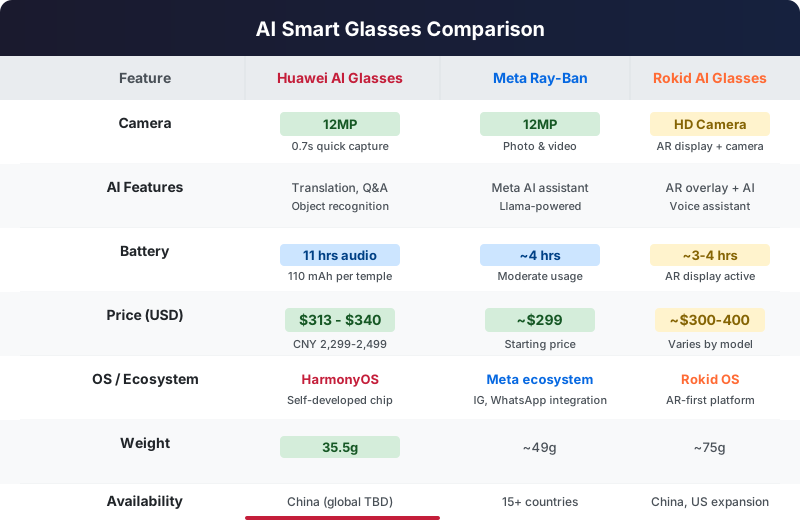
Huawei's launch feature set points to live streaming, first-person video calls, translation, voice assistance, and object-recognition use cases. Those features have obvious value in business travel, tourism, factory visits, retail, and service settings, but the article does not assume Huawei's software quality equals Meta, Apple, or Samsung before independent reviews and regional availability are clear.
These are not incremental improvements over Huawei's earlier Eyewear line, which was essentially audio-only glasses with basic notification support. This is a different product category. The earlier Huawei Smart Glasses 2, launched in 2024, offered audio playback, call handling, and smart notifications broadcast through an open-ear speaker design. They ran HarmonyOS 4 and supported dual-device connections. Useful, but fundamentally a Bluetooth headset shaped like glasses. The new AI Glasses add the camera and AI processing layer that transforms the form factor from an audio accessory into a genuine wearable computer.
The reported self-developed chip deserves attention, but it should not be overread. A wearable chip can be smaller, lower power, and less process-node sensitive than a flagship phone SoC. That suggests Huawei is treating wearables as a serious hardware platform, but without a teardown it remains a launch-reported silicon claim rather than proof of a new domestic foundry breakthrough.
Why Smart Glasses, Why Now
Third-party market estimates cited in launch coverage put 2025 AI-glasses shipments in the low single-digit millions globally and show very fast year-on-year growth from a small base. Those numbers are tiny beside smartphones, but the growth trajectory explains why Chinese technology companies are moving before the category has settled.
The competitive landscape in China's smart glasses market reads like a who's who of the country's technology ecosystem:
- Alibaba launched Quark AI Glasses, powered by its Qwen large language model, with AR text overlay capabilities
- Rokid, a Hangzhou-based AR company, is preparing to enter the US market directly challenging Meta's Ray-Ban
- Xiaomi is developing its own Ray-Ban Meta competitor leveraging its hardware supply chain
- XReal continues to refine its portable display glasses
- Huawei entered with HarmonyOS integration and its custom chip
Meta currently leads the global market with Ray-Ban Meta smart glasses, but the company has no meaningful presence in China. Meta's social media platforms -- Facebook, Instagram, WhatsApp -- are blocked, and by extension, its hardware distribution and AI services face significant barriers. That creates a vacuum in the world's largest consumer electronics market. Chinese companies are competing for domestic market share right now, knowing that the winner at home gains the scale and iteration speed to compete globally.
This is the familiar Chinese hardware path when it works: use the domestic market for fast iteration, then test export markets once the product, channel, and software stack are mature enough. Smart glasses have not proven that path yet.
The Sanctions Angle: A Category Beyond Restrictions
Huawei has been on the US Entity List since 2019. The restrictions prevent the company from buying American technology -- including chips fabricated using US-origin equipment -- without government approval. The practical impact on Huawei's phone business was severe: loss of Google Mobile Services, restricted access to advanced fabs, and an inability to use cutting-edge process nodes for its Kirin chips.
Smart glasses sidestep most of these constraints.
First, the chip requirement is different. You do not need a 3nm or 5nm process to build a capable wearable processor. The practical inference is that a glasses chip can lean more heavily on mature-node manufacturing than a flagship phone SoC, but the article does not identify the foundry or node because those details have not been independently confirmed in the sources used here.
Second, the software dependency is different. HarmonyOS gives Huawei a domestic operating layer that does not require Google Mobile Services. The AI experience can be built around Huawei's own assistant and model stack, though overseas usefulness will still depend on languages, app support, privacy controls, and local compliance.
Third, the supply chain. Smart glasses use commodity components -- speakers, microphones, cameras, accelerometers, Bluetooth modules -- sourced from mature, globally available supply chains. There is no single chokepoint analogous to the advanced lithography bottleneck that constrains Huawei's phone ambitions.
Huawei's broader chip strategy shows the depth of its self-sufficiency push: more domestic design, more domestic manufacturing partnerships, and more product-specific silicon where the use case allows it. The eyewear chip, if the launch reporting is accurate, sits at the lower-power end of that strategy. Huawei's Ascend AI chips sit at the opposite end and face much more direct U.S. export-control scrutiny under BIS advanced-computing guidance.
The glasses exist in a less contested space than flagship phones or data-center AI accelerators. They are consumer electronics, they can use more mature technology, and they target a market category where today's most sensitive controls are less directly aimed. That could change if Washington expands the scope, so the safer reading is "less constrained," not "unconstrained."
The Market Opportunity
At roughly $345-$400 depending on exchange rate and frame version, Huawei's AI Glasses sit in a competitive price band. Meta's Ray-Ban smart glasses start around $299 in the U.S. market, while Rokid and Alibaba-linked products vary by market and configuration.
But Huawei has structural advantages that its Chinese competitors lack:
Distribution network. Huawei operates physical retail stores and carrier or electronics-retail relationships across China and several overseas regions. Even without Google services on its phones, Huawei's brand recognition and retail footprint in many markets exceed those of Rokid, XReal, or Alibaba's hardware efforts. Whether that footprint will carry this specific glasses product depends on launch-market decisions.
Ecosystem integration. HarmonyOS connects the glasses to Huawei phones, tablets, watches, and even vehicles. For consumers already in the Huawei ecosystem, the glasses are an extension rather than a standalone purchase. This mirrors Apple's strategy with the Apple Watch and AirPods.
Brand positioning. Huawei carries premium brand associations in many markets outside the US. In the Middle East, Southeast Asia, and parts of Europe, Huawei is recognized as a high-end technology brand. Smart glasses benefit from this positioning more than budget phones do.
What Could Go Wrong
Several factors could limit Huawei's smart glasses ambitions.
Global availability remains uncertain. The glasses launched in China first, and Huawei has not confirmed international rollout plans. Without global availability, the product becomes a domestic curiosity rather than a sanctions workaround.
Samsung and Apple are coming. Both companies are reportedly developing AI glasses for 2026-2027 launch. When Apple enters a product category, it tends to reshape consumer expectations and pricing structures. Huawei's window of opportunity may be measured in months, not years.
Regulatory risk. US export controls are not static. If Huawei's wearables business grows significantly, Washington could extend restrictions to cover additional product categories. The Commerce Department has already shown willingness to expand the scope of Huawei-related controls.
Market maturity. Smart glasses remain a niche category. Even Meta's Ray-Ban glasses have not reached mainstream adoption. The use cases -- translation, photography, voice assistant -- are compelling but not yet essential for most consumers. Privacy concerns around always-on cameras mounted on faces also persist, particularly in markets with strict surveillance regulations like the EU. Huawei will need to navigate both consumer acceptance and regulatory approval in each market it enters.
AI model dependency. The quality of the glasses' AI features depends heavily on the underlying language models and computer vision systems. Huawei's in-house AI models have improved substantially, but they compete against Meta's Llama-powered assistant and whatever Apple eventually ships. If the AI experience falls short of competitors, the hardware advantages -- lightweight frame, good battery life -- will not compensate.
The Bigger Picture
Huawei's AI glasses are interesting as a product. They are more interesting as a strategy.
The company is demonstrating that US export controls, while damaging to its phone business, have not eliminated its ability to innovate and ship competitive hardware. By shifting focus to product categories where the restrictions matter less -- wearables, EVs, industrial equipment, enterprise networking -- Huawei maintains a global technology presence without directly confronting the semiconductor bottleneck.
This approach has historical precedent. Japanese companies in the 1980s and 1990s maintained global competitiveness in consumer electronics despite trade friction with the US by shifting toward higher-value categories and building proprietary ecosystems. Huawei appears to be following a similar trajectory.
The smart glasses market is also a test case for whether Chinese companies can compete in a new product category from the start rather than entering later as low-cost followers. In smartphones, Chinese brands often built market share on price before moving upmarket. In EVs, companies like BYD used batteries, vertical integration, and domestic scale to challenge incumbents. In smart glasses, Chinese companies are entering while the category is still undefined. The outcome will reveal something useful about Chinese product innovation, but it is too early to call the result.
For consumers outside China, Huawei's glasses offer a preview of the competitive dynamics ahead. Multiple Chinese technology companies are building capable AI wearables with distinct approaches -- Huawei's ecosystem integration, Alibaba's AI model prowess, Rokid's AR display technology. Competition this intense in a nascent category tends to accelerate both innovation and price pressure. That is good news for anyone considering smart glasses, regardless of which brand they ultimately choose.
The real question is not whether Huawei's AI glasses succeed as a specific product. It is whether they signal a broader pattern: Chinese technology companies looking for hardware categories where domestic software, mature-node silicon, camera/audio integration, and fast retail iteration matter more than access to the most restricted chips. If smart glasses become a global Chinese hardware category, Huawei's April 2026 launch may matter. If the product stays China-only or the use case remains niche, it will be a useful footnote. The evidence is not yet conclusive. The strategic experiment is real.
Claim Confidence File
| Claim | Confidence | Evidence boundary |
|---|---|---|
| Huawei launched AI glasses in April 2026 with camera, translation, HarmonyOS, and China-first pricing | High | Supported by multiple launch reports and SCMP coverage; exact regional availability can change. |
| The glasses are less constrained than flagship phones by advanced-chip controls | Medium-high | This is an export-control and hardware-requirement inference, not a formal legal conclusion. |
| The reported self-developed eyewear chip proves a domestic foundry breakthrough | Low | The article does not make this claim; no teardown or foundry confirmation is used. |
| Huawei can use this category for global export recovery | Medium | Plausible strategy based on brand, HarmonyOS, and retail footprint; still unproven because global rollout is uncertain. |
| Smart glasses will become the next Chinese hardware success story | Low | Treated as a scenario, not a forecast. |
Methodology And Source Notes
This analysis is based on Huawei launch material as reported by Chinese technology media, market data from third-party research firms, reporting from SCMP, TechNode, HuaweiCentral, and Notebookcheck, and public export-control documentation from the U.S. Commerce Department. Pricing was converted at approximate exchange rates as of the launch window. Market figures for AI glasses are estimates based on available industry data and may differ from final reported figures. The article separates verified launch facts, market estimates, supplier claims, and China Made & Tech interpretation.
Frequently Asked Questions
Are Huawei AI glasses a phone replacement?
No. They are better understood as an ecosystem accessory: a wearable interface for camera, audio, translation, assistant, and phone-connected AI features. The smartphone still provides much of the compute, account, and app ecosystem value.
Why does this product matter for the sanctions story?
Smart glasses sit in a category where Huawei can still combine industrial design, wearables, software, and AI services without needing to compete head-on in the most restricted flagship-phone chip race. That makes the product strategically interesting even if volumes remain modest.
What is the biggest adoption risk?
Consumer habit is the largest risk. Smart glasses must prove that translation, camera, voice assistant, and notifications are useful enough to justify wearing a camera-equipped device in public. Privacy rules and social comfort will matter as much as hardware.
How should buyers compare Huawei with Meta, Samsung, or Apple?
Compare ecosystem fit, camera quality, AI assistant quality, battery life, weight, privacy controls, app support, and regional availability. The best product for a China-based user may not be the best product for a US or EU user.
Related Entries
- Huawei Comeback Story: How Sanctions Remade It -- How Huawei survived US sanctions and rebuilt its chip supply chain
- SMIC Explained: China's Chipmaking Limits (2026) -- Why China's foundry stack still shapes Huawei hardware strategy
- China EUV Prototype: What It Proves And What It Does Not -- The lithography bottleneck behind China's advanced-chip limits
- Shenzhen Manufacturing: Complete Ecosystem Guide (2026) -- The hardware ecosystem behind fast consumer-electronics iteration