
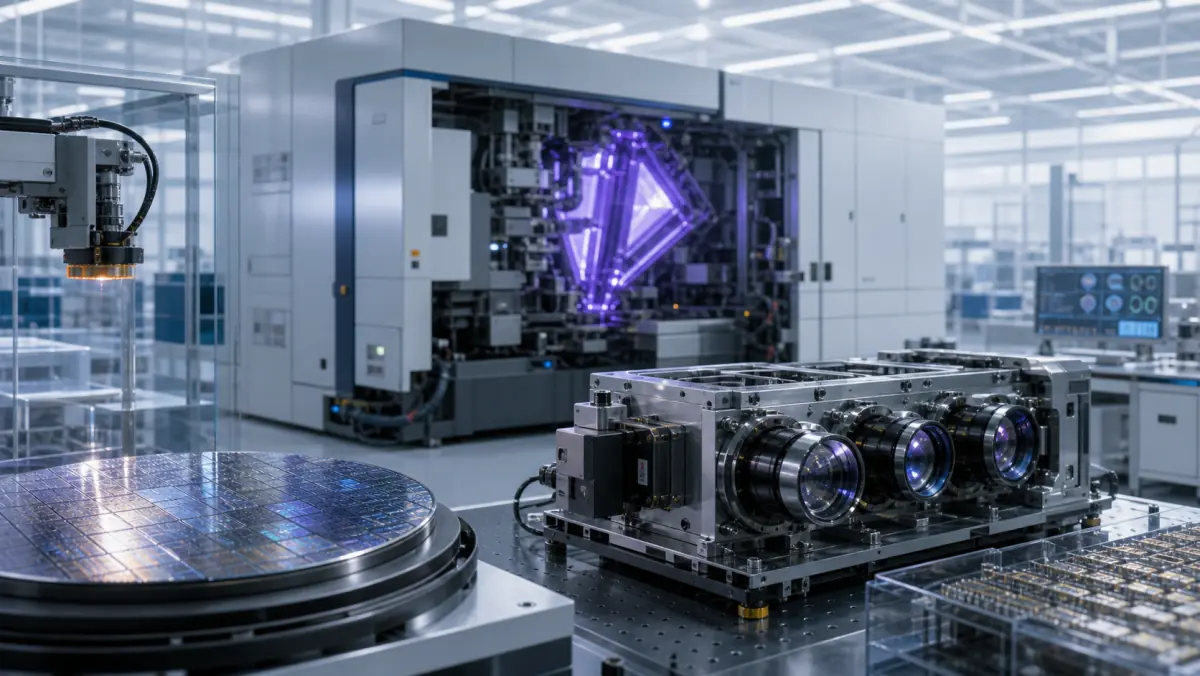
The useful question about China's reported EUV lithography prototype is not "has China cracked ASML?" It has not. The useful question is narrower: what does a reported working prototype prove about China's semiconductor-equipment system, and what does it still fail to prove about production-grade chipmaking?
Based on the Reuters-reported project account, public follow-up coverage, and ASML's later denial that any EUV machine or EUV-specific component was shipped to China, the strongest reading is this: China appears to be making progress toward a domestic EUV demonstrator, but the reported system has not produced a working chip and should not be treated as an imported ASML tool. It may generate EUV light and validate parts of the integration path. It does not yet show production uptime, wafer throughput, overlay precision, contamination control, serviceability, or commercial repeatability.
That distinction is the whole story. For analysts, suppliers, and policy readers, the prototype matters as evidence of intent, talent mobilization, and subsystem progress. For anyone asking whether China can mass-produce advanced chips without ASML today, it is not enough. The distance between "operational prototype" and "machine that can manufacture competitive chips at scale" is measured in years of optics, light-source, metrology, resist, software, and service engineering.
What Reuters Actually Reported
The detailed picture comes from a December 2025 Reuters exclusive by Fanny Potkin, drawing on sources described as having direct knowledge of the project. Because much of the account depends on anonymous project sources, the right way to read it is as a reported project file, not as independently audited machine data. The key reported points:
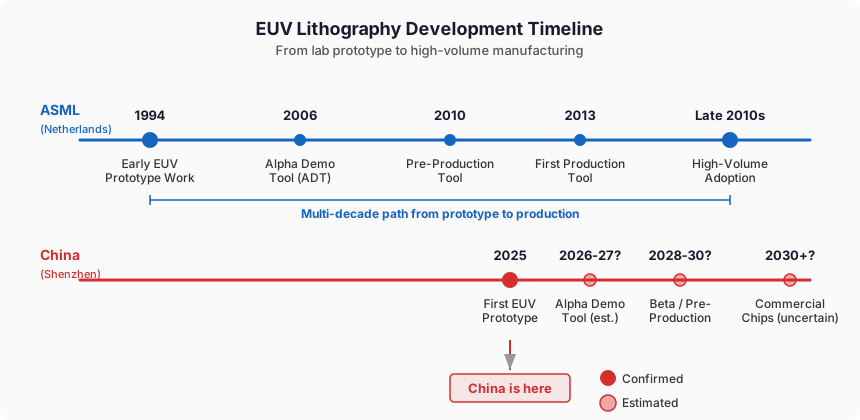
- A prototype was reportedly completed in early 2025 in Shenzhen by a team that included former ASML engineers and other semiconductor specialists.
- The machine was described as operational and generating extreme ultraviolet light, but it had not etched functioning circuits onto silicon wafers.
- Huawei is described as a supply-chain coordinator across parts of design, equipment, manufacturing, and final product integration, while the Reuters account frames the effort as government-backed.
- The government's internal target is 2028 for producing working chips on the prototype, but people close to the project say 2030 is more realistic.
- Recruits were given false names and ID cards. One veteran Chinese engineer from ASML was surprised to find, upon arrival, that colleagues recognized him but were using aliases themselves.
- About 100 recent university graduates are focused on reverse-engineering components, with individual desk cameras documenting their disassembly and reassembly work.
The boundary is just as important as the claim. ASML has said no EUV system has ever been sold into China, and in June 2026 it also denied that any EUV machine or EUV-specific component had been shipped there. That makes the article's central question narrower: not "did China obtain an ASML scanner?", but "how far can China get with domestic integration, public technical knowledge, recruited expertise, and any non-EUV or secondary-market inputs it can lawfully or illicitly access?"
Source File
This article separates reported machine status from production readiness. It was reviewed on 2026-07-03. The project account is based on Reuters' December 2025 investigation, with public follow-up coverage through Tom's Hardware's summary of the Reuters report. The counter-boundary is ASML's June 2026 denial, summarized by Tom's Hardware, that no EUV machine or EUV-specific component was shipped to China. The benchmark for EUV system complexity comes from ASML's own EUV lithography system materials. The Chinese industry-policy framing is checked against SCMP's report on senior chip executives calling for a national drive to build "China's ASML" and China Daily's 2026 government work report coverage of advanced manufacturing priorities. For the export-control context, we use the U.S. House Select Committee report on restricted chipmaking equipment sales, Selling the Forges of the Future.
Claim Confidence File
| Claim | Confidence | Evidence boundary |
|---|---|---|
| China's reported EUV prototype is a strategic signal, not production-grade chipmaking proof | High | Based on Reuters-reported project details, ASML denials, and the article's prototype-versus-production boundary. |
| Generating EUV light or completing a prototype proves high-volume manufacturing readiness | Low | The article separates demonstrator progress from uptime, overlay, throughput, contamination control, serviceability, and yield. |
| ASML's public position matters because the prototype should not be treated as an imported ASML scanner | High | Supported by ASML statements/reporting cited in the article. |
| The article can verify classified project timelines or chip output independently | Low | It relies on public reporting and clearly labels timelines as reported targets or estimates. |
The Prototype vs. Production Gap
ASML's own timeline is the most instructive comparison. ASML describes EUV as a multi-decade industrialization project: early industry prototypes in the 1990s, alpha demo tools in 2006, pre-production tools in 2010, production systems in 2013, and high-volume adoption only after years of customer process learning. That history matters because the hard part was not merely making EUV light. It was turning a physics demonstrator into a tool that fabs could run repeatedly, economically, and with useful yield.
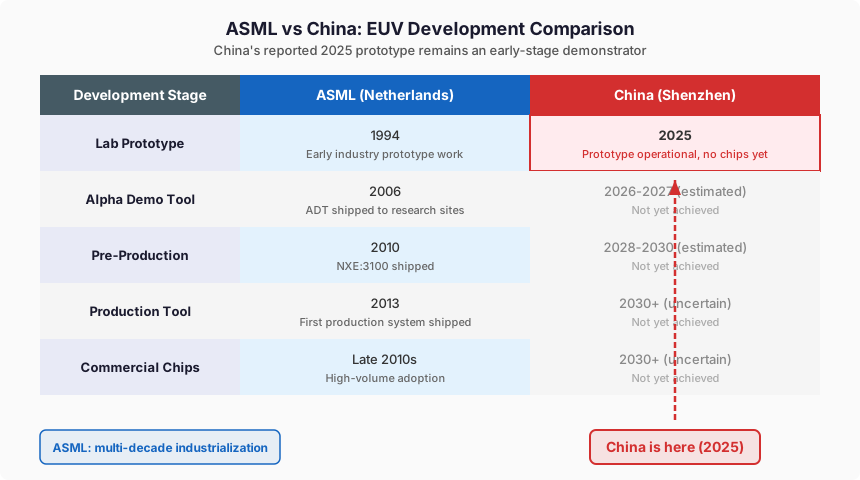
China has some advantages ASML did not. EUV is no longer theoretical — the basic physics and engineering approaches are documented in patents, academic papers, and ASML's publicly described system architecture. China is not inventing from zero. It also has the benefit of state-directed resource mobilization at a scale that even ASML, with its 5,000-plus supplier network, cannot match for sheer intensity of effort.
But the disadvantages are equally real, and they cluster around precision manufacturing at the bleeding edge.
The Optics Problem
The single biggest bottleneck is the optical system. ASML's EUV machines use mirrors made by Germany's Carl Zeiss AG that take months to produce and require surface precision measured in picometers — trillionths of a meter. These are among the most precisely manufactured objects ever created.
The Reuters-reported project account points to Chinese optics work, including institutions such as the Changchun Institute of Optics, Fine Mechanics and Physics, as part of the domestic integration path. But the sources also describe the optics as still requiring significant refinement, which in semiconductor engineering terms means they are not yet close to what Zeiss supplies for production ASML tools.
This is not a problem that money alone can solve. Zeiss spent decades developing its mirror manufacturing capability. The precision is cumulative — built through generations of instrument makers, process engineers, and measurement scientists working in lockstep. You can recruit former ASML engineers who understand the specifications, but building the industrial ecosystem to actually produce optics that meet those specifications is a different challenge entirely.
The Light Source Challenge
EUV lithography works by firing a CO2 laser at molten tin droplets 50,000 times per second, generating plasma at roughly 200,000 degrees Celsius. The resulting extreme ultraviolet light is then focused by mirrors onto the silicon wafer.
For production, the light source needs to deliver sufficient power reliably, with minimal contamination, for thousands of hours of operation. That is the benchmark analysts should use: enough power, enough reliability, and low enough contamination to support fab use rather than a lab demonstration.
The prototype has generated EUV light. Generating it with the stability, power output, and cleanliness required for high-volume manufacturing is another matter entirely.
Scale and Integration
ASML's most advanced EUV systems are roughly the size of a school bus and weigh 180 tons, with 100,000 components from 5,000 suppliers. The three Chinese semiconductor executives who published their March 2026 analysis in Science and Technology Daily made the scale vividly clear: ASML's EUV equipment has 100,000 components from 5,000 suppliers, with ASML "merely serving as the integrator." This is not a single-invention problem. It is an industrial ecosystem problem.
The reported Chinese prototype is described as much larger than an ASML system. If accurate, that is a telling detail. In semiconductor equipment, size is not neutral. A larger machine is harder to install, harder to maintain, harder to replicate across multiple fabs, and harder to iterate on quickly. ASML's compact form factor was not an aesthetic choice — it was the result of years of engineering optimization that reduced the machine's footprint while increasing precision and throughput.
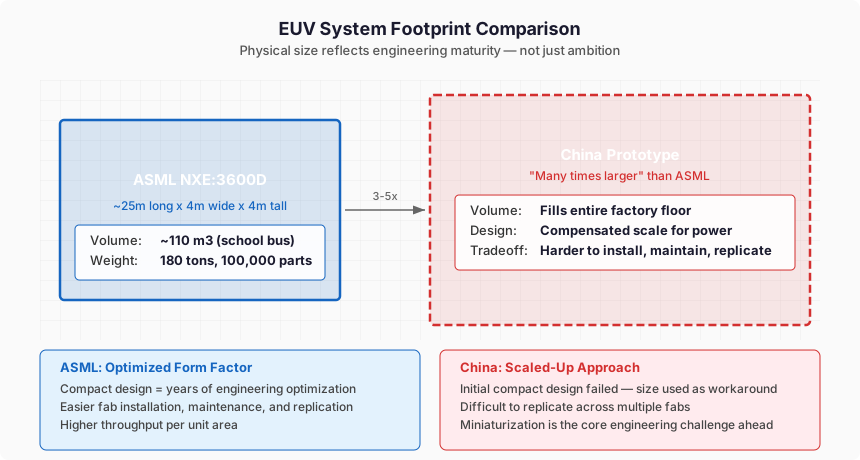
A machine that fills an entire factory floor is an impressive engineering achievement. A machine that chipmakers can install in a fab, operate cost-effectively, and maintain at high uptime is a different product altogether. The miniaturization and integration challenge is not trivial — it is, in many ways, the core engineering challenge. Every component must not only work in isolation but work in synchronization with every other component, under conditions of extreme precision, for thousands of hours of continuous operation.
How China Got Here: Talent, Knowledge, And Integration
The human pipeline behind this project deserves attention on its own. The Reuters-reported account describes a project that relied on experienced semiconductor engineers, university graduates, compartmentalized work, and strict secrecy. That is a plausible path for a country trying to compress learning time in a blocked technology stack.
It is also a reminder that EUV is not a single machine problem. Knowing the target architecture helps, but it does not automatically reproduce the supplier ecosystem. Engineers can carry tacit knowledge about integration, testing, failure modes, and supplier specifications. They cannot instantly recreate decades of mirror production, source reliability, contamination management, stage metrology, service infrastructure, and fab process integration.
That distinction keeps the analysis grounded. Talent acquisition can accelerate a demonstrator. It does not by itself prove a production tool.
The Parts Pipeline: What A Prototype Can Hide
The parts question should be handled carefully. Reuters' account and later reporting discuss salvaged parts, reverse engineering, and secondary-market sourcing, while ASML says no EUV machine or EUV-specific component has been shipped into China. Both facts can be true if the Shenzhen effort uses domestic subsystems, general industrial inputs, non-EUV lithography parts, teardown knowledge from older equipment, and recruited expertise without containing an ASML EUV scanner.
That still leaves a hard scaling problem. A prototype can tolerate one-off substitutions, oversized assemblies, manual calibration, and fragile sourcing. High-volume manufacturing cannot. A fab tool needs repeatable components, validated suppliers, documented service procedures, spare-parts availability, and years of process learning. You cannot scale a production line on clever workarounds alone.
This is why ASML's denial matters for analysts. If the system is not a diverted ASML EUV scanner, then the question shifts from enforcement failure to domestic-industrial capability. That question is more important, and also harder to answer from public evidence.
What the Industry Is Saying
In March 2026, three of China's most senior semiconductor executives — Zhao Jinrong (chairman of Naura Technology), Chen Nanxiang (chairman of Yangtze Memory Technologies), and Liu Weiping (chairman of Empyrean Technology) — published a joint article in Science and Technology Daily that was remarkably candid about the challenges ahead.
They acknowledged that while different Chinese institutions have made "breakthrough progress" in individual EUV subsystems — laser light sources, wafer stages, and optical systems — integrating these components into a complete system remains the key challenge for the 15th Five-Year Plan period (2026-2030).
Their proposed solution: a coordinated national effort to create "China's ASML," with unified allocation of funds and human resources across institutions. The framing itself reveals the gap. When your industry leaders are publicly calling for the creation of something that already exists in prototype form, you are hearing an implicit admission that the prototype alone is not enough.
The executives also identified bottlenecks in electronic design automation (EDA) software and basic materials — silicon wafers, electronic gases — as areas requiring national-level coordination. This is a broader point worth understanding: lithography is the most visible bottleneck in China's semiconductor push, but it is far from the only one. The supply chain for advanced chipmaking involves hundreds of specialized inputs, and China faces constraints across many of them. The focus on EUV is understandable given its symbolic and practical importance, but the actual path to semiconductor self-sufficiency runs through dozens of equally challenging materials and equipment challenges.
China's 2026 government work report, released the same week, designated semiconductors as a core pillar alongside aviation, biotechnology, and the low-altitude economy, but notably made no specific mention of lithography machines — calling instead to "improve advanced process manufacturing capabilities."
Why This Still Matters
It would be easy to dismiss the prototype as a curiosity — an impressive science project that changes nothing in the near term. That would be wrong, for three reasons.
First, it demonstrates intent backed by resources. If the Reuters account is directionally correct, this was a classified, multi-year project involving substantial engineering labor and supplier coordination. China is not dabbling. It has committed to a sustained effort to achieve EUV capability, and it appears able to mobilize enough talent to make technical progress.
Second, it changes the timeline debate, even if it does not eliminate the gap. ASML CEO Christophe Fouquet said in April 2025 that China would need many years to develop EUV technology. The reported prototype does not disprove that view, but it does suggest outside observers should track the program as an active integration effort rather than a distant aspiration.
Third, it underscores the limits of export controls as a long-term strategy. Restrictions bought time — probably several years. But they also created a powerful incentive for China to develop indigenous capability, and the talent and resource mobilization that resulted may ultimately prove more consequential than the delays imposed. As we noted in our analysis of SMIC explained, sanctions often redirect rather than restrict. They created a captive domestic market for Chinese chipmakers, and now they have accelerated the push for domestic equipment.
For readers trying to understand the broader semiconductor landscape, SMIC explained covers the foundry capability picture, while the U.S. House Select Committee export-control report cited above explains the restricted-equipment context. China's domestic equipment ecosystem is the next layer to watch, but this article only links to published source files.
What Analysts Should Track Next
The next useful signals are not slogans about "breakthroughs." They are evidence of production-readiness:
| Signal | Why it matters |
|---|---|
| Stable EUV source power over long runs | proves the light source can support fab use, not only lab operation |
| Optics quality and contamination control | determines whether wafers can be patterned at usable yield |
| Wafer-stage and overlay performance | shows whether the system can align layers repeatedly |
| Resist, mask, and pellicle supply | EUV is a materials ecosystem, not just a machine |
| Demonstrated chip output | separates a prototype from a manufacturing tool |
| Service and uptime data | determines whether fabs can run the tool economically |
| Supplier repeatability | shows whether China can build more than one demonstrator |
The Bottom Line
The reported Chinese EUV prototype is strategically significant, but it should be described with disciplined language. It represents reported technical progress achieved at significant cost and organizational effort. It also appears to sit at an early demonstrator stage, and the distance from there to production-grade EUV is where the real work begins.
The most informed estimate — from people inside the project — puts working chips from a Chinese EUV system at 2030, not 2028. That is five years of sustained engineering, integration, and optimization, assuming no major setbacks. Given the complexity of the optics, light source, and systems integration challenges, setbacks are more likely than not.
The strategic implication is not that China has "cracked" EUV. It is that China has decided to crack EUV, has committed the resources to try, and has made enough progress to credibly pursue the goal. Whether it succeeds on a 5-year, 10-year, or 15-year timeline depends on variables — optics breakthroughs, industrial ecosystem development, continued talent acquisition — that are genuinely uncertain.
What is certain is that the export control regime that denied China ASML machines has also guaranteed that China will keep pouring capital, talent, and policy attention into domestic lithography. The reported prototype is one signal of that response. In the meantime, China's mature-node capacity continues to expand, generating revenue and industrial experience that can fund long-cycle equipment projects.
Frequently Asked Questions
Does a Chinese EUV prototype mean China can mass-produce advanced chips now?
No. A prototype is a meaningful engineering milestone, but production EUV requires stable optics, light source power, metrology, contamination control, resist process integration, and factory uptime. The gap between demonstration and fab production is the hard part.
Why does the prototype matter if ASML still leads?
It matters because it shows China is mobilizing talent, capital, and secrecy around the EUV problem at national scale. Even if the first production systems arrive years later, the prototype changes the timeline and the credibility of the domestic-equipment push.
What is the biggest technical bottleneck?
The hardest bottleneck is not one part. EUV depends on the full system: mirrors, light source, vacuum, stages, control software, resist, inspection, and serviceability. A weakness in any layer can make the machine unusable for high-volume chip production.
Can export controls stop the EUV program?
Export controls can slow the program and raise cost, but they also increase the incentive to build domestic tools. The practical question is whether delay buys enough time for allied chipmakers to extend their lead.
Methodology And Source Notes
This analysis draws on Reuters' December 2025 exclusive reportage by Fanny Potkin, public summaries of that reporting, ASML's public EUV system materials, ASML's June 2026 denial that any EUV machine or EUV-specific component had been shipped to China, SCMP reporting on Chinese chip executives' call for a national lithography push, and export-control background from the U.S. House Select Committee. Where claims are attributed to anonymous sources ("people with knowledge of the project"), we have treated them as reported claims rather than verified machine data. We distinguish throughout between confirmed facts, informed estimates, and speculation.
By China Made & Tech Team. Independent English field guide to China's niche hardware brands, hidden champions, founders, factory towns, and supplier clusters.