
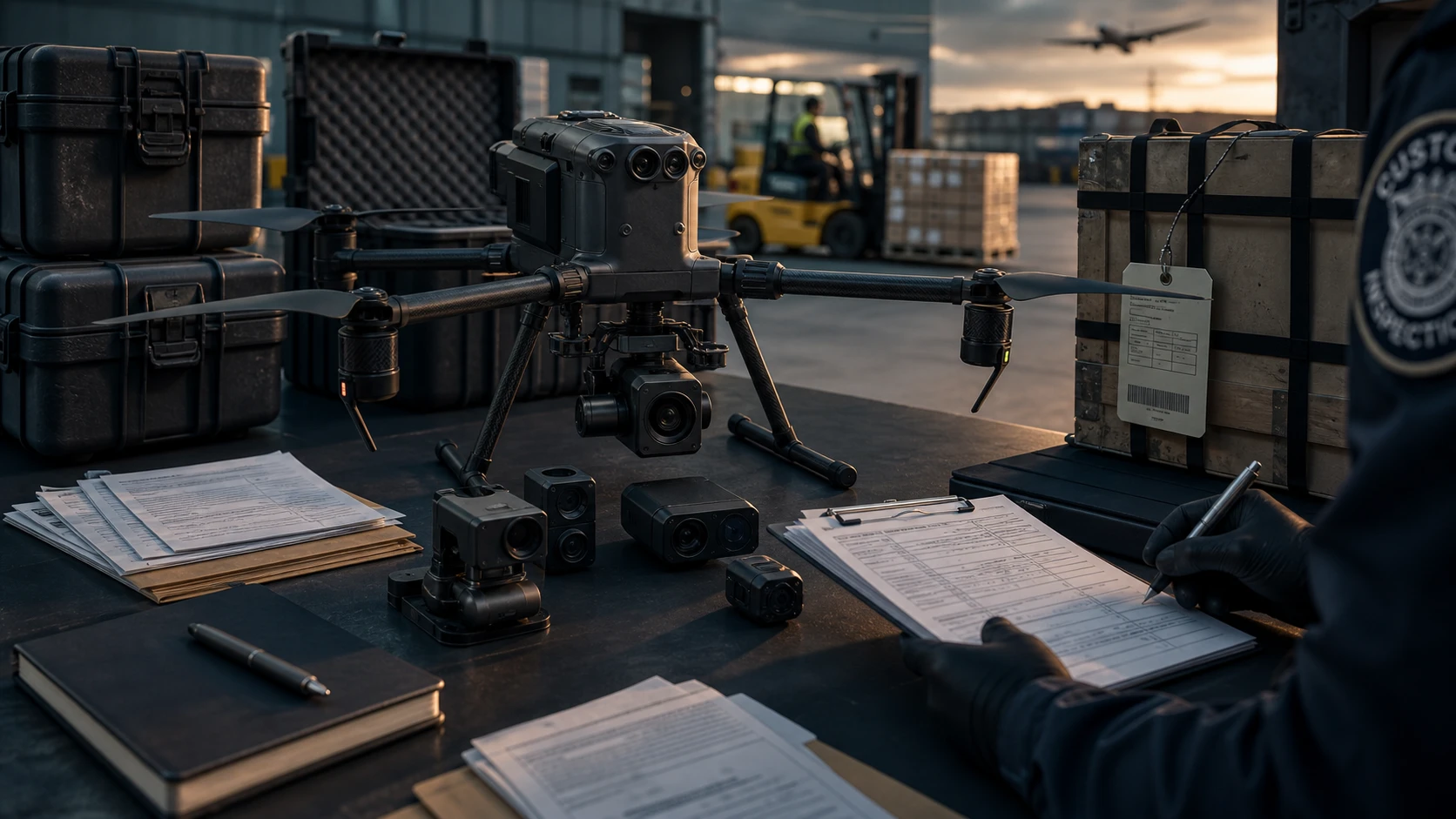
China's drone export rules are easy to summarize badly because there are two separate files in play.
The first file is the 2024 export-control adjustment that took effect on September 1, 2024. That package removed temporary controls on some consumer drones while adjusting control standards for certain unmanned-aircraft equipment and adding high-precision measurement-related items.
The second file is the 2026 customs layer. In June 2026, China's customs authority tightened export-declaration criteria for machine tools and drone-related products, effective June 30, 2026. That does not mean every drone is newly banned. It means exporters and overseas channels need cleaner classification, product descriptions, and document discipline.
Those two files belong in the same buyer checklist but not in the same mental bucket. One tells you whether a drone, component, payload, or measurement function may be controlled. The other tells you how the shipment is declared and documented. For overseas resellers, the real 2026 question is no longer "can I still source Chinese drones?" It is "which Chinese drone package, with which payload stack, under which export-control and customs-declaration file?"
This is a compliance-planning guide, not legal advice. The point is to help resellers ask the right classification, license, end-use, and documentation questions before a shipment becomes urgent.
Quick Answer
| Buyer question | Practical answer |
|---|---|
| Did China relax drone export controls? | Partly, in the 2024 adjustment. Certain consumer-drone temporary controls were removed, while selected component and measurement-related controls were adjusted. |
| What changed in 2026? | Customs export-declaration criteria for drone-related products became a filing and classification issue from June 30, 2026. |
| Why does this matter for overseas channels? | A reseller can no longer treat a camera drone, a mapping stack, and an enterprise inspection package as one paperwork category. |
| Who should pay attention first? | DJI channel partners, survey and inspection integrators, agricultural-drone exporters, and enterprise fleet buyers bundling payloads or specialized measurement modules. |
| Is this a legal conclusion? | No. It is a buyer file for preparing the questions an exporter, customs broker, or trade counsel should answer shipment by shipment. |
| Evergreen bridge | This belongs inside DJI Drone Dominance: How It Built a 70% Share, with follow-through from DJI Alternatives 2026: The Enterprise Buyer Reality and DJI's New Lock-In Is Workflow and AI, Not Just Airframes. |
Source File
This article now separates two rule layers. The export-control baseline is China's official 2024 adjustment published through the Ministry of Commerce export-control portal, which amended controls on unmanned aerial vehicles and related items, cross-checked against China's State Council English site on the UAV export-control adjustment and Reuters/VOA coverage of China's move to abolish temporary export controls on certain consumer drones. The 2026 filing layer is based on General Administration of Customs Announcement No. 78 on standardizing export declarations for drones and related items, the official customs explanatory note, China eVTOL News' summary of the June 30 declaration requirements, and Brownstein Hyatt Farber Schreck's analysis of China's tighter declaration criteria for machine tools and drone-related products. The operational buyer framing is connected to prior site work on DJI Drone Dominance: How It Built a 70% Share, DJI Alternatives 2026: The Enterprise Buyer Reality, and DJI's New Lock-In Is Workflow and AI, Not Just Airframes.
Correction Note (June 30, 2026)
An earlier version treated the consumer-drone relief, component-control adjustment, and 2026 customs filing update as one September 2026 rule change. This version separates the September 1, 2024 export-control adjustment from the June 30, 2026 customs-declaration update.
What The Rules Actually Say
The 2024 Ministry of Commerce adjustment said China would lift temporary export controls on certain consumer-grade drones while adjusting control standards for some unmanned-aircraft equipment and components. The policy rationale was national security and supply-chain stability, not a blanket retreat from drone controls.
The 2026 customs update is different. It is not a new consumer-drone green light. It is a declaration discipline issue for drone-related products and machine tools. For exporters, that means product attributes, technical parameters, controlled-item classification, and HS-code-driven filings need to line up more cleanly.
The extra source check matters because the Customs pages are not always easy to access from outside China. For the buyer file, the important point is consistent across the official pages, specialist reporting, and trade-law coverage: Announcement No. 78 is about more precise export declarations for unmanned aircraft, related equipment, key components, and civil counter-drone systems. It is not a blanket DJI ban and not a simple consumer-drone relief notice.
That combination tells you the state is trying to do two things at once:
- reduce unnecessary friction on parts of the ordinary civilian consumer market,
- keep a tighter hand on configurations that matter more for mapping, inspection, precision measurement, dual-use sensitivity, or strategic supply-chain scrutiny.
This is consistent with the broader Chinese drone story in 2026. China still wants to lead civilian and industrial drone manufacturing. It also wants more control over configurations that can drift into military, surveillance, precision-measurement, or politically sensitive end uses.
Why Resellers Should Stop Thinking In "DJI Or Not DJI" Terms
The simplest mistake is to read the rule change as only a DJI headline.
DJI matters because it anchors the global civilian and enterprise drone ecosystem, and because the site's existing coverage has already shown how hard it is to replace DJI in real workflows. But export compliance is not only about brand. It is about the exact package being sold.
| Old reseller shortcut | Better 2026 question |
|---|---|
| "This is a DJI drone" | Is this a consumer camera drone, an enterprise inspection kit, a mapping package, or a payload-driven workflow bundle? |
| "It is for civilian use" | Which payloads, measurement modules, and software functions could still trigger tighter review? |
| "The aircraft is the product" | Is the compliance-sensitive item actually the payload, sensor, or integrated measurement stack? |
Consumer Relief Does Not Mean Enterprise Relief
The line that matters most may be the easiest one to misread: China lifted temporary export controls for certain consumer drones in the 2024 adjustment.
That is good news for:
- hobby and creator-oriented drone channels,
- lower-complexity retail export,
- some education and prosumer use cases,
- distributors whose value proposition is mostly aircraft + batteries + accessories.
It is not the same thing as saying enterprise exporters can relax.
If the revised export-control layer captures high-precision measurement-related equipment, then the higher the drone bundle's value comes from measurement accuracy, specialized sensing, or industrial mapping capability, the less useful the consumer-drone relief becomes.
The Real Split Is Between Aircraft And Workflow
This is the deeper industry point.
China is increasingly comfortable exporting civilian flight hardware. It is more cautious when that hardware becomes part of a strategic workflow stack. A mapping or inspection sale may include:
| Workflow layer | Why it matters |
|---|---|
| Aircraft | The visible drone SKU |
| Payload | Camera, thermal, lidar, multispectral, or measurement module |
| Positioning / measurement | The layer most likely to trigger precision-related scrutiny |
| Software | Mapping, analysis, or flight-management stack |
| End-user context | Utility inspection, surveying, agriculture, public safety, or infrastructure |
DJI's Statement Matters For A Different Reason
DJI has consistently said its products are for civilian use only. That statement does not settle the compliance question, but it does show DJI wants to preserve room for normal commercial growth while separating itself from military end-use narratives.
This matches the company's broader 2026 posture. In recent months DJI has had to defend itself on several fronts:
- U.S. pressure on new-model market access,
- U.S. public-security and data-security scrutiny,
- the need to keep existing fleets operational,
- the need to expand enterprise workflow lock-in beyond the aircraft itself.
The 2024 export-control adjustment and the 2026 customs-declaration update give DJI and similar vendors a more nuanced home-country compliance story, but they also raise the documentation burden on channels that sell more than a basic consumer drone.
What Enterprise Resellers Need To Rebuild In The 2026 Filing File
If you are an overseas reseller or fleet buyer, the correct response is not panic. It is file hygiene.
The minimum 2026 checklist now looks like this:
| File | What to confirm |
|---|---|
| SKU split | Separate consumer, prosumer, and enterprise configurations in the product catalog |
| Payload map | Identify which payloads or sensors move the sale from simple retail into controlled workflow territory |
| End-use declaration | Tighten how the buyer describes use case, industry, and deployment environment |
| Component list | Recheck whether controlled measurement capability sits in the aircraft, payload, or bundled module |
| Lead-time planning | Build longer buffers for enterprise shipments that may need extra review or filing correction |
| Alternative bundle | Create a lower-risk package for markets that only need consumer-grade imaging |
A Better Way To Segment The Catalog
Resellers should consider a three-bucket model:
| Bucket | Typical examples | Compliance posture |
|---|---|---|
| Retail / creator | camera drone, spare batteries, standard controller | likely benefits most from consumer-drone relief |
| Prosumer / light commercial | photography, simple site imaging, light field documentation | still needs documentation discipline, but often lower complexity |
| Enterprise / measurement | mapping, precision surveying, infrastructure inspection, advanced agriculture, dock workflow | highest need for export-file review and payload-specific checks |
Why This Reinforces DJI's Moat Instead Of Weakening It
At first glance, more export scrutiny looks bad for Chinese drone firms. In practice, it may reinforce the position of the biggest players.
The reason is operational maturity. A large vendor and its top channel partners are better equipped to document payload configurations, segment catalogs, and support end-use compliance. Smaller exporters that rely on loose bundles and informal routing will feel the pressure first.
This is very similar to the logic behind DJI Drone Dominance: How It Built a 70% Share and DJI's New Lock-In Is Workflow and AI, Not Just Airframes. DJI's moat is not only the aircraft. It is the ecosystem's ability to turn hardware, software, service, and compliance into one workflow customers do not want to leave.
What Buyers Should Not Assume
Three assumptions need to die before the next enterprise shipment.
First, do not assume "consumer" and "civilian" mean the same thing in practice. A civilian sale with high-precision measurement capability can still sit in a more sensitive category than a plain camera-drone sale.
Second, do not assume the aircraft determines the entire rule outcome. Payload and end-use framing may matter as much as the aircraft body.
Third, do not assume a smooth past shipment means a smooth 2026 shipment. Distributors should rebuild paperwork and internal routing now, not after a key enterprise deal slips.
Buyer Takeaway
China's drone export-rule environment is not a blanket opening and not a blanket tightening. It is a sorting mechanism.
For consumer channels, that sorting may reduce friction. For enterprise channels, it raises the premium on classification discipline. The winners in 2026 will be the resellers and fleet buyers who can separate retail drones from measurement workflows, document payload stacks cleanly, and design alternative bundles before a customs filing or controlled-item mismatch makes a shipment urgent.
Claim Confidence File
| Claim | Confidence | Evidence boundary |
|---|---|---|
| The 2024 file removed temporary controls on some consumer drones while adjusting other UAV-related controls | High | Based on MOFCOM and State Council sources, with Reuters/VOA cross-checks. |
| GACC Announcement No. 78 took effect on June 30, 2026 for drone-related export declarations | High | Based on GACC materials and trade-law summaries; official Customs pages can be intermittently difficult to reach from outside China. |
| Announcement No. 78 is a blanket DJI export ban | Low | The article explicitly rejects this reading. The issue is declaration, classification, license, and end-use file discipline. |
| Enterprise bundles carry higher filing risk than simple consumer camera drones | Medium-high | Inference from controlled-item categories, payload sensitivity, and measurement-workflow use cases; still needs shipment-specific review. |
| Stronger documentation may reinforce large vendors' channel advantage | Medium | Industry interpretation, not an official policy statement. |
Methodology
This article was reviewed on July 6, 2026 to separate the 2024 export-control adjustment from the 2026 customs-declaration update. It uses MOFCOM, GACC, China's State Council English site, Reuters/VOA, China eVTOL News, and Brownstein Hyatt Farber Schreck as source checks. It is connected to prior site analysis in DJI Drone Dominance: How It Built a 70% Share, DJI Alternatives 2026: The Enterprise Buyer Reality, DJI Security Audit: What Enterprise Buyers Can Use, and DJI's New Lock-In Is Workflow and AI, Not Just Airframes. It treats the current state as a compliance signal and not as a substitute for shipment-by-shipment legal review by an exporter, customs broker, or qualified trade counsel.
Frequently Asked Questions
Does the June 30, 2026 rule ban DJI drone exports?
No. The practical issue is not a blanket ban; it is documentation, classification, end-use screening, and license-risk management. Resellers should treat the rule as a filing-file problem before treating it as a catalog-removal problem.
What should enterprise resellers collect before quoting affected models?
At minimum, collect model identity, HS / export classification assumptions, end-user identity, end-use description, destination, firmware / payload configuration, and any license or screening notes. The buyer file should explain why the specific shipment is allowed, not merely why the brand is familiar.
Should buyers avoid DJI because of the filing burden?
Not automatically. DJI's scale and enterprise ecosystem can still make it the strongest operational choice. The buyer decision should compare capability, support, compliance documentation, and alternative-vendor maturity rather than reacting only to the export-rule headline.