
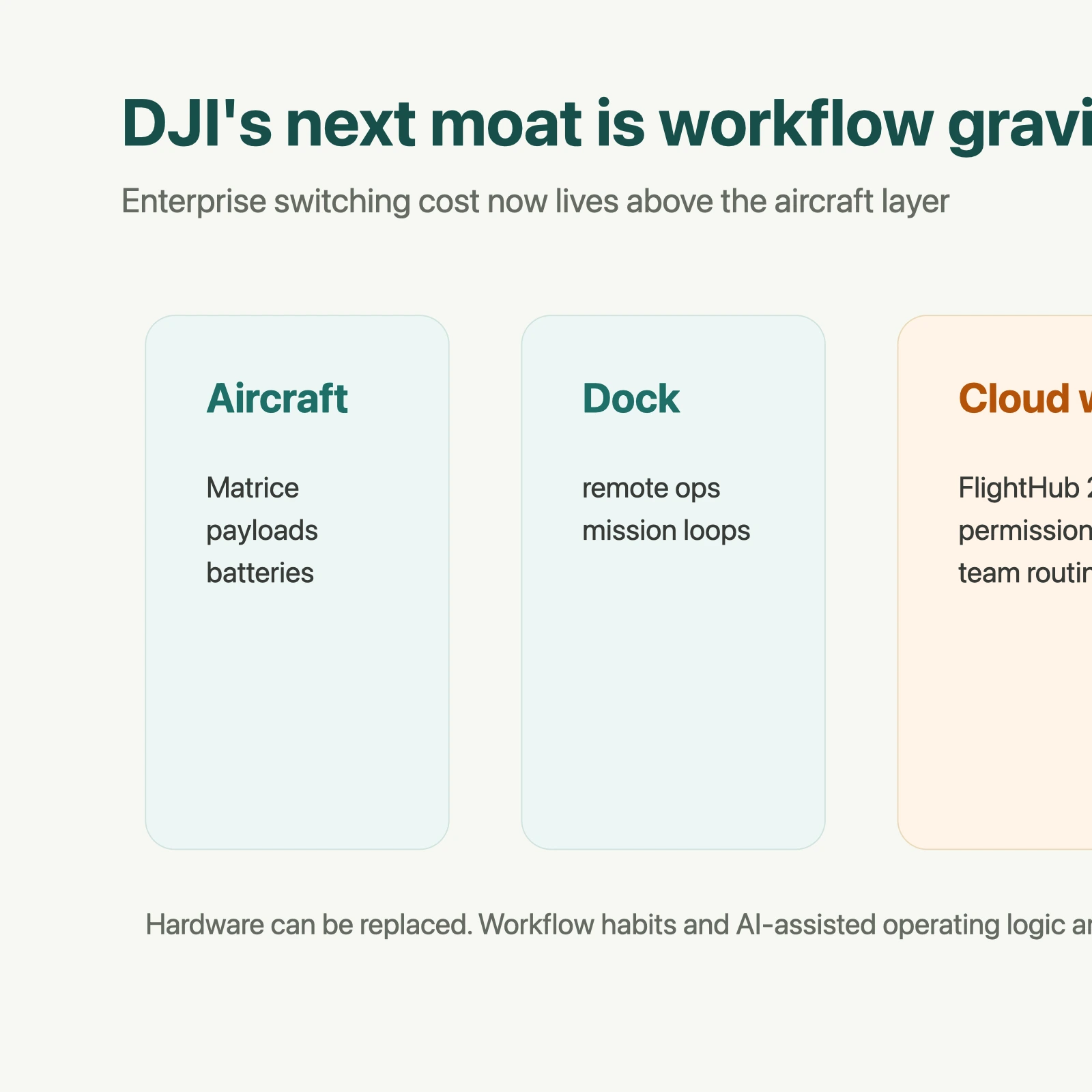
The hardest part of leaving DJI is increasingly not the drone.
It is the workflow wrapped around the drone: dock, controller, mission planning, team permissions, cloud review, route optimization, and now AI assistance.
That is the more important enterprise signal in DJI's latest product cycle. On 2026-04-02, DJI said FlightHub 2 added AI Copilot, multimodal AI route features, resource-library changes, and broader integration support. Separately, DJI Developer launched the 2026 Ecosystem Innovation Challenge, pushing third parties toward dock, payload, and software integrations on top of DJI's enterprise stack.
For enterprise buyers, this changes the migration question. The real decision is no longer only "Which aircraft matches the mission?" It is "How much of our operating system has already become DJI-shaped?"
Source File
| Source | What it supports | Why it matters |
|---|---|---|
| DJI FlightHub 2 April 2026 update | AI Copilot, multimodal route features, resource-library changes, and integration updates | Primary source for the workflow-and-AI moat |
| DJI Developer 2026 Ecosystem Innovation Challenge | Third-party dock, payload, and software integration push | Evidence that DJI is extending the ecosystem around enterprise workflows |
| DJI FlightHub 2 product page | Product scope for fleet management, live operations, route planning, and team coordination | Baseline source for the operating-layer analysis |
| FCC DA 26-454 | Software/firmware update waiver through at least 2029-01-01 for certain covered UAS | Policy context for why existing-fleet continuity is different from new standardization |
Quick Answer
| Layer | Old DJI moat | New DJI moat |
|---|---|---|
| Aircraft | flight performance, camera quality, reliability | still important, but more commoditized |
| Fleet management | basic mission planning and device control | cloud workflow, dock ops, permissions, remote response |
| Data review | manual human workflow | AI-assisted analysis, route optimization, and workflow suggestions |
| Ecosystem | batteries, payloads, dealers | APIs, developer tools, dock integrations, and operations software |
Why This Matters More Than Another Product Release
Most enterprise-drone comparisons still behave as if the procurement file ends at the aircraft.
That misses where operational dependence is building.
Fleet buyers who standardize on Dock, Matrice workflows, and FlightHub 2 are also standardizing:
- mission templates
- user permissions
- event-response logic
- data review paths
- remote-operations habits
- reseller and integrator training
Once those layers become embedded, even a technically acceptable alternative drone can feel expensive to adopt because the organization is not only changing hardware. It is retraining the operating model.
That is why this story belongs next to DJI Alternatives 2026: The Enterprise Buyer Reality rather than next to a generic product launch note.
The FlightHub 2 Update Shows Where DJI Wants The Margin
DJI's April update is revealing because it is not framed around airframe novelty. It is framed around workflow convenience.
According to DJI's own summary, FlightHub 2 now emphasizes:
- AI Copilot
- multimodal AI support in flight-route planning
- better dock and remote-operation workflows
- broader resource, integration, and operation coordination
Those features matter because they shift the product from "drone management tool" toward "operating layer for recurring field work."
That is a bigger strategic move than another sensor upgrade. A better camera can be matched eventually. A workflow habit is harder to displace.
AI Copilot Changes The Governance Question
AI Copilot should not be treated as a small interface feature. It changes who or what shapes the operator's next action.
In a manual workflow, a pilot or mission manager plans the route, reviews the scene, tags the issue, and writes the report. In an AI-assisted workflow, the platform may suggest priorities, flag anomalies, optimize routes, summarize field conditions, or make the operator's next task feel obvious. That can save labor. It also makes the vendor's software logic part of the organization's operational judgment.
For low-sensitivity inspection work, that may be a reasonable tradeoff. For public safety, critical infrastructure, insurance claims, evidence workflows, or regulated asset management, the buyer needs a governance file:
| AI workflow question | Why it matters |
|---|---|
| What data does AI Copilot read? | Determines whether imagery, telemetry, annotations, or user behavior become part of the workflow layer |
| What output does it generate? | Separates convenience suggestions from operational recommendations |
| Can suggestions be exported or audited? | Matters when a decision is challenged later |
| Can the feature be disabled by mission type? | Allows sensitive missions to run under stricter controls |
| Who sees logs and prompts? | Defines evidence, privacy, and vendor-access boundaries |
The Developer Challenge Confirms The Ecosystem Direction
The developer contest matters for the same reason.
DJI is not only selling fleets. It is encouraging third parties to build around enterprise scenarios that already assume DJI as the base platform. The challenge page highlights payload, dock, and software tracks rather than only consumer creativity.
That is ecosystem gravity.
Once a buyer's preferred analytics vendor, payload partner, or dock workflow performs best inside DJI's environment, the fleet becomes harder to replace for reasons that do not appear in a standard aircraft comparison spreadsheet.
Data Portability Is The Hidden Switching Cost
The weakest part of many drone migration plans is data portability.
Buyers often assume they can leave a vendor because they own the aircraft, batteries, payloads, and imagery. But a mature drone program also accumulates mission templates, flight logs, route histories, inspection annotations, user roles, dock routines, alert settings, customer report formats, API integrations, and training habits. Those assets can be harder to move than the drone itself.
A buyer should therefore separate three kinds of portability:
| Portability layer | What to test |
|---|---|
| Data export | Can imagery, telemetry, logs, annotations, and reports be exported in usable formats? |
| Workflow recreation | Can mission templates, approval steps, dock routines, and incident-response procedures be rebuilt on another platform? |
| Integration portability | Can GIS, CMMS, asset-management, evidence, or analytics systems keep working after the fleet changes? |
Procurement teams should ask for a portability test before expanding standardization. Export a representative mission history, rebuild a route and report on another platform, and calculate how many SOPs, integrations, users, and training documents would need to change. That exercise turns lock-in from a vague fear into a measurable cost.
This Changes The Alternative-Buyer Question
The usual alternative-buyer checklist asks:
- Can another aircraft fly as long?
- Can it carry the same payload?
- Is image quality close enough?
- Is the price acceptable?
That is now incomplete.
The more realistic alternative checklist is:
| Category | Buyer question |
|---|---|
| Aircraft | Can the new platform perform the mission safely and reliably? |
| Workflow | Can it replicate dock routines, mission templates, approvals, and incident response? |
| Data | Can it match current review, labeling, and reporting workflows without extra labor? |
| AI | Are route suggestions, automated review, or operator prompts equally mature? |
| Integration | Will current payload, API, cloud, and reseller relationships survive the switch? |
| Compliance | Does the migration reduce policy risk enough to justify the switching cost? |
A Lock-In Audit For Enterprise Fleets
Before adding more docks, subscriptions, or AI-assisted workflows, enterprise buyers should score lock-in by layer.
| Layer | Low lock-in | High lock-in |
|---|---|---|
| Aircraft | Other platforms can perform the same mission with similar payload and endurance | Mission requires DJI-only payloads, batteries, repair workflows, or operator habits |
| Dock operations | Dock routines can be reproduced on a second platform | Remote response, charging, route dispatch, and status monitoring are DJI-specific |
| Software | Data exports are complete and workflows are documented outside FlightHub 2 | Mission planning, approvals, user roles, and reports live mainly inside DJI tools |
| AI assistance | AI features are optional and auditable | Operators rely on AI suggestions that cannot be reviewed or recreated elsewhere |
| Integrations | APIs and downstream systems support multiple vendors | Key partners build primarily around DJI dock, payload, or cloud interfaces |
| Policy exposure | DJI is used only where customer/funding rules allow | Sensitive and grant-exposed missions depend on the same DJI stack |
Why The Regulatory Context Still Matters
Workflow lock-in would be a normal software story if the policy environment were stable. It is not.
The FCC's 2026-05-08 notice extending software and firmware support for already-authorized covered foreign-made drones through at least 2029-01-01 reduced some legacy-fleet maintenance risk. It did not normalize new procurement.
That means enterprises are living inside a contradiction:
- DJI still often sets the operational benchmark
- policy and funding constraints still raise long-term procurement risk
- the software layer makes departure more expensive with each new workflow dependency
This is why DJI Firmware Waiver 2029: What Enterprise Fleets Get and DJI Security Audit: What Enterprise Buyers Can Use both matter. Security evidence and firmware continuity help explain how current fleets survive. They do not remove the strategic risk of deeper stack dependence.
What Buyers Should Do Before Expanding DJI Standardization
The correct response is not panic and not blind standardization.
It is architecture discipline.
Before approving broader DJI deployment, a buyer should document:
- which parts of the workflow are aircraft-specific
- which parts are FlightHub- or Dock-specific
- whether mission data can be exported cleanly
- whether internal SOPs can be re-created on a second platform
- whether the switching cost is driven by hardware, software, or training
If the answer to every question points back to DJI-only workflows, the organization has more concentration risk than it may realize.
A Better Fleet Strategy
For many buyers, the strongest strategy is neither full exit nor full lock-in.
It is split architecture:
- keep DJI where mission economics and operating maturity remain hard to beat
- preserve at least one non-DJI pathway for sensitive, grant-exposed, or policy-heavy missions
- keep data and SOP documentation portable enough that migration remains possible
That requires discipline because convenience pushes in the opposite direction. AI Copilot, optimized routing, and integrated dock workflows reduce immediate labor. They also deepen future dependence.
What To Ask Before Renewing FlightHub Or Dock Subscriptions
Subscription renewal is the right moment to ask hard questions because the fleet team is already evaluating budget, users, and operational scope.
Ask DJI, the reseller, or the integrator:
- Which data types can be exported without losing annotations, route history, or report structure?
- Which AI Copilot outputs are logged, and can those logs be retained by the customer?
- Can AI features be disabled by mission, user group, or site?
- How are dock workflows documented outside the DJI interface?
- Which third-party integrations are standard APIs versus custom DJI-specific work?
- What happens to archived missions if the subscription ends?
- Can the organization run a parallel non-DJI workflow for sensitive missions without duplicating all reporting labor?
These questions do not assume the buyer should leave DJI. They make the dependence visible before it becomes too expensive to unwind.
Claim Confidence File
| Claim | Confidence | Evidence boundary |
|---|---|---|
| DJI added AI Copilot and related FlightHub 2 workflow features in April 2026 | High | Based on DJI's own FlightHub 2 update note. |
| DJI is pushing third parties to build around enterprise dock, payload, and software scenarios | High | Based on the DJI Developer 2026 Ecosystem Innovation Challenge. |
| AI Copilot creates data-governance and audit questions for sensitive fleets | Medium-high | Buyer-risk inference from feature scope; not an allegation of specific data misuse. |
| DJI workflow dependence can make migration resemble software replacement more than aircraft replacement | Medium-high | Operational inference grounded in fleet-management, dock, API, and reporting workflows. |
| Buyers should stop using DJI enterprise tools | Low | The article rejects this blanket conclusion and recommends split architecture based on mission sensitivity. |
The Real Story
The real story is not that DJI added another software feature.
The real story is that DJI's enterprise dominance is moving up the stack. Hardware leadership created the installed base. Workflow and AI can turn that installed base into something much harder to unwind.
For fleet buyers, that means the next procurement memo should not ask only whether the aircraft is best-in-class. It should ask whether the organization is comfortable letting one vendor define more of its operational logic.
That is a much bigger strategic decision.
Methodology
This article relies on DJI's FlightHub 2 April 2026 update note, DJI Developer's 2026 enterprise innovation challenge page, the public FlightHub 2 product page, and the FCC's DA 26-454 notice. Feature descriptions come from DJI. Lock-in, portability, and governance conclusions are China Made & Tech buyer-risk analysis.
Frequently Asked Questions
Is DJI lock-in mainly a hardware problem?
No. Hardware still matters, but the deeper lock-in is now workflow: FlightHub 2, dock routines, route planning, permissions, AI assistance, reporting, APIs, and reseller/integrator habits.
Does AI Copilot make DJI riskier for enterprise buyers?
It makes governance more important. AI assistance can reduce labor, but buyers should know what data it reads, what outputs it generates, whether suggestions are logged, and whether the feature can be disabled for sensitive missions.
What is the best way to test DJI switching cost?
Run a portability test. Export a representative mission history, rebuild the route/report workflow on a second platform, and count the SOPs, integrations, users, and training documents that would need to change.
Should buyers stop using DJI enterprise tools?
Not necessarily. Many buyers may keep DJI for missions where performance and workflow maturity are hard to beat. The safer strategy is split architecture: keep DJI where defensible, but preserve a non-DJI path for sensitive or policy-exposed work.