
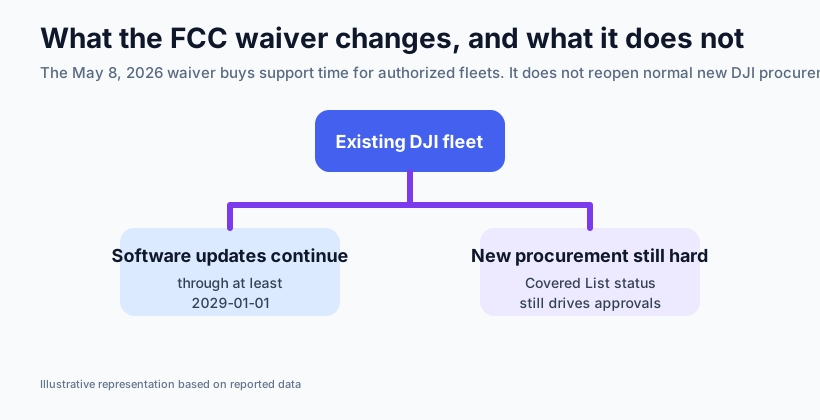
The May 8, 2026 FCC waiver was not a DJI comeback. It was a maintenance reprieve.
FCC Public Notice DA 26-454 extended and expanded the waiver that allows software and firmware updates for certain already-authorized foreign-made drones through at least 2029-01-01. That is important because without it, some operators would have faced the worst possible combination: still owning legal aircraft, but losing the updates needed to patch vulnerabilities and preserve normal functionality.
What the waiver did not do is just as important. It did not remove DJI from the Covered List. It did not normalize new imports. It did not make enterprise procurement officers forget the compliance problems already mapped in DJI Alternatives 2026: The Enterprise Buyer Reality.
Source File
This article was reviewed on 2026-07-06 against FCC Public Notice DA 26-454, AP reporting on Beijing's 2026 drone restrictions, and the related China Made & Tech page DJI Alternatives 2026: The Enterprise Buyer Reality. The waiver is treated as a legacy-fleet maintenance and cybersecurity-support signal, not as a normal new-procurement authorization. Enterprise teams should still separate existing-aircraft updates, new purchase approvals, agency-specific rules, data-security requirements, and mission continuity planning.
Quick Answer
For enterprise buyers, the new logic is straightforward:
| Situation | What changed | What did not change |
|---|---|---|
| You already operate an approved DJI fleet in the United States | Software and firmware updates can continue through at least 2029-01-01 | The regulatory cloud over DJI procurement still exists |
| You are deciding on a new enterprise drone purchase | Very little | Covered List status and procurement constraints still dominate |
| You work in public safety, critical infrastructure, or federally linked programs | Maintenance risk is lower for legacy fleets | Compliance risk for new buying is still the central question |
What the FCC Actually Said
The key language in DA 26-454 is operational, not political. The FCC's Office of Engineering and Technology said the waiver of prohibitions on certain software and firmware permissive changes would be extended at least until 2029-01-01. It also expanded the waiver so already-authorized foreign-made UAS could continue receiving software and firmware updates that mitigate harm to U.S. consumers.
That wording matters for two reasons:
- It applies to devices already authorized before they were added to the Covered List.
- It recognizes that cutting off security and functionality updates can itself create consumer and operational harm.
In plain English: the FCC is not endorsing DJI. It is admitting that freezing patches on already-deployed drones would create a different kind of risk.
Why This Is a Fleet Story, Not a Sales Story
This is where many headlines get sloppy.
If you run a drone program, there are two very different questions:
- Can we continue operating and maintaining the fleet we already have?
- Can we keep buying new units of the same platform without creating procurement risk?
The waiver mainly helps with the first question. It gives operators a support runway. It does very little to resolve the second.
That distinction reinforces the argument in DJI Drone Dominance: How It Built a 70% Share: DJI's advantage is not one aircraft model. It is an ecosystem of batteries, controllers, payloads, software, training, and operator habit. Extending the support life of existing fleets preserves that installed-base advantage even while the new-purchase path stays constrained.
The Waiver Creates Three Different Fleet Buckets
The practical mistake is treating the whole DJI fleet as one decision. A better compliance file splits aircraft into three buckets.
| Fleet bucket | Typical use | Waiver value | Procurement stance |
|---|---|---|---|
| Low-sensitivity legacy fleet | construction progress, roof inspection, agriculture scouting, training | high, because updates preserve ordinary operation | keep operating while documenting patch and mission controls |
| Policy-exposed legacy fleet | public safety, utility inspection, customer-restricted sites | medium, because update support helps but customer rules still matter | keep only under written mission exceptions and transition plan |
| New or expansion fleet | new docks, new aircraft classes, new public-sector programs | low, because the waiver is not a normal purchase clearance | evaluate alternatives before expanding DJI dependence |
Why the Waiver Matters More for Enterprise Than for Hobby Users
Consumer coverage often frames this as a relief for drone enthusiasts. That is true, but the bigger industrial point is enterprise continuity.
An enterprise or public-sector fleet has to think about:
- software patching
- cybersecurity exposure
- incident reporting
- workflow compatibility
- pilot retraining
- accessories and payload continuity
The cost of losing update support is therefore much higher for a mapping team, utility inspector, or public-safety unit than for a casual flyer. The waiver buys time across those workflows.
That does not mean buyers should become complacent. It means they now have a longer transition window to move in a more rational sequence instead of under emergency conditions.
What A Serious Update Log Should Contain
If an enterprise keeps using DJI under the waiver, it needs a written update-control record. That record should be more specific than "we installed the latest firmware."
At minimum, log:
- aircraft model, serial number, controller, payload, app, and firmware version
- update date, update source, approving manager, and operator who applied it
- mission category approved for that aircraft after the update
- whether Local Data Mode, network-off controls, or customer-specific rules apply
- known issues, rollback status, and any post-update test flight result
This matters because the waiver protects the ability to receive updates; it does not prove every update is appropriate for every mission. A disciplined fleet can show that updates were used to reduce security and functionality risk. A loose fleet may still fail a customer or agency review because it cannot prove what changed, who approved it, or which aircraft were affected.
For public-sector and critical-infrastructure buyers, that distinction can decide whether the waiver is useful evidence or just background noise.
The Compliance Contradiction Buyers Need to Understand
The current DJI situation looks contradictory only if you assume "allowed updates" equals "normal market access." It does not.
The FCC effectively accepted two ideas at the same time:
- continuing updates for already-authorized devices reduces harm
- allowing normal new approvals and procurement remains a separate national-security and compliance question
That split creates a two-lane market:
| Lane | Buyer reality |
|---|---|
| Legacy fleet operations | Lower short-term maintenance risk |
| New fleet procurement | Ongoing approval and compliance friction |
The Contract Risk Is Different From The Technical Risk
A fleet manager may look at the waiver and think the technical problem is solved through 2029. A procurement officer should still ask a different set of questions.
| Contract question | Why it matters |
|---|---|
| Does the customer contract prohibit DJI or covered foreign-made UAS regardless of update status? | Customer rules can be stricter than FCC maintenance logic |
| Does the grant, state rule, or agency policy distinguish existing fleet from new purchase? | The waiver may help maintenance but not reimbursable acquisition |
| Does insurance require disclosure of drone origin or cybersecurity controls? | Update support may reduce risk but still require documentation |
| Does the service provider promise a non-DJI substitute if rules change? | Mission continuity needs a fallback before the deadline arrives |
| Who owns replacement cost if a waiver expires or procurement rule tightens? | The buyer should not discover this after a policy change |
Beijing Shows the Pressure Is Not Only an American Story
There is another reason this article belongs next to the site's broader DJI coverage. AP reported that Beijing's citywide restrictions on drone sales and flights took effect on 2026-05-01, with exceptions mainly for approved institutional use.
That does not have the same legal effect as U.S. FCC action, but it points in the same strategic direction: civilian drones are increasingly treated as regulated infrastructure rather than ordinary consumer electronics.
For buyers, that means the old habit of comparing drones mainly by camera specs and flight time is becoming inadequate. Regulatory durability is now part of product evaluation.
What Enterprise Teams Should Do Now
The waiver creates time. Buyers need to use it well.
- Inventory every already-authorized DJI aircraft, battery set, controller, and software dependency.
- Confirm which workflows still require updates and whether internal cybersecurity rules allow continued operation under the waiver.
- Freeze assumptions that new DJI purchases will remain easy.
- Run side-by-side pilots with the alternative paths covered in DJI Alternatives 2026: The Enterprise Buyer Reality.
- Build a fleet retirement schedule based on mission criticality, not on headlines.
This sequence matters because many organizations will discover that only a portion of their fleet is compliance-sensitive. The right answer may be to keep some DJI aircraft operating legally while moving the most exposed missions first.
A Practical 2026-2029 Transition Timeline
The date that matters is not only 2029-01-01. The interim checkpoints matter more.
| Period | Fleet action |
|---|---|
| 2026 Q3-Q4 | Inventory all DJI dependencies, update SOPs, and classify missions by policy exposure |
| 2027 | Run non-DJI pilots for the most sensitive missions while keeping DJI for low-risk continuity work |
| 2028 | Move customer-restricted, grant-exposed, and critical-infrastructure workflows onto approved alternatives where feasible |
| Late 2028 | Decide which DJI use cases can remain as legacy exceptions and which must be retired before the waiver horizon |
The Contradictory Signal to Acknowledge
There is a fair counterargument here: if the FCC is willing to extend the waiver to 2029, maybe the practical risk is lower than people feared.
That is partly true for existing fleets. It is not a good reason to relax on procurement planning. The waiver solves a maintenance problem. It does not solve the market-structure problem. Buyers still need to assume that the United States wants less dependence on new foreign-made drone hardware, not more.
Methodology
This analysis relies on FCC Public Notice DA 26-454 from 2026-05-08, AP reporting on Beijing's 2026-05-01 drone restrictions, and the site's completed articles DJI Drone Dominance: How It Built a 70% Share and DJI Alternatives 2026: The Enterprise Buyer Reality. The framework separates legacy fleet support from new procurement risk because those are different enterprise decisions.
Claim Confidence File
| Claim | Confidence | Evidence boundary |
|---|---|---|
| FCC DA 26-454 extends software and firmware update relief for certain already-authorized UAS through at least 2029-01-01 | High | Directly tied to the FCC public notice |
| The waiver restores normal new DJI procurement | Low | The notice concerns permissive changes for already-authorized devices, not a broad procurement approval |
| Existing DJI fleets can use the waiver as a maintenance runway | High | Supported by the FCC's consumer-harm and update-continuity rationale |
| Public-sector buyers can ignore agency, grant, customer, or data-security rules because of the waiver | Low | Procurement and operating rules can be stricter than update authorization |
| The best response is staged transition rather than automatic fleet removal | Medium-high | Operationally supported, but final decision depends on mission exposure and buyer rules |
What To Watch Next
- Whether the FCC moves from temporary waiver logic to a more durable rulemaking path
- Whether major enterprise operators publicly split legacy-fleet maintenance from new-buy procurement
- Whether state and local public-safety procurement rules tighten faster than the federal update waiver timeline
FAQ
Does the 2026 FCC waiver mean DJI drones are fully back in the U.S. market?
No. The waiver mainly allows already-authorized devices to keep receiving software and firmware updates. It does not restore ordinary new-device market access.
Should enterprise operators replace all existing DJI drones now?
Usually no. The stronger approach is to use the support runway to plan a phased transition based on mission exposure and compliance constraints.
Why is this more important for enterprise buyers than for consumers?
Enterprise fleets depend on patching, software continuity, reporting, and workflow integration. Losing update support is therefore an operational and compliance problem, not just an inconvenience.