
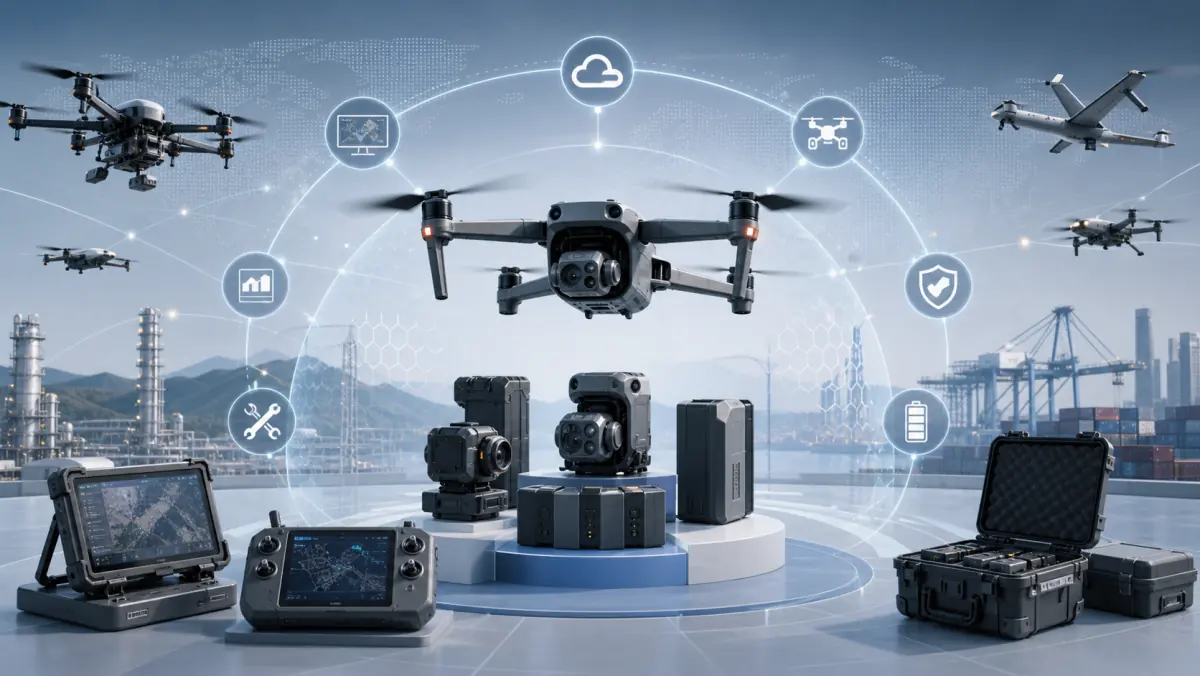
The Matrice 400 buyer question is not whether DJI can build a stronger enterprise drone.
The harder question is whether an enterprise fleet can accept DJI's aircraft-plus-software operating model while keeping enough local control over data, payloads, remote operations, and vendor exit options. That is why Matrice 400 should be read together with FlightHub 2 On-Premises, the Payload SDK, and the broader DJI workflow stack.
DJI introduced Matrice 400 on June 10, 2025, so this is not a new 2026 aircraft launch. The reason it still matters in June 2026 is that the aircraft sits at the center of a live procurement problem: enterprise users want longer endurance, heavier payload flexibility, safer power-line and infrastructure inspection, and local command-center control without losing the operational maturity that made DJI dominant.
DJI's Matrice 400 product page presents the platform around 59-minute flight time, up to 6 kg payload, integrated LiDAR and mmWave radar, O4 Enterprise Enhanced Video Transmission, Airborne Relay Video Transmission, smart detection, AR projection, ship-based takeoff and landing, and automation. Those features matter. But the buyer file is larger than the aircraft.
Source File
This article was reviewed on 2026-07-06 against DJI's official Matrice 400 product page, Matrice 400 specs, Matrice 400 release note, FlightHub 2 On-Premises page, DJI's FlightHub 2 On-Premises release article, the FlightHub 2 FAQ, and DJI Payload SDK release notes on GitHub. DJI feature claims are treated as vendor claims until validated in the buyer's own mission, network, payload, and compliance environment.
Claim Confidence File
| Claim | Confidence | Evidence boundary |
|---|---|---|
| Matrice 400 is a strong enterprise aircraft, but the buying decision is also a software and governance file | High | Supported by DJI product specs, FlightHub 2 On-Premises materials, and Payload SDK dependencies cited in the Source File. |
| FlightHub 2 On-Premises removes all DJI ecosystem dependency | Low | The article treats local deployment as a control improvement, not vendor neutrality or non-DJI fleet interoperability. |
| Payload, SDK, firmware, data location, and exit path should be verified before purchase | High | This is the article's procurement recommendation and follows directly from the cited DJI stack. |
| Published flight-time and payload specs guarantee buyer mission performance | Low | Mission endurance depends on payload, reserve rules, weather, altitude, battery condition, and operating profile. |
Quick Answer
| Buyer question | Practical answer |
|---|---|
| What is the real Matrice 400 issue? | The aircraft expands enterprise mission capability, but it also deepens dependence on DJI payloads, SDKs, FlightHub workflows, and support paths. |
| What numbers matter? | 59 minutes forward flight, 53 minutes hover, 6 kg max payload, IP55, 25 m/s horizontal speed, four E-Port V2 ports, and O4 Enterprise transmission. |
| Why does FlightHub 2 On-Premises matter? | It gives organizations a path to local deployment and data control while staying inside DJI's mission-management stack. |
| What should buyers verify? | Data location, remote-control authority, payload compatibility, SDK roadmap, offline operation, update policy, and non-DJI integration limits. |
| Evergreen bridge | Read this with DJI Drone Dominance: How It Built a 70% Share, DJI's New Lock-In Is Workflow and AI, Not Just Airframes, DJI Alternatives 2026: The Enterprise Buyer Reality, and China Drone Export Rules 2026: Reseller Filing Checklist. |
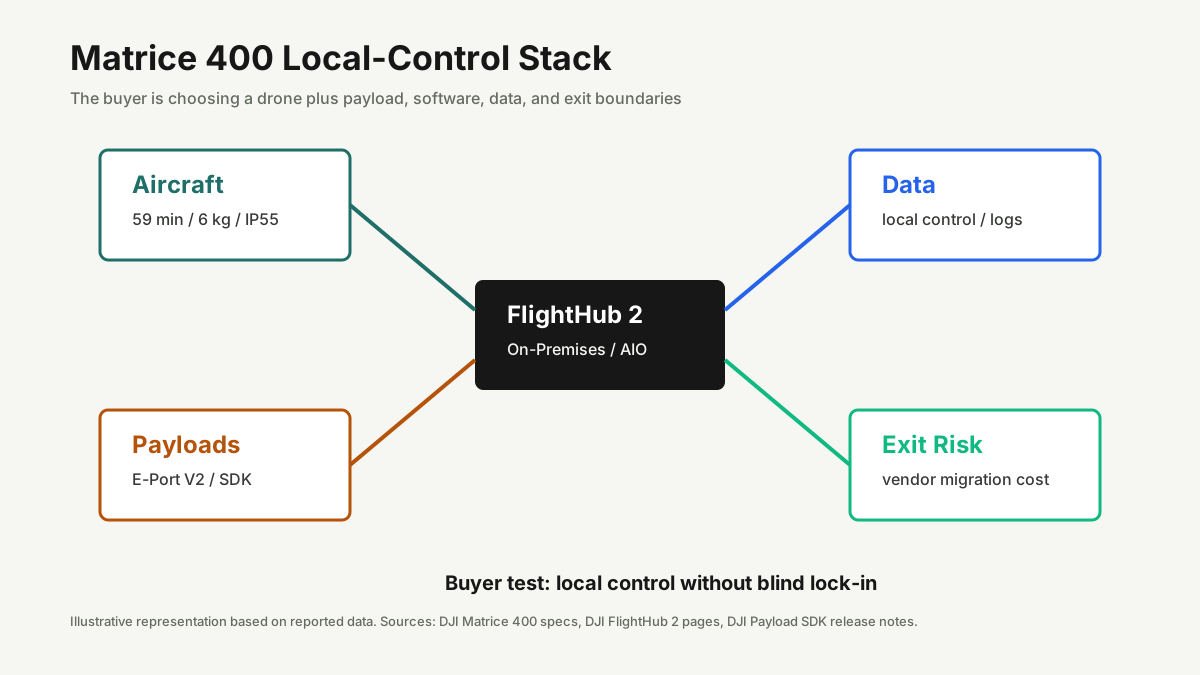 Source: China Made & Tech analysis based on DJI Matrice 400 specs, FlightHub 2 On-Premises pages, DJI FlightHub FAQ, and Payload SDK release notes.
The Protagonist Is A Fleet Buyer, Not The Drone
The protagonist in this story is the enterprise fleet buyer. That buyer may be a power utility, police department, fire service, construction firm, port operator, survey company, oil-and-gas inspection team, or public infrastructure owner. The buyer wants more mission capacity without giving up control over data, compliance, training, payloads, and long-term fleet flexibility.
The obstacle is DJI's own strength. DJI is attractive because the aircraft, payloads, controllers, software, maps, remote operations, SDKs, service channels, and user habits work together. That integration is the reason DJI is hard to displace. It is also the reason a buyer must treat a Matrice 400 fleet as a workflow commitment, not a simple aircraft purchase.
The environment is the one described in DJI Drone Dominance: How It Built a 70% Share. DJI has built a deep enterprise ecosystem. A rival drone can look comparable on one datasheet and still fail the real buyer test if it cannot match payload availability, software maturity, pilot familiarity, maintenance access, and mission workflow.
Matrice 400 strengthens that system. It makes DJI more useful for demanding missions. It also makes migration harder after the buyer builds procedures, data flows, payload inventory, and training around the platform.
The Aircraft Specs Matter Because They Expand The Workflow Envelope
The official specs page gives buyers the concrete starting point. DJI lists a maximum payload of 6 kg, 59 minutes of maximum forward flight in specified test conditions, 53 minutes maximum hover time, 49 km maximum flight distance, 25 m/s max horizontal speed, 7,000 m max takeoff altitude, -20 C to 50 C operating temperature, IP55 ingress protection, and standard ADS-B In receiver capability.
The details matter because they change what a fleet can attempt. A longer endurance and heavier payload platform can support more inspection work per sortie, more complex sensor packages, heavier gimbals, and more demanding infrastructure missions. DJI's page also frames Matrice 400 around emergency response, power inspection, mapping, AEC, ship-based operation, and automation.
But buyers should read every headline number with its test condition. DJI says the 59-minute flight time was measured at sea level, no wind, constant forward speed, with a specified payload and from full battery to zero. That is not a criticism. It is how aircraft specs work. It means the buyer must model real mission endurance under local wind, payload, temperature, altitude, reserve rules, and pilot operating procedures.
| Spec area | Why it matters | Buyer check |
|---|---|---|
| Endurance | More inspection distance per sortie | Model with real payload, wind, reserve, and emergency return rules |
| Payload | More sensors and mission tools | Confirm weight at each connector and altitude impact |
| IP55 | Better outdoor tolerance | Check dust, rain, cleaning, and maintenance limits |
| Speed and altitude | Wider mission envelope | Verify regulatory and operational constraints |
| ADS-B In | Airspace awareness | Confirm local airspace procedures and pilot training |
| Ports | Payload expansion | Verify E-Port V2 support, SDK status, and power limits |
The Payload And SDK Layer Is Where Lock-In Becomes Practical
DJI's specs list four E-Port V2 ports on the lower part of the aircraft, with 120W single-port power. That is a major clue. Matrice 400 is meant to be a payload platform, not just a flying camera.
Payload flexibility creates value. It lets buyers use visible cameras, thermal cameras, loudspeakers, spotlights, LiDAR, mapping tools, inspection sensors, or custom payloads. It also creates dependency. Once a fleet builds around specific payloads, connectors, SDK behavior, firmware versions, and pilot procedures, the drone choice becomes a system choice.
DJI's own developer ecosystem reinforces this point. The DJI Payload SDK release page on GitHub includes Matrice 400-specific notes, including a fix for payload camera control on Port 2. That is not a scandal; software ecosystems have bug fixes. It is evidence that payload integration is a living support relationship. Buyers should track SDK maturity, issue resolution, and compatibility with the exact aircraft, payload, and firmware stack they plan to run.
The right question is not "can Matrice 400 carry my payload?" It is:
- Can my payload work on the relevant port and firmware version?
- Who supports the integration: DJI, payload vendor, integrator, or internal engineering team?
- What happens when aircraft firmware changes?
- Are APIs stable enough for my mission-critical workflow?
- Can I export or preserve data if I later change aircraft vendors?
This is where DJI's New Lock-In Is Workflow and AI, Not Just Airframes becomes directly relevant. The moat is not only the drone. It is the accumulated workflow around the drone.
FlightHub 2 On-Premises Changes The Buyer Question
The strongest governance signal is FlightHub 2 On-Premises. DJI's On-Premises product page says it delivers capabilities similar to the public cloud version through secure local deployment, giving users complete control over their data, custom development, and rapid integration. DJI also presents a FlightHub 2 AIO appliance for easier deployment.
DJI's June 2025 On-Premises release article is even more useful for buyer diligence. It says the on-premises product supports deployment in private clouds, third-party clouds, or local servers. It describes end-to-end data sovereignty, local server deployment, offline operation in closed networks, enterprise system integration, OAuth 2.0 account integration, OpenAPI, MQTT Bridge, and a distinction between public cloud and on-premises update cadence.
That means the local-control story is real enough to inspect. It also means buyers have new questions:
| Control question | What FlightHub 2 On-Premises can address | What still needs review |
|---|---|---|
| Data location | Local/private deployment and data control | Logs, media retention, backups, access rights, and vendor support path |
| Remote operations | Mission management inside DJI stack | Who is authorized to command aircraft and payloads remotely |
| Integration | OpenAPI, MQTT Bridge, frontend components | API limits, cybersecurity review, and non-DJI system boundaries |
| Offline operations | Closed-network possibility | Map updates, weather data, firmware, and degraded-mode procedures |
| Upgrade cadence | On-premises upgrade packages | Security update timing and operational change management |
FlightHub 2 Still Does Not Mean Multi-Vendor Neutrality
The FlightHub 2 FAQ says FlightHub 2 supports DJI Docks, DJI platforms including Matrice 400, and DJI payloads such as Zenmuse H30 and H20 series, Zenmuse S1, and Zenmuse V1. It also says FlightHub 2 does not support connecting drones from other manufacturers.
That one answer is strategically important. FlightHub 2 On-Premises may solve a data-sovereignty problem while preserving a DJI ecosystem boundary. For many buyers, that is acceptable. For others, especially those trying to reduce single-vendor exposure, it is the central risk.
This is why DJI Alternatives 2026: The Enterprise Buyer Reality remains relevant. Alternatives are not evaluated only by aircraft specs. They are evaluated by whether they can replace the command center, pilot workflow, payload stack, data archive, mission templates, and training model.
Matrice 400 makes the switch harder because it gives buyers more reasons to consolidate on DJI. FlightHub 2 On-Premises makes that consolidation easier to justify to IT and compliance teams. The buyer must decide whether local deployment is enough governance comfort, or whether vendor diversity is a higher priority.
Compliance And Geography Are Not Side Notes
Enterprise drone procurement now sits inside policy, cybersecurity, data-sovereignty, export-control, public-safety, and domestic-preference debates. For some buyers, especially in public safety, energy, defense-adjacent infrastructure, ports, and government-linked operators, the drone choice must survive internal compliance review.
Matrice 400 plus FlightHub 2 On-Premises gives DJI a stronger answer than "trust our cloud." Local deployment and data control are meaningful. But geography still matters:
- Which country hosts the local server or private cloud?
- Can the system operate without public internet?
- What data leaves the network for support, licensing, map updates, or diagnostics?
- Are firmware updates mandatory or optional?
- Are flight logs, media, annotations, and mission plans exportable?
- Do procurement rules restrict DJI hardware regardless of data architecture?
- Does insurance or regulator guidance treat DJI differently from alternatives?
These questions are not anti-DJI. They are normal enterprise procurement questions for a system that collects sensitive operational data.
Run A Data-Exit Drill Before The Pilot Ends
The most useful Matrice 400 pilot is not only a flight test. It is a data-exit test. Before the pilot becomes the operating standard, the buyer should export a sample mission package and prove that another team can understand it without logging into the original DJI workflow.
That package should include flight logs, images or video, map layers, annotations, inspection results, pilot notes, payload metadata, user-permission history, maintenance records, and any API or MQTT outputs the organization expects to feed into its own systems. If FlightHub 2 On-Premises is chosen for data control, the buyer should verify where each file is stored, how backups work, how deleted accounts are handled, and whether support staff can access logs during troubleshooting.
This is not because the buyer necessarily plans to leave DJI. It is because a fleet program becomes more expensive when its history, training, and compliance evidence are trapped in one tool. Utilities, ports, rail operators, and public-safety teams often need audit trails years after a mission. A data-exit drill turns "local control" from a slogan into a measurable acceptance criterion.
The same drill helps compare alternatives fairly. A non-DJI aircraft that matches Matrice 400 on payload or endurance may still fail if it cannot reproduce the data workflow. Conversely, DJI may remain the best choice if its exported evidence, API path, and on-prem controls satisfy the buyer's governance rules.
A Better Buyer Checklist For Matrice 400
For operations teams, build a mission profile before comparing drones. List payloads, flight duration, reserve rules, takeoff environments, weather limits, data outputs, remote-control needs, and emergency procedures. Then test Matrice 400 against the profile rather than against a brochure.
For IT and security teams, test FlightHub 2 On-Premises as software. Ask for architecture diagrams, network requirements, user-permission models, API documentation, update policies, backup/restore procedures, and whether the system can run in a closed network under your security rules.
For payload teams, require an integration matrix. It should list each payload, connector, power draw, SDK dependency, firmware version, support owner, and data format. A payload that works in a demo is not the same as a payload that works inside a regulated operating procedure.
For procurement teams, compare total system dependency. Include aircraft, batteries, payloads, docks, controllers, FlightHub, Terra, SDKs, training, repair, warranty, insurance, and data-export path. The cheapest aircraft bid may not be the cheapest fleet outcome.
For compliance teams, document the reason local deployment is sufficient or insufficient. If the organization needs vendor diversity, say so explicitly before pilots and operators build more DJI workflow debt.
What Buyers Should Not Assume
Do not assume On-Premises means zero DJI dependency. It can improve local control while keeping the buyer inside DJI's aircraft and software ecosystem.
Do not assume the 59-minute flight time applies to your mission. Payload, wind, reserve rules, temperature, altitude, and pilot behavior change usable endurance.
Do not assume payload openness equals vendor neutrality. SDK access and E-Port V2 expand capability, but the support relationship remains part of the DJI ecosystem.
Do not assume compliance risk is solved by technical architecture. Some organizations face policy restrictions that local hosting cannot remove.
Do not assume a rival drone is interchangeable just because it meets endurance or payload numbers. The real comparison is aircraft plus payloads plus software plus training plus data governance.
Buyer Takeaway
Matrice 400 is a powerful enterprise aircraft. But the real buyer question is not "is this the strongest drone?" It is "how much of my fleet's operating model am I willing to place inside DJI's aircraft, payload, software, and support stack?"
For many buyers, the answer may be yes. DJI's ecosystem maturity can reduce operational friction, and FlightHub 2 On-Premises gives data-sensitive organizations a more credible local-control option. For others, especially those under strict vendor-risk rules, the same integration creates a lock-in problem.
The better decision is not ideological. It is architectural. Map the mission, data, payload, support, and exit boundaries before buying the aircraft.
Methodology
This article uses DJI's Matrice 400 product page, Matrice 400 specs, DJI's Matrice 400 release note, the FlightHub 2 On-Premises page, DJI's FlightHub 2 On-Premises release article, the FlightHub 2 FAQ, and DJI Payload SDK release notes on GitHub. Hardware and software claims are treated as vendor claims unless validated in the buyer's own mission environment.
FAQ
Is DJI Matrice 400 a 2026 launch?
No. DJI introduced Matrice 400 on June 10, 2025. It remains relevant in 2026 because enterprise buyers are now evaluating it as part of a full aircraft, payload, FlightHub 2, SDK, data-governance, and local-control stack.
Does FlightHub 2 On-Premises make DJI vendor-neutral?
No. FlightHub 2 On-Premises can improve data control and deployment flexibility, but the workflow still centers on DJI aircraft, DJI payloads, DJI software, and DJI-supported integrations. Buyers should test export paths and multi-vendor fallback before scaling.
What should enterprise buyers test before buying Matrice 400?
Run a pilot that includes the exact payload, firmware, SDK, network, command-center workflow, data-export process, offline behavior, user permissions, and incident-response path. Specs alone do not prove that the fleet will satisfy governance requirements.
Why does local control matter for enterprise drones?
Infrastructure, public safety, utilities, and regulated industrial users often need to control where flight logs, video, telemetry, user accounts, and maintenance records live. Local deployment reduces some cloud risk, but it does not remove vendor dependency.
By China Made & Tech Team. Independent English field guide to China's niche hardware brands, hidden champions, founders, factory towns, and supplier clusters.