
The most costly question in a China AI-chip purchase is usually not “How many TOPS or FLOPS does this accelerator have?” It is “Can our workload run, be operated and be changed on the exact system we are buying?” A peak number may be useful in an engineering conversation, but it cannot answer whether a model exports cleanly, whether its critical operators execute, whether a framework and driver version match, whether a compiler toolchain is available, whether collective communication works across the intended cluster, whether a server firmware version is supported, or whether the customer can reproduce the result after an update.
That problem is easy to hide behind company names. Huawei Ascend, Biren and Moore Threads have visibly different software environments and product stories. Ascend's CANN documentation describes a heterogeneous AI compute architecture with framework support, programming APIs, installation material and product mapping. Biren describes the BIRENSUPA software development platform and current AI-accelerator products on its official site. Moore Threads documents MUSA as a GPU parallel-computing platform and software stack that includes a compiler, runtime, libraries, CUDA-conversion tooling and profiling or debugging tools. These are meaningful product and developer signals. They are not a conclusion that any named model, server, cluster or customer workload is compatible.
This article is a desk-research field guide for infrastructure buyers, platform teams, private-cloud operators, model developers, systems integrators, OEMs and procurement teams assessing China-designed AI accelerators. It does not benchmark hardware, inspect a data centre, run a model, audit a supply chain, validate a driver, compare a product with Nvidia, establish export-control eligibility, or make a performance, availability, security, legal or procurement recommendation. Its purpose is to convert a broad “China AI chip” conversation into a controlled compatibility acceptance file.
The conclusion is deliberately practical: a chip name is a discovery signal; a compatibility file is an acceptance object. Until a supplier can connect a precise accelerator, server, firmware, driver, software stack, framework, model path, cluster topology, operations plan and change process to the buyer's workload, the buyer does not yet have an answer. It has a promising claim that needs an experiment.
Quick answer: buy a reproducible workload path, not a headline number
The simplest purchasing rule is this: do not accept a claim about a China AI accelerator until it is attached to the exact workload path the buyer intends to operate. The path begins with a workload and ends with an owned operational result. A different model, quantisation, container, driver, server BIOS, network topology, batch size, prompt length, concurrency target or software release can be enough to change the answer.
| Question | Evidence that can help | Unsafe shortcut |
|---|---|---|
| Does the accelerator exist in a usable product form? | Product form, card/module/server identity, supported component documentation | “The vendor has an AI chip.” |
| Does the system software align? | Driver, firmware, runtime and toolkit compatibility matrix | “It supports PyTorch.” |
| Can the target model run? | Controlled model/version, conversion steps, operator log and output check | “A similar LLM ran in a demo.” |
| Can the cluster run the intended job? | Node topology, interconnect, communication library and failure test | “The card has fast interconnect.” |
| Can the service be operated? | Container, observability, upgrade, rollback and support ownership | “The benchmark completed.” |
| Can the result survive change? | Versioned acceptance log and a defined re-test trigger | “The latest stack will be compatible.” |
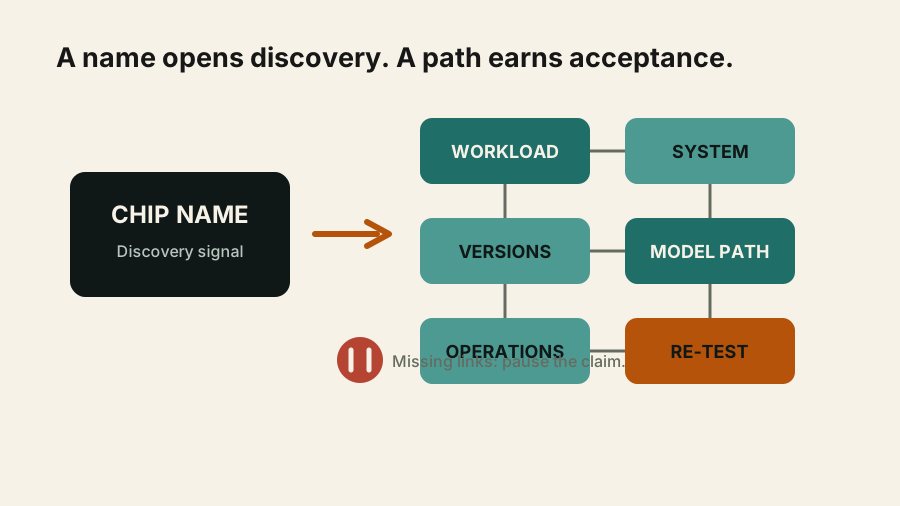
The buyer does not need to demand source code, commercially sensitive firmware or a public disclosure of every system detail. It does need a controlled evidence path. A supplier can offer a secure lab, a data room, a redacted compatibility matrix, an authorised engineering call or a jointly agreed proof-of-concept protocol. What matters is that the parties identify the object being tested, the owner of every dependency, the evidence that was observed, the limits of the observation and the change that makes the observation stale.
That is more rigorous than a benchmark contest and less adversarial than an open-ended request for “all documentation.” It gives a vendor a way to demonstrate a real stack while giving the buyer a way to avoid accidentally representing a demo configuration as its production environment.
Do not turn a peak specification into delivered workload performance
AI accelerator marketing is often built around a single number: precision-specific throughput, memory capacity, memory bandwidth, interconnect bandwidth, power, number of cards in a system or claimed efficiency. These figures are not useless. They are usually insufficient for an acceptance decision because the workload has more moving parts than the number does.
Consider an inference service. A buyer may care about time to first token, tokens per second at a defined concurrency, tail latency, cost per useful response, model accuracy after quantisation, context length, tool-call behaviour, failure handling and the ability to recover a node. A peak compute figure cannot tell the buyer which model version was used, whether the request mix had long contexts, whether the KV-cache policy matched its own service, whether an operator fell back to a different path, whether the output was checked against an agreed baseline, or whether the service can be upgraded safely. The same issue appears in training: throughput is not equivalent to convergence, checkpoint reliability, distributed stability or operational reproducibility.
This is especially important when readers ask for a direct comparison with Nvidia. Such a comparison can look simple but is normally a bundle of hidden choices: hardware generations, memory, host CPUs, interconnect, driver releases, compiler settings, framework releases, model variants, precision mode, batch shape, sequence length, dataset, kernels, power policy, node count, measurement method and failure exclusions. Unless the buyer has a controlled, like-for-like test, the useful conclusion is not “faster” or “slower.” It is “not yet comparable for this workload.”
The correct response to a vendor-provided performance result is a set of scope questions:
- What exact accelerator, board, server, firmware, driver and runtime were used?
- What framework, version, container and compiler settings were used?
- What model, revision, tokenizer, precision, quantisation and operator path were used?
- What batch, context length, concurrency, prompt distribution and output length defined the run?
- Which metric is reported, how was it measured and what variance or failure exclusion applies?
- What result did the buyer observe on its own representative workload, and who can reproduce it?
If these questions cannot be answered, the number may remain a marketing or early-engineering signal. It should not be inserted into a capacity plan, a customer commitment, a total-cost model or a product comparison as if it describes production reality.
The software stack is part of the product
For AI infrastructure, hardware and software are not separable purchases. The accelerator becomes usable through a stack of driver, firmware, runtime, compiler, communication library, framework integration, model-conversion tools, kernels, container base, observability components and deployment tooling. A buyer should treat the stack as a bill of compatibility, not as a footnote beneath the chip name.
Ascend illustrates why version control matters. The CANN 8.5 documentation describes CANN as a heterogeneous compute architecture for AI scenarios and says it supports multiple frameworks including MindSpore, PyTorch and TensorFlow. It also points to product models, environment setup, installation and version descriptions. That tells a buyer there is a documented software platform around Ascend. It does not mean every release of every framework or model is automatically supported. The CANN version-mapping documentation explicitly describes matching between CANN and Ascend component versions. That mapping should be a first-class acceptance artefact, because a stack upgrade can require coordinated component changes.
The buyer's question is not merely “Does CANN support PyTorch?” It is “Which exact PyTorch path, extension, container, CANN release, driver/firmware component, operating system and hardware product form is in the configuration we will operate?” A vendor may be able to show a framework integration while the buyer's custom operator, distributed-training dependency, tokenizer pipeline, security agent or model-serving layer remains untested. The gap is not evidence that the vendor is wrong. It is a gap in the buyer's compatibility file.
Ascend documentation also makes a more general procurement point: model compilation and deployment can be part of the workload boundary. The CANN material describes conversion of a network model into an offline model supported by Ascend AI processors. A conversion workflow can be valuable, but it adds an acceptance question. Which original model artefact was converted? With which tool version and settings? Which operators were transformed or substituted? Was the output validated for the buyer's use case? Is the compiled artefact reproducible from the same inputs? If a model update occurs, who reruns the conversion and quality check?
Moore Threads documents the same principle through a different stack. The MUSA software-stack documentation says the MUSA SDK provides a development and runtime environment for MT GPUs and includes a compiler, runtime, MUSA-X compute libraries, deep-learning libraries, CUDA compatibility tooling, debugging and profiling tools. The documentation also describes MCCL for multi-card and multi-node communication. These are useful engineering objects: they tell a buyer what category of tool and runtime exists. They do not remove the need to demonstrate that the buyer's code, dependencies and cluster topology take the intended path.
CUDA conversion deserves particular care. A conversion tool can shorten migration work. It cannot make a buyer's entire application equivalent by declaration. A serious migration file records the source repository or container image, the source CUDA/toolkit assumptions, the conversion tool/version, patches or manual changes, compiled artifacts, unsupported or changed operators, test coverage, output checks, performance observations and rollback path. If the migration relied on a developer's local change that was never captured, the buyer has not purchased portability; it has purchased a demonstration.
Biren's public material provides a third useful signal. The company describes BIRENSUPA as a software development platform and presents data-centre AI-accelerator modules and cards. Its developer community describes current product forms and the platform; its official company site states that its products are aimed at AI data-centre and other computing scenarios. This may make Biren a relevant supplier to investigate. It does not establish that a particular Biren accelerator, server, framework release, model or cluster arrangement is compatible with a reader's environment. The acceptance request is the same: show the component and version path, not merely the brand family.
Separate three kinds of compatibility before a proof of concept
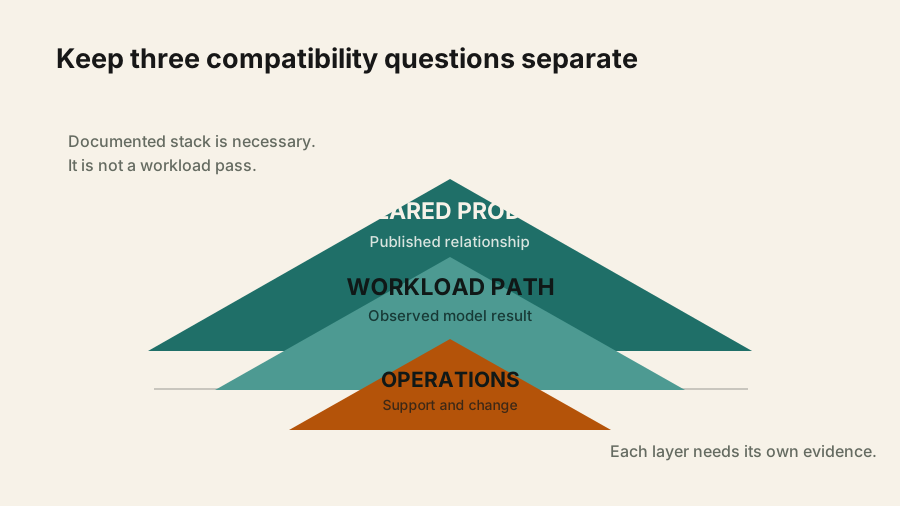
Many AI-chip evaluations fail because they put every issue into a single “POC” box. The result is a long demonstration that appears successful but cannot answer which part of the system actually worked. Separate compatibility into three layers before assigning a test.
Layer one: declared product compatibility. This is the vendor's documented relationship between an accelerator product form, server or card, operating system, firmware, driver, toolkit and supported software components. It is a necessary starting point. It should be dated and versioned. It can be checked against a published support list, a release note or a controlled vendor statement. It does not show the buyer's application works.
Layer two: workload compatibility. This is the buyer's representative model, data flow, pre/post-processing, framework, custom operators, container and serving or training pattern running under an agreed configuration. It includes functional output checks. A model may start and still fail this layer: a custom kernel may be absent, an operator may change a numerical path, a tokenizer or image processor may differ, a package may be unsupported, a model conversion may be unreproducible or a tool-call loop may not behave as expected.
Layer three: operational compatibility. This asks whether the workload can be deployed, monitored, updated, secured, recovered and supported in the buyer's target environment. It includes multi-node communication, orchestration, images, observability, log access, failure and restart behaviour, upgrade/rollback, supply of spares or support channels, and change control. A single-node benchmark can pass while operational compatibility remains entirely unknown.
The three layers should be represented in a simple status register: declared, observed, not observed, limited, blocked or not applicable. Do not use “supported” as a substitute for the register. “Supported” may mean a vendor supports a release line; it may mean a framework starts; it may mean an operator exists; it may mean a customer ran a private test. The word is too broad to be an acceptance conclusion without a named object and evidence owner.
Build the seven-file China AI-chip compatibility acceptance file
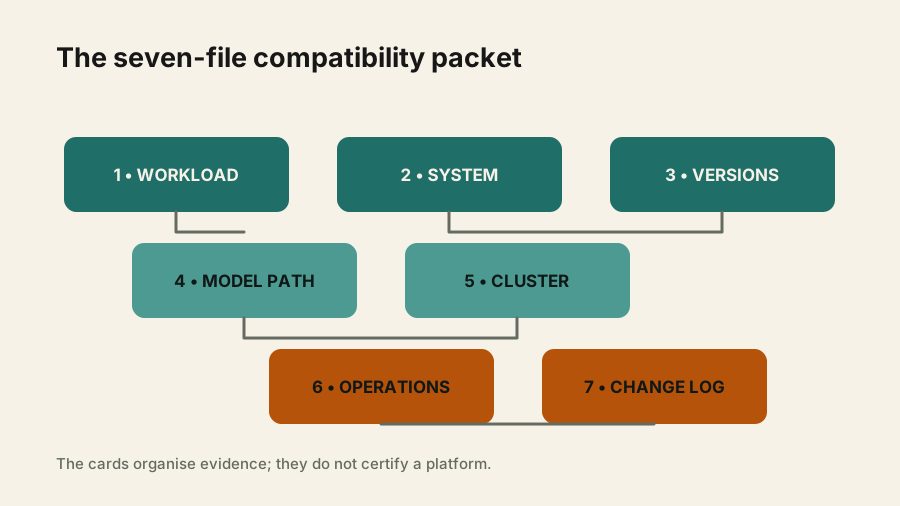
The following seven files are an editorial organisation model. They do not certify a chip, establish a benchmark, approve a production system or prove compliance with any regulation. They give a buyer, vendor and integrator a way to preserve the relationships that make a compatibility result meaningful.
1. Workload and success-criterion file
Start with the buyer's actual job. Name the application: model training, batch inference, online LLM inference, multimodal serving, retrieval, embedding, simulation, computer vision, recommendation, scientific computing or another workload. Record the model and revision, licence/rights status as relevant, input and output paths, context or sequence shapes, precision and quantisation choices, batch and concurrency targets, required functionality, quality checks and the business metric that matters. Separate a discovery demo from a production acceptance case.
The key discipline is to state success before measuring it. “The model runs” may be a valid discovery outcome. It is not necessarily an operational outcome. A production online service may require a defined output behaviour, tail-latency range, concurrency, observability, resilience and rollback. A training job may require distributed stability, checkpoint continuation, convergence observation and recovery. Do not let a vendor choose the success condition after a pleasing demo.
2. Accelerator, server and topology identity file
Record the exact accelerator product, board or module, quantity, server platform, host CPU and memory, storage, networking, cooling/power conditions where relevant, node count, interconnect arrangement and intended deployment location. Record the serial, batch or commercial configuration reference to the degree that the parties can disclose it. Name the hardware owner and support owner. If the vendor is proposing a reference system rather than the buyer's target server, say so.
This file makes physical substitutions visible. A compatible accelerator card in a vendor lab is not automatically compatible in a buyer's rack. The host operating system, BIOS, BMC, PCIe layout, network, rack power, firmware and cooling assumptions can matter. The article does not validate them; it requires the parties not to hide them behind a model name.
3. Firmware, driver and toolkit mapping file
This is the software bill of materials. List the accelerator firmware, driver, runtime/toolkit, compiler, communication library, framework extension, operating system, container base and relevant package versions. Include a source link or vendor document reference, a date, an owner and any known upgrade dependency. For Ascend, this is where CANN and matched component versions belong. For MUSA, it is where driver, SDK, runtime, libraries and communication tooling belong. For Biren, it is where the vendor's documented platform components and compatible server stack need to be specified.
The objective is reproducibility, not paperwork. A future operator should be able to identify what was installed for the acceptance run and whether a later upgrade changes the result. If a supplier cannot supply a version relationship, it may still be able to offer a controlled lab test. In that case the file should state that the deployment mapping is not yet accepted rather than imply that “latest” is compatible.
4. Framework, model and operator-path file
Record the framework and version, extension or plugin path, model source and revision, conversion/compilation procedure, custom operator list, kernel or graph compilation logs where available, unsupported elements, fallbacks, patches and output-validation method. Link each artifact to the workload success criterion. A functional test should record not only that a process returned, but what result was compared and what tolerance or behavioural rule was agreed.
This file is where migration claims become auditable. A PyTorch port, an ONNX export, an offline model conversion or a CUDA-to-MUSA conversion can all be valid engineering methods. The buyer should be able to identify the toolchain and transformed artifact. “Ported” should not mean “some code compiled once.” It should mean the agreed model path, under the agreed versions, produced the agreed output for the agreed workload scope.
5. Cluster, communication and resilience file
For a single card, describe what is single-node and what is untested. For a cluster, record node count, network and communication-library configuration, rank/world-size setup, storage and checkpoint path, orchestration layer, health checks, failure injection or recovery observations where agreed, and the owner of cluster operations. MUSA documentation's MCCL reference is useful evidence that a communications library exists; it is not evidence that the buyer's network and topology have been exercised.
Cluster claims are particularly vulnerable to extrapolation. A four-card demo may not establish a multi-node job. A stated interconnect capability may not establish that a particular collective operation, model-parallel configuration or checkpoint recovery works under load. Separate “available in stack,” “configured in test” and “observed in our topology.” If the last category is absent, do not use a cluster-scale conclusion in capacity planning.
6. Operations, security and support file
Record container provenance, image build process, package repository, licence or access conditions, observability/logging integration, metrics, alerting, access controls, patch process, support channel, response responsibility, spare or replacement arrangements where relevant, incident escalation and rollback owner. This file does not certify security. It gives security and operations teams a concrete set of questions before a promising lab result becomes an unattended service.
The operations file often decides whether an apparently compatible accelerator is economically usable. A buyer may be able to run a model in a lab but lack a supported upgrade path, image-scan process, monitoring agent, support contact or reproducible container build. The right response is not to declare the hardware incompatible. It is to mark operational compatibility incomplete and assign an owner.
7. Change, exception and acceptance log
Finally, record each test run and material change: date, workload revision, hardware and software configuration, observed result, source artifacts, limits, reviewer, unresolved items and the trigger for a re-test. Triggers may include a model revision, quantisation change, framework update, CANN/MUSA/BIRENSUPA release, driver or firmware update, server substitution, topology change, new operator, security-agent change, incident or service-level requirement change.
The log turns a one-time POC into a controlled operating statement. It also protects vendors. A vendor does not have to promise that every future software release will preserve every customer result. It needs to say what was accepted, under which conditions, and what change requires a new check. A buyer does not need to pretend an old result covers a new model or stack.
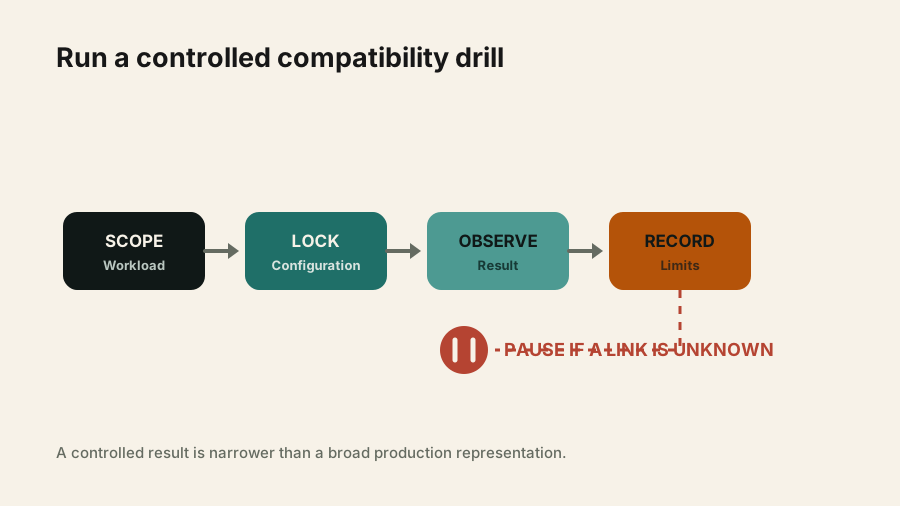
Run a compatibility acceptance drill before procurement language hardens
Choose one representative workload and run the seven-file packet as a drill. The drill should be small enough to finish, but realistic enough to expose the actual dependencies. A common failure is to use a toy model or a vendor-selected benchmark and then claim the production workload is covered. A better choice is a bounded slice of the actual service: the target framework, one representative model/version, defined prompts or inputs, a specified output check, the intended precision, a declared server configuration and a named software bill of materials.
Ask the following sequence:
- What exact workload outcome are we accepting, and what does failure look like?
- Which accelerator, server and topology are actually under test?
- Which firmware, driver, runtime, toolkit, framework and container versions are installed?
- How did the model reach the accelerator: native path, conversion, compilation, port or custom integration?
- Which operators or dependencies are critical, and how were they observed?
- What functional output, quality, latency, throughput or stability result was compared against the agreed criterion?
- Which cluster, recovery, monitoring, security and support conditions were tested, and which were not?
- Who owns the result, where is the artifact, and what change requires a rerun?
The result should fall into one of three buckets. Acceptable for the defined scope means the file can identify the workload, configuration, evidence and change control; it does not mean universal compatibility. Developable means the vendor and buyer can see the missing operator, package, topology, automation or support work and can assign it. Pause the representation means the parties cannot name the installed stack, reproduce the path, validate the output, identify the operations owner or state what was not tested. The correct action is to stop calling the workload compatible until the gap is closed.
Turn a proof of concept into a controlled comparison
A useful proof of concept is not a room full of unconstrained experiments. It is a small comparison in which the parties agree what may vary and what must stay fixed. The buyer should name one priority inference or training workload, one target operating condition and one success criterion before hardware is allocated. The vendor should then say which part of the requested configuration it can provide, which part is supplied by a server or network partner, and which part is outside the test.
For inference, the operating condition can include model revision, weights format, prompt or context distribution, maximum concurrency, batch policy, response-quality check, availability target and a stated observation window. For training, it can include the model branch, data-access arrangement, precision mode, optimizer, sequence length, global batch, checkpoint method, node count, communication configuration, restart test and the engineering definition of a completed run. Neither list is a universal test plan. It is a prompt to make the evaluation object sufficiently specific that a result can later be repeated.
The initial scope should be deliberately modest. A buyer that tries to prove every framework, model, topology and customer use case in one sprint creates an ambiguous result: the vendor may spend effort making one path work while the buyer believes several production paths were accepted. Start with a workload that is representative enough to matter but narrow enough to reproduce. Add a second workload only after the first has a stable artifact trail. This is also fairer to a supplier: a failed custom extension or undocumented private dependency should be logged as a compatibility gap, not presented as proof that an entire platform cannot run AI workloads.
| Control question | Put it in the POC record | Do not leave it as |
|---|---|---|
| Workload identity | Repository or package revision, model identifier, artefact hashes and input set | “Our production LLM” |
| Success | Named functional check plus agreed latency, throughput or training-progress measure | “It felt fast enough” |
| Configuration | Accelerator, host, memory, storage, network and node-count identity | A photo of a rack or a card name |
| Software | OS image, container digest, firmware, driver, toolkit, framework and library versions | “Latest release” |
| Test execution | Command, environment variables, date, operator and preserved log location | A demo memory or a slide |
The important distinction is between a test result and a representation. A test result might establish that one model revision produced valid output under a specified configuration on a specific date. A representation such as “the platform supports our model family” is broader: it implies that the conditions, variants and change behaviour have been understood. The buyer should only use the broader language after it has deliberately expanded the evidence. In a contract, executive update or customer-facing message, retain the narrower wording if that is all the file supports.
Make version mapping an acceptance gate, not an appendix
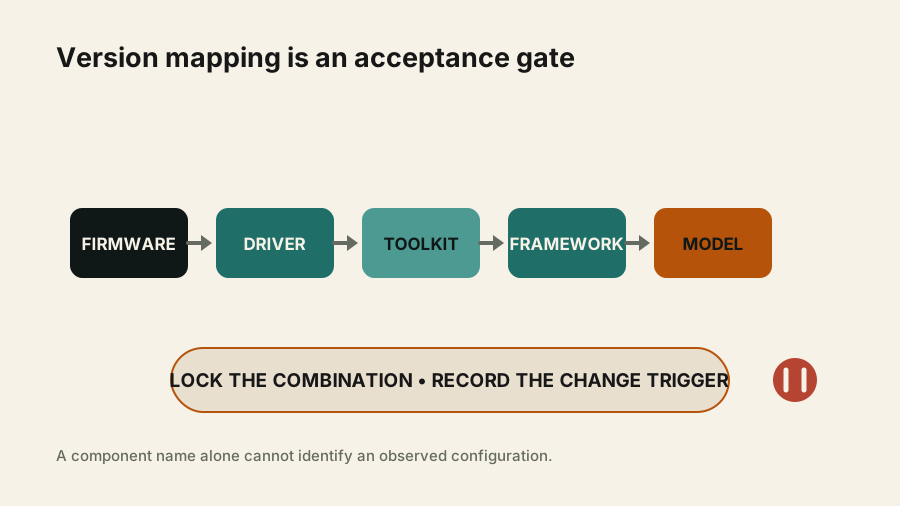
Accelerator software is an assembled system. A server can have a baseboard-management controller and firmware; the accelerator can have its own firmware; the host has an operating system and kernel; a driver exposes an interface; a toolkit bundles compilers, runtimes and libraries; the framework and containers introduce further dependencies. A name such as CANN or MUSA identifies an ecosystem, but it cannot identify the exact released combination. Ascend's public CANN version-mapping material explicitly provides mapping information between CANN and Ascend component versions. That is a useful example of why the buyer should ask for versioned compatibility evidence rather than relying on the name of the toolkit alone.
Create one locked mapping sheet for the test. It should record a vendor product identifier and serial-range or asset identity where that is appropriate; host vendor and model; server BIOS/BMC version; accelerator firmware; host OS and kernel; driver; toolkit; framework; container; communication library; orchestrator integration; model package; and release date. If any field is unavailable for security or commercial reasons, record the limitation and agree an alternative evidence mechanism, such as an authorised operator view, a redacted configuration export or a signed lab record. “Confidential” is not a reason to leave the dependency unidentifiable.
The mapping sheet also needs a disposition. A component can be matched and observed, declared compatible but not observed, outside test scope, requires vendor confirmation, or unknown. These labels prevent a release-note statement from silently turning into a lab observation. They also make partial results useful: a buyer can see whether the uncertainty lies in the driver interface, a framework build, a custom operator or the physical platform rather than treating the entire evaluation as a binary pass or fail.
Changes should have pre-agreed consequences. A minor documentation update may only require a review. A new accelerator firmware, driver, toolkit major release, framework build, container base image, kernel, BIOS, networking configuration or model revision should trigger an impact assessment. The assessment asks whether the original test is still representative, whether a smoke test is enough, and which acceptance rows must be repeated. The point is not to freeze a platform forever. It is to avoid keeping an old compatibility assertion after the object that was tested no longer exists.
Cluster evidence must include failure and recovery boundaries
A single-node demo can be an appropriate first step, but it tells the buyer very little about a distributed production service. Once the target workload uses multiple accelerators or hosts, record the communication implementation, network topology, node inventory, storage path, process placement, timeout behaviour, observability and recovery arrangement. Moore Threads describes its MUSA SDK as including development/runtime components, compute and deep-learning libraries, CUDA-conversion tooling and related developer utilities. That disclosure makes the software stack relevant to a study; it does not demonstrate that a buyer's exact distributed job, cluster manager or failure pattern is covered.
The first multi-node acceptance drill should be small and purposeful. Confirm that every host can be identified, the declared communication path is active, the intended job launches consistently, the test output is captured, and the parties know what evidence will be retained. Then select a bounded resilience exercise relevant to the workload: a controlled process restart, a scheduled restart after checkpointing, a specified node removal, a log/metric collection check, or a rollback to the locked stack. Do not simulate a dramatic failure just to make a persuasive story. The exercise should be safe, authorised and proportionate to the stage of evaluation.
The report must say what did not happen. If no network fault was introduced, do not imply network resilience. If the exercise used a synthetic input, do not imply customer-data acceptance. If the cluster used two nodes, do not generalise it to a larger topology. If a vendor engineer executed the recovery, record the support boundary rather than describing the buyer as operationally independent. Negative space is part of the evidence: a precise non-test helps the next team decide what to test instead of filling the gap with assumption.
Give support ownership the same precision as a benchmark
Compatibility can fail at 2 a.m. during a routine upgrade rather than during a vendor demonstration. Before a purchase or production commitment, identify the service owner for the accelerator, server, host operating system, driver/toolkit, framework, container registry, orchestration layer, model artifacts, networking, monitoring, security response, incident triage and patch approval. The answer may involve several companies and internal teams. That is normal. What is dangerous is an unowned handoff where each party can point to another layer.
The operations file should record support contacts and hours; severity definitions; data and log-sharing constraints; remote-access rules; diagnostic artifacts; escalation route; patch or advisory intake; planned maintenance communication; rollback method; and the buyer's right to preserve a known-good configuration. Do not mistake an account manager, a developer forum or a general documentation portal for a production support commitment. They can be useful channels, but they are different evidence objects.
Ask one practical support question during the evaluation: “A deployed workload fails after a defined component update; who owns the first diagnosis, which logs can be shared, how is a rollback authorised, and which acceptance test must be rerun before the workload is again represented as supported?” Record the real answer rather than an aspirational service diagram. A supplier that clearly states its responsibility boundary gives the buyer a better basis for planning. A supplier that cannot identify the boundary has exposed a procurement risk that no peak-performance figure can resolve.
Use policy and ecosystem signals carefully
China's AI-chip landscape is not only a product catalogue. It includes local policy, design tools, packaging, manufacturing, software, systems integration and developer communities. Those signals can be useful for supplier discovery and long-range planning. They should not become a substitute for a current compatibility result.
For example, Beijing E-Town's AI4Chip action plan for 2026–2028 describes a local programme to apply AI across chip design, manufacturing, packaging, testing, equipment, materials and ecosystem development. It includes goals around design/manufacturing collaboration, intelligent testing and related industrial capabilities. This is a local policy record. It does not certify a specific Ascend, Biren, Moore Threads or other accelerator, and it does not establish a buyer's software compatibility. Use it to understand ecosystem direction, not to answer a deployment acceptance question.
The same applies to vendor claims about ecosystem support. Documentation, release notes, developer tools, model examples and partnerships can lower the cost of investigation. They may be enough to justify a POC. They should be recorded as context, with their version and scope, rather than transformed into a claim that a buyer's full stack has been migrated. A company can have a credible developer platform while a particular workload remains untested. Both facts can be true at once.
For related context on China-linked hardware and deployment signals, see China AI and Robotics: The Deployment Evidence Guide. The reader should bring the same object-and-evidence discipline to AI compute that it brings to other manufacturing and robotics purchases: a visible product is not a verified operation; a promising ecosystem is not a current acceptance test.
A pause rule for “compatible with our stack” claims
Use this internal rule:
> Do not describe a Chinese AI accelerator as compatible with our workload until the team can identify the workload and success criterion, hardware/server/topology, firmware-driver-toolkit mapping, framework-model-operator path, observed result, operations/support boundary and change-triggered re-test process.
The rule is not an argument against Chinese AI chips. It is a way to make a serious evaluation fair. It prevents a buyer from asking a vendor to guarantee an unbounded future workload. It prevents a vendor from letting a single benchmark be read as a production commitment. It gives integrators, cloud operators and application teams a common language for what they own and what remains to be tested.
If a supplier can say, “This is the exact platform, stack and workload path we can show; these are the components that are version-matched; these are the gaps and the controlled path to test them,” the buyer has something useful. If the supplier can only say “the chip supports AI,” the buyer has not yet received a compatibility answer.
Method and limitations
This desk-research article was completed on 28 August 2026. It uses public Ascend CANN and version-mapping documentation, public Biren and Moore Threads developer/product material, and Beijing E-Town's AI4Chip policy document. It does not independently test an Ascend, Biren, Moore Threads or other accelerator; run a benchmark; port a model; inspect a server; validate a driver; audit a data centre; compare products with Nvidia; check export-control treatment; or evaluate security, performance, availability, cost, warranty or legal status.
Software and hardware compatibility changes quickly. A result depends on the exact product form, driver, firmware, toolkit, framework, model, container, server, topology, workload and date. This article is not engineering, security, legal, trade-compliance or procurement advice. The seven-file acceptance packet is editorial evidence organisation, not a certification or a vendor-selection result.
Frequently asked questions
Can I compare a Chinese AI chip with an Nvidia GPU by peak TOPS or FLOPS?
Not for a production decision. Peak figures may help form an engineering hypothesis, but a useful comparison requires a controlled workload, matching model and precision choices, server and topology details, software versions, measurement method and operational conditions. Without that, treat the comparison as incomplete.
Does CANN or MUSA support mean my PyTorch model will run unchanged?
No. CANN and MUSA documentation show that each vendor provides framework, runtime and developer tooling. Your model can still depend on a particular framework release, extension, custom operator, conversion path, container, driver, server or cluster configuration. Test the exact model path and record the result.
What is the best first proof of concept?
Choose one representative workload with a defined success criterion, target model/revision, hardware/server configuration and software bill of materials. Include functional output validation and record what operational or cluster conditions are not tested. A small reproducible POC is more useful than a broad demo.
Is a CUDA conversion tool enough to prove portability?
No. It may accelerate migration, but the buyer still needs a versioned conversion record, patches, generated artifacts, operator coverage, output validation and an operational test. Treat conversion as a method within the compatibility file, not as the compatibility result.
When should a buyer pause a compatibility claim?
Pause when the parties cannot identify the exact workload, configuration, version mapping, model/operator path, observed result, operations owner or re-test trigger. The result may still be developable, but it is not yet a reliable representation for a purchase or customer commitment.
By China Made & Tech Team. Independent English field guide to China's niche hardware brands, hidden champions, founders, factory towns, and supplier clusters.