

China’s AI-and-robotics advantage is real, but it is not one number, one model, or one kind of robot. It is a stack of digital reach, industrial hardware, factory integration, and task-level proof.
By China Made & Tech Team — an independent, desk-research field guide to Chinese manufacturing and technology.
China’s AI and robotics industry is often described as a race: a race in models, chips, humanoids, robotaxis, manufacturing, or national policy. That framing catches attention, but it does not help much when the real question is practical. If you are sourcing automation, evaluating a partnership, studying a supplier ecosystem, or simply trying to understand why Chinese physical AI matters, you need to know what each headline actually measures.
Start with two records that are both consequential and easy to misuse. China had 602 million generative-AI users at the end of 2025, according to CNNIC, and the International Federation of Robotics recorded 2,027,190 industrial robots in operation in China in 2024. The first is a measure of reported digital-AI reach. The second is a measure of installed industrial automation. Neither proves that a particular factory runs autonomously, that an AI model controls a robot safely, or that a humanoid can take over a job.
That distinction is the point of this guide. China has an unusually deep base for experimenting with AI in physical systems because software adoption, compute investment, manufacturing capacity, robot deployment, supply chains and policy programs can reinforce one another. But a country-level base is not a deployment certificate. The evidence that changes a real decision is much closer to the work: the task, the environment, the data, the hardware, the integrator, the safety case, the service path and a measured acceptance result.
This is therefore not a league table of Chinese AI companies or robot makers. It is a map for reading the system behind the headlines—and for recognizing where public data stops.
Quick answer: what China’s AI-and-robotics scale does and does not show
China is important in AI and robotics for four connected reasons.
- There is broad digital-AI reach. CNNIC’s December 2025 figure shows that generative-AI services have reached a large national user base. CNNIC also reported 42 intelligent-computing clusters with aggregate intelligent-computing capacity above 1,590 EFLOPS. Those are signs of distribution and infrastructure, not a test of any model’s reliability or economic value in a factory.
- There is a mature industrial-automation layer. IFR’s records show a very large operating stock and a large annual flow of industrial robot installations. This is the physical base most relevant to factory automation today, even though it is often overshadowed by humanoid headlines.
- There is a large integration environment. Public policy and manufacturing programs are pushing AI into quality, maintenance, digital-twin and process contexts. That makes China a significant place to watch for implementation patterns. It does not independently verify productivity at each participating site.
- There is a fast-moving embodied-AI layer. More companies, products and demonstrations can broaden experimentation. They do not settle the harder commercial questions: autonomy, task fit, recovery, total cost, safety, service and repeatability.
The useful conclusion is neither “China has already solved physical AI” nor “nothing matters until humanoids are perfect.” China has a large and varied experiment base. Treat it as a source of relevant signals, then insist on system-specific evidence before you treat any signal as an operating result.
| Signal | Latest public record used here | What it can support | What it cannot support on its own |
|---|---|---|---|
| Generative-AI reach | 602 million users; 42.8% penetration at December 2025 | National digital adoption and distribution context | Factory use, model quality, robot capability or buyer value |
| Intelligent computing | 42 clusters and more than 1,590 EFLOPS reported by CNNIC | Supporting infrastructure scale | Available capacity for your workload or a deployment outcome |
| Industrial robot stock | 2,027,190 units in operation in 2024 | A substantial installed automation base | AI enablement, utilization, safety or factory autonomy |
| Industrial robot installations | 295,045 installations in 2024 | Annual adoption flow | Production output, task performance or commercial return |
| Industrial robot output | 773,000 units produced in 2025, up 28.0% year on year | Manufacturing output | Where the units went, how they were used or how well they worked |
| Humanoid activity | More than 140 complete-machine enterprises and more than 330 products in 2025 | Breadth of current product and company activity | Comparable capability, paid deployment, uptime or ROI |
Read the system as layers, not as a national maturity score
The phrase “AI and robotics” compresses several systems that develop at different speeds. A chat service can spread to consumers quickly. A vision model can be added to a narrow inspection station. A six-axis robot can run a repeatable welding or handling process for years. A humanoid can perform an impressive demonstration while still requiring a structured environment, close supervision, or an unproven service model. A factory can have all four without being an autonomous factory.
The most useful way to read China’s position is as four layers with an integration zone between them.
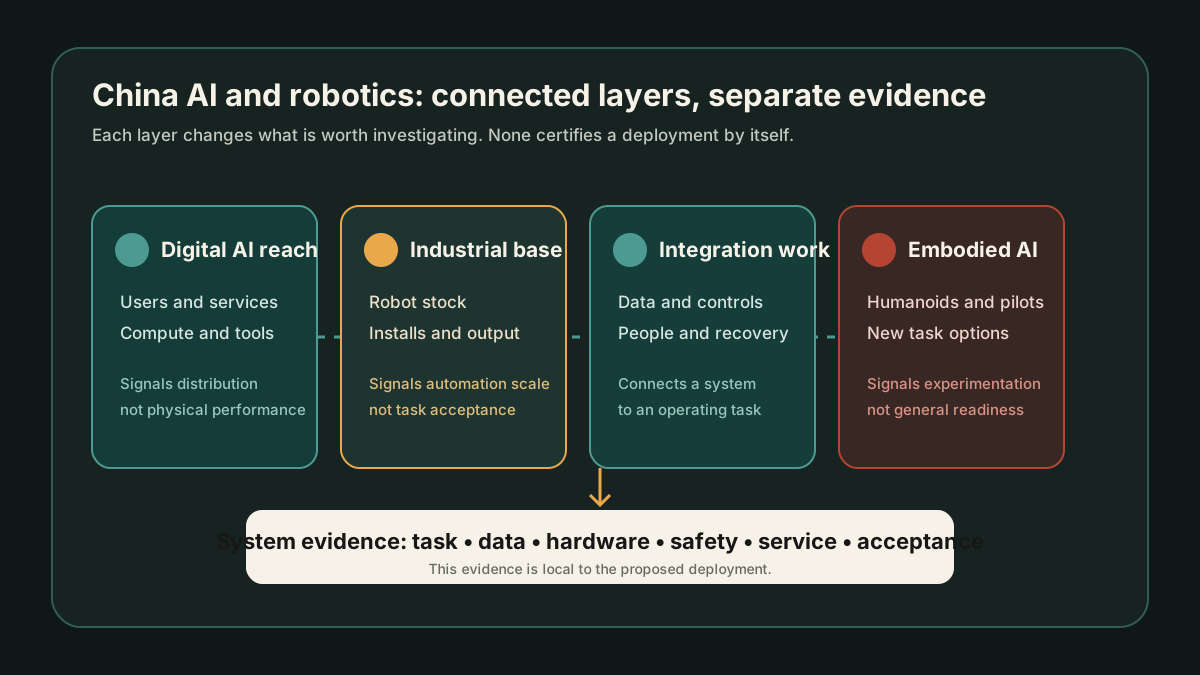 Editorial map: these layers reinforce experimentation but are not a maturity ladder or a causal proof chain.
Layer 1: digital AI reach and compute
This layer includes users, services, data flows, developer activity, cloud and edge infrastructure, and the growing habit of putting AI tools into ordinary work. It is where China’s generative-AI user figure belongs. The number matters because widespread use can create demand for AI products, capabilities around deployment, and a population of firms and workers who expect to interact with AI systems.
It does not tell you whether those users are daily users, enterprise users, manufacturing users, users of domestic models, or users who connect AI to machines. It also does not tell you whether an industrial dataset is available, lawful to use, accurate enough, or connected to the system that a robot must control. Consumer reach is a distribution signal. It is not an industrial-control result.
The same discipline applies to compute. CNNIC’s report of 42 intelligent-computing clusters and more than 1,590 EFLOPS describes an infrastructure environment. A prospective factory system still needs to answer much more local questions: what compute runs where; which model or rule is actually used; what data leaves the site; what latency the task tolerates; what happens when connectivity is interrupted; and who can update or roll back the system.
This is why an apparent contradiction is often not a contradiction at all. China can be highly consequential in generative AI without every factory using a foundation model. It can have extensive compute capacity without the right inference stack being economic for a particular visual-inspection cell. It can have an ambitious domestic model ecosystem while an operations team chooses a small model, conventional machine vision, deterministic control, or no AI at all for a particular job. The choice depends on the task and the error cost.
Layer 2: industrial automation
This is the mature physical foundation. Industrial robots are designed for defined motions and environments: welding, painting, pick-and-place, assembly, palletizing, machining support, inspection handling and many other bounded operations. They are not synonymous with humanoids, but their installed base matters more to near-term industrial capability than a casual scan of technology news might suggest.
IFR’s 2025 World Robotics executive summary says China had 2,027,190 industrial robots in operation in 2024, or 43% of the global operating stock. It also records 295,045 installations in China in that year, or 54% of global installations. The stock is an accumulated base. The installations are one year’s additions. Both are valuable, and neither is the same as a unit manufactured in China.
NBS records 773,000 industrial robots produced in China in 2025. Production is a manufacturing statistic. Some units can be installed domestically, some can move through inventories or export channels, and the figure does not reveal the task, brand, customer, utilization, maintenance burden or outcome of any unit. Putting stock, installations and output into a single “robot dominance” number would make the story cleaner and the analysis worse.
Layer 3: integration into an operating system
The difficult work lies here. An AI system becomes industrially meaningful only when it is joined to a physical process and to the people who own that process. It needs the right data, a defined decision, a control or recommendation path, hardware interfaces, rules for exception handling, version control, safety boundaries, cybersecurity practices, maintenance and a way to judge the result.
This is the layer where China’s manufacturing depth can matter most, and where public evidence is usually thinnest. A national robot statistic does not show integration quality. A model release does not show whether a cell can recover from a misplaced part. A factory tour does not show whether a vision flag is connected to containment and shipment release. The work has to be inspected at the level of the proposed system.
Layer 4: embodied AI and humanoids
This layer gets the strongest public attention because it promises flexibility. A humanoid form is appealing in environments built for people; it could potentially move between tools, stations and tasks without every work area being rebuilt around a fixed robot. Embodied AI also creates a direct link between perception, action, data collection and feedback. Those are important ambitions.
But ambition is not a substitute for evidence. The progression from a controlled demonstration to repeatable commercial work is especially demanding when the environment varies, objects are difficult to grasp, workers share the space, floors are imperfect, work instructions change, or failures are expensive. A system can be capable enough to create a useful pilot and still be far from a good deployment for an unrelated task.
The right reader instinct is to follow the connection between layers without collapsing them. Digital scale can make it easier to build AI products. Industrial automation can create a rich base of factories, integrators, components and operating knowledge. Humanoid experiments can expand the space of tasks to test. Yet the integration layer decides whether any of that becomes a reliable system.
The digital layer is large—but it is not the physical layer
The 602 million generative-AI user figure is worth taking seriously. It indicates how quickly AI services have become a public technology category in China. A wide user base can support product iteration, developer interest, business adoption and familiarity with AI interfaces. For a global reader, it is part of the answer to why China’s AI ecosystem cannot be reduced to a few model announcements.
It is also a measure with a sharp boundary. It does not identify how the AI is used, whether users rely on domestic or foreign models, what workload is being served, what data is involved, or whether a user touches a factory system. The number has no embedded answer to a buyer’s question about defect escape, planned downtime, picking accuracy, safe motion, cycle time, service response or contractual responsibility.
That distinction matters because the word “AI” changes meaning as it crosses a factory gate. In a consumer or office setting, a model may be useful when it drafts, retrieves, translates, summarizes, suggests or creates. An incorrect answer can be inconvenient, embarrassing or costly, but a person often sees it before it changes the physical world. In a robot or factory setting, the output may influence a movement, a release decision, an inspection result, a material allocation, a maintenance call, a process setting or a schedule promise. The system needs clear rules for when a person verifies, overrides or stops it.
The difference is not an argument against using advanced models in factories. It is an argument for specifying the role. A generative model may help technicians retrieve instructions, summarize an incident, create a first draft of a work instruction, assist an engineer with code, or interpret a structured body of maintenance material. A vision model may identify a possible anomaly. A planner may forecast a constraint. A conventional controller may execute motion. Each role needs a different safety, data and acceptance case.
For the same reason, do not use “AI-enabled robot” as a finished description. Ask which part is AI-enabled. Is AI used for perception, navigation, motion planning, task planning, language interaction, remote assistance, quality classification, fleet dispatch, predictive maintenance or reporting? Does the system act autonomously, recommend an action, or present a human with a queue? Does it work on the edge, on a local server or through a cloud service? What is the fallback? These questions make the system legible without requiring you to become a model researcher.
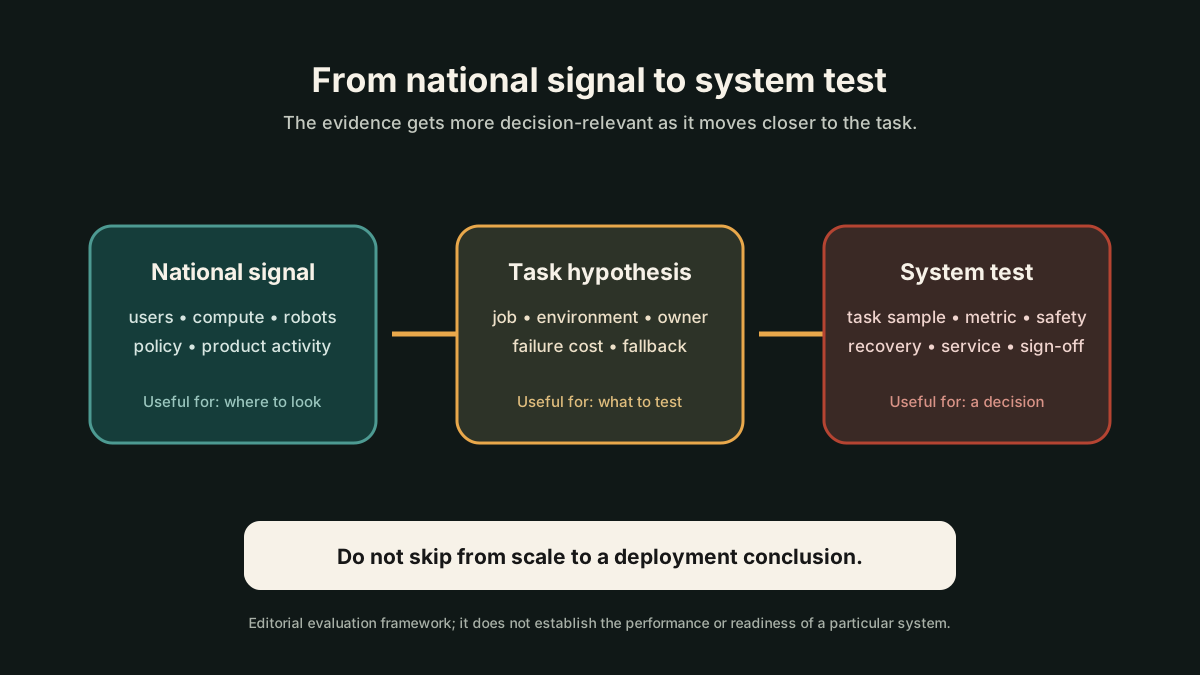 Editorial reading rule: country-level scale can justify investigation, but the acceptance evidence belongs to the proposed task and system.
The physical layer: separate stock, installations and output
Industrial robot statistics are powerful because they describe machinery in operation rather than software attention. They are also frequently made to carry claims they cannot support. The safest approach is to preserve three different units of analysis.
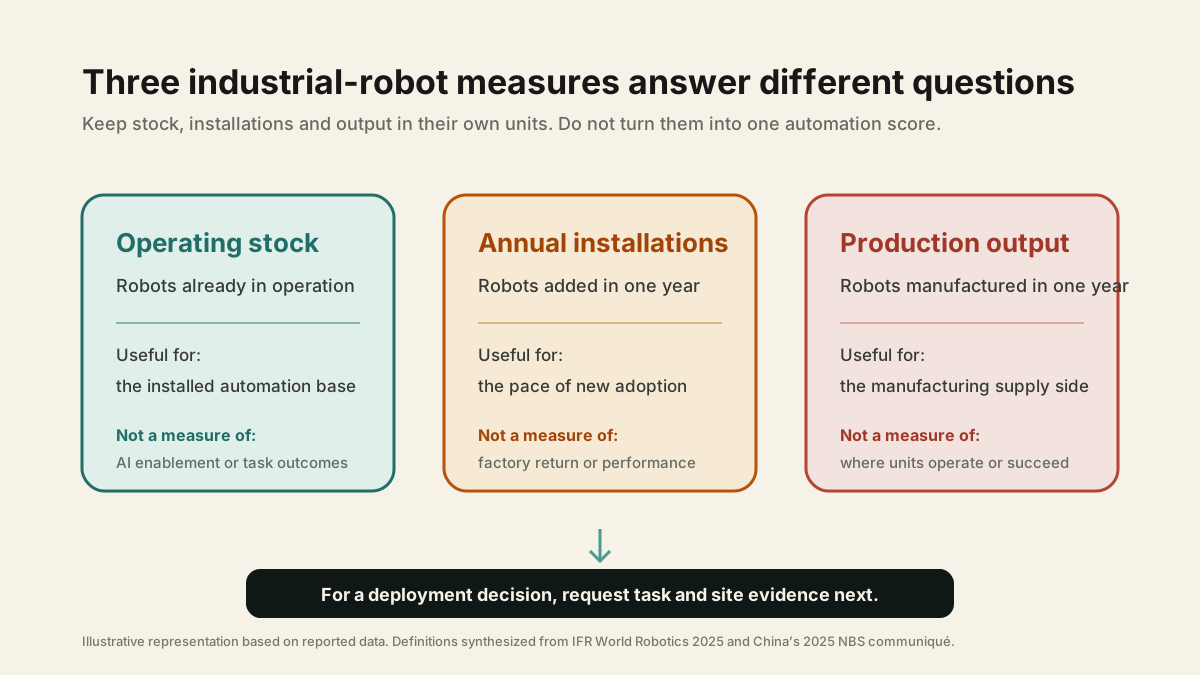 Editorial comparison based on IFR and NBS records. The measures are not additive and do not describe factory-level autonomy.
Operating stock answers: how much industrial automation is already in use?
IFR’s operating-stock number is the closest of the three measures to an installed physical base. An operating stock of more than two million industrial robots suggests that manufacturers, integrators, component suppliers, maintenance providers, training systems and production teams have a large environment in which to work with automation. It helps explain why China is not merely a market for future robots; it is already a major arena for existing industrial robotics.
But operating does not mean uniformly productive, connected, AI-enabled, newly installed or appropriate for your operation. Robot density can differ substantially by sector and region. A robot can perform a well-defined task in an automotive, electronics, metalworking, appliance, logistics or other setting without giving a factory a general-purpose automation capability. The record is a scale signal, not a performance audit.
Annual installations answer: how quickly is the base changing?
The annual-installation number shows a flow. IFR’s 295,045 installations in 2024 indicates that new industrial robots continued to enter China’s manufacturing landscape at scale. This can matter because a fresh flow brings new equipment generations, integrator work, process redesign, controls integration and training demand. It says something different from accumulated stock.
It does not say whether every installation replaced labor, raised throughput, improved quality, reduced risk, met its expected payback or remained in use. It also does not say whether the robots were domestic or foreign brands, whether they had AI perception, or whether a site is ready for a more flexible embodied system. Those are separate, task-specific questions.
Production output answers: what was manufactured, not what succeeded in the field
NBS’s 2025 output figure gives a view of the supply side. It shows that industrial-robot manufacturing itself was expanding: 773,000 units, up 28.0% year on year. That is relevant to China’s production capacity, component networks and the volume of industrial equipment moving through the ecosystem.
It should not be translated into a claim that 773,000 factories added robots, that all units were retained in China, or that they operated successfully. A production figure and an installation figure are generated by different processes, cover different periods and can be affected by inventories, exports, product mix and reporting definitions. Treat the separation as useful information, not a frustrating caveat.
| If someone says… | Ask which measure they mean | The next question |
|---|---|---|
| “China has millions of robots.” | Operating stock | In which sectors, tasks and sites are they operating? |
| “China is adding robots faster than anyone.” | Annual installations | What job is being automated, and what changed after installation? |
| “China is producing hundreds of thousands of robots.” | Production output | Where did the units go, and what support and integration ecosystem followed them? |
| “Robots prove that a factory is AI-ready.” | Usually none of the above | Which model, data, interface, safety rule and acceptance result proves that claim? |
Where AI meets the factory: policy can point to a path, but it cannot certify a result
China’s AI-plus policy and smart-manufacturing programs matter because they reveal the direction of institutional attention. They can create incentives, standards work, demonstration projects, supplier activity and common language around adoption. They can also make it easier for a reader to see which application categories are being encouraged.
The State Council’s 2025 AI-plus opinion calls for AI to be broadly and deeply integrated across six priority fields by 2027, and sets a target above 70% for application penetration of next-generation intelligent terminals and agents. It describes an intended direction for economic and social application. The document itself is clear about its status as policy: it is not evidence that a specific factory, robot or system already meets the objective. Read the AI-plus policy record as a map of intent, not as a deployment certificate.
MIIT’s January 2026 progress briefing gives the physical program context. It says China had more than 35,000 basic-level, more than 8,200 advanced-level and more than 500 excellent-level smart factories, plus 15 leading smart factories. These reported tiers indicate a large formal smart-manufacturing program. They do not say that the factories share one technical architecture, a common autonomy level, identical AI use cases or the same commercial outcomes. The MIIT briefing should be read as program context.
At the application level, MIIT-hosted reporting describes AI-plus-manufacturing work around inspection, predictive maintenance and digital twins, alongside more than 400 industry-demand notices, more than 1,000 enterprise matches and 151 selected cases. These are useful categories because they direct attention to real operating problems: seeing a defect, anticipating an equipment issue, or maintaining a usable digital representation of a physical process. They are not independent measurements of the reliability, return or transferability of every case. The manufacturing application report gives the program record, not a buyer audit.
Inspection: a camera is only the beginning of the loop
AI-assisted inspection can be valuable when a task has a repeatable visual or sensor signal, enough representative data, a meaningful containment action and a human owner for ambiguous results. It can fail when lighting, material finish, product variants, defect distribution or process conditions drift beyond what the system has seen.
When a supplier demonstrates inspection AI, do not stop at accuracy language. Ask for the product family and variant, the defect categories in scope, the blind spots, false-positive and false-negative handling, review thresholds, retained images or records, calibration process, change control, and the action that follows a flag. Ask what happens when the system is unavailable. A good answer is operationally specific; a vague answer usually means the system has not been connected to the buyer’s risk.
Predictive maintenance: prediction is valuable only with a recovery plan
Predictive maintenance promises to detect changes in equipment behavior before an interruption becomes severe. It may analyze vibration, temperature, power, pressure, motion, fault logs or other signals. The useful question is not whether a model can generate a health score. It is whether the score gives the maintenance and production teams enough time and authority to plan an intervention without creating a worse interruption.
For a proposed use, ask which assets are covered; what counts as a warning; how warnings are validated; how planned work is scheduled; what spare parts are available; which failures remain outside the system; and how the factory measures avoided disruption rather than simply counting alerts. If the supplier cannot connect a prediction to a work order, owner, scheduled action and recorded outcome, it remains an interesting dashboard rather than a resilient maintenance process.
Digital twins: a representation must stay connected to its physical referent
The term digital twin can describe anything from a useful production model to a static visualization. It becomes operationally meaningful when it has a declared scope, current inputs, an owner, a defined decision and a controlled relationship to the physical system. A twin used to simulate a line change, resolve a capacity constraint or test a configuration can be helpful. A visually impressive model that does not affect an approved decision is not yet a buyer-relevant capability.
For an order or system you are evaluating, ask what the twin represents, what data keeps it current, how often it updates, what assumptions it uses, which decisions depend on it, how those decisions are verified in the physical world, and how changes in product, tooling, layout or software are represented. This is the same discipline described in How Chinese Factories Use AI: A Buyer’s Evidence Guide: an AI or digital claim becomes meaningful when it changes a named decision with a visible owner and a recovery path.
Humanoids are a bridge layer, not a verdict on commercial readiness
China’s humanoid activity deserves serious attention. It combines a large manufacturing environment with public policy, a growing supplier ecosystem, component availability, a culture of fast product iteration and a willingness to stage demonstrations. It may accelerate learning about bodies, hands, actuators, batteries, perception, teleoperation, training data, remote operations and task design.
MIIT’s 2026 progress briefing says that more than 140 domestic complete-machine enterprises released more than 330 humanoid products in 2025. It also describes ongoing work on standards, product testing, network and data security, application demonstration and a research-to-application path. Those facts show breadth of activity and the fact that the surrounding system—testing, standards and security as well as hardware—is part of the agenda. They do not show that 330 products are comparable, useful for the same work, financially viable or deployed at scale.
Independent reporting gives a needed counterweight. Interact Analysis said in June 2026 that humanoid production had grown sharply in 2025 while autonomous, commercially viable real-world deployments remained limited. Because the firm is promoting an industry report and does not disclose its complete methodology in that summary, treat its production and deployment estimates as a qualified analytical signal rather than a market census. Its more durable point is the right one to test: autonomy, return on investment and multitask performance are linked constraints, not separate marketing boxes. Read Interact Analysis’s qualified assessment.
AP’s reporting points to related operational boundaries: progress in human-level movement does not settle the cost of equipment, the difficulty of working in fragile or unstructured settings, the data required to teach tasks or the gap between a controlled demonstration and reliable work. AP’s reporting on Chinese humanoid demand and constraints is useful precisely because it keeps the deployment question open.
What to look for instead of a general “humanoid readiness” claim
For a specific task, ask whether the robot has a task definition that a plant manager, safety lead and operator would recognize. “General-purpose” is not a task. “Move sealed totes from the end of line A to a marked staging rack during the second shift, then recover when an aisle is blocked” is closer to one. It gives you a place to define travel path, payload, grasp, cycle time, supervision, battery handling, environmental conditions, human interaction, exception cases and success criteria.
Then ask which parts of the task are actually autonomous. Is perception performed on the robot, nearby or remotely? Does a person select the task? Can an operator intervene? What is the remote-operation ratio? What happens after a failed grasp, an obstacle, a bad localization result or a low battery? Does the robot stop safely? Who resets it? How long does recovery take? What data is retained for diagnosis? How are software changes introduced and rolled back?
The commercial question follows. What is included in the price? Hardware, end effectors, software, cloud access, remote operations, deployment engineering, training, service visits, spares, replacement units and updates can sit with different parties. A low entry price can conceal a high integration or service burden. A vendor can be technically impressive and still be the wrong partner if it cannot define service coverage, parts access, response obligations, upgrade policy, liability boundaries and exit terms.
This is the lens behind Chinese Humanoid Robots: Unitree, AgiBot, and the Commercialization Test, World Robot Conference 2026: A Buyer's Test and XPENG Robotics $900M: A Buyer Deployment File. Public attention, capital events, product launches and trade-show demonstrations are useful screening signals. They are not substitutes for task-level acceptance evidence. The same discipline applies to adjacent physical-AI systems such as China Autonomous Driving Safety Standard: Buyer File: the stakes rise as software affects motion in a shared environment.
Turn a country story into a system evidence file
If China’s AI-and-robotics scale is the opening hypothesis, the system evidence file is the decision tool. It forces a reader to move from “the ecosystem is exciting” to “this proposed system can be understood, tested and governed.”
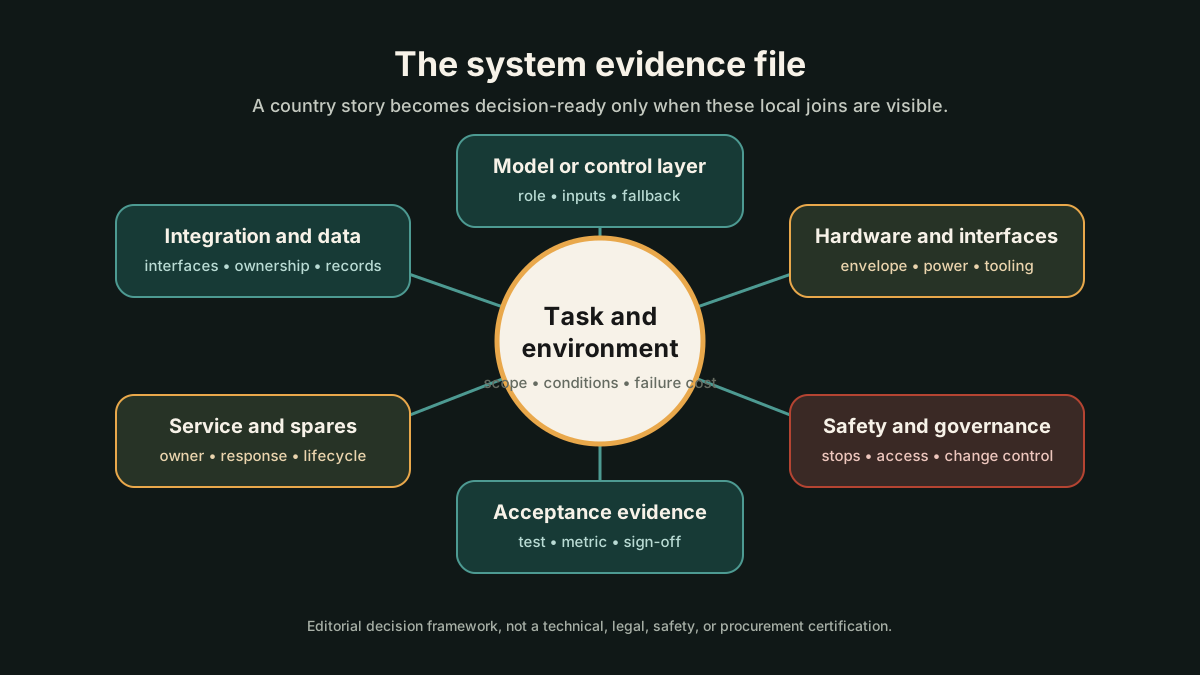 Editorial decision framework. It is not a technical, legal, safety or procurement certification.
1. Task and environment
Write the task in plain operational language. Define the starting condition, object, movement or decision, completion condition, cycle-time expectation, environmental variability, shift pattern, people nearby and consequences of failure. Identify what is deliberately out of scope. A task description should be specific enough that two different vendors could quote the same test without guessing what success means.
This first step prevents the biggest category error in the sector: asking whether a robot or model is “advanced” instead of asking whether it can perform one job with stated boundaries. It also creates a fairer comparison. A fixed industrial robot, an autonomous mobile robot, a vision station and a humanoid may all be candidates for one part of a workflow, but they should be compared against the task, not against a vague future of general intelligence.
2. Model or control layer
Identify what makes the decision or motion. It may be a conventional control program, rules engine, machine-vision model, planning model, foundation model, remote operator, or a combination. Document inputs, outputs, confidence or escalation behavior, update authority, model version, latency requirements and fallback behavior.
The goal is not to demand disclosure of every proprietary detail. It is to know what role the intelligence layer plays. A system that suggests a route to an operator needs a different evidence package from a system that moves a heavy payload near people. A model that retrieves a work instruction needs a different governance case from a model that changes a process parameter. The language becomes clearer as soon as the role is named.
3. Robot hardware and interfaces
List the body, end effectors, sensors, compute, charging or power arrangement, physical interfaces, operating envelope and wear items. Ask which components are standard, which are custom and which need a second source. Confirm payload, reach, speed, ingress protection, floor conditions, lighting needs, connectivity, environmental limits and any tooling or fixture assumptions.
Hardware facts are not glamorous, but they determine whether a promising demonstration can survive an actual shift. A robot may work with one tote but not another. A gripper may work in a controlled demo but not with damaged packaging. A camera may need a lighting condition that a busy factory does not preserve. A battery plan may alter shift coverage. A good evidence file makes those dependencies visible before they appear as a late project surprise.
4. Integration and data
Map the systems that must connect: manufacturing execution, warehouse management, enterprise resource planning, product lifecycle management, quality systems, safety systems, fleet management, identity systems and any cloud or remote-support service. Identify the source of truth for each relevant record and the owner responsible for an interface when data is delayed, wrong or missing.
This is often where a technology purchase becomes a real project. An AI application can be valid in isolation and still fail because a product revision was not passed through, a barcode convention changed, a quality hold did not reach the robot, an interface was not monitored, a wireless zone had poor coverage or an operator did not know who could correct a bad record. The value of China’s broad industrial ecosystem is that there are many opportunities to learn from integration work. The buyer still needs the integration plan for this system.
5. Safety, security and governance
Determine the hazard boundary, stop behavior, access control, user roles, audit logs, data handling, remote-access rules, incident reporting and change management. The exact requirements depend on the jurisdiction, machine type, task, workplace and applicable standards; this guide cannot certify any of them. It can insist that they are not afterthoughts.
Be especially careful when a vendor describes autonomy in a way that obscures supervision. Ask where the human authority lives, who can halt the system, what happens during a communications loss, how a software update is approved, how access is revoked, which data leaves the site, and how an incident is investigated. A technically capable system with an unclear safety or governance boundary may create more operational risk than a simpler system with accountable controls.
6. Service, spares and operating ownership
Every system has a service model, whether it is written down or not. The file should identify the legal seller, integrator, service entity, escalation route, parts location, warranty scope, response expectation, remote-support terms, replacement policy, training responsibility and lifecycle plan. If multiple suppliers are involved, state who owns the joined outcome.
This is particularly important for emerging humanoid and embodied-AI products, where the line between hardware supplier, software provider, remote operator and integrator can be blurred. A compelling robot demo does not tell you who will solve a failure at 2 a.m., who will supply a replacement actuator, who authorizes a patch, or what happens if a cloud dependency changes. Service evidence may feel mundane, but it determines whether the system remains deployable after launch day.
7. Acceptance evidence
Finally, agree on the test before you make the claim. Define the task sample, site conditions, success metric, safety conditions, intervention rule, recovery-time measure, defect or error threshold, evidence to retain, responsible signatories and the decision that follows a pass, conditional pass or fail. Start with a reversible pilot where possible. Set an exit route as carefully as a scale-up route.
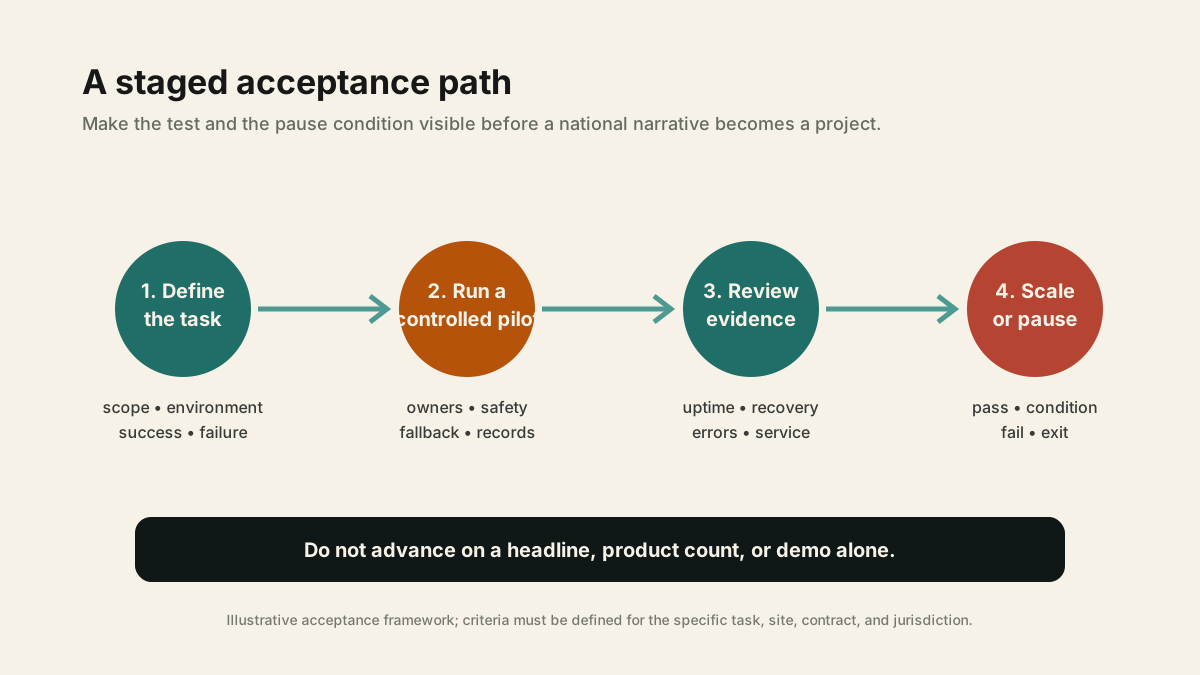 Editorial acceptance path: each stage requires evidence from the proposed task and site, not a national-scale inference.
The acceptance plan turns the article’s central distinction into practical behavior. China’s AI and robotics ecosystem can make a pilot worth investigating. It cannot decide the pilot for you. A vendor’s national story, product announcement or demonstration can get a project onto the shortlist. Only a task-specific evidence package should move it through the gate.
How to use this guide for different decisions
If you are sourcing a factory or manufacturing partner
Use China’s industrial-robot scale and smart-factory program context as reasons to ask sharper questions, not as reasons to waive normal supplier diligence. Ask the factory which processes are automated for your product class, which AI-supported decisions touch quality or delivery, what data and owners sit behind them, and how exceptions are controlled. If a claim is important to the award, turn it into a measurable requirement in the supplier process rather than a line in a presentation.
If you are evaluating a robot, integrator or physical-AI partnership
Begin with the task, then work outward. Identify whether a conventional industrial robot, mobile robot, vision station, process redesign or humanoid is actually the most appropriate technical path. Request a bounded demonstration or pilot against your task. Make sure the commercial proposal names deployment engineering, safety work, integration, service and change control—not only the device.
If you are tracking companies or the market
Separate portfolio activity from operating proof. A new model, funding round, factory opening, policy mention or trade-show performance can be a meaningful signal about direction. It does not establish customer acceptance. Follow the next evidence: named task, site, customer permission, operating period, intervention rate, uptime, recovery process, service responsibility, renewal or repeat deployment. DeepSeek Profile: China's AI Lab Explained (2026) provides a related reminder from the model side: model attention and system usefulness are not identical questions.
If you are comparing China with another ecosystem
Avoid a one-variable comparison. Compare the layers relevant to your purpose: digital adoption, model availability, component supply, robot stock, integration capacity, operating labor, standards, deployment customers, service infrastructure, export constraints and local task economics. Different ecosystems can be strong at different layers. The choice should follow the task and operating boundary, not a generalized national narrative.
Frequently asked questions
Is China ahead in AI and robotics?
China has a large and important base across digital-AI reach, compute infrastructure, industrial robot deployment, manufacturing capacity and embodied-AI activity. “Ahead” is too broad to answer without naming the layer, task, metric and comparison. The public records in this guide establish scale in their stated categories, not an overall performance ranking.
How many industrial robots does China have?
IFR records 2,027,190 industrial robots in operation in China in 2024. It separately records 295,045 installations in that year, while NBS records 773,000 industrial robots produced in China in 2025. Those are different measures—operating stock, annual installations and output—and should not be combined into one figure.
Are Chinese humanoid robots ready for factories?
Some may be suitable for carefully bounded pilots or tasks, but a country-level answer cannot determine readiness for your factory. Current reporting points to open questions around autonomy, task generalization, ROI, structured environments, data, integration, safety and service. Ask for task-specific, site-specific acceptance evidence rather than relying on a product count or demonstration.
What should a buyer ask before deploying a Chinese AI robot?
Ask for the task definition, environment, model or control role, hardware and interface assumptions, data and integration map, safety and governance boundary, service and spare-parts plan, and a measurable acceptance test. The answer should identify owners, exceptions, fallbacks and a path to pause or exit—not just the device’s stated capabilities.
Method and limitations
This is desk research based on Chinese public statistics and policy records, IFR industrial-robot data, and bounded independent reporting available through August 26, 2026. It is not a factory visit, robot test, systems-integration audit, cybersecurity assessment, supplier assessment or product recommendation. National statistics, policy documents and program counts establish their stated measures; they do not prove the performance, safety, cost, data governance or commercial readiness of a particular model, robot, factory, integrator or deployment.
The system evidence file is an editorial framework for asking better questions. A real automation, sourcing, partnership or investment decision requires task-, site-, contract- and jurisdiction-specific review by responsible technical, safety, legal and commercial people.
Related entries
- China's Industrial Robotics Revolution: What the Factory Data Actually Says — the mature factory-automation layer and the data behind it.
- How Chinese Factories Use AI: A Buyer’s Evidence Guide — how to inspect an AI claim in one named factory process.
- Chinese Humanoid Robots: Unitree, AgiBot, and the Commercialization Test — the commercialization questions behind China’s humanoid wave.
- World Robot Conference 2026: A Buyer's Test — how to turn a robotics event into a buyer test.
- XPENG Robotics $900M: A Buyer Deployment File — why capital and deployment evidence must remain separate.