

By China Made & Tech Team
As of August 17, 2026, the World Robot Conference 2026 is still ahead. The official Beijing program schedules it for August 19–23 in Beijing, with a Release Day, a Procurement Day, a Developer Day, and two public-open days. Its official program describes Procurement Day as a place for procurement negotiations and supply-chain matchmaking driven by application demand. That makes it commercially interesting. It does not make any robot procurement-ready.
The useful question is therefore not “Which humanoid robot will look most impressive in Beijing?” It is: what evidence should a buyer request after the conference before treating a launch, booth demonstration, or procurement meeting as a production decision?
The short answer is a five-stage test:
- A launch proves that a company is releasing or positioning a product.
- A public demonstration proves that a configured behavior can be shown under stated conditions.
- A pilot proves only the task, site, operating period, and support conditions actually tested.
- A repeatable production task needs records for cycle time, quality, intervention, uptime, and recovery.
- A supported deployment adds safety ownership, data rights, software change control, spares, service, and a release decision.
The conference can make the first two stages easier to observe and the third stage easier to discuss. It cannot skip the last two.
The conference is a demand signal, not an acceptance certificate
The event format itself is a meaningful signal. The official Beijing announcement separates product release, procurement, development, and public viewing instead of presenting robotics as one undifferentiated exhibition. The distinction matters because each day answers a different commercial question.
Release Day asks: what is new, and what does the vendor want the market to notice?
Procurement Day asks: where is application demand strong enough to bring buyers, suppliers, and supply-chain partners into the same room?
Developer Day asks: what software, data, tools, interfaces, and ecosystem relationships are needed to make the robot useful beyond a scripted demonstration?
The public-open days ask a different question again: can the technology attract attention and communicate capability to a broad audience?
Those are all legitimate questions. None is the same as acceptance.
A buyer should record Procurement Day as a commercial-intent event. A meeting can reveal whether a vendor understands a task, has a route to components, can discuss integration, and is willing to put a product into an application conversation. It can also reveal whether the vendor has only a general humanoid narrative. The difference will be visible in the questions the seller can answer: offered configuration, task boundary, expected operator involvement, test method, safety function, maintenance plan, software update policy, and evidence from a comparable site.
The wrong interpretation is: “There is a Procurement Day, so commercial orders are now proven.” The better interpretation is: “The organizers are trying to make demand and supply-chain matching visible; I should use the event to improve my evidence file.”
That is why the event should be read as a test of the market's ability to talk about procurement, not as proof that the market has solved procurement.
What the program reveals about China’s robotics ecosystem
The official program is large enough to show that China’s humanoid-robot story is not only about complete robots. The Beijing announcement expects more than 300 exhibitors, more than 2,000 exhibits, more than 150 first-time products, and more than 60 sessions. It also names application areas such as production and manufacturing, warehousing and logistics, catering and retail, healthcare and eldercare, workplace safety, and emergency rescue. Component zones cover sensors, reducers, ball screws, motors, batteries, dexterous hands, and integrated joints.
This is a useful map of an industrial ecosystem. It tells a buyer where to look for the layers behind a humanoid product:
- the whole robot and its control stack;
- the components that determine motion, sensing, power, and hand function;
- the application partner that defines the task;
- the developer tools that make data and integration possible;
- the service and supply-chain partners that keep a deployment alive.
It also explains why a humanoid-robot booth can be misleading when viewed in isolation. A robot may look like one product, but the procurement object is usually a system: hardware revision, end effector, software version, task model, operator workflow, network, safety controls, spare parts, and service boundary.
The event’s application framing is consistent with Beijing’s broader attempt to turn robotics demonstrations into scenario evidence. A related official description of the 2026 World Humanoid Robot Games describes 32 competitive and scenario-based events, including autonomous and service situations. A competition is not a production acceptance test, but a scenario-based event at least points toward the right unit of analysis: what must the robot do, in what environment, with what autonomy and operating rules?
For a buyer, the application zone should be treated as a question generator. If a vendor presents a humanoid robot moving a tote, ask for the tote's dimensions, weight distribution, presentation variation, lighting, floor condition, cycle definition, recovery behavior, and operator interventions. If it presents a dexterous hand, ask whether the result depends on a fixed fixture, a known object pose, teleoperation, a remote human, or a particular software version. If the vendor presents a factory scenario, ask whether the claimed result is a laboratory demonstration, an internal production test, a customer pilot, or a released commercial task.
The conference gives the buyer more places to ask those questions. It does not answer them automatically.
The policy signal is a training-and-demand loop
China’s current humanoid-robot policy language is important because it describes a mechanism rather than only a market size. A government summary of the 2026 real-world training action describes a loop from real-world training to data, product iteration, and scale deployment. It names manufacturing, testing, maintenance, warehousing and logistics, retail, healthcare, and safety or emergency work as task areas. It also states targets of more than 100 high-value scenarios and 10,000 units landing by the end of 2026.
Those are policy targets. They are not a verified shipment record, a vendor scorecard, or evidence that a particular buyer's task is ready. But they show how the ecosystem is being organized. The intended progression is not simply “build more robots.” It is:
- place robots in real or realistic work situations;
- collect the physical data that a model needs;
- use failures and edge cases to change the product;
- package a more repeatable task;
- move the task toward broader deployment.
That loop creates a different procurement environment from a conventional equipment purchase. A mature industrial arm is often bought against a stable task, a known fixture, and a well-understood integration pattern. A humanoid system may still be changing its hardware, policy, data pipeline, and operator model while the buyer is trying to define the business case.
This is not automatically a weakness. A fast iteration loop can be exactly how a new category becomes useful. It does mean that the buyer should write change control into the purchase conversation. Which model revision is being offered? Which software or foundation-model version produced the demonstration? Who owns the task data? Can the vendor update the policy after acceptance? What happens if an update improves one task and changes another? Does the buyer have a rollback path? Are safety functions independent of the learned behavior, or does a software change alter the safety case?
If a conference discussion stays at “the robot is getting smarter,” it is not yet a procurement discussion. Procurement starts when the parties can define the task, the record, the change, and the release owner.
Where factory evidence begins and ends
The bridge from prototype to product is also visible in Beijing E-Town. A Beijing government article reports a planned 2026 capacity of 10,000 units, a claimed 15-minute assembly process, and a pre-packaging whole-machine test lasting 8–12 hours. The article says the test covers more than 200 items, includes repeated 50-metre runs, and is organized around five matrices: precision structure, electrical performance, environmental simulation, safety compliance, and reliability.
This is useful factory-process evidence. It shows the kind of test architecture a buyer should want to see: more than a short demo, more than a final visual inspection, and more than a single “works / does not work” judgment. It also shows the value of a traceable test loop. If a robot walks off course, the factory says its data can help identify the reason and link the issue back to a production step.
But there are at least four boundaries.
First, assembly cadence is not task performance. A robot leaving an assembly line every 15 minutes does not establish that it can execute a customer’s 30-second pick-and-place cycle for a full shift.
Second, a factory test is not a customer acceptance test. The factory may test the machine's own functions under its own conditions. A buyer must test the offered configuration against the buyer's material, fixture, environment, operators, and quality standard.
Third, a test matrix is not raw evidence. The buyer needs the test method, revision, sampling rule, failure definition, repair or rework disposition, and record retention period. “Safety compliance” is a heading; it is not a safety case.
Fourth, a process claim is not an independent outcome. The article reports the factory and company context. It does not provide a representative distribution of failures, customer uptime, intervention rate, total cost, or long-term service performance.
The correct procurement response is neither to dismiss the factory process nor to treat it as proof. Ask to map the supplier's factory tests to the buyer's acceptance tests. Which items are identical? Which are only proxies? Which customer conditions are absent? What data travels with the shipped robot? What is the release rule when a test fails?
That mapping is where manufacturing competence becomes buyer evidence.
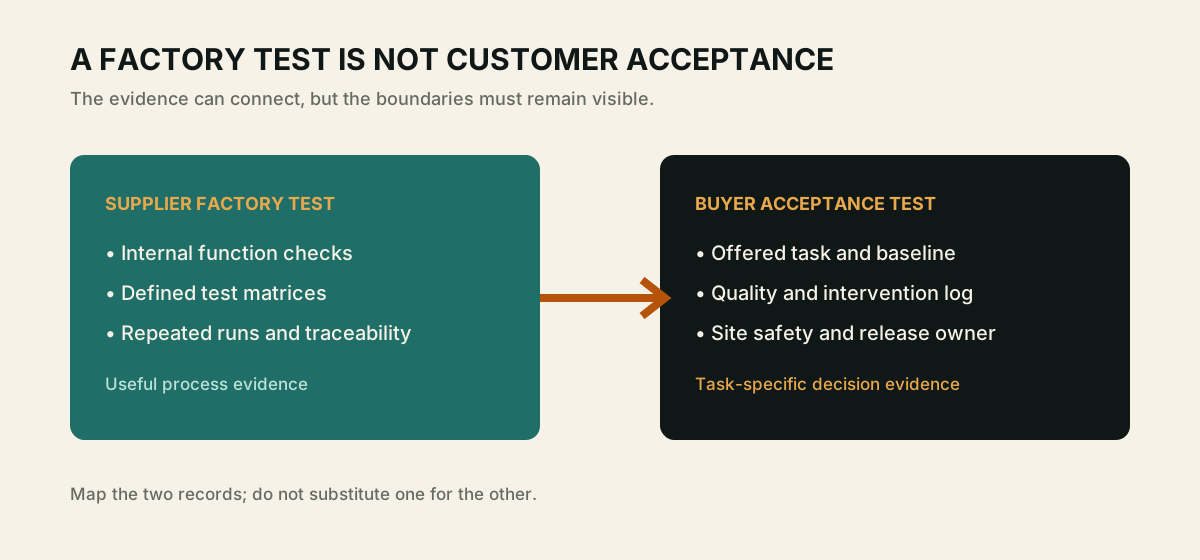 A factory test can supply process evidence; customer acceptance still has to bind the robot to the offered task, site, and release owner.
Why production scale is not deployment proof
The independent counterweight is important because humanoid robotics is unusually good at producing impressive scale narratives. Interact Analysis describes an “impossible triangle” among autonomous operation, ROI or task success, and multi-task generalization. Its analysis reports that Chinese vendors account for more than 90% of production and that roughly 75% of deliveries are in China, while also saying that early demand has been strongly associated with research, entertainment, data collection, attention, and government support rather than proven broad commercial deployment.
The numbers are useful context, but they are not a readiness score. A large share of production can coexist with a small number of repeatable tasks. A high shipment total can include research units, development units, demonstration units, government-supported pilots, or machines whose human support burden is not visible in the headline. A vendor can be excellent at manufacturing a platform before it has proved that the platform creates a durable labor or quality advantage in a specific work cell.
The Associated Press report on China's humanoid-robot push gives the same story a different angle. It reports a crowded market, large model counts, government-supported demand, and early-stage mass production, while also describing commercialization lag, high cost, physical-data needs, and the fact that conventional industrial arms already perform many factory tasks.
That last comparison is essential. The buyer is not deciding whether a humanoid robot is more exciting than a human-shaped machine in a video. The buyer is deciding whether the proposed system is better than the current process and the available alternatives. If a conventional arm, cobot, gantry, mobile manipulator, fixture change, or human-assisted station can complete the same task with a lower intervention burden, the humanoid category label does not create ROI.
The right baseline is the task:
- What is the current takt time and quality loss?
- What part of the process is physically difficult or expensive for the incumbent solution?
- How many object variants appear in the real work mix?
- How often does the robot need a human to recover, reposition, recharge, or explain the scene?
- What happens during a network, perception, gripper, battery, or software failure?
- Does the proposed robot reduce total operating cost after integration, supervision, service, and downtime?
Until those questions are answered, “commercial deployment” is a category claim, not a buyer result.
The demo-to-deployment ladder
The following ladder is the article's editorial framework. It is not a robotics standard. Its purpose is to stop buyers from treating five different evidence states as one.
| Evidence stage | What it can establish | What it cannot establish | Buyer gate before moving on |
|---|---|---|---|
| Launch | A company has announced a model, capability, or commercial direction | That the model is available in the offered configuration or can do the buyer's task | Exact model, revision, availability, commercial entity, and scope of claims |
| Public demo | A configured behavior was shown under stated conditions | Repeatability, shift-level performance, unattended operation, or customer ROI | Task definition, video/test conditions, operator involvement, and raw result record |
| Bounded pilot | The offered setup worked—or failed—at a named site for a named period and task | General performance across sites, variants, seasons, or future software revisions | Pilot protocol, baseline comparison, intervention log, quality record, and exit criteria |
| Repeatable production task | The task meets an agreed cycle, quality, availability, recovery, and cost boundary over a defined sample or period | Broad humanoid generality or performance outside the tested task and configuration | Acceptance report, traceable logs, change control, spares, training, and accountable release owner |
| Supported deployment | The buyer has an operating system around the robot: safety, service, data, software, spares, and escalation | A permanent guarantee that the system will never degrade or need requalification | Contractual support, safety ownership, update policy, recovery plan, and reacceptance triggers |
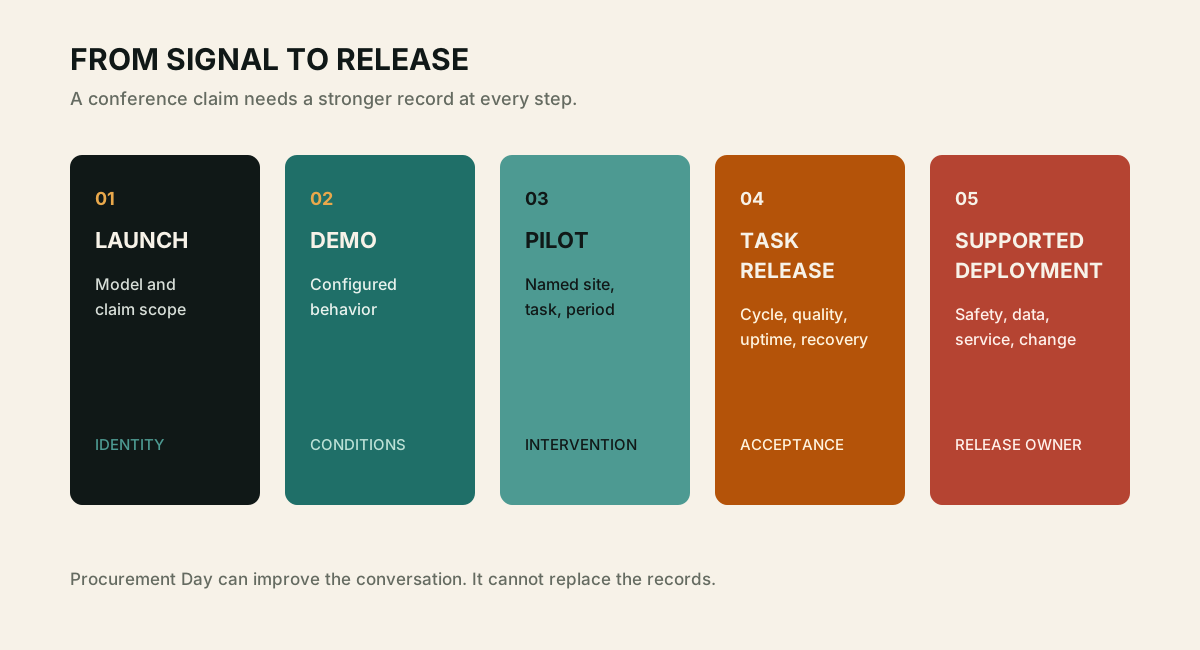 Editorial framework: a conference signal becomes a release decision only as task, quality, safety, service, and change records accumulate.
This ladder also clarifies what Procurement Day is good for. It can move a vendor from an unknown launch to a more concrete conversation. It can help a buyer find a pilot partner, an integrator, a component source, or a developer. It can expose whether the vendor has a task vocabulary. It cannot move a robot from public demo to production task without the records in the middle.
The buyer’s acceptance file
A conference visit or procurement meeting should end with a file, not only a contact list. For each proposed robot and task, ask for the following.
1. Define the offered configuration
Record the model, hardware revision, joints, hands or end effectors, sensors, battery, onboard compute, network assumptions, software version, policy or model version, and any teleoperation or remote-assistance layer. If the conference demo used a different hand, fixture, model, or software branch, record the difference.
Ask for a configuration freeze date. A buyer cannot accept a moving target by comparing a current offer with an earlier video.
2. Define the task and baseline
Write the task as an operational unit rather than a slogan. “Bin picking” is not enough. Define the object family, presentation, weight, pose variation, lighting, reach, placement tolerance, cycle start and end, acceptable defects, replenishment method, and recovery path.
Then record the baseline. What does the existing human, arm, cobot, gantry, fixture, or mobile system cost? What is its cycle time, first-pass yield, downtime, and supervision burden? What problem is the humanoid system supposed to solve that the baseline cannot solve at acceptable cost?
3. Measure quality, not only motion
For the proposed task, request first-pass yield, defect categories, false picks, dropped objects, wrong placements, damage, and rework. Define how many trials are required, how the sample is selected, and what counts as a failure. A robot completing a motion is not the same as a robot completing a sellable or safe task.
If the vendor gives only a success percentage, ask for the denominator, object mix, human interventions, excluded trials, and failure handling. A percentage without a trial definition is a marketing number.
4. Measure intervention and recovery
Track every human touch: prompt, remote teleoperation, physical repositioning, object reset, software restart, fault clearance, battery change, and safety stop. Separate planned supervision from unplanned intervention. A system that succeeds with a human quietly correcting every difficult case may still be valuable, but it is a different business case from an autonomous system.
Define recovery time and recovery ownership. Can the line operator recover the robot, or must a vendor engineer connect remotely? What happens if the robot falls, loses localization, jams a hand, loses network access, or receives an unfamiliar object? Is the recovery procedure documented and trained?
5. Define uptime and the operating envelope
“Runs for eight hours” can mean battery endurance, not eight hours of productive work. Ask for productive uptime, charging time, planned maintenance, fault downtime, intervention downtime, and availability by shift. Record temperature, floor, lighting, network, payload, speed, and human-access conditions.
The operating envelope should include the conditions under which the vendor will refuse responsibility. That boundary is not a problem; an undocumented boundary is.
6. Treat safety as a scoped engineering file
The 2026 Unitree G1 EDU safety paper is a useful example of this discipline. It describes a Reaction subsystem with power removal and Stop Category 0 behavior, validated on a Unitree G1 EDU pick-and-place cell measuring 3 metres by 1.5 metres. It also explicitly does not claim PL e or SIL3 for the full robot, and it discusses the special hazard of a balancing humanoid falling after power removal.
That is a meaningful result precisely because it is bounded. A buyer should ask the offered system's equivalent questions:
- What hazards were identified for this robot, tool, workspace, and task?
- Which safety functions are independent of learned perception or policy behavior?
- What happens during emergency stop, power removal, loss of balance, network loss, sensor failure, and software fault?
- What subsystem, hardware revision, cell, and test conditions were validated?
- Who owns the site risk assessment and final acceptance?
- What changes trigger revalidation?
Do not accept “AI safety,” “industrial-grade,” or “compliant” as a complete answer. Ask for the safety function, boundary, evidence, and owner.
7. Clarify data and software rights
Embodied AI depends on physical data. Ask what data is collected, where it is stored, who can use it to improve a general model, whether customer data is isolated, and how data is deleted or exported. Ask whether the vendor can use recordings for training, demonstrations, support, or third-party research.
For software, record the update channel, release notes, rollback method, cybersecurity responsibilities, offline behavior, and reacceptance trigger. A software update that changes grasping, navigation, speed, or recovery behavior can change the task acceptance result even if the robot's hardware is unchanged.
8. Put service and spares inside the purchase decision
Ask who supplies batteries, hands, actuators, cables, sensors, compute modules, and other wear or failure parts. Identify the service geography, response time commitment, escalation path, training material, and whether the buyer can perform first-line maintenance. Ask what happens when a component revision changes.
The conference's supply-chain matchmaking theme makes these questions especially relevant. A component booth can show that a part exists. It does not prove that the part is qualified for the offered robot, available for the contract period, or covered by a change-notification obligation.
9. Agree on a release decision
At the end of a pilot, someone must be able to say: release, hold, rework, narrow the task, extend the pilot, or stop. Name that person or committee. Define what evidence is required, how deviations are handled, and what new condition would reopen acceptance.
If no one owns release, the project can drift from a pilot into production by optimism. That is a procurement failure, not a robot feature.
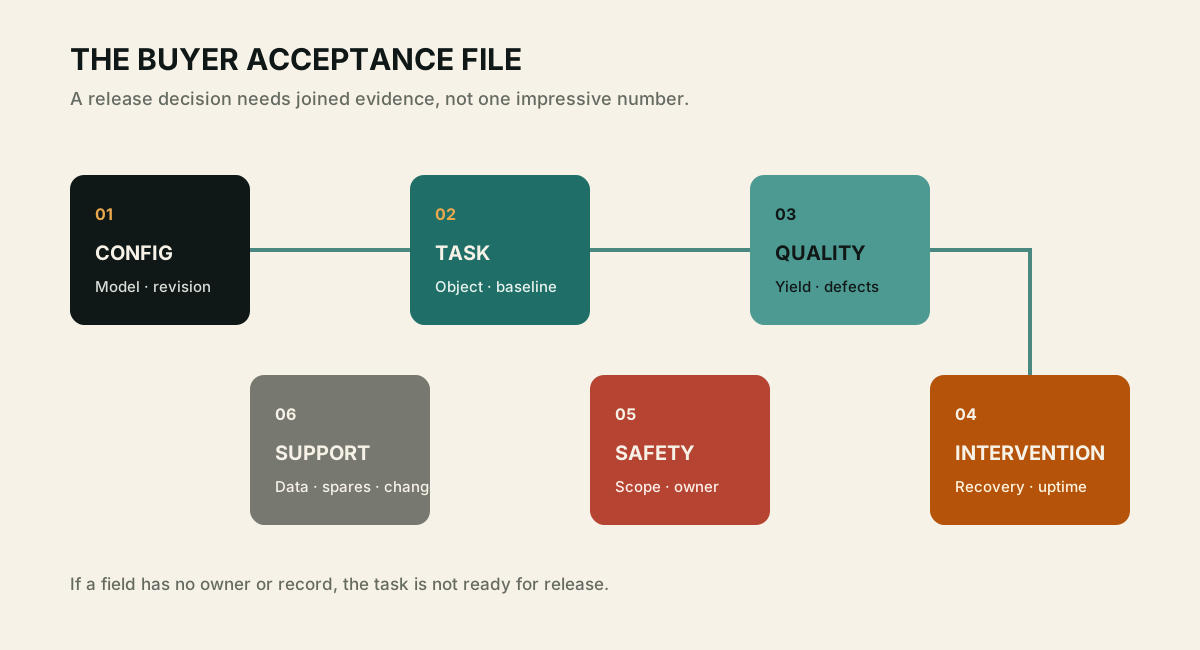 Buyer-file framework: each field needs a record and an owner before release.
Questions to take to Procurement Day
Use these questions to distinguish a vendor with an application plan from a vendor with a demonstration script:
- What exact task has this offered configuration completed, and what is the denominator of the reported success rate?
- How many trials were consecutive, and how many required human intervention?
- What is the defined cycle, and does it include picking, placing, verification, recovery, and replenishment?
- What is the baseline process, and what cost or quality problem does the robot improve?
- Which part of the result depends on a fixed fixture, known object pose, teleoperation, or remote support?
- What happens after a fall, emergency stop, network loss, perception failure, or hand fault?
- Which safety functions were tested on this hardware revision and in what cell?
- Who owns task data, training data, logs, and the right to export or delete them?
- What software changes require buyer reacceptance?
- Which spares are stocked locally, and who performs first-line repair?
- What is the pilot exit criterion, and who can hold or release the task?
- Can the vendor provide a redacted acceptance report from a comparable deployment rather than only a launch video?
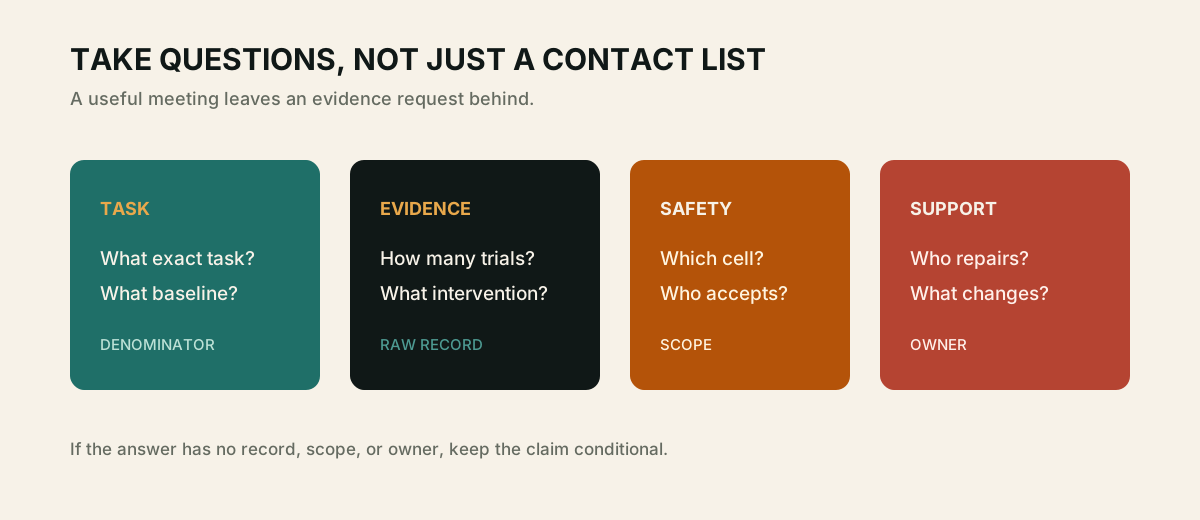 A useful procurement meeting leaves a task, evidence, safety, or support request behind.
These questions do not assume that humanoid robots are overhyped. They assume that a buyer should be able to tell the difference between a promising system and a releasable one.
What this conference can tell a buyer
World Robot Conference 2026 is valuable because it puts several parts of China's robotics system in the same frame: product releases, application demand, procurement matchmaking, developers, components, scenario demonstrations, and public attention. The planned program also reflects a country trying to move embodied intelligence from prototype visibility toward manufacturing, training, and application scale.
But the conference cannot answer the final buying question by itself. Production scale is not task repeatability. A factory test is not a customer acceptance test. A scenario competition is not a production shift. A procurement meeting is not a purchase order. A purchase order is not a supported deployment.
The right reading is conditional: the event is evidence that the market is building the institutions and vocabulary of procurement; the buyer still has to supply the task record, baseline, acceptance criteria, safety boundary, data terms, service plan, and release decision.
For the wider manufacturing-system context behind this procurement test, continue to the published evergreen guide How China Manufactures: Inside the World's Factory (2026). It provides the broader cluster, supply-chain, and factory context that sits behind the task-level evidence in this article.
Method and limitations
This is desk research conducted on August 17, 2026. It uses the official Beijing event announcement for schedule and program facts; official government pages for policy targets and a factory-process description; Interact Analysis and AP for independent or attributed market context; and a 2026 technical preprint for a bounded Unitree G1 EDU safety example. No conference attendance, factory visit, pilot, customer interview, product test, safety assessment, or supplier audit was conducted.
Government targets and factory descriptions are presented as published targets or attributed process claims. Analyst figures and forecasts remain source-scoped. The public sources reviewed do not provide a representative order-level dataset for cycle-time variance, first-pass yield, intervention rate, uptime, total cost, or broad platform safety. Those are buyer acceptance fields, not numbers this article can responsibly invent.
Frequently asked questions
When is World Robot Conference 2026?
The official Beijing announcement schedules it for August 19–23, 2026, at Beiren Etrong in Beijing E-Town. The conference is planned around Release Day, Procurement Day, Developer Day, and two public-open days. Recheck the official program before travel or a purchase meeting.
What is Procurement Day at the World Robot Conference?
It is the program day described for procurement negotiations and supply-chain matchmaking driven by application demand. Treat it as a place to improve a buyer or supplier evidence file, not as proof that a robot has passed production acceptance.
Does a humanoid-robot demo prove commercial deployment?
No. A demo can establish that a configured behavior was shown under stated conditions. It does not establish repeatability, shift-level uptime, intervention burden, quality, safety for a different site, ROI, or long-term support.
What should a buyer request from a humanoid-robot supplier?
Request an exact configuration record, task definition, baseline comparison, trial denominator, quality and intervention logs, uptime and recovery data, safety scope, data and software terms, spares and service plan, and a named release owner. Ask for a comparable acceptance report when possible.
Is China’s humanoid-robot production scale the same as deployment readiness?
No. Production scale shows manufacturing and market momentum. Deployment readiness is narrower: a named robot and task must meet an agreed operating, quality, safety, service, and change-control boundary at a real site.