
By China Made & Tech Team
AI-generated editorial illustration. It depicts no real robot, company, factory, customer, task, or performance result.
China's humanoid-robot market has made one thing clear: this is no longer a category made only of laboratory announcements. Unitree has a public humanoid product page and a visible developer ecosystem. AgiBot presents multiple robot, data, hand, and teleoperation families and has announced a large production milestone. Independent researchers report unusually high Chinese production and shipment volumes. Government agencies are explicitly pushing real-world training and application validation.
Those are all meaningful signals. They still do not answer the question a factory, warehouse, retailer, or research organisation must eventually answer: can this exact configuration perform our task, in our environment, with an agreed level of human intervention, safety, service, cost, and recovery?
That question is not anti-humanoid. It is the commercialization test. A robot can be an available product without being a released work system. A company can produce or ship thousands of units without proving customer acceptance for a particular process. A policy can target real-world validation without establishing that the target has been met. The fastest way to misunderstand China's humanoid momentum is to collapse those states into one word: “commercial.”
Independent market commentary illustrates the gap. Interact Analysis estimates that global humanoid production exceeded 20,000 units in 2025, yet says only around 10% were deployed in real-world applications and characterises current growth as driven mainly by small pilots rather than scaled commercial projects. Its 2026 market analysis does not make the sector unimportant. It makes the evidence boundary visible.
This guide uses Unitree and AgiBot to explain that boundary. It does not rank them against Tesla, Figure, or another vendor. Public sources reviewed here do not provide a common task, configuration, autonomy level, safety arrangement, support model, or economics test that would make such a ranking credible. Instead, the article shows what each kind of record can establish and what a prospective buyer should request next.
Commercialization has four different states
For a humanoid robot, the word “commercial” is doing too much work. It may mean that a web page lists a model. It may mean a unit was produced. It may mean a customer ordered hardware. It may mean a team is running a supervised pilot. Or it may mean a buyer accepted a defined task after repeatable operation under a support agreement. These are not adjacent marketing phrases; they are different milestones with different evidence.
- Available platform. A vendor identifies a configuration, components, development tools, terms, and intended use. This is enough to start a technical conversation or equip a research team. It is not evidence that a customer task is solved.
- Produced or shipped unit. A company or market source reports manufacturing, sales, or delivery volume. This is an ecosystem and supply signal. It does not identify the end user, task, autonomy level, uptime, utilisation, or commercial outcome.
- Supervised pilot. A robot performs a bounded exercise in a live or representative environment, often with remote help, safety controls, engineering attention, structured inputs, and a narrow definition of success. A pilot can be valuable learning. It is not necessarily a scalable operating model.
- Released task deployment. A named configuration completes an agreed task under documented conditions. The buyer can see the intervention model, quality or service metric, safety arrangement, support owner, change process, fallback route, acceptance record, and commercial boundary. This is the state that matters when a process owner must rely on the system.
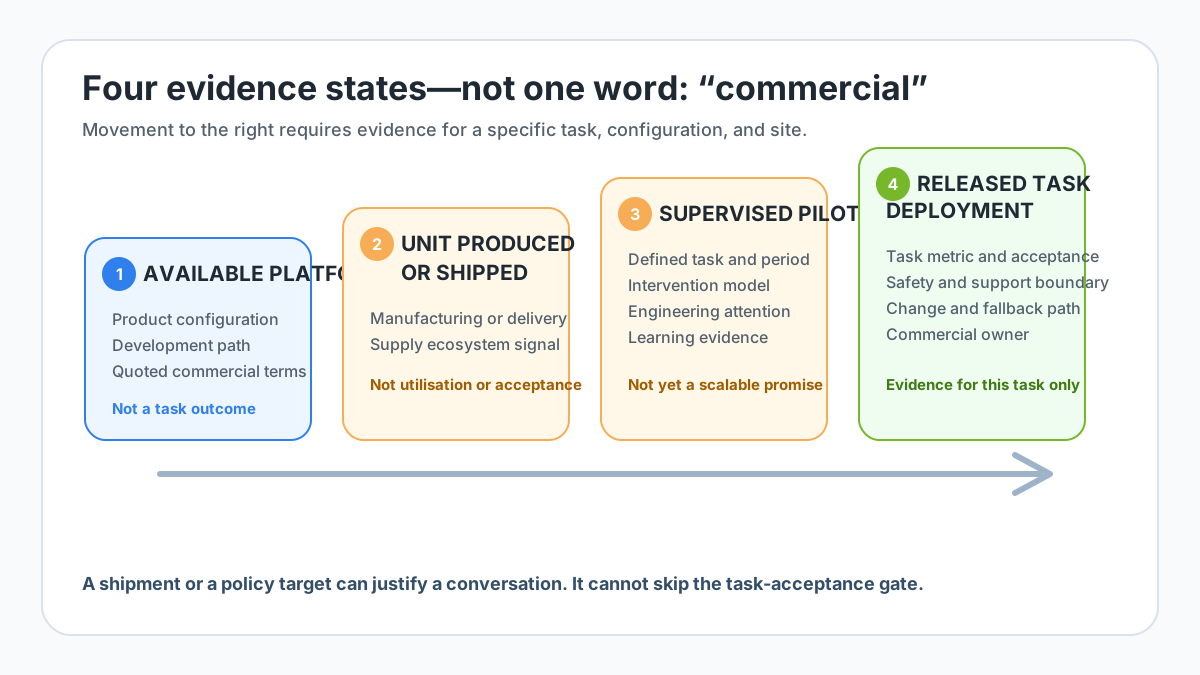
Editorial commercialisation ladder. A higher stage needs task-specific evidence; it is not a vendor ranking.
The distinction is particularly important because humanoids are systems, not appliances. Hardware revision, legs or wheels, hands, sensors, task policy, training data, teleoperation, network connections, charging, human workflow, site layout, maintenance, and programme control can all change what the robot actually does. A buyer cannot infer the state of those layers from a video of locomotion or a single volume figure.
Unitree is a platform offer, not a factory outcome
Unitree is relevant because its G1 humanoid page gives a buyer more than a cinematic demonstration: it shows an offer with configuration boundaries. The page lists a starting price of US$13,500, says battery life is about two hours, and distinguishes the G1 EDU configuration as the one with secondary-development capability. It also says parameters can vary by scenario and configuration. Unitree's G1 page is therefore useful as a vendor product record.
It is not a factory outcome record. The published starting price is not a delivered project price. It does not include the buyer's selected computing package, hand, integration, fixture, protective measures, shipping, local taxes, training, support, spares, site changes, or service response. “About two hours” does not answer how much productive work is completed per charge in a particular task, how many stops occur, how a battery change is managed, or what happens when the workpiece is presented incorrectly.
The EDU distinction is equally instructive. A buyer interested in research, application development, or a controlled proof of concept may value the ability to develop software. A buyer interested in a released work cell needs to turn that freedom into governance: Who owns the code and model version? Who can change it? Which data leave the site? What test is required before a change reaches production? Who supports the system after the integrator leaves?
These questions are not specific to Unitree. They apply to any flexible robot platform. They are especially pressing for humanoids because software, sensing, manipulation, and task policies are central to the offer. If the buyer's need is a stable, repetitive process, the comparison should start with the existing process and purpose-built alternatives—not with the most visually persuasive robot body. China's industrial-robotics base is important context here: most established factory automation is designed around constrained, repeatable tasks and known integration patterns.
Unitree's public-company status may matter for corporate, disclosure, and continuity questions, but it does not substitute for task acceptance. For that separate lens, see our Unitree buyer governance file. Procurement still begins with the physical work that must be completed.
AgiBot is a system family, not one comparable robot
AgiBot illustrates a second mistake in humanoid coverage: treating a company name as if it identified one comparable product. Its official catalogue presents A, X, Genie/G, quadruped, cleaning, data-service, hand, and teleoperation lines. It labels the A2-W a “flexible manufacturing robot” and the G2 a “universal embodied intelligent robot.” AgiBot's product catalogue establishes that the company is presenting a portfolio with different physical forms and system layers.
That breadth can be a commercial advantage. A buyer may prefer a supplier able to discuss the body, end effector, data collection, software, and teleoperation tooling together. It can also create a comparison problem. An A-series biped, a wheeled G-series product, an open-source X platform, a hand, and a data-service offer are not one purchasing object. They may have different operating assumptions, safety cases, software dependencies, support terms, and alternatives.
The right question is not “Is AgiBot better than Unitree?” It is “Which exact AgiBot configuration, in which task architecture, is being proposed against which baseline?” A wheeled system may trade stair access for stability and duty-cycle characteristics. A development platform may be appropriate for data collection but not for a released production task. A humanoid upper body may be useful where a site already has human-oriented workstations; it may be unnecessary where a conventional arm, cobot, gantry, mobile manipulator, or fixture change does the job more simply.
This is why a buyer should request a configuration sheet before comparing vendors: hardware revision, mobility base, arm and hand, sensor package, compute, task software, operator interface, battery and charging arrangement, teleoperation or remote-support role, network route, data retention, safety functions, support period, and exclusions. “General-purpose” is a starting hypothesis for an application conversation, not an acceptance criterion.
A production milestone is not an acceptance report
AgiBot says its 15,000th robot rolled off the production line and identifies the milestone unit as the G2, which the company describes as an industrial-grade embodied task robot. The company announcement is a relevant manufacturing-scale signal. It suggests that the supplier is building a production and supply story, not merely showing a one-off prototype.
It is still a company statement about a milestone. It does not identify which units are working for paying customers, what share of their time is autonomous, whether the tasks are economically useful, how much human intervention they need, how reliable a configuration is, or whether a buyer's workpiece and site are within the operating envelope. It also does not establish a warranty, service, safety, or support result for an order.
The same caution applies to market estimates. Interact says Unitree and AgiBot each produced and shipped more than 5,000 humanoid robots in 2025, together representing more than half of the global market in its estimate. In the same analysis, it warns that early leadership is associated with research, physical-AI data collection, attention, and trials rather than proven broad commercial deployment. Read the full qualification. The number is worth knowing; the qualifier is part of the number.
For a buyer, ask a supplier to split any impressive count into categories: units manufactured, shipped, delivered, installed, contracted, paid for, active in a real task, operating without remote intervention, and accepted against a named metric. The categories may all be commercially relevant, but they are not evidence of the same thing. A vendor that can make this distinction clearly is easier to evaluate than one that responds with a single aggregate total.
Policy makes application validation a target, not a result
China's 2026 policy language is unusually explicit about the need to move beyond exhibitions. A joint Ministry of Industry and Information Technology and State-owned Assets Supervision and Administration Commission notice, dated June 3 and published June 8, calls for real-world training, application-deployment validation, higher-quality robot data, and lifecycle management mechanisms. It sets an end-2026 goal of more than 100 high-value application scenarios and the capability for 10,000-unit-scale landing. The MIIT/SASAC notice is a useful public record of policy direction.
The key words are validation, goal, and capability. The notice is not a result sheet. It does not certify that every named scenario is viable, that a 10,000-unit deployment has happened, or that a particular company has met the target. Its value is strategic: it describes why China is likely to generate more trial environments, data, system integration work, and application-learning loops than a market focused only on robot bodies.
That matters for companies considering pilots. A real-world training programme can help a supplier learn faster. It may also mean the buyer is participating in an evolving system. The commercial document should therefore say whether the buyer is purchasing a product, funding a development pilot, providing a data-collection environment, or joining an application-validation programme. Each relationship needs different pricing, data, intellectual-property, safety, confidentiality, performance, exit, and support terms.
The alternative is part of the comparison
The current process is not a blank sheet of paper. Associated Press reporting on China's humanoid push notes that conventional industrial arms already perform many repetitive factory tasks and cites continuing demand, cost, data, and reliability constraints in the humanoid market. Its market report is a useful reminder that a humanoid must compete with the available alternative, not just with another humanoid.
Sometimes the alternative is a fixed arm with a dependable fixture. Sometimes it is a cobot, gantry, conveyor change, mobile manipulator, redesign of the workstation, or a better human-assisted process. A humanoid becomes interesting when the physical environment or task variation makes those alternatives unusually awkward, expensive, or inflexible. That is an application hypothesis to test—not an automatic property of a human-shaped machine.
This is also why a conference booth cannot settle a procurement decision. It can show product direction and generate a technical conversation. Our World Robot Conference procurement test explains how to convert that conversation into test boundaries, intervention records, support questions, and acceptance criteria.
The commercialization test a buyer can run
Before treating a Unitree, AgiBot, or any humanoid as a deployable work system, build a one-page task file. The file should make it possible to compare a humanoid proposal with the current process and alternatives on the same terms.
- Define the task and baseline. Name the parts, presentation variation, weight, reach, motion, cycle, environment, quality rule, shift pattern, and existing human or machine process. State what the robot must improve and what it may not make worse.
- Record the intervention model. Is the robot autonomous, supervised, teleoperated, remotely recoverable, or dependent on an on-site operator? Count interventions by type and time, rather than accepting a general claim of autonomy.
- Set the evidence and acceptance rule. Agree the sample, duration, task success definition, quality or service metric, available time, failure classification, logging, and release authority before the trial begins. A single successful demonstration is not enough for an operating promise.
- Review safety, data, and change control. Confirm the operating boundary, stop and recovery behaviour, access control, software and model versions, network path, data handling, and approval process for configuration changes. These controls must be defined for the actual site.
- Name the support and fallback chain. Identify the vendor, integrator, local service owner, critical spares, response route, battery plan, manual fallback, work quarantine rule, and decision maker when the robot cannot complete the task.
- Compare the whole system. Include integration, supervision, downtime, training, service, spares, fixture changes, site controls, and fallback in the comparison—not just the robot purchase price. A fixed alternative may win. That is a useful decision, not a failed humanoid experiment.
For each gate, name one buyer owner and one vendor owner. Evidence without an accountable decision maker becomes a demonstration record rather than an operating commitment.
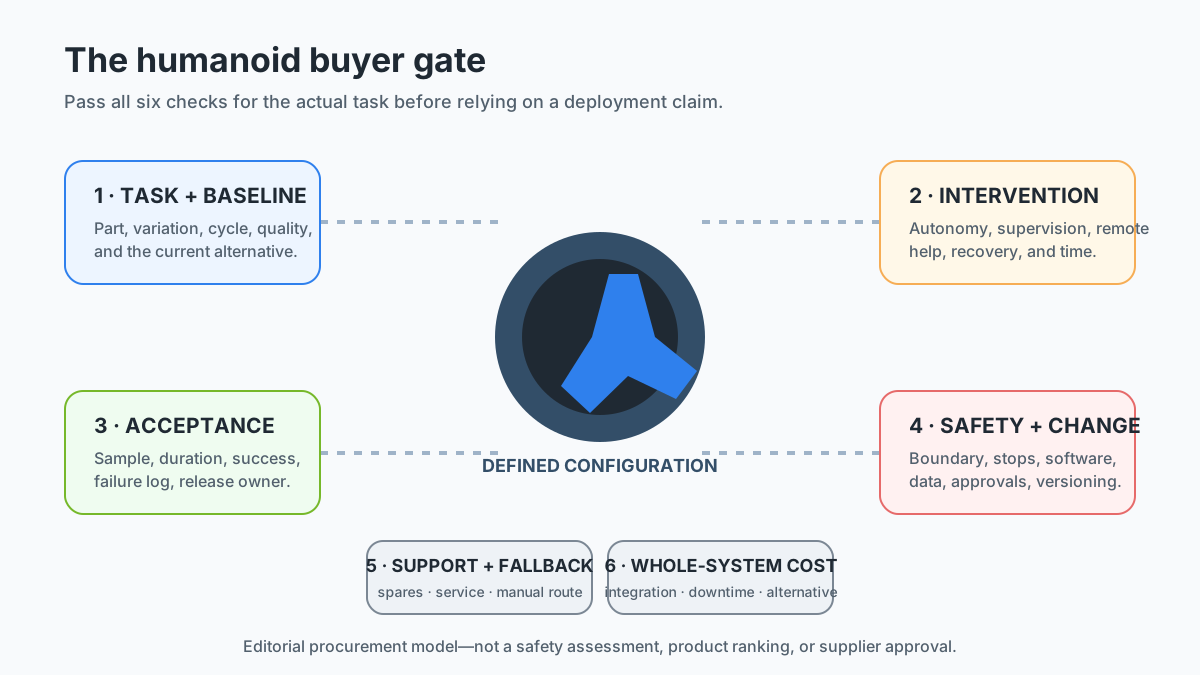
Editorial humanoid buyer gate. Validate every field for the actual task and site.
The durable conclusion
Unitree and AgiBot deserve close attention because China is building a visible humanoid ecosystem around product platforms, components, data, trials, and application learning. Product pages, company milestones, policy action, and independent market estimates all show that the category is moving quickly.
The strongest statement a buyer can make today is narrower than a race headline: a humanoid is commercially real for the task, configuration, site, and support model that it can document and accept. Everything else—an attractive body, a viral video, a production total, or a national target—is a reason to investigate, not a reason to skip the investigation.
Method and limitations
This is desk research conducted on August 24, 2026. It uses Unitree and AgiBot company pages for attributed product and milestone information, a June 2026 MIIT/SASAC notice for policy context, and Interact Analysis plus Associated Press reporting for market and commercialisation limits. No robot, deployment, factory, customer, pilot, safety arrangement, support operation, or performance result was observed or tested. Confirm the specific hardware, software, task, price, service, safety, data, support, and acceptance terms before relying on a humanoid system.