
By China Made & Tech Team
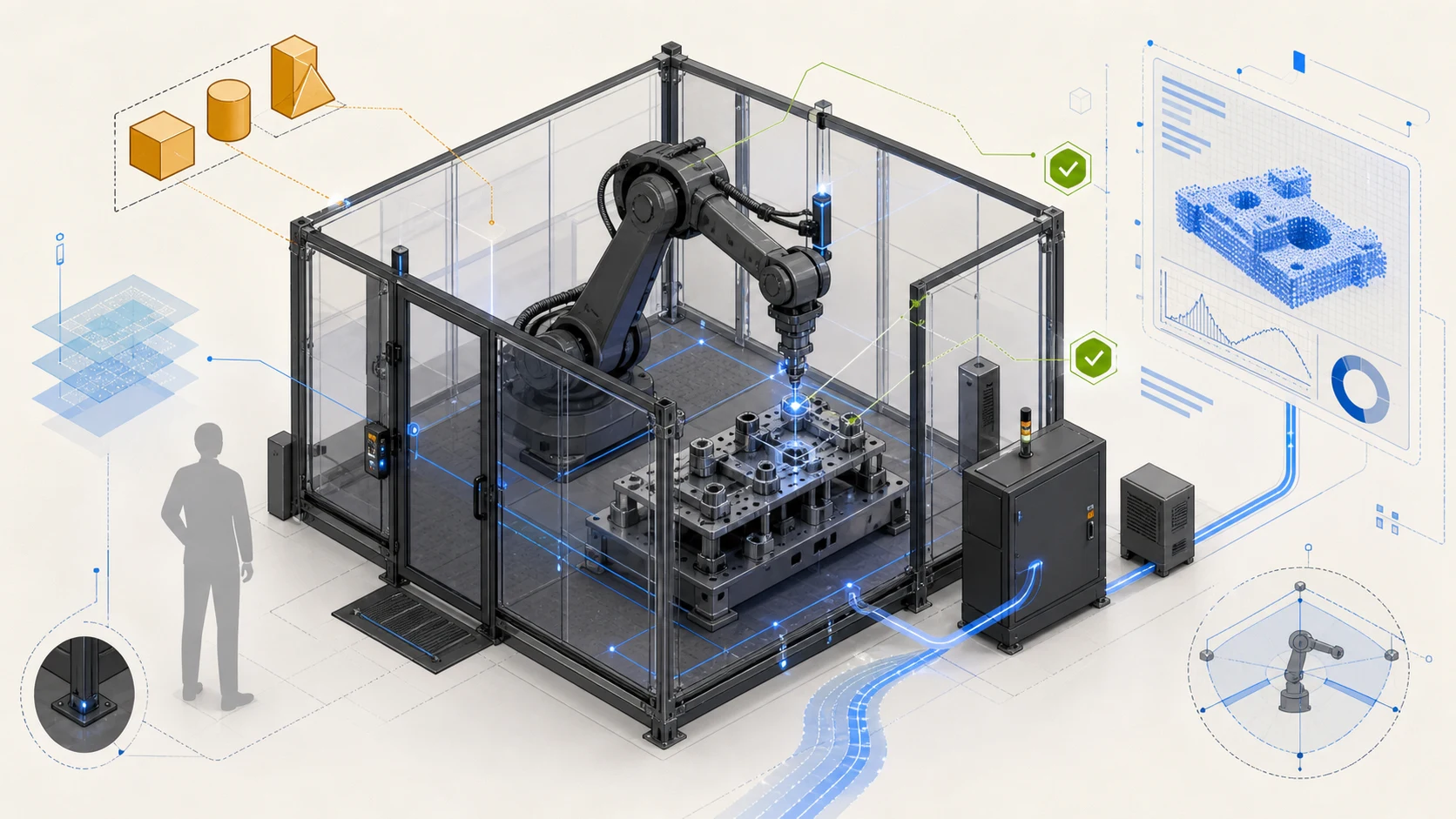
AI-generated editorial illustration. It depicts no real factory, robot brand, worker, production line, or performance result.
China's industrial-robot story deserves the superlatives it attracts. It does not deserve a shortcut. A headline about factories operating "without humans" folds several very different ideas into one dramatic picture: robots purchased, robots installed, robots operating, local suppliers gaining share, machines produced, people redeployed, and a particular production line working reliably. Those are not interchangeable observations.
The useful starting point is more precise. The International Federation of Robotics (IFR) says China installed 295,000 industrial robots in 2024—54% of global demand—and had an operating stock of 2.027 million robots. Those are exceptional market-scale figures. They are not a census of human work, a productivity test, a quality audit, or a verdict on any supplier. IFR's China release gives the scale; it does not inspect a factory cell.
That distinction matters to anyone buying from, investing in, competing with, or trying to understand Chinese manufacturing. National-scale automation changes the industrial environment: there are more applications, more integration experience, more component and service relationships, and more reasons to study where work is migrating. But an order is still made on a line. The line has a specific product, part presentation, fixture, programme, end effector, changeover pattern, inspection rule, maintenance routine, operator role, and recovery procedure.
This article separates the measurements before translating them into a buyer's factory file. The conclusion is deliberately practical: China's robot scale is a consequential manufacturing fact. A supplier's automation claim is still something to verify in the exact cell that will make the product.
Scale is real; the headline needs a unit
The first discipline is to name what each number counts.
Annual installations are a flow: robots newly deployed during a stated year. IFR's 295,000 figure says China was by far the largest destination for new industrial robots in 2024. A flow is useful for reading current demand, deployment momentum, and the breadth of the customer base. It does not say that every installed machine is fully utilised, that it replaced a particular number of people, or that a factory has automated its entire process.
Operating stock is an accumulated base: robots that IFR counts as operational in the country. The reported 2.027 million figure is useful because it describes the large installed environment in which suppliers, integrators, programmers, maintenance teams, component makers, and factory managers operate. It still does not expose the age of a cell, its uptime, its task mix, its safety performance, or whether it produces a buyer's product within specification.
Robot density is a ratio. IFR reports China at 567 industrial robots per 10,000 manufacturing employees in 2024. The federation's 2025 industrial-robot foreword provides that comparison measure. Density helps a reader compare automation intensity while accounting, at a high level, for manufacturing employment. It is not a score for a plant's autonomy. A country can have high density and many roles in setup, loading, material replenishment, troubleshooting, quality review, process engineering, maintenance, logistics, supervision, and change control.
The words around a statistic are as important as the statistic itself. “China has 2.027 million robots in operation” is an evidenced description of stock. “Chinese factories are without people” is a separate and much larger claim that the number does not establish.
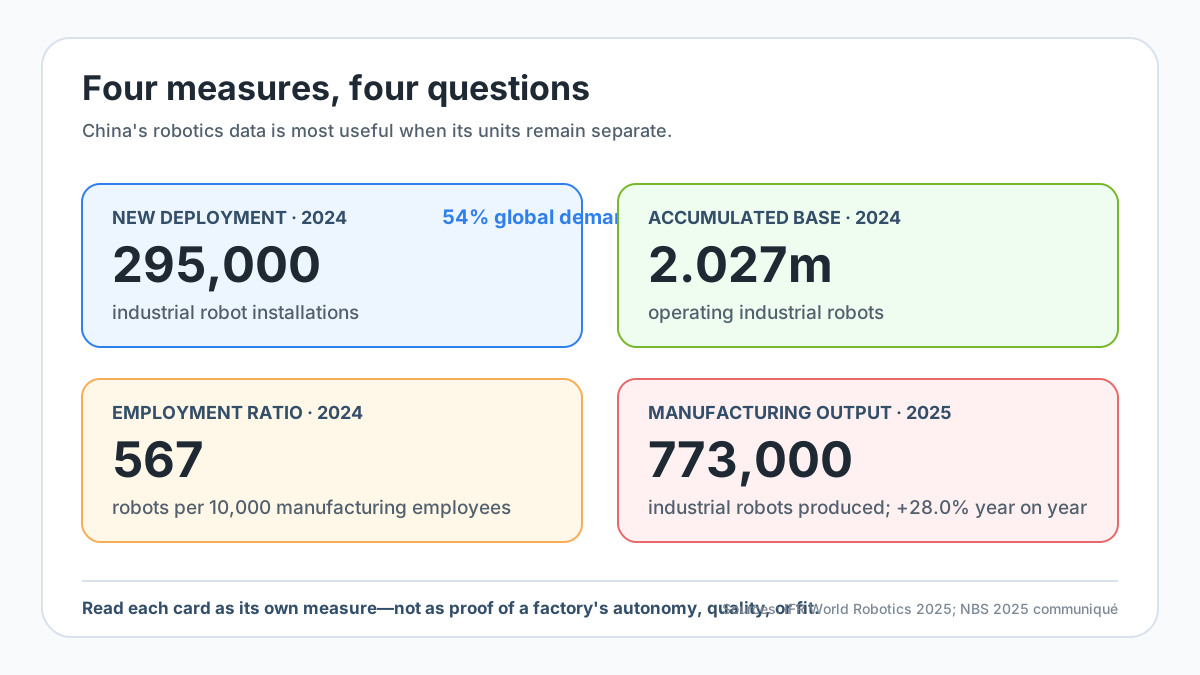
Editorial data reading aid using IFR and National Bureau of Statistics records. The measures use different units and must not be equated.
A measurement map for readers and buyers
| Measure | What it records | What it can suggest | What it cannot prove |
|---|---|---|---|
| Annual installations | New industrial robots deployed in a year | Market demand and deployment activity | Labour outcome, utilisation, or a factory result |
| Operating stock | Accumulated operational robot base | The scale of the installed environment | Cell age, uptime, quality, or programme maturity |
| Robot density | Robots relative to manufacturing employment | National automation intensity | Autonomy or staffing on an individual line |
| Production output | Robots manufactured in a year | Manufacturing output in the reporting scope | Domestic installation, stock, or application success |
| Domestic supplier share | Suppliers' share of a stated market | Local market presence | Technical equivalence, support quality, or fit for an order |
Production is another measure, not the same measure
China's production figures reinforce the importance of keeping units separate. The National Bureau of Statistics reported 773,000 industrial robots produced in 2025, up 28.0% year on year, in its national economic and social development communiqué. NBS Table 3 identifies this as an output statistic.
That makes it an important record of manufacturing activity. It does not make 773,000 a count of new Chinese installations, a count of exports, or an estimate of the operating base. A robot can be produced in one period and installed later; it can be sold into another market; it can be held in inventory; and its successful deployment depends on an application, an integrator, and a customer production environment. The NBS figure and the IFR figures can belong in the same article precisely because they answer different questions.
For a buyer, the distinction changes the follow-up. If the interest is local availability and the breadth of the robotics supply environment, output is relevant context. If the interest is whether a factory's welding, dispensing, machine-tending, palletising, testing, or assembly cell can meet a specification, the buyer needs evidence from that task. National output does not substitute for a programme version, a documented cycle, a first-off approval, a quality record, or an acceptance run.
This is the same mistake that can undermine discussions of factory digitisation. Visible machinery and production dashboards can be useful signals, but they are not a closed control loop. Our guide to what buyers can verify in China's smart manufacturing explains why traceability, exception ownership, controlled changes, and quality closure often matter more than an impressive equipment list.
The robot is only one layer of the cell
Robot adoption in China is not confined to a single industrial use. IFR's 2024 China customer-industry chart records 82,993 installations in electrical and electronics, 57,196 in automotive, and 154,856 in general industry including unspecified categories. IFR's 2025 market presentation is useful for seeing that breadth. The categories do not identify a particular task, brand, integrator, or factory outcome, but they do point to applications beyond a narrow automotive narrative.
The next step is to stop seeing the robot arm as the unit of analysis. A robot is one component in a production cell. Whether the cell is valuable depends on the connections around it.
- Part presentation and material condition. Are parts consistently oriented, fed, clean, separated, and within the incoming tolerances the process assumes? A precise machine cannot correct an unstable upstream material flow by itself.
- Fixtures and tooling. Does the fixture locate the part repeatably? Are wear, changeovers, pins, clamps, and tool offsets controlled? A stable demonstration can conceal a fixture problem that appears only after a production run.
- Robot, end effector, and programme. Which motion, gripper, tool, programme revision, and parameter window belong to the product configuration? The buyer needs the link between the controlled instruction and the output, not merely a robot brand on the shop floor.
- Sensors, vision, and interlocks. What is being measured? What is the acceptable range? How does a failed reading stop, divert, hold, or escalate work? Sensors add value only when their signal has an agreed operational consequence.
- Safety and access control. Who can enter the cell, override a stop, change a parameter, recover a fault, or release the work? A safety arrangement should be reviewed for the actual application; a national statistic cannot provide that review.
- Controls, data, and traceability. Can the factory tie the product revision, material lot, programme, machine or cell event, inspection result, rework, and release decision together? If a customer question arrives later, can the affected scope be found without rebuilding the record from disconnected files?
- Inspection, rework, packaging, and fallback. The normal cycle is only part of the system. How are marginal outputs handled? How does the line change when a component is short, a tool wears, a vision model is uncertain, or a machine stops? Who decides whether work can continue, be reworked, or be held?
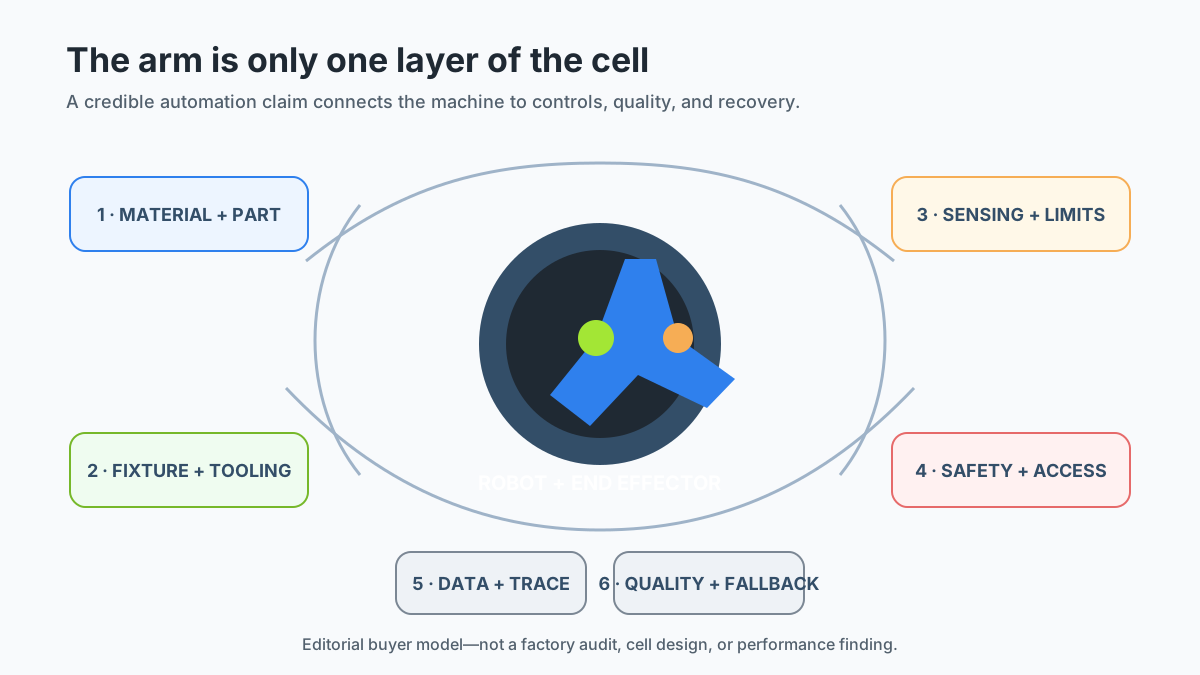
Editorial robot-cell map. It is not a factory audit, safety assessment, or performance finding.
This broader view explains why national deployment scale is material without being decisive for an order. A large domestic market gives factories and integrators more opportunities to build application knowledge, but the buyer still needs to know whether that knowledge is present in this cell, with these materials, at this cadence, under this quality plan. A palletising cell tells little about a tight-tolerance dispensing process. A high-volume stable programme tells little about a product with frequent engineering changes.
On a factory visit, separate the demonstration sample from the order condition. The demonstration may use clean parts, a well-known programme, one skilled operator, a settled fixture, and a convenient product variant. The order condition may introduce approved alternatives, a different surface finish, a mixed batch, a new revision, a short production window, or a customer-specific inspection rule. Neither condition is illegitimate; they answer different questions. Ask the factory to name the difference, state whether the cell is qualified for it, and show how the changed condition would be released into production.
The same separation is valuable when a factory shows a cycle-time estimate. A cycle time can refer only to the robot motion, or it can include loading, unload, scanning, inspection, rework, waiting, packaging, and the interruptions that occur over a shift. A buyer does not need to insist on one universal definition. The buyer does need the definition to be written down before a commercial promise rests on it. A clear scope makes later capacity, cost, and delivery discussions more honest.
The right response is neither to dismiss factory automation nor to reward “automation theatre.” Ask the factory to show a controlled operating story: the agreed task, the relevant constraints, the measured result, the exception path, and the evidence that ties it to the product being purchased.
The market is becoming more domestic
IFR also says Chinese robot manufacturers accounted for 57% of domestic sales in 2024, compared with 47% in 2023. Its China release supports that market-share observation. It is a meaningful indicator of growing domestic supplier presence in the market.
It is not an equivalence certificate. A domestic share statistic does not reveal the country of origin of every component, the durability of a specific model, the availability of local field support in the buyer's region, the quality of an integrator, cybersecurity practices, spare-parts commitments, or suitability for a particular workpiece. It also cannot decide whether a buyer should choose a domestic or foreign supplier for a given application.
Treat the share figure as a reason to widen the supplier and integrator map. A robust request for quotation should separate the robot supplier from the system integrator and the factory operating the cell. Ask which entity owns the application design, who can modify the programme, who holds critical spares, which response time is committed, who supports a failure during a production run, and how responsibility passes between equipment vendor, integrator, and factory.
The commercial comparison should also avoid a misleading machine-price contest. A lower quoted cell cost can be offset by commissioning work, fixture rework, spare-parts exposure, programme changes, operator training, line downtime, inspection integration, or an unclear recovery path. The relevant total is the cost of obtaining the agreed output with the agreed control, not the invoice price of the arm. That is consistent with the broader discipline in manufacturing cost comparison: compare the unit of value and the terms around it, not a convenient headline number.
Policy is context, not a performance certificate
China's policy record helps explain why industrial robotics has been treated as an important industrial topic. In December 2021, 15 agencies issued the 14th Five-Year Plan for Robot Industry Development. MIIT's notification and plan are a dated public record of that direction.
The appropriate inference stops there. A plan can describe goals, coordination, and areas of policy attention. It does not by itself measure the causes of later market outcomes; certify a robot company; prove that a factory is advanced; or transfer technical performance from a programme to a supplier. Treat policy as background for the industrial environment, then return to independent evidence for the specific decision.
This boundary is useful for factory visits as well. A factory may accurately say that it participates in a local automation initiative, operates in a robotics cluster, has received equipment support, or is pursuing a digitalisation programme. Those facts may help a buyer decide what to investigate. They should be documented separately from the evidence that the buyer needs for production acceptance: product identification, process capability where relevant, inspection records, change control, corrective action, capacity commitments, and contractual remedies.
Turn the national story into a factory question
When a supplier points to China's robotics leadership—or to its own robot cell—ask for a compact automation file. The request should be proportionate to the product's risk and should protect confidential information, but it needs to be specific enough to distinguish a working system from a tour talking point.
1. Define the task, product, and boundary
Ask what the cell actually does for the item you are buying. Is it handling, welding, fastening, dispensing, machining, inspection, testing, packaging, or something else? Which product revision and variants run through it? Which materials, tolerances, environmental conditions, and upstream steps affect the result? A factory can be heavily automated in one operation while the buyer's critical operation is manual or outsourced.
2. Request the baseline and the measured result
If the factory claims a benefit—throughput, repeatability, scrap reduction, lead-time improvement, or labour redeployment—ask for the definition, period, baseline, measurement method, owner, and scope. Ask what changed at the same time: a fixture, material, product design, inspection rule, staffing level, or demand mix. The aim is not to demand a universal metric. It is to ensure that the factory's claim matches the task and that a comparison is not constructed from unlike conditions.
3. Identify the operating and support chain
List the robot maker, end-effector provider, vision or sensor provider, integrator, controls owner, and factory owner. Who receives the fault call? Who can access and revise the programme? Which spare parts are critical, where are they stored, and what is the escalation route if a component fails? The system is only as supportable as those handoffs are clear.
4. Follow changeover and maintenance, not just the normal cycle
A polished cell demonstration often shows the most stable case. Ask to see the last product changeover, a preventive-maintenance record, a fault or alarm record, and the method for confirming that the cell returned to approved conditions. Ask which adjustments are authorised at line level and which require engineering or quality approval. Those records show whether automation is governed through the exceptions that eventually arrive.
5. Connect the cell to product quality and traceability
For the buyer's product, request the applicable work instruction, programme or parameter version, fixture identification, inspection plan, nonconformance route, and release authority. If an issue is found after shipment, ask how the factory would identify potentially affected units, lots, materials, and production periods. A robot cell that cannot participate in the product's traceability chain may still perform a useful task, but its automation claim should not be mistaken for a complete quality system.
6. Test the fallback and acceptance path
Ask what happens when the cell is unavailable, uncertain, or outside its limits. Is there an approved manual fallback? How are rework and quarantine controlled? What acceptance evidence will be produced before the buyer relies on the line for the agreed order? The answer should be agreed before production pressure makes it difficult to define.
The buyer should also name the decision owner for each unresolved point. A video of the cell may be enough to begin a conversation, while an engineering change may need a signed revision record, and a production release may need a pre-agreed acceptance package. Matching the evidence to the decision keeps the request workable for the factory and meaningful for the buyer. It also makes clear what must be escalated rather than solved informally at the line.
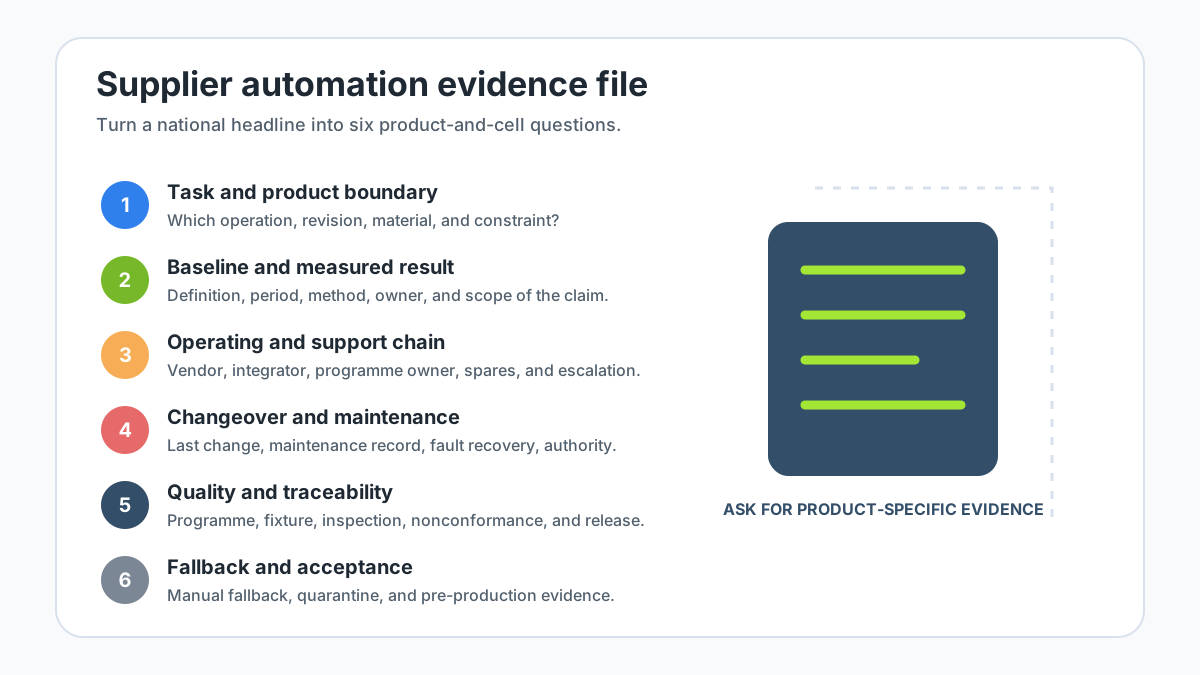
Editorial automation buyer file. It is not a supplier rating, safety assessment, or acceptance test; validate every item for the actual production line.
The durable conclusion
China's industrial-robotics scale is real, measurable, and globally important. IFR's installation, stock, density, industry-mix, and domestic-share records reveal a manufacturing environment with extraordinary automation activity. The NBS production figure adds a different measure of robotics output. The policy record provides historical context. Each point belongs in the story.
But none changes the level at which a buyer decides. The decision is made at the cell and product level: can this factory perform this task, under this control plan, with this support chain, for this material and configuration, while handling changes and failures in a way the buyer can verify?
That is a more demanding question than “How many robots does China have?” It is also the question that turns a national revolution into a trustworthy manufacturing decision.
Method and limitations
This is desk research based on IFR market publications, China's National Bureau of Statistics, and a Ministry of Industry and Information Technology policy record, all accessed on August 24, 2026. It does not inspect a factory, robot system, integrator, product, quality record, safety arrangement, or production result. National statistics and public policy do not determine the performance, quality, cost, labour, safety, or suitability of a particular supplier or robot cell. Verify the actual line, task, evidence, and contractual responsibilities before relying on an automation claim.