
By China Made & Tech Team
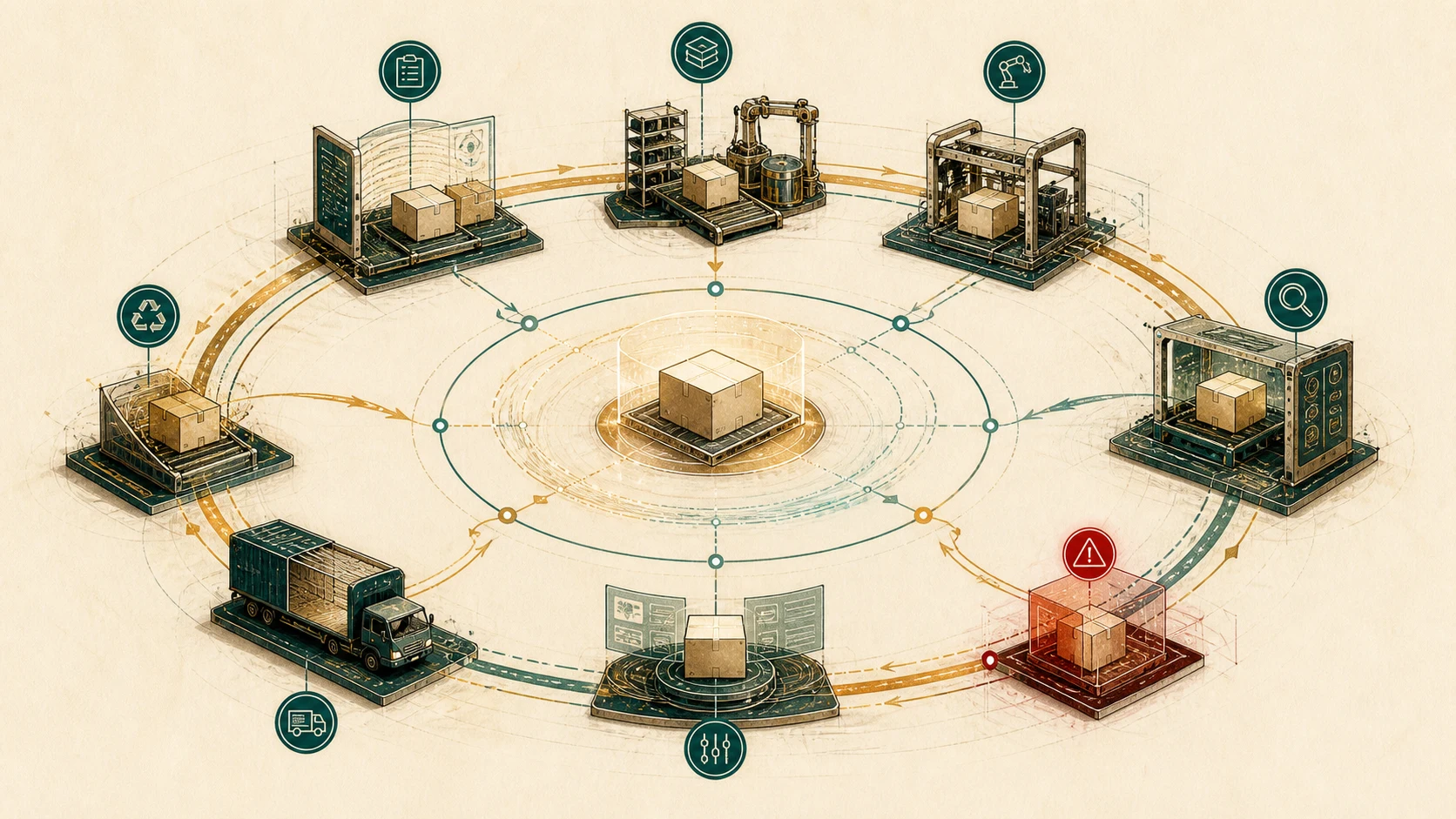
AI-generated editorial illustration. It depicts no real factory, product, dashboard, company, shipment, data record, or performance result.
The wrong question on a factory tour is, “How many robots do you have?” It is easy to ask because the answer is visible. A robot cell, an automated warehouse, a wall of dashboards, or an AI defect-detection demo gives the visitor a quick signal that something modern is happening.
The useful question is harder: show me this product revision moving from order to material, process, test, defect, change, shipment, and recovery—and show who acted when the record did not match reality.
That question does not dismiss automation. It tests whether automation is part of an operating-control loop. A factory can have sophisticated equipment and still struggle to identify the lot affected by a component change, close a recurring defect, hold an unauthorised substitution, update a work instruction, reconcile a schedule, or prove what was shipped. Conversely, a less theatrical factory can have disciplined records and clear exception ownership. Buyers need both the process and the evidence.
China's public smart-manufacturing agenda is useful context, but it is not a substitute for that evidence. The Ministry of Industry and Information Technology (MIIT) published its Smart Manufacturing Typical Scenarios Reference Guide (2025 edition) on April 27, 2025 to support smart-factory cultivation, solution development, standards work, and manufacturing digital transformation. MIIT's notice tells you that the relevant question is broader than a robot: the work spans the factory's operating scenes. It does not certify a supplier, line, product, or order.
This guide converts that distinction into a buyer file. Use it to decide what a smart-manufacturing claim can mean for your product—and what you still need to verify before you rely on it.
Smart manufacturing is a control loop, not a technology inventory
For a buyer, a smart factory is valuable when it shortens the distance between an operating event and a controlled response. The event might be a late component, an out-of-spec measurement, a failed functional test, an engineering change, a production bottleneck, a damaged shipment, or a field return. The response should be visible in an identity, record, decision, owner, and action.
Think of the loop this way:
- Identify. The factory can identify the product revision, serial or lot, material batch, workstation, operator or machine event, test result, and shipment involved.
- Detect. A specification, plan, sensor, inspection, or customer signal exposes the deviation early enough to matter.
- Contain. The affected material, work in progress, finished goods, documentation, or shipment can be stopped or isolated according to a named rule.
- Decide. A responsible person or governed system evaluates disposition, rework, release, substitution, communication, and customer impact.
- Learn. The root cause, corrective action, revision control, and effectiveness check feed the next order rather than disappearing in a spreadsheet.
IoT devices, machine vision, automated guided vehicles, industrial robots, manufacturing-execution systems, digital twins, planning software, and industrial AI can all strengthen one or more steps. They do not make the loop real by themselves. The buyer should therefore ask about the handoff rather than the brand name of the software.
For example, “we use AI inspection” should lead to: What feature is inspected? What is the accepted threshold? What happens to a marginal result? Can the factory show the image or measurement tied to the unit, the review decision, the disposition, and the recurrence check? “We have a digital twin” should lead to: Which process decision does it alter? How is the model input validated? Who can override it? What record proves that the change was authorised?
Those questions connect smart manufacturing to the fundamentals in quality control at Chinese factories. Technology may improve a control; it does not eliminate the need to define the product, the acceptance rule, the evidence, and the remedy.
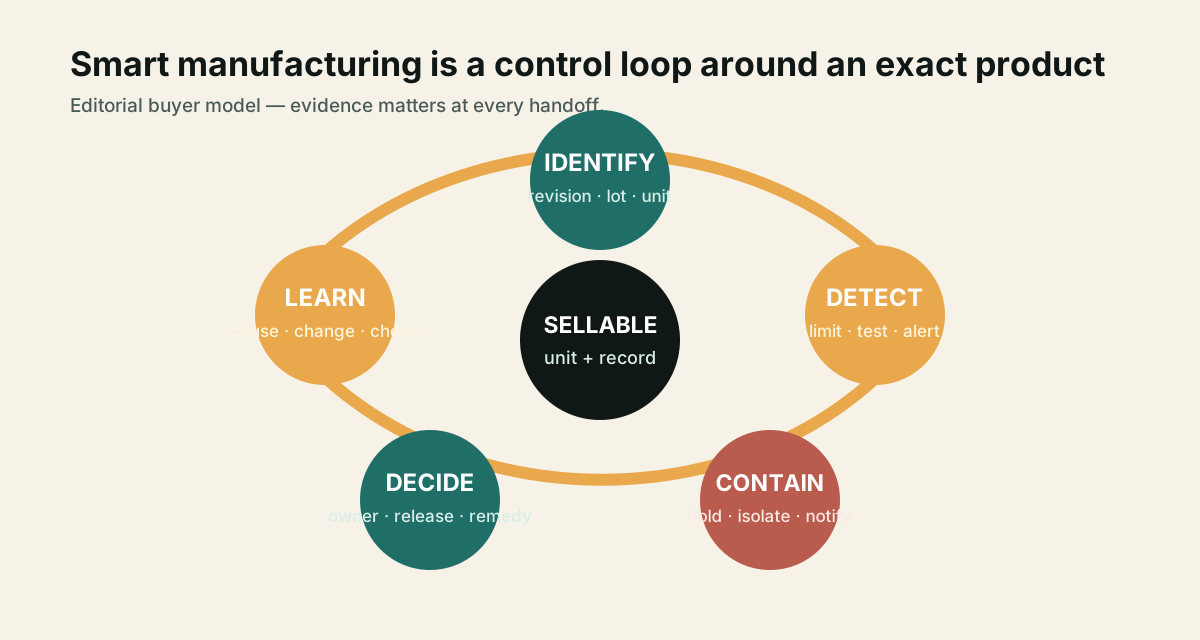
Editorial control loop: a smart-manufacturing claim becomes operationally useful when the product and its exceptions remain traceable.
What China's public programmes describe—and what they do not
MIIT's 2025 guide should be read as a scene map. Public smart-manufacturing work includes the activities around research and design, production, quality, logistics, safety, energy, and supply-chain coordination. That is a useful correction to the narrow “factory robot” image. Smart manufacturing can exist in planning and scheduling, material flow, quality control, equipment condition, warehouse operations, energy management, or after-sales information—not only at the final assembly station.
For a buyer, turn each scene into a record request.
| Operating scene | What a public programme can signal | What a buyer should ask to see |
|---|---|---|
| Planning and scheduling | The factory may use digital planning or connected equipment data | A current order's release date, constraints, schedule revision history, and owner of a missed milestone |
| Material and warehouse | The site may track material movement or automate storage | The approved material identity, lot path, quarantine rule, substitution approval, and shortage escalation |
| Process and equipment | The site may monitor machines or digitise work instructions | The revision-controlled instruction, parameter limits, exception record, maintenance link, and release authority |
| Quality | The site may use vision, sensors, or statistical tools | The specification, sample or unit evidence, defect code, containment action, root-cause record, and effectiveness check |
| Supply chain and shipment | The site may connect suppliers, warehouses, or carriers | The order-to-shipment trace, document control, delay escalation, inventory ownership, and customer communication path |
| Service and return | The site may collect field or repair data | The serial or lot link, failure classification, spare-parts route, corrective-action owner, and feedback-to-design path |
Public adoption scale does not change this boundary. A 2025 MIIT update says China had cumulatively built more than 35,000 basic-level, 7,000 advanced-level, and 500 excellent-level smart factories. MIIT's update makes the programme's scale concrete. It does not tell you whether a particular supplier's line can produce your configured product at your quality, volume, data-access, lead-time, and recovery requirements. A tier can help you decide where to investigate. It should not end the investigation.
A lighthouse is a case, not a shortcut
The same caution applies to the Global Lighthouse Network. In June 2026, the World Economic Forum said 16 new sites brought its network to 238 leading industrial sites. Its announcement describes digital technology combined with operating fundamentals, workforce engagement, and clear strategic objectives—not a simple equipment purchase. The WEF's June 2026 release is useful because it frames transformation as an operating system.
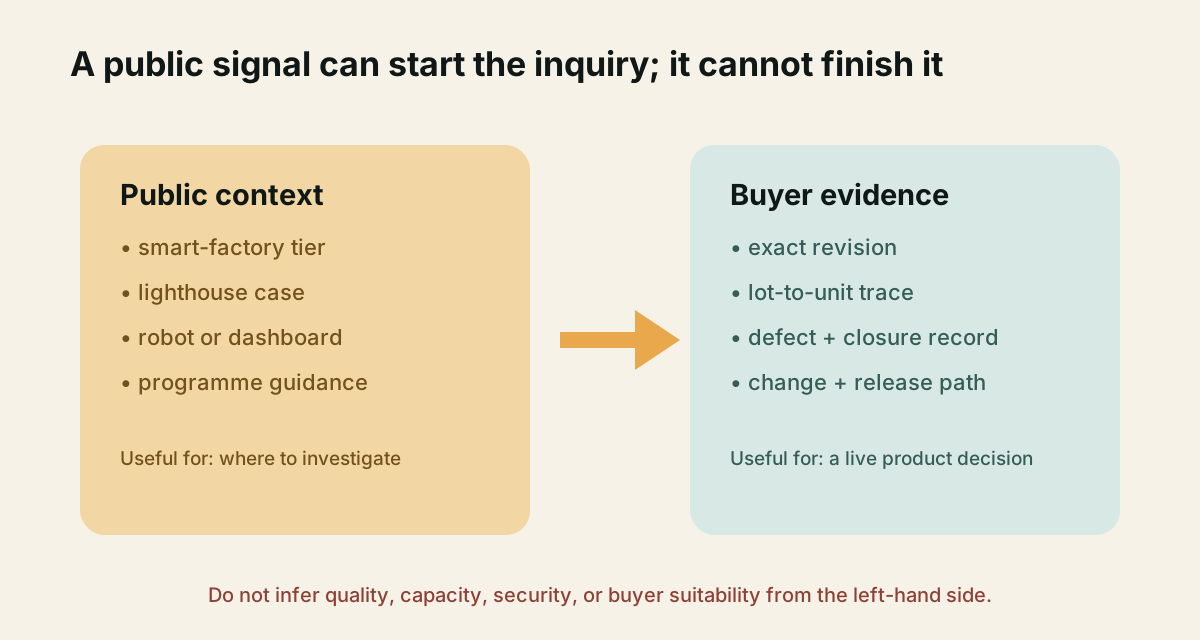
Editorial evidence boundary: programmes, awards, and visible technology can begin an inquiry, but do not replace product-specific records.
It is not a buyer's certificate.
Take a specific public case as a bounded example. In a September 2025 release, the Forum attributes to Haier's Shanghai washing-appliance site a 37% production increase, 40% delivery-efficiency improvement, and 33% conversion-cost reduction after a technology-enabled transformation. The WEF's Haier case description belongs to that site, its stated period, its selected technologies, and its operating context. It does not predict the result of another Haier site, a different appliance, another company, or your order.
The case is still useful if read correctly. It prompts a buyer to ask what made the result possible:
* What product mix, volume, quality target, and baseline were used? * Which decisions moved from manual coordination to a controlled workflow? * Which data were available at the line, and which stayed in another system? * How were people trained to act on an alert rather than work around it? * What metric changed, who verified it, and what trade-offs accompanied the change? * Which conditions would have to exist for the approach to transfer to this product and site?
A site can be innovative and still be a poor fit for a buyer's current need. A buyer may require short-run change control while the public case concerns high-volume stability. A buyer may need field-service traceability while the case focuses on conversion cost. A buyer may need secure, limited visibility into a critical parameter while the supplier can show only an executive dashboard. None of those gaps make the public case false. They make it incomplete for the transaction.
Four smart-factory signals that still need proof
The most common factory-tour mistake is to treat an attractive signal as a completed conclusion. The signal may be real. It simply answers a narrower question than the buyer needs.
1. The dashboard that does not control an exception
A dashboard can aggregate output, quality, machine status, energy, or delivery metrics. It becomes operationally meaningful only when an exception creates an action. Ask to select one red or amber item and follow it: Who received the alert? What threshold triggered it? Who was allowed to change the schedule or hold a lot? Which record confirms the action? When did the metric return to control, and how was recurrence checked?
If the dashboard is only a management view, it may still be useful for leadership. But it does not prove that line staff, engineering, quality, logistics, and the buyer have a controlled path when a problem touches an active order. The difference is response authority and record continuity.
2. The robot cell that is disconnected from product identity
Automation can improve safety, repeatability, speed, or material handling. Yet a robot cell is not automatically traceable. The buyer should ask which product revision, material lot, fixture, programme version, tool state, and inspection result are tied to the output. If a fixture changes or a parameter drifts, can the factory identify the affected scope? If the answer is a paper log in a different room, find out who reconciles it and how often.
This is especially important for products that have multiple customer configurations or frequent engineering updates. The physical automation may be stable while the product-control problem is not. A controlled change path can therefore be more important than an impressive cycle-time demonstration.
3. The AI inspection claim without a release rule
AI or vision inspection may find patterns that an operator misses. It may also produce false positives, uncertain classifications, or model drift as materials, lighting, tooling, or product appearance changes. The buyer does not need the supplier's proprietary model. The buyer does need the release rule around it.
Ask what result is automatically rejected, what result is escalated for human review, who owns that review, how the decision is captured, and how disputed or changed reference samples are governed. Then ask what happens to units already built under an earlier threshold or reference set. This keeps the conversation on product assurance rather than marketing language.
4. The traceability system that stops at the factory gate
A factory may trace materials and work in progress well, but a buyer's exposure often begins after release: a delayed shipment, a wrong label, a missing document, a distributor return, a repair request, or a field-quality signal. Ask where the factory record joins the shipment, invoice, packing list, serial or lot mapping, warranty, and corrective-action path.
The goal is not universal data access. It is an agreed interface. Define the minimum record set, recipients, timing, confidentiality boundaries, retention period, and escalation route. A supplier that cannot safely provide raw system access may still provide a credible, governed buyer report. What matters is that both sides know which event becomes visible, to whom, and quickly enough to act.
Separate operational evidence from data-access entitlement
Smart manufacturing often creates a second source of confusion: a buyer can reasonably need evidence without being entitled to unrestricted access to a supplier's production systems. A healthy relationship distinguishes the two.
| Buyer need | Reasonable evidence pattern | Boundary to agree |
|---|---|---|
| Revision compliance | Approved revision record, effective date, affected-order list, change notification | Do not expose unrelated customer designs or source code |
| Material traceability | Lot-to-unit or lot-to-shipment extract for the buyer's product | Limit to agreed parts, time range, and recall or quality purpose |
| Quality release | Certificate, test extract, defect disposition, and containment status | Protect operator identity and unrelated product data where appropriate |
| Capacity and schedule | Agreed milestones, constraint notice, recovery plan, and change log | Avoid revealing another customer's commercial data |
| Field or return linkage | Serial or lot map, failure category, corrective-action status | Define service data privacy, retention, and communication ownership |
For a connected product, add account and software boundaries. A factory may program a device, but another entity may operate the customer account, cloud service, or update channel. Keep identity, access, data, and remedy questions visible rather than assuming they sit inside the same factory system.
Build the buyer control file
Use a single product or pilot order as the test object. Ask the supplier to prepare a controlled walk-through before the visit or remote review. The goal is not to collect screenshots. It is to follow one record through the system and observe how exceptions move.
1. Product identity and release
Start with the product identity. Ask for the exact model, revision, approved BOM, drawings, software or firmware version where relevant, packaging revision, required certification scope, customer-specific requirements, and effective date. Then ask how the line learns about a change.
The useful evidence is a release record: who approved the revision, which orders use it, what inventory remains under the prior revision, which work instructions changed, and how the factory prevents old material or instructions from silently re-entering production. A large screen showing a current work order is not enough if it cannot be tied to the product configuration that the buyer approved.
2. Material and sub-supplier traceability
Pick one critical material: a safety component, key electronic part, coating, label, fabric, fastener, battery cell, or moulded part. Trace it from receiving to the finished unit. Ask how incoming inspection, lot assignment, storage location, FIFO or other issue rule, approved substitute, expired material, and quarantine are recorded.
Then create an exception. What happens when the lot fails inspection or a supplier changes a specification? Who can stop use? Which work in progress and finished goods can be found? Who tells purchasing, engineering, quality, and the buyer? How is the decision recorded? The answer matters more than whether the warehouse uses a robot.
3. Process and test evidence
Select a process step that could create a customer-visible failure: torque, weld, adhesive cure, software flashing, pressure test, calibration, coating, final functional test, or pack-out. Ask for the approved limit, the method of capture, the link to the unit or lot, the action for an out-of-limit result, and the record that releases rework.
If the supplier says a vision or AI system performs the check, ask to see the human and process boundary. Who maintains the reference set? What occurs when the system is uncertain? Can an operator override it? Is the override visible? Is a false positive or false negative fed back into a controlled review? These are governance questions, not a request to inspect proprietary algorithms.
4. Defect closure and change control
Ask for one closed internal defect and, where appropriate and permitted, a redacted customer or field-return example. Follow it from detection through containment, investigation, disposition, corrective action, verification, and recurrence monitoring. A good record names the event, the affected scope, the decision owner, the communication path, and the condition for closure.
Then ask to see a recent engineering or process change. The factory should be able to explain why it changed, who approved it, which product or orders it affects, how it was validated, which documents were revised, and what happened to old material or old instructions. This is where a digital system can make a major difference: it can preserve the chain of evidence. But only the actual records show whether the chain was followed.
5. Schedule, shipment, and recovery
Finish at the order promise. Pick a real or simulated order and ask for its planned and actual dates, material constraints, production status, quality release, shipping document path, destination handoff, and escalation route. If the date slips, who decides between re-planning, partial shipment, expedited freight, substitute material, overtime, or customer notification? What costs or service commitments are triggered?
This links factory intelligence to the broader landed-cost file in manufacturing cost comparison. A factory-floor alert is only valuable when the commercial system can act on it before inventory, freight, service, or customer trust absorb the damage.
Run the validation in stages
Do not make a large capacity or tooling commitment after a single tour. Use stages that increase proof with exposure.
- Desk screen. Define the product, market, volume, control points, and non-negotiable evidence. Ask for a scoped system map and a sample record set.
- Record walk-through. Follow a pilot product or a carefully redacted comparable path through identity, material, process, test, defect, change, and shipment records.
- Pilot release. Agree measurable acceptance criteria: revision compliance, traceability coverage, test-record completeness, defect containment time, change-notification rule, and shipment-document accuracy.
- Exception test. During the pilot, test an ordinary exception—late material, failed test, revision change, or schedule slip. Evaluate the containment and communication, not only the final sample.
- Scale gate. Commit to tooling, volume, or deeper systems access only after the supplier has demonstrated the agreed evidence loop for the actual product.
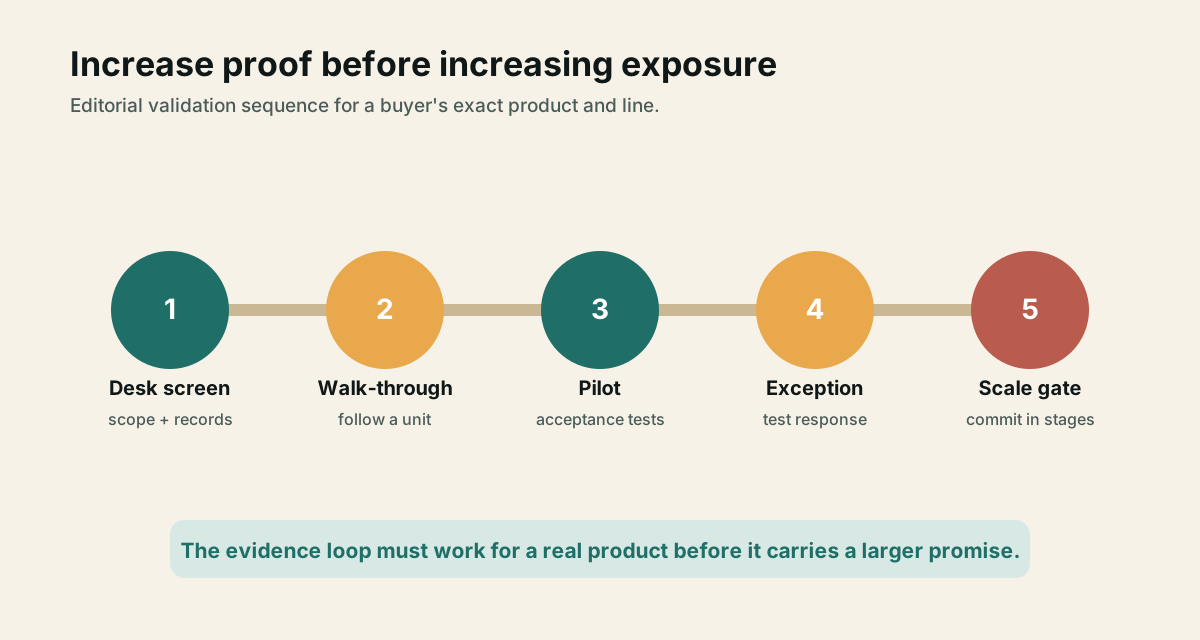
Editorial validation sequence: increase proof before increasing a financial, operational, or customer commitment.
This approach does not require a buyer to become a manufacturing-software integrator. It requires the buyer to make the expected control visible, assign who can see what, and define how the supplier will demonstrate it. It is equally relevant when working through a cluster: industrial clusters may improve the surrounding component and process network, but the current site still has to show how its exact line controls a current order.
The questions to bring to the factory floor
If time is short, bring these ten questions:
- Which exact product revision is live on this line, and how can we prove it?
- Can you trace one critical material lot into finished goods and shipments?
- Where does the approved process limit live, and who can change it?
- Show one out-of-spec result: what was contained, who decided, and where is the closure record?
- What stops an old instruction, old material, or unapproved substitute from being used?
- Which alerts require human judgement, and where is that judgement recorded?
- How is a supplier, component, process, or software change communicated to the line and the buyer?
- Which current order is most at risk of slipping, and how does the system expose the reason?
- What information can the buyer receive, at what cadence, with what security and confidentiality boundary?
- If this product fails after shipment, how do serial or lot records connect the field event back to material, process, test, and corrective action?
The strongest answer is a controlled walk-through, not a polished promise. When a supplier can make that walk-through routine for the product you plan to buy, smart manufacturing becomes operationally relevant.
For the wider sourcing context, start with China Manufacturing Guide, map the likely system through county industrial clusters, and combine the factory review with the supplier-verification work in how to find a factory.
Method and limitations
This is desk research and an editorial buyer-verification framework, not a factory audit, product test, cybersecurity review, software assessment, certification, or supplier recommendation. It uses MIIT public records to describe programme context and World Economic Forum releases to describe the Global Lighthouse Network and one attributed site case. Neither source type establishes the quality, capacity, security, data access, cost, delivery, certification, or commercial suitability of a particular factory or order.
Before relying on a smart-manufacturing claim, verify the exact site, legal entity, product revision, production line, software and data boundaries, serial or lot traceability, quality record, change-control history, capacity, shipment route, access permissions, and recovery commitments with the appropriate technical, commercial, and compliance stakeholders.