
By China Made & Tech Team. This is desk-researched buyer guidance, not an audit, inspection, certification, engineering, product-safety, or legal determination.
A pre-shipment inspection report can be clean while the buyer still lacks the information needed to release the shipment. The report may not match the approved product revision. It may sample a lot that is not clearly defined. A defect may have been found, sorted, and visually removed without an explanation of where it started or whether it will recur. Or the product may pass the sample test but leave without the packing, serial/lot, warranty, or exception record needed later.
That is why quality control is not an inspection event at the end of a Chinese factory order. It is an evidence chain: define the product, observe the relevant process, test a defined lot, contain a difference, verify the corrective action, and record the release decision. Each part answers a different question. A factory tour cannot accept a batch. An AQL sample cannot prove a quality system. A promise to be more careful is not a corrective action.
The aim is not to produce a universal AQL or a factory rating. The buyer must define what conformity means for its product, customer, destination, and agreement. The aim is to make a defect visible while there is still a real choice to hold, rework, re-inspect, accept a documented exception, or stop release.
Quick Answer: Inspection Is Evidence. Release Is a Decision.
| Evidence layer | Question it answers | Record the buyer needs |
|---|---|---|
| product standard | What counts as conforming? | revision, golden sample, critical features, defect classes, test/packing rule |
| process/capability observation | Is the claimed process relevant to this product? | process boundary, current work instruction, critical input/control record |
| lot sample | What was observed in this defined finished lot? | lot size, selection method, sample size, defects, tests, limits |
| corrective action | What was contained and changed after a difference? | affected scope, cause investigation, action owner, verification |
| release record | Who accepted which state, with what limitation? | dated decision, exceptions, linked shipment and handover file |
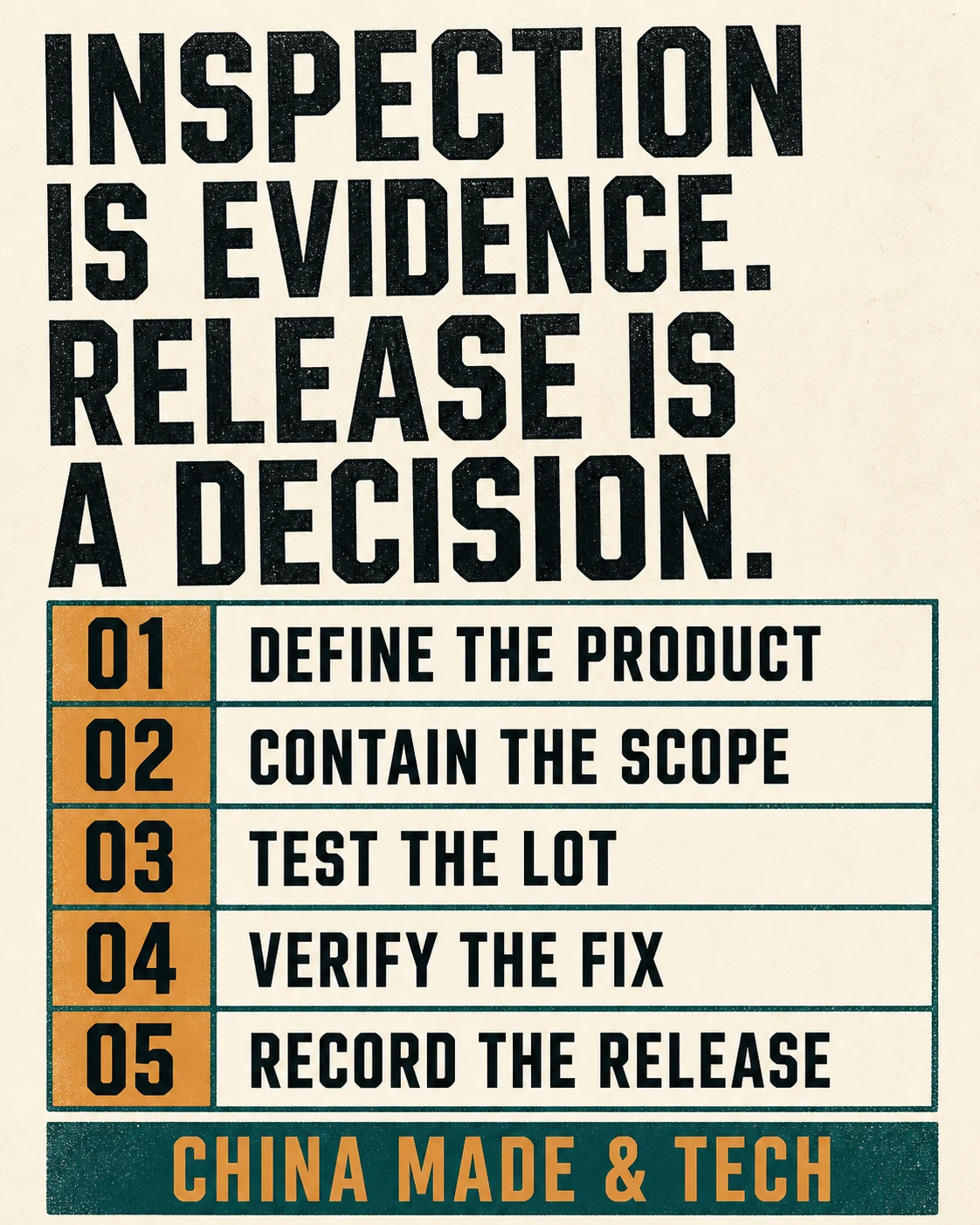 Field Note: a source-backed quality decision framework, not approval of a lot or factory.
1. Separate Capability, Consistency, and Lot Results
A factory capability review asks whether the site and its claimed production boundary are relevant to the product. It may look at process flow, key equipment, incoming-material control, calibration, records, training, subcontracting, and traceability. It is a signal about a system and a place, not a result for one batch.
A lot inspection asks a narrower question: did a defined sample selected from a defined lot meet a defined inspection/test rule at that time? A usable report says how the lot was identified, how samples were chosen, what test conditions were used, what defects were observed, what was not examined, and which product revision it represents. It is a batch signal, not proof that the factory will perform the same way next year.
SAMR's factory-inspection guidance distinguishes quality-assurance capability, product consistency, conformity, product scope, and site boundaries in a certification setting. That does not turn a buyer visit into an official inspection or make China Compulsory Certification applicable to every export product. It does offer a helpful discipline: ask whether a document or visit supports a system claim, a product-consistency claim, or a lot claim, and do not reuse it as an answer to all three.
Follow the product's actual risk rather than the reception area. For a mechanical component, it may be a material certificate, heat treatment, thread, coating, or critical dimension. For electrical hardware, it may be a component, firmware build, torque, safety test, or serial record. For a packaged consumer product, it may be the accessory set, label, carton, and packing sequence. Ask which location and record control that point, including any outsourced operation.
2. Write the Product Standard Before Production Starts
The most common quality dispute is an undefined requirement. “No scratches,” “good colour,” “works normally,” and “equivalent component” sound clear until a line operator, inspector, buyer, and end customer apply them differently.
Create an order-specific standard that states the product revision, approved/golden reference, critical dimensions/tolerances, materials and components, firmware or software state where relevant, functional and safety tests, pack/label/manual/accessory requirements, defect classes, sample method, lot definition, rework boundary, and escalation contacts. For cosmetic requirements, attach images and define viewing condition, distance, size, location, and allowed variation. For a functional test, identify the equipment, input, load/cycle, sequence, duration, pass/fail limit, and retained record.
ISO 2859-1:2026 provides AQL-indexed acceptance-sampling schemes for lot-by-lot inspection. It can help an organization choose a sampling structure and acceptance/rejection threshold for a defined context. It does not choose the buyer's AQL, define a critical defect, decide a product's safety requirement, or determine the commercial disposition of a failed lot. Those choices belong in the buyer's product and agreement file before the sampling table is applied.
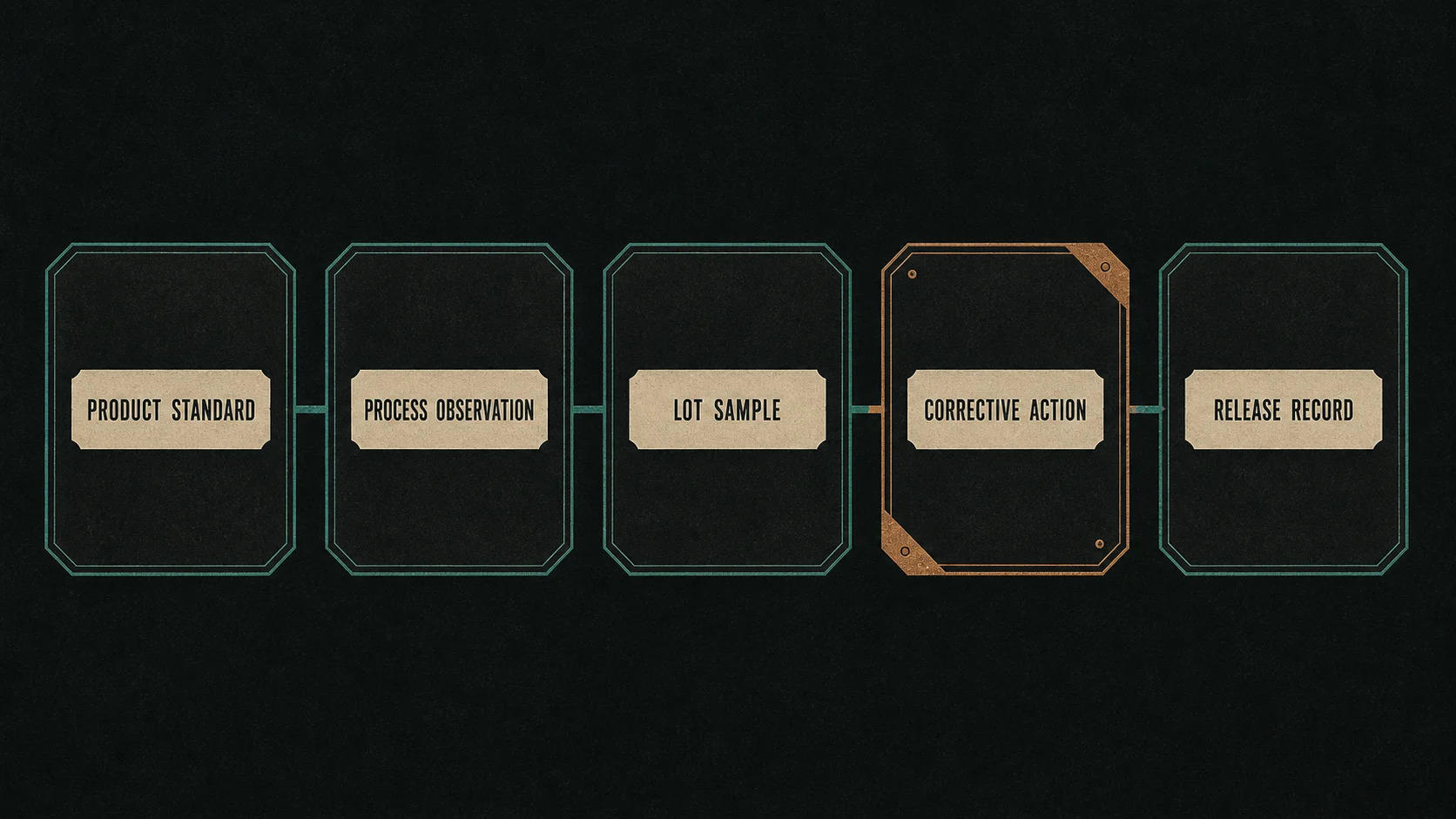 The chain prevents a capability review, sample result, or corrective action from being treated as a complete quality conclusion.
3. Run Controls at the Moments When a Difference Is Still Cheap
Quality control needs timing, not a pile of reports at the end. Use a simple production calendar:
| Moment | Decision question | Evidence/control |
|---|---|---|
| pre-production | Are the current revision, critical inputs, packing, and test method approved? | controlled BOM/component boundary, pre-production reference, change log |
| first run | Does the process understand the approved standard? | first-off/initial-unit record, work instruction, fixture/test confirmation |
| in process | Is drift, rework, or a new input change becoming normal? | defined checks, defect/rework trend, containment trigger |
| finished lot | Does a randomly selected defined lot meet the agreed rule? | sample selection, result, test conditions, packaging/label/serial evidence |
| after arrival | Can field failures be connected to the production/lot record? | returns, defect codes, condition record, service/serial feedback |
For a large lot or manual process, an in-process look can be more valuable than an additional final sample because it may expose a change in shift, fixture, material, instruction, or rework practice while correction is possible. The buyer need not watch every operation. It should identify the highest consequence uncertainty and require a record at that point.
Define Defects and Disposition Before the First Failure
Defect labels should describe business consequence, not merely a convenient spreadsheet column. A critical failure can involve safety, legal marking, traceability, a required functional protection, or a condition that makes the product unsafe to release. A major failure may prevent intended function, fit, or promised appearance. A minor failure may not materially affect intended use but can still become a trend, warranty, or retailer problem if repeated.
| Class | Buyer question | Typical decision path |
|---|---|---|
| critical | can this product be released or traced safely at all? | hold, contain, investigate, and obtain qualified project-specific review |
| major | does it defeat the agreed function, fit, or customer-facing requirement? | define sort, rework, replacement, or rejection evidence before release |
| minor | is the product usable within the buyer's stated tolerance? | record trend and accept only under the agreed limit and disposition |
Rework deserves the same discipline as new production. A rework instruction should say which units are in scope, what operation is permitted, which materials/parts/tools are used, what condition is prohibited, how repaired units are identified, and what reinspection or test proves the result. If the buyer cannot state how a repair will be checked, it is not a controlled remedy; it is a hope that the visual defect disappeared.
4. Treat a Defect as a Containment and Learning Problem
A defect is not automatically a reason to accuse a supplier or reject an entire order. It is a reason to establish scope before accepting any explanation. Start with containment: identify affected product, lot, date range, work cell, material/component, firmware/revision, and packed versus unpacked inventory. Then compare the observed fact with the approved standard and ask which evidence link broke.
| Stage | Required question | Useful record |
|---|---|---|
| contain | What could be affected, and what is frozen? | lot/serial scope, location, hold status |
| investigate | What differs from the approved state? | photos/test data, records compared, provisional cause |
| act | What physical or process change is made? | rework/sort instruction, fixture/material/instruction action, owner/date |
| verify | Did the action work on the relevant scope or subsequent run? | retest/reinspection result, review of recurrence |
| decide | Can the buyer release, conditionally accept, rework, hold, or reject? | dated commercial/quality decision and limitation |
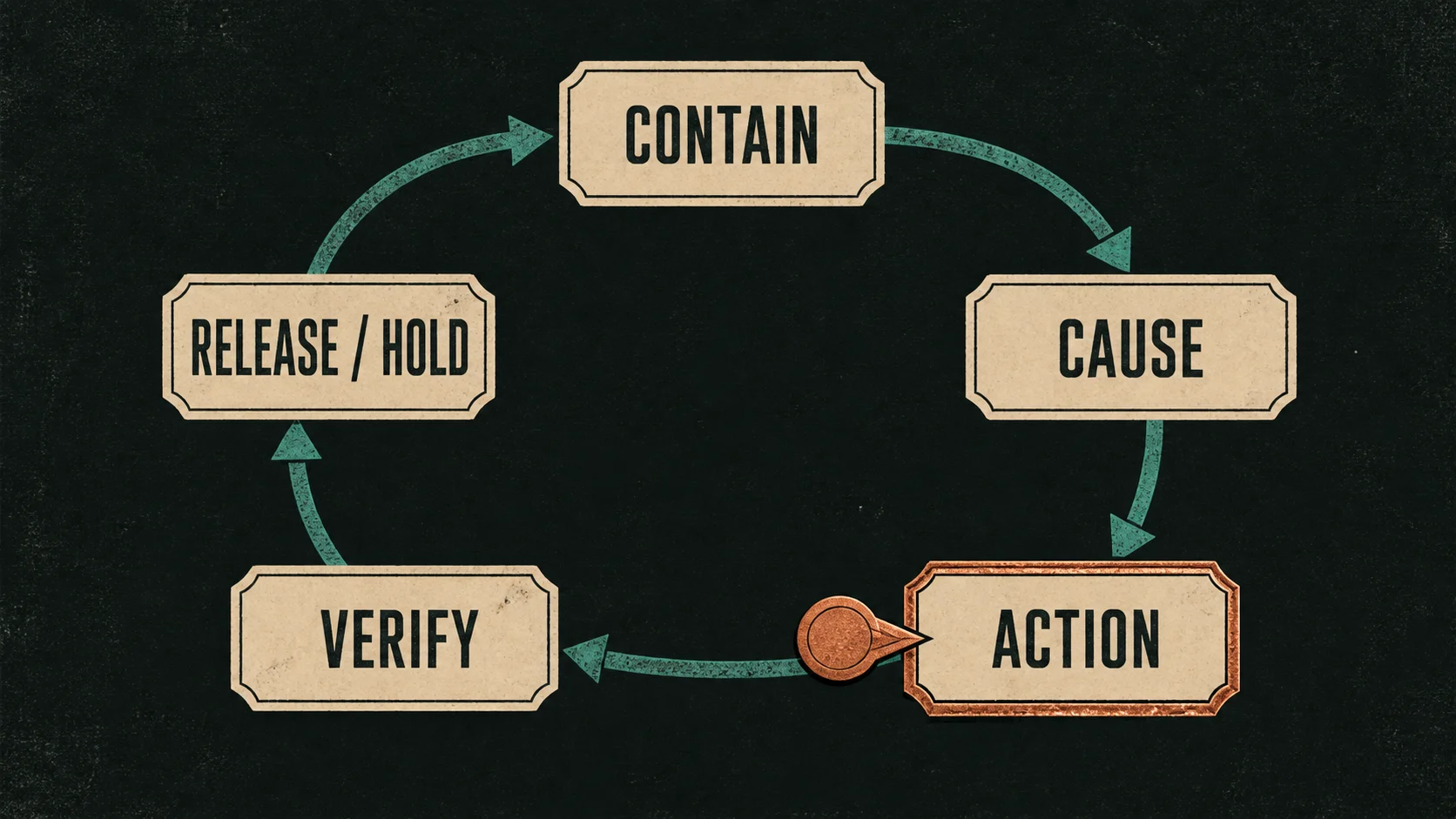 A corrective-action loop organizes the response to a difference; it does not guarantee the fix or the release decision.
5. Give Inspectors Context, but Keep the Decision With the Buyer
An independent inspector is useful when it receives the current product standard: signed/latest drawings, approved reference images, component restrictions, defect taxonomy, test method, packing artwork, lot size, and an escalation contact. State whether it may inspect finished packed product, select samples, open cartons, witness a test, request an explanation, or pause the visit. Its report should separate observed facts from the supplier's explanation and name limitations.
Do not ask an inspector to settle a price dispute or improvise a quality rule. An inspector's independence comes from reporting a bounded observation. The buyer and supplier still decide whether a documented deviation is accepted, reworked, sorted, credited, delayed, or rejected under their actual agreement. That distinction protects the inspection record from becoming a retroactive negotiation tool.
6. Make Critical Tests Reproducible
Many arguments presented as product-quality disputes are actually test-method disputes. A buyer says a product failed; the factory says it passed on its own bench. Both observations may be sincere if the power source, load, duration, ambient condition, fixture, firmware state, calibration status, or pass/fail interpretation differs.
For every critical test, record enough information for a second qualified reviewer to repeat it: equipment and its condition; input; load or cycle; sequence; duration; sample/lot identity; environment if relevant; failure threshold; result; and the record retained. A battery-powered product may require charger, charge state, load profile, cut-off behaviour, and temperature. A coated part may require panel preparation, exposure time, viewing condition, and adhesion method. A software-controlled device may need the precise firmware build and reset state.
The point is not paperwork for its own sake. A later return, warranty claim, or customer escalation has a better chance of being resolved when the parties can compare like with like. Calibration evidence also has a narrow but useful role: it shows a tool's state against a reference, not that the buyer selected the correct tool or test for the actual requirement.
7. Build the Release File for the Future Claim
Before final payment or shipment, a second reviewer should be able to reconstruct the approved state and every accepted exception. Keep the product revision/golden reference, critical-input approvals, test method and results, lot/sample definition, inspection report, defect/disposition record, packing/label/accessory/serial or lot evidence, commercial parties, warranty/service route, and release decision together.
Traceability need not mean a perfect unit-level database for every product. For low-cost products, a bounded lot and carton record may be the useful compromise. For products with safety, warranty, recall, field-service, or customer-contract exposure, serial-level or more detailed records may be needed. Decide the appropriate granularity before launch; a field failure cannot be reliably reconstructed from a showroom sample and old email.
A Second-Reviewer Release Test
Before authorizing final payment or shipping instructions, give the file to a reviewer who did not negotiate the order and ask them to answer these questions without calling the salesperson:
- Which exact product revision, reference sample, critical inputs, packing,
- What lot was inspected, how was its sample selected, and what did the report
- Which defects, substitutions, rework, or exceptions occurred, and what is
- Has any corrective action been verified against a defined record or
- Do invoice, packing, serial/lot, exporter, warranty/service, and release
If the answer to a material question is “the factory said it was fine,” the buyer has a communication, not a controlled evidence file. The next action may still be to release, but it should be an explicit acceptance of an unresolved risk by the owner who can make that commercial decision. That is more honest and often more useful than forcing an inspector or junior buyer to carry a decision outside their authority.
The same file should travel through receiving and early field feedback. A container can pass a pre-shipment sample and still arrive damaged, mismatched, or without the service data needed for a later claim. Record condition at arrival, count/scan or lot reconciliation, exceptions, returns, repair reason, and recurring failure signal. Feed a concise recurring signal back to the factory so the production record and the customer's experience do not become two unrelated stories.
When the Factory Proposes a Change
Quality control and supplier change control meet whenever a factory proposes a new material, component, work cell, test method, packing method, firmware, or subcontracted operation. A change is not necessarily a quality failure. But it can invalidate the evidence that supported the earlier product release.
Ask for the old and proposed fact, affected product/lot/date, reason, expected impact, supporting documents or samples, required buyer reviewers, and the default if approval is not received. Recheck the product standard, critical test, defect rule, traceability and packing record that the change disturbs. For a low-impact administrative correction, a document owner may simply record it. For a change that affects fit, function, safety, destination requirement, warranty, or customer promise, use a named technical/commercial decision before it enters the lot.
This creates a useful boundary for both parties. A factory can surface a real constraint early instead of quietly improvising. The buyer can approve a bounded alternative, request proof, or hold the affected line without treating every ordinary supply-chain change as misconduct. The durable quality signal is not the absence of changes; it is the ability to reconstruct who accepted them and why.
Method and Limits
This article is editorial desk research using public ISO, SAMR, and NIST materials. It does not verify a factory, inspector, quality system, product, sample, lot, defect, test, corrective action, shipment, certificate, or warranty. It is not legal, engineering, inspection, product-safety, certification, customs, or commercial advice. Actual product requirements, destination rules, agreement, and qualified reviewers control the release decision.
Related Entries
- How to Find a Factory in China: Evidence Gates Before Each Payment
- supplier-verification-china
- china-manufacturing-aql-inspection
- Buying Chinese Solar Panels: Build a File for the Exact Module