
By China Made & Tech Team. This is a desk-researched buyer file, not a factory audit, supplier approval, legal opinion, engineering review, or inspection service.
Most factory searches fail before the first supplier responds. The buyer asks where to find a Chinese manufacturer, collects marketplace profiles and catalogue PDFs, then treats the resulting list as a decision. It is only a lead list. A profile, a trade-fair badge, a referral, a public company record, a site tour, and a good sample each answer a limited question. None makes the next irreversible payment safe on its own.
The more useful question is: what evidence is enough for the next commitment, and what commitment should still wait? The commitment may be an RFQ, a sample fee, tooling payment, production deposit, final payment, or shipment release. A disciplined search makes only one of those decisions at a time.
This guide uses four evidence gates: define the product, map the counterparty, test the claimed process, and control the sample-to-lot transition. It does not tell you that a particular factory should be approved. It gives you a way to avoid inventing certainty from a familiar platform or an impressive factory video.
Quick Answer: Discovery Finds Leads; Evidence Releases Money
| Gate | Buyer decision | Minimum evidence | What it still cannot prove |
|---|---|---|---|
| 1. Defined product | Is the RFQ comparable? | revision-controlled brief, drawings/photos, materials, critical tolerances, destination requirements, quantity and packaging assumptions | that any supplier can manufacture it consistently |
| 2. Named counterparty | May this entity quote, sample, or receive a limited payment? | Chinese legal name, unified social credit code, address, contact, role map, invoice/payee explanation | ownership of a factory or future performance |
| 3. Claimed process | Is a sample or limited validation worth the next step? | product-family process map, relevant equipment/outsourcing boundary, records for the product's likely failure point | stable mass-production quality |
| 4. Controlled sample | Can the buyer release a tooling or production decision? | approved revision, sample log, test/defect rule, packing/label/serial plan, change process | that no future lot will fail |
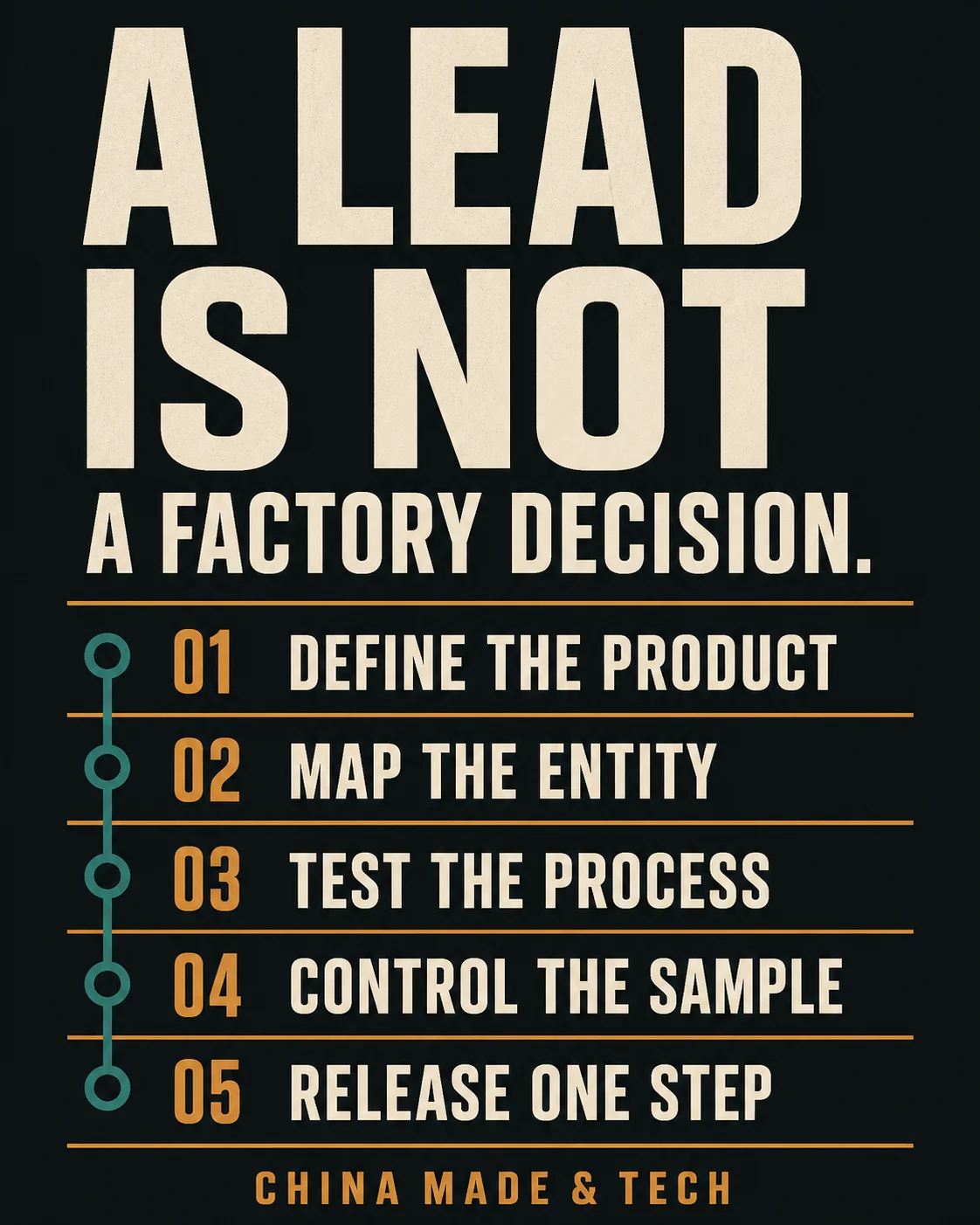 Field Note: an editorial framework for sequencing evidence, not a supplier qualification decision.
1. Define the Product Before Searching for a Factory
“Find me a factory for this” is too vague to produce comparable quotations. A factory needs a defined manufacturing problem: what the product does, what must not change, what is still open, and which project constraint matters most.
Build a compact RFQ pack before you search. It should identify the intended use; current drawing, CAD, photo, or reference sample; material and finish; critical dimensions/tolerances; required test or destination-market condition; target quantity; packaging and labelling; target date; expected service or warranty exposure; and the exact questions the buyer needs the supplier to answer. Mark unknowns as open. Otherwise each supplier fills them with its own assumptions and the buyer later calls the differences “quality problems.”
Give candidates the same return format: price by volume, currency, delivery assumption, minimum order, tooling/non-recurring charges, sample cost and lead time, production lead time, key bought-in parts, customer-supplied materials, packaging assumption, warranty assumption, and every exclusion. The goal is not identical quotations. It is a visible record of why they differ.
Do not use a certificate gallery as the product definition. Certification may be relevant for a particular product and destination, but the required regime, test scope, importer role, labels, technical file, and ongoing obligation can be project-specific. SAMR's factory-inspection guidance is useful here because it distinguishes product scope, site boundaries, quality-assurance capability, and consistency with type-test samples. It is not a universal export checklist or proof that a supplier can meet your destination-market requirement.
2. Map the Legal Counterparty, Then Its Manufacturing Boundary
Once a lead is commercially interesting, ask for the exact Chinese legal name, unified social credit code, address, invoice entity, payment beneficiary, and the role each entity will perform. Compare the legal identity against the National Enterprise Credit Information Publicity System, which accepts a name, Unified Social Credit Code, or registration number query.
That public record is a comparison point, not a factory qualification. It can help reveal whether the name supplied in a quotation maps to a public enterprise entry. It does not establish that the entity owns a production line, controls quality, can take your payment, or will deliver your product. Preserve the limitation in the file rather than filling it with inference.
Then ask a product-specific question: which entity performs which operation? A seller may be a trading company; an affiliated factory may make a housing; a specialist partner may make electronics; another party may export. That structure can be commercially workable. The risk is an unstated split where the buyer does not know who is responsible for the part of the product that matters.
Ask for a simple role map:
| Role | Fact to obtain | Buyer use |
|---|---|---|
| contracting seller | exact legal name and signatory | who owes the commercial promise |
| manufacturer/process owner | factory or bounded production path | who is claimed to make the product |
| critical subcontractor | operation and boundary | where a key capability is external |
| invoice/payee/exporter | entity and document path | who receives money and appears in shipment records |
| warranty/service route | notice contact and responsibility | who handles a future product issue |
Make the RFQ Comparable Before Negotiating
The first price is normally a hypothesis. It can omit a mould, fixture, export carton, test, bought-in component, engineering revision, material-price assumption, or change to the minimum order quantity. When quotations use different inputs, the lowest figure may only be the one with the most unstated assumptions.
Issue one RFQ pack and require one response format. At a minimum, capture unit price by volume tier, currency, delivery assumption, tooling and non-recurring engineering, sample cost and timing, production lead time after the agreed release, minimum order quantity, key supplied/bought-in components, packaging, test, warranty/service assumptions, and exclusions. Ask each candidate to flag an unclear dimension, material, certification, test, or packing condition instead of silently choosing one.
Then normalize the file rather than forcing false uniformity. An EXW figure and a FOB figure are not equivalent. One supplier's price may include a power unit, a special coating, labelling, or an export carton that another has excluded. One may name an approved material while another says “equivalent.” Each difference can be legitimate. It needs to be visible before the buyer decides whether lower price reflects volume, a process/material change, a delivery boundary, or a genuine commercial concession.
Keep the quote revision with the product revision. When a drawing, material, test, quantity, or date changes, record which quotation incorporates it, what it changes in price and lead time, and what is still open. This record stops a buyer from approving a sample against one assumption and a bulk order against another. It also makes a supplier's next request clearer: it can state which fact must change to meet a price rather than asking the buyer to accept an undefined “optimization.”
3. Test the Claimed Process, Not the Reception Area
Factory photos and a video call are discovery aids. Use them to test the process boundary that matters for the actual product. Start from the likely failure point: a torque setting, mould/tool condition, weld, coating, firmware station, leak test, material traceability, or final packaging control. Ask the supplier to explain the sequence, show the relevant work instruction or control record where appropriate, and identify whether the operation is in-house or subcontracted.
SAMR describes factory inspection as an evaluation of quality-assurance capability, product consistency, and conformity, with product scope and site boundaries. That suggests useful buyer questions: which site performs the relevant operation; which product family is being shown; what records tie a process to a product revision; and how are changes controlled? It does not mean a buyer's video call is an official inspection or that a well-presented line is proof of future consistency.
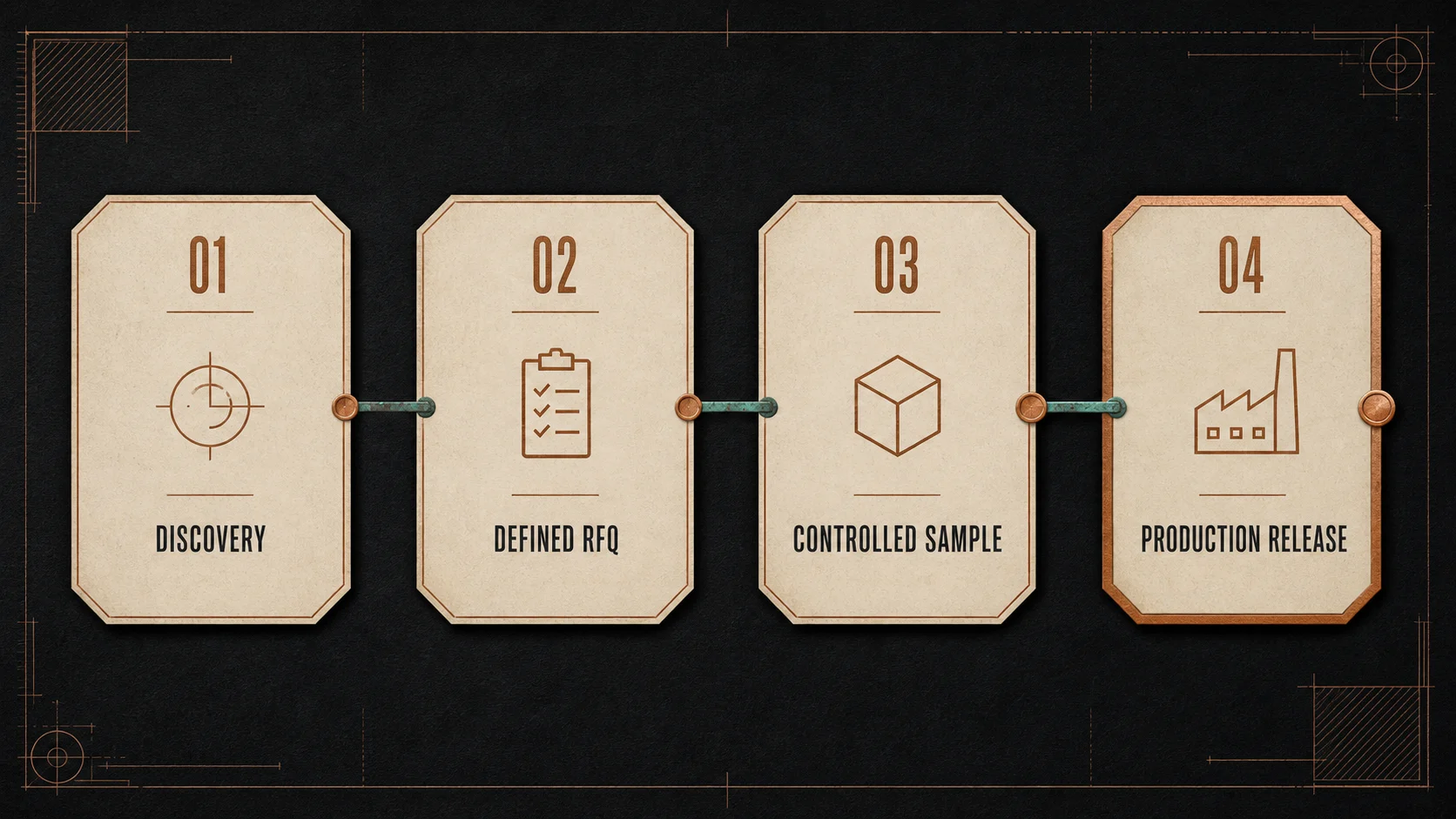 Every gate permits a narrower next step; none is a complete supplier verdict.
Keep a lead log with the source of the lead, claimed legal entity, product family, process claims, questions asked, documents received, unresolved gaps, and next permitted commitment. This makes a shortlist useful even when the buyer chooses not to proceed. It also prevents an old sales claim from reappearing later as a “verified” factory fact.
4. Turn a Sample Into a Controlled Production Target
A sample demonstrates that one product was made once. It does not demonstrate that a line can reproduce it at volume, or that future components, materials, operators, and packing will remain the same. The sample becomes useful only when its approved state can be compared with a later lot.
Maintain a sample log: revision, date, supplier/manufacturer role, materials and substituted parts, dimensions, test results, cosmetic reference, packing, unresolved defects, and decision. If the buyer approves a reference unit, label it as the golden sample and attach clear photographs or controlled files. Define what must be unchanged, what may vary, and what requires written approval.
The production acceptance plan should answer operator-level questions: which characteristics are critical; what tolerances and defect classes apply; which materials, components, firmware, colours, labels, or certifications are fixed; what is tested per unit versus sampled; which serial or lot record is required; and what happens when a lot fails.
ISO 2859-1:2026 describes AQL-indexed acceptance-sampling plans for lot-by-lot inspection. It is a sampling system, not a magic quality number. It does not choose a buyer's AQL, define its critical defects, or decide whether rework is acceptable. Those decisions must be stated in the buyer's own product and commercial file.
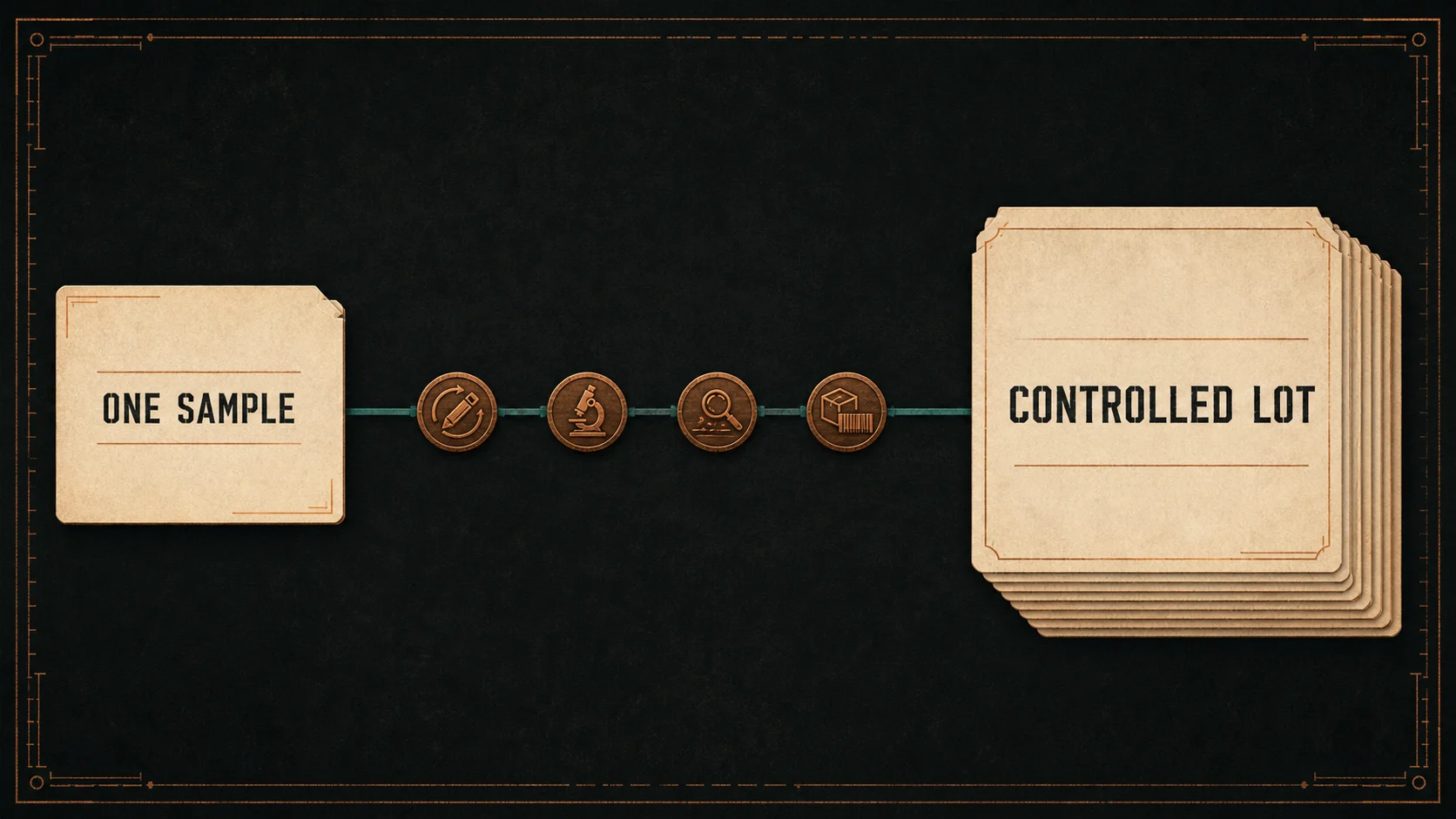 A sample becomes a production reference only when the buyer defines how it will be compared with the lot.
Record a Mismatch Without Manufacturing an Accusation
The moment that reveals whether a buyer file is useful is often a mismatch: a different legal name appears on an invoice; the factory video shows a partner operation; the sample uses a component that is not in the quote; a certificate does not match the offered configuration; the production date changes; or the bank beneficiary differs from the contracting seller. None of these facts is automatic proof of fraud or failure. They are changes that need a bounded explanation and a decision before the affected money or goods are released.
Use a small discrepancy record:
| Field | What to record |
|---|---|
| observed fact | exact name, model, process, document version, date, or payment detail |
| approved or claimed fact | the corresponding RFQ, schedule, sample, or contract reference |
| supplier explanation | who stated it, when, and which evidence supports the explanation |
| affected decision | RFQ, sample, tooling, deposit, production, final payment, or shipment |
| buyer response | accept, accept conditionally, hold for a record, or escalate |
| remaining limit | what still has not been independently or transaction-linked established |
Put Quality Evidence on the Production Calendar
The least useful inspection is the one planned only after every carton is sealed. If the buyer has reached a production release, the technical file and acceptance plan should be tied to moments when a difference can still be corrected.
| Moment | Question to answer | Record or control |
|---|---|---|
| pre-production | are critical materials, bought-in parts, and the current revision the approved ones? | approved BOM or component boundary, pre-production reference, change log |
| first-run | does the line understand the product's critical operation and test? | first-article or initial-unit record, work instruction, fixture/test confirmation |
| in-process | is variation appearing before the full lot is made? | defined check, defect/rework log, controlled response to an exception |
| pre-shipment | does the finished lot meet the buyer-defined acceptance and packing record? | sample plan, result, packing/label/serial or lot reconciliation |
| receiving | can the buyer connect what arrived to what was approved and preserve exceptions? | count, condition record, scan/lot evidence, handover archive |
For each control, define the decision rather than only the activity. Who sees the result? What is an unacceptable difference? Can it be reworked, sampled again, replaced, or accepted only as a recorded concession? Which payment or shipment milestone is affected? A report that arrives after final payment with no agreed consequence is evidence of a problem, not a control of it.
The same distinction applies to a third-party inspection. An external inspection can add independent observation, but it cannot choose the buyer's specification, know which undocumented substitution matters, or repair a missing commercial role map. Give any inspector the approved revision, defect definitions, sample method, packaging/label expectations, and escalation contact. Then preserve the result alongside the lot and release decision.
Keep One File That a Second Reviewer Can Read
At any gate, a colleague who did not negotiate the quotation should be able to answer five questions from the record alone: what is being made; who is making or selling which part of it; which evidence supports that claim; what has changed since the prior release; and what decision is permitted now. If the answer lives only in a sales chat, one person's memory, or an unversioned spreadsheet, the file is not ready for the next irreversible commitment.
Keep the buyer's original brief, supplier responses, legal/entity comparison, quote revisions, sample and test log, acceptance plan, exceptions, payment instructions, packing/serial or lot record, and final handover materials in a stable place. This does not create certainty. It creates a disciplined way to see where certainty ends, route a question to the right owner, and preserve the evidence needed when the product is no longer in the supplier's showroom.
5. Release One Commitment at a Time
Use the file to make each release explicit:
- RFQ release: the product brief is sufficiently defined to compare assumptions.
- Sample release: the legal counterparty and claimed product/process boundary justify a limited test, not a bulk order.
- Tooling or deposit release: the approved revision, ownership/return terms where relevant, acceptance plan, payment beneficiary, and change process are documented.
- Production release: the product, materials/critical components, golden sample, test/inspection plan, packaging, and production path are approved or the exceptions are recorded.
- Final-payment or shipment release: invoice, exporter, packing/serial or lot record, inspection/exception file, and warranty/service route can be reconciled with the approved state.
At every gate, choose one of three outcomes: advance, hold for a defined record, or escalate to the person qualified to decide the project-specific question. Do not turn a mismatch into an unsupported fraud conclusion. An unfamiliar entity, changed part, or missing record may have a legitimate explanation. The buyer still needs that explanation, a new bounded evidence link, and a decision before it gives up a practical option.
Method and Limits
This article is editorial desk research based on public enterprise, SAMR, and ISO materials. It does not verify a particular supplier, factory, product, certificate, sample, payment path, inspection, shipment, customs outcome, or warranty. It is not legal, engineering, quality, product-safety, customs, finance, or inspection advice. A project's actual product, agreement, destination, and qualified reviewers determine what evidence is sufficient.
Related Entries
- Quality Control in Chinese Factories: Build a Defect-to-Release Evidence Chain
- supplier-verification-china
- China's Industrial Clusters: Why Everything Is Made in One Place
- Buying Chinese Solar Panels: Build a File for the Exact Module