
By China Made & Tech Team. This is desk-researched procurement analysis, not firsthand factory, customs, engineering, legal, financing, or installation work.
A 670 W Chinese module quote is not a product specification. It is an invitation to find out which 670 W module, from which factory and document revision, will actually be made, shipped and supported. The difference becomes visible only after a buyer asks for the model suffix, the approved data sheet, the factory path, the warranty counterparty and the serial-to-carton file.
That is not theoretical paperwork. Jinko's current Tiger Neo 3.0 documentation page, for example, separates data sheets, product certificates, factory certificates, installation material and warranty documents for a defined product family. Its July 2026 procurement announcement is a further public signal of commercial scale. Neither page proves that a reseller's 670 W offer is the same module, from a particular factory, on a particular date. The buyer still needs a transaction file that makes that connection.
This is that file. It is for an importer, EPC, developer or procurement lead who needs to turn a Chinese module offer into a release decision. It does not rate brands, determine customs origin, replace an engineer, or promise that a document package will make a supplier perform. It shows which questions belong to the order, which belong to the site, and which change should stop the process.
The Quick Answer: Buy a Baseline, Not a Brand Name
The right first decision is not "is this manufacturer reputable?" It is: what exact baseline am I approving, and can every later record point back to it?
The baseline should contain the matters that materially change technical fit, compliance analysis, field work or future warranty handling:
| Decision | Baseline evidence | Why a quote alone is insufficient |
|---|---|---|
| Exact module | manufacturer, full model suffix, power class, data-sheet revision and label artwork | a family name or wattage can cover multiple constructions |
| Site fit | structural load, wind/snow/hail/fire context, electrical design and mounting interface | a higher wattage does not establish environmental suitability |
| Legal and commercial chain | contracting seller, manufacturer, exporter, factory and warranty provider | a brand logo does not identify who invoices, exports or answers a claim |
| Product proof | current data sheet, certificates, installation manual, warranty revision and test scope | a web link can change after the purchase order is signed |
| Physical delivery | packing hierarchy, serial/lot allocation, factory-release record and container map | a packing list cannot reconstruct an unbounded production batch |
| Project acceptance | receiving inspection, commissioning record, as-built allocation and record owner | a warranty claim will happen after procurement has handed the modules away |
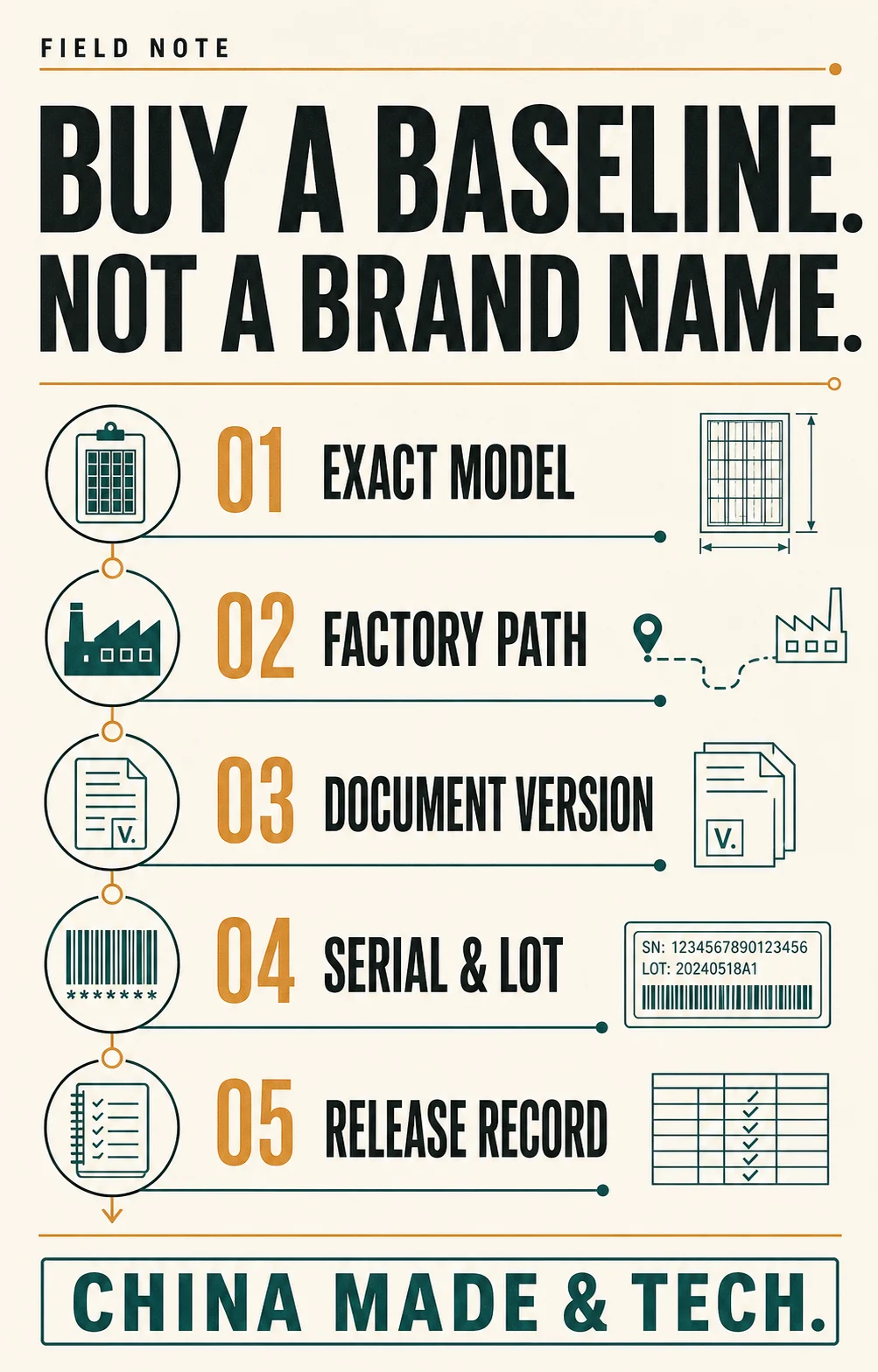 Field Note: a module quote becomes a decision only when it resolves to a controlled purchase baseline.
The table is intentionally broader than module price. The U.S. Department of Energy's 2026 procurement guidance places technical specifications through award, submittal review, equipment delivery and commissioning. That is the right mental model for any serious project: the module is not finally selected when a salesperson sends a PDF. It is selected when the contract, submittal and delivered equipment still describe the same thing.
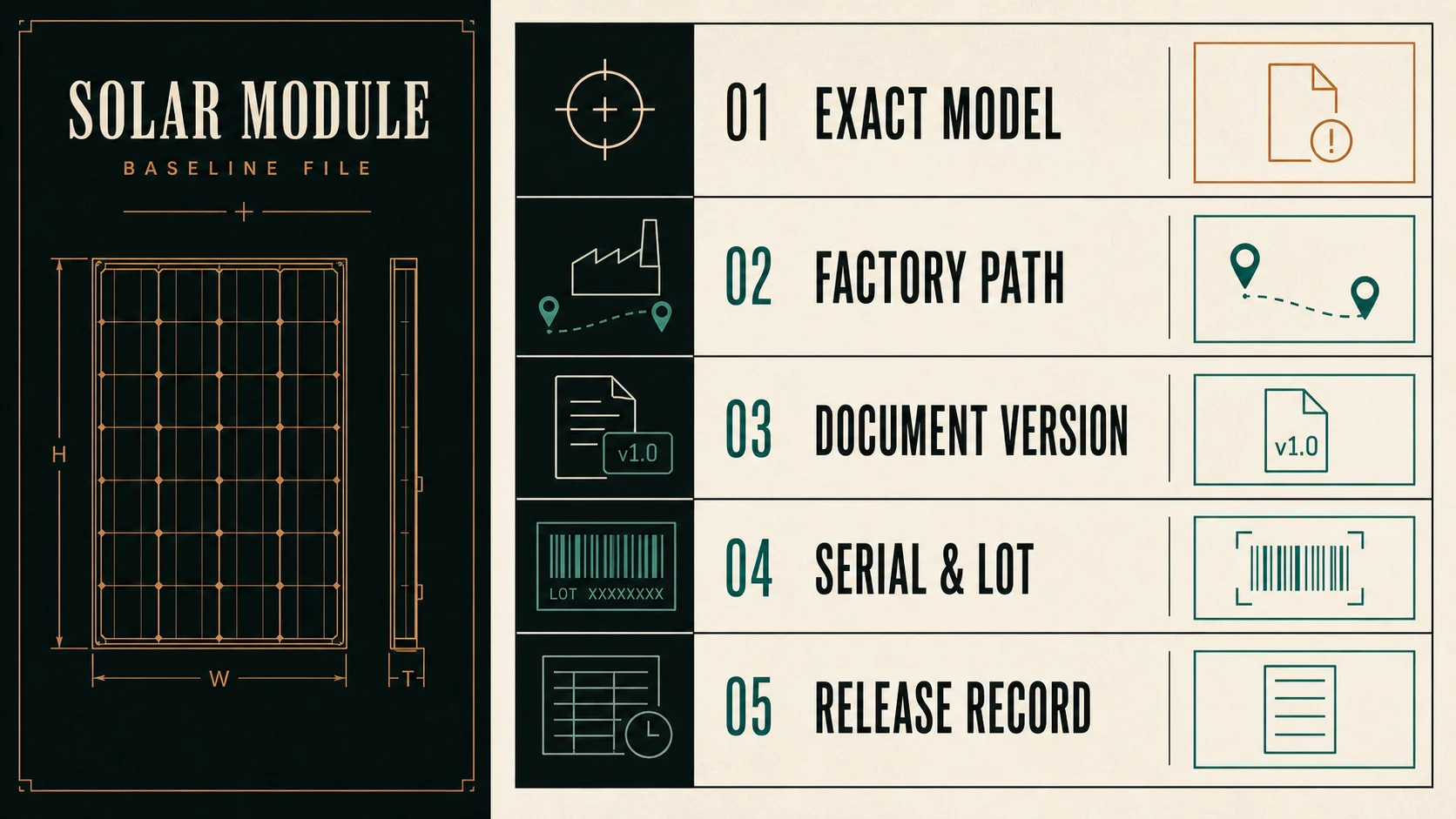 The baseline ties every later document to one controlled purchase object.
1. Start With the Project Pressure, Not a Catalogue Filter
Chinese manufacturing scale gives buyers a wide menu of N-type, TOPCon, bifacial, dual-glass and high-power products. That can reduce price and improve availability. It can also hide whether the product on a quote is suited to the project that will own it for decades.
Write the pressure down before asking for prices. A small commercial roof has different constraints from a utility tracker field. A hail-prone site does not ask the same questions as a hot coastal installation. A project with a tight physical layout, existing inverter architecture or lender-required documentation has constraints that a nameplate comparison will miss.
DOE's current PV commissioning guidance illustrates the point: system documentation, array testing and whole-system performance testing are not decorative close-out files. They are part of making the installed system verifiable. Its hail mitigation guidance similarly treats site hazard, module selection and system design as connected decisions. It is not enough to ask whether a module passed a generic test. Ask which site exposure matters, which evidence covers it, and who accepts the residual risk.
Create a one-page project brief before the RFQ:
- destination market, applicable code/certification and customer requirements;
- system type, design constraints, expected mounting and electrical interface;
- exposure assumptions: wind, snow, hail, salt, heat, fire or other material conditions;
- model, power, size and weight limits the EPC or engineer will accept;
- required commissioning, O&M, spare-part and warranty handover records;
- commercial constraints: schedule, payment milestones, Incoterm, named handover point and permitted substitutions; and
- any origin, tariff, traceability, financing or public-procurement question that must be reviewed before production.
This does not turn procurement into engineering design. It stops the inverse workflow, where a cheap catalogue item becomes the project baseline and everyone tries to make the site fit it later.
2. Normalize Every Quote to an Exact Module Identity
Ask each supplier to complete the same technical and commercial schedule. Do not accept a comparison that has one supplier quoting a full model and another quoting "N-type 670 W bifacial". The latter is a feature string, not a purchase object.
For each proposed item, record:
- manufacturer and full model code, including all suffixes;
- product data-sheet revision and issue date;
- rated power bin, electrical parameters and tolerance;
- cell technology, glass/backsheet or glass-glass construction, frame, dimensions, mass, connectors and cable;
- mechanical-load, environmental and safety information relevant to the site;
- factory or permitted-factory set, production window and any approved substitute rule;
- certificate identifiers and scope, installation manual and warranty document revision;
- contracting seller, invoicing party, exporter, manufacturer and warranty claimant/recipient; and
- price basis, currency, quantity, named delivery term/place, freight, insurance, packaging, inspection and payment milestones.
This is where public product documentation has a practical use. A manufacturer portal should let a buyer discover what a coherent document family looks like. It should not be used as a substitute for the documents incorporated into the order. The approved data sheet and warranty must be saved with their filename or revision, not merely bookmarked. If a supplier sends a new PDF just before shipment, compare it against the order before treating it as a harmless update.
A Product Family Is a Signal, Not a Shipment Fact
Jinko's public Tiger Neo material tells a buyer that the company publishes a document system around named module families. That is a positive public signal. The same is true of an announcement describing a large framework procurement: it may support the inference that the group has current delivery activity. Neither source establishes any of the following for a buyer's cargo:
- that the seller is authorized to sell the model;
- that the proposed factory will make the units;
- that the stated certificate applies to the submitted configuration;
- that the module will not be substituted during allocation;
- that the invoice/exporter path matches the buyer's assumptions; or
- that a later warranty claim will be accepted by the company named on the public website.
Treat those as separate confirmation tasks. This distinction is the difference between due diligence and borrowing a famous manufacturer's credibility for an untested sales offer.
3. Make the Supplier Prove the Commercial and Factory Path
The seller who sends the quotation may be a manufacturer, a subsidiary, a distributor, a trading company or a broker. None is inherently disqualifying. The risk is ambiguity: the buyer thinks it has one counterparty while the product, payment, export and warranty paths involve different entities that were never reconciled.
Build a role map before a deposit:
| Role | Question to answer | Controlled evidence |
|---|---|---|
| Contracting seller | Who owes delivery and the agreed documents? | signed contract and legal-entity details |
| Manufacturer | Who makes the approved module and where? | factory identification, product/factory documents, production commitment |
| Exporter | Who appears on shipping and export records? | pro forma/final invoice and shipping instruction path |
| Warranty provider | Who receives a formal notice and can authorize a remedy? | named warranty schedule and notice route |
| Service channel | Who supports installation, failure diagnosis and returns in the destination market? | service contact, response process and contract allocation |
The SEIA 101 traceability standard is helpful here even when the buyer's immediate goal is not a forced-labor review. It describes traceability as due diligence, data collection, analysis and a management program. The operational lesson is simple: the supplier should be able to connect the commercial order to a product and production record through a defined system. A polished declaration with no transaction link is weaker than a bounded, honest disclosure with supporting files.
For U.S.-bound cargo, origin, HTS classification and duty treatment are distinct questions. Do not let a quote's country label answer all three. Use Solar Panel HTS Codes for US Imports, Importing Solar Panels From China to the US 2026 and UFLPA Solar Panel Import Checklist as separate decision files, and give their specific question to qualified customs and legal advisers before production is released.
4. Compare Price Only After the Scope Is Normalized
Two quotations can show the same price per watt and still describe different purchases. One may include a defined model, acceptable production site, packing configuration, port handover, serial export and a named warranty procedure. Another may reserve the right to nominate the module later, use a flexible exporter, change the packing plan or leave the buyer to solve replacement transport. The lower figure is not necessarily deceptive. It is incomplete until those differences are priced and allocated.
Normalize the commercial schedule before comparing suppliers:
| Cost or risk line | Question that makes it comparable | What to retain |
|---|---|---|
| Module price | Is the price for the identical approved model/power/revision and quantity? | signed quote and technical schedule |
| Factory and allocation | Is the factory defined, and what happens if capacity moves? | permitted-factory/change clause |
| Packing and inspection | Are pallets, export packing, pre-shipment checks and serial files included? | packing specification and inspection scope |
| Carriage and insurance | Which party books, pays, bears risk and can claim under the named rule? | exact rule, named place, booking and insurance evidence |
| Destination work | Are unloading, storage, inspection, inland delivery and damage handling budgeted? | logistics plan and project responsibility map |
| Warranty execution | Who pays for diagnostics, removal, freight, customs, replacement and reinstall if a claim is disputed? | warranty schedule and remedy/cost clause |
| Compliance records | Which party supplies source data, declarations and refreshes them after a change? | document list, timing and owner |
Do Not Let an Incoterm Hide an Operating Gap
An Incoterm with a named place is useful; a slogan such as "freight included" is not. Under ICC's Incoterms 2020 C/D-rules overview, a seller's payment for carriage under a C rule does not necessarily mean the seller keeps risk through the destination. That distinction matters when a container is delayed, rolled, damaged or needs a change in instructions.
For every offer, write the rule, exact named place and version, then ask four operational questions: who books the carrier; who can change the booking; when does the buyer become responsible for loss under the deal; and whose policy can respond to a damage claim? Record the commercial invoice, freight invoice, insurance certificate, shipping instructions and final transport document alongside the technical file. A freight term answers only part of the delivery story.
5. Define the Evidence That Triggers a Hold
Good procurement does not demand perfect information. It defines the minimum proof required before a decision becomes irreversible, then treats missing or contradictory evidence as a business event rather than an inconvenient email.
The following conditions should normally trigger a hold until the responsible owner resolves them:
- the full model suffix, data sheet or warranty revision on the final package differs from the approved schedule;
- the seller cannot identify the legal entity that invoices, exports or accepts the warranty notice;
- the declared manufacturing/factory path changes without the promised approval process;
- the serial or lot allocation cannot be tied to the factory-release record and physical packing hierarchy;
- certificates, labels, data sheets and invoices disagree on the model, quantity, issuer or dates;
- a key origin, eligibility or traceability assertion cannot be linked to the proposed shipment; or
- cargo is about to hand over while the buyer cannot identify the named place, carrier-control party and insurance/claims route.
None of these proves fraud or a defective module. A supplier may have a routine documentation lag, a new entity, a valid model revision or an allocation issue. The point is that the buyer should decide after receiving a clear change record, not discover the change through a bill of lading, customs question or warranty rejection.
The escalation note should be concise: affected PO line; original fact; new or missing fact; source record; potential engineering, compliance, cost or schedule effect; decision owner; and deadline. This preserves a useful audit trail without converting each clarification into a negotiation crisis.
6. Put the Baseline Into a Change-Controlled Purchase Order
The purchase order is where a supplier's flexible production system meets the buyer's need for a fixed decision. Attach the approved baseline rather than burying it in email threads. The contract should state which changes need written buyer consent, what notice is required, and what happens if evidence no longer supports the original assumption.
At minimum, define a change event for:
- module model, suffix, power class or bill-of-material feature that affects approval;
- module plant, cell source boundary, exporting entity or origin-marking assumption;
- data sheet, certificate, installation manual or warranty revision;
- delivery rule, named place, carrier/route, containerization or packaging plan;
- serial/lot method, production period or factory-release schedule; and
- service, warranty or claim-notice counterparty.
For each event, require the supplier to identify the old fact, proposed new fact, affected order line, reason, effective date, documents to be replaced and decision deadline. The buyer then has a real choice: approve, seek engineering/compliance review, negotiate compensation, or hold the order. Without this mechanism, an allocation change can appear only after a factory has built modules or a forwarder has booked cargo.
The buyer should also assign its own owners. Engineering approves technical equivalence. Procurement controls the commercial baseline. Compliance or the broker reviews trade-related questions. Logistics controls release and documents. The asset owner accepts commissioning records. A single overloaded buyer cannot reliably perform all five roles through an urgent shipping window.
7. Inspect the Evidence at Factory Release, Not After Arrival
The most valuable pre-shipment inspection is a reconciliation, not an inspection theatre. It should check whether the module, documents, packaging and shipment plan all refer to the approved baseline.
Before release, request and reconcile:
- final model/data-sheet/warranty/certificate package, with revisions matching the PO;
- factory-release or production record tied to the approved order;
- final serial or bounded lot export, including model, quantity, factory and production period;
- carton-to-pallet-to-container hierarchy or another agreed physical mapping;
- photographs or records of labels, packing condition, pallet count and container loading;
- packing list, commercial invoice, proposed shipping instructions and named commercial parties; and
- an exception log for substitutions, shortages, damaged units, unreadable labels or document conflicts.
The objective is not to demand a confidential factory database. It is to make one delivered module traceable to the files a receiver, insurer, lender, customs professional or warranty administrator will later need. If records conflict, preserve the conflict and resolve it. Do not replace the old file with a corrected spreadsheet and lose the history of what changed.
Receiving is the second reconciliation point. Record seals and visible package condition before unloading, count pallets and cartons, capture damage, scan the agreed serial/lot population, and compare the results with the factory export and packing list. The receiving record should distinguish factory evidence from carrier-condition evidence. A cracked module discovered after pallets have been mixed across sites is not the same claim as visible shipping damage recorded at delivery.
8. Finish Procurement at Commissioning Handover
The project has not received a usable module merely because a container arrived. It has received one when the exact hardware is installed, accepted and handed over with the evidence necessary to operate and claim against it.
DOE's commissioning guidance highlights system documentation, array testing and whole-system performance testing. Translate that to a buyer handover file:
| Handover record | Why it matters later |
|---|---|
| approved product schedule and final document versions | proves the installed equipment against the contracted baseline |
| serial/lot, packing and receiving reconciliation | joins the physical module to the purchase and shipment |
| installation and as-built allocation | lets an O&M team locate the affected unit |
| commissioning/acceptance records | separates installed-system evidence from later deterioration or damage |
| warranty registration, notice route and claim owner | makes a time-sensitive claim operational rather than aspirational |
| controlled archive and retention rule | prevents the EPC, broker or salesperson from becoming the only memory of the order |
At this point the commercial team should formally transfer the controlled package, not simply send a cloud-folder link. The handover record should name the final document set, serial-file version, outstanding exceptions, warranty notice route, retention location and the person who owns the next action. If the project will change owner, financier, EPC or O&M contractor, repeat the access test with the receiving party. A file that only the original buyer can navigate is a fragile warranty and compliance asset.
Make the archive read-only after handover, with later material kept as dated additions. That preserves the baseline that the project actually accepted while allowing corrective records and claims evidence to remain visible.
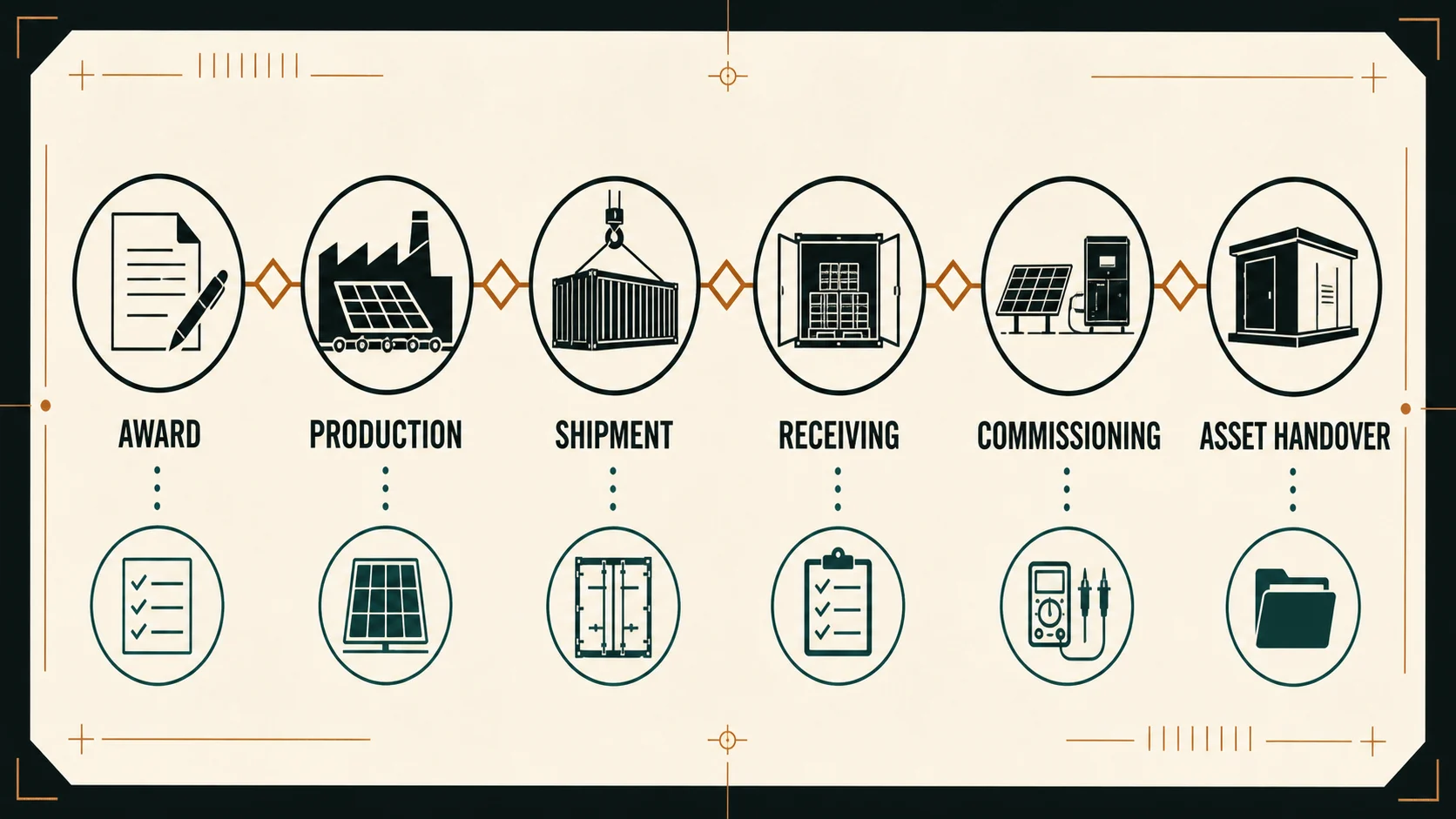 The purpose is a continuous record, not a promise that delivery or performance will be problem-free.
A Release Test for the Buyer
Do not authorize final payment or shipment merely because the supplier says production is complete. Ask a reviewer who did not negotiate the order to answer these questions from the controlled file:
- What exact module configuration, data-sheet revision and warranty revision were approved?
- Which legal entities sell, manufacture, export and receive a warranty notice for this cargo?
- Which factory/production path is permitted, and what change needs approval?
- Which records connect the final serial or lot allocation to packing, containers and the invoice?
- Does the delivered product still fit the site, certificate and trade/compliance assumptions that justified the order?
- Can the asset owner locate a failed module and retrieve its purchase, shipment, installation and commissioning records?
If the answer to one is "the supplier will send that later," the item is not ready for release. That is not hostility to Chinese suppliers. It is the discipline that lets a buyer use the speed and breadth of China's solar manufacturing without turning an attractive quote into an unbounded downstream risk.
Method and Limits
This article uses public manufacturer documentation and U.S. Department of Energy lifecycle guidance to describe a source-bounded procurement record. It does not verify a supplier, factory, module, certificate, shipment, site condition, customs/origin treatment, project acceptance, warranty outcome, or product suitability. The actual order, project requirements, agreements, delivered records, and qualified reviewers control the decision.
What This Article Does Not Determine
This article does not determine whether a particular supplier, module, factory, certificate, origin declaration, tariff position or warranty claim is valid. Public manufacturer documents can show what a company publishes; they cannot prove the facts of a buyer's transaction. Project-specific engineering, customs, legal, insurance and contractual questions require the responsible professionals and the actual documents.