
A US solar buyer does not need an HTS code because customs likes paperwork. The buyer needs it because the HTS code is the doorway into the duty model. A Chinese solar quote can look cheap until the product is classified, the producer is named, and the importer knows which tariff and trade-remedy files attach to that classification.
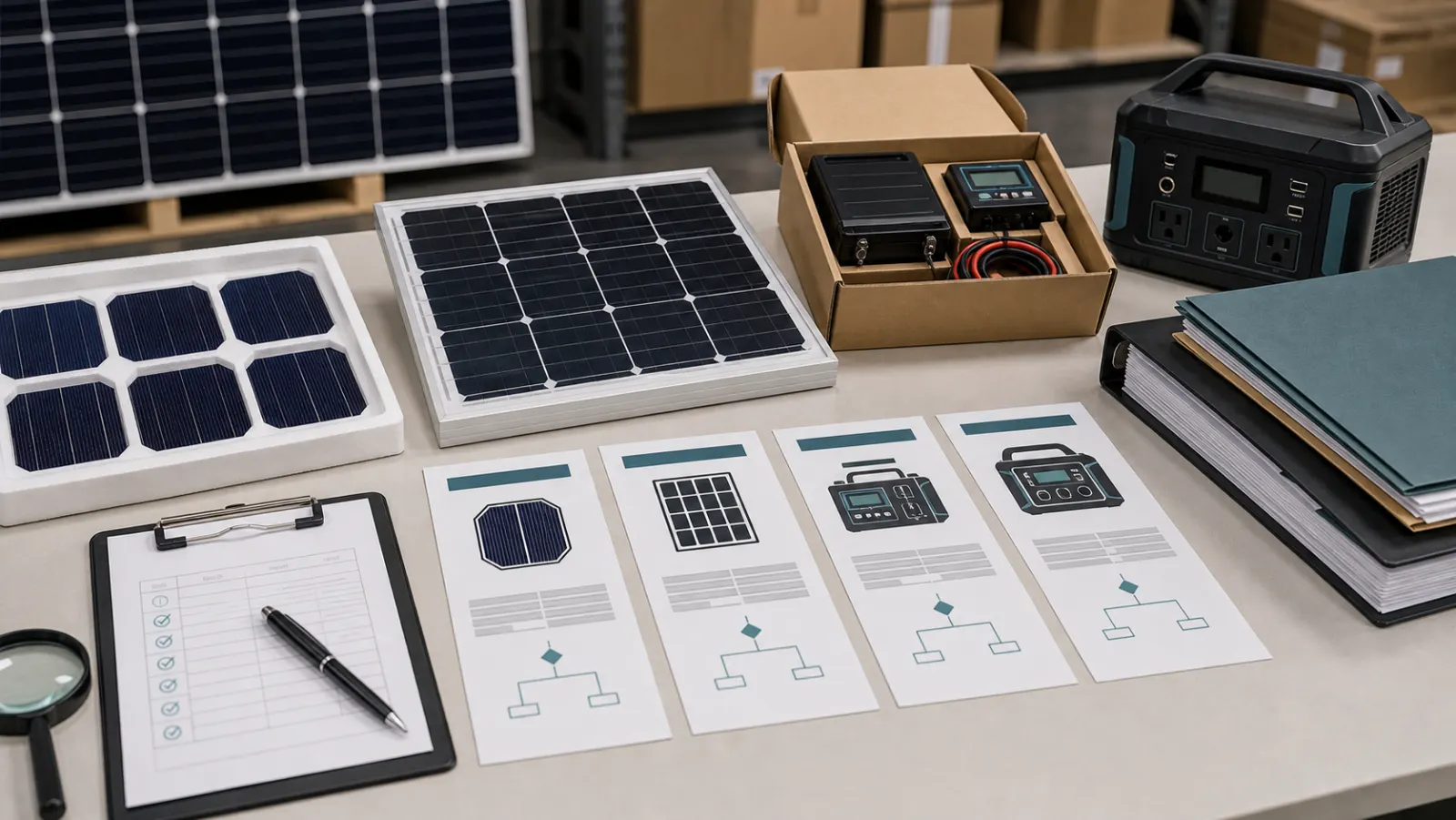
The most common mistake is treating every solar product as "a panel." A loose photovoltaic cell, a finished module, a module bundled with a controller, and a portable solar generator kit can sit in different classification conversations. If the importer uses the wrong starting point, the tariff spreadsheet is built on sand.
This article is a practical HTS code guide for US solar imports. It is not a customs ruling. It gives buyers the questions and file structure to bring to a licensed customs broker before committing to a Chinese solar shipment.
For current Chinese solar panel duty levels, see US & EU Tariffs on Chinese Solar Panels 2026. For the US importer checklist, see Importing Solar Panels From China to the US 2026. For the solar-cell-specific tariff page, see US Tariffs on Chinese Solar Cells 2026.
Source File
This article was reviewed on 2026-06-30 against the USITC HTS system entries for 8541.42.00.10 and 8541.43.00.10, the Federal Register Section 301 solar-cell modification notice, the USITC 2026-05-27 CSPV sunset-review decision, CBP's UFLPA resources, and IRS/Treasury 2026 prohibited foreign entity guidance. The article provides buyer-facing classification starting points, not a binding ruling. Final classification should be confirmed from the exact product, bill of materials, invoice language, and shipment structure.
Quick Answer: Common Solar HTS Starting Points
The two HTS references buyers see most often for PV cells and modules are:
| Product form | Common HTS reference | What it usually covers |
|---|---|---|
| Crystalline silicon photovoltaic cells not assembled into modules or panels | 8541.42.00.10 | Loose solar cells |
| Solar cells assembled into modules or panels | 8541.43.00.10 | Standard PV modules or panels |
| Solar panel plus battery/controller/generator package | Not automatically a module code | Needs broker review; bundled systems can move into other headings |
| Inverters, batteries, mounting, cables, optimizers | Separate classification analysis | Do not classify the entire shipment as a solar module |
Why HTS Classification Comes Before Tariff Math
The HTS code is not just a label. It determines which duty lines, trade actions, exclusions, and reporting requirements may be reviewed. In solar, classification also helps decide whether the product is treated as a cell, a module, or a larger system.
For Chinese solar imports, the HTS file connects to:
| Question | Why HTS matters |
|---|---|
| Does Section 301 apply? | China-origin solar cells and cells assembled into modules have specific treatment |
| Does AD/CVD apply? | Product scope and classification help identify the trade-remedy file |
| Is the item a module or a system? | Bundled components can change analysis |
| Is the shipment mixed? | Modules, inverters, batteries, and controllers may need separate lines |
| Can the supplier quote landed cost? | No reliable landed cost exists without classification |
8541.42.00.10: Solar Cells Not Assembled Into Modules
HTS 8541.42.00.10 is a common reference for crystalline silicon photovoltaic cells not assembled into modules or panels. This is the loose-cell file.
The buyer should use this starting point when the shipment is individual cells rather than finished modules. A US assembler importing cells for module production may fall into this conversation. So might a buyer bringing in cells for specialized manufacturing, testing, or replacement use.
For this file, the importer should document:
- whether the cells are crystalline silicon PV cells
- whether they are loose or assembled
- cell producer and factory address
- country of cell conversion
- wafer origin
- polysilicon traceability where relevant
- whether the cells are packaged with anything else
- intended use after import
The tariff question then moves to country of origin, producer identity, Section 301, AD/CVD, and traceability. If the cells are China-origin, the 50% Section 301 solar-cell layer is a baseline issue. If the cell producer is non-reviewed or the product falls into AD/CVD exposure, the duty model can become much larger.
8541.43.00.10: Cells Assembled Into Modules Or Panels
HTS 8541.43.00.10 is a common reference for solar cells assembled into modules or panels. This is the standard finished-module file.
Most commercial solar panel imports begin here because buyers usually buy modules, not loose cells. But the module file still depends on cell origin. The code tells you that cells are assembled into a module. It does not by itself tell you who made the cells, where the cells were converted, whether AD/CVD applies, or whether UFLPA documentation is strong enough.
For this file, collect:
- module datasheet
- product photos
- label photos if available
- bill of materials
- module producer
- cell producer
- country of module assembly
- country of cell conversion
- commercial invoice and packing list
- whether the shipment contains modules only
A finished module can still create a cell-origin problem. That is why US Tariffs on Chinese Solar Cells 2026 exists as a separate deep dive.
When A Solar Product Is Not Just A Module
Many products are sold with the word "solar" but are not simple PV modules for classification purposes.
Examples:
| Product | Why it needs separate review |
|---|---|
| Solar panel with integrated charge controller | Controller may change the product analysis |
| Solar panel plus battery kit | Battery and system function matter |
| Portable solar generator package | The product may be closer to a generator or power station package than a bare module |
| Solar street light kit | Lamp, battery, controller, and panel can create a kit analysis |
| Solar pump kit | Pump and controls may drive classification |
| Inverter plus module bundle | Inverter has its own classification and compliance file |
If the supplier gives one HS code for a mixed kit, ask for a bill of materials and broker review. A cheap all-in-one quote can become expensive if the importer discovers too late that the product was not a standard module.
The Product Packet To Send The Broker
The broker cannot classify a product from a short email. Send a complete product packet.
| Document | Why it helps |
|---|---|
| Datasheet | Shows product form, electrical specs, dimensions, and rated output |
| Product photos | Confirms what the shipment actually looks like |
| Bill of materials | Shows whether non-module components are included |
| Wiring diagram | Helps identify integrated controllers, batteries, or system functions |
| Commercial invoice draft | Shows product description, value, Incoterms, and seller |
| Packing list draft | Shows how items are grouped and shipped |
| Country-of-origin statement | Helps broker and counsel start origin review |
| Prior ruling or prior entry | Useful if the exact SKU has entered before |
| User manual | Can reveal integrated functions not obvious from a datasheet |
Four Classification Scenarios Buyers Actually Face
The useful way to think about solar HTS classification is by product scenario, not by keyword.
Scenario 1: Loose Cells For Assembly
The buyer imports crystalline silicon PV cells that are not assembled into modules. The cells will be used in US module assembly or another manufacturing process. This is the cleanest case for the 8541.42 starting point, but it is not a low-risk case. The buyer still needs cell producer identity, origin, Section 301 treatment, AD/CVD review, UFLPA traceability, and any tax-credit implications.
Scenario 2: Standard PV Modules
The buyer imports finished modules or panels. This is the common 8541.43 starting point. The file should show that the shipment is module-only. If the supplier also includes inverters, controllers, mounting hardware, cables, or spare parts in the same shipment, those items should be broken out.
Scenario 3: Solar Kit With Control Hardware
The buyer imports a kit that includes a panel, charge controller, battery, lights, cables, or a small load device. The product may be marketed as a "solar panel kit," but customs classification may not be the same as a bare module. The bill of materials, relative value, essential character, and intended use can matter. This is exactly the kind of shipment that should go to a broker before deposit.
Scenario 4: Portable Solar Generator Package
The buyer imports a portable power station bundled with solar panels, or a solar charging kit that includes storage and output electronics. The panel may be only one component of a broader power product. In that case, using the solar module code for the whole package can be wrong. The battery, inverter, charging electronics, and generator function may drive a different classification conversation.
These scenarios explain why a supplier's HS code is not enough. A supplier may know how the product exports from China. The US importer needs to know how the product enters the United States.
Commercial Invoice Discipline
Classification problems often start with the invoice. If the invoice says only "solar panel" for a mixed shipment, the importer has already made the broker's job harder.
A better invoice structure separates lines:
| Bad invoice line | Better invoice structure |
|---|---|
| Solar kit, 500 sets | PV module line, controller line, cable line, battery line, mounting line |
| Solar generator package | Power station line, PV panel line, adapter/cable line, spare accessory line |
| Solar panels and accessories | Module line, spare connector line, tool line, packaging/accessory line |
| PV system | Each major product type listed separately with value and quantity |
The packing list should follow the same logic. If the container has modules and inverters, do not let the paperwork make it look like a module-only shipment.
When To Consider A Binding Ruling
For repeated imports, unusual products, or high-value shipments, a buyer may consider asking counsel or the broker whether a binding ruling is appropriate. A ruling can provide more certainty for a specific product, but it requires accurate product facts. It is not a shortcut around product documentation.
A ruling discussion is more likely to be useful when:
- the product is a kit or integrated system
- the supplier will ship the same SKU repeatedly
- classification changes the duty model materially
- the shipment value is large
- the product has batteries, controllers, inverters, or generator functions
- prior entries used inconsistent codes
- different brokers have given different answers
For a one-off import of standard modules, a normal broker review may be enough. For a recurring private-label solar generator kit, a stronger classification file may be worth the time.
Questions To Ask The Broker
Do not ask only "what is the HTS code?" Ask the questions that make the answer usable:
| Broker question | Why it matters |
|---|---|
| What product facts drove the classification? | Shows which details are decisive |
| Does the answer assume module-only shipment? | Prevents accidental use on a kit |
| Do any components need separate lines? | Avoids one-code container mistakes |
| Does Section 301 attach to this classification and origin? | Connects classification to China tariff exposure |
| Is AD/CVD scope review needed? | Keeps classification separate from trade remedies |
| Does the entry date affect temporary measures? | Avoids stale tariff assumptions |
| Would a ruling be useful for repeat imports? | Adds certainty for recurring SKUs |
| What documents should be saved in the file? | Builds a defensible record |
How HTS Connects To Section 301
For China-origin cells and modules, HTS classification connects directly to Section 301 analysis. The Federal Register notice implementing USTR's Section 301 modifications increased duties on solar cells, whether or not assembled into modules, to 50%.
That is why 8541.42 and 8541.43 matter so much. They help identify whether the product sits in the solar-cell category affected by the Section 301 increase.
But Section 301 is not the only layer. Once classification is clear, the importer must still check:
- normal duty
- Section 301
- AD/CVD
- temporary surcharges active for the entry date
- UFLPA traceability
- FEOC or project tax-credit risk
- any exclusions, notes, or changes active at entry
HTS classification opens the door. It does not close the file.
How HTS Connects To AD/CVD
AD/CVD analysis is scope-driven. HTS codes are useful, but scope language and producer records matter. An importer cannot rely on an HTS code alone to prove that a product is out of scope.
The USITC's 2026-05-27 sunset-review decision kept existing China/Taiwan crystalline silicon photovoltaic product orders alive. That means the classification and AD/CVD file should be reviewed together.
For each shipment, ask:
| Question | Why it matters |
|---|---|
| Is the product within scope? | Scope language can matter more than the shorthand product name |
| Who is the producer? | AD/CVD cash deposits can be producer-specific |
| Who is the exporter? | Exporter identity can affect documentation and rate review |
| What is the country of origin? | Origin drives the trade-remedy path |
| Is Southeast Asia involved? | Circumvention or separate AD/CVD cases may apply |
| Has counsel reviewed the assumption? | High-duty shipments justify legal review |
HTS And UFLPA: Different Files, Same Shipment
UFLPA does not disappear because the HTS code is correct. A perfectly classified solar module can still face forced-labor traceability review.
CBP's UFLPA resources are relevant because solar supply chains can include high-risk upstream inputs. The HTS code may tell customs what the product is. The UFLPA file tells the importer whether the supply chain can be documented.
For solar products, the buyer should map:
- polysilicon source
- wafer producer
- cell producer
- module producer
- production records
- transaction records
- transportation records
- supplier declarations
- entity-list screening
This is especially important when a supplier says the product is made outside China but cannot document upstream inputs. Classification and traceability must travel together.
HTS And FEOC: Customs Code Is Not Project Eligibility
The HTS code helps the shipment enter. It does not prove that a project can claim tax-credit value. If the buyer, sponsor, lender, or offtaker cares about FEOC or prohibited foreign entity rules, the project file needs a separate review.
Treasury and IRS have published 2026 guidance on prohibited foreign entity rules. For solar buyers, the key point is practical: project eligibility is not the same as customs classification.
Separate the questions:
| File | Main question |
|---|---|
| HTS file | What is the imported product? |
| Duty file | What does it cost to enter? |
| Origin file | Where was it made and by whom? |
| UFLPA file | Can the upstream chain be documented? |
| FEOC file | Does the equipment preserve tax-credit value? |
Mixed Shipments: Do Not Use One Code For The Whole Container
Solar shipments often include more than modules. A container may include modules, spare junction boxes, cables, inverters, monitoring devices, mounting hardware, batteries, optimizers, labels, and tools.
The buyer should not assume one module code covers everything.
Use a line-item approach:
| Shipment line | Classification approach |
|---|---|
| PV modules | Review under module/panel classification path |
| Loose cells | Review under cell classification path |
| Inverters | Separate electrical equipment classification |
| Batteries | Separate battery classification and safety file |
| Mounting hardware | Material and function-specific classification |
| Cables and connectors | Separate electrical component review |
| Controllers and monitoring devices | Separate classification and compliance review |
The Broker Memo Template
For every solar import quote, create a one-page broker memo before deposit:
| Field | Entry |
|---|---|
| Product description | What is physically imported |
| Product form | Cell, module, kit, system, accessory, or mixed shipment |
| Proposed HTS | Supplier-proposed code and broker-reviewed code |
| Origin | Country of origin by product line |
| Cell producer | Legal name and factory, if cells or modules are involved |
| Module producer | Legal name and factory |
| Shipment contents | Whether non-module components are included |
| Duty assumptions | Normal duty, Section 301, AD/CVD, temporary measures |
| Traceability status | UFLPA document status |
| Project status | FEOC/tax-credit review needed or not needed |
| Open questions | What must be answered before PO |
Red Flags In Solar HTS Classification
Pause the quote if:
- the supplier gives only a six-digit HS code
- the shipment includes batteries or controllers but is described only as "solar panel"
- the same code is used for cells, modules, and kits
- the supplier refuses product photos or bill of materials
- DDP pricing hides who is importer of record
- the HTS code is used as proof that no AD/CVD applies
- the buyer has no entry date in the duty model
- the code was copied from a prior shipment with a different product
- the project depends on tax credits but only customs classification has been reviewed
The code is important. Blind confidence in the code is dangerous.
Common Supplier Code Mistakes
Most Chinese suppliers are not trying to mislead the buyer when they provide a weak code. They may simply be giving the export HS code used in China, a code copied from a previous customer, or a simplified code used by a freight forwarder. That can still create a US problem.
Common mistakes include:
| Supplier answer | Why it may be weak |
|---|---|
| "Use our HS code" | The export code may not be the final US HTS classification |
| "All solar products use the same code" | Cells, modules, kits, inverters, batteries, and accessories differ |
| "Our forwarder handled it before" | A prior shipment may have had different product facts or entry assumptions |
| "DDP includes customs" | DDP can hide who classified the product and which documents were used |
| "No tariff because it is a kit" | Kits can create more classification work, not less |
This is especially important for repeat purchases. A single bad classification can become a repeated process problem if the buyer builds a supply chain around it.
Save the review record with the entry file: broker email, product packet, classification memo, supplier code source, invoice draft, and the date the assumptions were checked. If a temporary tariff window, AD/CVD rate, or product configuration changes later, the buyer can see which assumption changed instead of reopening the whole file from memory. That record is also useful when the same SKU is reordered by another team six months later.
For repeat imports, make this memo part of supplier onboarding, not an afterthought at shipment booking or customs clearance review later internally.
How This Page Fits The Solar Tariff Hub
This page is not a tariff-rate guide. It is a classification guide.
The hub works like this:
- US & EU Tariffs on Chinese Solar Panels 2026 explains the current US/EU landed-cost picture
- Importing Solar Panels From China to the US 2026 explains the US importer checklist
- US Tariffs on Chinese Solar Cells 2026 explains the cell-specific tariff file
- this page explains the HTS classification starting point
That separation prevents keyword cannibalization. A buyer searching for `solar panel HTS code` needs product classification. A buyer searching for `tariffs on Chinese solar panels 2026` needs landed cost. They overlap, but they are not the same page.
Bottom Line
Solar panel HTS codes for US imports are not a minor administrative detail. They are the starting point for the duty, AD/CVD, traceability, and project-risk file.
For many solar imports, 8541.42.00.10 is a common starting point for crystalline silicon PV cells not assembled into modules, while 8541.43.00.10 is a common starting point for cells assembled into modules or panels. But mixed kits, batteries, controllers, inverters, portable systems, and accessories need separate review.
The importer's job is not to memorize codes. It is to build a product file that lets a broker classify the shipment correctly before the buyer accepts the quote.
Claim Confidence File
| Claim | Confidence | Evidence boundary |
|---|---|---|
| Solar import duties, origin rules, and enforcement can materially change landed cost and delivery risk | High | Supported as a buyer-risk principle across CBP, Commerce, ITC, EU, UFLPA, Section 301, and AD/CVD contexts cited by the articles. |
| A tariff or duty number is universal for every shipment under the headline category | Low | The articles repeatedly limit the claim: classification, country of origin, producer/exporter, scope, exemptions, and timing can change the result. |
| Buyers should preserve HTS classification, origin evidence, supplier declarations, traceability files, broker notes, and contract pass-through terms | High | This is the compliance-file recommendation shared by the solar trade-risk articles. |
| The articles provide legal advice for a specific import entry or tender | Low | They are procurement-risk guides and explicitly require broker/counsel confirmation for shipment-specific decisions. |
FAQ
What HTS code is used for solar panels imported into the US?
Solar cells assembled into modules or panels are commonly reviewed under 8541.43.00.10. The final classification depends on product form, so a customs broker should review the datasheet, photos, bill of materials, and shipment contents.
What HTS code is used for solar cells?
Crystalline silicon photovoltaic cells not assembled into modules or panels are commonly reviewed under 8541.42.00.10. If the cells are assembled into modules, the classification path changes.
Can a solar kit use the same HTS code as a solar panel?
Not automatically. A kit with batteries, charge controllers, inverters, lights, pumps, or generator functions can require a different classification analysis. Do not assume the module code applies to the whole kit.
Does the HTS code determine AD/CVD by itself?
No. HTS codes help identify the product, but AD/CVD depends on scope language, producer identity, exporter identity, origin, and trade-remedy records. Broker and counsel review may both be needed.
Should I trust the supplier's HS code?
Use it as a starting point, not as the final answer. The importer of record is responsible for entry accuracy, so the buyer should have a customs broker review the final product and documents.
Methodology
This article is a buyer-facing classification guide based on USITC HTS references for solar cells and modules, current China solar tariff analysis, USITC 2026 solar duty review context, CBP UFLPA resources, IRS prohibited foreign entity guidance, and internal China Made & Tech import-file frameworks. It is not a customs ruling. Product classification should be confirmed by a licensed customs broker or trade counsel using the exact product, bill of materials, and shipment documents.
Related Articles
- US & EU Tariffs on Chinese Solar Panels 2026 - Full 2026 US/EU landed-cost guide for Chinese solar panels
- Importing Solar Panels From China to the US 2026 - US importer checklist for Chinese solar panels
- US Tariffs on Chinese Solar Cells 2026 - Cell-specific US tariff guide
- USITC Solar Duty Review: China Module Cost Risk - Why the 2026 USITC review kept the duty wall alive
- Jinko Global Manufacturing 3.0: Solar Buyer Origin Risk Guide - Why origin documentation now sits inside solar module quotes