
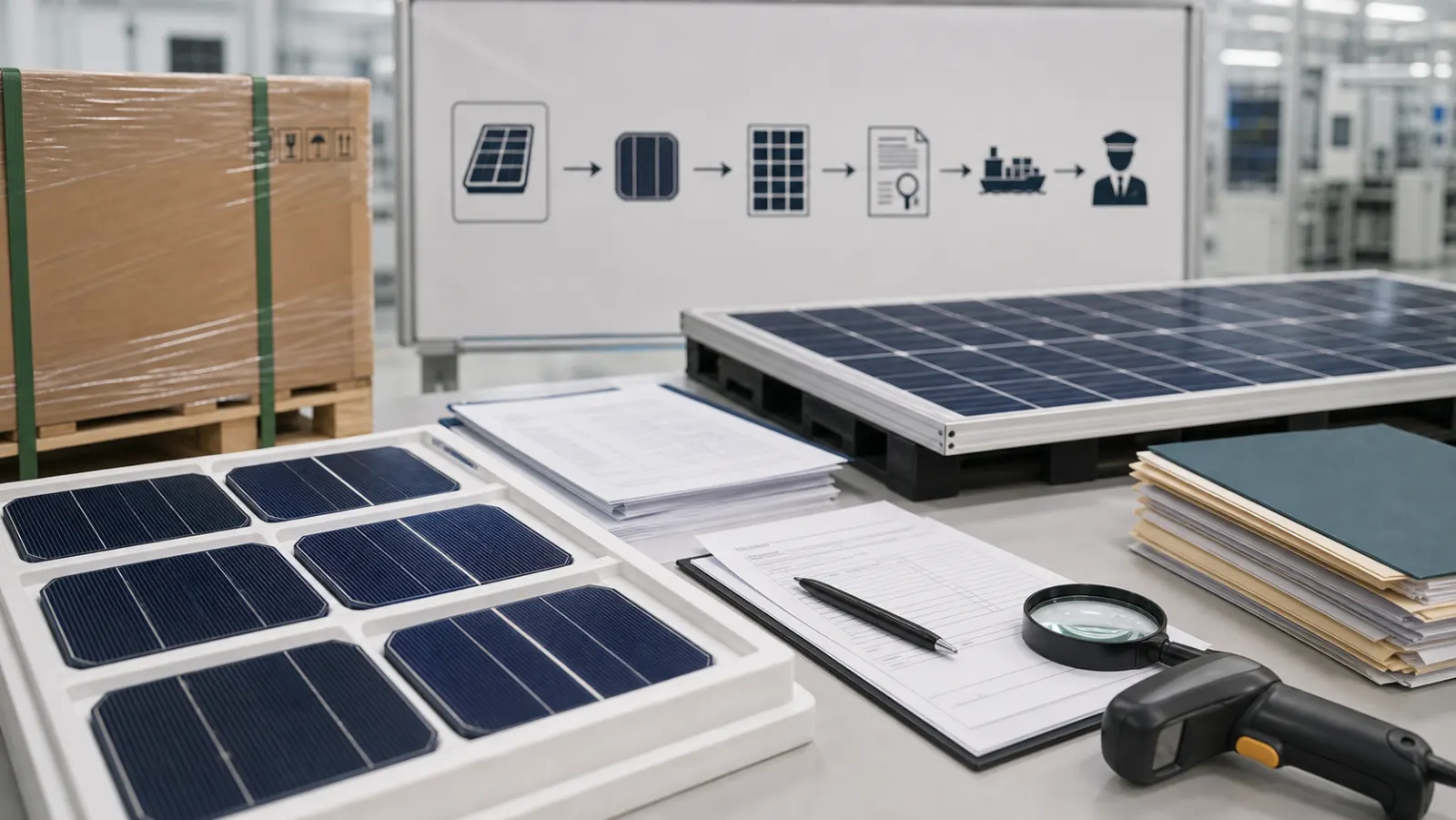
A US buyer asking about tariffs on Chinese solar cells in 2026 is usually trying to solve a more precise problem than "solar panels from China." They need to know whether the tariff applies to individual photovoltaic cells, cells assembled into modules, or a finished module quote that hides the cell origin inside the bill of materials.
That distinction matters. In US solar trade, the cell is often the point where origin, classification, and duty exposure become real. A module assembled outside China may still create a China-related file if the cells, wafers, producer record, or ownership route trigger trade measures. A shipment of loose cells has a different entry file from a pallet of finished modules.
This article focuses only on US tariffs on Chinese solar cells in 2026. For the broader US/EU module landed-cost comparison, see US & EU Tariffs on Chinese Solar Panels 2026. For the operational import checklist, see Importing Solar Panels From China to the US 2026.
Source File
This article was reviewed on 2026-06-30 against the USITC HTS references for 8541.42.00.10 and 8541.43.00.10, the Federal Register Section 301 modification notice, the USITC 2026-05-27 sunset-review decision, Commerce's Southeast Asia solar AD/CVD determinations, CBP's UFLPA resources, and IRS/Treasury 2026 prohibited foreign entity guidance. The analysis separates customs classification, Section 301, AD/CVD, forced-labor admissibility, and tax-credit eligibility; exact treatment depends on the entry file and should be confirmed by a licensed customs broker or trade counsel.
Quick Answer
US tariffs on Chinese solar cells in 2026 start with the 50% Section 301 layer for China-origin solar cells, whether or not they are assembled into modules. But the full import file can also include AD/CVD, temporary surcharges, HTS classification, UFLPA traceability, and tax-credit eligibility issues.
| Product question | 2026 importer answer |
|---|---|
| Chinese solar cells not assembled into modules | Commonly reviewed under HTS 8541.42.00.10; China-origin cells face the 50% Section 301 solar-cell layer and may need AD/CVD review |
| Solar cells assembled into modules or panels | Commonly reviewed under HTS 8541.43.00.10; the Section 301 solar-cell increase still matters when China-origin cells are assembled into modules |
| Finished Chinese solar modules | The module file includes cell origin, module assembly, producer-specific AD/CVD, Section 301, and traceability |
| Third-country modules using Chinese inputs | Do not rely only on port of export; origin, circumvention, and producer records still matter |
| US tax-credit projects | Customs clearance is not enough; FEOC/material-assistance and project eligibility may still change value |
Why "Solar Cell" Is The Critical Word
In a solar supply chain, the module is what most buyers see. The cell is where much of the trade-policy analysis begins. A module is an assembly of cells. A cell is the electricity-generating unit created through wafer processing and cell conversion. Trade rules can care deeply about that conversion step.
For a procurement team, this creates three questions:
- Are we importing individual cells?
- Are we importing modules made from cells?
- If the module is assembled outside China, where were the cells produced?
Those questions decide whether a quote is a simple module purchase or a deeper origin file. A finished module price can hide the cell producer. A buyer who only asks for module wattage and brand may miss the part of the supply chain that drives the tariff.
The story is not that every China-related cell route is automatically unusable. The story is that the cell route must be documented before the buyer can price the import.
HTS Codes: 8541.42 And 8541.43
US classification depends on product form. Two common references appear often in solar import files:
| HTS reference | Common use in buyer files | What to verify |
|---|---|---|
| 8541.42.00.10 | Crystalline silicon photovoltaic cells not assembled into modules | Whether the shipment is actually loose cells rather than modules, kits, or systems |
| 8541.43.00.10 | Solar cells assembled into modules or panels | Whether the product is a standard module or part of a larger integrated system |
Still, the distinction is useful. It gives the buyer a vocabulary for asking the supplier the right questions. Are these cells? Are these cells assembled into modules? Is the shipment module-only? Are there other components in the box?
Section 301: The 50% Baseline For China-Origin Solar Cells
The main tariff fact is the Section 301 increase. The Federal Register notice implementing USTR's Section 301 modifications increased duties on Chinese solar cells, whether or not assembled into modules, to 50%.
That phrase matters: "whether or not assembled into modules." It means the buyer should not assume that assembling cells into a module removes the solar-cell tariff issue. The module form may change classification details, but the solar-cell layer remains central to the China-origin analysis.
For a China-origin solar cell or cell-based module, the buyer should model Section 301 as a baseline. Then the buyer should ask what else applies:
- AD/CVD exposure
- temporary Section 122 surcharge if still active for the entry date
- customs processing fees
- UFLPA traceability risk
- project tax-credit eligibility
- producer-specific review status
The mistake is treating 50% as the final answer. It is the starting line.
AD/CVD: The Producer File Is Separate From Section 301
Anti-dumping and countervailing duties are not the same as Section 301. Section 301 is a China-origin trade action. AD/CVD is tied to trade-remedy orders, product scope, producers, exporters, and review periods.
The USITC's 2026-05-27 sunset-review decision kept existing China/Taiwan crystalline silicon photovoltaic product orders alive. That means a buyer should not assume the AD/CVD file disappeared in 2026.
For solar cells and modules, the importer should ask:
| AD/CVD question | Why it matters |
|---|---|
| Is the product in scope? | AD/CVD orders apply to defined products, not vague categories |
| Who is the producer? | Rates can be producer-specific |
| Who is the exporter? | Exporter identity can matter in rate and documentation review |
| What is the review period? | Cash-deposit rates can change over time |
| Is the company reviewed or non-reviewed? | Non-reviewed exposure can be much higher |
| Is Taiwan or Southeast Asia involved? | Some product routes have their own duty and origin issues |
Cell Origin Versus Module Assembly
The third turning point is origin. A module can be assembled in one country using cells from another. A buyer who only asks "where is the module assembled?" may miss the cell-origin issue.
For each quote, build a cell/module origin table:
| Supply-chain step | Required answer |
|---|---|
| Polysilicon | Country and supplier, if traceability is needed |
| Wafer | Country and producer |
| Cell conversion | Country and cell producer |
| Module assembly | Country and module producer |
| Exporter | Legal seller/exporter |
| Importer of record | US legal importer |
The point is not to panic over complexity. It is to document it. Solar buyers now need an origin file, not only a module datasheet.
Southeast Asia Does Not Automatically Solve The Cell Problem
Many solar supply chains run through Cambodia, Malaysia, Thailand, and Vietnam. That can be legitimate manufacturing. It can also create a circumvention or AD/CVD question if Chinese-origin inputs or Chinese-controlled production are routed through a third country without enough transformation.
Commerce's final affirmative determinations on crystalline photovoltaic cells from Cambodia, Malaysia, Thailand, and Vietnam show why this matters. A Southeast Asian route is not a magic eraser. The importer needs to know what happened in the factory and who controlled the production.
Ask:
- where were the wafers made?
- where were the cells converted?
- where were the modules assembled?
- who owns or controls the producer?
- does the producer have an individual rate or finding?
- what records support the origin claim?
- does the bill of materials match the shipment documents?
For a US importer, the safe sentence is not "not from China." The safe sentence is "here is the documented production path, producer identity, and rate basis."
Section 201 And Section 122: Timing Still Matters
One older solar tariff layer is no longer part of the current cell/module model used here: the Section 201 safeguard. USTR's 2026 Trade Policy Agenda states that safeguard duties on crystalline silicon photovoltaic cells and modules expired on 2026-02-06. If a quote still includes a Section 201 solar safeguard line for a mid-2026 entry, ask the broker to explain the legal basis.
There is also a temporary Section 122 surcharge window in the current China import environment, running through 2026-07-24 unless changed. That is not the same as the 50% Section 301 solar-cell layer, and it is date-sensitive. A serious duty model should include the planned entry date.
The importer file should therefore include:
| Timing field | Why it matters |
|---|---|
| Purchase order date | Commercial commitment and rate-change allocation |
| Shipment date | Determines logistics and documentation timing |
| Entry date | Determines which temporary measures may apply |
| AD/CVD rate date | Cash-deposit rate can depend on period and publication |
| Review date | Shows when the broker or counsel checked the file |
UFLPA And FEOC: Not Cell Tariffs, Still Cell-Linked Risks
UFLPA and FEOC are often mentioned in the same conversations as tariffs, but they are different.
UFLPA is an admissibility and forced-labor traceability issue. CBP's UFLPA resources explain the enforcement framework. For solar cells and modules, the upstream polysilicon and wafer chain can become central evidence.
FEOC and prohibited foreign entity rules affect tax-credit eligibility and project economics. Treasury and IRS have published 2026 prohibited foreign entity guidance. If the project relies on 45Y, 48E, or 45X value, a module that clears customs may still create project-finance risk.
The buyer should not ask "is this a tariff?" The buyer should ask "which file does this belong to?"
| Risk | File type | Buyer output |
|---|---|---|
| Section 301 | Duty file | Cost model |
| AD/CVD | Producer and scope file | Cash-deposit rate |
| UFLPA | Traceability file | Admissibility evidence |
| FEOC | Tax-credit/project file | Eligibility position |
| HTS | Classification file | Entry basis |
Cost Logic: Why Cells Can Break The Module Quote
Suppose a buyer sees a module assembled outside China and assumes it avoids the China tariff problem. The module price looks attractive. The supplier says "assembled in Southeast Asia." The buyer does not ask where the cells were made.
That is a weak file.
The cell origin can affect:
- Section 301 analysis
- AD/CVD or circumvention review
- UFLPA tracing
- tax-credit material-assistance review
- customer origin requirements
- lender or offtaker acceptance
Even if the finished module is the commercial product, the cell can be the policy trigger. That is why this article deserves to exist separately from the broader panel tariff guide. "Solar panels" is the buyer-facing object. "Solar cells" is often the compliance object.
Import Scenario 1: Loose Cells For US Module Assembly
Some buyers are not importing finished Chinese panels. They are importing cells to assemble modules in the United States. On paper, this can look like a domestic-manufacturing strategy. In practice, the cell file is still central.
The buyer needs to separate four ideas:
| Idea | What it means |
|---|---|
| Cell import | The solar cells enter the US as components |
| Module assembly | The cells are laminated and assembled into modules in the US |
| Domestic module label | The finished module may support a US assembly story |
| Upstream exposure | The imported cell may still carry tariff, origin, traceability, or tax-credit questions |
The commercial question is also different from a module buyer's question. A module buyer asks, "What does this finished panel cost landed?" A US assembler asks, "Can I import this cell, assemble it into a bankable module, and still sell the finished product into projects that care about domestic content, tax credits, and origin?"
That second question is more demanding. It requires a manufacturing cost model and a compliance model.
Import Scenario 2: Modules With Chinese Cells
The more common buyer-facing scenario is a finished module. The module may be assembled in China, Southeast Asia, the Middle East, or another location. The buyer sees a module brand and wattage. The compliance team asks for the cell origin.
This matters because a module assembled outside China can still carry China-linked exposure if the cells, wafers, producer ownership, or input route create a trade issue. The buyer should not accept "assembled outside China" as a complete answer.
Ask the supplier to fill out this table:
| Question | Required answer |
|---|---|
| Where were the cells produced? | Country, legal producer, factory address |
| Were the cells made from Chinese wafers? | Country and wafer producer |
| Who assembled the module? | Legal module producer and factory address |
| Are cell and module producers related? | Ownership or supply relationship |
| Has this producer been reviewed in US trade cases? | Rate or finding support |
| Can production records support the claim? | Batch, BOM, shipment, and input-output records |
Import Scenario 3: US-Branded Modules With Imported Cells
Another common confusion is the US-branded module. A module may be sold under a US-facing brand, assembled in the United States, or distributed by a US company, while still relying on imported cells. That does not make it bad. It does mean the buyer should understand what "US" refers to.
Possible meanings include:
- US sales office
- US warranty counterparty
- US module assembly
- US cell production
- US wafer or polysilicon supply
- US ownership or non-FEOC ownership
- US project eligibility under a specific tax-credit interpretation
These are not interchangeable. A US-assembled module with imported cells is not the same as a module made from US cells. A US sales counterparty is not the same as US manufacturing. A domestic-content claim is not the same as a customs-origin claim.
For buyers, the safer language is specific:
| Vague claim | Better question |
|---|---|
| "US-made module" | Which steps are performed in the US: cell, module, frame, junction box, testing? |
| "Domestic content" | Which rule is being applied, and who has reviewed it? |
| "Non-China supply" | Which tier is non-China: cell, wafer, polysilicon, module assembly, ownership? |
| "Tariff safe" | Which tariff, which HTS code, which producer, and which entry date? |
What To Ask A US Module Assembler
If you are buying from a US module assembler that uses imported cells, ask for a cell-origin file. The assembler may not want to disclose every supplier detail publicly, but it should be able to provide enough evidence under NDA or through counsel for serious projects.
Ask:
- Are the cells imported or US-made?
- If imported, what country are they from?
- Who is the legal cell producer?
- What HTS code is used for the cell import?
- Does Section 301 apply to the cells?
- Has AD/CVD been reviewed?
- Can the assembler support UFLPA traceability?
- Does the assembler provide FEOC/material-assistance information for tax-credit projects?
- Is the module claim based on US assembly only, or also US cells?
- What happens if the cell supplier changes?
That last question is important. Solar manufacturers may change cell suppliers as prices, availability, and trade rules shift. If the buyer's project eligibility depends on a specific cell path, the purchase agreement should restrict substitution or require notice and approval.
Comparing Cell Routes
For a US buyer, the right comparison is not simply China cell versus non-China cell. It is a file-quality comparison.
| Cell route | Possible advantage | Main risk to check |
|---|---|---|
| China-origin cells | Low manufacturing cost and mature supply | Section 301, AD/CVD, UFLPA, FEOC, customer acceptance |
| Southeast Asian cells | Potentially lower China-origin exposure | Circumvention, ownership, wafer origin, producer rate |
| US-made cells | Stronger domestic-content story | Higher cost, limited supply, technology and volume constraints |
| Other non-China cells | Diversification | Capacity, bankability, documentation, price, supplier stability |
This is the practical buyer judgment: the cheapest cell is not always the cheapest module input once tariff, detention, eligibility, financing, and customer acceptance are included.
The Solar Cell Import Checklist
Before importing Chinese solar cells or modules containing Chinese cells, collect:
| File | Minimum contents |
|---|---|
| Product file | Datasheet, photos, cell type, module status, BOM |
| Classification file | Broker-reviewed HTS path, including 8541.42 or 8541.43 where relevant |
| Cell producer file | Legal name, factory address, country of conversion |
| Module producer file | Legal name, factory address, assembly country |
| Duty file | Section 301, AD/CVD rate support, temporary surcharge assumption |
| Origin file | Wafer, cell, module, and exporter path |
| Traceability file | UFLPA evidence for upstream supply chain |
| Tax-credit file | FEOC/material-assistance review if credits matter |
| Contract file | Rate changes, substitution, detention, documentation failure |
The broker memo should be short enough that finance and procurement can read it. One page is often enough: product form, likely HTS code, cell producer, module producer, country of cell conversion, country of module assembly, Section 301 assumption, AD/CVD assumption, UFLPA document status, FEOC review status, and open questions. The memo does not replace legal advice. It prevents the team from treating a cell-origin unknown as if it were a solved tariff number.
Red Flags In Solar Cell And Module Quotes
Pause the quote if:
- the supplier will not identify the cell producer
- the module producer and cell producer are conflated
- the quote says "not China" but gives no cell-conversion evidence
- the supplier uses one generic HS code for mixed goods
- the seller claims "50% tariff only" with no AD/CVD review
- the supplier claims UFLPA is irrelevant without upstream evidence
- the quote changes cell supplier after deposit
- the seller offers DDP but refuses to share entry documentation
- the project assumes tax credits but no FEOC review has been done
The biggest warning sign is a cheap module quote that cannot answer a cell question.
How This Page Avoids Cannibalizing The Main Tariff Guide
The main pillar, US & EU Tariffs on Chinese Solar Panels 2026, answers the broad question: what are current US and EU tariffs on Chinese solar panels in 2026, and how do they affect landed cost?
This page answers a narrower technical question: how do US tariffs apply to Chinese solar cells, cells assembled into modules, and cell-origin documentation?
That difference matters for SEO and for buyers. A procurement manager looking for "US tariffs on Chinese solar panels 2026" wants the whole tariff stack. A broker-facing buyer looking for "US tariffs on Chinese solar cells 2026" needs classification, cell origin, and producer-rate discipline.
Bottom Line
US tariffs on Chinese solar cells in 2026 start with the 50% Section 301 layer, including solar cells whether or not assembled into modules. But the real import decision depends on more than that single number.
The buyer needs to know whether the product is a loose cell, an assembled module, or a larger system; whether HTS 8541.42 or 8541.43 is the right classification path; who made the cells; who assembled the modules; which AD/CVD rate applies; whether UFLPA traceability is strong enough; and whether FEOC or project tax-credit rules change the economics.
If the supplier can document the cell file, the buyer can price the risk. If the supplier cannot, the module quote is not ready for a US project.
Claim Confidence File
| Claim | Confidence | Evidence boundary |
|---|---|---|
| Solar import duties, origin rules, and enforcement can materially change landed cost and delivery risk | High | Supported as a buyer-risk principle across CBP, Commerce, ITC, EU, UFLPA, Section 301, and AD/CVD contexts cited by the articles. |
| A tariff or duty number is universal for every shipment under the headline category | Low | The articles repeatedly limit the claim: classification, country of origin, producer/exporter, scope, exemptions, and timing can change the result. |
| Buyers should preserve HTS classification, origin evidence, supplier declarations, traceability files, broker notes, and contract pass-through terms | High | This is the compliance-file recommendation shared by the solar trade-risk articles. |
| The articles provide legal advice for a specific import entry or tender | Low | They are procurement-risk guides and explicitly require broker/counsel confirmation for shipment-specific decisions. |
FAQ
What are the US tariffs on Chinese solar cells in 2026?
China-origin solar cells face a 50% Section 301 tariff layer in 2026, whether or not they are assembled into modules. AD/CVD, temporary surcharges, customs fees, UFLPA, and project tax-credit issues can also affect the full file.
Are solar cells and solar panels treated the same?
No. Solar cells not assembled into modules and cells assembled into modules can sit in different HTS classifications, commonly 8541.42 and 8541.43 respectively. A customs broker should review the final product form.
Does assembling Chinese cells into modules outside China avoid US tariffs?
Not automatically. The buyer must document where the cells were made, where the module was assembled, who the producer is, and whether AD/CVD, circumvention, UFLPA, or project eligibility rules apply.
Is the old Section 201 solar safeguard still active?
No, not in this mid-2026 model. USTR's 2026 Trade Policy Agenda says the solar safeguard duties expired on 2026-02-06. Current analysis should focus on Section 301, AD/CVD, UFLPA, FEOC, and any temporary surcharge active for the entry date.
What should I ask a supplier before buying solar cells from China?
Ask for the legal cell producer, factory address, product datasheet, HTS classification support, AD/CVD rate basis, origin documents, UFLPA traceability records, and notice if the cells will be assembled into modules or shipped as loose cells.
Methodology
This article separates product classification, tariff layers, and project-risk files for US imports of Chinese solar cells and cells assembled into modules. Sources include the USITC HTS system for 8541.42 and 8541.43 references, the Federal Register record for Section 301 solar-cell modifications, the USITC 2026 sunset-review decision for AD/CVD continuity, Commerce trade-defense materials for Southeast Asian cell/module routes, CBP UFLPA resources, IRS prohibited foreign entity guidance, and internal China Made & Tech analysis on Chinese solar module landed costs. The article is date-stamped 2026-06-12 because rates, temporary measures, and guidance can change.
Related Articles
- US & EU Tariffs on Chinese Solar Panels 2026 - Full 2026 US/EU landed-cost guide for Chinese solar panels
- Importing Solar Panels From China to the US 2026 - US importer checklist for Chinese solar panels
- US AD/CVD on Chinese Solar Panels in 2026: The Producer-Rate File Buyers Need - US AD/CVD producer-rate and cash-deposit file for Chinese solar panels
- Southeast Asia Solar Duties 2026: Check Producer File First - Cambodia, Malaysia, Thailand, and Vietnam solar AD/CVD route file
- US Solar Tariffs 2025 vs 2026 - What changed in the US solar tariff file from 2025 to 2026
- USITC Solar Duty Review: China Module Cost Risk - Why the 2026 USITC review kept the duty wall alive
- Jinko Global Manufacturing 3.0: Solar Buyer Origin Risk Guide - Why origin documentation now sits inside solar module quotes
- China Solar Dominance: Supply Chain Power, Profit Crisis - How China came to dominate solar manufacturing