
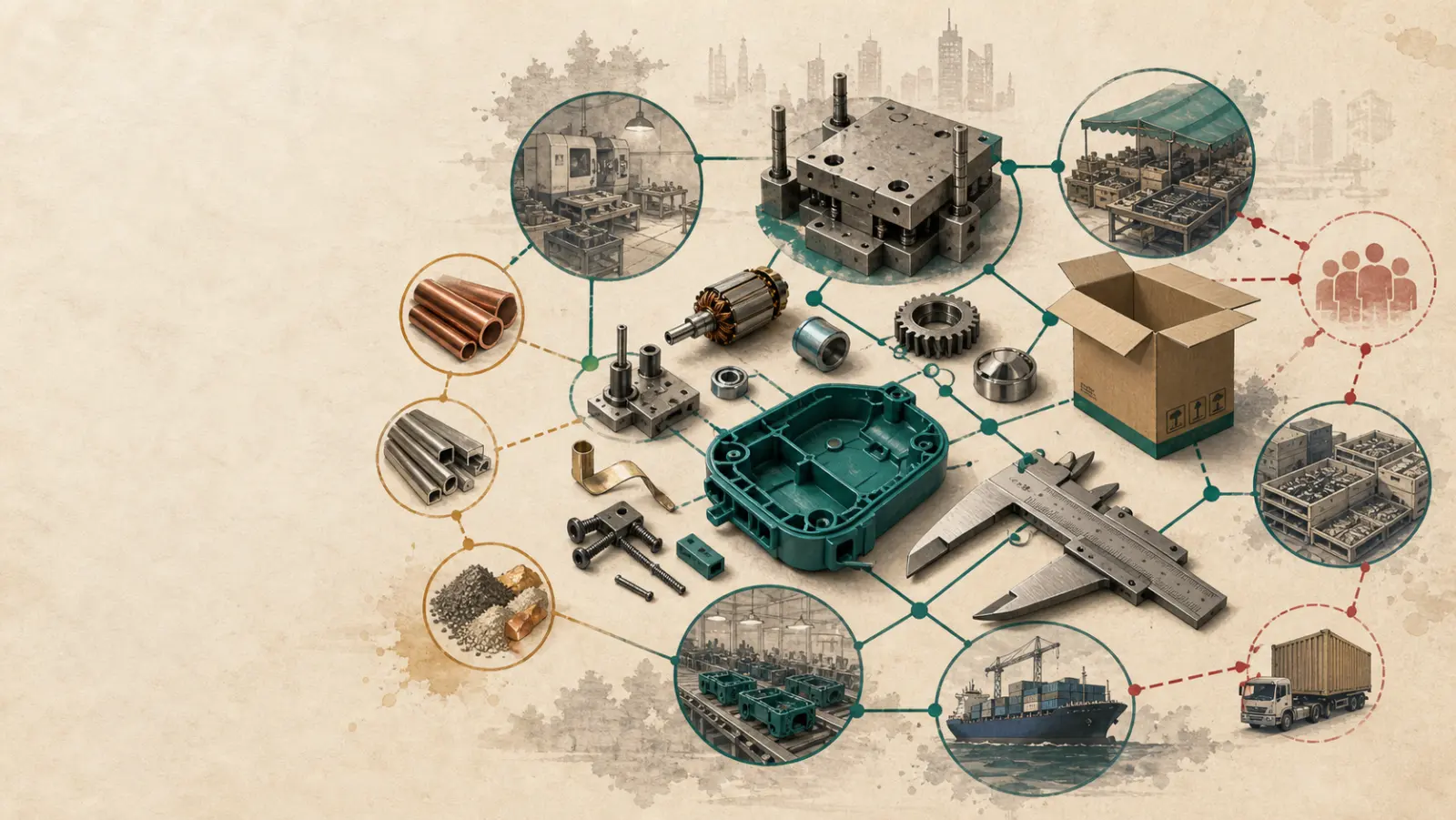
If you are looking for a supplier of an angle grinder, a steel door, a rechargeable work light, or a stainless-steel flask, you can spend weeks searching company profiles—or begin with the system around the product. In Yongkang, a hardware buyer is not only looking at factories. The local system described in a 2025 public issuer disclosure connects eight hardware sectors with China Technology Hardware City, a professional market the issuer says attracts materials, equipment, technology, and talent.
That is the useful meaning of a Chinese industrial cluster: a concentrated product-family system that can make it easier to find alternatives, compare inputs, get early design-for-manufacturing feedback, and understand how goods move to market. It is not a promise that the first seller you meet is a good supplier.
China's own SME-cluster policy defines these clusters at county level through a focused industry, concentrated resources, collaboration networks, and service and governance infrastructure; it also calls for specialized support, innovation, digitization, and external cooperation. The MIIT framework is useful because it describes a system, not simply a row of factories. It is equally useful for what it does not do: it does not certify an individual factory, product, or order.
For a buyer, that distinction changes the sequence of work. Use a cluster to discover and challenge an RFQ. Then restart diligence with the exact legal entity, factory, model, process, certification, origin, warranty, service path, and contract you may rely on.
The short answer: a cluster is a map, not a verdict
The phrase “China manufacturing hub” often invites the wrong mental picture. It can sound as though one city has a magical advantage, or as though all a buyer needs is the correct place name. Neither is useful.
A cluster is better understood as a local operating system around a product family. It can bring together some combination of component and material sellers, specialist processes, tooling and mould shops, assembly capacity, workers who know a recurring production problem, professional markets, freight and export services, fairs, e-commerce channels, testing or design support, and local public services. The exact combination differs sharply between electronics, furniture, toys, lighting, tools, and power equipment.
That proximity can change the first stages of sourcing. A buyer may be able to identify several plausible manufacturers instead of one catalogue seller. A supplier may be able to name a compatible component, finish, fixture, or subcontract process more quickly because the ecosystem already has language for the product. A quotation can expose assumptions earlier when more than one local specialist can respond to the same problem. A physical market or trade event can make product variation and competing offers visible in a way that a single company website cannot.
None of those advantages gives the buyer the right to make a quality claim. Density can also mean similar-looking offers, heavy use of traders, subcontracting that is not fully explained, thin differentiation, or a fast answer that masks an undefined assumption. The right question is not, “Is this place good?” It is, “Which part of this product's supply and feedback loop is actually local, and what evidence do I need before I pay this seller?”
That is why this article sits beside the broader China manufacturing guide. The national system matters, but the buyer normally makes a product-family decision first.
Why cheap labor is the wrong explanation
Price matters in manufacturing, but “cheap labor” is too blunt to explain why particular products repeatedly concentrate in particular places. It also gives a buyer no next action. It cannot tell you whether a proposed supplier has the right process, whether a component is actually available locally, or whether the seller controls the production route it is quoting.
The more useful explanation is coordination.
Imagine a product with a metal housing, plastic moulded parts, a purchased motor, a surface finish, printed packaging, a test fixture, and a spare-parts promise. A dispersed supply chain can make each handoff slow and opaque. Someone needs to find each input, translate a change, arrange a sample, settle a tolerance question, and reconcile the result with a price and lead-time promise. A cluster does not remove that work. It can reduce the distance between the people and businesses doing it.
There are seven links worth looking for.
- Product-family suppliers. A cluster is more useful when firms repeatedly make adjacent versions of the thing you need, rather than merely share a post-code.
- Inputs and specialist processes. This can include materials, components, moulds, tooling, finishing, printing, testing, packaging, or a particular repair skill. The buyer still needs to ask who performs each operation.
- People and tacit process knowledge. Repetition creates familiar questions: which defect shows up after assembly, which fixture drifts, which material substitution changes a finish, which packing choice breaks in transit. That does not make an individual process controlled, but it can make the relevant questions easier to ask.
- Commercial feedback. Wholesale markets, fairs, distributor networks, and online channels tell firms which variants move, which features are copied, and which price points are visible. Feedback can improve a product; it can also intensify sameness.
- Logistics and export handling. A buyer needs to know the actual Incoterm, exporter, customs and document path. Still, a local ecosystem with forwarders, consolidators, warehouses, and repeat export work can make those services easier to locate and compare.
- Shared services. Design, IP, testing, training, financing, and e-commerce services are not automatically present. When they are, they can become a practical part of the sourcing environment rather than a distant outside provider.
- Policy and public infrastructure. Industrial parks, market facilities, training, environmental controls, public platforms, and local support can influence how a place develops. They are context, not proof of a firm's performance.
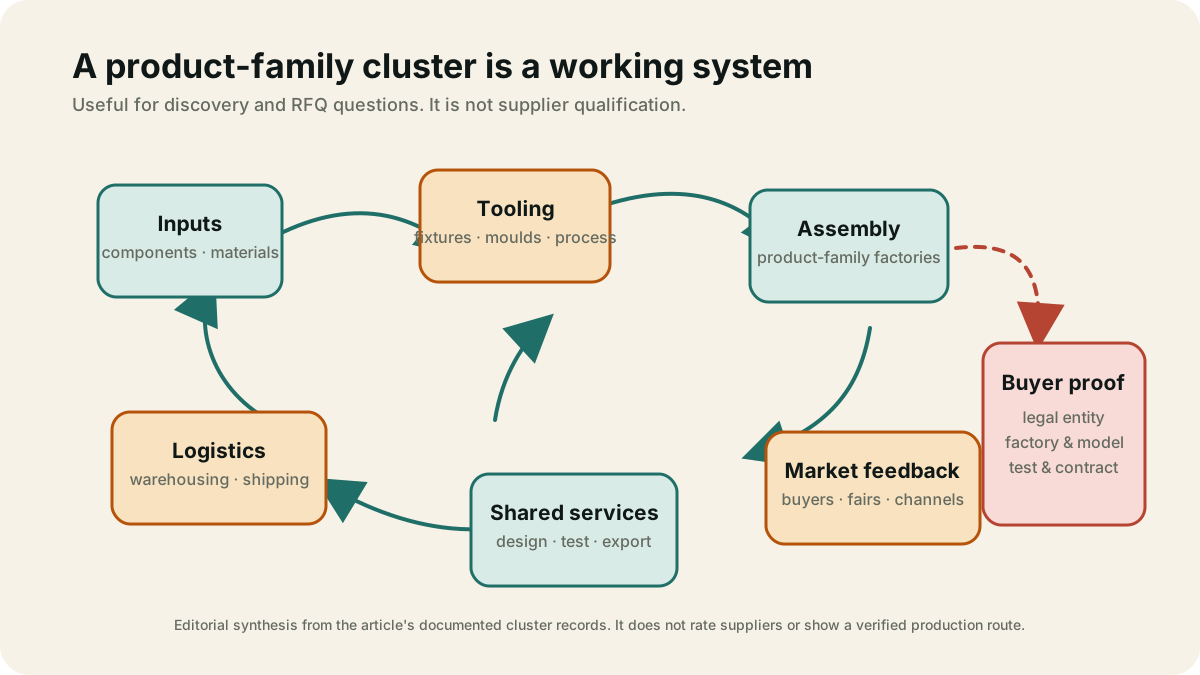 A cluster can connect several local operating layers. The final buyer-proof gate remains separate and order-specific.
The cluster advantage is therefore conditional. It appears when the product you need overlaps a genuine local production-and-service system, and when the buyer uses that system to create better questions. It disappears when a location is chosen only because it is famous, when the product does not fit the local specialty, or when a seller is allowed to borrow a place name instead of documenting its own role.
Yongkang: the hardware case
Yongkang, a county-level city in Zhejiang, is the clearest case for seeing the system rather than the slogan. The place is often presented to foreign buyers as a long list of tools and hardware suppliers. The better starting point is not a list. It is the relationship between product families and the market infrastructure around them.
The 2025 issuer disclosure cited above lists eight Yongkang hardware sectors: power tools, measuring scales, non-ferrous metals, small appliances and cookware, stainless-steel products, automotive and motorcycle parts, security doors, and scooters. It says hardware industrial output exceeded 90% of the city's industrial output. Because that statement comes from a state-controlled local issuer, it should be read as attributed regional context—not as an independent ranking or a shortcut to judging any factory.
The more revealing passage is about China Technology Hardware City. The report describes the market as a selling and display platform for local and nearby enterprises, and says that its expanded functions attract related technology, raw materials, machinery, equipment, and talent. In plain English: a buyer looking at a hardware product may be able to see more of the production stack because the market, its suppliers, and its commercial services developed together.
This is the same story examined in more detail in our Yongkang hardware cluster dossier. The county is not a single “tool factory.” It is a series of overlapping product systems. A buyer sourcing a security door, a vacuum flask, a garden tool, cookware, or a scooter should not assume that the same company, process, test regime, or export path applies to all of them simply because they share a location.
Yongkang's power-tool record makes the point concrete. In a 2022 Ministry of Finance local-policy report, the city was said to have more than 1,700 electric-tool manufacturers and supporting companies, more than 50 product series, and exports to more than 100 countries and regions. The same report discusses standards participation and digital-transformation pilots. Those are historical, promotional local figures, so they cannot establish current market share or the readiness of a specific supplier. They do establish why a narrow question—“What is the local electric-tool stack?”—is more useful than the broad question—“Can China make tools?”
What a buyer can do differently in Yongkang
Suppose you are sourcing a corded or battery-powered tool. The cluster signal should not prompt, “Choose a Yongkang factory.” It should prompt a tighter investigation:
- Which company is the seller, and which company owns the critical assembly and test steps?
- Which motor, battery, electronics, gearing, housing, coating, and packaging operations are internal, nearby, or subcontracted?
- Does the quote name the product revision, voltage configuration, accessory pack, carton, testing assumption, and destination-market condition?
- Can competing local candidates explain the same technical issue in a comparable way, or are they actually quoting different products?
- What does the selected company show for the exact model's quality records, change control, technical file, service parts, warranty counterparty, and export route?
The first four questions use the cluster as a discovery and comparison tool. The last question is where the cluster stops helping. It is the point at which the buyer needs a supplier-specific evidence file.
A product-family map, not a leaderboard
China has many industrial concentrations, and the same broad product can intersect more than one of them. The list below is deliberately directional. It is a set of research starting points, not an exhaustive catalogue, a market-share table, or an endorsement of any company.
| Place | Product-family direction | What the public record establishes | A buyer's first useful question |
|---|---|---|---|
| Shenzhen / Pearl River Delta | electronics, hardware, related component markets | A mega-region where electronics discovery, components, engineering services, assembly, and export work often intersect | Which part of this product's electronics, enclosure, firmware, test, and final-assembly route is actually controlled by the proposed seller? |
| Yongkang, Zhejiang | hardware, power tools, doors, metal goods, cookware, scooters | Eight hardware sectors and a professional hardware market are described in the local issuer record | Is the claimed product family truly made by this supplier, or is “Yongkang” only a sales address? |
| Cixi, Zhejiang | small appliances and components | People's Daily reporting described more than 2,000 small-appliance assemblers and more than 10,000 component firms, plus a local innovation platform | Which components are local, which are bought in, and which design, testing, or service promises belong to the seller rather than the cluster? |
| Guzhen, Guangdong | lighting and lighting-related trade | A 2026 Guzhen town overview describes lighting as the lead industry in a cluster centered on the town and its surrounding areas | Which light source, driver, housing, optics, controls, and compliance responsibility are in scope for this exact product? |
| Chenghai, Guangdong | toys, creative toys, product development and trade | A Shantou industry notice describes a 2024 provincial cluster recognition and links from materials and design to IP, manufacturing, sales, and trade | Who owns the design and tooling, how are age grading and safety obligations handled, and what model-specific tests apply? |
| Anji, Zhejiang | chairs and seating | A 2025 collective-mark record reports 311 above-scale chair firms and RMB 33.14 billion in 2024 above-scale revenue | Which factory makes the frame, mechanism, foam, upholstery, and final inspection for the proposed chair? |
| Shunde, Guangdong | home appliances and related supply chains | A 2023 local report says industry associations again awarded Shunde the “China Home Appliance Capital” designation | Which appliance platform, critical component, repair-spares route, and after-sales entity will support this model? |
| Ningbo, Zhejiang | photovoltaic manufacturing and inverter-related equipment | A published Ningbo policy identified photovoltaic manufacturing and inverter, monitoring, and smart-grid product technology as local development areas | Which exact inverter or power-electronics product is being quoted, under which current standard and test evidence, by which entity? |
This is why maps beat superlatives. “The best cluster” implies a stable ranking that the available records do not support. “The cluster that matches your product's working system” gives you something testable: can the candidate identify the process, inputs, support services, and commercial boundaries that matter for your order?
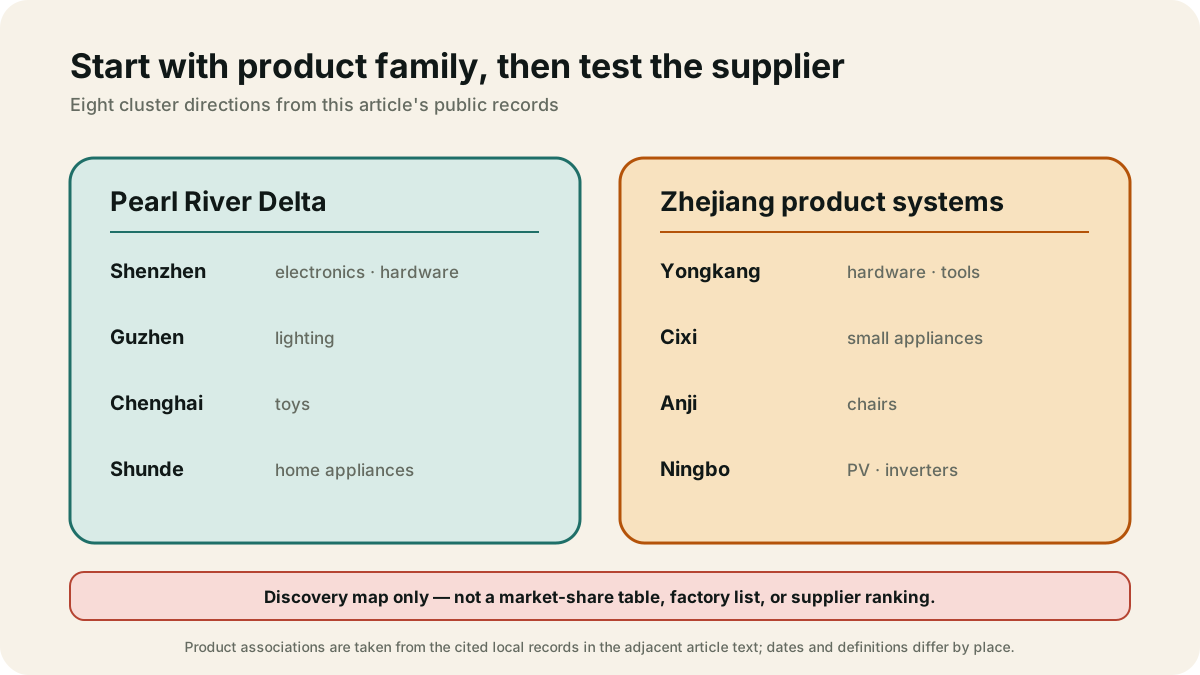 A directional product-family map built from the local records cited in the table above; it is not a supplier ranking.
How clusters compress the early sourcing loop
When people say a Chinese cluster is “fast,” they often blur several different advantages into one claim. Separate them and the idea becomes more practical.
Faster discovery is not faster qualification
In a dense product-family location, it may be easier to create an initial longlist. You can often find specialist factories, traders, component houses, market stalls, fair participants, and service providers that use the same product vocabulary. That can help a buyer see alternative designs, materials, and commercial models earlier.
But a large longlist is not a supplier decision. It can contain manufacturers, trading companies, mixed industry-and-trade firms, component suppliers, and companies that outsource the step you care about. Use the discovery advantage to ask better role questions, not to make an earlier deposit.
Our factory-finding guide lays out a useful discipline: map the named counterparty before treating a lead as a factory, make the RFQ comparable, test the claimed process, and only then convert an approved sample into a controlled production target.
Faster feedback is not an approved design change
Cluster environments can make it easier to hear that a material is hard to source, a tolerance is unrealistic, a tooling design needs a draft angle, or a packaging assumption will add cost. That feedback has real value. It can prevent the buyer from asking three companies to solve three different, unstated manufacturing problems.
Yet feedback is only a proposed change until it is put into the product file. Record the revision, material, dimension, test condition, price effect, lead-time effect, and approval decision. Otherwise a “small optimization” becomes an invisible change between sample and production.
Faster quoting is not a comparable quote
A cluster can produce fast answers because local firms recognize the product category. Fast answers can also conceal different assumptions. One quote may include a motor, another may not. One may assume a standard carton, another a retail-ready pack. One may rely on an existing mould, another on new tooling. One may include a destination-market version, another only a domestic configuration.
The buyer's response is simple but demanding: issue one RFQ pack and require each candidate to state its assumptions, exclusions, role map, product revision, commercial term, tooling and sample charges, lead time, key bought-in parts, quality or test plan, and service or warranty boundary. A cluster gives you more candidates to compare. It does not make unlike quotations equal.
Faster supplier switching is not a painless switch
Alternative manufacturers can be valuable when a project has a constrained component, a capacity question, a price dispute, or a need for backup. But switching a factory may require a different tooling condition, process route, BOM, firmware version, test fixture, certification scope, packaging line, exporter, or warranty holder. Treat alternative-source discovery as risk reduction only after the product and evidence boundaries are made explicit.
The same logic applies to e-commerce. Product clusters often connect to domestic platforms and cross-border selling because the local system produces a broad set of variants quickly. A platform listing can be a source of demand signals and candidate names. It is not a document trail for the business that will manufacture, invoice, export, or support your order. For the channel side of the system, see how Temu's marketplace model uses supply-chain density—then return to the specific seller and product file.
Turn the cluster map into an RFQ advantage
The most practical use of a cluster is not to add a place name to a search bar. It is to write a better request for quotation.
An ordinary RFQ asks for a price and lead time. A cluster-aware RFQ asks the supplier to expose the production assumptions that a dense local system may otherwise hide. It asks what is made in-house, what is purchased, what is subcontracted, and which part of the proposed route is a standard local capability versus a one-off promise.
For a hardware product, for example, a useful RFQ can ask the candidate to identify the source and specification boundary for the motor, battery, charger, switching electronics, moulded housing, metal gear or spindle, coating, labels, carton, test fixture, and final inspection. It should ask whether the critical item is an existing approved component, a local supplier's catalogue part, a customer-nominated part, or a proposed substitute. It should ask what changes at a higher or lower order quantity. The point is not to force disclosure of trade secrets. It is to make the commercial comparison legible.
For lighting, the equivalent file may focus on the LED, driver, optics, thermal path, control protocol, ingress-protection assumption, mounting hardware, wiring, labels, packaging, and model-specific conformity material. For a chair, it may focus on frame, mechanism, gas lift, casters, foam, fabric or mesh, loading assumptions, assembly instructions, carton, spare parts, and returns path. For toys, it may focus on design ownership, age grade, material and battery choices, tooling, software or electronics where relevant, labels, packaging, and product-specific safety evidence.
The categories differ, but the commercial question is the same: which named business is accountable for which defined part of this product? A supplier that explains a bounded role is easier to assess than one that answers every question with “we can do it.”
Ask for the local route, not a generic capability claim
When a candidate says “all processes are nearby,” turn that into a map. Ask which process is on its own site, which is carried out by an affiliate, which is a routine named subcontract category, and which one depends on a part whose availability or price can move. Ask whether the proposed sample and the proposed production lot will use the same route.
This helps in two ways. First, it gives the buyer a more realistic picture of change risk. A product can be well made through a multi-company route, but the route needs defined responsibility and change control. Second, it makes supplier comparison less theatrical. You are no longer comparing how impressive two factory videos look. You are comparing whether two candidates can describe the same product's critical path in a form that the contract and inspection plan can later control.
Do not confuse a detailed answer with a verified answer. It is a stronger starting point for verification, not its replacement. Confirm documents, samples, factory or process evidence, and contract responsibility in proportion to the decision you are about to make.
Use local alternatives to test assumptions, not only price
The buyer who has three local candidates gains more than negotiating leverage. Different answers can reveal what is not yet defined.
If two candidates identify the same bought-in component and one silently substitutes another, the issue is not simply price. It is whether the product specification permits an equivalent. If one candidate says a surface finish requires an outside process and another says it is in-house, the next question is not which answer is more attractive. It is what evidence connects that process to the required finish, defect standard, throughput, and change approval. If a candidate claims a short lead time, ask which inventory, tooling, capacity, and approval assumptions make that possible.
This is a more productive use of cluster competition than a race to the lowest quotation. The density of alternatives gives the buyer a chance to locate uncertainty before it becomes a dispute. It cannot remove the need to manage that uncertainty through a defined specification and commercial file.
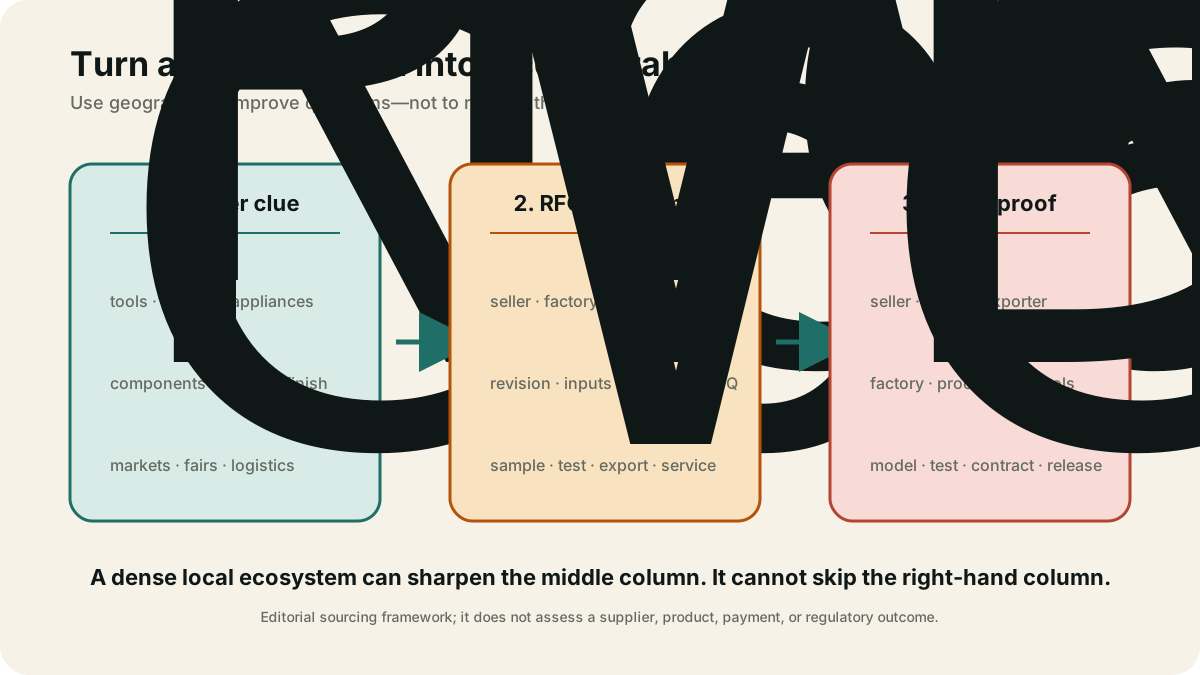 A cluster-aware RFQ turns local product knowledge into questions, then requires entity-, factory-, model-, and order-level proof.
Cluster signal versus buyer proof
This is the line worth preserving. A cluster can tell you where to look and what questions are likely to matter. It cannot tell you whether to award an order.
Use the following split when reviewing a supplier claim.
| A cluster signal may help you investigate | It does not prove |
|---|---|
| likely product-family familiarity | the seller's legal identity or payment beneficiary |
| alternative components, processes, or factories nearby | that the named factory will make the order |
| professional-market, fair, or export-service context | current capacity, lead time, or allocation for your order |
| local design, testing, training, or logistics services | model-specific quality control or test performance |
| a recognizable regional industry label | applicable certification, importer obligation, customs origin, or regulatory outcome |
| a plausible spare-parts or service ecosystem | the warranty counterparty, response commitment, or remedy |
The buyer proof file
For a promising lead, build a file that matches the next irreversible commitment.
Before an RFQ or sample payment
- Define the product: drawings, photos, intended use, critical dimensions, materials, finish, target market, quantity, packaging, and unknowns.
- Identify the legal seller, Chinese name where relevant, registered identifier, address, invoice entity, payment beneficiary, and each entity's role.
- Ask which factory and which process route are being proposed. A trading company may be usable; an undisclosed production boundary is not.
Before tooling or a production deposit
- Freeze the approved revision and list any acceptable substitutions.
- Map critical operations, bought-in components, subcontracts, inspections, and process records to the proposed product.
- Compare like-for-like quotations: commercial term, MOQ, tooling, sample, packing, test, lead time, exclusions, and changes.
- Confirm who owns tooling, drawings, test fixtures, firmware where relevant, and the right to approve changes.
Before final payment or shipment release
- Tie the production lot to the approved sample, revision, inspection plan, defect definitions, packing, labels, serial or lot traceability, and agreed disposition of failures.
- Reconcile the contracted seller, invoice, payee, exporter, shipping documents, and warranty or service contact.
- Check that the evidence actually applies to the model, factory, market, and production lot at issue.
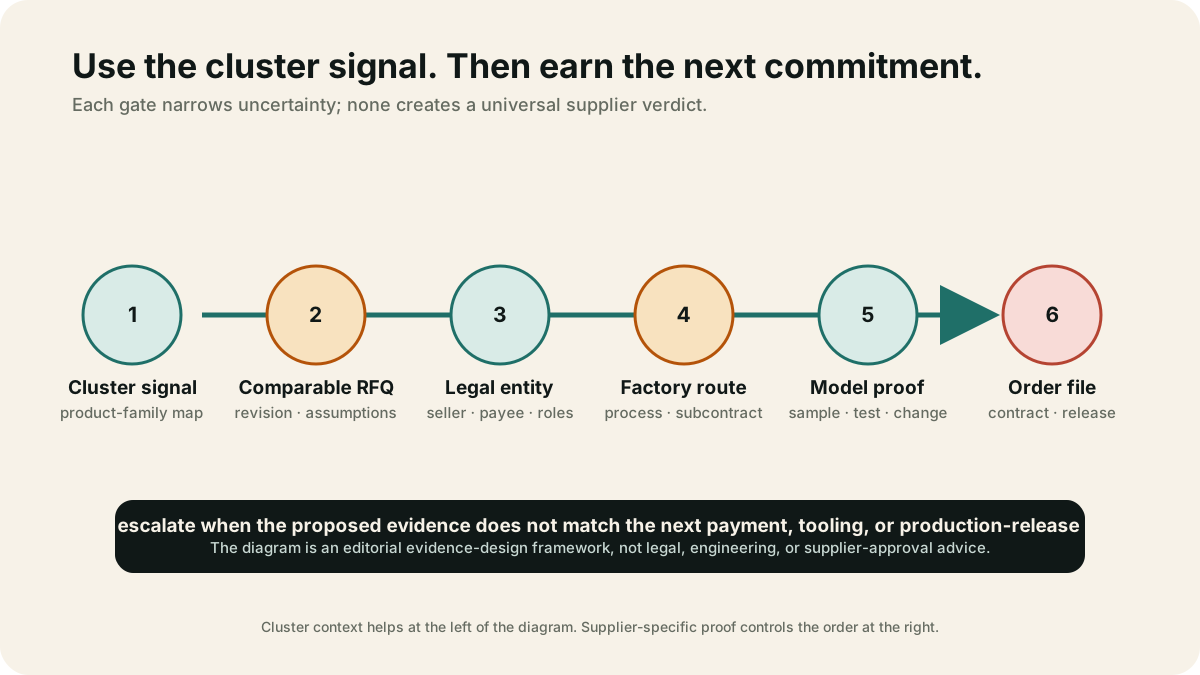 An editorial sequence for matching evidence to the next commitment; adapt it to the product, market, and contract at hand.
For quality-control detail, use the factory quality-control guide. It is the complement to this article. A cluster can make a quality conversation easier to start; it cannot substitute for controls tied to your product, factory, lot, and release decision.
A practical search-to-proof sequence
Here is a compact way to use this article in live sourcing work.
- Start with the product family. Describe the item by its critical processes and components, not only its consumer category. “Rechargeable handheld tool with a battery pack and plastic housing” is more useful than “hardware product.”
- Choose one or two cluster directions. Use the map to generate a research hypothesis, not a conclusion. A product may belong in multiple systems.
- Build a diverse initial longlist. Include likely manufacturers, traders, mixed firms, component specialists, and service providers, but label each role rather than pretending every lead is a factory.
- Send one comparable RFQ. Make the product revision, specification, target market, quantity, packaging, commercial term, and open questions visible. Ask each candidate to identify assumptions and external processes.
- Use local density to challenge weak answers. If one candidate says a component, process, or test is impossible, do not assume that answer is universal. Ask what is unavailable, why, and whether alternatives exist. Compare the response with other candidates without forcing a race to the lowest price.
- Move to factory- and order-level proof. Before meaningful money moves, verify the legal and production boundary, control the sample-to-lot transition, and put quality, change, documentation, warranty, and remedy expectations into the commercial file.
- Refresh the map when the decision is live. Local counts, export claims, policy programs, service platforms, and business conditions change. Recheck current facts and the live status of every internal resource before using an old location signal for a new award.
The framework is intentionally unspectacular. It does not tell you that one cluster is always better than another, nor does it promise that a more famous location is safer. It gives you a way to convert a geographic clue into disciplined work.
Method and limitations
This is a desk-researched field guide, not a factory audit, supplier approval, legal opinion, product test, customs-origin review, or inspection service. It uses national policy material, a Yongkang state-owned issuer disclosure, local government and service-platform records, and a reported Cixi case to explain manufacturing-system context.
Those sources have different purposes. The Yongkang issuer's account of hardware-sector concentration and market infrastructure is attributed local context. The Ministry of Finance electric-tool figures are from a 2022 local-policy report. The place map combines records with different dates and definitions, so it should guide discovery rather than serve as a comparable ranking. No source reviewed here proves an individual supplier's ownership, capability, compliance, quality, capacity, commercial reliability, or suitability for your order.
Frequently asked questions
What are China's main industrial clusters?
There is no single definitive list that makes every location comparable. For buyer discovery, it is more useful to think in product families: Shenzhen for electronics and hardware systems, Yongkang for hardware, Cixi for small appliances, Guzhen for lighting, Chenghai for toys, Anji for chairs, Shunde for appliances, and Ningbo for parts of the PV and inverter ecosystem. Treat each as a question to research, not a supplier recommendation.
Why are Chinese factories often located near each other?
Firms cluster when a recurring product family creates demand for suppliers, components, tooling, workers, markets, logistics, and support services in the same area. The practical benefit is coordination during discovery and development. It does not mean every firm is equally capable or that distance alone determines price or lead time.
Does a factory in a famous manufacturing hub have better quality?
No. A famous hub can make it easier to find alternatives and ask product-specific questions, but it does not prove the legal entity, production route, process control, test result, certification, origin, warranty, or service commitment of a particular seller. Quality evidence must be tied to the exact factory, model, revision, and lot.
How should I use a cluster when finding a Chinese manufacturer?
Use it to create a product-aware longlist and a sharper RFQ. Then map the named counterparty, compare comparable quotations, test the claimed production boundary, and control the sample-to-lot transition before releasing larger commitments. The place name helps you start; the evidence file decides what can proceed.
Related entries
- How China Manufactures: Inside the World's Factory
- Shenzhen Manufacturing Guide
- Yongkang Hardware Cluster
- How to Find a Factory in China
- Quality Control at Chinese Factories
By China Made & Tech Team. Independent English field guide to China's niche hardware brands, hidden champions, founders, factory towns, and supplier clusters.