
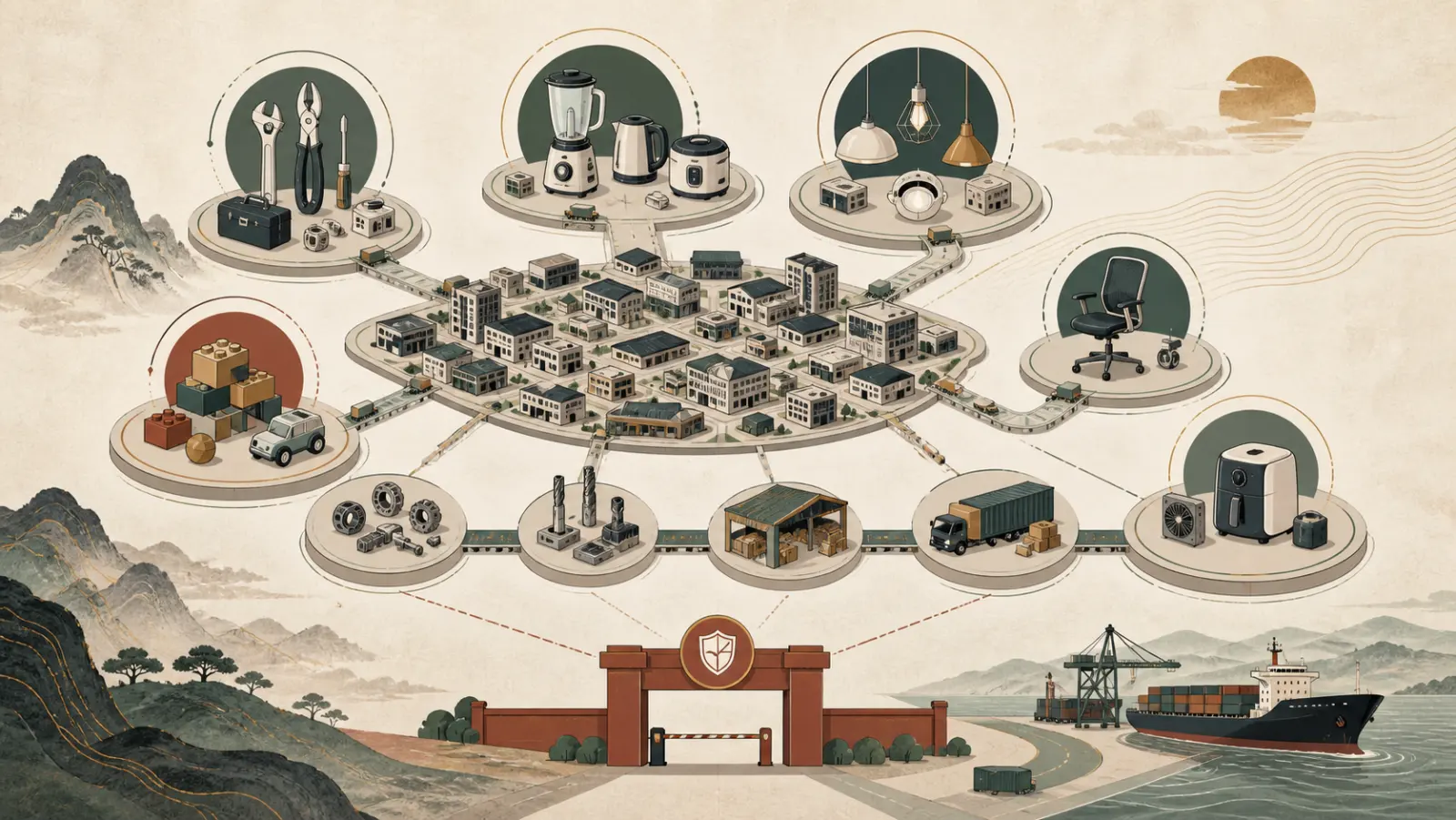
By China Made & Tech Team · August 22, 2026
A Chinese factory town is useful when it helps you turn a vague product search into a much better set of questions. It may put component makers, specialist processes, trading channels, a physical market, product designers, export services, and several plausible manufacturing routes within the same local system. That can make discovery faster and quotations more revealing.
It does not make the first seller you find a qualified supplier.
That distinction is the whole point of researching county and town clusters. Use a place to understand a product family and to test assumptions. Then return to the exact legal entity, factory, model, process, certificate, service promise, and contract you may rely on. A town is a lead. It is not a supplier verdict.
China's SME cluster framework is helpful here because it defines the relevant unit at county level: a focused industry with concentrated resources, collaboration networks, services, and governance, subject to a formal review process. The MIIT measures describe a regional system. They do not certify an individual plant, product, or transaction.
For an overview of the national manufacturing map, start with China's industrial clusters. This article goes a level closer to the ground: the county and town systems that repeatedly show up behind tools, small appliances, lighting, toys, chairs, and home appliances.
The short answer: use the town to improve the search, not to finish it
Buyers often ask, “Which city should I source this from?” That can be a useful first question, but it becomes dangerous when it is treated as an answer.
A better sequence is:
- Define the product through its critical parts and processes.
- Identify one or two likely product-family towns.
- Use the local system to find alternatives and expose assumptions.
- Qualify the exact counterparty and production route before you make a commitment.
The first three steps are about discovery. The fourth is about proof.
This distinction matters because factory towns create two opposite effects at the same time. They can create useful local depth: several firms may know the same product family, nearby specialists may recognize a component problem, and markets or trade events may make alternative offers visible. But the same density can also create near-identical catalogue products, unclear factory-versus-trader roles, invisible subcontracting, and quick quotations that rely on different assumptions.
If the buyer treats local reputation as a shortcut, the cluster becomes a source of false confidence. If the buyer treats it as a hypothesis generator, it becomes valuable.
What a factory town actually concentrates
The phrase “manufacturing hub” is too broad. A town becomes useful only when a relevant set of functions has accumulated around a product family. The exact mix varies: a hardware town does not behave like a chair town, and a lighting town does not behave like an electronics city.
Look for six working layers.
1. Adjacent product knowledge
The first signal is not the number of factories. It is whether local firms repeatedly make adjacent versions of the item you need.
A buyer of cordless garden tools, for example, may need a motor, housing, battery interface, gearing, charger, packaging, and a process for final assembly and test. A buyer of chairs may need a frame, mechanism, gas lift, casters, foam, upholstery, carton, spare parts, and a returns path. The more the local system knows those recurring combinations, the more likely your first conversations will be specific rather than generic.
That is not a promise of engineering competence. It is a reason to ask a more focused question: which part of this product family does this candidate actually control?
2. Inputs and specialist processes
Clusters can make particular inputs and processes easier to find: moulds, castings, metalwork, surface treatment, printed packaging, LED drivers, motors, upholstery, testing fixtures, or repair parts. The buyer should never infer that every one of those steps is in-house. Instead, ask which are internal, which are routine local subcontracts, and which depend on a single external source.
The answer is important for more than price. It reveals where a product can change between sample and production. A company may be perfectly capable of managing outside processes, but the route needs defined responsibility, change control, and an inspection plan.
3. Commercial feedback
Wholesale markets, recurring fairs, distributors, local e-commerce, and export-service businesses can give a cluster a feedback loop. Firms see which variants sell, which features buyers ask for, which packaging fails in transit, and which price points have become crowded. This can improve product iteration. It can also accelerate copying and sameness.
The useful buyer question is not whether a market is “good.” It is whether the market exposes product variation and alternative sourcing routes that can help you test your RFQ.
4. Services that sit beside production
Some places accumulate design, testing, training, trade, warehousing, financing, standards, and intellectual-property services alongside production. These services can make a local system more usable, especially for a company moving from a basic catalogue item to a defined export product.
But shared services remain context. A public testing platform does not prove that the seller's exact model was tested. A local export ecosystem does not prove that the invoicing entity is the exporter. An industrial park does not prove that a factory owns the equipment in its video.
5. Labour and tacit process knowledge
Repeated work around one product family creates familiar problems: a finish that scratches during packing, a hinge that needs a different tolerance, an LED thermal path that changes performance, a chair mechanism that creates returns, a toy label that does not fit the target market. A local labour pool can make it easier to find people who recognize those problems.
Again, that is not evidence that the problem has been solved for your order. Treat it as a reason to ask sharper questions about the candidate's process records, test conditions, defect definitions, and change approvals.
6. Public infrastructure and local policy
Industrial parks, market facilities, training programs, service platforms, and local policy can shape how a town develops. The MIIT framework explicitly includes collaboration, specialized support, innovation, digitalization, openness, and governance in its county-level cluster program. Those are useful clues to investigate. They are not performance certificates for every local company. The framework itself is careful about the regional scope.
The practical consequence is simple: a factory town can change the quality of your first search. It cannot change the type of evidence required for the final decision.
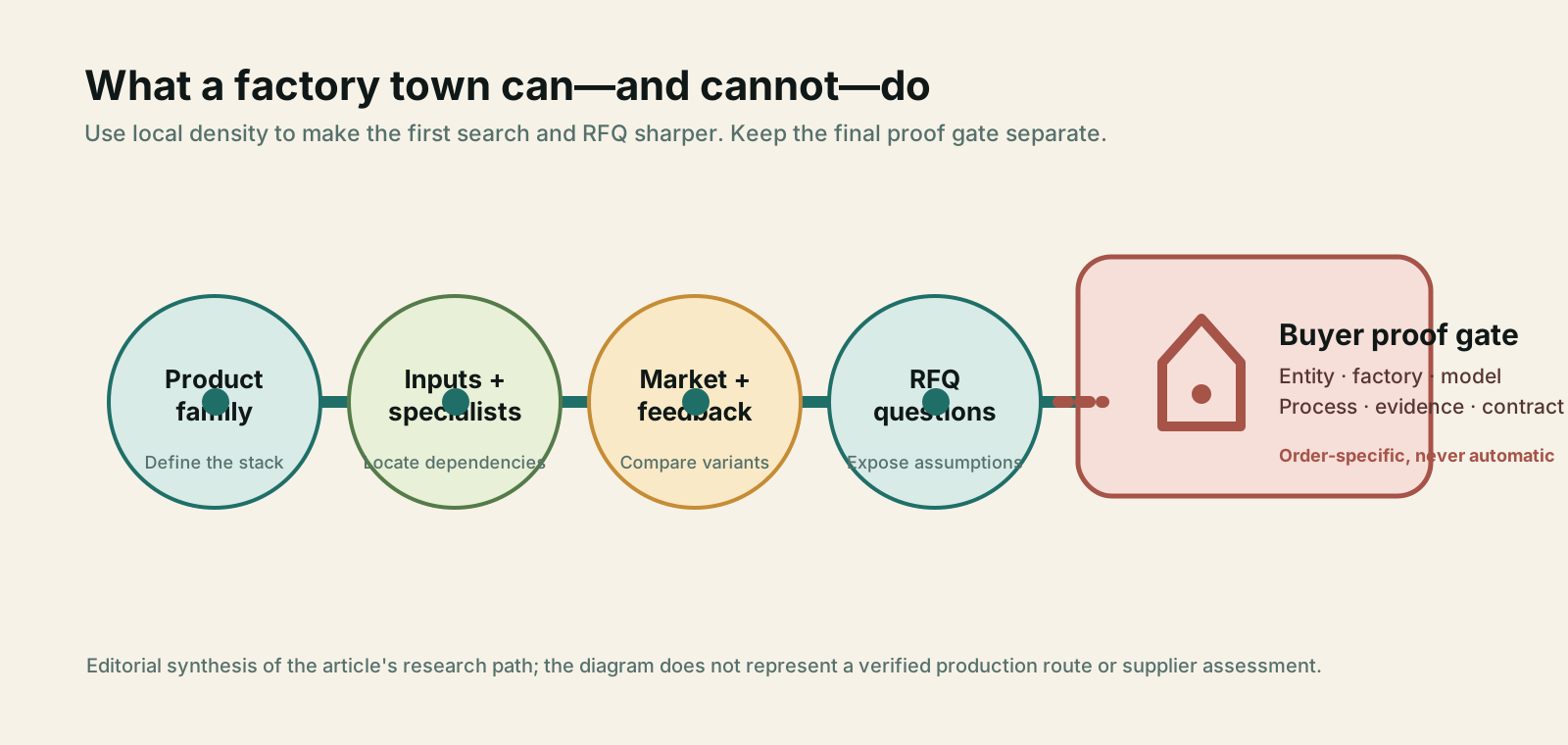 A factory town can make discovery and RFQs more specific. The final proof gate remains tied to the actual company, model, and order.
Yongkang: a hardware town with a market in the loop
Yongkang, a county-level city in Zhejiang, is a useful place to see the difference between a category system and a supplier claim.
The quick version is “Yongkang makes hardware.” The more useful version is that a 2025 Shanghai Stock Exchange issuer disclosure describes eight local hardware sectors and China Technology Hardware City as a sales and display platform that attracts technology, materials, equipment, and talent resources. That is a public issuer's description of a local operating environment. It is not an independent capacity audit of any factory.
The eight sectors in that record include power tools, measuring scales, non-ferrous metals, small appliances and cookware, stainless-steel products, automotive and motorcycle parts, security doors, and scooters. The value for a buyer is not the list itself. It is the possibility that production, market feedback, and specialist inputs are close enough to make an early product investigation more concrete.
Take a battery-powered tool. A supplier's “we make this” claim becomes more informative if you can ask where the motor, battery pack, charger, gearing, moulded housing, metal components, coating, carton, test fixture, and final inspection sit in the proposed route. A town with a dense hardware system may give you alternative answers. Those answers let you find what is undefined in the original RFQ.
The moment the buyer chooses one answer, the geography recedes. The questions become company- and order-specific: who owns the assembly; which part number is approved; what test is applied to the exact model; what changes are permitted; who holds the warranty; and who is accountable when the delivery fails?
Our Yongkang hardware dossier explores the local hardware system in more depth. Read it as a way to form questions about tools, doors, bottles, cookware, or related hardware—not as a list of prequalified factories.
Cixi: components and alternatives in small appliances
Cixi, in Zhejiang, illustrates another mechanism: density can matter because it makes alternatives easier to identify.
A Zhejiang government portal report describes Cixi as a household-appliance base with more than 2,000 appliance makers and nearly 10,000 supporting enterprises. The same article quotes a local company executive saying that most components for a small appliance can be found within a short local radius, apart from chips, with multiple manufacturers for many components. That is a reported local account, not an independent time-and-cost study. It does, however, make a defensible point about how a component ecosystem can change the first sourcing move.
Suppose you are buying a fan, dehumidifier, heater, vacuum accessory, kitchen appliance, or a related electrical product. A component-dense cluster can help you distinguish between a true product platform and a collection of look-alike offers. Ask each candidate to identify the motor, controller, heating or cooling element, plastic mouldings, power parts, wiring, switches, packaging, and any safety-critical bought-in components. Then ask which choices are fixed, which are alternatives, and which change with order quantity or market.
The point is not to pressure a supplier into disclosing confidential terms. It is to make the quotation comparable. One candidate may be pricing an established configuration; another may be making a substitution; a third may be relying on an external process that carries a different lead-time or approval risk.
Cixi's lesson is therefore not “components nearby means low risk.” It is: when alternatives are likely to exist, use them to test assumptions before you negotiate price.
Six factory-town systems worth understanding
The following map is intentionally not a leaderboard. Its examples come from different years, publishers, and definitions. A public local figure for one town cannot be laid beside a different local figure for another and turned into a conclusion about quality, cost, capacity, or global rank.
Use the map as a directional starting point for product-family research.
| Town or county direction | What the record supports | What a buyer should investigate next |
|---|---|---|
| Yongkang, Zhejiang | Hardware sectors and a professional market tied to sales, display, materials, equipment, and talent flows. | Which of those processes and market relationships applies to the proposed hardware product and counterparty? |
| Cixi, Zhejiang | Small-appliance makers and supporting firms, with reported local component density. | Which component choices, product revisions, and test assumptions are in the exact quote? |
| Guzhen, Zhongshan | A lighting production center with a broad product range and international-buyer activity. | Which factory owns the LED, driver, optics, thermal, control, and conformity responsibilities? |
| Chenghai, Shantou | A 2024 public notice describes a toy-creative cluster spanning materials, design, IP, manufacturing, sales, and trade. | Who owns the design, tooling, age grading, labels, electronics, and product-specific safety file? |
| Anji, Zhejiang | A green-furniture cluster associated with chairs, documented export outreach, and aggregate industry scale. | Which company controls the frame, mechanism, gas lift, upholstery, carton, spares, and warranty path? |
| Shunde, Foshan | A home-appliance manufacturing hub with reported export activity and companies responding to international-market requirements. | Which seller, factory, model, market requirements, and service commitments are actually included? |
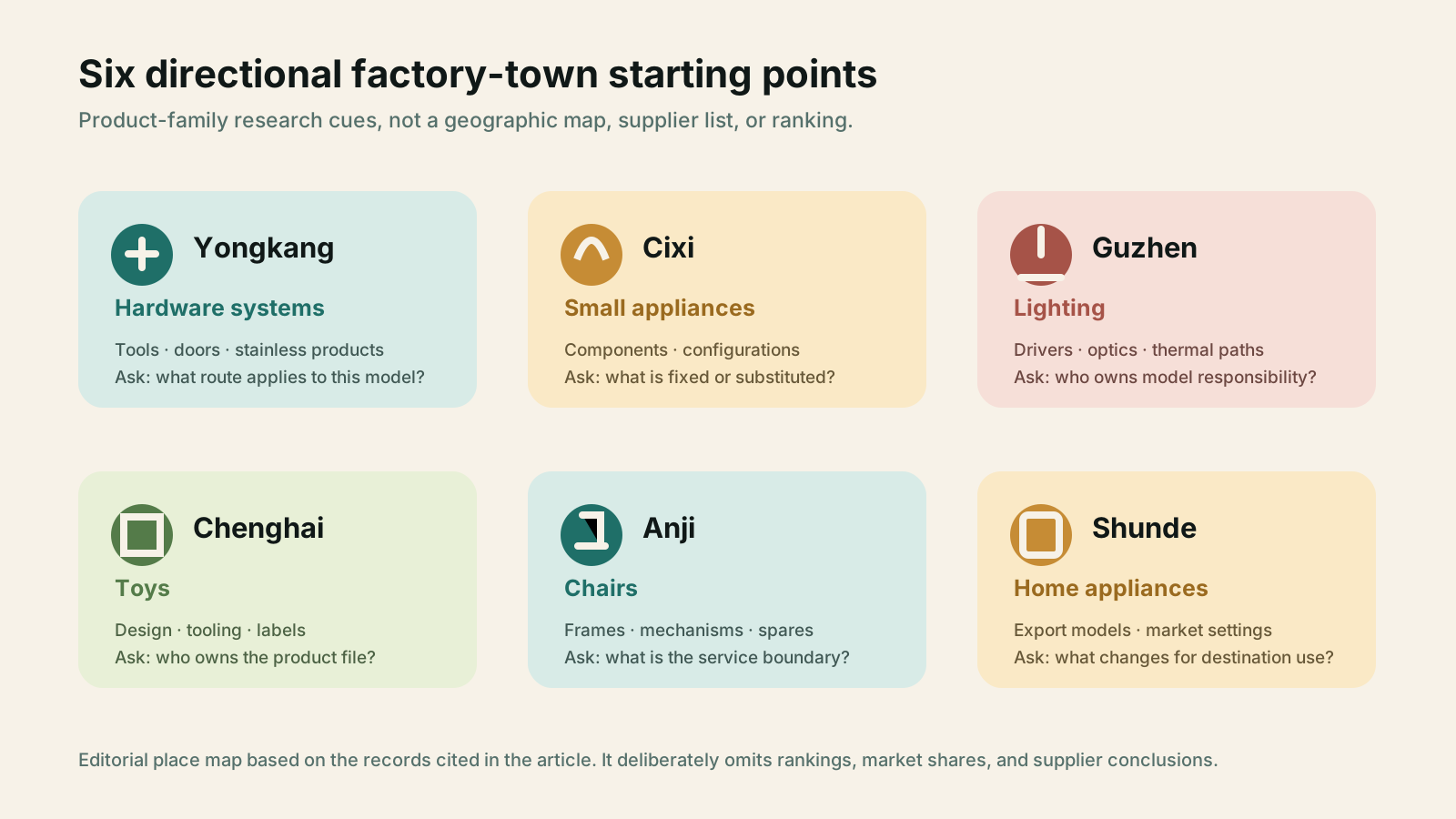 A directional product-family map built from the records cited above. It is not a geographic precision map, supplier list, or ranking.
Guzhen: lighting is a system, not a luminaire claim
Guzhen in Zhongshan is commonly associated with lighting. In April 2026, a Guangdong Foreign Affairs Office portal report described the town as a lighting production center, noted international-buyer activity, and described product ranges from household styles to bespoke engineering work. The report also includes local-authority scale statements; treat those as attributed promotional context, not a supplier assessment.
Lighting is a good reminder that a product category can hide several separate systems. A table lamp, outdoor floodlight, downlight, decorative fixture, and connected-control product may each raise different questions about LEDs, drivers, optics, thermal design, ingress protection, wiring, control protocols, mounting, labels, packaging, and destination-market obligations.
The useful town signal is that these conversations may be easier to start in a lighting-focused environment. The proof task is unchanged: identify the actual factory and product revision, map the critical components, verify the appropriate model-level technical and conformity material, and define who owns field failures, replacements, and service.
Chenghai: toys connect design, trade, and product responsibility
For toys, the production system is rarely only about moulding and assembly. Design ownership, age-grade suitability, materials, electronics or batteries where relevant, labels, packaging, testing, and the importer-facing product file can all matter.
A 2024 Shantou industry-bureau notice identifies Chenghai's toy-creative cluster in Guangdong's SME cluster list and describes a chain from materials and design through IP, manufacturing, sales, and trade. That is useful evidence that the town has a documented product-family system. It is not evidence that a particular toy is safe, that the seller owns its design, or that the proposed product's labels and test documents apply in your market.
For a buyer, Chenghai should therefore generate a more detailed brief, not a faster award. Ask which entity owns the design; whether tooling is existing, shared, or bespoke; which materials and battery configurations are proposed; whether a software or electronic component is involved; which age grade and warnings apply; and whether the documentation is tied to the exact product and destination market.
Anji: a chair cluster exposes the component stack
Anji is a useful chair and furniture direction because its public reporting gives the category enough scale to make the operating system visible. A December 2025 Zhejiang government portal report described Anji's green-furniture industry as having more than 1,700 enterprises and RMB 50 billion in industry value, alongside a Dubai marketing center for Anji-made chairs. Those are aggregate local-report figures, not a list of validated producers or a measure of any one chair's quality.
The buyer advantage is conceptual. A chair is a component system: frame, mechanism, gas lift, base, casters, foam, fabric or mesh, fasteners, instructions, carton, spare parts, and a policy for returns or replacements. In a dense category environment, several firms may recognize those trade-offs. That can make an RFQ more specific.
It cannot tell you whether a given mechanism will last, whether the load assumptions match the end use, whether a textile is the same across lots, or whether the warranty is enforceable. The right evidence still has to connect the chosen company and model to the defined component stack and service responsibility.
Shunde: home appliances and the export-facing boundary
Shunde in Foshan is often described as a home-appliance manufacturing hub. A 2025 Xinhua report carried by the Belt and Road Portal said that an average of 600 containers of home appliances left Shunde each day in the first half of that year, in the context of overseas demand for cooling products. That is a time-bounded reported export signal. It should not be read as a quality measure or a promise about an individual company's delivery capability.
The interesting buyer question is what changes when a domestically successful product becomes an export product. A company may need a different voltage configuration, documentation route, energy or performance specification, label, packaging, importer arrangement, warranty promise, or spare-parts plan. “We export” is a starting claim. Ask which of those decisions is built into the exact model and target market you are considering.
This is especially important in small appliances, where a visually similar product may be a different electrical and commercial proposition once it crosses a border.
Four ways a factory-town signal can mislead you
The cluster is most useful when it makes a buyer ask a harder question. It is least useful when it becomes a substitute for one. Four failure modes appear repeatedly in practical sourcing work.
A famous town can be irrelevant to the actual product
Retail categories are too broad to select a location. “Lighting,” “furniture,” “hardware,” or “small appliances” may describe hundreds of different product and process combinations. A decorative fixture and an outdoor rated luminaire may sit in different technical systems. A dining chair and an ergonomic office chair can have very different mechanisms, test assumptions, packaging, and service exposures. A low-voltage consumer product and a commercial electrical product can share a visual language without sharing the same compliance or production route.
Start with the product stack, then test the town fit. If the proposed product's critical parts and processes are not plausibly part of the local system, the place name adds noise. Search for the more relevant process or product family instead.
The seller may use the town as a borrowed identity
A company can be located near a cluster without owning the relevant factory. It can be a trader, a product developer using outside manufacturing, a component supplier, a retailer, a branch office, or a firm whose address is historical rather than operational. None of those roles is automatically disqualifying. They become risky only when the role is unclear or conflicts with the offer.
Ask a simple role-map question: who sells, who invoices, who receives payment, who owns or controls the critical production steps, who exports, and who carries the warranty? The answer can involve more than one company. The buyer needs it to be explicit before price, sample, and contract documents start treating an assumed factory as a fact.
Local alternatives can conceal unlike offers
Three fast quotations are not three comparable quotations. The candidates may be offering different materials, component grades, test conditions, target-market configurations, packaging, tooling assumptions, or commercial terms. In a dense category, the danger is often not a lack of choices. It is an excess of plausible-looking offers whose differences are still invisible.
Normalize the brief before you normalize the price. Use the same revision, target market, quantity, pack-out, commercial term, and critical component assumptions. Then require every exception to be named. If the offers remain unlike, that is a useful result: the buyer has discovered that the product definition is not ready for a price comparison.
A local service ecosystem can be mistaken for supplier evidence
A town may have laboratories, trade agencies, exhibition infrastructure, cross-border logistics, a professional market, or local support programs. These can be valuable ways to find information and providers. They do not establish which services the selected supplier actually uses or whether the evidence applies to the exact model and market.
Treat the local ecosystem as a source of candidate questions and, where appropriate, independent service providers. Then bind the relevant answer to the company and order: named service, scope, model, date, destination market, document holder, and contractual responsibility. That sequence preserves the benefit of local density without letting it become a substitute for proof.
What clusters can help you do—and what they cannot prove
The table below is the guardrail for the rest of the article.
| A town signal can help you investigate | It does not prove |
|---|---|
| likely product-family familiarity | the seller's legal identity, ownership, or payment beneficiary |
| nearby alternatives for inputs or specialist processes | that the named factory will make the order |
| a market, fair, or export-service context | current capacity, allocation, lead time, or delivery performance |
| categories of local testing, design, or service support | model-specific quality control, test performance, or certificate validity |
| a regional industry label or cluster recognition | customs origin, regulatory outcome, or importer responsibility |
| a plausible spare-parts ecosystem | a binding warranty, repair obligation, or remedy |
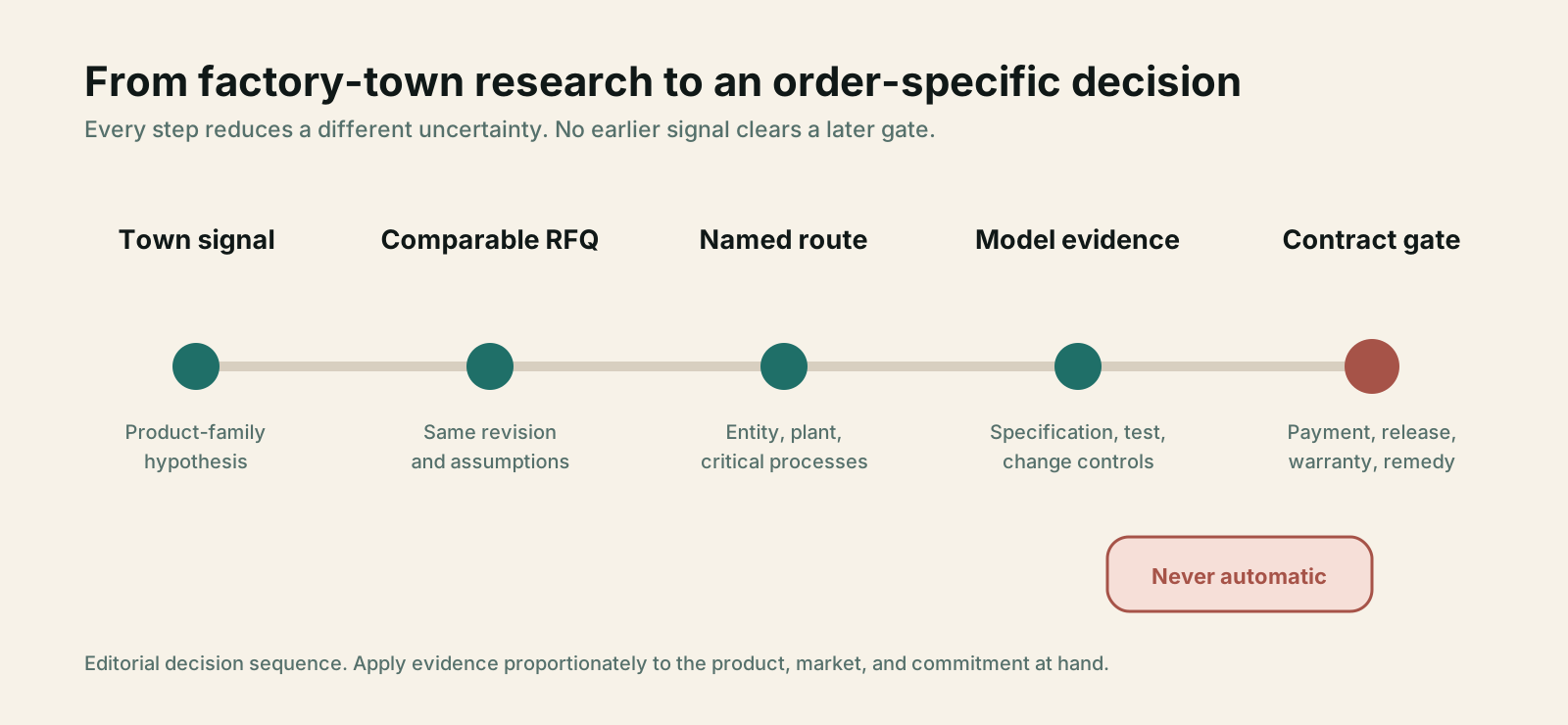 An editorial decision sequence: each stage addresses a different uncertainty, and no early signal clears a later proof gate.
For a broader workflow on moving from online search to a defensible shortlist, see how to find a factory in China. For the product and lot controls that follow, use the factory quality-control guide.
Turn a town into a repeatable dossier
Instead of keeping a vague note that says “check Guzhen” or “try Cixi,” build a small dossier for every town you intend to use in discovery. The goal is not to create a travel guide. It is to make the local hypothesis falsifiable.
The factory-town dossier template
1. Product family and boundary
Write the actual product family, not only the retail category. Include the critical parts and processes. For example: “corded kitchen appliance with heating element, controller, injection-moulded housing, food-contact surfaces, retail carton, and EU-market labelling.” This makes it possible to judge whether the town is relevant at all.
2. Local system hypothesis
Record what the town is known to concentrate according to a dated source: suppliers, components, a professional market, a fair, a design or service platform, export services, or a named industry chain. Keep the publisher and date beside the statement.
3. Candidate roles
List companies as manufacturer, trader, component maker, designer, logistics provider, repair partner, or unknown. Do not collapse those roles into “supplier.” A trader can be a valid counterparty, but its production route needs to be disclosed and contractually coherent.
4. RFQ assumptions to test
Identify the variables most likely to differ across candidates: product revision, motor or controller, material, finish, tooling, test condition, packaging, quantity, market configuration, commercial term, and lead-time assumption. Send the same RFQ pack to comparable candidates.
5. Proof required before the next commitment
State what must be resolved before sample payment, tooling, deposit, shipment release, or warranty launch. This is where you list legal entity, payment beneficiary, factory route, product file, inspection plan, change-control rules, export documents, and service responsibility.
6. Freshness note
Record which local claims can become stale: company counts, industry output, export data, fair dates, platforms, market ownership, and designation status. A town may remain relevant while the detail that justified your initial search has changed.
This template turns geography into a structured research input. It also makes it easier to explain to colleagues why a location is being explored without implying that an order has already been approved.
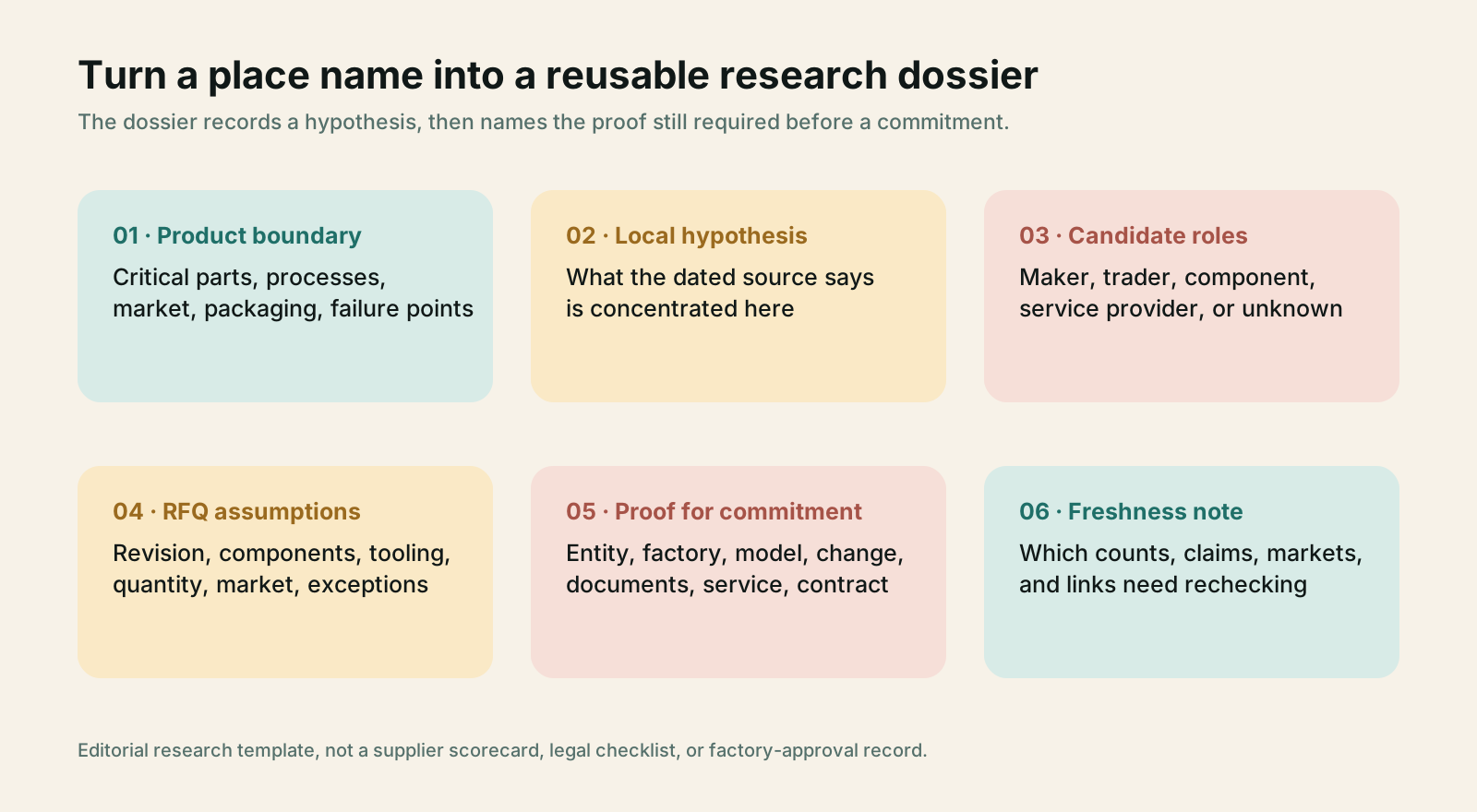 An editorial research template that keeps town context separate from supplier qualification and contract approval.
Write an RFQ that uses local density without hiding risk
An ordinary RFQ requests price, MOQ, and lead time. A cluster-aware RFQ asks the candidate to make the product route visible.
For each bid, request:
- the exact product revision, target market, quantity, and commercial term;
- a list of critical components, materials, and processes, with the candidate's role in each;
- which steps are in-house, affiliate-managed, routinely subcontracted, or still to be determined;
- the sample, tooling, inspection, packaging, and change-control assumptions;
- model-specific documents and the limit of any certification or test claim;
- the legal seller, invoice entity, payment beneficiary, exporter where relevant, and warranty or service counterparty;
- exceptions, substitutions, and the conditions under which price or lead time changes.
The point is not to make every supplier reveal its commercial secrets. It is to create a comparable description of the proposed offer. If two candidates both say they can make a chair, a light, a toy, or a tool, the buyer needs to know whether they mean the same component stack, test condition, packaging, quantity, market configuration, and responsibility boundary.
Use alternatives to discover uncertainty, not only to force price down
Town-level density can give a buyer more than negotiating leverage. It can show that the original brief is incomplete.
If one candidate says a part is unavailable and another says it is standard, ask for the part number, specification, approval boundary, and effect on the product. If one quote includes an existing mould and another requires new tooling, make the tooling condition explicit. If one candidate claims a shorter lead time, ask what inventory, capacity, bought-in parts, or approval assumptions make that possible.
The useful outcome is not necessarily a lower price. It is a better-defined project before money moves.
Do not turn fast feedback into an unapproved change
Clusters can make it easier to hear that a material needs substitution, a tolerance needs revision, a package needs reinforcement, or a component will change lead time. That feedback is valuable only when it enters the product file.
Record the proposed change, reason, part or drawing revision, price and lead-time effect, test or inspection implication, and approver. Otherwise, a “small local optimization” can become an invisible difference between the sample and the production lot.
This is one reason factory-town research belongs beside, rather than instead of, quality control. It makes change risk visible earlier. It does not manage it for you.
A practical search-to-proof sequence
Use this sequence when a town looks relevant to a live product search.
- Describe the product as a process stack. Name critical components, materials, target market, packaging, and failure points.
- Choose one or two town hypotheses. Use a dated public record and product-family fit, not a famous name alone.
- Build a role-labelled longlist. Separate manufacturers, traders, component specialists, and service providers.
- Issue one controlled RFQ. Make the revision, quantity, market, and assumptions consistent across candidates.
- Compare explanations, not only prices. Use alternative answers to reveal missing inputs, unapproved changes, or unlike product configurations.
- Build the proof file before the next irreversible commitment. Verify the entity, production route, product boundary, inspection and change controls, commercial documents, and service responsibility.
- Refresh local facts when the decision is live. Do not reuse old scale claims, export statements, or market assumptions without checking their date and scope.
The word “cluster” should therefore make a buyer more curious and more disciplined at the same time. A strong factory town can give you a richer search surface: more candidates, more specialist language, more comparisons, and more ways to locate an undefined assumption. The final decision still rests on evidence attached to the company, factory, product, lot, and contract in front of you.
Method and limitations
This is a desk-research article by China Made & Tech Team, based on Chinese government records, a public-market issuer disclosure, and government-hosted or attributed reporting reviewed through August 22, 2026. No factory visits, supplier audits, product tests, company-registry checks, customs-origin review, supplier interviews, or transaction records were conducted.
The named town examples are a directional product-family map, not a ranking. Local counts, export statements, market descriptions, and policy or industry-recognition material are attributed to their publishers and dates. They cannot establish the capability, compliance, ownership, quality, origin, warranty performance, or suitability of a particular supplier or order. Recheck all current facts and perform product-, company-, factory-, market-, and contract-specific diligence before relying on a supplier decision.