
By China Made & Tech Team.
Unitree's first trading day changed the company's disclosure file. It did not change the burden of proving what a robot can do in a buyer's environment.
On August 19, 2026, Hangzhou-based Yushu Technology, the company behind Unitree, began trading in Shanghai after pricing its offering at RMB 150.80 per share. The final issue document records 40,446,434 new shares, equal to 10% of enlarged share capital, and gross proceeds of approximately RMB 6.099 billion. The Associated Press described the debut as the first mainland listing by a humanoid-robot maker and reported the market's extraordinary first-day reaction. The final issue record establishes the offering terms; the AP report establishes the dated market context.
For a buyer, however, the useful question is not whether the stock price validated humanoid-robot enthusiasm. It is what becomes easier to inspect now, and what still has to be proved before a robot is awarded, piloted, accepted, scaled, or renewed.
The short answer is this: the IPO makes Unitree more legible as a scaling supplier. Its filings give buyers a clearer view of revenue, product mix, pricing, channels, research spending, planned capacity, control structure, and stated risks. They do not certify uptime, task success, cybersecurity, warranty quality, local service, regulatory clearance, or return on investment for any particular deployment.
That distinction matters because a public company can be easier to diligence while the underlying deployment remains difficult to govern. Unitree's own filing describes a fast-growing business, but also a business exposed to price changes, outsourced assembly, working-capital movement, policy shifts, software and hardware uncertainty, and the unresolved question of large-scale commercial use. A buyer should treat the listing as a reason to build a better evidence file—not as a reason to skip one.
The IPO changes the file, not the robot
The offering creates three different signals that should not be collapsed into one headline.
The first is a capital signal. Unitree now has a public offering and a stated use-of-proceeds plan. That can support more research, product development, manufacturing capacity, testing infrastructure, and organizational continuity. It may eventually improve a buyer's confidence that the company can fund a longer product and service lifecycle.
The second is a disclosure signal. Public filing introduces a more structured record of the issuer's financial history, products, sales channels, risks, governance, and planned projects. This is valuable to a procurement team that previously had to assemble those facts from product pages, distributor conversations, demonstrations, and scattered announcements.
The third is a market signal. Investors assigned a price to the offering and traded the shares in public. That tells a reader that the market is willing to form a view about the company's prospects. It does not tell an operator that a particular robot will meet a cycle-time target, survive a shift pattern, integrate with a plant network, or receive a replacement part inside a contractual window.
The first two signals belong in supplier diligence. The third belongs in a market story. Mixing them produces a category error: a public valuation becomes a substitute for a customer acceptance test.
The better lens is the one used in How China Manufactures: Inside the World's Factory (2026): a supplier is not only a product or a corporate name. It is a system of design ownership, component dependencies, assembly, quality control, software updates, channels, local service, documentation, and continuity. The listing makes more of that system visible. It does not automatically make every layer strong.
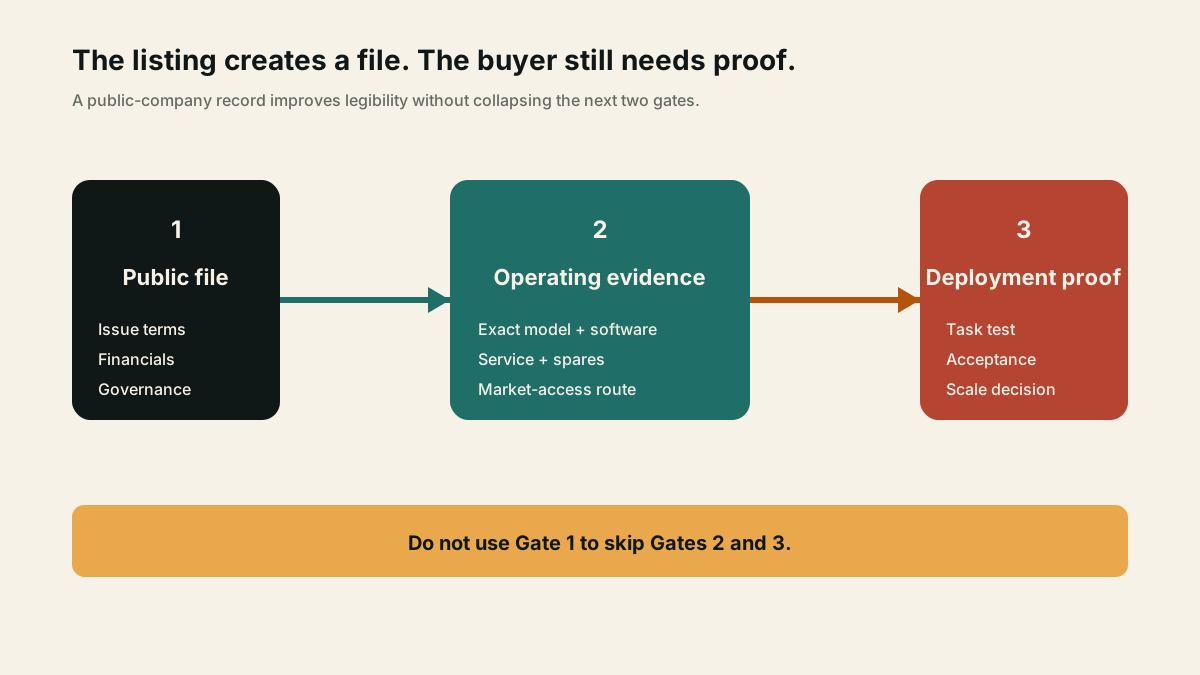 Editorial diagram: the three evidence gates are deliberately kept separate.
What the prospectus makes visible
A real scaling company, with real qualifications
The filing gives a buyer something that a launch video cannot: a dated financial and organizational record. Unitree reports operating revenue of RMB 159.13 million in 2023, RMB 392.77 million in 2024, and RMB 1.699 billion in 2025. It reports a 2025 gross margin of 60.13%, reported net profit of RMB 278.21 million, adjusted net profit of RMB 590.75 million, and operating cash flow of RMB 669.98 million. These figures come from the company's filed prospectus, not from an estimate assembled by a market commentator.
That is meaningful evidence. It shows that Unitree is not merely a lab project or a pre-revenue prototype maker. It has recorded products, customers, revenue recognition, personnel, inventories, receivables, and a supply and sales system large enough to require public disclosure.
But the same section of the filing also tells the buyer how to read the numbers cautiously.
The difference between reported and adjusted 2025 profit is large because the company recorded approximately RMB 349.07 million in share-based payment expense. That expense is non-cash in the period it is recorded, but it still matters when a buyer is trying to understand the economics of a growing company and the relationship between reported profit, compensation, and future dilution or cost structure.
The early-2026 update is even more useful as a diligence warning. Unitree reports first-quarter 2026 revenue of RMB 422.84 million, up 68.49% year on year. But net profit fell 47.69% to RMB 50.01 million, adjusted net profit fell 52.55% to RMB 40.25 million, and operating cash flow fell 85.65% to RMB 34.40 million from RMB 239.73 million a year earlier. The filing attributes pressure to research and development and sales spending, higher purchases, and expenses. It also provides a first-half management estimate of RMB 1.052 billion to RMB 1.128 billion in revenue and RMB 236 million to RMB 283 million in adjusted net profit. Those first-half figures are unaudited, unreviewed management estimates, not an earnings commitment.
For a buyer, the lesson is not that Unitree's finances are good or bad. The lesson is that scale, profit, and cash conversion are different questions. A supplier with rising revenue can still be investing heavily, carrying more inventory, extending payment terms, or spending ahead of a product and service build-out. The buyer's file should therefore ask for the commercial terms that matter to the project: deposit exposure, acceptance-linked payment, spare-parts inventory, warranty reserves, support staffing, and what happens if a planned capacity project is delayed.
Product volume is not product proof
The 2025 product tables are more useful than the debut price because they show how Unitree's business is actually composed.
The filing reports 5,511 humanoids shipped and 5,215 humanoids sold in 2025. It reports humanoid-robot revenue of RMB 867.83 million, or 51.78% of operating revenue. The reported average selling price was RMB 166,400, down from RMB 260,400 in 2024 and RMB 593,400 in 2023.
For quadrupeds, the filing reports 23,037 units sold in 2025, with revenue of RMB 697.63 million and an average selling price of RMB 30,300. The quadruped average selling price also declined across the period, from RMB 38,300 in 2023 to RMB 32,300 in 2024 and RMB 30,300 in 2025. Components contributed a further RMB 103.74 million in 2025.
Several buyer-relevant signals sit inside those figures.
First, Unitree has a meaningful product volume beyond the humanoid headline. Quadrupeds still represent a major part of the business, while humanoids have become the largest revenue category. A buyer evaluating a humanoid should not assume that the company's historic service, parts, or field experience is identical across both product families.
Second, volume growth and price decline are happening together. Lower average prices can support market access and broaden experimentation. They can also compress the room available for quality assurance, local inventory, integration engineering, and long-tail support. A lower purchase price is not the same as a lower total cost of ownership.
Third, shipments and sales are not identical. The prospectus notes that some units were shipped but not yet accepted by customers, creating a lag between delivery and revenue recognition. That is a normal commercial distinction, but it is precisely why a buyer should not treat shipment counts as accepted production deployments.
The evidence gap is straightforward. The filing can tell a buyer how many units were sold and at what reported average price. It cannot, by itself, tell the buyer how many units completed a defined task for a defined number of hours, how often they required intervention, how quickly failed components were replaced, or how software changes affected performance.
Those questions belong in a pilot and acceptance protocol. The protocol should define the task, environment, shift pattern, human intervention, safety boundary, data capture, failure classification, spare-part response, and retest rule before the robot arrives. A unit count is a reason to ask for that protocol with more specificity, not a reason to remove it.
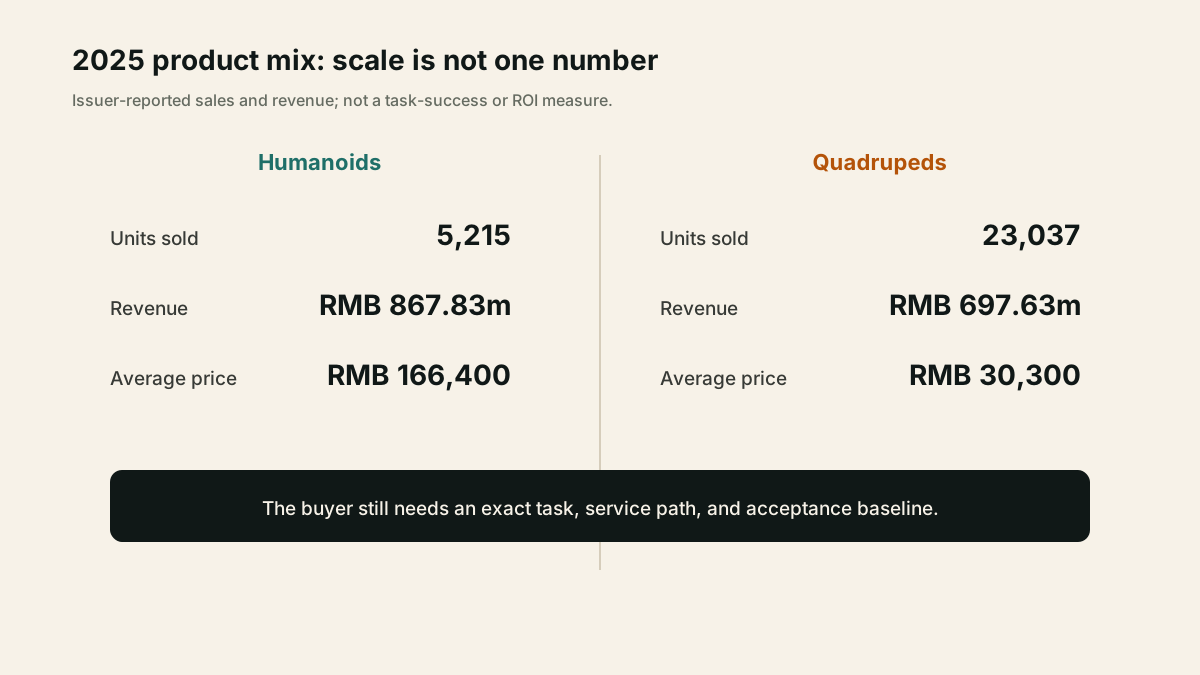 Data chart based on the 2025 product tables in Unitree's filed prospectus; figures are not deployment or ROI measures.
The channel is global; support is local and contractual
Unitree's 2025 revenue was geographically broad. The filing reports domestic revenue of RMB 944.46 million, or 56.35%, and overseas revenue of RMB 731.66 million, or 43.65%. Overseas revenue had been above 55% in the two prior years, so the 2025 mix changed as domestic demand increased.
The company also reports that 89.28% of 2025 sales were made through offline channels. On its channel classification, direct sales represented 51.10% and distributor sales 38.18%, with a smaller online share.
This matters because “sold overseas” is not a support definition. It does not identify who owns the warranty, where parts are stocked, which party can authorize a repair, whether an integrator can modify the software, or whether a distributor is responsible for safety documentation and acceptance testing.
Two dated partner announcements make the architecture visible. GMO AI & Robotics says it signed an authorized distributor agreement with Unitree in Japan and lists implementation support, software development, maintenance, operations, secure communications, and safety-related work among its offerings. Its announcement also describes implementation as a process involving on-site challenge identification, design, motion development, integration, operations, maintenance, and verification. The GMO announcement is evidence of a named arrangement and a support model, not of global uptime or customer success.
Weston Robot separately announced a planned global Unitree service center, describing factory-grade service, an MRO team, testing, and regional support. That announcement is useful for showing the kinds of support layers a buyer may need to contract. It does not provide a measured repair rate, average turnaround, coverage map, or warranty-claim dataset.
The buyer should turn the channel percentages into a counterparty map:
- Who signs the sales contract?
- Who is the legal warranty provider?
- Who can approve firmware, safety, or motion changes?
- Who keeps critical spares in the buyer's geography?
- Who performs first-line diagnosis and who performs factory escalation?
- Who owns the data generated during operation?
- Who is responsible if the distributor, integrator, or service partner exits?
If those answers are not in writing, a global sales footprint should not be mistaken for a global service footprint.
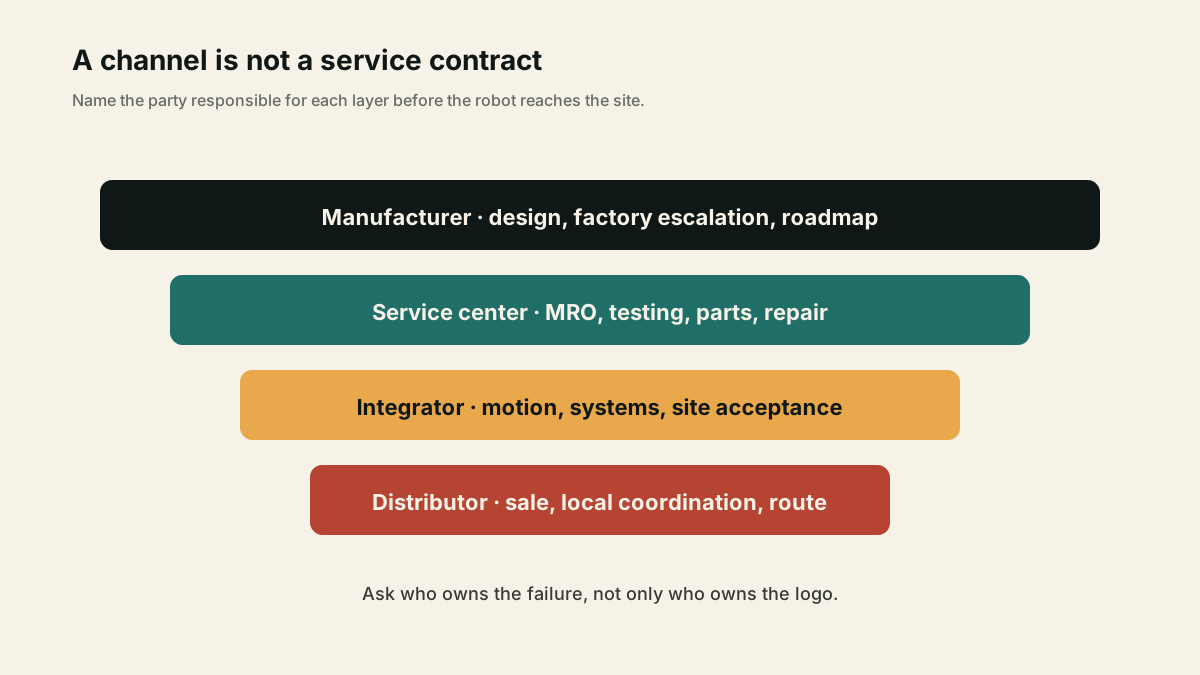 Editorial diagram: support responsibilities should be named in the contract, not inferred from a sales channel.
The Hangzhou system behind the company
Design ownership and manufacturing control are different
The prospectus describes Unitree as developing a broad stack: humanoid and quadruped bodies, embodied artificial intelligence, reinforcement learning and motion control, motors, reducers, hands, lidar, and sensors. It reports RMB 264.93 million of R&D investment across 2023-2025 and 184 R&D staff out of 516 total staff in the filing context.
This supports a specific conclusion: Unitree has built a substantial engineering organization around its own robot products. It does not support the broader conclusion that every component is made internally, that every assembly process is controlled in-house, or that a design change will move cleanly through production and service.
The filing itself discloses outsourced assembly expense—RMB 11.62 million in 2023, RMB 19.22 million in 2024, and RMB 68.03 million in 2025—and warns that a labor supplier's termination or operating constraint could affect production. This is not an accusation. It is a useful map of dependency. A company can own the design and still depend on external labor, assembly capacity, fixtures, test processes, or local service partners.
That distinction should shape the buyer's technical file. Ask for the exact model's bill of materials, critical-to-function components, assembly location, test ownership, calibration process, software version, replacement-part policy, and engineering-change procedure. Ask which items have approved alternates and which have a single source. Ask what happens if the assembly partner changes, if a reducer or actuator is unavailable, or if a firmware release changes the acceptance baseline.
What the new capital might change
Unitree's planned use of proceeds is unusually relevant to the buyer's forward-looking file. The prospectus lists four categories totaling approximately RMB 4.202 billion:
| Planned category | Approximate amount | What a buyer should monitor |
|---|---|---|
| Intelligent robot model R&D | RMB 2.022 billion | Model releases, compute and data boundaries, version-control discipline |
| Robot-body R&D | RMB 1.110 billion | Actuator, body, hand, sensor, and durability milestones |
| New-product development | RMB 445 million | Product-line changes, compatibility, and support horizon |
| Intelligent robot manufacturing base | RMB 624 million | Capacity, test coverage, yield, location, and commissioning evidence |
The right response is milestone visibility. A buyer should request advance notice for material model, firmware, actuator, sensor, data, and manufacturing-site changes. The contract should state whether a change triggers a retest, a new safety assessment, a spare-parts review, or a right to pause scale-up. Public capital is useful when it improves the supplier's ability to provide evidence. It is not useful if the buyer has no way to observe whether the new capacity affects the exact model being purchased.
Public listing, concentrated control
The prospectus also discloses special voting rights. Founder Wang Xingxing's direct economic ownership is lower than his voting control, and the filing describes combined control of approximately 68.78% after the offering. This is a governance fact, not a verdict on the company's quality.
For a procurement team, its relevance is practical. The legal entity, signing authority, warranty counterparty, software-licensing entity, service partner, and any parent or affiliate should be identified separately. If a project depends on a long support period, the buyer should understand who can approve a product withdrawal, a major software change, a manufacturing transfer, or a distributor replacement.
Concentrated founder control can coexist with strong execution. It can also mean that the buyer needs clearer contractual authority and continuity provisions because the public listing has not eliminated key-person or control-concentration questions. The buyer does not need an opinion on the governance structure to ask for a clear counterparty and an enforceable change-control path.
What the IPO still cannot prove
The most important limits are not hidden in the stock-market coverage. They are in the company's own risk disclosures and in the difference between shipping a robot and making it dependable at work.
The prospectus warns that large-scale commercialization remains uncertain. It identifies questions around foundation-model generalization, dexterity, durability, non-standard scenes, energy consumption, computing resources, industry standards, regulation, and social acceptance. These are not abstract research concerns for a buyer. They become acceptance criteria, operating boundaries, training requirements, safety controls, and maintenance costs.
Independent reporting makes the same distinction from another direction. AP's debut report cites analysis that reliable performance and attractive ROI in large industrial or commercial deployments remain the competitive test. It also notes that many humanoid shipments are still associated with demonstrations, performances, or research. Its separate report on China's robot market describes the challenge of finding repeatable buyers and work cases after building the machines. That AP commercialization report is not proof that commercial deployments do not exist. It is context for why a buyer should define the work case instead of using shipment volume as a proxy.
The missing evidence falls into five groups.
1. Task evidence
There is no public dataset in the reviewed sources that gives a model-specific, independently auditable record of uptime, mean time between failure, task completion, intervention rate, or failure recovery under a buyer-relevant operating condition. A product demonstration can show possibility. It does not define a production baseline.
The buyer should require a test that has a start condition, an operating period, a target output, a failure taxonomy, a human-intervention rule, and a retest process. For a warehouse, that could include navigation, pickup, handoff, charging, and exception handling. For a factory, it could include a specific workpiece, cycle time, fixture tolerance, quality threshold, and safe-stop behavior. The point is not to demand a universal benchmark. It is to prevent “works in a demo” from becoming an undefined acceptance claim.
2. Service evidence
A distributor or service-center announcement proves that a support layer has been proposed or contracted in a named geography. It does not prove response time, parts availability, remote-diagnostic quality, or the outcome of a repair.
The buyer should put service on the same evidence footing as the robot: named support entity, hours, escalation path, local spares, loaner or replacement rules, remote-access permissions, service-level targets, firmware rollback, and end-of-life notice. If service is provided by a partner, the buyer should know whether the original manufacturer remains jointly responsible or whether the partner is the sole recourse.
3. Software and data evidence
The filing's engineering and model-development plans make software a central part of the future supplier relationship. Yet a public filing does not tell a buyer the complete boundary of the model, what data leaves the site, what remote services are required, how logs are retained, who can change a motion policy, or how an update is rolled back.
Those questions need a software bill of materials or equivalent inventory, version identifiers, update notices, access controls, network diagrams, log-retention terms, vulnerability reporting, and a clear statement of what happens if a cloud or remote service is unavailable. Cybersecurity should not be inferred from the fact that a company is listed.
4. Market-access evidence
Market access is part of the robot's specification. In August 2026, the FCC's July 28 public notice added foreign-produced advanced robotic devices to the Covered List, subject to the notice's conditional-approval pathway. Specialist reporting and AP then discussed possible implications for future US sales while existing models might be treated differently under the described rule context. The Bloomberg Law report is useful as independent context, not as a substitute for the operative FCC record, customs review, or counsel.
The buyer's question is model-specific and transaction-specific: Is this exact model covered? Does the rule apply to import, sale, operation, or some combination? Is there an exception? Who is responsible for the determination? What happens to existing inventory, replacement parts, software updates, and service access? The answer should be refreshed before a purchase, especially when the market and product classification are moving quickly.
5. Continuity evidence
Rapid growth creates its own continuity questions. A buyer may be dealing with a direct sales team, a local distributor, a systems integrator, a service center, and the original manufacturer at once. The IPO may improve the visibility of the issuer, but it does not automatically bind all of those parties into one support obligation.
The continuity file should cover spare-parts availability, software support duration, model retirement, manufacturing-site changes, distributor termination, warranty assignment, data export, and the buyer's rights if the exact model is replaced. It should also cover the commercial basics: payment linked to acceptance, limits on non-refundable deposits, and a right to pause expansion if the pilot does not meet the agreed gate.
How the file should work inside a buying team
The governance file is most useful when it is shared across functions. Procurement should not own it alone, because the hardest questions are neither purely commercial nor purely technical.
Procurement owns the counterparty and commercial spine: which entity sells, which entity warrants, how payment is linked to acceptance, who supplies parts, and what remedies exist when a milestone is missed. Legal or compliance owns the jurisdictional and contractual boundary: import route, equipment authorization, data handling, remote access, insurance, safety obligations, and the consequences of a regulatory change. Engineering owns the exact configuration and test method: model revision, firmware, end-effector, network condition, task sequence, intervention rule, and failure classification. Operations owns the environment and the human workflow: who trains, who supervises, who clears an exception, how a shift is stopped, and what happens when the robot is unavailable. Finance owns exposure: deposits, inventory risk, support reserves, currency, payment milestones, and the cost of expanding from one pilot unit to a fleet.
The IPO changes the first conversation with each function in a slightly different way.
For procurement, the company is now easier to compare against a formal supplier record. The team can ask why the legal entity, sales channel, warranty entity, and service partner do or do not line up. It can ask the supplier to explain any difference between the prospectus's product categories and the configuration being quoted. It can also ask how the planned manufacturing-base investment is expected to affect lead time, production location, test coverage, and parts availability. None of those questions require an investment opinion.
For engineering, the filing's product volume and falling average prices are prompts to check revision control. If the buyer is receiving a lower-priced or newer configuration, which components changed? Does the acceptance baseline remain valid? Are the actuator, battery, sensor, hand, or software stack the same as the unit used in the demonstration? If the answer is no, the demonstration is a reference point, not acceptance evidence.
For compliance, the FCC notice is a reminder that the robot's market-access status is part of the product definition. A buyer should preserve the rule version, model identifier, production location, importer, end use, and any approval or exception in the project record. If a model is reclassified later, the team should know whether the supplier or buyer owns the re-check and whether the shipment, operation, replacement parts, or software update is affected.
For operations, the service question is not “is there a distributor?” It is “who arrives when the robot stops, who has the authority to change it, and what does the operator do while waiting?” A service network that looks adequate on paper may still be unsuitable for a site that needs a spare actuator within one shift, local language support, offline operation, or a defined safe-recovery process. The operating team should walk through at least one imagined failure before approving scale.
For finance, the company's revenue growth and planned capital spending are useful continuity signals, but not a reason to front-load irreversible exposure. A buyer can use staged purchase orders, acceptance-linked payments, capped deposits, and explicit parts commitments to preserve optionality. The question is not whether the supplier is financially attractive. It is whether the buyer's downside is bounded if a pilot fails, a model changes, a partner exits, or a market-access condition moves.
The file should therefore have a single owner and a visible status for each gate. “Requested” means the buyer has asked. “Received” means a document exists. “Verified” means the buyer checked it against the exact model, entity, geography, and contract. “Accepted” means the evidence has met the agreed threshold. A press release, partner webpage, or public filing may move an item from unknown to received. It should not move a task-level performance item to accepted.
This status discipline is especially important after a high-profile listing because attention tends to compress time. Sales teams may want a quick purchase order while investors, media, and internal executives are focused on momentum. A shared file gives the buyer a way to preserve momentum without pretending that every question has been answered. The team can proceed with a bounded research or pilot purchase while keeping scale approval conditional.
The buyer governance file
The following matrix is not a certification of Unitree or any other supplier. It is a way to convert the new public disclosure into decisions that a procurement, engineering, compliance, and operations team can actually make.
| File to request | Why it matters after the IPO | Evidence that should change the decision |
|---|---|---|
| Legal entity, signing authority, warranty counterparty | A listed issuer, distributor, integrator, and service center may be different parties. | Proceed only when the contract, invoice, warranty, software license, and service obligations point to named entities with authority. |
| Exact model and configuration file | “Unitree robot” is not a sufficient product definition. | Record model, hardware revision, firmware, sensors, end-effector, battery, accessories, and approved alternatives before the pilot. |
| Product and software boundary | The robot may depend on an SDK, model service, remote support, cloud, or integrator layer. | Hold if the buyer cannot identify what is on-site, what is remote, who can update it, and how it is rolled back. |
| Task-level acceptance protocol | Units sold and demonstrations do not establish production performance. | Pilot only with measurable task, environment, intervention, safety, duration, failure, and retest criteria. |
| Safety and risk file | A public listing is not a site-specific risk assessment. | Require hazard analysis, operating envelope, safe-stop behavior, training, guarding, and incident reporting appropriate to the site. |
| Data and cybersecurity file | Listing status does not reveal data flows or update controls. | Require network architecture, data location, access roles, log policy, vulnerability contact, update notice, and offline behavior. |
| Service and spare-parts plan | A distributor announcement is not a service-level guarantee. | Name first-line and factory escalation, local parts, response targets, repair authority, replacement rules, and warranty exclusions. |
| Market-access and customs file | Model classification and rules can change by jurisdiction and date. | Verify the exact model, transaction, destination, end use, exception, importer, and responsibility for re-checking. |
| Change-control and roadmap file | IPO-funded R&D and manufacturing expansion can change hardware, software, and support. | Require notice, retest triggers, compatibility commitments, end-of-life notice, and a right to pause scale-up. |
| Continuity and commercial protections | Growth, partner changes, and product retirement can strand a deployment. | Link payment to acceptance, define support duration, protect data export and parts access, and document remedies for failed gates. |
At the award stage, the buyer is checking whether the entity and product are defined well enough to sign. At the pilot stage, it is checking whether the robot can perform the exact bounded task with known intervention and safety conditions. At the acceptance stage, it is checking whether the agreed evidence has been met and recorded. At the scale stage, it is checking whether service, spares, software, data, and market access can support a larger installed base. At renewal, it is checking whether the original evidence still applies after firmware, model, site, or partner changes.
The public company file is most valuable when it feeds those gates. Its value is lower when it sits in a procurement folder beside a press release and is treated as a substitute for a test report.
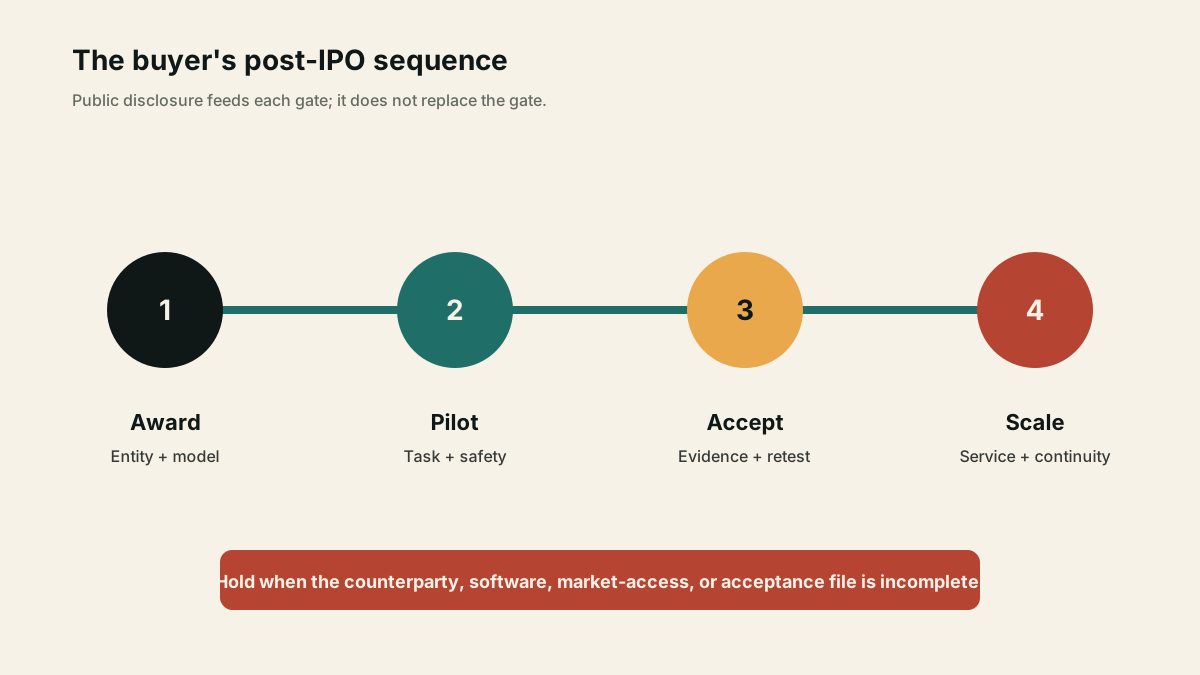 Editorial diagram: public disclosure should feed each gate, not replace it.
Three buyer postures after the listing
Proceed to a bounded pilot
A buyer can consider a pilot when the counterparty is clear, the exact model and software boundary are recorded, the jurisdictional route is open, and the supplier agrees to a measurable task protocol. The pilot should be limited in scope and duration, with payment and scale rights tied to evidence. It should not be described internally as a production deployment until the acceptance gate is passed.
Scale conditionally
Conditional scale requires more than a successful demonstration. It requires repeatable task evidence, a service and spares path, security and data controls, market-access confirmation, and a change-control mechanism. The supplier's public financial and manufacturing disclosures can strengthen the continuity case, but the buyer still needs contractual obligations from the parties actually performing service.
Hold pending evidence
Hold when the supplier cannot identify the warranty entity, will not define the software or data boundary, cannot support the exact jurisdiction, refuses a task-level acceptance protocol, or offers no credible spare-parts and escalation plan. Hold does not mean the product is unusable. It means the buyer cannot responsibly make the next irreversible commitment with the current file.
This is the practical meaning of a public robot company. The company is easier to inspect, and that is valuable. But inspectability raises the quality of the questions; it does not answer the deployment questions for you.
Method and limitations
This is desk research by China Made & Tech Team, based on the CNINFO prospectus and final issue document, Shanghai Stock Exchange records, dated Associated Press reporting, specialist market-access reporting, and named distributor and service-partner announcements accessed on August 20, 2026. The article has no firsthand robot test, factory audit, customer interview, contract review, uptime dataset, repair-rate dataset, cybersecurity assessment, or ROI study.
Financial and product numbers are reported as disclosed in the filing. The H1 2026 ranges are management estimates and should not be read as audited results. Company and partner statements are attributed to their sources. The buyer matrix is editorial procurement synthesis, not legal, customs, investment, safety, credit, or deployment advice.
Before relying on this article for a live purchase, recheck the latest filing, exact model availability, software and data boundary, warranty terms, service coverage, spare-parts location, and current market-access rules. The IPO changed Unitree's public file. The buyer still has to build the field file.