
A national L3/L4 baseline is important. It is still not a verdict on a vehicle, a software release, or a road operation.
By China Made & Tech Team — an independent, desk-research field guide to Chinese manufacturing and technology.
MIIT’s final release gives this story a firm public anchor: GB 44721-2026 was issued as a mandatory national standard for defined L3/L4 systems, with a July 2027 planned implementation point. It should make the evidence behind an autonomous-driving proposal more visible—not make a vehicle-level conclusion automatic. Read the MIIT release.
Quick answer
China has released GB 44721-2026, a mandatory national safety standard for L3 and L4 automated-driving systems used on M and N vehicles. The Ministry of Industry and Information Technology (MIIT) says it was approved and issued on July 30, 2026 and is planned to take effect on July 1, 2027; automated parking is outside its stated scope. That is a meaningful change in the national baseline for a defined class of automated-driving system. It is not a certificate saying that a named car is safe, compliant, approved to operate on a particular road, insured, or suitable for a buyer’s intended use. MIIT’s release
For a buyer, investor, fleet partner, supplier, or overseas regulator, the useful question is therefore not “does this vehicle have the new standard?” It is: what current, configuration-specific evidence connects the published standard to this vehicle, this software version, this operating design domain, this service model, and this jurisdiction?
| If you are reading… | Treat it as… | Do not treat it as… |
|---|---|---|
| The MIIT release | A formal record of the standard’s public status, scope, and planned implementation date | A safety result for a particular vehicle |
| A national standards-platform entry | Evidence of the standards project and its official process | A type-approval, road-access, or insurance decision |
| A manufacturer presentation | A description of what the manufacturer says its product can do | Independent proof that the feature works in your use case |
| A test or assurance document | Potentially relevant evidence, if it names the exact system and conditions | A transferable conclusion about a different configuration or road domain |
| A local pilot permit or operating approval | Evidence about a specified place, route, service, and time | Permission to operate everywhere |
The announcement changes the baseline, not the burden of proof
Autonomous-driving announcements often compress several different questions into one sentence. A standard has been issued. A vehicle has a feature. A city allows a pilot. A company has completed a test. A passenger can book a ride. Each statement may be true in its own category. None automatically answers the next category.
GB 44721-2026 makes that compression more tempting because the headline is substantial. MIIT’s August 4 announcement says the mandatory standard concerns safety requirements for intelligent connected-vehicle autonomous-driving systems. It identifies L3 and L4 systems on M and N vehicles as its scope, excludes automated parking, and states a July 1, 2027 planned implementation date. The national standards platform separately records a mandatory-standard project with the responsible ministry, committee, and proposed implementation timing. MIIT’s release and the national standards record establish the kind of fact that a procurement or policy file needs: a formal public record, a defined scope, and a date.
They do not establish the kind of fact that a vehicle decision needs. They do not identify a particular model year, sensor set, compute unit, software build, user interface, handover logic, mapping dependency, remote-assistance arrangement, maintenance process, or insurance arrangement. They do not state that any named car has passed every applicable check. They do not tell a reader whether a particular service can operate in a city, on a route, in weather conditions, or with a particular user population. The public release is deliberately not that document.
This is not a criticism of the release. A national standard and a vehicle-specific evidence file have different jobs. The first creates a common floor for a class of systems. The second is the traceable record needed to decide whether a concrete product or service belongs on a road, in a fleet, in a supply chain, or in a customer promise.
The practical implication is simple: welcome the standard as a stronger reference point, then resist the urge to stop reading.
What GB 44721-2026 actually establishes
The official material lets a reader make several bounded statements with confidence.
First, the standard is a national mandatory-standard release rather than a company roadmap, a trade-show claim, or an unpublished proposal. That matters because product teams, suppliers, and service operators can now orient their documentation and assurance work around a public national reference. The change is more consequential than a loose policy aspiration: it turns a broad discussion of automated-driving safety into a named formal instrument with stated scope and timing.
Second, scope discipline is part of the content. MIIT says the standard applies to L3 and L4 autonomous-driving systems on M and N vehicles and excludes automated parking. This tells a reader where not to overextend the announcement. A parking feature should not be casually folded into the standard’s remit. Nor should a consumer-assistance feature be relabeled as L3 or L4 simply because it appears in a vehicle with an impressive sensor stack. MIIT’s release
Third, time matters. The issue date and planned July 2027 implementation point create a transition period. A team evaluating a 2026 or early-2027 product cannot assume that a future implementation date has already answered today’s documentation, contractual, test, or local-operating questions. Conversely, a team designing a program that will be delivered after the implementation point should not treat the date as distant background. It belongs in the product roadmap, supplier requirements, software-change process, and diligence calendar.
These are substantial effects. Yet none of them erases the need to ask what, exactly, is being bought or approved.
What it does not establish
The most useful negative statement is also the least glamorous: a national standard is not a model-specific safety verdict.
Consider how many variables can hide inside the phrase “the same car.” A vehicle sold in one market may have a different sensor package, tire specification, mapping supplier, data connection, human-machine interface, feature set, language setting, or software branch from a vehicle carrying the same badge elsewhere. A fleet vehicle can differ from a retail vehicle in its monitoring, maintenance, geofencing, remote support, passenger instructions, or incident response. A feature may be activated only on defined roads, only in defined weather, or only after a particular update. Even an unchanged hardware bill of materials does not guarantee an unchanged operational system when software, maps, cloud services, and policy controls are part of the service.
The standard does not make those differences disappear. It makes it harder for serious participants to ignore them.
That is why an international buyer should avoid both exaggerated readings. The first exaggeration is celebratory: “China has a mandatory L3/L4 standard, therefore this car is ready for unrestricted autonomous use.” The second is dismissive: “It is only a standard, therefore it has no commercial significance.” The better reading lies between them. The standard is a real common reference. The decision remains vehicle- and operation-specific.
The unit of analysis is a system, not a feature label
The quickest way to lose discipline in automated-driving diligence is to make the feature label the unit of analysis. Feature labels are useful shorthand. They are poor substitutes for a system boundary.
If someone says that a vehicle has “L3 capability,” the next question should be: capability where, under which conditions, in which configuration, and with what responsibility model? The answer should not be a brochure sentence. It should be a controlled description that can be compared with test material, product documentation, operating rules, and contractual commitments.
The same discipline applies if a seller uses a different term: intelligent driving, navigation assistance, city assistance, end-to-end driving, hands-free feature, robotaxi stack, or autonomous-ready platform. Marketing vocabulary can describe a product experience. It cannot, by itself, identify the technical and operational boundary a buyer needs to evaluate.
Separate three layers before you ask for evidence
For practical work, split a proposal into three layers.
Layer one: the standard. This is the public rule or reference point. It has a title, scope, date, issuing path, and stated applicability. It tells you something about the category of system the state is regulating. It does not tell you whether a supplier’s implementation is complete.
Layer two: the vehicle system. This is the actual configuration: vehicle platform, hardware, software, sensors, compute, control functions, user interface, safety strategy, data path, and update regime. It is the layer that should be named in test records, assurance documentation, and change-control documentation. A buyer needs to know whether the evidence applies to the configuration being proposed, not to a product family in the abstract.
Layer three: the operating service. This is how the system will be used: road type, geography, speed environment, weather policy, user training, remote support, maintenance, incident response, permits, commercial terms, and insurance. A vehicle that is technically capable under one operating design domain may be unsuitable for a different fleet route, city, customer population, or business model.
These layers overlap, but they are not interchangeable. A strong national baseline can coexist with a weak vehicle file. A strong vehicle test package can coexist with an unprepared operating service. A valid local pilot can coexist with a configuration that is not identical to a proposed export model. Treating all three as “autonomous driving compliance” creates a fog precisely where a decision needs clarity.
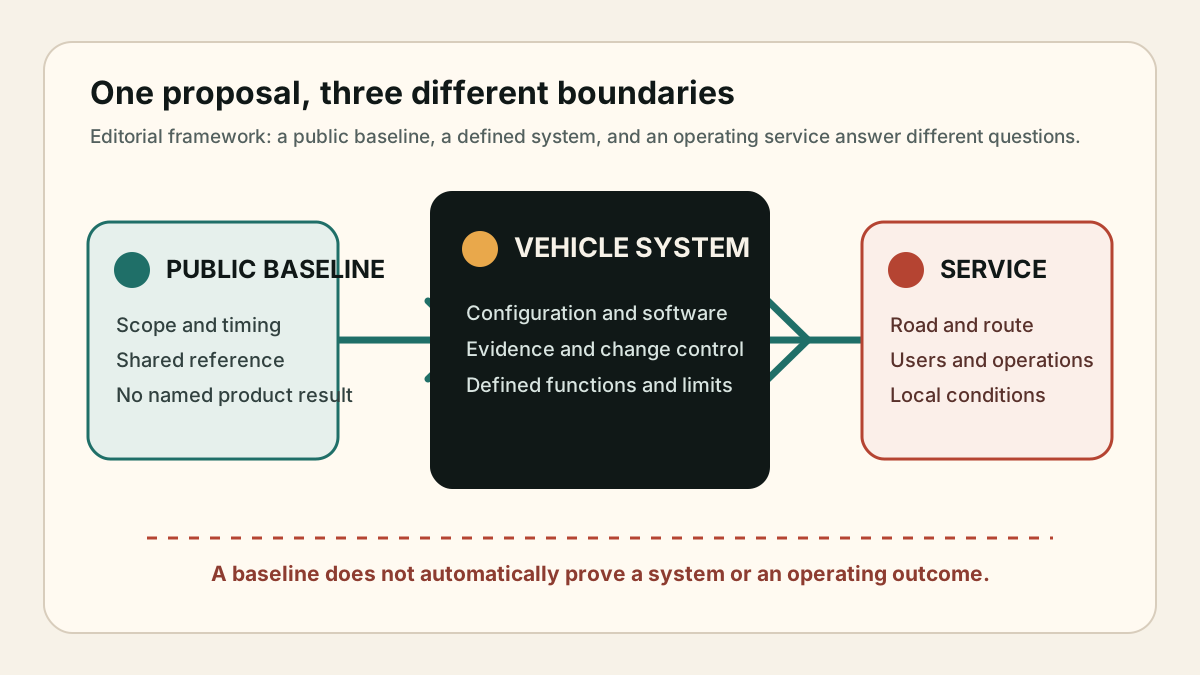 Editorial system-boundary framework: a public standard, a vehicle system, and an operating service are related but distinct decision objects.
A simple boundary test
When reading any claim, ask which noun it names:
| Claim wording | Likely object | The follow-up question |
|---|---|---|
| “The standard applies from 2027.” | Standard | Which exact rule, implementation date, and scope are being cited? |
| “Our vehicle meets the standard.” | Vehicle system | Which model, configuration, software version, evidence set, and assessment path? |
| “The car can drive itself on this route.” | Operating service | Under what operating design domain, permissions, human supervision, and incident process? |
| “The feature is safer.” | Safety outcome | Compared with what baseline, measured how, under which conditions, and by whom? |
| “It is approved in China.” | Regulatory status | Approved for which activity, by which authority, where, and for how long? |
Why configuration control becomes commercially important
Automated-driving systems make configuration control a business issue, not only an engineering issue. A conventional component may be specified largely by a part number and a test report. A software-defined driving system changes through releases, calibration, maps, cloud interactions, and operating policies. The buyer therefore needs a way to identify the object that the evidence describes.
Start with a configuration statement. It should define the vehicle variant, hardware revision, sensor bill of materials, compute hardware, software release, map or localization dependency, connected-service dependency, regional setting, and intended operating design domain. If any of these are unknown, the word “compliance” is premature. There may still be a promising development program. There is not yet a fully bounded product claim.
Then ask what happens when any of those variables changes. Does the supplier classify the change? Is there a safety review? Are regression checks specified? Who decides whether a change is material? Which record links the new release back to the evidence package? What is communicated to a fleet operator or end user? A vendor does not need to reveal every proprietary implementation detail to answer these questions. It does need to show that it can govern change in a way a customer can understand and audit.
The standard’s arrival makes those questions more, not less, relevant. A mature compliance conversation should move from “we are aligned with the direction of regulation” to “here is the defined system, here are the controlled records, and here is how changes are handled.”
The public evidence architecture points to a vehicle file
The strongest public clue about how to read GB 44721-2026 is not a marketing claim. It is the standards architecture described by the China Automotive Technology and Research Center (CATARC), which says it led drafting and test validation work. CATARC’s release summary says the standard covers technical requirements, assurance requirements, and same-type determination, and describes assurance inspection, safety-archive inspection, and confirmation testing. It also says L3 and L4 indicators are specified separately. CATARC’s summary
This does not give a reader a complete final text or a ready-made certification checklist. It does something more useful for a decision-maker: it shows that the public discussion is not just about a driving feature. It points toward a documentary and assurance structure.
The right response is not to copy those labels into a slide deck. It is to convert each label into a request for current evidence about the proposed system.
Technical requirements: ask what the system is intended to do
“Technical requirements” can sound self-explanatory, but it is too broad to be useful without an operating boundary. A buyer should ask for the supplier’s current statement of intended functions and limits. What can the system take on? What must the human do? What initiates or terminates automated operation? What information is presented to the user? What conditions prevent activation? What happens if the system detects a fault, uncertainty, degraded sensing, a blocked route, a lost connection, or an unexpected road situation?
This is not a request for an unlimited product roadmap. It is a request to make the promised product legible. The answer should distinguish planned functions from enabled functions, demonstration functions from delivered functions, and general capability language from functions available in the exact configuration under review.
For an overseas buyer, this is also where translation risks surface. “Autonomous,” “assisted,” “intelligent,” “hands-free,” and “no takeover needed” can carry different implications across languages and markets. Use the supplier’s terms, but ask them to map those terms to a plain-English description of human responsibility, activation conditions, fallback behavior, and operating limits. A good supplier should welcome the chance to remove ambiguity before it becomes a warranty dispute or a safety misunderstanding.
Assurance requirements: ask how the supplier knows what it claims
The word “assurance” should shift the discussion from capability to evidence. A useful assurance conversation asks how the supplier connects its stated system boundary to the records it keeps. Which internal process identifies safety-relevant assumptions? Which functions are covered by which evaluation? How are failures, limitations, and unresolved issues tracked? What constitutes release readiness? Who can stop deployment? How is a field issue fed back into the development and update process?
The buyer does not need to dictate an engineering methodology to use this question. The buyer needs to know whether the supplier has a coherent one. A response that consists only of performance highlights, total road miles, or a polished demonstration does not answer it. Those may be useful context, but they do not establish the assurance logic for the delivered configuration.
Ask for an evidence map rather than a pile of documents. The map should state each material safety or operational proposition, the record supporting it, the configuration to which it applies, the relevant operating conditions, the document owner, and the date or release status. The map is valuable because it exposes gaps early. A missing record can be assigned. A vague claim cannot be resolved until it is made specific.
Same-type determination: ask whether the evidence travels with the product
CATARC’s public description includes same-type determination. For a buyer, the practical question is: why should evidence generated for one vehicle or system be considered relevant to the one on offer?
That question matters whenever a seller offers a platform family, a localized version, a new sensor supplier, a different wheelbase, a different compute unit, a later software build, or a market-specific service. It is not enough to say that the product is “based on” the tested version. The buyer should ask what the supplier treats as the same type, what changes fall outside that boundary, and what re-evaluation or confirmation follows a material change.
This is particularly important in cross-border transactions. An export vehicle can be physically similar while differing in maps, connectivity, user interface, language, cybersecurity settings, driver-monitoring behavior, or local regulatory features. A component substitution can be rational for cost or supply resilience. It can also change the relevance of evidence. The diligence question is not whether change is bad. It is whether change is controlled, disclosed, and tied to an evidence decision.
Safety archives: ask for a usable record, not a ceremonial file
The phrase “safety archive” can tempt a buyer to request one large document and tick a box. That is the wrong mental model. A usable archive is a navigable system of records. It lets an informed reviewer understand what system was assessed, under which assumptions, what evidence exists, what limitations are known, who owns the next decision, and what has changed since the last review.
A buyer’s request can be proportionate. You may not need raw source code, full data sets, or confidential test artifacts. You do need a structured index and enough underlying support to confirm that the index is not merely an assertion. In a commercial contract, the parties can agree what is shared before award, what is held for audit, what is available under confidentiality, and what must be updated after a material release or incident.
The key is traceability. If a fleet operator asks, “Which software release was active when this event happened?” the answer should not depend on memory or a marketing team. If a regulator asks, “What was the declared operating boundary?” the answer should not be reconstructed from a sales presentation. If a buyer asks, “Does the evidence cover the configuration delivered to us?” the answer should point to a controlled record.
Inspection and confirmation: ask who did what, and to which object
CATARC’s summary refers to assurance inspection, safety-archive inspection, and confirmation testing. These labels signal that the public framework is concerned with more than a static design description. For a buyer, however, the essential follow-up remains specific: who inspected or tested what, under which protocol or criteria, when, and for which configuration?
Do not convert a general description of inspection into a claim that a particular supplier has passed it. Do not convert a test reference into a claim that a different product is cleared. Ask for the exact title, issuer, date, scope, limitations, configuration identifier, and status of any document being offered as evidence. If the supplier cannot share the record, ask for a controlled summary, an independent attestation, or a contractually defined review path. If none is available, record that absence honestly in the risk decision.
The point is not to create an impossible burden. It is to prevent silent substitution: a general national framework standing in for a vehicle test, a legacy test standing in for a new build, or a supplier assertion standing in for a documented assessment.
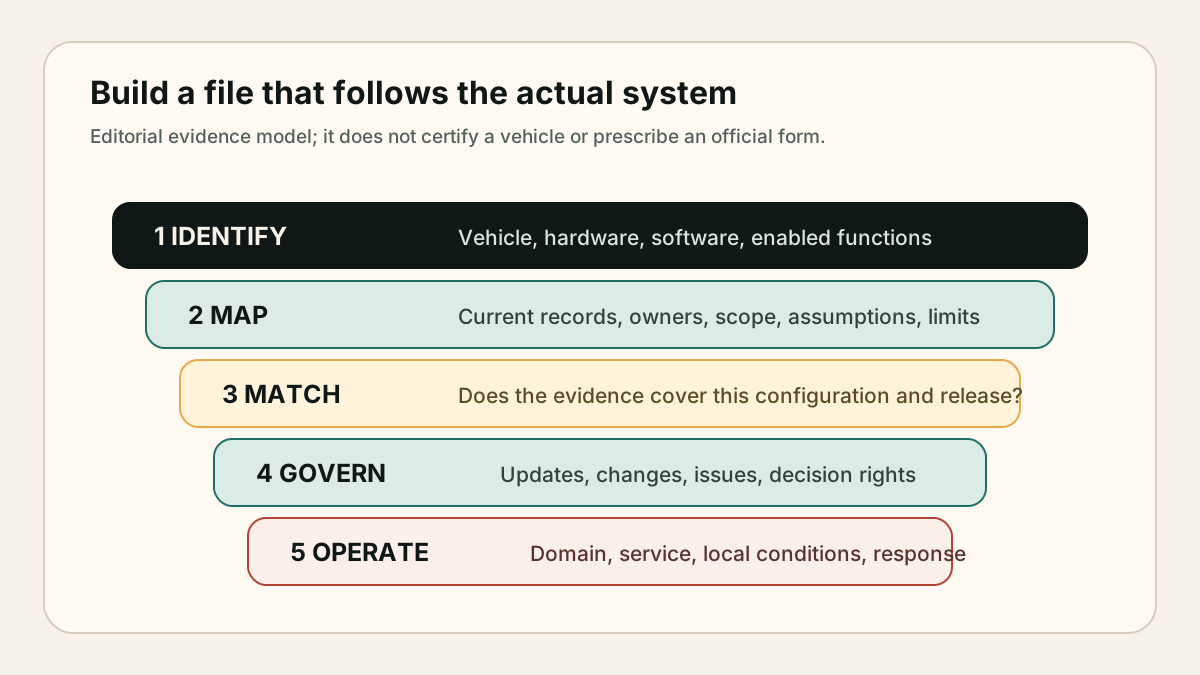 Editorial evidence-file model: identify the system, connect current records, match scope, govern change, and define operation.
A national baseline is not a safety verdict
The difference between a baseline and a verdict deserves its own section because it is where otherwise careful readers often slip.
A baseline can tell the market that a defined category of system has been brought inside a national safety-requirements framework. It can influence product planning, supplier work, test planning, documentation, and the language used by regulators and customers. It can create a stronger common vocabulary. Those are material changes.
A safety verdict says something much narrower and much harder: that an identified system, under identified conditions, has met a stated threshold or has demonstrated a particular outcome. A road-access decision says something different again: that an identified vehicle or service may operate in a particular jurisdiction, subject to stated conditions. An insurance decision says something different again: that a risk has been priced and covered on certain terms. A customer-suitability decision says something different again: that the service is appropriate for a fleet’s routes, drivers, passengers, maintenance capability, and risk tolerance.
Do not let a strong word in one category migrate into another.
The L3 issue is responsibility, not just automation
Independent reporting can make the public discussion easier to understand, provided it remains attributed and bounded. CnEVPost reported that the standard sets a competent, attentive-driver safety baseline and described L3 systems as monitoring a driver’s readiness to take over. CnEVPost’s report is useful in that limited role: it signals why user readiness and handover logic belong in a serious conversation.
It does not establish the final technical wording for every implementation. It does not show that a particular driver-monitoring system is adequate. It does not settle what happens in a particular incident, under a particular contract, or in a particular legal setting. A buyer should therefore use the report to formulate questions, not to close them.
For an L3-related proposal, the questions should be concrete. How does the system state whether automated operation is available? What conditions trigger a request to take over? What information reaches the driver? What happens if the request is not acknowledged? How is the intended operating boundary communicated? How are user instructions localized? How are human-factors assumptions tested or monitored? What data is retained following a handover, a near miss, or a system exit? Who has access to it, and under what governance?
These are not academic additions. An automated-driving service is partly a human-organization system. The safest technical design can still be undermined by a confusing interface, an unrealistic user expectation, an unclear escalation path, or an operator with no plan for degraded conditions.
The L4 issue is operations, not just a driverless cabin
L4 discussions have a parallel trap. It is easy to focus on the absence of a driver and overlook the presence of an operating organization. A service may rely on geofencing, remote support, maps, vehicle preparation, cleaning, charging, maintenance, dispatch, incident response, passenger communication, local permissions, and a clear rule for when service is paused. The vehicle is one part of that system.
For a fleet partner, the question is not merely whether a vehicle can move without a human at the wheel. It is whether the operating organization can recognize a degraded condition, take a service out of operation, communicate with passengers, recover a vehicle, preserve relevant records, investigate an event, and return to service under a controlled process. A national safety standard does not eliminate the need for that operational proof.
That is why a procurement file should include a service annex alongside a vehicle annex. The service annex should define the intended operating design domain, the local operating permissions, remote-support scope, incident categories, decision rights, downtime procedure, maintenance responsibilities, escalation contacts, customer communication, and reporting commitments. It should identify what the service will not do, not only what it hopes to do.
Read the public record as a sequence, not a shortcut
The public trail around GB 44721-2026 tells a useful story if it is read in order. It does not give a buyer one document that closes every question.
Start at the end of the sequence. MIIT’s August release and the national standards-platform record are where formal scope and timing belong. They let a reader say that a mandatory standard exists, identify its stated L3/L4 M- and N-vehicle boundary, and work from the July 2027 implementation point. MIIT and the national standards platform do not, however, name a vehicle or a service. They are the beginning of diligence, not its conclusion.
Step back to February and the picture changes. MIIT opened a draft and explanatory note for public consultation on February 12, 2026. The public standards record also identifies GB/T 44721-2024, an earlier voluntary general technical-requirements standard issued and implemented in September 2024. The consultation notice and the 2024 registry entry help explain the direction of travel. They are not a safe substitute for final wording. When a contract, approval, or release decision turns on an exact clause, definition, or test method, obtain the current authoritative text and use the relevant qualified reviewer.
CATARC’s public summary adds another part of the story. It describes technical requirements, assurance requirements, same-type determination, assurance inspection, safety-archive inspection, and confirmation testing, with separate L3/L4 indicators. CATARC’s summary makes clear why the standard should lead a reader toward a structured vehicle file rather than a feature headline. It does not state that a specific manufacturer has completed that work or that the work transfers unchanged between configurations.
Finally, reporting and analysis can help a reader notice questions that a formal notice does not explain. CnEVPost’s account of driver readiness makes handover and user understanding worth examining; Counterpoint’s five-pillar report framing makes a useful prompt for technical and commercialization discussion. CnEVPost and Counterpoint remain context, not vehicle results. They should prompt a request for the real configuration, evidence, and operating plan—not replace them.
That sequence leads to a straightforward reading habit. Use the final public record for what it actually says; use the earlier material to understand development without treating it as final; use explanatory and analytical material to frame questions; and ask the supplier for the records that belong to the vehicle and service in front of you. It is not a conservative way to avoid a decision. It is the shortest route to a decision that can withstand delivery, an update, or an incident.
Build the evidence request before the sales meeting
Many teams wait until late diligence to ask for safety and compliance evidence. That is expensive. By then, feature expectations, pricing, route plans, integration assumptions, and public commitments may already have hardened. The better moment is before the sales meeting becomes a negotiation about exceptions.
The following request is an editorial framework, not a legal checklist or a claim that every item is mandated by GB 44721-2026. Its purpose is to connect the public standard’s documentary logic to the real decision a buyer must make. Scale it to the risk of the intended use. A limited technical evaluation needs less than a public passenger service; a safety-critical fleet needs more than a demonstration vehicle.
Gate 1: identify the exact object
Ask the supplier to identify, in writing:
- the vehicle model, variant, market, model year, and configuration;
- hardware and sensor revisions relevant to the driving function;
- compute hardware and key connected-service dependencies;
- software release identifier and update channel;
- mapping, localization, and communications dependencies;
- enabled automated-driving functions and functions that are not enabled;
- intended operating design domain, including road, traffic, weather, and geographic assumptions; and
- the user, operator, and remote-support roles.
This gate sounds basic. It is often skipped because people assume a product name is sufficiently precise. It is not. A product name may contain multiple configurations and a moving software stack. If the supplier cannot define the object, pause. No downstream test, assurance, or approval claim can be evaluated cleanly until the object is stable enough to name.
Gate 2: connect the object to current evidence
Ask for a concise evidence map. At minimum, it should show what records exist for the defined configuration, who issued or owns them, when they were produced, what they cover, and what they do not cover. The map can point to controlled documents held under confidentiality rather than exposing sensitive details in the first meeting.
Questions to ask include:
- What technical and assurance records support the proposed configuration?
- Which assumptions, operating conditions, and limitations are attached to those records?
- What inspection, review, or confirmation has been completed, and by whom?
- Which records are current for the software build being offered?
- What material changes have occurred since the evidence was created?
- What evidence, if any, remains planned rather than complete?
- What is the supplier’s process for updating the evidence set after a material change or incident?
Listen for the difference between “we have done extensive testing” and “this document covers this configuration, under these conditions, as of this date.” The latter is a useful answer. The former may still be true, but it is not yet decision-grade.
Gate 3: inspect the operating design domain as a commercial boundary
The operating design domain is where an abstract feature becomes an operating promise. It should not be described only with optimistic language such as “urban roads,” “highways,” or “all scenarios.” Ask the supplier to state the included and excluded conditions in a form a fleet, insurer, operator, and customer-support team can use.
For example, what happens at construction zones, toll plazas, complex intersections, tunnels, unmarked roads, unusual traffic control, low visibility, poor weather, map mismatch, degraded positioning, sensor obstruction, network loss, emergency vehicles, or roadworks? The article does not answer those questions for any vehicle. A viable proposal must.
The important commercial question is not whether the system can encounter an edge case in a demonstration. It is what the service does when it encounters one during normal operation. Does it alert a driver? Request a takeover? Transition to a minimal-risk condition? Contact remote support? Exit the operating mode? Remain in service? The operating rule should be consistent with the product’s stated system boundary and with the capabilities of the organization running it.
Gate 4: make change control visible
Software updates can improve a product. They can also invalidate assumptions that a buyer relied on. The contract and governance process should therefore address change before the first release, not after an incident.
Ask which changes the supplier classifies as material. Ask what notice the buyer receives, what review is triggered, what evidence is refreshed, and what right the buyer has to delay deployment or require a rollback. Ask how a fleet can identify the software state of each vehicle at a moment in time. Ask how the supplier handles a difference between a domestic release and an export release.
This should be handled proportionately. A small user-interface correction may not need the same process as a change to perception, control, activation logic, or driver monitoring. The point is to have a rule rather than an improvisation. A buyer who cannot identify the delivered software state cannot reliably connect it to the evidence they reviewed.
Gate 5: define responsibility at the seams
Automated-driving programs create seams: OEM and software supplier; vehicle owner and fleet operator; cloud provider and remote-support provider; local distributor and manufacturer; driver and vehicle; regulator and insurer. Incidents often become difficult at those seams because each party can describe the issue as outside its component or contract.
Before award, assign responsibility for at least these questions:
- Who owns the system safety case and the controlled evidence index?
- Who monitors field signals and decides whether a feature is paused?
- Who informs the buyer after a material defect, update, or newly identified limitation?
- Who provides remote assistance, if any, and what authority does it have?
- Who handles vehicle recovery, passenger communication, and emergency escalation?
- Who preserves logs and provides them to the entitled parties after an event?
- Who pays for update validation, recall-like actions, or downtime caused by a system issue?
- Who confirms that local operating and data-handling requirements have been met?
The purpose is not to force one answer. Different operating models allocate responsibility differently. The purpose is to stop a project from discovering, after launch, that no party owns a necessary decision.
Gate 6: treat local approval and insurance as separate workstreams
The national standard is not a universal operating permit. A buyer should separately confirm the rules and approvals applicable to the intended location and service. This may include road-use conditions, test or pilot permissions, business licensing, passenger-service rules, data-handling requirements, incident reporting, product liability, and insurance. Those questions are jurisdiction-specific and can change.
Do not ask an engineering team to give a legal answer it cannot give. Do not ask a sales team to treat a national standard as an insurance binder. Bring the relevant local counsel, regulatory adviser, insurer, operator, and technical reviewer into the process before public launch or material commitment.
A stop rule that protects both sides
Every evidence request should have a stop rule. A practical version is: do not describe the proposal as approved, safe, compliant, deployable, or fit for the intended use until the actual configuration, evidence set, operating boundary, responsible parties, and local conditions have been identified and reviewed by people qualified for those decisions.
This is not an anti-innovation rule. It is a way to create an honest pilot. A supplier may say, “We have not completed that evidence yet; here is the plan and the boundary for a limited evaluation.” That can be a sound commercial starting point. The dangerous answer is an unqualified assurance that no longer matches the documentation.
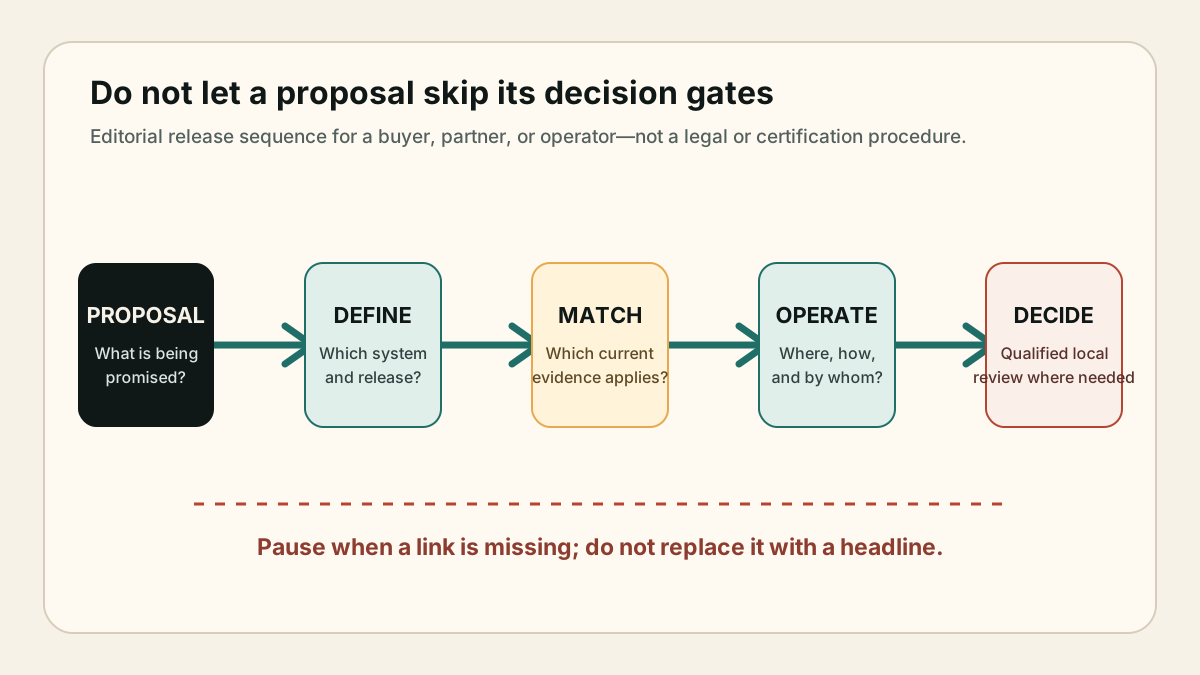 Editorial decision sequence: make the system, evidence, operating boundary, and qualified local review visible before a commitment hardens.
How different readers should use the standard
The same public release creates different work for different participants. The questions should reflect that.
For OEMs and system suppliers
Treat the standard as a program-management signal. Map current functions, documentation, assurance activities, test plans, supplier controls, and software-change processes against the applicable final requirements. Identify where the product definition is too vague to support an evidence file. Establish a release gate that forces the business, engineering, regulatory, service, and legal teams to use the same configuration identity.
Do not make a public conformity claim merely because the organization has begun alignment work. Use careful language: “being assessed,” “planned for,” “subject to final review,” or “available only in the stated configuration and operating conditions.” Precision is a commercial asset when the product is complex.
For component and software suppliers
Do not assume that an OEM will solve the evidence chain for you. A component, sensor, compute platform, mapping module, driver-monitoring function, or cloud service may affect the vehicle system’s evidence boundary. Provide controlled specifications, version information, limitations, change notices, cyber and data dependencies, and an escalation path that lets the OEM understand what has changed.
The best suppliers make integration easier by defining their own boundary. They do not claim that a component “makes the vehicle compliant.” They state what the component does, under what assumptions, which records support it, and what the vehicle integrator must decide.
For fleet operators and mobility partners
Demand an operating file, not only a vehicle deck. The file should cover the route or service boundary, passenger journey, remote support, incident handling, uptime decision, maintenance, charging, data access, local permissions, insurance, and communications. Run tabletop exercises before launch: a vehicle stops in an awkward location, a passenger cannot understand an instruction, a mapping dependency fails, a software issue affects multiple vehicles, or a local authority asks for an explanation. The point is not to predict every event. It is to establish who acts first and which records are available.
For overseas distributors and buyers
Separate Chinese domestic evidence from export-market suitability. A domestic configuration, standard reference, test environment, service arrangement, or update policy may not map neatly to another market. Ask whether the delivered vehicle is the same configuration as the one described in the evidence. Ask who is the accountable entity after import. Ask how data, language, maps, support, warranties, spare parts, and software updates will work in the target market.
If the answer relies on a future localization plan, price that uncertainty honestly. It may still be the right partnership. It is not the same as a deployed and documented capability.
For investors and analysts
Avoid making the standard a single-variable market model. It can improve the clarity of the regulatory and documentation environment, but it does not by itself establish adoption speed, profitability, fleet utilization, consumer trust, export acceptance, or liability allocation. Look for evidence that a company can turn a product promise into a controlled operating system: configuration discipline, assurance process, supplier governance, change control, approval strategy, service readiness, and transparent handling of limitations.
Counterpoint’s report framing illustrates the appropriate role of analysis. Its five-pillar approach can help structure questions about the technical and commercialization implications of the release. It should not be converted into a factual claim that a specific company will clear a path to deployment. Counterpoint’s report overview
The relationship to China’s broader automotive transition
China’s autonomous-driving market is not developing in isolation. It sits inside a dense manufacturing system of vehicle platforms, electronics, sensors, compute, battery systems, software teams, suppliers, cities, logistics networks, and national and local rulemaking. That density helps explain why standards matter: a common reference can coordinate a large number of technical and commercial actors.
But density also makes unqualified conclusions dangerous. A standard can improve coordination without making every product equivalent. A cluster of capable suppliers can shorten development cycles without proving safety performance. A fast software-update culture can be a competitive strength without eliminating the need for release governance. The exact buyer question still matters.
Readers looking for the commercial context should pair this evidence guide with China autonomous driving in 2026, which examines the difference between deployment narratives and commercialization reality. The underlying vehicle-and-supplier context also belongs beside China’s industrial robotics field guide and China’s industrial clusters guide. Those articles explain why China’s manufacturing depth can accelerate product development; this article explains why that same speed needs a documentable boundary before it becomes a procurement conclusion.
Method and limitations
This is desk research, not an engineering review, vehicle test, certification assessment, legal opinion, insurance opinion, or local road-access decision. It was reviewed on August 24, 2026 against the MIIT final release, the national standards-platform record, CATARC’s public release summary, MIIT’s February 2026 consultation notice, the GB/T 44721-2024 registry record, CnEVPost’s reporting, and Counterpoint Research’s report overview.
The official final-release material supports the standard’s public status, high-level scope, and planned timing. The public draft and the earlier voluntary standard are included only as historical development context; they are not treated as a substitute for the final text. Independent reporting and analyst material are attributed and used for context, not as regulatory text or a vehicle-specific conclusion. No named vehicle, component, operating design domain, test record, conformity file, approval, insurance policy, or service operation was inspected for this article.
Before a live procurement, deployment, investment, or approval decision, obtain the current final standard text and any applicable guidance, then verify the precise vehicle and system configuration, current software release, evidence set, operating design domain, test and assurance records, update and service responsibilities, cybersecurity and data arrangements, local approvals, contractual allocation of risk, and insurance conditions. Use qualified technical, legal, regulatory, and insurance reviewers for the parts of that decision that require them.
Frequently asked questions
Is GB 44721-2026 proof that a car is safe to buy or operate?
No. The official release establishes a national mandatory standard with stated L3/L4 M- and N-vehicle scope and a planned July 2027 implementation date. It does not provide a vehicle-specific safety result, road-access permission, insurance decision, or suitability assessment. A buyer still needs the current evidence for the exact configuration and intended operation. MIIT’s release
Does the standard cover automated parking?
MIIT’s public announcement explicitly says the standard excludes automated parking. Do not assume a parking function is covered simply because it is marketed alongside another automated-driving feature. Confirm the applicable rule and evidence for the particular function. MIIT’s release
When is the standard planned to take effect?
MIIT says July 1, 2027. The national standards-platform record also lists that date as the proposed implementation date. Before a real decision, recheck the current official text and any subsequent implementation guidance; dates and associated requirements should not be frozen from an article into a live compliance decision. MIIT and the national standards platform
What should I ask a supplier for first?
Ask them to identify the exact vehicle and system configuration, software release, enabled functions, operating design domain, and relevant evidence map. The most important first outcome is a stable definition of the object being discussed. Once that exists, the parties can assess whether the documents, tests, approvals, and service plan actually apply to it.
Can a February 2026 draft be used as the final rule?
No. MIIT’s February notice shows that a draft and explanatory note were opened for public consultation; it is useful for development history, not as a substitute for the final text. Where an obligation turns on exact wording, use the current authoritative text and qualified review. MIIT’s consultation notice
What does CATARC’s public summary add?
CATARC says the standard includes technical requirements, assurance requirements, same-type determination, assurance inspection, safety-archive inspection, and confirmation testing, with separate L3/L4 indicators. That helps a reader understand why a real proposal needs a structured evidence file. It does not show that a named supplier or vehicle has satisfied those categories. CATARC’s summary
Is this legal, certification, or insurance advice?
No. It is an editorial evidence guide. National standards, local permission, vehicle conformity, contractual responsibility, data governance, and insurance can involve different authorities and professional judgments. Use appropriate qualified advisers before acting on a transaction or deployment.
Related entries
- China autonomous driving in 2026 — the commercialization context behind the new documentary baseline.
- China’s industrial robotics field guide — how hardware, software, and operating systems meet in real industrial adoption.
- China’s industrial clusters guide — why manufacturing density accelerates development but does not replace buyer diligence.